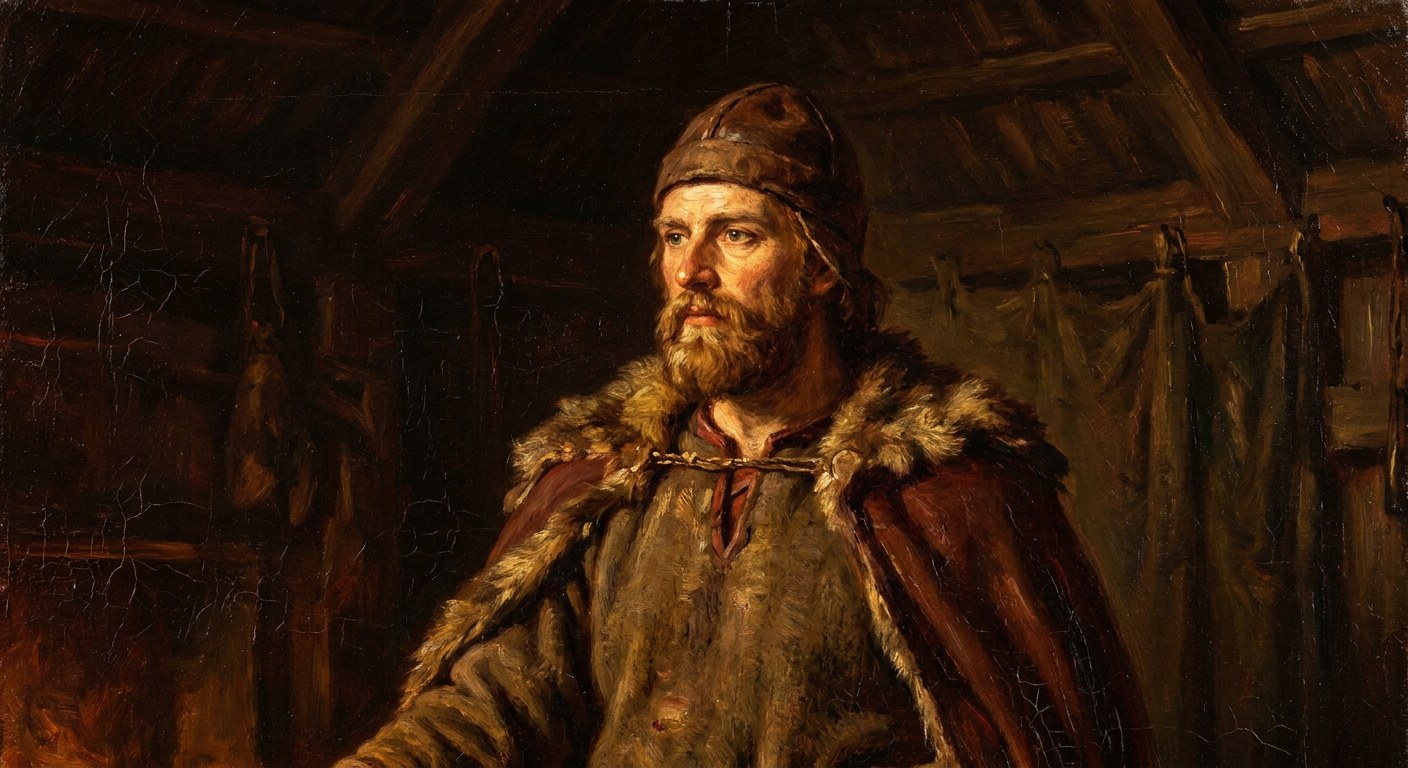
Leif Erikson
970 – 1020 · Norse Icelandic · Explorer & Navigator
Recommended Audiobooks
Listen next from Marcus Alden

Life Lessons from Frederic Chopin
Marcus Alden · 54 min

Life Lessons from John Wesley
Marcus Alden · 52 min
Introduction
Leif Erikson—also spelled Leif Eiriksson, Leifr Eiríksson, or Leif the Lucky—was a Norse explorer traditionally credited with leading the first known European expedition to reach continental North America. His voyage occurred around the year 1000, nearly five centuries before Christopher Columbus crossed the Atlantic. According to medieval Icelandic sagas, Leif sailed west from Greenland, encountered several unfamiliar lands, and established a temporary base in a region the Norse called Vinland.
The broad outline of Norse travel to North America is supported by archaeology. At L’Anse aux Meadows, on the northern tip of Newfoundland, researchers have excavated the remains of an unmistakably Norse settlement dating to approximately 1000. Scientific analysis has demonstrated that Norse people were active there in 1021, although the site cannot be connected to Leif personally through inscriptions or contemporary documents.
Most details about Leif’s life come from two works written more than two centuries after his lifetime: The Saga of the Greenlanders and The Saga of Erik the Red. These narratives preserve older oral traditions, but they differ in chronology, motivation, and the roles assigned to individual explorers. Consequently, Leif’s biography lies at the intersection of history, archaeology, oral tradition, and literary legend.
Leif was more than an explorer. He belonged to a prominent family that helped establish Norse Greenland, participated in the North Atlantic world of Viking Age trade and migration, introduced—or helped introduce—Christianity to Greenland, and became a symbol of maritime daring. His expeditions revealed that Europeans could cross the western Atlantic using the sailing technology and navigational knowledge of the Viking Age.
Quick Facts
| Category | Details |
|---|---|
| Full name | Leif Erikson, from Old Norse Leifr Eiríksson |
| Alternative spellings | Leif Ericson, Leif Ericsson, Leif Eiriksson |
| Epithet | Leif the Lucky |
| Born | Traditionally around 970 |
| Birthplace | Probably Iceland, though Greenland is sometimes suggested |
| Died | Probably between 1018 and 1025 |
| National or cultural identity | Norse-Icelandic and Greenlandic |
| Father | Erik the Red |
| Mother | Thjodhild, also spelled Þjóðhildr |
| Grandfather | Thorvald Asvaldsson |
| Siblings | Thorstein, Thorvald, and Freydis, according to saga traditions |
| Partner mentioned in the sagas | Thorgunna of the Hebrides |
| Known child | Thorgils; possibly also Thorkell |
| Religion | Raised in Norse pagan culture; converted to Christianity |
| Occupation | Explorer, mariner, landowner, and Greenlandic chieftain |
| Best known for | Leading or participating in a Norse expedition to North America around 1000 |
| Lands associated with his voyage | Helluland, Markland, and Vinland |
| Likely Norse base in North America | L’Anse aux Meadows, Newfoundland, or a site within the same region |
| Principal written sources | The Saga of the Greenlanders and The Saga of Erik the Red |
| Archaeological context | Norse settlement at L’Anse aux Meadows, active by 1021 |
Early Life & Background
Leif was born around 970 into a family already associated with exploration, exile, and colonization. His father, Erik the Red, was the son of Thorvald Asvaldsson, who had left Norway for Iceland after being outlawed for manslaughter. Erik himself was later banished from parts of Iceland following violent disputes. During his exile, he explored the land west of Iceland that became known to Norse settlers as Greenland.
Leif’s mother, Thjodhild, belonged to the interconnected society of Norse farmers and chieftainly families that occupied Iceland and later Greenland. The family’s status gave Leif access to ships, crews, livestock, and political networks—resources essential for long-distance exploration.
The sources do not agree on Leif’s birthplace. He was probably born in Iceland before Erik established the Greenland colony, but some later traditions place his birth in Greenland. His childhood would have unfolded during a period of rapid Norse expansion across the North Atlantic. By the late tenth century, Norse communities existed in Norway, Iceland, the Faroe Islands, the Hebrides, Ireland, and Greenland. Voyagers navigated this maritime world through practical knowledge of winds, currents, birds, cloud formations, sea color, celestial bodies, and coastal landmarks.
Around 982, Erik the Red began exploring Greenland’s southwestern coast. After returning to Iceland, he promoted the new territory under the attractive name “Greenland.” In approximately 985 or 986, he led a colonizing fleet westward. The sagas state that 25 ships departed and only 14 reached their destination. The settlers created two principal regions: the Eastern Settlement, near present-day Qaqortoq and Narsarsuaq, and the Western Settlement, near modern Nuuk.
Erik established his estate at Brattahlid, located near present-day Qassiarsuk in southern Greenland. Leif likely spent much of his youth there. Life in Greenland required adaptability. Settlers raised cattle, sheep, and goats; hunted seals and caribou; fished; gathered hay; and traded valuable products such as walrus ivory, hides, and rope made from walrus skin.
As Erik’s son, Leif occupied a privileged but demanding position. He would have been expected to manage land, command loyalty, settle disputes, and demonstrate competence at sea. Saga descriptions portray him as physically impressive, intelligent, thoughtful, and unusually fortunate. Such characterizations are partly literary, yet they reflect the qualities medieval audiences valued in a successful leader.
Rise to Prominence
Leif’s emergence as an independent figure is linked to a voyage eastward from Greenland. According to The Saga of Erik the Red, he sailed to Norway around 999 and entered the service of King Olaf Tryggvason, who ruled Norway from 995 to 1000. Olaf was forcefully promoting Christianity among Norse populations, and Leif accepted baptism while at the royal court.
On his return journey, Olaf supposedly commissioned Leif to introduce Christianity to Greenland. This story is plausible within the political and religious context of Olaf’s reign, although the exact details cannot be independently confirmed. Christianity was spreading throughout the North Atlantic at the time: Iceland formally adopted the religion around 999 or 1000, and Greenlandic settlers were connected to the same cultural networks.
The sagas also associate Leif with the Hebrides. During a stay there, he formed a relationship with a high-born woman named Thorgunna. She later claimed that Leif was the father of her son, Thorgils. Leif reportedly declined to take Thorgunna with him but agreed that the child could later come to Greenland.
Leif’s conversion enhanced his historical importance. When he returned to Greenland, his mother embraced Christianity and had a church built near Brattahlid. This small structure became known in tradition as Thjodhild’s Church. Erik the Red was reportedly reluctant to abandon the old gods, illustrating the tensions that could accompany conversion within Norse households.
Leif’s greatest rise to prominence came through his western expedition. Yet the two principal sagas explain that voyage differently.
In The Saga of the Greenlanders, a merchant named Bjarni Herjolfsson was the first known Norse mariner to sight lands west of Greenland. Blown off course while sailing from Iceland to join his father in Greenland, Bjarni saw forested coastlines but did not go ashore. Years later, Leif purchased Bjarni’s ship, recruited a crew of 35, and deliberately set out to investigate.
In The Saga of Erik the Red, Leif discovers Vinland accidentally while returning from Norway to Greenland. This version emphasizes his Christian mission and his providential good fortune rather than Bjarni’s prior sighting. Historians generally consider the account in The Saga of the Greenlanders more geographically coherent, but neither saga can be treated as a contemporary logbook.
Major Achievements
Leif’s central achievement was the exploration of lands west of Greenland around the turn of the first millennium. His expedition demonstrated that the North Atlantic could be crossed in stages and that habitable land existed beyond Greenland.
Following The Saga of the Greenlanders, Leif and his crew first encountered a bleak region covered with broad stone slabs and glaciers. He named it Helluland, meaning “Land of Flat Stones.” Most scholars identify Helluland with Baffin Island or nearby parts of the Canadian Arctic.
Sailing farther south, the expedition reached a heavily forested coastline with pale beaches. Leif called this land Markland, or “Forest Land.” It is usually associated with Labrador. For Greenlanders, timber-rich territory would have been exceptionally valuable because large trees were scarce in Greenland.
The explorers continued south and arrived at a more hospitable region. The sagas describe grassy ground, salmon, comparatively mild winters, timber, and vegetation interpreted as wild grapes. Leif named the region Vinland. The meaning of the name has been debated. It is traditionally translated as “Wine Land,” referring to grapes or grape-like berries. Some scholars have proposed “Pasture Land,” but linguistic evidence generally favors an association with wine.
Leif and his crew established buildings at a place later called Leifsbudir, or “Leif’s Booths.” They spent a winter there, divided into groups to explore the surrounding area, and loaded their ship with timber and other resources before returning to Greenland.
It is unlikely that “Vinland” referred only to a single settlement. In saga geography, the term may have covered a broad region of Atlantic Canada, perhaps extending from Newfoundland toward the Gulf of St. Lawrence and areas farther south. Grapes do not naturally grow at L’Anse aux Meadows today, so the grape episode may reflect exploration beyond northern Newfoundland, imported fruit, misidentified berries, climatic variation, or literary elaboration.
Leif’s voyage was not an isolated event. It initiated or inspired additional Norse expeditions. His brother Thorvald explored Vinland and, according to the sagas, died after a clash with Indigenous people. Thorstein Erikson attempted another voyage but failed to reach the destination. The merchant Thorfinn Karlsefni later led a larger colonizing expedition with livestock and families. Leif’s sister or half-sister Freydis Eriksdottir also appears in conflicting accounts of later ventures.
The archaeological discovery at L’Anse aux Meadows transformed Leif’s story from a largely literary tradition into part of a verifiable historical framework. Excavations beginning in 1961, led by Norwegian archaeologists Helge Ingstad and Anne Stine Ingstad, uncovered turf-walled buildings, ironworking remains, and Norse artifacts. The structures closely resembled buildings in Iceland and Greenland.
A 2021 scientific study showed that Norse people cut wood at the site in 1021. Researchers used traces of a major solar storm recorded in tree rings to identify the exact year in which several pieces of wood were felled with metal tools. The result does not prove that Leif was present, but it establishes a secure date for Norse activity in North America.
Defining Moments
One defining moment was Leif’s conversion to Christianity. Whether it occurred directly under Olaf Tryggvason’s influence or through broader North Atlantic contacts, the conversion placed Leif within a profound cultural transformation. He became associated not only with geographic expansion but also with the religious transition from Norse paganism to Christianity.
A second decisive moment was his choice to investigate the western lands. In the Greenlanders’ Saga version, Leif did what Bjarni had not: he turned a distant sighting into deliberate exploration. He acquired a suitable vessel, assembled a crew, and followed a reported route across dangerous seas.
The wintering in Vinland was equally important. Rather than merely observing the coast, Leif’s party constructed shelters, explored inland, collected resources, and survived long enough to return with information. This made the expedition a reconnaissance mission with economic and colonizing implications.
On the return journey, Leif rescued a group of shipwrecked Norse travelers and recovered part of their cargo. This act supposedly earned him the epithet “Leif the Lucky.” His good fortune therefore referred not only to discovering Vinland but also to acquiring wealth and saving lives.
Leif’s later transfer of the Vinland base to other expeditions was another defining development. He retained ownership of the buildings but allowed relatives and associates to use them. This suggests that the western lands were considered a family resource and potential extension of Greenlandic enterprise.
Timeline
| Year | Event |
|---|---|
| c. 970 | Leif Erikson is probably born in Iceland to Erik the Red and Thjodhild. |
| 982 | Erik the Red begins exploring Greenland after being outlawed from Iceland. |
| 985–986 | Erik leads a colonizing fleet to Greenland; the family settles at Brattahlid in the Eastern Settlement. |
| c. 986 | Bjarni Herjolfsson, according to The Saga of the Greenlanders, sights unknown lands west of Greenland. |
| c. 999 | Leif sails east and reaches Norway after spending time in the Hebrides. |
| 999–1000 | Leif is reportedly baptized and commissioned by King Olaf Tryggvason to promote Christianity in Greenland. |
| c. 1000 | Leif explores Helluland, Markland, and Vinland, according to saga tradition. |
| c. 1000–1001 | Leif and his crew winter at Leifsbudir before returning to Greenland. |
| Early 11th century | Leif rescues shipwrecked travelers and becomes known as Leif the Lucky. |
| c. 1002–1004 | Thorvald Erikson uses Leif’s base for another expedition and is reportedly killed in Vinland. |
| c. 1004–1010 | Thorfinn Karlsefni leads a larger attempt to settle Vinland; exact chronology is uncertain. |
| After 1000 | Christianity becomes established within Leif’s family; Thjodhild’s Church is associated with Brattahlid. |
| 1003 | According to traditional chronology, Erik the Red dies during an epidemic, leaving Leif as a leading figure at Brattahlid. |
| 1018 | Leif is still alive according to an indirect reference commonly associated with saga chronology. |
| 1021 | Timber is cut with metal tools at L’Anse aux Meadows, providing the first exact scientific date for Norse activity in North America. |
| By c. 1025 | Leif is probably dead; his son Thorkell appears as a leader at Brattahlid in later tradition. |
| 1960 | Helge Ingstad identifies ruins at L’Anse aux Meadows as a possible Norse site. |
| 1961–1968 | Helge and Anne Stine Ingstad conduct major excavations confirming a Norse presence. |
| 1978 | UNESCO designates L’Anse aux Meadows a World Heritage Site. |
| 2021 | Researchers publish evidence securely dating Norse woodcutting at the site to 1021. |
Personal Life
Leif’s personal life is only fragmentarily preserved. He was the son of Erik the Red and Thjodhild and grew up among siblings identified as Thorstein, Thorvald, and Freydis. Whether Freydis was his full sister or half-sister is unclear.
During Leif’s journey in the Hebrides, he stayed with a local ruler or noble family and entered a relationship with Thorgunna, a woman described as high-born and independent. She wished to accompany him when he departed, but Leif refused, reportedly because he feared her relatives would oppose the arrangement. Thorgunna later gave birth to Thorgils, whom she identified as Leif’s son. Thorgils eventually traveled to Greenland, although the sagas do not assign him a major later role.
Another son, Thorkell Leifsson, is mentioned as succeeding Leif in authority at Brattahlid. The identity of Thorkell’s mother is unknown. Medieval sources provide no reliable record of Leif’s marriage, if he married at all.
After Erik the Red’s death, Leif appears to have inherited Brattahlid and become a leading chieftain in the Eastern Settlement. His position would have involved supervising agricultural production, hosting travelers, organizing trade, and participating in legal assemblies. His authority rested on property, family reputation, personal alliances, and his experience as a captain.
The sagas do not describe Leif’s death. He was probably dead by about 1025, when Thorkell appears to have assumed his position. No grave has been securely identified.
Beliefs & Philosophy
Leif was born into a culture shaped by Norse pagan religion. His family would have known traditions involving Odin, Thor, Freyr, and other deities, as well as beliefs concerning fate, honor, ancestors, and supernatural forces. The sagas, however, were written by Christian authors who interpreted the pagan past through later religious assumptions.
Leif’s acceptance of Christianity was one of the most consequential choices attributed to him. In The Saga of Erik the Red, King Olaf Tryggvason entrusts him with converting Greenland. Leif’s mother responds favorably, while Erik remains skeptical. This family division reflects the gradual and uneven character of conversion.
Christianity also influenced how later writers portrayed Leif. His rescue of shipwrecked travelers, success at sea, and discovery of new lands could be presented as signs of divine favor. His epithet “the Lucky” resonated with both older Norse concepts of personal fortune and Christian ideas of providence.
No writings by Leif survive, and it would be misleading to assign him a systematic philosophy. His actions, as represented in the sagas, suggest practical values central to Norse leadership: courage, preparation, generosity, loyalty, reputation, adaptability, and willingness to pursue opportunity.
Challenges & Controversies
The greatest challenge in reconstructing Leif’s life is the nature of the evidence. The Vinland sagas were written in the thirteenth century, roughly 200 years after the events they describe. They likely preserve genuine memories but also contain literary patterns, family rivalries, supernatural episodes, and conflicting chronologies.
The sagas disagree about Leif’s discovery. The Saga of the Greenlanders credits Bjarni Herjolfsson with the first sighting and Leif with the first purposeful exploration. The Saga of Erik the Red makes Leif’s arrival accidental. It gives a larger role in Vinland exploration to Thorfinn Karlsefni and places some episodes differently.
The location of Vinland is another controversy. L’Anse aux Meadows is the only confirmed Norse site in North America outside Greenland, but its northern environment does not fully match every saga description. It may have been Leifsbudir, a gateway camp, a ship-repair station, or a base used by later explorers. Vinland may have encompassed a much wider territory.
Norse encounters with Indigenous peoples also require careful treatment. The sagas call them Skrælings, an outsider term that may have referred to different populations, including ancestors of the Beothuk or Indigenous peoples of the Arctic and subarctic. The narratives describe trade as well as deadly conflict. Indigenous communities had inhabited these regions for thousands of years before Norse arrival, so Leif did not “discover” an empty continent.
The phrase “first European to discover America” is therefore imprecise. Leif may have been the leader of the earliest known European landing expedition, but Bjarni may have sighted the coast first, other Norse sailors may have arrived earlier, and North America was already home to diverse societies.
Claims of Norse discoveries far inside the United States—often based on alleged runestones or artifacts—have generally failed scholarly scrutiny. The Kensington Runestone in Minnesota, for example, is widely regarded by specialists as a modern creation rather than evidence of a medieval Norse expedition.
Finally, the popular title “Viking” can be misleading. Viking originally referred more closely to raiding or overseas expeditionary activity than to every Scandinavian person. Leif was a Norse mariner and settler, but the Vinland voyages were primarily exploratory and economic rather than raids.
Famous Quotes
No authenticated words written or spoken by Leif Erikson survive. The following passages are associated with him through medieval saga narratives; wording varies among translations.
“There is no lack of grapes here.”
This sentiment is connected with the Vinland naming episode, particularly the report of grapes brought by Tyrkir. It should not be treated as a verbatim statement recorded during the voyage.
“I shall give the land a name and call it Vinland.”
A traditional saga-style formulation associated with Leif’s naming of the newly explored region.
“He was a large, strong man, of very striking appearance, and wise, as well as being a man of moderation in all things.”
This description of Leif appears in translations of The Saga of the Greenlanders. It is a characterization by the saga narrator, not a quotation from Leif.
“Leif had the ship’s company rescued, and was afterward called Leif the Lucky.”
This traditional description explains his famous epithet and emphasizes the rescue carried out on his return toward Greenland.
Legacy & Influence
Leif Erikson’s most important legacy is his place in the history of transatlantic contact. The Norse voyages established that Europeans reached North America around 1000 and maintained at least a temporary presence there. Although those expeditions did not produce lasting European colonization, they connected Greenland with the Canadian Atlantic world.
The voyages also illuminate the sophistication of Norse maritime culture. Open ships constructed with overlapping planks could transport people, animals, tools, and supplies across large stretches of ocean. Norse navigators combined accumulated environmental knowledge with flexible route planning, using Iceland and Greenland as stepping-stones.
L’Anse aux Meadows provides physical context for this achievement. Its buildings could house a substantial expedition, while evidence of ironworking shows that the inhabitants processed bog iron and repaired rivets—an essential task for maintaining ships. Butternut remains found at the site indicate contact with regions south of northern Newfoundland, supporting the idea of wider exploration.
Leif’s expedition did not lead directly to Columbus’s voyage. There is no conclusive evidence that fifteenth-century Iberian navigators possessed reliable knowledge of the Vinland journeys. The Norse settlement was short-lived, and Vinland gradually receded into saga tradition.
In the nineteenth century, Leif became especially important to Scandinavian immigrants in the United States. Writers and community leaders promoted him as a pre-Columbian European explorer, partly as a source of ethnic pride. Statues were erected in Boston, Milwaukee, Chicago, Reykjavík, and elsewhere.
In 1964, the United States Congress authorized the president to proclaim October 9 as Leif Erikson Day. The date does not commemorate Leif’s birth or voyage. It was chosen because the Norwegian immigrant ship Restauration arrived in New York on October 9, 1825, an event associated with organized Norwegian immigration to the United States.
Modern scholarship presents Leif within a broader and more balanced history. His accomplishments are recognized without erasing Bjarni Herjolfsson, later Norse voyagers, or the Indigenous peoples who already knew and inhabited the lands the Norse encountered. Leif’s fame endures because his story combines documented geographic achievement with the imaginative power of saga literature.
Interesting Facts
- Leif’s patronymic, Erikson, means “son of Erik”; it was not originally a hereditary family surname.
- The Old Norse form of his name is Leifr Eiríksson.
- He was probably born in Iceland, raised partly in Greenland, baptized through Norwegian influence, and connected personally to the Hebrides.
- His father, Erik the Red, gave Greenland its promotional name in hopes of attracting settlers.
- According to one saga, Erik planned to accompany Leif west but fell from his horse before departure and interpreted the accident as a bad omen.
- Leif’s crew is traditionally said to have consisted of 35 men.
- Helluland is usually associated with Baffin Island, and Markland with Labrador.
- Markland’s timber may have attracted Greenlanders for generations after the first Vinland voyages.
- A German-speaking foster father or crew member named Tyrkir is credited in the sagas with finding grapes.
- Leif’s Vinland buildings were called Leifsbudir, meaning “Leif’s booths” or “Leif’s shelters.”
- L’Anse aux Meadows contained eight Norse-style turf structures.
- Archaeologists found a bronze ring-headed pin, a stone oil lamp, an iron nail, and evidence of iron smelting at the site.
- The exact date of 1021 was established using a cosmic-ray event from 993 that left a recognizable signal in tree rings.
- L’Anse aux Meadows was probably occupied only briefly rather than becoming a permanent town.
- No surviving Norse map made during Leif’s lifetime depicts Vinland.
- Leif Erikson Day is observed on October 9, not on a known date from Leif’s life.
Frequently Asked Questions
When was Leif Erikson born?
Leif was probably born around 970. No contemporary birth record survives, and the estimate is based on saga chronology. Iceland is the most likely birthplace, although some traditions associate his birth with Greenland.
Did Leif Erikson discover America?
Leif led or participated in one of the earliest known European expeditions to continental North America. However, Indigenous peoples had inhabited the Americas for thousands of years, so “discovery” is appropriate only from the limited perspective of the Norse newcomers.
Was Leif Erikson the first European in North America?
He is traditionally credited as the first known European to land and explore there. According to The Saga of the Greenlanders, Bjarni Herjolfsson sighted the North American coast earlier but did not land. It is also possible that unnamed Norse travelers arrived before the expeditions preserved in the sagas.
When did Leif Erikson reach North America?
His voyage is generally dated to around 1000, with proposed dates ranging across the final years of the tenth century and opening years of the eleventh. Archaeology independently confirms Norse activity at L’Anse aux Meadows in 1021.
Where was Vinland?
Vinland was somewhere in Atlantic Canada and may have designated a broad region rather than one settlement. Newfoundland, the Gulf of St. Lawrence, New Brunswick, Nova Scotia, and lands farther south have all featured in the debate. L’Anse aux Meadows is the only confirmed Norse site, but it may have served as a northern base for exploration elsewhere.
Did Leif Erikson reach the present-day United States?
There is no accepted archaeological evidence that Leif reached the territory of the modern United States. Claims based on supposed Norse artifacts or inscriptions have not been verified. Confirmed evidence is limited to Newfoundland, Canada.
Why was he called Leif the Lucky?
The sagas connect the epithet with his successful voyages, acquisition of valuable goods, conversion mission, and rescue of shipwrecked travelers. In Norse culture, luck could be viewed as a personal quality associated with effective leaders.
Did Leif Erikson meet Indigenous people?
The surviving sagas do not clearly describe Leif himself meeting them. Later Norse expeditions encountered and traded with Indigenous inhabitants before conflict developed. The sources use the term Skrælings, but they do not permit a certain identification of every group involved.
Was Leif Erikson a Christian?
Yes, according to saga tradition. He was baptized around 999 or 1000, probably while connected to the court of Olaf Tryggvason in Norway. He then helped introduce Christianity to Greenland.
What kind of ship did Leif use?
The exact vessel is unknown. It was probably a broad, ocean-going Norse cargo ship similar to a knarr, rather than the narrow longship commonly associated with raiding. Such vessels could carry crews, livestock, timber, and supplies across the North Atlantic.
Is L’Anse aux Meadows Leif’s settlement?
It may be the place remembered as Leifsbudir, but there is no inscription or artifact naming Leif. Archaeology confirms that Norse explorers used the site; assigning it to a particular saga figure remains uncertain.
How did Leif Erikson die?
The circumstances and date of his death are unknown. He probably died sometime between 1018 and 1025, after which his son Thorkell appears to have succeeded him at Brattahlid.
Lessons from Leif Erikson
- Investigate credible possibilities: Leif’s fame rests on acting upon reports of western lands rather than dismissing them.
- Preparation enables courage: Oceanic exploration required ships, provisions, navigational skill, and an experienced crew—not bravery alone.
- Adaptability is essential: Leif moved successfully among Icelandic, Greenlandic, Norwegian, Hebridean, pagan, and Christian settings.
- Leadership includes rescue: The tradition of saving shipwrecked travelers contributed as much to his favorable reputation as exploration did.
- Historical sources require comparison: Conflicting sagas show why historians must evaluate authorship, chronology, purpose, and archaeological evidence.
- Exploration is not the same as discovery: New lands were new only to the arrivals; Indigenous peoples possessed their own histories and geographic knowledge.
- Success may be temporary: The Norse reached North America but did not establish a durable colony there.
- Evidence can transform old stories: Archaeology at L’Anse aux Meadows demonstrated that saga accounts preserved a real history of transatlantic travel.
- Reputation evolves over time: Leif has been remembered as a voyager, missionary, ethnic symbol, and subject of scientific investigation.
- Achievement is often collective: His voyage depended on sailors, craftspeople, informants, family networks, and the expeditions that preceded and followed his own.
Further Reading
- The Saga of the Greenlanders, in a reliable modern translation of the Vinland sagas.
- The Saga of Erik the Red, for the principal alternative account of Leif and Vinland.
- Magnus Magnusson and Hermann Pálsson, trans., The Vinland Sagas: The Norse Discovery of America.
- Helge Ingstad, Westward to Vinland: The Discovery of Pre-Columbian Norse House-Sites in North America.
- Anne Stine Ingstad, The Norse Discovery of America, for archaeological interpretation of L’Anse aux Meadows.
- Birgitta Wallace, writings on L’Anse aux Meadows and Norse exploration published by Parks Canada and in archaeological journals.
- William W. Fitzhugh and Elisabeth I. Ward, eds., Vikings: The North Atlantic Saga.
- Kirsten A. Seaver, The Frozen Echo: Greenland and the Exploration of North America, ca. A.D. 1000–1500.
- Eleanor Rosamund Barraclough, Beyond the Northlands: Viking Voyages and the Old Norse Sagas.
- UNESCO World Heritage Centre, “L’Anse aux Meadows National Historic Site.”
- Parks Canada, educational and archaeological resources on L’Anse aux Meadows.
- Margot Kuitems and colleagues, “Evidence for European Presence in the Americas in AD 1021,” published in Nature in 2021.