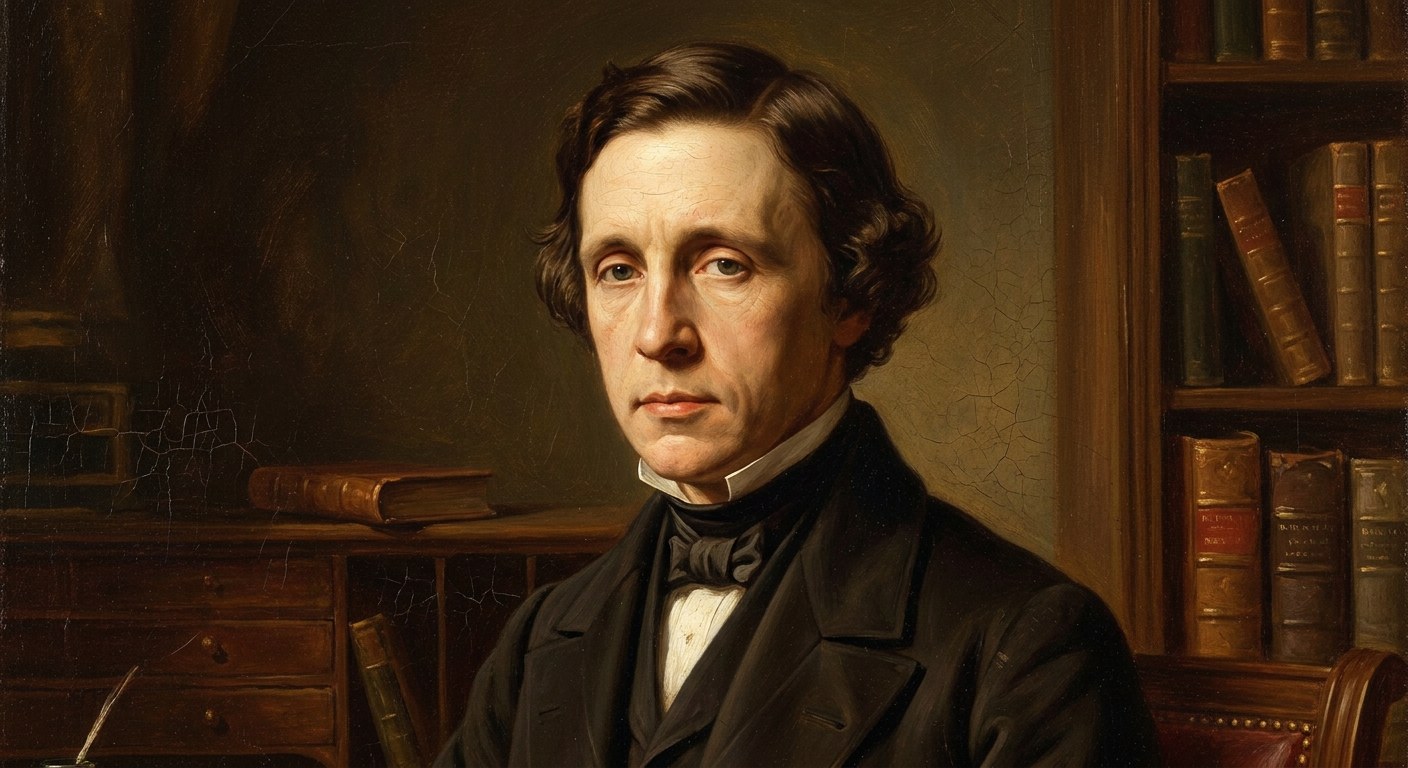
Lewis Carroll
1832 – 1898 · British · Novelist, Mathematician & Photographer
Recommended Audiobooks
Listen next from Marcus Alden

Life Lessons from Frederic Chopin
Marcus Alden · 54 min

Life Lessons from John Wesley
Marcus Alden · 52 min
Introduction
Lewis Carroll was the pen name of Charles Lutwidge Dodgson (1832–1898), an English author, mathematician, logician, photographer, Anglican deacon and Oxford lecturer. He is remembered above all for Alice's Adventures in Wonderland and its sequel, Through the Looking-Glass, and What Alice Found There. These books transformed children's literature by rejecting heavy-handed moral instruction in favor of imaginative freedom, verbal play, dream logic and intellectual comedy.
Carroll's importance extends far beyond the creation of Alice, the White Rabbit, the Cheshire Cat and the Mad Hatter. His fiction explores questions about language, identity, authority, time and logic. Its apparent absurdities often depend on rigorous patterns of reasoning, making his work appealing to children while also rewarding philosophers, mathematicians, linguists and literary critics. Expressions such as “down the rabbit hole,” “through the looking-glass” and “Mad Hatter” have entered everyday language.
Under his legal name, Dodgson spent most of his adult life at Christ Church, Oxford, where he taught mathematics and published works on geometry, algebra, logic and voting procedures. He was also an important early photographer whose portraits preserve a vivid record of Victorian cultural life. His interest in puzzles, games, inventions and systems of communication further demonstrates the unusual range of his intellect.
Carroll's personal life has nevertheless generated controversy, particularly because of his friendships with children and his photographs of young girls, including a small number of nude studies. Surviving evidence does not establish that he committed sexual abuse, but the subject raises legitimate ethical questions and has inspired sharply conflicting interpretations. A balanced biography must therefore recognize both his extraordinary creative achievements and the limits of what can responsibly be claimed about his private life.
Quick Facts
| Fact | Details |
|---|---|
| Born | 27 January 1832, Daresbury, Cheshire, England |
| Died | 14 January 1898, Guildford, Surrey, England |
| Nationality | British |
| Known For | Alice's Adventures in Wonderland, Through the Looking-Glass, literary nonsense and mathematical puzzles |
| Occupation | Author, mathematician, logician, photographer, lecturer and Anglican deacon |
| Era | Victorian era |
Early Life and Education
Charles Lutwidge Dodgson was born on 27 January 1832 at the parsonage in Daresbury, Cheshire. He was the third child and eldest son of the Reverend Charles Dodgson and Frances Jane Lutwidge Dodgson. The family eventually included eleven children, seven daughters and four sons, all of whom survived into adulthood—an unusual outcome in an age of high childhood mortality.
His father was a mathematically gifted Oxford graduate and a conservative Anglican clergyman who later became archdeacon of Richmond. In 1843 he received the living of Croft-on-Tees in Yorkshire, and the family moved into the spacious rectory there. Charles grew up in a close, educated and strongly religious household. He and his siblings staged plays, invented games, created family magazines and entertained one another with stories. Among his youthful productions was The Rectory Magazine, which already displayed his enthusiasm for parody, illustration, puzzles and comic verse.
Dodgson was educated at home before attending Richmond School in Yorkshire. In 1846 he entered Rugby School. Academically he performed well, especially in mathematics and religious studies, but he disliked much of school life. His later recollections suggest that the rough social environment of a Victorian public school made him unhappy. He also had a stammer, or speech hesitation, that remained with him throughout his life, although its severity varied.
In May 1850 Dodgson matriculated at Christ Church, Oxford, his father's former college, and began residing there in January 1851. Only days after his arrival, his mother died suddenly at the age of forty-seven. The loss deeply affected the family, although Dodgson rarely discussed his grief directly in surviving writings.
At Oxford he distinguished himself in mathematics. He obtained first-class honors in mathematics in 1854, although his result in classics was less impressive, and received his Bachelor of Arts degree. In 1855 he was appointed mathematical lecturer at Christ Church. The position provided financial security and a permanent connection to Oxford, but it came with institutional and religious obligations. Dodgson retained the lectureship until 1881 and remained associated with Christ Church for the rest of his life.
Christ Church studentships normally required ordination. Dodgson was ordained an Anglican deacon in December 1861 but did not proceed to the priesthood. His exact reasons remain uncertain. His stammer may have made regular preaching unattractive, and he appears to have experienced personal reservations about assuming full clerical responsibilities. Henry Liddell, dean of Christ Church, allowed him to retain his position without becoming a priest.
Rise to Prominence
Dodgson began publishing poetry and humorous prose in periodicals during the 1850s. He used several signatures before adopting the name Lewis Carroll. The pseudonym was created through an elaborate linguistic transformation: “Charles Lutwidge” became the Latin forms Carolus Ludovicus, the names were reversed, and they were translated back into English as “Lewis Carroll.” The editor Edmund Yates selected it from a list of possibilities supplied by Dodgson. The name appeared in print with the poem “Solitude” in The Train in 1856.
That same year Dodgson became acquainted with the family of Henry George Liddell, dean of Christ Church and a distinguished classical scholar. The Liddells had several children, including Lorina, Alice and Edith. Dodgson often entertained the sisters with stories, puzzles and excursions. These friendships became central to the creation of his most famous work.
On 4 July 1862 Dodgson and his friend the Reverend Robinson Duckworth took the three Liddell sisters on a rowing trip from Oxford toward Godstow. During the excursion, Dodgson improvised a story about a girl named Alice who followed a white rabbit into an underground world. Ten-year-old Alice Liddell asked him to write it down.
Dodgson expanded and illustrated the tale in a handwritten volume entitled Alice's Adventures Under Ground, which he presented to Alice in November 1864. Encouraged by friends, including the novelist George MacDonald, he prepared the story for publication. He enlarged the narrative, added episodes such as the Mad Hatter's tea party and changed the title to Alice's Adventures in Wonderland.
The celebrated political cartoonist and illustrator John Tenniel supplied the published illustrations. Macmillan issued an initial printing in 1865, but Tenniel objected to its print quality, and most copies were withdrawn. A new edition appeared late in 1865 with an 1866 title-page date. The book quickly gained admirers and made Lewis Carroll a major literary figure.
Its success was not based simply on novelty. Victorian children's books were frequently designed to teach explicit moral lessons. Carroll instead offered a world in which adult rules became unstable, language rebelled against authority and a child attempted to preserve her identity amid constant transformations. The book appealed to young readers while also entertaining adults through satire, parody and intellectual humor.
Major Achievements and Contributions
Carroll's greatest achievement was the creation of the two Alice books. Together they established one of the most influential imaginary worlds in modern literature. Wonderland and the looking-glass country are not random collections of absurdities. They operate according to shifting systems: cards in the first book, chess in the second, and recurring patterns of games, riddles, legal procedures, school lessons and grammatical arguments throughout.
He became a leading practitioner of literary nonsense, a form that creates comedy by combining precise structures with impossible conclusions. His poems parody familiar Victorian verse, but many of the originals have disappeared from popular memory while Carroll's versions remain famous. “Jabberwocky,” with words such as “slithy,” “frabjous” and “galumphing,” demonstrates how grammar and context can suggest meaning even when vocabulary is invented.
Carroll also made substantial contributions to recreational mathematics and symbolic logic. His academic publications were not as revolutionary as his fiction, but they reflected considerable ingenuity. He defended Euclidean geometry, developed methods for solving logical problems and designed diagrams that helped represent relationships among categories. He sought to make reasoning accessible through games and visual systems.
In an 1866 paper, Dodgson described a technique now known as Dodgson condensation, a method for calculating determinants by reducing a matrix through successive operations. The method remains part of the history of linear algebra, although it has limitations when certain intermediate values are zero.
He also studied election procedures. In pamphlets including A Method of Taking Votes and The Principles of Parliamentary Representation, Dodgson examined how preferences could be aggregated more fairly. He criticized systems that distorted voter intentions and considered methods related to proportional representation and ranked choices. Modern scholars of social choice sometimes cite him as an insightful early analyst of voting theory.
Photography was another major field of achievement. Dodgson took up the demanding wet-collodion process in 1856, when photography required chemical preparation, careful staging and long exposures. He became especially skilled in portraiture. His subjects included the poet Alfred Tennyson, the painters Dante Gabriel Rossetti and John Everett Millais, the actress Ellen Terry and the theologian Frederick Denison Maurice.
Children made up a significant part of his photographic work, but he also photographed adults, families, landscapes and artistic compositions. Although he is believed to have produced roughly 3,000 photographs, fewer than 1,000 are known to survive. He stopped practicing photography in 1880, possibly because of the burden of maintaining a studio and changing technical conditions. His surviving images are now valued for their composition and as documents of Victorian society.
Key Works / Battles / Ideas
Alice's Adventures in Wonderland
Published in 1865, Alice's Adventures in Wonderland follows Alice after she pursues the White Rabbit into a bewildering underground realm. There she changes size, swims in a pool of tears, meets a hookah-smoking Caterpillar, attends a chaotic tea party and witnesses the Queen of Hearts' absurd trial. The story examines identity, education and arbitrary power through dreamlike comedy.
Tenniel's illustrations became inseparable from the text. His Alice, Cheshire Cat and other characters helped establish their enduring visual forms. The collaboration was not always easy—both author and artist had strong views—but it produced one of the most recognizable illustrated books in history.
Through the Looking-Glass
Published in December 1871 with an 1872 title-page date, Through the Looking-Glass, and What Alice Found There is more formally organized than its predecessor. Alice enters a world arranged like a chessboard and advances from pawn toward queen. The book introduced Tweedledum and Tweedledee, the White Queen, Humpty Dumpty and the poems “Jabberwocky” and “The Walrus and the Carpenter.”
The sequel explores the instability of language and perception. Humpty Dumpty's claim that words mean what he chooses them to mean has become a classic statement in debates about linguistic authority. The Red King's dream raises another philosophical problem: is Alice dreaming of him, or is she merely a figure in his dream?
The Hunting of the Snark
Published in 1876, The Hunting of the Snark (An Agony in 8 Fits) describes a bizarre expedition to capture an undefined creature. Its crew includes a Bellman, a Baker, a Butcher, a Beaver and other figures identified by occupations beginning with the letter B. The poem's mixture of repetition, ominous suggestion and unresolved symbolism has encouraged many interpretations. Carroll denied that it had a single intended allegorical meaning.
Sylvie and Bruno
Carroll attempted a more ambitious combination of fantasy, social commentary and moral reflection in Sylvie and Bruno (1889) and Sylvie and Bruno Concluded (1893). The books move between the real world and fairyland and address subjects including religion, society and human responsibility. They contain memorable episodes and ideas but never achieved the popularity or unity of the Alice books.
Mathematical and Logical Works
Under the name Charles L. Dodgson, he published An Elementary Treatise on Determinants (1867), Euclid and His Modern Rivals (1879), The Game of Logic (1886), Curiosa Mathematica, Part I: A New Theory of Parallels (1888) and Symbolic Logic, Part I (1896). Euclid and His Modern Rivals presents mathematical debate in dramatic form, revealing his tendency to merge formal reasoning with literary performance.
Games, Puzzles and Inventions
Dodgson devised the word game Doublets, in which one word is transformed into another by changing one letter at a time while preserving a valid word at every step. He designed a writing tablet called the nyctograph, enabling him to record thoughts in darkness using a grid and special alphabet. He also created the Wonderland Postage-Stamp Case and proposed organizational systems for letters, travel and everyday tasks. These inventions reflect his fascination with making disorder manageable through rules.
Timeline of Key Events
| Year | Event |
|---|---|
| 1832 | Born Charles Lutwidge Dodgson at Daresbury, Cheshire, on 27 January |
| 1843 | Family moves to the rectory at Croft-on-Tees, Yorkshire |
| 1846 | Enters Rugby School |
| 1850 | Matriculates at Christ Church, Oxford |
| 1851 | Begins residence at Oxford; his mother dies shortly afterward |
| 1854 | Earns first-class honors in mathematics and receives his BA |
| 1855 | Appointed mathematical lecturer at Christ Church |
| 1856 | Adopts the pseudonym Lewis Carroll, begins photography and meets the Liddell family |
| 1861 | Ordained a deacon in the Church of England |
| 1862 | Tells the original Alice story during the 4 July boating trip |
| 1864 | Presents Alice Liddell with Alice's Adventures Under Ground |
| 1865 | Alice's Adventures in Wonderland is published after the first printing is withdrawn |
| 1866 | Publishes the method later called Dodgson condensation |
| 1867 | Travels through Europe to Russia and publishes a treatise on determinants |
| 1871 | Through the Looking-Glass appears in December |
| 1876 | Publishes The Hunting of the Snark |
| 1879 | Publishes Euclid and His Modern Rivals |
| 1880 | Gives up photography |
| 1881 | Resigns his Christ Church mathematical lectureship |
| 1886 | Publishes The Game of Logic and a facsimile of the original Alice manuscript |
| 1889 | Publishes Sylvie and Bruno |
| 1893 | Publishes Sylvie and Bruno Concluded |
| 1896 | Publishes Symbolic Logic, Part I |
| 1898 | Dies at Guildford on 14 January |
Personal Life and Character
Dodgson never married and spent most of his adult life in rooms at Christ Church. He maintained close ties with his siblings, corresponded extensively and regularly visited family members. Six unmarried sisters eventually lived together at a house called the Chestnuts in Guildford, where he often stayed.
His personality resists simple description. The familiar image of a painfully shy recluse is only partly accurate. He did have a stammer and could feel uncomfortable in some adult social situations, yet he also enjoyed theaters, exhibitions, seaside holidays, dinners and friendships with prominent artists and writers. He could be witty and engaging, particularly when entertaining children. He was meticulous about appointments, expenses, correspondence and daily routines.
Dodgson kept diaries for much of his life and created registers to manage the enormous number of letters he sent and received. His correspondence combined humor with careful practical advice. He often supported acquaintances, gave books as gifts and donated money to charitable causes, usually without making a public display of generosity.
Religion remained important to him. Although he did not become a priest, he took his diaconal status seriously, occasionally preached and approached moral questions within an Anglican framework. At the same time, he was fascinated by the theater, an interest some stricter Victorians viewed with suspicion. He admired actresses, attended performances and formed friendships within theatrical circles.
His public and private identities were deliberately separated. “Lewis Carroll” was the literary author, while “C. L. Dodgson” was the mathematician and Oxford academic. He sometimes returned letters addressed to Lewis Carroll at Christ Church, resisting attempts to collapse the pseudonym into his everyday identity.
Challenges and Controversies
Dodgson's stammer was a persistent personal challenge, although accounts differ concerning its seriousness. It did not prevent him from teaching, preaching or participating in conversation, but it may have contributed to his discomfort in formal situations. He also suffered recurring illnesses and headaches and was highly conscious of the demands placed on his time.
Publication created difficulties of another kind. The first printing of Alice's Adventures in Wonderland had to be withdrawn after Tenniel criticized its quality, forcing Dodgson to bear substantial financial risk. His insistence on high standards could cause friction with publishers and illustrators, but it also contributed to the careful design of his books.
The greatest modern controversy concerns his relationships with children and his photography. Dodgson cultivated friendships with numerous families and frequently photographed children, especially girls. Some portraits placed children in costumes or idealized poses. A small number were nude studies, produced with parental knowledge in a period when artistic images of childhood innocence occupied a recognized, though contested, cultural category. Dodgson instructed that such photographs should not circulate beyond the families concerned.
These facts understandably cause discomfort today. Some writers have interpreted them as evidence that Dodgson had a sexual interest in children. Others argue that this conclusion goes beyond the surviving evidence and imposes a modern narrative on incomplete Victorian records. No conclusive evidence shows that he sexually abused a child, and allegations should not be presented as established fact. Equally, historical context does not eliminate modern ethical concerns about children's ability to consent to being photographed or about unequal adult-child relationships.
His friendship with Alice Liddell also remains debated. Dodgson's close contact with the Liddell children diminished abruptly in 1863, but a crucial page is missing from his diary, apparently removed by family members after his death. The surviving record does not establish why the relationship cooled. Proposals range from a disagreement with the parents to gossip about Dodgson's attachment to the family. The often-repeated claim that he formally proposed marriage to the eleven-year-old Alice is unsupported by reliable documentary evidence.
Additional diary pages were removed by members of the Dodgson family, complicating attempts to reconstruct his private life. Scholars consequently work from an incomplete archive. Responsible interpretation requires distinguishing documented events from speculation.
Carroll has also been criticized for aspects of his broader cultural setting. His books emerged from imperial Victorian Britain and sometimes use parody, class assumptions or visual conventions that later audiences may find troubling. Yet the Alice stories also repeatedly challenge authoritarian adults, rigid educational systems and the arbitrary use of power.
Death and Immediate Aftermath
In January 1898 Dodgson was staying with his sisters at the Chestnuts in Guildford when he became ill with influenza. Pneumonia followed, and he died on 14 January, thirteen days before his sixty-sixth birthday. He was buried in the Mount Cemetery in Guildford. His grave identifies him by his legal name while also acknowledging Lewis Carroll.
News of his death prompted tributes to the creator of Alice, although many readers knew relatively little about the Oxford mathematician behind the pseudonym. His nephew Stuart Dodgson Collingwood published The Life and Letters of Lewis Carroll in 1898. The biography preserved valuable correspondence but presented a protective family portrait, emphasizing Dodgson's piety and kindness while avoiding sensitive aspects of his life.
The Alice books remained in print and continued to spread internationally. Their characters were already appearing in stage adaptations, merchandise and popular references. Carroll's death therefore marked not the end of his cultural presence but the beginning of an expanding afterlife.
Legacy and Influence Today
Lewis Carroll occupies a unique position at the intersection of children's literature, fantasy, mathematics and philosophy. The Alice books have been translated into well over 100 languages and adapted for theater, film, television, ballet, opera, visual art, comics and video games. Major screen versions include Walt Disney's animated Alice in Wonderland and Tim Burton's later reinterpretations, although adaptations often combine characters and episodes from both original books.
His influence on literature is immense. Writers associated with modernism, surrealism, fantasy and postmodernism have drawn on his dream structures and verbal experiments. James Joyce, Jorge Luis Borges, Vladimir Nabokov and many others engaged with Carrollian language or logic. His work helped make sophisticated fantasy for children an important literary form, influencing authors from L. Frank Baum and C. S. Lewis to Neil Gaiman.
Philosophers and linguists continue to quote Humpty Dumpty's argument about who controls meaning. Logicians discuss Carroll's paradoxes, including the regress presented in “What the Tortoise Said to Achilles.” Mathematicians remember Dodgson condensation and his contributions to recreational problems. Scholars of electoral systems have renewed interest in his proposals for representing voter preferences.
“Jabberwocky” remains a central example in discussions of morphology, syntax and invented language. Readers can infer that “slithy toves” perform actions even without fixed definitions because the words occupy recognizable grammatical positions. Carroll thus demonstrated, through comedy, how structure produces meaning.
His photography has also undergone reassessment. Museums and historians regard him as a significant Victorian portraitist, while continuing to debate the ethics and interpretation of some child images. This combination of aesthetic achievement and ethical unease has become part of his modern reputation.
The enduring power of Carroll's work lies in its refusal to settle into a single meaning. Alice's adventures can be read as children's fantasies, social satires, linguistic experiments, mathematical games or explorations of growing up. Each generation discovers new reflections in the looking-glass, ensuring that Lewis Carroll remains one of the most recognizable and intellectually provocative authors of the nineteenth century.
Famous Quotes
“Curiouser and curiouser!”
—Alice, Alice's Adventures in Wonderland
“What is the use of a book,” thought Alice, “without pictures or conversations?”
—Alice's Adventures in Wonderland
“We're all mad here. I'm mad. You're mad.”
—The Cheshire Cat, Alice's Adventures in Wonderland
“Begin at the beginning,” the King said gravely, “and go on till you come to the end: then stop.”
—The King of Hearts, Alice's Adventures in Wonderland
“I can't go back to yesterday—because I was a different person then.”
—Alice, Alice's Adventures in Wonderland
“When I use a word,” Humpty Dumpty said, in rather a scornful tone, “it means just what I choose it to mean—neither more nor less.”
—Through the Looking-Glass
“The time has come,” the Walrus said, “To talk of many things.”
—“The Walrus and the Carpenter,” Through the Looking-Glass
“'Twas brillig, and the slithy toves / Did gyre and gimble in the wabe.”
—“Jabberwocky,” Through the Looking-Glass
Frequently Asked Questions
What was Lewis Carroll's real name?
Lewis Carroll's legal name was Charles Lutwidge Dodgson. He created his pseudonym by Latinizing “Charles Lutwidge” as Carolus Ludovicus, reversing the order and translating the names back into English. He generally used Lewis Carroll for imaginative literature and C. L. Dodgson for mathematics.
Why did Lewis Carroll write Alice's Adventures in Wonderland?
The story began as an improvised tale told to Lorina, Alice and Edith Liddell during a boating excursion on 4 July 1862. Alice Liddell asked Dodgson to write it down. He later expanded the manuscript for publication, producing Alice's Adventures in Wonderland.
Was Alice based on a real person?
Alice Liddell clearly inspired the occasion on which the story was created and shared her name with its heroine. However, Carroll denied that the fictional Alice was simply a portrait of one child. The literary character combines imaginative traits and does not closely reproduce Alice Liddell's appearance or biography.
Was Lewis Carroll a professional mathematician?
Yes. Under his real name, Dodgson taught mathematics at Christ Church, Oxford, from 1855 to 1881. He published works on determinants, Euclidean geometry, algebra, logic and voting systems. His literary fame ultimately overshadowed his academic career.
Did Lewis Carroll invent any words?
Carroll popularized numerous invented or blended words, especially in “Jabberwocky.” “Chortle,” formed from “chuckle” and “snort,” and “galumph,” associated with a triumphant or clumsy movement, entered standard English. He called such combinations “portmanteau” words.
Why is Lewis Carroll controversial?
Controversy centers on his close friendships with children and his photographs of young girls, including a few nude studies. These images raise ethical concerns, but surviving evidence does not prove that he abused children. Missing diary material and changing social assumptions have contributed to conflicting interpretations.
Was Lewis Carroll a priest?
He was ordained a deacon in the Church of England in 1861 but never advanced to the priesthood. He occasionally preached and remained religiously committed, yet he received permission to retain his Christ Church position without taking priestly orders.
What is Lewis Carroll's most important legacy?
His greatest legacy is the expansion of what children's literature could accomplish. The Alice books combine fantasy, satire, logic, poetry and philosophical inquiry without reducing the story to a simple moral lesson. He also left noteworthy contributions to photography, mathematics, logic and wordplay.
Lessons We Can Learn
-
Imagination and logic can strengthen each other. Carroll showed that disciplined reasoning need not oppose creativity. The internal patterns of his fantasy make its absurdities more convincing and memorable.
-
Question arbitrary authority. Alice repeatedly encounters rulers, teachers and officials who demand obedience without offering coherent reasons. Her willingness to question them remains one of the books' most valuable themes.
-
Language deserves careful attention. Carroll's jokes reveal that words can clarify thought, create confusion or become instruments of power. Precision matters, but language also offers room for invention.
-
Experiment across disciplines. Dodgson worked in literature, mathematics, photography, logic and game design. His career demonstrates how ideas from one field can enrich another.
-
Approach historical figures critically but fairly. Carroll's life illustrates the need to acknowledge ethical concerns, incomplete records and historical context without turning speculation into fact or allowing admiration to prevent scrutiny.
Further Reading
- Morton N. Cohen, Lewis Carroll: A Biography (Alfred A. Knopf, 1995).
- Edward Wakeling, Lewis Carroll: The Man and His Circle (I. B. Tauris, 2014).
- Jenny Woolf, The Mystery of Lewis Carroll (St. Martin's Press, 2010).
- Robert Douglas-Fairhurst, The Story of Alice: Lewis Carroll and the Secret History of Wonderland (Harvard University Press, 2015).
- Stuart Dodgson Collingwood, The Life and Letters of Lewis Carroll (T. Fisher Unwin, 1898).
Watch and Learn
The Hidden Meanings of Alice in Wonderland · TED-Ed