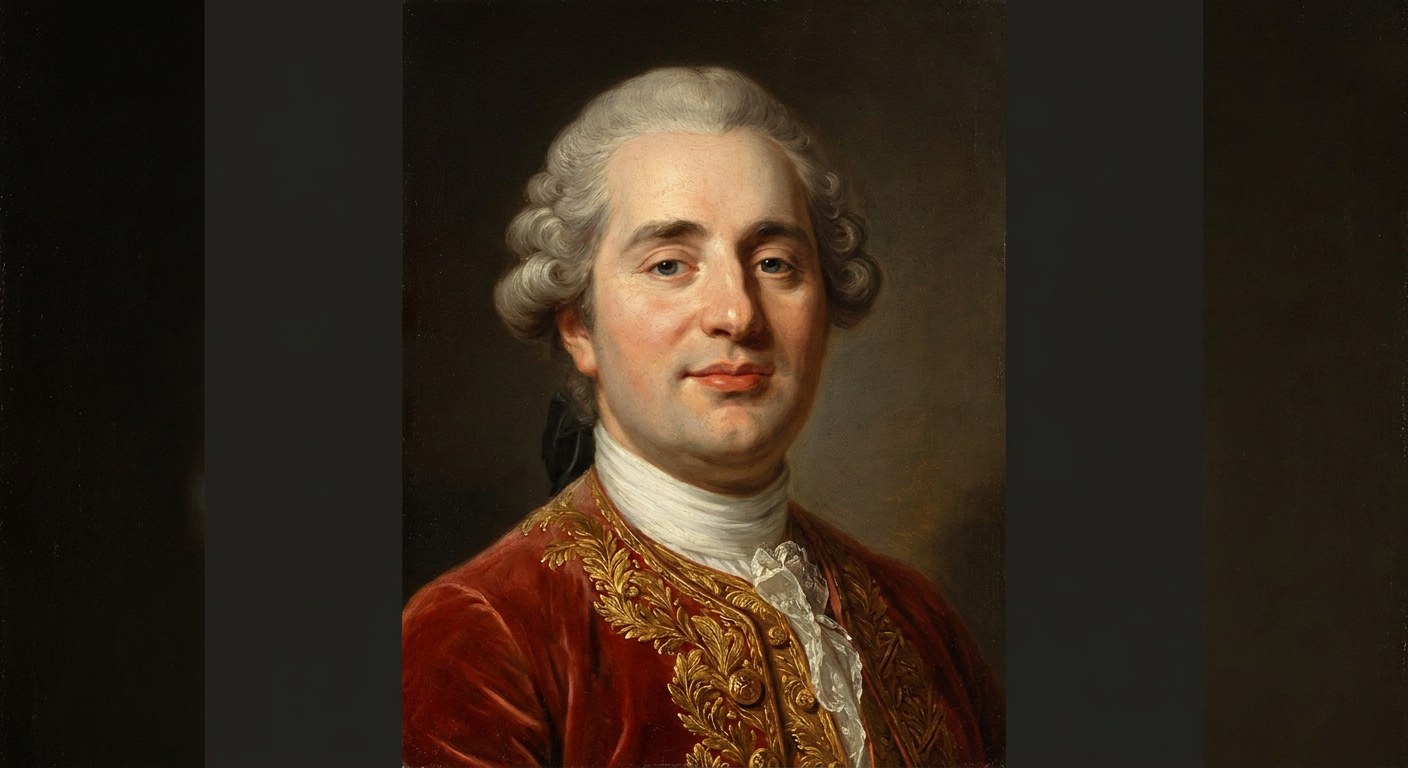
Louis XVI
1754 – 1793 · French · King of France
Recommended Audiobooks
Listen next from Marcus Alden

Life Lessons from Frederic Chopin
Marcus Alden · 54 min

Life Lessons from John Wesley
Marcus Alden · 52 min
Introduction
Louis XVI of France (23 August 1754–21 January 1793) was the last king of France before the abolition of the monarchy during the French Revolution. He reigned from 1774 to 1792, presiding over a kingdom of immense cultural prestige, considerable economic strength, and deep structural inequality. Personally conscientious, intellectually curious, and inclined toward reform, Louis nevertheless proved unable to reconcile France’s inherited system of absolute monarchy and privilege with mounting demands for fiscal justice, political representation, and popular sovereignty.
His reign began with widespread hope. The young monarch appointed reforming ministers, relaxed some religious restrictions, supported improvements in criminal justice, and authorized French intervention in the American War of Independence. France’s assistance contributed decisively to the defeat of Britain and the creation of the United States. Yet the war also worsened the royal government’s already severe financial problems. Repeated efforts to reform taxation encountered resistance from privileged groups, courts, and political institutions unwilling to surrender exemptions.
In 1789, a fiscal crisis forced Louis to summon the Estates-General, which had not met since 1614. Its transformation into the National Assembly initiated a revolution that rapidly escaped royal control. Louis alternated between compromise and resistance, accepting major reforms while privately seeking ways to restore royal authority. His attempted flight from Paris in June 1791 profoundly damaged public trust. After the fall of the monarchy on 10 August 1792, he was tried by the National Convention, convicted of treason, and executed by guillotine on 21 January 1793.
Louis XVI has consequently been portrayed in sharply different ways: as a well-meaning but weak ruler, a defender of legitimate monarchy, an obstacle to democratic transformation, or a tragic figure overwhelmed by circumstances. Modern historians generally reject simple caricatures. His fate resulted from the interaction of personal limitations, institutional paralysis, ideological conflict, war, economic hardship, and revolutionary radicalization.
Quick Facts
| Category | Details |
|---|---|
| Full name | Louis-Auguste de France |
| Regnal name | Louis XVI |
| Born | 23 August 1754, Palace of Versailles, France |
| Died | 21 January 1793, Place de la Révolution, Paris |
| Age at death | 38 |
| Dynasty | House of Bourbon |
| Father | Louis, Dauphin of France |
| Mother | Maria Josepha of Saxony |
| Grandfather | Louis XV of France |
| Spouse | Marie Antoinette of Austria |
| Marriage | 16 May 1770, Versailles |
| Children | Marie-Thérèse Charlotte, Louis Joseph, Louis Charles, and Sophie Hélène Béatrix |
| Became dauphin | 20 December 1765 |
| Reign | 10 May 1774–21 September 1792 |
| Coronation | 11 June 1775, Reims Cathedral |
| Predecessor | Louis XV |
| Constitutional title | King of the French, formally used under the Constitution of 1791 |
| Major conflict | American War of Independence |
| Deposed | Monarchy suspended on 10 August 1792; abolished on 21 September 1792 |
| Trial | December 1792–January 1793 |
| Execution | Guillotined on 21 January 1793 |
| Burial | Initially Madeleine Cemetery; reinterred in the Basilica of Saint-Denis in 1815 |
Early Life & Background
Louis-Auguste was born at Versailles on 23 August 1754. He was the third surviving son of Louis, Dauphin of France, and Maria Josepha of Saxony. As a grandson of the reigning Louis XV, he initially stood behind his father and elder brothers in the line of succession and was not expected to become king.
His childhood was shaped by bereavement. His elder brother Louis Joseph Xavier, Duke of Burgundy, was considered the more promising heir but died in 1761 at the age of nine. Another elder brother had died in infancy. Louis-Auguste therefore became the senior surviving son, although his father remained heir to the throne until his own death from tuberculosis on 20 December 1765. At eleven, Louis-Auguste became dauphin. His mother died in March 1767, leaving the future king orphaned before his thirteenth birthday.
His principal governor was Paul François de Quelen de La Vauguyon, who emphasized Catholic devotion, morality, obedience, and the responsibilities of kingship. Among Louis’s tutors was the Abbé de Radonvilliers. His education covered religion, history, geography, literature, mathematics, and languages. He developed a strong interest in geography, naval affairs, mechanics, locks, and practical crafts. He could read Latin and possessed some knowledge of English and Italian.
Louis was physically robust but socially awkward. Contemporaries often described him as shy, reserved, and uncomfortable in court society. His hesitation should not be mistaken for lack of intelligence: surviving papers show attention to administrative detail and an informed interest in international affairs. Nevertheless, he lacked the ease, decisiveness, and skill in managing personalities that an eighteenth-century monarch needed.
His upbringing also encouraged a severe moral view of kingship. He believed the ruler was answerable to God and obligated to protect his subjects. Yet he inherited a political system in which royal authority coexisted uneasily with local privileges, venal offices, provincial customs, clerical rights, noble exemptions, and the claims of the parlements, especially the Parlement of Paris. The monarchy appeared absolute in theory but was constrained in practice.
Diplomacy determined Louis’s marriage. France and Austria had become allies in the “Diplomatic Revolution” of 1756, reversing centuries of rivalry. To strengthen that alliance, Louis married Archduchess Maria Antonia of Austria, the daughter of Empress Maria Theresa and Emperor Francis I. Known in France as Marie Antoinette, she arrived in 1770. Their wedding ceremony took place at Versailles on 16 May.
The couple’s marriage was not consummated for several years, prompting diplomatic concern and court gossip. The precise cause remains uncertain; historians have challenged older claims that Louis suffered from a condition requiring surgery. The marriage was probably consummated in 1777, after a visit by Marie Antoinette’s brother, Emperor Joseph II.
Rise to Prominence
Louis became king on 10 May 1774 when Louis XV died of smallpox. He was nineteen years old. The accession was welcomed by many French subjects who associated the late king’s final years with scandal, military disappointment, and political conflict. Louis XVI and Marie Antoinette appeared young enough to symbolize renewal.
One of Louis’s first major decisions was to dismiss the late king’s unpopular ministers and restore the parlements abolished during Chancellor René Nicolas de Maupeou’s reforms. The move was celebrated as a victory against perceived despotism. In the longer term, however, the restored courts became centers of resistance to royal fiscal reform. By reversing Maupeou’s restructuring, Louis revived institutions capable of blocking his own government.
Louis appointed Anne Robert Jacques Turgot as controller-general of finances in 1774. Turgot advocated economic liberalization, reduced court expenditure, the abolition of compulsory labor on roads, and reform of guilds. His attempt to liberalize the grain trade coincided with poor harvests, rising prices, and the “Flour War” disturbances of 1775. Opposition from court interests, officeholders, and privileged groups intensified. Louis initially supported Turgot but dismissed him in May 1776 when the political cost became too great.
Jacques Necker, a Genevan banker and Protestant, emerged as another important financial minister. As director-general of finances, Necker relied heavily on loans rather than creating a comprehensive tax settlement. His publication of the Compte rendu au roi in 1781 presented an apparently favorable picture of ordinary royal finances while excluding much wartime borrowing. It enhanced Necker’s popularity but contributed to public misunderstanding of the state’s true fiscal position.
Foreign policy brought Louis greater success. Guided by Foreign Minister Charles Gravier, comte de Vergennes, France covertly aided the American rebels and formally entered the war against Britain in 1778. French money, weapons, troops, ships, and diplomacy were essential to American victory. The French fleet under Admiral de Grasse helped trap British forces at Yorktown, where Lord Cornwallis surrendered in October 1781. The Treaty of Paris in 1783 weakened Britain and restored French prestige, but France gained few direct material benefits.
By the mid-1780s, debt service consumed an enormous share of royal revenue. The government’s fragmented tax system placed disproportionate burdens on commoners while many clergy, nobles, provinces, and corporate bodies possessed privileges or exemptions. Louis and his ministers increasingly recognized that reform was unavoidable. What they lacked was an accepted mechanism for imposing it.
Major Achievements
Louis XVI’s reign is often viewed through the catastrophe of the Revolution, but it included meaningful reforms and international accomplishments.
Support for American independence: France’s intervention in the American War of Independence was the greatest geopolitical success of his reign. French military and naval power played a decisive role at Yorktown. The conflict restored some of the prestige lost in the Seven Years’ War and contributed to the emergence of the United States.
Religious toleration: The Edict of Versailles, signed in November 1787 and registered in January 1788, granted non-Catholics—especially Protestants—legal civil status. It allowed them to register marriages, births, and deaths without converting to Catholicism. It did not establish full religious equality, but it reversed important consequences of Louis XIV’s revocation of the Edict of Nantes.
Criminal justice reform: The crown curtailed the judicial use of torture. The question préparatoire, employed to extract confessions before conviction, was abolished in 1780. The question préalable, used after conviction to obtain information about accomplices, was abolished in 1788. These reforms reflected Enlightenment criticism of cruel and arbitrary punishment.
Reduction of servile obligations: In 1779, Louis abolished certain forms of serfdom and personal servitude on the royal domain and encouraged other landowners to follow his example. The measure was limited geographically but represented an acknowledgment that such obligations were incompatible with reforming principles.
Scientific and maritime patronage: Louis maintained a serious interest in exploration and naval development. His government sponsored Jean-François de Galaup, comte de Lapérouse, whose expedition left France in 1785 to explore the Pacific. The king followed the voyage closely; the expedition disappeared after leaving Botany Bay in 1788.
Administrative reform efforts: Under ministers including Turgot, Necker, Charles Alexandre de Calonne, and Étienne Charles de Loménie de Brienne, the monarchy attempted to rationalize taxation and administration. Most plans failed politically, but they identified the central problems later addressed more radically by the Revolution.
These accomplishments were constrained by inconsistency. Louis often approved reform in principle but retreated when faced with determined opposition. His inability to sustain ministers or create a durable coalition for change weakened otherwise serious initiatives.
Defining Moments
The first defining crisis of Louis’s reign was France’s decision to enter the American War in 1778. The war demonstrated the renewed strength of French arms and inflicted a strategic defeat on Britain. At the same time, wartime borrowing helped push the monarchy toward insolvency. It also exposed French officers and readers to American constitutional ideas, although the relationship between the American and French revolutions was complex rather than automatic.
A second turning point came with Calonne’s reform program. Appointed controller-general in 1783, Calonne eventually proposed a universal land tax, provincial assemblies, and freer internal trade. Because the parlements were unlikely to register the program, Louis summoned an Assembly of Notables in 1787. Instead of endorsing the reforms, the notables demanded greater scrutiny and questioned the crown’s authority to impose new taxes. Calonne was dismissed, and the monarchy’s financial weakness became public.
In August 1788, the government effectively suspended payments and announced that the Estates-General would meet in 1789. Louis agreed that the Third Estate would have twice as many representatives as either the clergy or nobility, but he did not clearly settle whether votes would be counted by head or by order. This ambiguity proved disastrous.
The Estates-General opened at Versailles on 5 May 1789. Disputes over voting and verification of credentials soon led the Third Estate, joined by some clergy and nobles, to declare itself the National Assembly on 17 June. On 20 June, deputies excluded from their meeting hall gathered in a royal tennis court and swore not to separate until France had a constitution.
Louis’s reaction was hesitant. At the royal session of 23 June, he offered reforms but rejected the Assembly’s claim to sovereign authority. When many deputies refused to disperse and elite troops gathered around Paris, fears of a royal crackdown intensified. Louis dismissed Necker on 11 July. Three days later, Parisians stormed the Bastille. Louis then recalled Necker and accepted the revolutionary cockade, signaling a temporary accommodation.
The Women’s March on Versailles on 5–6 October 1789 forced the royal family to move to the Tuileries Palace in Paris. Louis was now physically surrounded by the revolutionary capital. He approved, under pressure, the August Decrees dismantling feudal privilege and the Declaration of the Rights of Man and of the Citizen.
The most damaging moment came with the Flight to Varennes on 20–21 June 1791. Louis and his family attempted to escape Paris and reach the eastern frontier, where the king hoped to negotiate from a position of greater freedom. Recognized at Sainte-Menehould and stopped at Varennes-en-Argonne, they were returned to Paris under guard. The episode appeared to confirm that Louis rejected the Revolution and could not be trusted as a constitutional monarch.
Louis accepted the Constitution of 1791 in September, but cooperation remained fragile. War against Austria began on 20 April 1792. Louis expected conflict might restore his authority, while many revolutionaries believed war would expose domestic enemies and spread revolutionary principles. Early French defeats, suspicion of the king’s vetoes, and the Brunswick Manifesto threatening Paris radicalized public opinion.
On 10 August 1792, insurgents attacked the Tuileries. The royal family sought refuge with the Legislative Assembly, which suspended Louis. The National Convention abolished the monarchy on 21 September and proclaimed a republic.
Timeline
| Year | Event |
|---|---|
| 1754 | Louis-Auguste is born at Versailles on 23 August. |
| 1761 | His elder brother, the Duke of Burgundy, dies; Louis moves closer to the succession. |
| 1765 | His father dies on 20 December, and Louis becomes dauphin. |
| 1767 | His mother, Maria Josepha of Saxony, dies. |
| 1770 | Louis marries Marie Antoinette at Versailles on 16 May. |
| 1774 | Louis XV dies on 10 May; Louis XVI becomes king. |
| 1775 | He is crowned at Reims on 11 June; the Flour War exposes economic tensions. |
| 1776 | Turgot is dismissed after opposition to his reform program. |
| 1778 | France formally enters the American War of Independence. |
| 1779 | Certain servile obligations are abolished on the royal domain. |
| 1780 | The question préparatoire, a form of judicial torture, is abolished. |
| 1781 | French-American forces win at Yorktown; Necker publishes the Compte rendu. |
| 1783 | The Treaty of Paris ends the American war; Calonne becomes controller-general. |
| 1785 | The Lapérouse expedition sails; the Diamond Necklace Affair harms the monarchy’s reputation. |
| 1787 | The Assembly of Notables rejects Calonne’s fiscal program; Louis signs the Edict of Versailles. |
| 1788 | A financial crisis forces the crown to summon the Estates-General. |
| 1789 | The Estates-General meets; the National Assembly forms; the Bastille falls; the royal family moves to Paris. |
| 1790 | Louis publicly participates in the Festival of the Federation on 14 July. |
| 1791 | The royal family is stopped at Varennes; Louis later accepts the new constitution. |
| 1792 | France declares war on Austria; the Tuileries is stormed; the monarchy is abolished; Louis goes on trial. |
| 1793 | Louis is sentenced to death and guillotined on 21 January. |
| 1815 | His remains and those attributed to Marie Antoinette are reinterred at Saint-Denis. |
Personal Life
Louis’s marriage to Marie Antoinette became one of the most scrutinized royal relationships in European history. Its early difficulties produced ridicule and political gossip. Over time, however, the couple developed affection and a functioning partnership, although their temperaments differed. Louis preferred hunting, study, mechanical work, and private family life; Marie Antoinette enjoyed theater, music, fashion, gambling, and the intimate society of the Petit Trianon.
They had four children. Marie-Thérèse Charlotte was born in 1778 and survived the Revolution. Louis Joseph, born in 1781, became dauphin but died of illness in June 1789. Louis Charles was born in 1785 and was regarded by royalists as Louis XVII after his father’s death, although he never reigned and died in captivity in 1795. Sophie Hélène Béatrix, born in 1786, died before her first birthday.
The death of Louis Joseph occurred during the opening phase of the Revolution and caused the royal family profound grief. Public events, however, left little space for private mourning. Louis’s family attachments became especially visible during imprisonment in the Temple after August 1792.
He was a dedicated hunter and maintained detailed records of his outings. He also took pleasure in metalwork and lockmaking, sometimes working with the royal locksmith François Gamain. Hostile propaganda later used these interests to depict him as dull or insensitive, but practical mechanics were compatible with the era’s aristocratic enthusiasm for science and craftsmanship.
Louis ate heartily and became heavier with age, contributing to unflattering caricatures. Yet he was physically active and accustomed to long hunts. Personally, he was less extravagant than the mythology surrounding Versailles might suggest, although the royal court as an institution remained extremely costly and symbolically alienating.
Beliefs & Philosophy
Louis XVI was a devout Catholic who understood monarchy as a sacred responsibility. His coronation at Reims placed him within a centuries-old religious tradition in which French kings were anointed with holy oil and portrayed as guardians of the Church and kingdom.
His faith encouraged charity, personal morality, and concern for justice. It also limited his willingness to accept policies he regarded as attacks on Catholicism. The Civil Constitution of the Clergy, adopted in 1790, reorganized the French Church and required clergy to swear loyalty to the new order. Louis reluctantly sanctioned the measure but was deeply troubled by it, especially after Pope Pius VI condemned the settlement.
Politically, Louis was not a systematic theorist. He accepted that abuses required reform and could tolerate representative institutions under royal leadership. He did not, however, readily embrace the idea that sovereignty resided entirely in the nation rather than in the crown. His conduct after 1789 reflected the tension between his public role as constitutional king and his continuing belief in hereditary monarchical authority.
He valued useful knowledge and showed genuine interest in navigation, cartography, engineering, and scientific exploration. These interests connected him to aspects of the Enlightenment, even though he did not share the more radical philosophical criticism of throne and altar.
Challenges & Controversies
The central challenge of Louis’s reign was fiscal. France possessed extensive resources, but the state’s revenue system was inefficient, unequal, and expensive to administer. Tax farming, exemptions, overlapping jurisdictions, and reliance on loans made reform both necessary and politically explosive. Louis failed to impose a stable solution before confidence in the monarchy collapsed.
His leadership style compounded the crisis. He frequently recognized sound advice but hesitated when reform threatened entrenched interests. He dismissed Turgot, lost confidence in Necker, abandoned Calonne, and failed to support Brienne decisively. Rapid ministerial turnover deprived royal policy of continuity.
The king’s relationship with Marie Antoinette also became controversial. As an Austrian archduchess, she was targeted by xenophobic propaganda and accused of dominating her husband. Her influence was real but often exaggerated. The Diamond Necklace Affair of 1785, in which she was not personally involved, nevertheless reinforced beliefs that the court was corrupt and extravagant.
Louis’s actions during the Revolution remain the greatest source of controversy. Supporters emphasize that he sanctioned sweeping changes, refused to authorize large-scale bloodshed, and attempted to preserve order in extraordinary circumstances. Critics note that he communicated with émigrés and foreign powers, used constitutional vetoes against revolutionary legislation, and pursued strategies that could undermine the new political order.
The Flight to Varennes was especially destructive. Louis’s written declaration left behind before the escape criticized major revolutionary measures. Even citizens who had previously favored constitutional monarchy began to suspect that the king’s public acceptance of reform was insincere.
Documents discovered in the Tuileries after the monarchy’s fall—including papers associated with the so-called iron chest—were used to demonstrate secret dealings with political figures and efforts to influence opinion. At his trial, Louis denied conspiring against the nation and argued that many of his actions had been constitutionally lawful.
On 15 January 1793, the National Convention found him guilty. Deputies then voted on punishment in a tense roll call. A narrow majority favored immediate death without an effective reprieve. Louis’s former cousin, Louis Philippe Joseph, Duke of Orléans—known as Philippe Égalité—voted for execution.
The trial’s fairness remains debated. It was both a judicial proceeding and an act of revolutionary sovereignty. Louis was allowed defense counsel, including Raymond de Sèze, François Denis Tronchet, and the former minister Malesherbes, but the Convention simultaneously acted as accuser, judge, and political authority.
Famous Quotes
“I die innocent of all the crimes imputed to me. I pardon the authors of my death, and I pray God that the blood you are about to shed may never fall upon France.”
These words, or a close version of them, were reported as Louis’s final declaration on the scaffold. Accounts differ slightly because drums interrupted him and witnesses recorded the scene afterward.
“I recommend to my son, if he should have the misfortune to become king, to remember that he owes himself entirely to the happiness of his fellow citizens.”
This sentiment appears in Louis’s testament, written in the Temple on 25 December 1792. The document stressed forgiveness, religious faith, and the moral duties of kingship.
“I forgive my enemies; I desire that my blood may be useful to the French and appease the anger of God.”
This statement is traditionally associated with Louis’s final hours and reflects the devotional tone of contemporary accounts.
“Nothing.”
The famous diary entry for 14 July 1789 is frequently misunderstood. Louis’s terse “nothing” almost certainly referred to the result of that day’s hunt, not to ignorance of or indifference toward the fall of the Bastille. The anecdote illustrates how fragments of evidence can become powerful historical myths.
Legacy & Influence
Louis XVI’s execution marked a decisive rupture in European history. Regicide transformed the French Revolution from a struggle over constitutional reform into a direct challenge to hereditary monarchy. It shocked royal courts, energized counterrevolutionaries, and contributed to the expansion of war between revolutionary France and European powers.
For royalists, Louis became a martyr. His composure during imprisonment, his testament, and his reported forgiveness of his executioners supported an image of a Christian king sacrificed by revolutionary violence. After the Bourbon Restoration, Louis XVIII commemorated his brother, reinterred his remains at Saint-Denis, and sponsored the Chapelle Expiatoire near the original burial site.
Republican interpretations traditionally portrayed Louis as a traitor who conspired against national liberty. In this account, Varennes, foreign correspondence, and resistance to revolutionary decrees justified his removal. Later Marxist histories tended to view him less as the central cause of events than as the representative of a decaying feudal and absolutist order.
Modern scholarship presents a more complex picture. Louis was neither the foolish glutton of revolutionary caricature nor simply an innocent victim. He possessed intelligence, seriousness, and reforming intentions, but he struggled to make timely, consistent decisions. His desire to avoid civil conflict often produced ambiguity rather than reconciliation. By attempting to preserve incompatible roles—an anointed Bourbon monarch and a constitutional executive dependent on a sovereign nation—he lost the confidence of both revolutionaries and defenders of uncompromised royal authority.
His reign demonstrates that political systems can collapse even when many participants recognize the need for reform. France’s crisis was not caused by one person. It emerged from public debt, social privilege, institutional fragmentation, poor harvests, political mistrust, expanding print culture, Enlightenment arguments, and the unintended consequences of royal decisions.
Louis’s support for the American Revolution also gave his legacy an enduring paradox. He helped secure republican independence abroad while the costs and ideas associated with that conflict contributed to the destruction of his monarchy at home.
Interesting Facts
- Louis XVI was not born heir apparent; deaths within his family unexpectedly placed him in the direct line of succession.
- He became king at nineteen and was twenty when crowned at Reims.
- He was knowledgeable about geography and took a particular interest in naval strategy and exploration.
- His reign sponsored the global expedition of Lapérouse, whose disappearance became one of the era’s great maritime mysteries.
- Louis personally enjoyed working with locks and metal mechanisms.
- He was more personally frugal than the popular image of Versailles suggests, although the court remained expensive.
- The celebrated diary entry “Nothing” on 14 July 1789 referred to hunting rather than the political events in Paris.
- Louis was temporarily known in official revolutionary usage as “Louis Capet,” a name intended to reduce him from king to ordinary citizen.
- His defense attorney Raymond de Sèze argued that Louis could not be judged under laws applied retroactively.
- Charles-Henri Sanson, executioner of Paris, carried out the king’s execution.
- The execution took place at the Place de la Révolution, later renamed the Place de la Concorde.
- Louis’s daughter Marie-Thérèse was the only one of his children to survive beyond 1795.
- His younger brothers later became Kings Louis XVIII and Charles X.
- The Catholic Church considered but never completed a formal process that might have led to his beatification.
- His surviving papers reveal greater administrative engagement than hostile revolutionary caricatures implied.
Frequently Asked Questions
Why was Louis XVI executed?
Louis was executed after the National Convention convicted him of conspiring against the liberty and security of the French nation. Evidence cited against him included the Flight to Varennes, secret political contacts, his use of vetoes, and documents discovered after the fall of the Tuileries. The trial was also fundamentally political: the republic’s leaders believed that the former king remained a focus for counterrevolution and foreign intervention.
Was Louis XVI an absolute monarch?
At the beginning of his reign, Louis inherited what historians commonly call an absolute monarchy, meaning sovereignty was formally concentrated in the crown. In practice, his authority was constrained by laws, customs, courts, privileges, provincial institutions, and the need to obtain credit. From 1791 until the monarchy’s suspension in 1792, he served as a constitutional monarch.
Was Louis XVI a bad king?
The answer depends on the standard used. He was conscientious, educated, and open to some humanitarian reforms. He also supported the successful American war. Yet he was indecisive, inconsistent in supporting ministers, and unable to manage the fiscal and political crisis. His secretive actions after 1789 made constitutional monarchy increasingly difficult to sustain.
Did Louis XVI support the American Revolution?
Yes. His government initially provided covert assistance and entered the war openly in 1778. French troops, supplies, loans, diplomacy, and naval forces were vital to American victory. Louis’s motive was primarily strategic—to weaken Britain—rather than a desire to promote republican government.
Why did Louis summon the Estates-General?
The monarchy could no longer resolve its financial crisis through ordinary methods. Attempts to establish new taxes had been blocked or disputed, and lenders were losing confidence. In 1788, Louis agreed to summon the Estates-General so representatives of the clergy, nobility, and Third Estate could address the crisis.
Why was the Flight to Varennes important?
The failed escape destroyed much of the remaining trust between Louis and the revolutionary public. It suggested that his acceptance of constitutional changes had been forced and that he hoped to recover power with support from loyal troops or foreign pressure. After Varennes, republicanism became substantially more influential.
Did Marie Antoinette control Louis XVI?
Marie Antoinette sometimes influenced appointments, court politics, and the royal response to the Revolution, but she did not consistently control her husband. Louis made many decisions independently and often resisted her preferences. Claims that she secretly governed France were amplified by misogynistic and anti-Austrian propaganda.
Who succeeded Louis XVI?
No monarch immediately succeeded him because France had become a republic. Royalists recognized his imprisoned son Louis Charles as Louis XVII after January 1793, but the child never ruled. Louis XVI’s brother eventually became Louis XVIII during the Bourbon Restoration.
Where is Louis XVI buried?
After his execution, Louis was buried at the Madeleine Cemetery in Paris. During the Bourbon Restoration, remains identified as his were transferred in January 1815 to the royal necropolis in the Basilica of Saint-Denis.
Lessons from Louis XVI
- Reform must be timely: Delayed reform can make moderate solutions impossible.
- Good intentions are not enough: Leadership requires consistency, coalition-building, and decisive execution.
- Fiscal systems shape political stability: Persistent debt and unequal taxation can undermine even powerful states.
- Public trust is difficult to recover: The Flight to Varennes turned suspicion into a lasting crisis of legitimacy.
- Ambiguity can satisfy no one: Louis’s attempts to balance royal restoration with constitutional cooperation alienated opposing factions.
- Foreign-policy victories can carry domestic costs: Success in America enhanced French prestige while aggravating the financial crisis.
- Institutions matter as much as individuals: The monarchy’s failure resulted from structural weaknesses as well as Louis’s decisions.
- Political symbolism has real power: Versailles, court privilege, the Bastille, and the king’s attempted escape acquired meanings beyond their immediate practical importance.
- Polarization narrows peaceful choices: War, economic hardship, and mutual fear pushed both royalists and revolutionaries toward more extreme positions.
- Historical judgment requires nuance: Louis was a reform-minded ruler in some respects, a defender of inherited authority in others, and a participant in a crisis larger than himself.
Further Reading
- John Hardman, Louis XVI: The Silent King
- John Hardman, The Life of Louis XVI
- Timothy Tackett, When the King Took Flight
- Munro Price, The Road from Versailles: Louis XVI, Marie Antoinette, and the Fall of the French Monarchy
- Munro Price, The Fall of the French Monarchy: Louis XVI, Marie Antoinette and the Baron de Breteuil
- Simon Schama, Citizens: A Chronicle of the French Revolution
- William Doyle, The Oxford History of the French Revolution
- William Doyle, Origins of the French Revolution
- Peter McPhee, Liberty or Death: The French Revolution
- Tackett, The Coming of the Terror in the French Revolution
- Ambrogio A. Caiani, Louis XVI and the French Revolution, 1789–1792
- Antonia Fraser, Marie Antoinette: The Journey
- Thomas E. Kaiser, “Who’s Afraid of Marie-Antoinette? Diplomacy, Austrophobia, and the Queen”
- The testament of Louis XVI, dated 25 December 1792
- The trial records and speeches of Louis XVI’s defense counsel, especially Raymond de Sèze’s plea before the National Convention