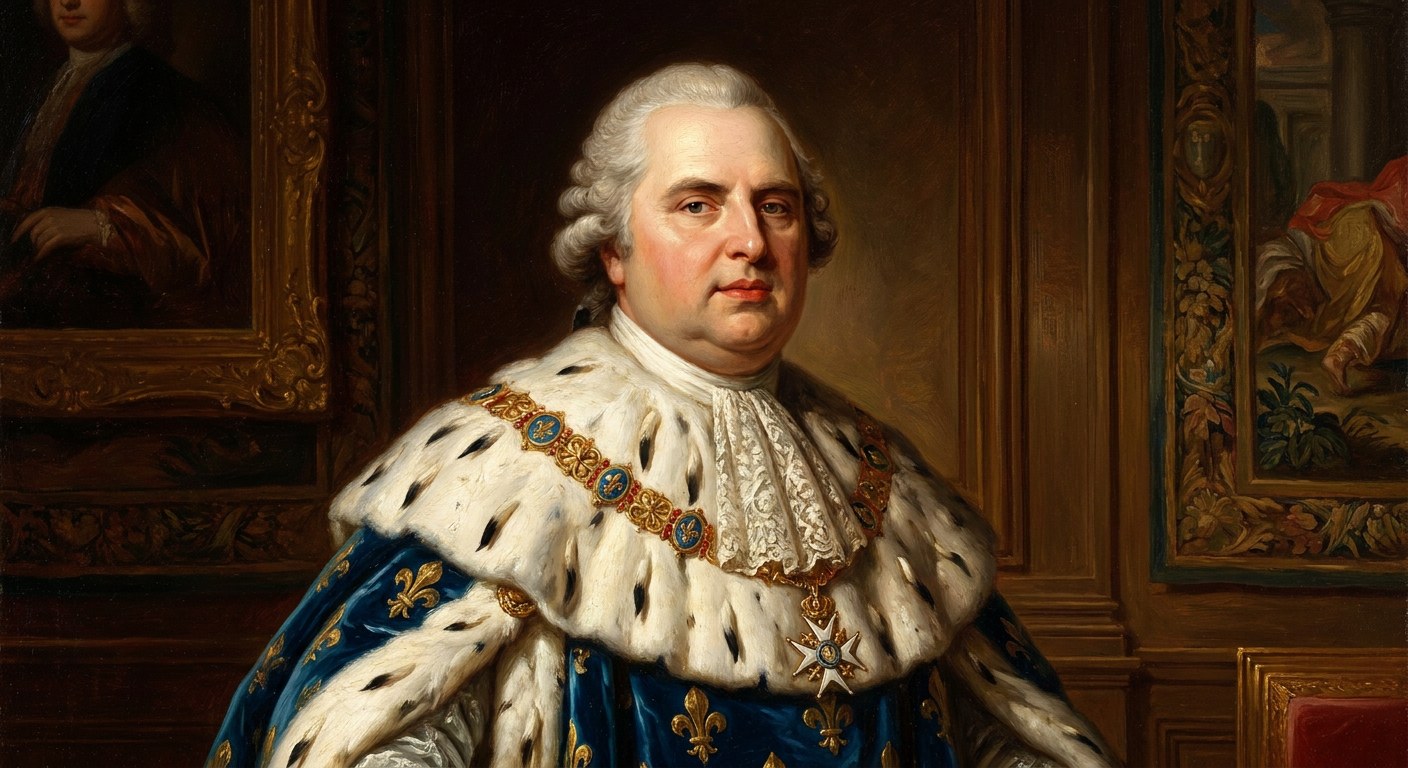
Louis XVIII
1755 – 1824 · French · King of France
Recommended Audiobooks
Listen next from Marcus Alden

Life Lessons from Frederic Chopin
Marcus Alden · 54 min

Life Lessons from John Wesley
Marcus Alden · 52 min
Introduction
Louis XVIII (17 November 1755–16 September 1824) was king of France during the Bourbon Restoration, reigning in practice from 1814 to 1815 and again from 1815 until his death. The younger brother of Louis XVI and elder brother of the future Charles X, he spent more than two decades in exile during the French Revolution and the Napoleonic era. He returned to rule a country profoundly transformed by revolution, war, social upheaval, and administrative centralization.
His reign represented neither a simple revival of the ancien régime nor a complete acceptance of revolutionary principles. Instead, Louis attempted to reconcile hereditary monarchy with selected features of the new France. The Constitutional Charter of 1814 preserved legal equality, the Napoleonic administrative system, the sale of national lands, and much of the Civil Code while restoring the Bourbon dynasty, a hereditary peerage, and a privileged position for the Catholic Church.
Louis was politically cautious, intellectually cultivated, and more pragmatic than many of his royalist supporters. Although he believed firmly in dynastic legitimacy, he understood that pre-revolutionary France could not be reconstructed exactly as it had existed before 1789. His willingness to compromise distinguished him from the ultraroyalists, including his brother Charles, who sought a more thorough restoration of aristocratic and clerical authority.
His government nevertheless faced severe challenges. Napoleon’s return during the Hundred Days forced Louis into a second exile. After Waterloo, France suffered foreign occupation, financial penalties, political purges, and royalist violence known as the White Terror. The assassination of Louis’s nephew, the Duke of Berry, in 1820 also pushed the monarchy toward increasingly conservative policies.
Louis XVIII’s reign was an important experiment in post-revolutionary government. It restored France to the European diplomatic system, established a limited constitutional monarchy, and demonstrated both the possibilities and weaknesses of compromise between royal legitimacy and the social legacy of the Revolution.
Quick Facts
| Category | Details |
|---|---|
| Full name | Louis Stanislas Xavier de France |
| Regnal name | Louis XVIII |
| Born | 17 November 1755 |
| Birthplace | Palace of Versailles, France |
| Died | 16 September 1824 |
| Place of death | Tuileries Palace, Paris, France |
| Age at death | 68 |
| Dynasty | House of Bourbon |
| Father | Louis, Dauphin of France |
| Mother | Maria Josepha of Saxony |
| Grandfather | Louis XV of France |
| Siblings | Included Louis XVI and Charles X |
| Pre-accession title | Count of Provence |
| Spouse | Marie Joséphine of Savoy |
| Children | None |
| Claimed reign | 8 June 1795–16 September 1824 |
| Effective reign in France | 3 May 1814–20 March 1815; 8 July 1815–16 September 1824 |
| Predecessor in Bourbon reckoning | Louis XVII |
| Successor | Charles X |
| Religion | Roman Catholicism |
| Principal residence in exile | Hartwell House, Buckinghamshire, England |
| Burial place | Basilica of Saint-Denis, France |
Early Life & Background
Louis Stanislas Xavier was born at the Palace of Versailles on 17 November 1755. He was a grandson of King Louis XV and a son of Louis, Dauphin of France, and Maria Josepha of Saxony. At birth he received the title Count of Provence and, as a grandson of the reigning monarch in the male line, held the rank of petit-fils de France.
He grew up within a royal family marked by piety, ceremony, and intense dynastic expectations. His elder surviving brother, Louis Auguste, Duke of Berry, later became Louis XVI. His younger brother, Charles Philippe, Count of Artois, eventually ruled as Charles X. Another elder brother, the Duke of Burgundy, had initially appeared destined for prominence but died in 1761.
The Count of Provence received a broad education in history, literature, religion, languages, and government. He developed a reputation for intelligence, verbal skill, and an excellent memory. He especially enjoyed classical authors and cultivated the image of a learned prince. This intellectual confidence sometimes appeared as wit and sophistication, but it could also make him seem self-important or condescending.
Louis’s father died in December 1765, and his mother died in March 1767. Their deaths left the royal children under the authority of Louis XV and court-appointed tutors. The young princes had been raised in a household critical of court frivolity, but their later personalities diverged sharply. Louis XVI was serious and hesitant; the Count of Provence was sociable and politically ambitious; the Count of Artois became associated with aristocratic reaction and fashionable extravagance.
On 14 May 1771, Louis married Princess Marie Joséphine of Savoy at Versailles. She was the daughter of Victor Amadeus III, the future king of Sardinia, and Maria Antonia Ferdinanda of Spain. The marriage strengthened Bourbon ties with the House of Savoy but was personally unhappy. The couple had no children. Contemporary reports suggested that the marriage was not consummated for some time, and later reports of pregnancies did not result in surviving offspring.
When Louis XVI ascended the throne in 1774, the Count of Provence became the king’s eldest surviving brother and was conventionally known at court as Monsieur. Because Louis XVI initially had no children, Provence stood close to the succession. The birth of royal sons later reduced his immediate dynastic importance, but the deaths of those children and the Revolution ultimately brought him to the throne.
Rise to Prominence
During Louis XVI’s reign, the Count of Provence sought a meaningful political role but was rarely entrusted with sustained authority. He maintained his own household, participated in court politics, and sometimes presented himself as more decisive than his brother. He showed interest in reform while also defending the dignity and privileges of the monarchy.
In 1787, he took part in the Assembly of Notables, which Louis XVI summoned in an attempt to address France’s fiscal crisis. Provence presided over one of the assembly’s committees. He accepted some administrative and financial reforms, but the political breakdown surrounding taxation exposed the monarchy’s inability to compel privileged groups to share the fiscal burden.
When the French Revolution began in 1789, Provence adopted a cautious position. Unlike the Count of Artois, who left France shortly after the fall of the Bastille, he remained in the kingdom. He did not embrace popular sovereignty, but he avoided identifying himself completely with the earliest émigré campaign against the Revolution.
That caution ended in June 1791. While Louis XVI and his immediate family attempted the unsuccessful Flight to Varennes, Provence and his wife separately escaped from Paris. Disguised and assisted by his favorite, Antoine Louis François de Béziade, Count—and later Duke—of Avaray, Provence reached the Austrian Netherlands and continued to the émigré center at Koblenz. His brother was recognized and arrested at Varennes.
From exile, Provence became increasingly important to the royalist cause. After Louis XVI was executed on 21 January 1793, he declared himself regent for his nephew, Louis Charles, whom royalists recognized as Louis XVII. The child remained imprisoned in Paris and died in the Temple prison on 8 June 1795. Provence then proclaimed himself King Louis XVIII.
The choice of “Louis XVIII” affirmed the principle that kingship passed automatically by hereditary right. In Bourbon interpretation, Louis XVII had been king from the moment of his father’s death, even though he never exercised power. Louis XVIII therefore dated his own reign from 1795, nearly nineteen years before he entered Paris as ruler.
His early declarations from exile were uncompromising. The Declaration of Verona in 1795 promised the restoration of monarchy and Catholicism and threatened punishment for some revolutionary actors. Such language reassured hard-line royalists but frightened French property owners and officials who had benefited from revolutionary change.
Louis spent the following years moving across Europe as diplomatic circumstances shifted. He lived at Verona until Venetian authorities, under French pressure, required him to leave. He later stayed at Blankenburg in Brunswick, Mitau in the Russian Empire—now Jelgava in Latvia—and Warsaw. He returned to Mitau before eventually seeking refuge in Britain.
In 1807, Louis settled at Gosfield Hall and then Hartwell House in Buckinghamshire. He maintained a small court and continued to issue declarations, cultivate supporters, and seek international recognition. His financial circumstances were often strained, and he depended on subsidies from friendly governments and royal sympathizers.
Napoleon Bonaparte’s military dominance made a Bourbon restoration appear unlikely. Yet Louis refused to renounce his claim. Over time, he moderated his public position, recognizing that French society had been irreversibly altered. Napoleon’s disastrous Russian campaign in 1812 and the allied invasion of France in 1814 finally created an opportunity for the Bourbons to return.
Major Achievements
Louis XVIII’s most consequential achievement was the creation of a workable, though limited, constitutional framework for restored monarchy. Before entering Paris in 1814, he issued the Declaration of Saint-Ouen on 2 May, promising a representative system rather than accepting unchanged the constitution proposed by the French Senate.
The Constitutional Charter, promulgated on 4 June 1814, established a bicameral legislature consisting of a hereditary or royally appointed Chamber of Peers and an elected Chamber of Deputies. The franchise was highly restricted by property qualifications, giving political influence primarily to wealthy men. Ministers were appointed by the king, who retained substantial executive authority, the power to initiate laws, and control of foreign policy.
Yet the Charter protected several fundamental results of the Revolution. It recognized equality before the law, admitted citizens to public employment without formal distinction of birth, guaranteed a measure of religious toleration, and confirmed legal ownership of property—including former church and émigré lands sold during the Revolution. It also preserved much of the Civil Code, the prefectural system, and the centralized state inherited from Napoleon.
Louis’s second major accomplishment was the diplomatic rehabilitation of France. After Napoleon’s final defeat, the Second Treaty of Paris, signed on 20 November 1815, imposed an indemnity of 700 million francs, territorial losses, and an allied army of occupation. The government led by Armand-Emmanuel du Plessis, Duke of Richelieu, negotiated the fulfillment of France’s obligations more rapidly than initially expected.
At the Congress of Aix-la-Chapelle in 1818, the powers agreed to end the occupation early. France was admitted into the diplomatic consultations of the great powers, transforming the wartime Quadruple Alliance into a broader European concert. Only three years after Waterloo, France had regained an accepted place in European diplomacy.
Louis also helped preserve administrative continuity. Rather than dismantling every Napoleonic institution, his governments retained experienced civil servants, the departmental system, the Bank of France, the Legion of Honour, and major elements of military and legal organization. This continuity limited disruption and reassured many who feared a total reversal of post-1789 society.
His willingness to restrain the ultraroyalists was another important contribution. After the 1815 election produced the aggressively royalist “Chamber Beyond Compare”—the Chambre introuvable—Louis dissolved it in September 1816. He recognized that its punitive policies threatened national reconciliation and could destabilize the restored dynasty.
The reign also witnessed financial stabilization, the payment of war indemnities, and renewed commercial activity. These achievements belonged partly to capable ministers and financiers, but Louis’s support for comparatively moderate government made them possible.
Defining Moments
The first defining moment of Louis’s political life was his escape from France on the night of 20–21 June 1791. Unlike Louis XVI, he successfully crossed the frontier. The escape saved him from imprisonment but permanently associated him with the émigré movement and foreign opposition to the Revolution.
A second turning point came with the death of Louis XVII in June 1795. Louis’s assumption of the royal title transformed him from a prince and regent into the Bourbon claimant. It also required him to hold together a divided royalist movement whose members disagreed over revenge, religion, constitutionalism, and the restoration of confiscated property.
His entry into Paris on 3 May 1814 was the culmination of twenty-three years in exile. The event was ceremonially triumphant, but his authority depended on allied victory, French political acceptance, and a settlement with institutions inherited from the Revolution and Empire. He could not rule as though 1789 had never occurred.
Napoleon’s return from Elba created the most humiliating crisis of the reign. Napoleon landed near Cannes on 1 March 1815 and advanced toward Paris as royal troops defected. Louis left the capital on 19 March and established an exile court at Ghent. He returned only after Napoleon’s defeat at Waterloo on 18 June.
The Second Restoration began under harsher conditions. Royalist violence erupted, especially in southern France, where Protestants and suspected Bonapartists were attacked during the White Terror. Marshal Michel Ney, who had joined Napoleon after promising loyalty to Louis, was convicted of treason by the Chamber of Peers and executed on 7 December 1815. Louis did not prevent the sentence, a decision that remained one of the most controversial acts associated with his government.
The assassination of Charles Ferdinand, Duke of Berry, was another decisive event. Berry, the younger son of the Count of Artois and an important hope for continuation of the senior Bourbon line, was stabbed by the Bonapartist Louis Pierre Louvel outside the Paris Opera on 13 February 1820 and died the following day. Ultraroyalists blamed the liberal atmosphere encouraged by the king’s favorite minister, Élie Decazes.
Under intense pressure, Louis dismissed Decazes. His later governments moved toward censorship, electoral manipulation, and closer alliance with conservative royalists. The shift did not destroy the Charter, but it weakened the centrist balance Louis had previously attempted to maintain.
Timeline
| Year | Event |
|---|---|
| 1755 | Louis Stanislas Xavier is born at Versailles on 17 November. |
| 1761 | His elder brother, the Duke of Burgundy, dies. |
| 1765 | His father, Louis, Dauphin of France, dies. |
| 1767 | His mother, Maria Josepha of Saxony, dies. |
| 1771 | Marries Marie Joséphine of Savoy at Versailles on 14 May. |
| 1774 | Louis XVI becomes king; Provence becomes known as Monsieur. |
| 1787 | Participates in the Assembly of Notables. |
| 1789 | The French Revolution begins; Provence remains in France while Artois emigrates. |
| 1791 | Escapes from Paris and reaches the Austrian Netherlands during the Flight to Varennes. |
| 1793 | After Louis XVI’s execution, declares himself regent for Louis XVII. |
| 1795 | Louis XVII dies; Provence assumes the title Louis XVIII. |
| 1795 | Issues the Declaration of Verona. |
| 1798 | Establishes his court at Mitau in the Russian Empire. |
| 1807 | Moves to Britain and later resides at Hartwell House. |
| 1812 | Napoleon’s Russian disaster revives hopes of a Bourbon restoration. |
| 1814 | Issues the Declaration of Saint-Ouen and enters Paris on 3 May. |
| 1814 | Promulgates the Constitutional Charter on 4 June. |
| 1815 | Flees to Ghent during Napoleon’s Hundred Days. |
| 1815 | Returns to Paris on 8 July after Waterloo. |
| 1815 | Second Treaty of Paris imposes indemnities and allied occupation. |
| 1816 | Dissolves the ultraroyalist Chambre introuvable. |
| 1818 | Allied occupation ends; France joins the Concert of Europe at Aix-la-Chapelle. |
| 1820 | The Duke of Berry is assassinated; Louis dismisses Decazes. |
| 1823 | A French army intervenes in Spain and restores Ferdinand VII’s authority. |
| 1824 | Louis dies at the Tuileries Palace on 16 September. |
| 1824 | His brother succeeds him as Charles X. |
Personal Life
Louis XVIII’s marriage to Marie Joséphine of Savoy was dynastically respectable but personally distant. The couple developed separate households and interests, and they produced no heir. Marie Joséphine eventually joined her husband in exile but spent significant periods away from him. She died at Hartwell House on 13 November 1810, before the Bourbon restoration.
One of the most important personal relationships in Louis’s life was with the Count of Avaray. Avaray helped organize his successful escape in 1791 and became a trusted companion and political adviser during exile. Louis later created him Duke of Avaray. Their intimate correspondence reflected deep affection and reliance, although historians differ over how the relationship should be interpreted.
Louis also enjoyed the companionship of Zoé Talon, Countess of Cayla, during his later reign. She gained considerable personal access to the aging king and was associated with conservative political circles. Claims about her influence were often exaggerated by opponents, but she became an important figure at court.
Physically, Louis suffered increasingly severe health problems. He had long been corpulent and became progressively less mobile. Gout and circulatory illness caused considerable pain, and during his final years he often used a wheelchair or required assistance to move. His decline culminated in ulceration and gangrene shortly before his death.
Despite his illnesses, Louis retained his interest in literature, conversation, food, ceremony, and political detail. He was known for a strong memory for names and precedents. His wit could charm visitors, but his formal manners and dynastic self-confidence sometimes created emotional distance.
Louis died at the Tuileries Palace in Paris on 16 September 1824. He was buried in the Basilica of Saint-Denis, the traditional necropolis of French monarchs. His brother, the Count of Artois, succeeded him as Charles X.
Beliefs & Philosophy
Louis believed deeply in hereditary monarchy and dynastic legitimacy. His use of the title Louis XVIII from 1795 reflected the doctrine that the crown passed immediately upon a monarch’s death, independent of election or popular approval. He rejected the claim that the French nation had the right to create or abolish the monarchy at will.
At the same time, experience taught him that legitimacy alone could not sustain government. Revolutionary property transfers, civil equality, religious change, and Napoleonic administration had created powerful interests that no prudent monarch could ignore. Louis therefore accepted compromise as a means of preserving the dynasty.
His constitutionalism was conservative rather than democratic. The Charter was formally “granted” by the king, not presented as the product of national sovereignty. Louis retained broad executive powers and favored a narrow electorate based on wealth. Nevertheless, he usually respected the existence of parliamentary institutions and recognized the need to govern through ministers capable of securing legislative support.
Religiously, Louis was a Roman Catholic and restored Catholicism as the official religion of the state. Yet the Charter protected freedom of worship, an essential provision in a country containing Protestants, Jews, religious skeptics, and former revolutionaries. He resisted some demands for a complete clerical restoration, although church influence increased during his later years.
Louis’s central political instinct was balance: between royal authority and representative government, émigrés and purchasers of national property, the church and religious toleration, old nobles and Napoleonic elites. That balance was imperfect and sometimes inconsistent, but it defined the most constructive aspect of his rule.
Challenges & Controversies
Louis’s greatest structural problem was the uncertain legitimacy of the Restoration. Royalists considered him king by hereditary right, but many French citizens saw the Bourbons as having returned in the baggage train of victorious foreign armies. The allied invasions of 1814 and 1815 made it difficult to separate dynastic restoration from national defeat.
His conduct in exile also remained controversial. Early declarations threatened revolutionary participants and suggested that the old order might be reconstructed. Although Louis later adopted moderation, many veterans, officials, and landowners continued to distrust him.
The White Terror of 1815 was a grave test. Royalist mobs and local factions attacked Bonapartists, former revolutionaries, and Protestants, especially in Nîmes, Marseille, Avignon, and other southern communities. The violence was not simply directed from the royal court, and Louis’s government eventually restored order, but it was slow and inconsistent in protecting victims.
Official reprisals deepened the controversy. Ney’s execution became a symbol of Bourbon vengeance. Other prominent figures were prosecuted, dismissed, or forced into exile. A law adopted in January 1816 banished many regicides who had supported Napoleon during the Hundred Days. Such measures contradicted the language of reconciliation associated with the Restoration.
The Charter itself contained tensions. It guaranteed rights but gave the king significant authority. Electoral participation was restricted to a tiny wealthy minority. Press freedoms were repeatedly narrowed or expanded according to political circumstances. Governments used administrative pressure to influence elections, weakening the representative system’s credibility.
Louis also struggled with the ultraroyalists. They demanded stronger support for the church, compensation for émigrés, punishment of revolutionaries, and the recovery of aristocratic influence. Louis’s dissolution of their chamber in 1816 demonstrated independence, but after 1820 he increasingly conceded to their program.
Foreign policy produced another controversy in 1823, when France sent the “Hundred Thousand Sons of Saint Louis,” commanded by Louis Antoine, Duke of Angoulême, into Spain. The expedition defeated Spain’s constitutional government and restored King Ferdinand VII’s unrestricted authority. The campaign was militarily successful and enhanced Bourbon prestige, but it associated France with counterrevolutionary intervention and absolutism.
Louis must also be judged against the eventual failure of the senior Bourbon restoration. His cautious policies delayed confrontation, but they did not resolve the conflict between divine-right monarchy and the political expectations created since 1789. Under Charles X, that conflict led to the July Revolution of 1830.
Famous Quotes
“Punctuality is the politeness of kings.”
This famous maxim—L’exactitude est la politesse des rois—is traditionally attributed to Louis XVIII. It expresses the idea that powerful people show respect by not wasting the time of others, although the exact circumstances of its first use are uncertain.
“We are resolved to adopt a liberal constitution.”
This statement, translated from the Declaration of Saint-Ouen of 2 May 1814, announced Louis’s willingness to accept constitutional government while reserving the crown’s role in shaping it.
“The authority in France resides entire in the person of the King.”
This sentence from the preamble to the Constitutional Charter of 1814 summarized Louis’s theory of royal legitimacy. The Charter imposed legal forms and representative institutions, but Louis presented those institutions as concessions of hereditary monarchy rather than expressions of popular sovereignty.
“Divine Providence, in recalling us to our states after a long absence, has imposed great obligations upon us.”
In the Charter’s preamble, Louis framed his restoration as both providential and morally binding. The wording illustrates how he combined traditional sacred monarchy with recognition that France required a new political settlement.
Many witty remarks have been attributed to Louis XVIII without reliable contemporary documentation. His reputation for polished conversation encouraged later memoirists to place memorable sayings in his mouth, so such quotations should be treated cautiously.
Legacy & Influence
Louis XVIII left a more durable institutional legacy than the dramatic circumstances of his reign might suggest. The Charter of 1814 established the framework within which French constitutional politics developed during both the Bourbon Restoration and the later July Monarchy. Its bicameral legislature, ministerial politics, controlled suffrage, and guarantees of civil equality helped normalize the idea that monarchy could coexist with representative institutions.
He also ensured that the Restoration did not erase the Revolution’s principal social settlement. Purchasers retained former church and émigré property. The Civil Code survived. Careers remained formally open to talent, and the centralized administrative machinery of departments and prefects continued. In this sense, post-Napoleonic France remained a society shaped by 1789 even while ruled by a Bourbon king.
Internationally, Louis’s governments achieved France’s rapid reintegration into Europe. The early evacuation of occupying forces in 1818 and France’s admission to great-power diplomacy were significant accomplishments after a generation of warfare. By 1823, France was again capable of mounting a major foreign expedition.
Louis’s personal moderation also delayed the Bourbon dynasty’s collision with liberal opinion. He understood better than Charles X that monarchy needed consent—or at least broad acquiescence—from elites formed by the Revolution and Empire. Yet his constitutionalism remained limited, and his conservative turn after 1820 empowered forces that later undermined the dynasty.
His historical reputation has often been overshadowed by Louis XVI, Napoleon, and Charles X. He lacked the tragedy of the first, the military brilliance of the second, and the dramatic downfall of the third. Nevertheless, his reign was a crucial bridge between revolutionary France and nineteenth-century parliamentary government.
Louis XVIII was the last French monarch to die while still reigning. Charles X abdicated in 1830, Louis-Philippe was overthrown in 1848, and Napoleon III was deposed in 1870. Louis’s peaceful succession by his brother in 1824 was therefore the final ordinary transfer of the French crown under a reigning monarch.
Interesting Facts
- Louis XVIII’s birth name was Louis Stanislas Xavier; “Louis XVIII” was a regnal designation adopted in exile.
- He considered himself king from 1795, although he did not govern France until 1814.
- The “missing” Louis XVII was his nephew, who died as a child in revolutionary captivity.
- Louis escaped France successfully in June 1791 while Louis XVI was captured at Varennes.
- He spent approximately twenty-three years outside France.
- His places of exile included Koblenz, Verona, Blankenburg, Mitau, Warsaw, and Hartwell House.
- He had no children, making the succession dependent on his brother’s family.
- His wife died in England four years before he recovered the French throne.
- Louis retained the Napoleonic Legion of Honour rather than abolishing it.
- The Charter of 1814 preserved ownership of property confiscated and sold during the Revolution.
- His governments paid France’s enormous post-Waterloo indemnity ahead of schedule.
- His nephew’s posthumous son, Henri, Duke of Bordeaux, was celebrated by royalists as the “miracle child.”
- Louis’s mobility became so limited that court ceremonies had to be adapted to his condition.
- He was the only Bourbon Restoration king to die on the throne.
- His reign showed that restoration did not necessarily mean the complete reversal of a revolution.
Frequently Asked Questions
Why was he called Louis XVIII if Louis XVII never ruled France?
Royalists recognized Louis XVI’s young son, Louis Charles, as Louis XVII immediately after Louis XVI’s execution in 1793. The child remained imprisoned and never exercised power, but under hereditary royal theory he was nevertheless king. When he died in 1795, his uncle therefore assumed the title Louis XVIII.
When did Louis XVIII actually rule France?
He first entered Paris as king on 3 May 1814. His rule was interrupted in March 1815 when Napoleon returned during the Hundred Days. Louis came back after Waterloo and re-entered Paris on 8 July 1815, remaining king until his death in 1824.
Was Louis XVIII an absolute monarch?
No. He believed in hereditary royal authority and retained extensive executive powers, but he ruled under the Constitutional Charter of 1814. France had a bicameral legislature, limited elections, legally protected civil rights, and a developing system of parliamentary ministerial politics.
Did Louis XVIII reverse the French Revolution?
He reversed the republic and restored the Bourbon monarchy, but he did not abolish all revolutionary reforms. Equality before the law, national property sales, the Civil Code, centralized administration, and the end of feudal privilege largely survived.
Why did Louis XVIII flee during the Hundred Days?
Napoleon escaped from Elba and landed in France on 1 March 1815. As Napoleon advanced toward Paris, royal troops defected or refused to resist him. Louis judged that remaining in the capital risked capture and left for Ghent on 19 March.
Was Louis XVIII responsible for the White Terror?
The White Terror was driven mainly by local royalist groups, political revenge, religious tensions, and the instability following Napoleon’s defeat. Louis did not openly order the violence, but his government failed to suppress it promptly and participated in a broader legal purge of Bonapartists and former revolutionaries.
Why was Marshal Ney executed?
Ney had sworn allegiance to Louis XVIII but joined Napoleon during the Hundred Days. After Napoleon’s defeat, he was tried by the Chamber of Peers for treason and executed by firing squad on 7 December 1815. Louis’s refusal to intervene damaged his reputation for reconciliation.
Who succeeded Louis XVIII?
His younger brother Charles Philippe, Count of Artois, succeeded him as Charles X. Charles’s increasingly reactionary policies contributed to the July Revolution of 1830, which forced him to abdicate.
Did Louis XVIII have any children?
No. His marriage to Marie Joséphine of Savoy produced no surviving children. This absence of direct heirs made the future of the senior Bourbon line dependent on the descendants of his brother Charles.
What was Louis XVIII’s greatest achievement?
His most important achievement was probably the stabilization of France through the Charter of 1814 and the preservation of key revolutionary institutions. His governments also secured the early end of allied occupation and restored France’s position among Europe’s great powers.
Lessons from Louis XVIII
- Political restoration requires compromise. Louis understood that returning a dynasty did not make it possible to restore society exactly as it had existed before a revolution.
- Legal continuity can reduce instability. Preserving the Civil Code, administrative institutions, and property settlements prevented renewed social upheaval.
- Legitimacy has several sources. Hereditary right mattered to royalists, but effective government also required public order, institutional acceptance, and diplomatic support.
- Moderation can be politically courageous. Louis’s dissolution of the ultraroyalist chamber in 1816 showed that a monarch sometimes had to resist his most enthusiastic supporters.
- Punitive politics undermines reconciliation. The White Terror, political exclusions, and Ney’s execution left enduring resentment.
- Constitutions depend on practice as well as text. The Charter protected rights, but censorship and electoral manipulation weakened confidence in constitutional government.
- Foreign-policy recovery can support domestic stability. Ending the occupation and restoring France’s diplomatic standing strengthened the monarchy.
- Health and succession affect politics. Louis’s physical decline and lack of children increased the influence of relatives, courtiers, and competing factions.
- Short-term concessions can create long-term risks. The conservative turn after 1820 stabilized Louis’s position temporarily but strengthened forces that contributed to the dynasty’s fall in 1830.
- Adaptability is essential after national upheaval. Louis survived politically because he learned—imperfectly—to distinguish between principles he considered fundamental and institutions he could accept.
Further Reading
- Philip Mansel, Louis XVIII
- Guillaume de Bertier de Sauvigny, The Bourbon Restoration
- Munro Price, The Perilous Crown: France Between Revolutions, 1814–1848
- Mark Jarrett, The Congress of Vienna and Its Legacy: War and Great Power Diplomacy after Napoleon
- Robert S. Alexander, Re-Writing the French Revolutionary Tradition: Liberal Opposition and the Fall of the Bourbon Monarchy
- Pamela Pilbeam, The Constitutional Monarchy in France, 1814–48
- The Constitutional Charter of 1814, primary-source text
- The Declaration of Saint-Ouen, 2 May 1814
- The First and Second Treaties of Paris, 1814 and 1815
- Proceedings and diplomatic records of the Congress of Aix-la-Chapelle, 1818