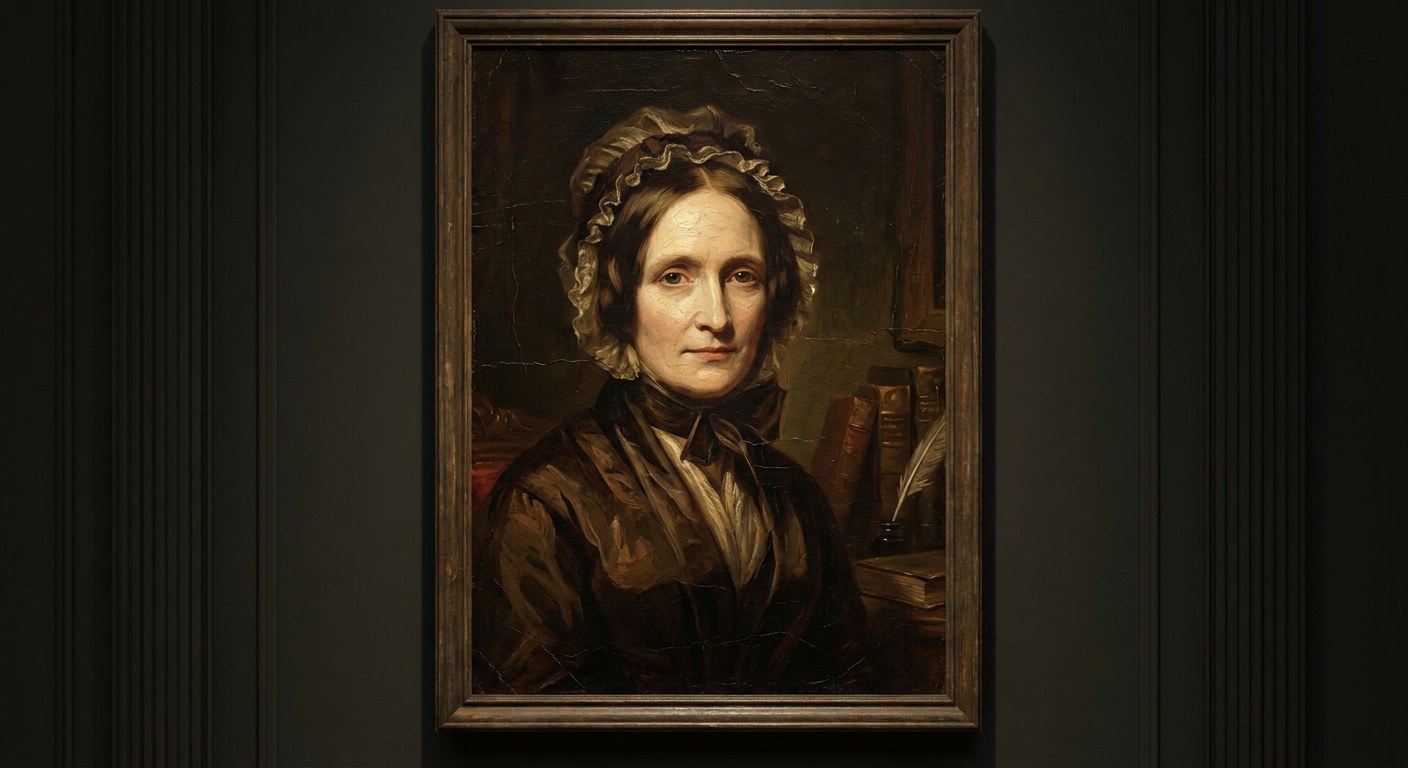
Mary Shelley
1797 – 1851 · British · Novelist & Essayist
Recommended Audiobooks
Listen next from Marcus Alden

Life Lessons from Frederic Chopin
Marcus Alden · 54 min

Life Lessons from John Wesley
Marcus Alden · 52 min
Introduction
Mary Shelley was an English novelist, essayist, biographer, travel writer and editor whose reputation rests above all on Frankenstein; or, The Modern Prometheus. First published anonymously in 1818, when she was only twenty, the novel created one of the most enduring myths in modern culture: the scientist who makes a living being and then recoils from his own creation. The story has influenced literature, theater, cinema, political argument and debates about scientific responsibility for more than two centuries.
Shelley was far more than the author of a single famous book. She wrote historical novels, apocalyptic fiction, short stories, biographies, essays and travel narratives. Her 1826 novel The Last Man helped establish modern end-of-the-world fiction by imagining a plague that destroys humanity. She also preserved and edited the writings of her husband, the Romantic poet Percy Bysshe Shelley, playing a crucial role in securing his posthumous reputation.
Her life brought together several defining currents of the Romantic era. She was the daughter of feminist writer Mary Wollstonecraft and radical philosopher William Godwin; the wife of one of England's most important poets; and a member of the literary circle that included Lord Byron and John Polidori. Yet she developed a distinctive voice of her own. Her fiction repeatedly examines ambition, isolation, family, political idealism, social rejection and the moral consequences of creation.
Shelley's biography was marked by intellectual privilege but also by debt, scandal, bereavement and precarious social status. She lost her mother shortly after birth, endured the deaths of three children, became a widow at twenty-four and spent much of her later life supporting her surviving son through professional writing. Her ability to transform grief, intellectual inquiry and political disillusionment into imaginative literature makes her one of the most consequential novelists of the nineteenth century.
Quick Facts
| Field | Details |
|---|---|
| Born | 30 August 1797, Somers Town, London, England |
| Died | 1 February 1851, Chester Square, London, England |
| Nationality | British |
| Known For | Frankenstein, The Last Man, and editing Percy Bysshe Shelley's works |
| Occupation | Novelist, short-story writer, essayist, biographer, travel writer and editor |
| Era | Romantic era and early Victorian period |
Early Life and Education
Mary Shelley was born Mary Wollstonecraft Godwin on 30 August 1797 in Somers Town, then on the northern edge of London. Her parents were two of the most prominent radical thinkers in Britain. Her mother, Mary Wollstonecraft, had defended women's intellectual and political equality in A Vindication of the Rights of Woman. Her father, William Godwin, was the author of An Enquiry Concerning Political Justice and the novel Caleb Williams.
The circumstances of Mary's birth were tragic. Wollstonecraft developed puerperal fever after delivery and died on 10 September 1797, eleven days after her daughter was born. Mary grew up conscious of her mother's formidable reputation and often read her writings. Wollstonecraft became both an absent personal presence and an intellectual model whose ideas about education, independence and women's capacities helped shape her daughter.
Godwin raised Mary and her older half-sister, Fanny Imlay, who was Wollstonecraft's daughter by the American businessman Gilbert Imlay. In 1801 he married Mary Jane Clairmont, a widow with two children, Charles and Claire Clairmont. Godwin and his second wife later had a son, William. The blended household was lively, intellectually stimulating and frequently strained by emotional tensions and financial problems.
Mary received little conventional schooling, but her education was unusually rich. Godwin allowed her access to his library and encouraged her to read history, philosophy and literature. She heard conversation from visitors such as Samuel Taylor Coleridge, whose recitation of The Rime of the Ancient Mariner made a lasting impression. Aaron Burr, William Hazlitt and other intellectual figures also moved through Godwin's circle.
Godwin described his daughter as unusually bold, intellectually active and eager for knowledge. She learned through reading, writing exercises, conversation and exposure to political argument. She also spent time at her mother's grave in the churchyard of St Pancras Old Church, where she reportedly read and reflected.
In 1812 Mary was sent to stay with the family of William Baxter near Dundee, Scotland. She returned there in 1813. The broad landscape around the River Tay gave her freedom from the crowded and tense Godwin household. Shelley later connected this period with the development of her imagination, describing herself as someone who built castles in the air and inhabited imagined worlds.
Rise to Prominence
Percy Bysshe Shelley first knew William Godwin as an intellectual mentor. A wealthy young aristocrat and radical poet, Percy admired Godwin's political philosophy and attempted to help him financially. By 1814 Mary and Percy had fallen in love, although Percy was already married to Harriet Westbrook.
On 28 July 1814, the sixteen-year-old Mary left England with Percy. Claire Clairmont accompanied them. The three traveled through war-scarred France and into Switzerland, often short of money, before returning to England in September. Godwin, despite his earlier attacks on conventional marriage, disapproved of the elopement and temporarily broke with his daughter. Mary later transformed the journey into History of a Six Weeks' Tour, published in 1817.
The following years brought poverty, social condemnation and repeated loss. Mary's first child, a daughter born prematurely in February 1815, died after less than two weeks. Her journal records a haunting dream in which the baby returned to life after being warmed by a fire. In January 1816 she gave birth to a son, William.
During the summer of 1816, Mary, Percy, their infant son and Claire traveled to Switzerland. Claire had begun a relationship with Lord Byron, who was staying at the Villa Diodati near Lake Geneva with his physician, John Polidori. The group read ghost stories and discussed philosophy, poetry, supernatural phenomena and contemporary scientific experiments. Cold, wet weather associated with the global climatic disruption later called the Year Without a Summer often kept them indoors.
Byron proposed that each person write a ghost story. Mary initially struggled to find an idea. After listening to a conversation about the principle of life, galvanism and whether dead matter might be reanimated, she experienced a waking dream of a student kneeling beside the being he had assembled. She began with the thought that what terrified her might also terrify others. What started as a short tale expanded, with Percy's encouragement, into Frankenstein.
The end of 1816 was shadowed by two suicides. Mary's half-sister Fanny Imlay died in October. In December, Percy's estranged wife Harriet was found drowned in London's Serpentine. Mary and Percy married on 30 December 1816, partly in the hope of strengthening Percy's unsuccessful effort to gain custody of his children by Harriet.
Frankenstein; or, The Modern Prometheus was published anonymously in three volumes in January 1818. A preface written by Percy caused some readers to assume that he was the author. Nevertheless, the novel rapidly attracted attention for its combination of Gothic horror, philosophical speculation and emotional intensity. It made Mary Shelley a significant literary figure before her twenty-first birthday.
Major Achievements and Contributions
Mary Shelley's greatest achievement was the creation of Frankenstein, a novel that transcended its literary period to become a foundational modern myth. Earlier stories had imagined artificial beings, but Shelley joined the theme of manufactured life to contemporary science, individual ambition and moral responsibility. Victor Frankenstein does not merely discover forbidden knowledge; he creates a dependent being and then abandons it. The tragedy therefore arises as much from failed care and social rejection as from scientific transgression.
For this reason, Shelley is frequently described as a pioneer of science fiction. The classification must be used with some caution because Frankenstein also belongs to Gothic fiction, philosophical romance and the Romantic novel. Yet its speculative engagement with scientific possibility distinguishes it from tales based solely on magic. Its questions remain relevant to genetics, artificial intelligence, robotics, transplantation, biotechnology and environmental intervention.
Shelley also made an important contribution to apocalyptic literature. The Last Man, published in 1826, depicts a future world in which political conflict and a spreading plague reduce humanity to a single survivor. Contemporary reviewers often reacted dismissively, but modern scholars recognize it as a major early example of secular catastrophe fiction. Its empty cities, failed governments, mass displacement and global pandemic anticipate themes central to later science fiction.
Her historical novels expanded the range of her political thought. Valperga explores power, conquest and republican ideals in fourteenth-century Italy. The Fortunes of Perkin Warbeck revisits the Yorkist claimant to the English throne, portraying him sympathetically. Lodore and Falkner focus more closely on domestic life, paternal authority, women's dependence and reconciliation.
Shelley earned income through shorter works as well. She contributed stories and essays to annual gift books and other periodicals, adapting her literary ambitions to the realities of the publishing market. She also wrote biographical and critical essays on European authors for Dionysius Lardner's Cabinet Cyclopaedia. Her accounts of Italian, Spanish, Portuguese and French writers helped introduce British readers to continental literary traditions.
A further achievement was her stewardship of Percy Bysshe Shelley's legacy. After his death, she collected, edited and annotated his poetry and prose. Family pressure initially limited what she could publish, but her 1839 edition of his Poetical Works, with extensive notes, helped establish the biographical framework through which generations encountered him. Her editing was shaped by discretion and Victorian respectability, yet without her persistence much of his work might have remained inaccessible or misunderstood.
Key Works / Battles / Ideas
Frankenstein; or, The Modern Prometheus
The novel uses a layered narrative. Explorer Robert Walton writes to his sister about his Arctic expedition; he then records Victor Frankenstein's story; within Victor's account, the creature narrates his own experiences. This structure forces readers to compare competing voices rather than accept a simple division between hero and monster.
Victor, a student at Ingolstadt, discovers a means of generating life and constructs a humanoid being. Horrified by its appearance, he abandons it. The creature educates itself by observing a family and reading works including Milton's Paradise Lost. Rejected whenever it approaches human beings, it turns against its creator and kills people Victor loves. Creator and creation ultimately pursue each other into the Arctic.
Major themes include dangerous ambition, parental neglect, social prejudice, loneliness, education and revenge. The creature begins as sensitive and capable of sympathy; violence follows abandonment and repeated abuse. Shelley thereby complicates the common cultural image of an inarticulate monster. In the novel, Frankenstein is the creator's surname, not the creature's name, although later adaptations often transfer it to the being.
Shelley revised the book for an 1831 edition. The revision added her famous account of the novel's origin and altered aspects of Victor's characterization. The 1818 version more strongly emphasizes choice and responsibility, while the later text places greater weight on destiny and forces beyond individual control.
Mathilda
Written around 1819–1820, Mathilda is an intense novella about grief, isolation and an incestuous declaration by a father to his daughter. William Godwin considered its subject unsuitable and did not arrange publication. The work remained unpublished in full until 1959. Modern critics study it for its treatment of loss, guilt, forbidden desire and autobiographical emotion.
Valperga
Published in 1823, Valperga tells the story of Castruccio Castracani, a historical military leader who seeks power in medieval Italy. Shelley contrasts political conquest with alternative values represented by women, particularly the principled Euthanasia. The novel challenges heroic histories centered on victorious men and reveals the human cost of authoritarian ambition.
The Last Man
Set in the late twenty-first century, The Last Man follows Lionel Verney through political upheaval, personal relationships and a pandemic that gradually destroys civilization. Several characters have been read as transformed portraits of Percy Shelley, Byron and members of their circle. Beneath its futuristic plot lies Mary's experience of surviving friends and children who died young. The last survivor becomes an image of bereavement as well as human extinction.
Later Novels
The Fortunes of Perkin Warbeck appeared in 1830 and reconstructs the life of the man who claimed to be Richard, Duke of York, one of the missing Princes in the Tower. Shelley treated his claim with more sympathy than many historians of her time.
Lodore was published in 1835. It examines the consequences of an aristocratic father's decisions for his estranged wife and daughter. Falkner, published in 1837, centers on guilt, adoption, paternal affection and forgiveness. These books reveal Shelley's continuing interest in how private families absorb the effects of male pride and secrecy.
Travel Writing and Editorial Work
History of a Six Weeks' Tour combines journals, letters and observations from the journeys of 1814 and 1816. Rambles in Germany and Italy, published in 1844, blends travel description with reflections on culture, art, history and Italian politics. Her editions of Percy's writings, especially the 1839 Poetical Works, were equally important to Romantic literary history.
Timeline of Key Events
| Year | Event |
|---|---|
| 1797 | Born Mary Wollstonecraft Godwin in London on 30 August; her mother dies eleven days later. |
| 1801 | William Godwin marries Mary Jane Clairmont. |
| 1812 | Mary stays with the Baxter family near Dundee and meets Percy Bysshe Shelley through Godwin's circle. |
| 1814 | Mary and Percy elope to continental Europe with Claire Clairmont. |
| 1815 | Mary's first child is born prematurely and dies; she begins writing her novella Mathilda several years later under the shadow of such losses. |
| 1816 | Son William is born; Mary conceives Frankenstein near Lake Geneva; Fanny Imlay and Harriet Shelley die; Mary marries Percy. |
| 1817 | Publishes History of a Six Weeks' Tour; daughter Clara Everina is born. |
| 1818 | Frankenstein is published anonymously; the Shelley household moves to Italy. |
| 1818–1819 | Clara and William die in Italy. |
| 1819 | Mary gives birth to Percy Florence Shelley, her only child to survive into adulthood. |
| 1822 | Mary suffers a dangerous miscarriage; Percy Shelley drowns off the Italian coast on 8 July. |
| 1823 | Returns to England and publishes Valperga. |
| 1824 | Publishes Posthumous Poems of Percy Bysshe Shelley, though family pressure soon restricts distribution. |
| 1826 | Publishes the apocalyptic novel The Last Man. |
| 1830 | Publishes The Fortunes of Perkin Warbeck. |
| 1831 | A revised edition of Frankenstein appears with Shelley's account of its creation. |
| 1835 | Publishes Lodore and begins contributing literary biographies to the Cabinet Cyclopaedia. |
| 1837 | Publishes her final novel, Falkner. |
| 1839 | Edits a major four-volume edition of Percy Shelley's poetry. |
| 1844 | Publishes Rambles in Germany and Italy. |
| 1851 | Dies in London on 1 February, aged fifty-three. |
Personal Life and Character
Mary Shelley's personal life cannot be separated from her writing, but her novels should not be reduced to autobiography. She grew up among theories of political freedom and rational improvement, then experienced the unstable consequences of unconventional relationships, financial insecurity and exile. These experiences sharpened her interest in the conflict between ideals and obligations.
Mary and Percy Shelley had four children. Their first daughter died shortly after birth in 1815. William, born in 1816, died of malaria in Rome in 1819. Clara Everina, born in 1817, died in Venice in 1818. Percy Florence Shelley, born in Florence in 1819, was their only child to survive. The repeated deaths deeply affected Mary and contributed to periods of depression and withdrawal.
The Shelleys' relationship was intellectually productive but emotionally difficult. Percy supported Mary's writing and read drafts of Frankenstein, offering editorial suggestions. Manuscript evidence shows that Mary was the novel's author and that Percy acted as an engaged editor rather than a co-author. Their household nevertheless faced debt, gossip, travel, unconventional romantic arrangements and disagreements involving Claire Clairmont and others.
After Percy's death, Mary returned to England in 1823. She devoted herself to raising Percy Florence and establishing financial security. Percy's father, Sir Timothy Shelley, provided limited support but opposed a full biography of his son and could threaten to withdraw assistance. Mary therefore had to balance literary honesty with family expectations.
Her surviving journals and letters reveal a person who was emotionally intense, self-critical and determined. She valued friendship but became wary after repeated betrayals and losses. She retained liberal sympathies, particularly toward Italian independence, while growing less confident than Percy in abstract revolutionary solutions. Her mature writing emphasizes gradual improvement, sympathy, domestic responsibility and the danger of pursuing ideals without regard for other people.
Challenges and Controversies
Mary Shelley faced public condemnation from an early age. Her relationship with a married man violated social conventions, and Harriet Shelley's suicide intensified hostile gossip. Although Mary and Percy married soon afterward, respectable society did not easily forget their earlier conduct. The Court of Chancery's refusal to grant Percy custody of his children by Harriet demonstrated how his views and private life could carry legal consequences.
Financial insecurity was a persistent challenge. William Godwin was frequently in debt, Percy had difficulty accessing family money and the young couple was pursued by creditors. After becoming a widow, Mary relied on writing, editorial work and restricted support from the Shelley family. Professional authorship was therefore not simply an artistic vocation but a means of survival.
She also endured extraordinary bereavement. Her mother's death formed the background of her childhood, while the deaths of three children, Fanny Imlay, Harriet Shelley, Percy Shelley and Byron all occurred before Mary reached middle age. Illness, depression and grief recur in her journals and fiction.
One long-running controversy concerns the authorship of Frankenstein. Because the first edition was anonymous, Percy wrote its preface and the book was dedicated to Godwin, some early readers believed Percy had written it. Later commentators occasionally revived this claim. Surviving manuscripts, however, clearly document Mary's composition and Percy's revisions. His changes were meaningful but limited in comparison with the whole. The scholarly consensus recognizes Mary Shelley as the author.
Critics have also debated whether Mary abandoned the radical beliefs of her parents and husband. Her later emphasis on family, compromise and social order can appear conservative. Yet her fiction continued to criticize inherited privilege, war, patriarchal control and irresponsible authority. Rather than simply rejecting reform, she questioned forms of idealism that ignored emotional duties and practical consequences.
In 1845 she faced an attempted blackmail by the Italian exile Ferdinando Gatteschi, to whom she had given assistance and personal letters. With help from acquaintances and the authorities, she recovered the correspondence. The episode reinforced her caution about trust and reputation.
Death and Immediate Aftermath
Mary Shelley's health declined during the 1840s. She suffered headaches, episodes of partial paralysis and other neurological symptoms. She died at her home in Chester Square, London, on 1 February 1851, aged fifty-three. Her physician believed the cause to be a brain tumor.
She was buried at St Peter's Church in Bournemouth. Percy Florence and his wife, Jane Shelley, later arranged for the remains of Mary Wollstonecraft and William Godwin to be moved from St Pancras to the same family grave. According to Jane Shelley's account, items found in Mary's desk after her death included locks of her dead children's hair, a notebook shared with Percy and a parcel containing some of his ashes and remains associated with his heart.
At the time of her death, Mary was respected as the widow and editor of Percy Shelley and remembered as the author of Frankenstein. Several of her other novels had fallen from public attention. Her son and daughter-in-law preserved family papers and encouraged a dignified image of both Shelleys, helping prepare the way for later biographical and scholarly work.
Legacy and Influence Today
Mary Shelley's legacy is global. Frankenstein has never disappeared from cultural life and has generated plays, films, television programs, comics, games, music and visual art. Stage adaptations began during her lifetime. Richard Brinsley Peake's 1823 melodrama Presumption; or, the Fate of Frankenstein helped establish features that differed from the novel. Twentieth-century cinema, especially James Whale's 1931 film starring Boris Karloff, gave the creature a square-headed appearance and limited speech that became iconic despite Shelley's more articulate original character.
The term Frankenstein has entered political and scientific language as a metaphor for a creation that escapes its maker's control. This usage can oversimplify the novel, whose tragedy results not only from invention but from the creator's refusal to accept responsibility. That deeper insight explains why the book remains central to discussions of artificial intelligence, genetic engineering and technological ethics.
Feminist scholarship transformed Shelley's reputation during the later twentieth century. Earlier critics often treated her as the daughter of Wollstonecraft or the wife of Percy Shelley. Scholars recovered her full body of writing and examined how it addresses authorship, reproduction, motherhood, education and patriarchal power. The rediscovery of Mathilda and renewed interest in The Last Man, Valperga and her later novels established her as a major Romantic author in her own right.
Her life also challenges simplistic accounts of female authorship. Shelley entered literary history extraordinarily young, but she sustained a professional career for decades. She negotiated publishers, family restrictions and a marketplace that often undervalued women's intellectual labor. As an editor and biographer, she helped define how another major writer would be remembered while continuing to produce original work.
Today Mary Shelley is taught across literature, history, science and ethics courses. She matters because she understood that creation is a relationship carrying obligations. Knowledge without empathy, ambition without responsibility and community without tolerance become destructive in her fiction. Those concerns remain as urgent in the twenty-first century as they were in 1818.
Famous Quotes
The following passages are from works written by Mary Shelley; several are spoken by fictional characters rather than being records of her personal speech.
“Beware; for I am fearless, and therefore powerful.”
— Frankenstein
“Nothing is so painful to the human mind as a great and sudden change.”
— Frankenstein
“Life, although it may only be an accumulation of anguish, is dear to me, and I will defend it.”
— Frankenstein
“I am malicious because I am miserable. Am I not shunned and hated by all mankind?”
— Frankenstein
“Learn from me, if not by my precepts, at least by my example, how dangerous is the acquirement of knowledge, and how much happier that man is who believes his native town to be the world, than he who aspires to become greater than his nature will allow.”
— Frankenstein
“Invention, it must be humbly admitted, does not consist in creating out of void, but out of chaos.”
— Introduction to the 1831 edition of Frankenstein
“I busied myself to think of a story—a story to rival those which had excited us to this task.”
— Introduction to the 1831 edition of Frankenstein
Frequently Asked Questions
Who was Mary Shelley?
Mary Shelley was a British Romantic-era novelist, essayist, biographer, travel writer and editor. She was the daughter of Mary Wollstonecraft and William Godwin, the wife of Percy Bysshe Shelley and the author of Frankenstein and The Last Man.
How old was Mary Shelley when she wrote Frankenstein?
She conceived the story in 1816 when she was eighteen and completed most of the novel while still a teenager. It was published anonymously in January 1818, when she was twenty.
Why did Mary Shelley write Frankenstein?
The immediate stimulus was a ghost-story challenge proposed during the summer of 1816 near Lake Geneva. Discussions of experiments involving electricity, the nature of life and the possible reanimation of matter inspired her waking dream of a student horrified by the being he had created. Her education, reading and experiences of birth and death also informed the novel.
Did Percy Bysshe Shelley write Frankenstein?
No. Manuscript evidence establishes Mary Shelley as the author. Percy read the draft, suggested revisions and wrote the anonymous first edition's preface. His editorial contribution was important but does not make him the novel's author or co-author.
Is Frankenstein the name of the monster?
In Shelley's novel, Victor Frankenstein is the scientist who creates the being. The creature itself is never given a personal name. Calling the creature Frankenstein became common through popular adaptations and everyday usage.
Why is Mary Shelley considered a founder of science fiction?
Frankenstein imagines an extraordinary event through speculative engagement with scientific inquiry rather than through magic alone. It explores how a technological breakthrough might affect its inventor, the created being and society. This combination makes it a foundational text in the development of science fiction, although it is also a Gothic and Romantic novel.
What other books did Mary Shelley write?
Her other major works include Mathilda, Valperga, The Last Man, The Fortunes of Perkin Warbeck, Lodore, Falkner, History of a Six Weeks' Tour and Rambles in Germany and Italy. She also wrote short fiction, essays and literary biographies.
How did Mary Shelley die?
She died in London on 1 February 1851 after suffering serious neurological symptoms. Her physician attributed her death to a brain tumor. She was fifty-three years old.
Lessons We Can Learn
- Creation brings responsibility. Frankenstein shows that making something powerful is only the beginning; creators must consider care, consequences and accountability.
- Empathy can prevent alienation from becoming destructive. Shelley's creature is driven toward violence by abandonment and rejection, illustrating the human cost of denying dignity to outsiders.
- Grief can be transformed into meaningful art. Shelley did not escape bereavement, but she gave personal loss imaginative forms that continue to help readers think about loneliness and survival.
- Intellectual independence requires persistence. Despite scandal, financial pressure and assumptions about women writers, Shelley maintained a long professional career and developed ideas distinct from those of her celebrated family.
- Ambition should be joined to ethical judgment. Knowledge and idealism can become dangerous when pursued without humility, practical wisdom or concern for other people.
Further Reading
- Charlotte Gordon, Romantic Outlaws: The Extraordinary Lives of Mary Wollstonecraft and Mary Shelley (2015).
- Miranda Seymour, Mary Shelley (2000).
- Emily W. Sunstein, Mary Shelley: Romance and Reality (1989).
- Fiona Sampson, In Search of Mary Shelley: The Girl Who Wrote Frankenstein (2018).
- Betty T. Bennett, Mary Wollstonecraft Shelley: An Introduction (1998).
Watch and Learn
Everything You Need to Know to Read Frankenstein · TED-Ed