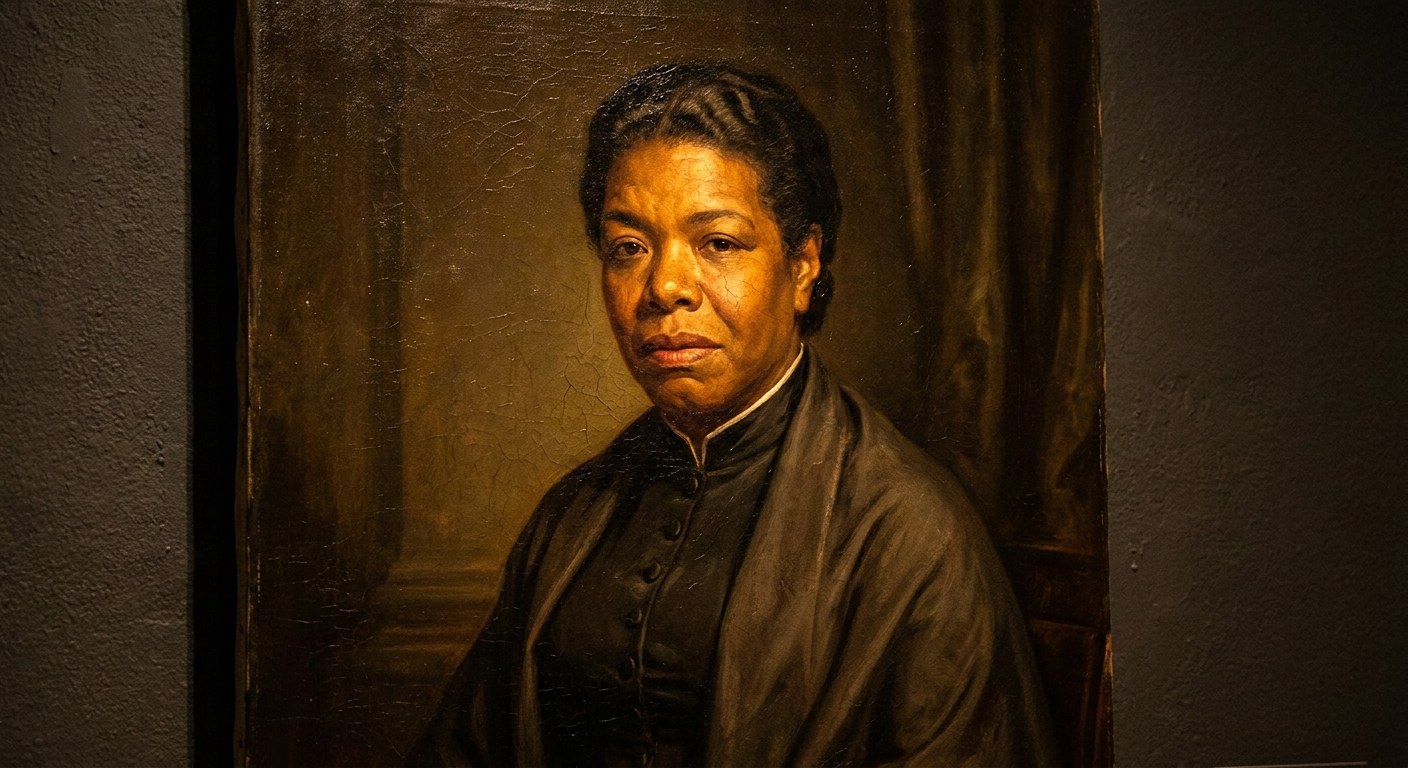
Quick Facts
- Years
- 1928 – 2014
- Nationality
- American
- Occupation
- Poet, Memoirist & Civil Rights Activist
Maya Angelou
1928 – 2014 · American · Poet, Memoirist & Civil Rights Activist
Recommended Audiobooks
Listen next from Marcus Alden

Life Lessons from Frederic Chopin
Marcus Alden · 54 min

Life Lessons from John Wesley
Marcus Alden · 52 min
1. Introduction
Maya Angelou was an American poet, memoirist, performer, educator, and civil rights activist whose writing transformed personal experience into a powerful public language of survival, dignity, and hope. Best known for her groundbreaking memoir I Know Why the Caged Bird Sings and poems such as “Still I Rise” and “Phenomenal Woman,” she became one of the most recognizable literary voices of the twentieth and early twenty-first centuries.
Angelou mattered not only because of what she wrote, but also because of whose experiences she placed at the center of American literature. Her autobiographical books addressed childhood trauma, racism, sexual violence, motherhood, work, migration, creativity, and political awakening with unusual candor. By presenting a Black girl’s development as a subject worthy of serious literature, she challenged conventions surrounding both autobiography and African American women’s writing.
Her life extended far beyond the printed page. Angelou worked as a streetcar conductor, dancer, singer, actress, journalist, editor, screenwriter, director, university professor, and political organizer. She lived in the United States, Egypt, and Ghana; worked with both Martin Luther King Jr. and Malcolm X; performed in films and television programs; and delivered “On the Pulse of Morning” at President Bill Clinton’s 1993 inauguration.
Angelou’s public image combined moral authority with theatrical warmth. Her resonant speaking voice, commanding presence, humor, and emphasis on courage made her a sought-after lecturer and mentor. Although scholars have debated the relationship between memory and factual reconstruction in her autobiographies, her influence is unquestioned. She expanded the possibilities of memoir, brought poetry to enormous popular audiences, and provided generations of readers with a language for confronting suffering without surrendering to it.
2. Quick Facts
| Fact | Details |
|---|---|
| Born | April 4, 1928, St. Louis, Missouri, United States |
| Died | May 28, 2014, Winston-Salem, North Carolina, United States |
| Nationality | American |
| Known For | I Know Why the Caged Bird Sings, “Still I Rise,” civil rights activism, and “On the Pulse of Morning” |
| Occupation | Poet, memoirist, author, performer, director, educator, and activist |
| Era | Twentieth and early twenty-first centuries; Civil Rights Movement and contemporary American literature |
3. Early Life and Education
Maya Angelou was born Marguerite Annie Johnson in St. Louis, Missouri, on April 4, 1928. Her parents were Bailey Johnson, a doorman and naval dietitian, and Vivian Baxter Johnson, a nurse and card dealer. Her older brother, Bailey Jr., gave her the childhood nickname “Maya,” reportedly derived from “My” or “Mya Sister.”
After their parents’ marriage ended, three-year-old Marguerite and four-year-old Bailey were sent by train to Stamps, Arkansas. There they lived with their paternal grandmother, Annie Henderson, whom they called Momma, and their uncle Willie. Henderson operated a general store serving the local Black community. Her relative economic stability, religious faith, discipline, and self-possession became important influences on Angelou.
Stamps was governed by the racial hierarchy of the segregated South. Angelou witnessed humiliations, threats, and inequalities imposed on African Americans, but she also experienced the strength of Black family, church, commerce, storytelling, and communal life. These contrasting realities later became central to I Know Why the Caged Bird Sings.
When Angelou was about seven, she and Bailey returned to St. Louis to live with their mother. There, her mother’s boyfriend, Freeman, raped her. Angelou disclosed the assault, and Freeman was tried and convicted, although he served only a brief period in jail. Soon afterward he was found dead, apparently murdered. The child concluded that her spoken words had helped cause his death. Traumatized and frightened by the imagined destructive power of her voice, she stopped speaking to nearly everyone except Bailey.
Angelou’s silence lasted for almost five years. During this period, she read extensively and developed an intense appreciation for language. She later credited Bertha Flowers, an educated woman in Stamps, with helping restore her speech. Flowers encouraged her to read poetry aloud, teaching her that the human voice gave language its fullest meaning. Shakespeare, Charles Dickens, Edgar Allan Poe, Paul Laurence Dunbar, and Black women writers including Frances Harper became part of Angelou’s imaginative education.
As a teenager, she moved to California, where her mother had settled. She attended George Washington High School in San Francisco and studied dance and drama on scholarship at the California Labor School. During World War II, she sought work as a streetcar conductor. After initially being rejected, she persistently returned to the company and was hired by the Market Street Railway. She later described herself as San Francisco’s first Black female streetcar conductor, though some historical accounts qualify the exact institutional and chronological details of that distinction.
Angelou briefly lived with her father in Southern California, an episode that ended in conflict and instability. At one point she stayed in a junkyard community of homeless teenagers, an experience she later portrayed as an unexpected lesson in cooperation across racial boundaries.
She returned to San Francisco, completed high school, and gave birth in 1945, shortly after graduation. Her son was initially named Clyde and later became known as Guy Johnson. Angelou was seventeen. The demands of single motherhood led her into numerous jobs while she continued to pursue performance and artistic expression.
4. Rise to Prominence
During the 1950s, Angelou developed a career as a dancer and singer. She studied modern dance and performed with choreographer Alvin Ailey before either had achieved national fame. For a period they appeared together as “Al and Rita.” She also performed in San Francisco nightclubs, where she adopted the stage name Maya Angelou. “Maya” came from her childhood nickname, while “Angelou” was adapted from the surname of her first husband, Greek American sailor and musician Tosh Angelos.
Her nightclub repertoire emphasized calypso music, then enjoying international popularity. In 1954 and 1955, she toured Europe and Africa in a production of George Gershwin’s Porgy and Bess. The tour widened her knowledge of the world and encouraged her interest in languages. She later appeared in the film Calypso Heat Wave and recorded the album Miss Calypso in 1957.
Angelou’s ambitions gradually shifted toward writing and political engagement. After moving to New York, she joined the Harlem Writers Guild, an important gathering place for Black authors. There she encountered writers including John Henrik Clarke, Rosa Guy, and Julian Mayfield and received serious criticism of her work.
In 1960 she helped organize and perform in Cabaret for Freedom, a benefit for Martin Luther King Jr.’s Southern Christian Leadership Conference. She subsequently became the SCLC’s northern coordinator, raising funds and increasing support for the civil rights struggle.
Angelou then entered a relationship with South African anti-apartheid activist Vusumzi Make and moved with him and her son to Cairo. She worked as an editor for the English-language newspaper The Arab Observer. After the relationship ended, she moved to Accra, Ghana, where Guy was recovering from a serious automobile accident. In Ghana, she worked in journalism, broadcasting, and administration, including service at the University of Ghana and contributions to the Ghanaian Times and The African Review.
Accra in the early 1960s attracted African American expatriates who viewed Ghanaian independence as a symbol of Pan-African possibility. Angelou became part of a community that included W. E. B. Du Bois, Shirley Graham Du Bois, Julian Mayfield, and other writers and activists. Her years in Africa deepened her understanding of colonialism, diaspora, and the complicated relationship between African Americans and the African continent.
In 1964 Angelou met Malcolm X during his visit to Ghana. She returned to the United States to assist him in building the Organization of Afro-American Unity. His assassination in February 1965 ended that plan. Several years later, Martin Luther King Jr. asked her to help organize the Poor People’s Campaign. King was assassinated on April 4, 1968—Angelou’s fortieth birthday. For years afterward, she avoided celebrating her birthday and instead sent flowers to King’s widow, Coretta Scott King.
The losses of Malcolm X and King left Angelou devastated, but writing provided a new direction. Television producer and writer John Oliver Killens encouraged her, and editor Robert Loomis of Random House challenged her to produce an autobiography with literary merit. The resulting book made her internationally famous.
5. Major Achievements and Contributions
Angelou’s greatest literary achievement was her transformation of autobiography. Published in 1969, I Know Why the Caged Bird Sings recounts her childhood and adolescence through the birth of her son. It combined the narrative arc and symbolism of a novel with the authority of remembered experience. Its treatment of rape, silence, racism, family, and self-creation was especially striking at a time when Black women’s childhoods rarely occupied the center of mainstream American literature.
The book became a bestseller, was nominated for a National Book Award, and entered school and university curricula. It also attracted censorship because of its depictions of sexual assault, racism, and sexuality. Its lasting significance lies partly in its insistence that trauma can be narrated without allowing victimization to become the narrator’s entire identity.
Angelou eventually produced seven autobiographical volumes. Together they form an unusual serialized account of a life continually reconstructed through memory. Rather than treating autobiography as a single retrospective summary, she returned repeatedly to different stages of her life, examining how identity changes across time and social settings.
Her poetry reached an audience much broader than that of most contemporary American poets. Collections such as Just Give Me a Cool Drink of Water ’fore I Diiie, And Still I Rise, and Shaker, Why Don’t You Sing? drew on Black musical traditions, oral performance, blues rhythms, prayer, and direct public address. Academic critics sometimes judged her poetry less formally innovative than her prose, but readers responded to its accessibility, cadence, humor, defiance, and emotional clarity.
Angelou was also a pioneering screenwriter. Her screenplay Georgia, Georgia, filmed in Sweden and released in 1972, is commonly identified as the first original screenplay by a Black woman to be produced as a feature film. She later wrote for television and became the first Black woman to direct a major Hollywood feature with Down in the Delta in 1998.
As a performer, Angelou appeared in the television miniseries Roots in 1977 and received an Emmy nomination for her role as Nyo Boto. She earned a Tony Award nomination for the 1973 play Look Away. Her spoken-word recordings won three Grammy Awards, demonstrating how powerfully her work depended on voice as well as text.
In 1982, Wake Forest University appointed Angelou Reynolds Professor of American Studies. She held the lifetime position despite not possessing a conventional university degree. At Wake Forest she taught subjects including philosophy, writing, theater, ethics, and world culture. Her appointment reflected the breadth of her intellectual and professional experience.
On January 20, 1993, Angelou read “On the Pulse of Morning” at Bill Clinton’s first presidential inauguration. She was the first poet to appear at a U.S. presidential inauguration since Robert Frost participated in John F. Kennedy’s ceremony in 1961, and the first Black person and first woman to serve as an inaugural poet. The nationally televised reading brought poetry into millions of homes and won a Grammy for its recorded version.
Her honors included more than thirty honorary degrees, the National Medal of Arts, the Lincoln Medal, and the Presidential Medal of Freedom, presented by President Barack Obama in 2011. These distinctions recognized not only literary accomplishment but also her contribution to American civic culture.
6. Key Works / Battles / Ideas
I Know Why the Caged Bird Sings (1969)
Angelou’s first memoir follows her from childhood in Stamps through adolescence and early motherhood. Its title alludes to Paul Laurence Dunbar’s poem “Sympathy.” The caged bird became Angelou’s central symbol for the human desire for freedom under conditions of confinement. The book’s frank account of sexual violence has made it both influential and frequently challenged.
Gather Together in My Name (1974)
The second autobiography portrays Angelou as a young mother navigating poverty, unstable employment, relationships, and dangerous choices. Its refusal to turn its author into an uncomplicated moral heroine is essential to its power.
Singin’ and Swingin’ and Gettin’ Merry Like Christmas (1976)
This volume recounts Angelou’s development as a performer, her marriage to Tosh Angelos, and her international tour with Porgy and Bess. It explores artistic ambition, racial identity, motherhood, and travel.
The Heart of a Woman (1981)
Covering her New York activism and years in Africa, this memoir describes her work with the Harlem Writers Guild, Martin Luther King Jr., and the SCLC, as well as her relationship with Vusumzi Make. It is an important account of the connections among art, motherhood, civil rights, and Pan-African politics.
All God’s Children Need Traveling Shoes (1986)
Angelou examines her life in Ghana and the emotional search for an African homeland. The book does not offer a simple narrative of return. Instead, it recognizes both kinship and distance between African Americans and Africans.
A Song Flung Up to Heaven (2002)
This memoir chronicles Angelou’s return to the United States, the assassinations of Malcolm X and Martin Luther King Jr., and the beginning of her career as an autobiographer. It concludes as she prepares to write I Know Why the Caged Bird Sings.
Mom & Me & Mom (2013)
Her final autobiography focuses on her complicated relationship with Vivian Baxter. It revisits the pain of childhood separation while portraying the gradual creation of trust, friendship, and mutual respect between mother and daughter.
“Still I Rise” and And Still I Rise (1978)
“Still I Rise” is Angelou’s best-known poem. Its speaker answers historical oppression, sexual objectification, and personal contempt with confidence and repeated resurrection. The poem’s memorable refrain has made it a global statement of resistance.
“Phenomenal Woman”
First published in And Still I Rise, this poem rejects narrow standards of beauty. The speaker’s power comes from self-knowledge, physical presence, and confidence rather than conformity to external expectations.
“On the Pulse of Morning” (1993)
Written for Clinton’s inauguration, this poem uses the voices of a rock, river, and tree to address American history. It acknowledges conquest, slavery, immigration, violence, and environmental responsibility while inviting citizens to imagine a more inclusive future.
Central Ideas
Across her work, Angelou returned to several principles: language can liberate or wound; racism damages both individuals and institutions; courage makes other virtues possible; identity is created rather than passively received; and survival should lead not merely to endurance but to creative self-affirmation. Her writing rarely denied suffering, yet it resisted allowing suffering to have the final word.
7. Timeline of Key Events
| Year | Event |
|---|---|
| 1928 | Born Marguerite Annie Johnson in St. Louis, Missouri |
| 1931 | Sent with her brother Bailey to live with their grandmother in Stamps, Arkansas |
| c. 1935 | Sexually assaulted in St. Louis; subsequently entered a long period of near-total silence |
| 1940s | Moved to California and attended George Washington High School and the California Labor School |
| 1944 | Worked as a streetcar conductor in San Francisco |
| 1945 | Graduated from high school and gave birth to her son, Guy Johnson |
| 1951 | Married Tosh Angelos |
| 1954–1955 | Toured Europe and Africa with Porgy and Bess |
| 1957 | Released Miss Calypso and appeared in Calypso Heat Wave |
| 1960 | Helped stage Cabaret for Freedom and became northern coordinator for the SCLC |
| 1961 | Moved to Cairo and worked for The Arab Observer |
| 1962 | Relocated to Accra, Ghana |
| 1964 | Met Malcolm X in Ghana and returned to the United States to assist his political work |
| 1968 | Martin Luther King Jr. was assassinated on Angelou’s fortieth birthday |
| 1969 | Published I Know Why the Caged Bird Sings |
| 1971 | Published Just Give Me a Cool Drink of Water ’fore I Diiie, later nominated for a Pulitzer Prize |
| 1972 | Georgia, Georgia, based on her screenplay, was released |
| 1973 | Received a Tony nomination for Look Away |
| 1977 | Appeared in Roots and received an Emmy nomination |
| 1978 | Published And Still I Rise |
| 1982 | Became Reynolds Professor of American Studies at Wake Forest University |
| 1993 | Recited “On the Pulse of Morning” at President Bill Clinton’s inauguration |
| 1998 | Directed the feature film Down in the Delta |
| 2002 | Published A Song Flung Up to Heaven |
| 2011 | Received the Presidential Medal of Freedom |
| 2013 | Published her final autobiography, Mom & Me & Mom |
| 2014 | Died in Winston-Salem, North Carolina, at age 86 |
| 2022 | Became the first Black woman depicted on a circulating U.S. quarter |
8. Personal Life and Character
Angelou’s only child, Guy Johnson, was central to her personal life and autobiographical writing. Becoming a mother at seventeen required her to balance caregiving with financial uncertainty and artistic ambition. Their relationship endured separations, travel, illness, and Guy’s eventual adulthood as a writer.
She married Tosh Angelos in 1951. Their interracial marriage attracted social pressure, and the couple divorced several years later. Angelou retained a variation of his surname as her professional identity. Her later relationship with Vusumzi Make took her to Africa, although accounts differ over whether their union constituted a legally formalized marriage. In 1973 she married Welsh carpenter and writer Paul du Feu; they divorced in the early 1980s.
Angelou’s memoirs openly discuss relationships, sexuality, mistakes, and periods of insecure or stigmatized work. This candor was part of her refusal to present respectability as the price of dignity. She portrayed herself as capable of poor judgment and reinvention, insisting that a human life could not be reduced to its most vulnerable episodes.
Friends and students described Angelou as generous, disciplined, humorous, ceremonious, and commanding. She was known for preparing elaborate meals and welcoming writers, performers, politicians, and students into her home. At the same time, she placed great importance on manners and respect. Oprah Winfrey, whom Angelou mentored for decades, often referred to her as a guiding maternal figure.
Her spirituality drew principally from Christianity while remaining open to African traditions and other religious ideas. Biblical rhythms and themes of deliverance appear throughout her writing. She emphasized gratitude and believed that faith should produce courage and humane action rather than passivity.
Angelou did much of her writing in rented hotel rooms, where she removed distracting decorations and worked with legal pads, a Bible, a dictionary, a thesaurus, and sometimes a bottle of sherry. She revised carefully, despite the conversational ease of her finished prose. Her performance background also shaped her compositions: she heard sentences rhythmically and understood literature as something spoken as well as read.
9. Challenges and Controversies
Angelou’s greatest challenges included childhood abandonment, sexual violence, mutism, poverty, racism, single motherhood, and the assassinations of political leaders with whom she had worked. Her achievement is sometimes summarized as a story of triumph, but her books show that survival was neither simple nor complete. Trauma continued to influence memory, relationships, and self-understanding.
I Know Why the Caged Bird Sings has repeatedly appeared on lists of books challenged or removed from classrooms and libraries. Objections commonly concern its account of rape, descriptions of sexuality, strong language, and portrayal of racism. Supporters argue that removing it denies students access to a carefully written account of realities experienced by many children and communities.
Scholars have also debated how her books should be classified. Angelou shaped remembered events through dialogue, imagery, symbolism, scene construction, and thematic selection. Like many autobiographers, she reconstructed conversations that could not have been recorded word for word. Critics therefore caution against treating every detail as documentary evidence. Literary scholars generally approach the books as autobiographical narratives in which factual memory is consciously organized through artistic form, rather than dismissing them as fiction.
Some critics considered Angelou’s poetry overly direct, repetitive, or dependent on performance. Others argued that such judgments undervalued African American oral traditions, blues structures, popular accessibility, and the communal function of recited poetry. Her enormous public readership sometimes placed her uneasily between academic literary culture and mass culture.
Her 1993 inaugural poem received both admiration and mixed critical reviews. Its ambition, inclusiveness, and public delivery were widely praised, while some reviewers found its language generalized or ceremonial. Whatever the critical division, the reading restored poetry to a prominent place in a national political ritual.
Angelou also became the subject of widespread misquotation. Aphorisms circulated online under her name without reliable sources, blurring the line between her documented words and sentiments merely resembling her style. A notable example occurred in 2015, when the U.S. Postal Service issued a Maya Angelou stamp containing the line “A bird doesn’t sing because it has an answer, it sings because it has a song.” Although often credited to Angelou, the wording came from Joan Walsh Anglund’s 1967 book A Cup of Sun. Angelou had used the line publicly, but she did not originate it.
These controversies do not diminish her stature. They demonstrate the difficulty of maintaining textual accuracy around a figure whose image and language became part of popular culture.
10. Death and Immediate Aftermath
Maya Angelou died at her home in Winston-Salem, North Carolina, on the morning of May 28, 2014. She was eighty-six and had experienced declining health. Her son, Guy Johnson, announced that she had died quietly and described her as a teacher, activist, artist, and human being who lived without surrendering understanding or compassion.
News of her death prompted tributes from writers, artists, educators, civil rights leaders, and political figures around the world. President Barack Obama called her one of the brightest lights of the era and noted that she had helped generations recognize their own strength. Former president Bill Clinton remembered her words and voice, while Oprah Winfrey mourned a mentor whom she regarded as a mother, sister, and friend.
Wake Forest University held a memorial service on June 7, 2014. Speakers included Michelle Obama, Bill Clinton, and Winfrey. The ceremony combined political remembrance, music, faith, and literary tribute, reflecting the many worlds Angelou had connected during her lifetime.
11. Legacy and Influence Today
Angelou’s most enduring legacy is the space she created for Black women to narrate their lives with complexity and authority. Her success helped broaden the audience for writers who treated race, gender, trauma, family, and sexuality as interconnected subjects. Authors, poets, actors, musicians, teachers, and public speakers continue to cite her as an influence.
Her autobiographies helped establish memoir as a major form in contemporary publishing. They showed that one life could be examined across multiple volumes and that autobiography could incorporate techniques associated with fiction without abandoning its claim to remembered truth. Her work remains important in discussions of trauma narrative, feminist literature, African American studies, and life writing.
“Still I Rise” and “Phenomenal Woman” remain widely recited at graduations, commemorations, protests, and celebrations. Their popularity derives from their adaptability: readers apply them to struggles against racism, sexism, illness, personal abuse, and political oppression. That broad use occasionally detaches the poems from their specifically Black historical context, but it also demonstrates their global emotional reach.
Angelou’s public career provided a model of the artist as citizen. She rejected the assumption that literary work must be isolated from politics, education, performance, and community service. Her relationships with Malcolm X and Martin Luther King Jr., her support for later political leaders, and her decades of teaching all expressed a belief that language carries ethical responsibility.
Institutions, schools, awards, and public spaces have been named in her honor. In January 2022, the United States Mint began shipping quarters bearing her image as part of the American Women Quarters Program. She became the first Black woman featured on a circulating U.S. coin. The design depicts her with uplifted arms before a bird and rising sun, imagery inspired by her writing and symbolic of the way the nation remembers her.
Her legacy also requires careful reading rather than mere quotation. Angelou’s message was not that confidence erases injustice. Her work repeatedly shows that dignity must be defended within systems structured by violence and exclusion. Hope, in her writing, is a discipline grounded in memory, courage, community, and action.
12. Famous Quotes
“There is no greater agony than bearing an untold story inside you.” — I Know Why the Caged Bird Sings
“Still, like dust, I’ll rise.” — “Still I Rise”
“I’m a woman / Phenomenally. / Phenomenal woman, / That’s me.” — “Phenomenal Woman”
“You may not control all the events that happen to you, but you can decide not to be reduced by them.” — Letter to My Daughter
“We may encounter many defeats but we must not be defeated.” — Letter to My Daughter
“The caged bird sings / with a fearful trill / of things unknown / but longed for still.” — “Caged Bird”
“History, despite its wrenching pain, / Cannot be unlived, but if faced / With courage, need not be lived again.” — “On the Pulse of Morning”
13. Frequently Asked Questions
What was Maya Angelou’s real name?
She was born Marguerite Annie Johnson. Her brother Bailey called her Maya, and she later adapted the surname of her first husband, Tosh Angelos, to create the professional name Maya Angelou.
Why is Maya Angelou important?
Angelou expanded the possibilities of autobiography, centered the experiences of Black women in American literature, brought poetry to a large public audience, and participated in the Civil Rights Movement. She also broke barriers in film, television, teaching, and public performance.
What is Maya Angelou’s most famous book?
Her best-known book is I Know Why the Caged Bird Sings, published in 1969. It recounts her childhood in Arkansas and Missouri, her experience of sexual violence and silence, and her development into a young mother.
Why did Maya Angelou stop speaking?
After being raped as a child, Angelou testified against her attacker. When he was killed soon after his release, she believed her words had caused his death. She became almost entirely silent for several years, speaking mainly to her brother. Bertha Flowers helped her rediscover her voice through poetry and reading aloud.
Did Maya Angelou work with Martin Luther King Jr. and Malcolm X?
Yes. She served as northern coordinator for King’s Southern Christian Leadership Conference in 1960. She later planned to assist Malcolm X with the Organization of Afro-American Unity, but he was assassinated before the collaboration could fully develop. King asked her to help with the Poor People’s Campaign shortly before his own assassination.
What poem did Maya Angelou read at a presidential inauguration?
She read “On the Pulse of Morning” at President Bill Clinton’s first inauguration on January 20, 1993. Her performance made her the first Black and first female inaugural poet in United States history.
How many autobiographies did Maya Angelou write?
Angelou published seven autobiographical volumes: I Know Why the Caged Bird Sings, Gather Together in My Name, Singin’ and Swingin’ and Gettin’ Merry Like Christmas, The Heart of a Woman, All God’s Children Need Traveling Shoes, A Song Flung Up to Heaven, and Mom & Me & Mom.
How did Maya Angelou die?
Angelou died at her home in Winston-Salem, North Carolina, on May 28, 2014, after a period of declining health. She was eighty-six years old.
14. Lessons We Can Learn
-
A painful history need not determine the limits of a life. Angelou did not deny trauma, but she transformed it into knowledge, art, and solidarity with others.
-
Finding one’s voice can be a gradual process. Her years of silence and later mastery of spoken language show that expression may emerge through patience, reading, mentorship, and practice.
-
Courage enables other virtues. Angelou repeatedly presented courage as the quality that allows compassion, honesty, persistence, and generosity to be practiced consistently.
-
Identity can be remade. Her movement among occupations, countries, artistic forms, and political communities demonstrates that reinvention is not a rejection of the past but a way of building upon it.
-
Art and citizenship can strengthen each other. Angelou used literature, teaching, performance, and activism as connected forms of public responsibility.
15. Further Reading
- Maya Angelou, I Know Why the Caged Bird Sings — The essential starting point for understanding her childhood, literary voice, and treatment of trauma and resilience.
- Maya Angelou, The Heart of a Woman — A valuable account of her civil rights work, artistic community, motherhood, and years connected to African politics.
- Maya Angelou, Mom & Me & Mom — Her final autobiography and a focused examination of her relationship with her mother, Vivian Baxter.
- Marcia Ann Gillespie, Rosa Johnson Butler, and Richard A. Long, Maya Angelou: A Glorious Celebration — An illustrated biographical tribute created with contributions from people who knew her.
- Linda Wagner-Martin, Maya Angelou: Adventurous Spirit — A scholarly critical biography examining Angelou’s life, autobiographies, poetry, and cultural significance.
Watch and Learn
Maya Angelou - Civil Rights Activist & Author | Mini Bio · Biography