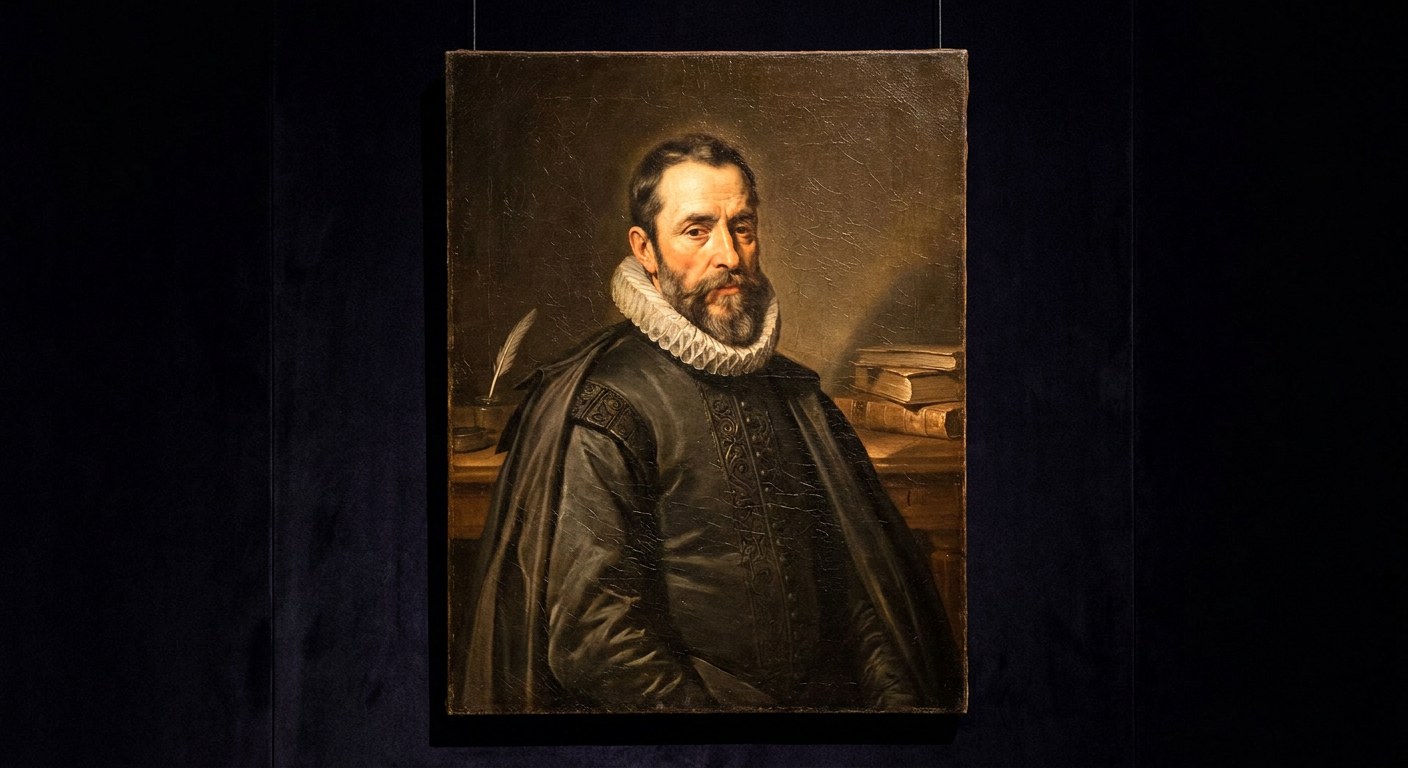
Miguel de Cervantes
1547 – 1616 · Spanish · Novelist, Poet & Playwright
Recommended Audiobooks
Listen next from Marcus Alden

Life Lessons from Frederic Chopin
Marcus Alden · 54 min

Life Lessons from John Wesley
Marcus Alden · 52 min
1. Introduction
Miguel de Cervantes Saavedra (1547–1616) was a Spanish novelist, playwright, poet and former soldier whose Don Quixote became one of the most influential works in world literature. Often described as the first modern European novel, it transformed a comic parody of chivalric romances into a profound investigation of identity, freedom, storytelling, social class and the uncertain boundary between reality and imagination.
Cervantes lived during Spain’s Golden Age, when the Spanish monarchy commanded a vast global empire and Spanish literature and art flourished. Yet his own existence was marked less by comfort than by war, captivity, financial insecurity, imprisonment and repeated professional disappointment. He fought at the Battle of Lepanto, suffered disabling wounds, spent five years as a captive in Algiers and later worked in difficult administrative posts. Literary fame came slowly, and lasting financial security never arrived.
These experiences gave Cervantes an unusually broad view of society. His fiction contains aristocrats and farmers, priests and criminals, actors and innkeepers, soldiers, enslaved captives, impoverished gentlemen, marginalized communities and women seeking greater control over their lives. Rather than arranging them into a simple moral order, he allowed competing perspectives to coexist. His narrators interrupt themselves, manuscripts acquire fictional editors, characters challenge their authors and readers are repeatedly asked to decide what should be believed.
Cervantes did not single-handedly invent the novel, which developed from several earlier narrative traditions. Nevertheless, Don Quixote helped establish central features of modern fiction: complex characterization, self-conscious narration, realism mixed with fantasy, sustained irony and a fascination with how books shape human behavior. Writers from Henry Fielding and Laurence Sterne to Gustave Flaubert, Fyodor Dostoevsky, Jorge Luis Borges and Salman Rushdie have acknowledged his example. The Spanish language is sometimes called la lengua de Cervantes—“the language of Cervantes”—a measure of his extraordinary cultural standing.
2. Quick Facts
| Field | Details |
|---|---|
| Born | Traditionally 29 September 1547; baptized 9 October 1547 in Alcalá de Henares, Spain |
| Died | 22 April 1616 in Madrid, Spain; buried 23 April |
| Nationality | Spanish |
| Known For | Writing Don Quixote, a foundational work of the modern novel |
| Occupation | Novelist, poet, playwright, soldier, purchasing agent and tax collector |
| Era | Spanish Golden Age; late Renaissance and early Baroque |
3. Early Life and Education
Miguel de Cervantes was born in Alcalá de Henares, a university town northeast of Madrid. His exact birth date is undocumented, although 29 September 1547 is traditionally accepted because it was the feast of Saint Michael. The surviving parish register records his baptism on 9 October at the church of Santa María la Mayor.
He was the fourth of seven children of Rodrigo de Cervantes and Leonor de Cortinas. Rodrigo practiced as a barber-surgeon, a profession combining shaving and minor medical procedures such as bloodletting, wound treatment and bone setting. His income was unstable, and debt troubled the family. Cervantes’s paternal ancestry probably included conversos—families descended from Jews who had converted to Christianity—although the evidence and its significance remain debated by scholars.
The family moved frequently, living or spending time in places that probably included Valladolid, Córdoba, Seville and Madrid. These relocations exposed the young Cervantes to contrasting levels of Spanish society. They may also help explain the attentiveness to inns, streets, markets, legal disputes and itinerant lives that later distinguished his fiction.
Little reliable evidence survives concerning his formal education. He did not attend a university as far as is known. He may have studied with the Jesuits in Córdoba or Seville, but this cannot be firmly demonstrated. By 1569 he was associated in Madrid with the humanist teacher Juan López de Hoyos, who called Cervantes his “dear and beloved pupil.” López de Hoyos included several of Cervantes’s poems in a commemorative volume honoring Queen Elisabeth of Valois.
Cervantes’s writing reveals wide reading in classical literature, Renaissance poetry, history, theology and popular romance. Whether acquired in classrooms or independently, his education gave him command of both elite literary conventions and everyday speech. This ability to move between elevated rhetoric and colloquial dialogue became one of his greatest strengths.
In 1569 Cervantes left Spain for Italy. A royal warrant issued that year ordered the arrest of a Miguel de Cervantes for wounding Antonio de Sigura in a duel and sentenced him in absentia to the loss of his right hand and ten years of exile. Many historians identify the accused man with the author, although absolute certainty is impossible. Whatever his reason for leaving, Cervantes entered the household of Cardinal Giulio Acquaviva in Rome and encountered the art, architecture and literature of Renaissance Italy.
4. Rise to Prominence
Cervantes soon exchanged household service for military life. By 1570 he had enlisted in a Spanish infantry company commanded by Diego de Urbina. On 7 October 1571 he took part in the Battle of Lepanto, where a Holy League fleet defeated the Ottoman navy in the Gulf of Patras.
Although ill with fever, Cervantes reportedly insisted on fighting aboard the galley Marquesa. He received three gunshot wounds, two in the chest and one in the left hand or arm. The last injury permanently impaired the limb, earning him the later nickname “the one-handed man of Lepanto.” His hand was not literally amputated. Cervantes regarded his participation in the battle as one of the proudest achievements of his life and later called Lepanto a supreme event witnessed by past or future ages.
After recovering, he continued serving in the Mediterranean. He participated in expeditions connected with Navarino, Corfu, Tunis and La Goulette and spent periods in Naples, Sicily and Sardinia. Military service broadened his geographical knowledge and introduced him to the multinational world of Mediterranean warfare.
In September 1575 Cervantes and his younger brother Rodrigo sailed from Naples toward Spain aboard the galley Sol. Ottoman-aligned corsairs attacked the vessel near the Catalan coast and carried the brothers to Algiers. Letters of recommendation found on Miguel suggested that he was a person of importance, so his captors demanded a ransom greater than his family could afford.
Cervantes remained captive for five years. He attempted escape at least four times, sometimes taking responsibility in an effort to protect other prisoners. Plans involving hidden caves, overland flight and rescue ships all failed. Despite severe punishment being common in Algiers, he survived. His persistence impressed both fellow captives and later biographers, though some romanticized details come from sources requiring cautious interpretation.
Rodrigo was ransomed in 1577. Miguel was finally freed in September 1580 after Trinitarian friars, aided by his family’s contributions, assembled the required payment. The friar Juan Gil completed the transaction shortly before Cervantes was to be transported to Constantinople. Experiences of captivity, cultural contact and uncertain freedom later shaped works such as The Captive’s Tale, The Bagnios of Algiers and The Liberal Lover.
Back in Spain, Cervantes sought compensation and government employment, but his military record did not produce a lucrative career. He undertook a mission to Oran in North Africa in 1581 and then turned more seriously toward literature. His pastoral romance La Galatea appeared in 1585. It won recognition but not substantial wealth, and its promised continuation was never published.
Cervantes also wrote plays for Madrid’s expanding commercial theater. He later claimed that twenty or thirty of his dramas had been performed without audiences throwing vegetables at the stage—a characteristically modest joke. His early tragedy Numancia, depicting collective resistance to Roman conquest, eventually became one of his most respected plays. Yet the theatrical innovations of the younger Lope de Vega soon dominated Spanish stages, limiting Cervantes’s prospects as a dramatist.
True prominence arrived only with the publication of the first part of Don Quixote in Madrid in 1605. Its comic adventures became an immediate sensation in Spain and abroad. Multiple editions appeared within the year, and translations soon carried Don Quixote and Sancho Panza across Europe. Cervantes was nearly sixty years old.
5. Major Achievements and Contributions
Cervantes’s greatest contribution was his reimagining of long prose fiction. Don Quixote begins as a parody of chivalric romances. Alonso Quijano, an aging and impoverished gentleman from La Mancha, reads so many tales of wandering knights that he decides to become one. Renaming himself Don Quixote, he recruits the practical farmer Sancho Panza as his squire and interprets ordinary Spain according to the conventions of heroic romance.
The premise produces famous comic disasters: windmills become giants, an inn becomes a castle and a barber’s basin becomes a legendary helmet. Yet Cervantes gradually deepens the joke. Don Quixote’s ideals may be delusional, but they expose cruelty, injustice and spiritual emptiness in the supposedly sensible world around him. Sancho is grounded in appetite, proverbs and common sense, yet he too becomes enchanted by possibility. Each influences the other until neither can be reduced to a simple type.
Cervantes also transformed the role of the narrator. Don Quixote presents itself as a history assembled from different sources, most famously a manuscript by the fictional Arab historian Cide Hamete Benengeli. Translators, editors and narrators disagree about evidence, prejudice and accuracy. This playful structure makes the book an early masterpiece of metafiction: fiction that draws attention to its own creation.
The two parts demonstrate a further innovation. In Part II, published in 1615, characters have read Part I and recognize Don Quixote and Sancho as literary celebrities. Their fame changes how other people treat them. The fictional world therefore responds to the publication history of the real book, creating a complex dialogue among author, character and reader.
Cervantes made equally important contributions to the novella. The twelve Novelas ejemplares (Exemplary Novels), published together in 1613, range from romance and adventure to urban realism, satire and crime narrative. Cervantes emphasized that they were original compositions in Castilian rather than direct imitations or translations of Italian models. Works such as Rinconete and Cortadillo, The Little Gypsy Girl and The Dialogue of the Dogs display his range and his interest in lives outside respectable society.
As a playwright, Cervantes is especially admired for his short comic interludes, or entremeses. Performed between the acts of longer plays, these works depict quarrelsome marriages, fraudulent officials, social pretension and collective self-deception. The Marvelous Puppet Show offers a particularly sharp satire of fear, conformity and anxieties about “purity of blood.”
Cervantes’s broader achievement was ethical as well as technical. His works rarely insist on a single uncomplicated interpretation. They invite sympathy without eliminating irony and expose falsehood without assuming that truth is easily possessed. His attention to dialogue, ambiguity and conflicting viewpoints helped make prose fiction a vehicle for serious inquiry into human consciousness.
6. Key Works / Battles / Ideas
La Galatea (1585)
Cervantes’s first published book is a pastoral romance about shepherds whose refined conversations explore love, poetry and emotional conflict. Though less widely read today, it established him as a prose author and demonstrated his engagement with Renaissance literary fashion. Cervantes continued to promise a second part late in life, but none appeared.
Numancia (probably composed in the 1580s)
This tragedy dramatizes the ancient Celtiberian city of Numantia, whose inhabitants choose death rather than surrender to Roman forces. Its themes include sacrifice, imperial violence, collective identity and heroic resistance. The play has been revived during later political crises, including the Spanish Civil War.
The Battle of Lepanto (1571)
Lepanto was not a literary work, but it was central to Cervantes’s self-understanding. He repeatedly expressed pride in fighting there despite the permanent injury to his left hand. The battle reinforced his admiration for courage while giving him direct knowledge of war’s physical costs.
Don Quixote, Part I (1605) and Part II (1615)
Known in Spanish as El ingenioso hidalgo don Quijote de la Mancha and, in the second part, El ingenioso caballero don Quijote de la Mancha, the novel is Cervantes’s masterpiece. It combines parody, pastoral romance, inserted tales, social observation, philosophical dialogue and literary criticism. Its heroes are comic yet dignified, deluded yet capable of revealing truths ignored by others.
Part II is darker and more self-conscious than Part I. Many characters deliberately manipulate Don Quixote because they have read about him. Cervantes also responds to an unauthorized continuation issued under the name Alonso Fernández de Avellaneda in 1614. Don Quixote condemns the counterfeit book and even changes his intended route to contradict it.
Novelas ejemplares (1613)
These twelve novellas display remarkable diversity. Rinconete and Cortadillo follows young rogues entering Seville’s organized criminal underworld. The Glass Graduate portrays a scholar who believes he is made of glass. The Dialogue of the Dogs allows two dogs to discuss human corruption. The adjective “exemplary” may suggest moral instruction, artistic models or an ironic challenge to readers.
Journey to Parnassus (1614)
This long narrative poem imagines a literary journey involving contemporary poets. Humorous, allusive and often self-deprecating, it provides insight into Cervantes’s views of Spain’s literary culture and his own uncertain place within it.
Eight Comedies and Eight New Interludes (1615)
Unable to secure stage productions for these later plays, Cervantes published them for reading. The volume includes longer dramas and the celebrated comic interludes The Judge of the Divorce Court, The Cave of Salamanca and The Marvelous Puppet Show.
The Trials of Persiles and Sigismunda (1617)
Published posthumously, Persiles is an expansive Byzantine romance following northern European lovers through shipwrecks, separations, disguises and journeys toward Rome. Cervantes considered it an ambitious final achievement. Although overshadowed by Don Quixote, it illustrates his continuing experimentation with prose narrative.
7. Timeline of Key Events
| Year | Event |
|---|---|
| 1547 | Born in Alcalá de Henares and baptized on 9 October |
| 1569 | Poems published by Juan López de Hoyos; Cervantes travels to Italy |
| 1570 | Enters Spanish military service in Italy |
| 1571 | Wounded at the Battle of Lepanto, permanently impairing his left hand |
| 1572–1574 | Continues military service in the Mediterranean |
| 1575 | Captured by corsairs while returning to Spain and taken to Algiers |
| 1575–1580 | Endures captivity and organizes several unsuccessful escape attempts |
| 1580 | Ransomed by Trinitarian friars and returns to Spain |
| 1581 | Undertakes a royal mission to Oran |
| 1584 | Marries Catalina de Salazar y Palacios |
| 1585 | Publishes La Galatea and begins gaining notice as a dramatist |
| 1587 | Begins work requisitioning provisions for the Spanish Armada |
| 1590 | Unsuccessfully petitions for an official post in Spain’s American territories |
| 1594 | Works as a tax collector in the kingdom of Granada |
| 1597 | Imprisoned in Seville following financial and accounting difficulties |
| 1605 | Publishes Part I of Don Quixote |
| 1613 | Publishes Novelas ejemplares |
| 1614 | Publishes Journey to Parnassus; Avellaneda’s unauthorized Quixote appears |
| 1615 | Publishes Part II of Don Quixote and Eight Comedies and Eight New Interludes |
| 1616 | Completes the dedication to Persiles shortly before dying on 22 April |
| 1617 | The Trials of Persiles and Sigismunda is published posthumously |
8. Personal Life and Character
Cervantes had a daughter, Isabel, born around 1584 to Ana Franca de Rojas, a married Madrid tavern keeper. He later acknowledged Isabel, who used the surname de Saavedra, and she became part of his household. Their relationship appears to have experienced periods of legal and financial tension.
In December 1584 Cervantes married Catalina de Salazar y Palacios, a young woman from Esquivias in central Castile. He was approximately thirty-seven and she about eighteen. They had no known children. Cervantes spent long periods away from Esquivias because of government employment and later lived with Catalina in Madrid. Despite separation and occasional speculation by biographers, surviving documents do not justify confident conclusions about the private quality of their marriage.
His household at various times included his wife, daughter, sisters Andrea and Magdalena, niece Constanza and other women. Hostile contemporaries used this predominantly female household as material for gossip, but documentary evidence offers no solid foundation for the more sensational accusations.
Cervantes’s personality must be reconstructed cautiously from records and literary self-portraits. He appears to have been courageous, persistent and capable of irony about his failures. The captive testimony collected after his return from Algiers portrays him as resourceful and protective of companions. His works suggest compassion for outsiders and skepticism toward rigid social hierarchies, although he also shared assumptions of his era.
He was deeply proud of his military service. In the prologue to his later plays, he emphasized that the injury at Lepanto had been received in honorable action. At the same time, his fiction is alert to the poverty and neglect experienced by ordinary veterans. This combination of martial pride and realism about war is characteristic of his resistance to simple judgments.
Cervantes joined religious confraternities in later life and became associated with the Third Order of Saint Francis. His writings are shaped by Catholic culture, but they often dramatize moral uncertainty rather than offer mechanical instruction. His humor could be earthy and irreverent while remaining connected to serious questions about conscience, charity and freedom.
9. Challenges and Controversies
Financial insecurity was Cervantes’s most persistent challenge. Literary publication brought prestige but limited income. Early modern authors generally sold rights to publishers and did not receive modern royalties from every subsequent edition. The enormous success of Don Quixote therefore did not make Cervantes wealthy.
From 1587 he worked as a purchasing agent requisitioning wheat, oil and other supplies in Andalusia for the Spanish Armada and related naval operations. The work was unpopular and administratively hazardous. It required him to obtain goods from communities, landowners and religious institutions, sometimes provoking resistance. Disputes over requisitioned church property led ecclesiastical authorities to issue orders of excommunication against him, though these disciplinary measures were temporary rather than a permanent separation from the Church.
Cervantes later collected taxes. Money he deposited with a Seville banker was lost when the banker failed, leaving him responsible to the treasury. In 1597 he was jailed in Seville while officials examined his accounts. He experienced other brief legal detentions or summonses connected with his administrative work. The romantic claim that he began Don Quixote in prison derives from his own ambiguous statement that the book was “begotten” in a prison; it is possible but cannot be proved literally.
In 1590 Cervantes petitioned the Council of the Indies for an official appointment in the Americas, listing posts in present-day Colombia, Guatemala and Bolivia. The petition was rejected. Had it succeeded, the future of European literature might have been very different.
Another challenge was competition in the theater. Cervantes wanted recognition as a dramatist, but Lope de Vega’s more flexible and commercially successful style transformed Spanish drama. Cervantes respected Lope’s talent while also expressing frustration at his own exclusion from the stage.
The appearance in 1614 of a false sequel to Don Quixote, published under the pseudonym Alonso Fernández de Avellaneda, created a famous literary controversy. Avellaneda mocked Cervantes and appropriated his characters. Cervantes answered in the authentic Part II through wit, structural invention and direct references to the impostor. The real identity of Avellaneda remains unknown.
Modern scholarship also debates Cervantes’s attitudes toward religion, ethnicity, gender and empire. Some readers emphasize his sympathy for captives, Moriscos, women and social outsiders; others note stereotypes and limitations inherited from Golden Age Spain. His works often contain multiple voices without clearly identifying one as the author’s final opinion, making simplistic ideological labels unreliable.
Even the title “inventor of the modern novel” requires qualification. Long prose narratives existed in antiquity, medieval Europe and cultures beyond Europe, while writers such as Giovanni Boccaccio, François Rabelais and the anonymous author of Lazarillo de Tormes were crucial predecessors. Cervantes’s importance lies not in creating fiction from nothing but in bringing inherited forms together with unprecedented narrative self-awareness and psychological depth.
10. Death and Immediate Aftermath
By early 1616 Cervantes was seriously ill, probably with diabetes or another condition producing intense thirst, although retrospective diagnosis is uncertain. He completed the dedication to The Trials of Persiles and Sigismunda only days before his death. In it he adapted a popular verse—“With a foot already in the stirrup”—and offered a moving farewell to life and his readers.
Cervantes died in Madrid on 22 April 1616. He was buried the following day at the Convent of the Barefoot Trinitarians, whose religious order had helped ransom him from Algiers. Because 23 April was long treated as his death date, UNESCO later chose it as part of the basis for World Book and Copyright Day.
Cervantes and William Shakespeare are often said to have died on the same day, but the comparison is misleading. Cervantes died on 22 April according to the Gregorian calendar and was buried on 23 April. Shakespeare died on 23 April under the Julian calendar then used in England, equivalent to 3 May in Gregorian dating.
Cervantes’s grave was eventually lost during alterations to the convent. In 2015 investigators announced that fragmentary remains believed to include those of Cervantes and other individuals had been identified within the building and were reinterred in a marked monument. Because the bones were mixed and DNA confirmation was unavailable, attribution to Cervantes was based on archaeological and historical evidence rather than definitive individual identification.
Persiles appeared in 1617 under the supervision of Cervantes’s widow. His reputation continued to grow, above all through translations and new editions of Don Quixote. What had begun as a popular comic book became increasingly recognized as a major work of philosophy, psychology and narrative art.
11. Legacy and Influence Today
Few fictional partnerships are as recognizable as Don Quixote and Sancho Panza. The adjective “quixotic” now describes idealistic, impractical or extravagantly romantic action. The phrase “tilting at windmills” refers to attacking imaginary enemies or pursuing a hopeless struggle. These expressions preserve only part of Cervantes’s vision, however, because Don Quixote’s failures coexist with moral courage and a genuine longing for justice.
The novel influenced the development of European realism and comic narrative. Henry Fielding called Joseph Andrews a “comic epic-poem in prose” written in imitation of Cervantes. Laurence Sterne adopted Cervantine digression and self-conscious humor in Tristram Shandy. Flaubert’s Madame Bovary reworked the problem of a reader whose expectations have been shaped by fiction, while Dostoevsky regarded Don Quixote as one of literature’s most beautiful embodiments of goodness.
Cervantes’s influence extends through modernism and postmodernism. Borges repeatedly revisited the instability of authorship created by Cide Hamete Benengeli, most famously in “Pierre Menard, Author of the Quixote.” Vladimir Nabokov lectured on the novel, Milan Kundera treated it as a foundation of European fiction and Salman Rushdie adapted its patterns of quest, migration and delusion in Quichotte.
Visual artists including Honoré Daumier, Gustave Doré, Pablo Picasso and Salvador Dalí interpreted Cervantes’s heroes. Richard Strauss composed the tone poem Don Quixote. The Broadway musical Man of La Mancha popularized a romanticized version of the story and the song “The Impossible Dream.” Film, television, ballet, opera and comics continue to remake the novel.
Cervantes is a central symbol of Spanish-language culture. The Instituto Cervantes promotes the Spanish language internationally, and the Miguel de Cervantes Prize is among the most prestigious honors for literature in Spanish. His birthplace in Alcalá de Henares houses a museum, while monuments, libraries and schools across the world bear his name.
His continuing relevance comes from more than historical prestige. Modern readers still confront the questions he staged: Do stories clarify reality or distort it? Can an identity invented through imagination become authentic? Is idealism noble when it causes harm? Who has the authority to tell another person’s history? Cervantes offers no single answer. Instead, he created characters vivid enough to keep the debate alive more than four centuries later.
12. Famous Quotes
Translation wording varies among English editions. The following passages are genuinely drawn from Cervantes’s works rather than later inspirational paraphrases.
“In a village of La Mancha, the name of which I have no desire to call to mind, there lived not long since one of those gentlemen that keep a lance in the lance-rack, an old buckler, a lean hack, and a greyhound for coursing.”
—Opening of Don Quixote, Part I, Chapter 1
“Freedom, Sancho, is one of the most precious gifts that heaven has bestowed upon men.”
—Don Quixote, Part II, Chapter 58
“Where there is music, there can be no evil.”
—Don Quixote, Part I, Chapter 34
“The pen is the tongue of the mind.”
—Don Quixote, Part II, Chapter 16
“The truth may be stretched thin, but it never breaks, and it always surfaces above lies, as oil floats on water.”
—Don Quixote, Part II, Chapter 10
“Until death, it is all life.”
—Sancho Panza in Don Quixote, Part II, Chapter 59
“By the streets of ‘By-and-By’ one arrives at the house of ‘Never.’”
—Don Quixote, Part II, Chapter 71
13. Frequently Asked Questions
Why is Miguel de Cervantes important?
Cervantes expanded what prose fiction could accomplish. Don Quixote combines comedy, realism, literary criticism, philosophical inquiry and metafiction while developing characters who change through conversation and experience. Its narrative experiments profoundly influenced the modern novel.
Did Cervantes invent the novel?
Not literally. Long prose fiction existed in ancient, medieval and Renaissance traditions, and Don Quixote had important predecessors. Cervantes is often called a founder of the modern novel because he combined those traditions with psychological complexity, realism and sustained reflection on how fiction itself works.
Did Cervantes lose his hand at Lepanto?
No. He received a wound that permanently impaired his left hand or arm, but the hand was not amputated. The traditional description el manco de Lepanto means the one-handed or crippled-handed man of Lepanto rather than proving literal loss of the limb.
How long was Cervantes held captive in Algiers?
He was held for approximately five years, from 1575 until September 1580. His captors demanded a high ransom because recommendation letters led them to believe he was an important person. He organized several failed escape attempts before Trinitarian friars secured his release.
When was Don Quixote published?
Part I was published in Madrid in 1605, and Part II appeared in 1615. An unauthorized sequel by the pseudonymous Avellaneda was published in 1614, prompting Cervantes to address the impostor within his authentic continuation.
Is Don Quixote based on Cervantes himself?
There is no evidence that Don Quixote is a direct self-portrait. Nevertheless, Cervantes shared some of his hero’s qualities, including persistence, attachment to ideals and an uneasy relationship with social success. His military and administrative experiences also supplied material for the novel’s world.
Did Cervantes and Shakespeare die on the same day?
No. Cervantes died on 22 April 1616 in Gregorian-calendar Spain and was buried on 23 April. Shakespeare died on 23 April according to England’s Julian calendar, corresponding to 3 May on the Gregorian calendar.
Was Cervantes successful during his lifetime?
Don Quixote brought him widespread fame, and his other works earned literary respect. However, fame did not produce substantial wealth. He continued to face financial limitations, and some of his plays could not secure professional performances.
14. Lessons We Can Learn
-
Hardship can deepen creative understanding. Cervantes transformed experiences of war, captivity, bureaucracy and poverty into fiction attentive to many kinds of human life.
-
Success may arrive late. He was nearly sixty when the first part of Don Quixote made him famous. Decades of disappointment did not prevent his greatest work.
-
Idealism needs self-knowledge. Don Quixote shows both the beauty and danger of trying to force reality to match an imagined heroic pattern.
-
Truth benefits from multiple perspectives. Cervantes allowed narrators and characters to disagree, encouraging readers to question authority and examine evidence.
-
Humor can address serious ideas. His comedy explores freedom, dignity, prejudice, literature and moral responsibility without reducing them to abstract lectures.
15. Further Reading
- Jean Canavaggio, Cervantes (translated by J. R. Jones). A major scholarly biography by one of the leading Cervantes specialists.
- William Byron, Cervantes: A Biography. An accessible narrative emphasizing the historical and Mediterranean setting of Cervantes’s life.
- Donald P. McCrory, No Ordinary Man: The Life and Times of Miguel de Cervantes. A detailed biography connecting the writer’s experiences to Golden Age Spain.
- Stephen Marlowe, The Death and Life of Miguel de Cervantes. A biographical study with a strongly literary approach; readers should distinguish its interpretive elements from securely documented facts.
- Edith Grossman, translator, Don Quixote by Miguel de Cervantes. A widely praised modern English translation with an introduction by Harold Bloom.
Watch and Learn
Why should you read Don Quixote? · TED-Ed