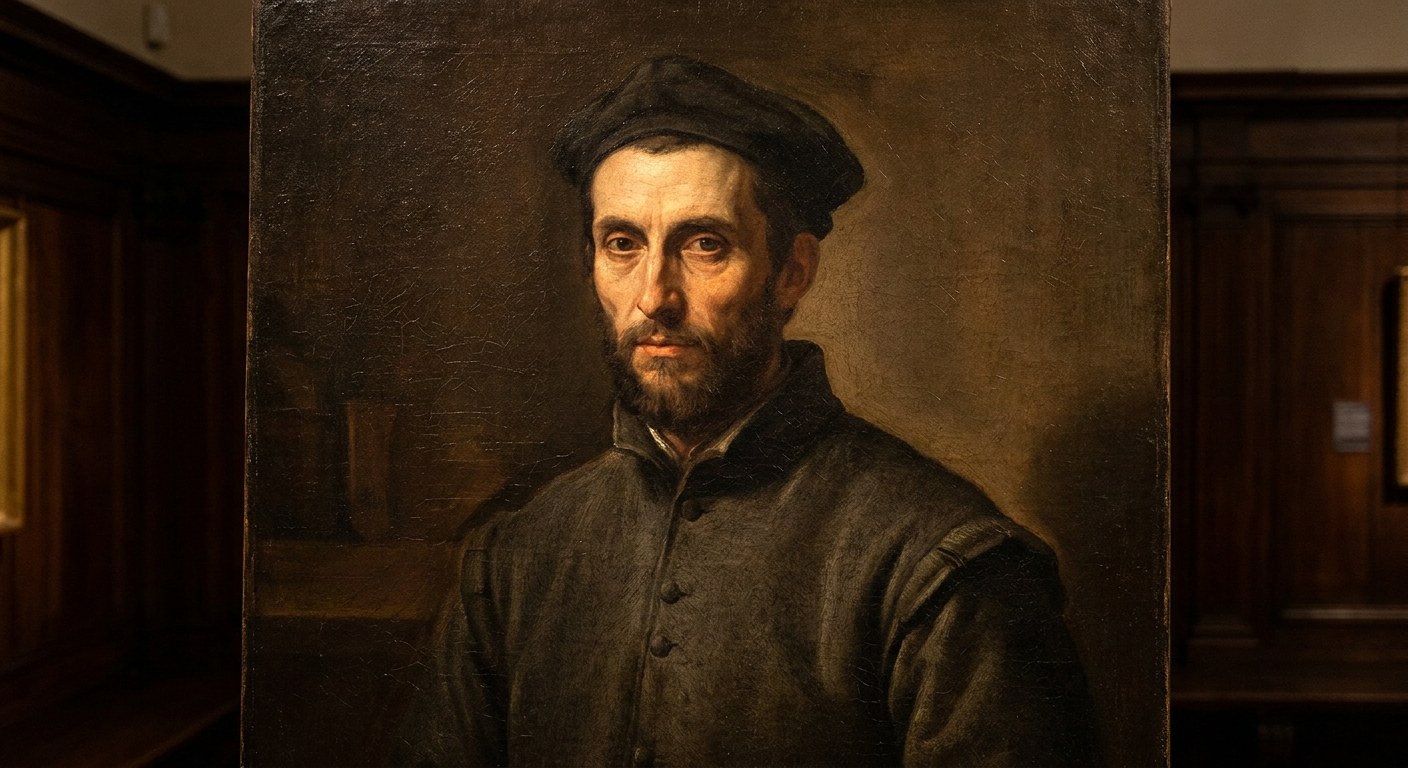
Quick Facts
- Years
- 1469 – 1527
- Nationality
- Florentine (Italian)
- Occupation
- Political Thinker & Diplomat
Niccolò Machiavelli
1469 – 1527 · Florentine (Italian) · Political Thinker & Diplomat
Recommended Audiobooks
Listen next from Marcus Alden

Life Lessons from Frederic Chopin
Marcus Alden · 54 min

Life Lessons from John Wesley
Marcus Alden · 52 min
Introduction
Niccolò Machiavelli was a Florentine diplomat, civil servant, historian, playwright, military theorist, and political thinker whose name became synonymous with the ruthless pursuit of power. That reputation rests chiefly on The Prince, a short treatise in which he examined how rulers acquire states, preserve authority, overcome fortune, and respond to political danger. Yet the popular adjective “Machiavellian”—usually meaning cunning, deceitful, or unscrupulous—captures only part of his complex intellectual legacy.
Machiavelli mattered because he analyzed politics as it operates in the world, not merely as moralists believed it ought to operate. He studied ambition, fear, violence, law, military power, public opinion, and institutional weakness without assuming that political success naturally rewards conventional virtue. His writings helped establish an influential form of political realism and contributed to the development of modern political science.
At the same time, Machiavelli was not simply an adviser to tyrants. He spent most of his public career serving the Florentine Republic, admired the civic energy of ancient Rome, and argued in the Discourses on Livy that free institutions, public participation, and conflict regulated by law could make republics strong. His preference for citizen militias, his concern about corruption, and his belief that liberty requires active defense reveal a committed republican dimension to his thought.
His career unfolded during the Italian Wars, when France, Spain, the Holy Roman Empire, the papacy, and competing Italian states struggled for influence. Florence repeatedly changed regimes, while invasion and conspiracy made political survival uncertain. Machiavelli’s often unsettling conclusions arose from direct experience of this unstable world. Five centuries later, leaders, scholars, soldiers, executives, and citizens still debate whether he exposed the realities of power, encouraged immorality, or did both.
Quick Facts
| Fact | Details |
|---|---|
| Born | 3 May 1469, Florence, Republic of Florence |
| Died | 21 June 1527, Florence, Republic of Florence |
| Nationality | Florentine; commonly described as Italian |
| Known For | The Prince, Discourses on Livy, political realism, republican theory |
| Occupation | Diplomat, civil servant, political thinker, historian, playwright |
| Era | Italian Renaissance |
Early Life and Education
Niccolò di Bernardo dei Machiavelli was born in Florence on 3 May 1469. His father, Bernardo di Niccolò Machiavelli, was trained in law and belonged to an old but comparatively modest Florentine family. His mother, Bartolomea di Stefano Nelli, came from a respectable household and wrote devotional verse. The family owned rural property, including land at Sant’Andrea in Percussina, but it was neither among Florence’s richest clans nor central to the ruling oligarchy.
Bernardo kept a detailed household record that provides glimpses of Niccolò’s education. The boy studied Latin grammar and encountered major classical authors, especially Roman historians and moralists. Livy, Cicero, Sallust, and later Tacitus formed part of the intellectual world from which Machiavelli drew historical examples. He apparently did not receive the extensive Greek training available to some elite Renaissance humanists, and he did not attend a university. Nevertheless, he developed an effective humanist education grounded in rhetoric, history, and Latin literature.
Machiavelli grew up under Lorenzo de’ Medici, known as Lorenzo the Magnificent, whose family dominated Florentine politics while preserving republican forms. After Lorenzo’s death in 1492, Italy entered a period of crisis. The French king Charles VIII invaded the peninsula in 1494, the Medici were expelled from Florence, and the Dominican preacher Girolamo Savonarola became the leading force in a new republic. Savonarola denounced corruption and presented Florence as a divinely favored city, but he lost support, was excommunicated, and was executed in 1498.
Little reliable evidence survives about Machiavelli’s activities before that year. His later discussion of Savonarola as an “unarmed prophet,” however, shows how deeply the preacher’s rise and fall impressed him. Savonarola possessed charisma and a compelling message, Machiavelli concluded, but lacked the force necessary to sustain power when belief weakened.
Rise to Prominence
Shortly after Savonarola’s fall, Machiavelli entered public service. In June 1498 he became secretary of the Florentine Republic’s Second Chancery. He also served the Ten of Liberty and Peace, the committee responsible for diplomatic and military affairs. Although his title was not exceptionally grand, the office placed him near the center of government and required enormous administrative energy.
For the next fourteen years, Machiavelli drafted official correspondence, prepared reports, advised magistrates, organized military affairs, and undertook numerous diplomatic missions. He traveled to the courts of King Louis XII of France, Emperor Maximilian I, Pope Julius II, and several Italian rulers. These assignments taught him to compare political institutions and to judge leaders under pressure.
His encounters with Cesare Borgia were especially important. Borgia, the son of Pope Alexander VI, was attempting to create a territorial state in central Italy. Machiavelli observed him during missions in 1502 and 1503, including the period surrounding Borgia’s destruction of disloyal commanders at Senigallia. He admired Borgia’s boldness, strategic deception, and ability to impose order, while also recognizing his dependence on papal power and extraordinary fortune.
One episode later retold in The Prince concerned Ramiro de Lorqua, whom Borgia appointed to pacify the Romagna through severe measures. Once order had been restored and resentment had gathered around Ramiro, Borgia had him executed and displayed publicly. Machiavelli interpreted the act as calculated political theater: cruelty was concentrated in a subordinate, while the ruler presented himself as the source of justice. It became a disturbing example of how force, spectacle, and reputation could be coordinated.
Machiavelli also studied the weaknesses of Florence itself. The republic relied heavily on mercenary commanders and hired troops, whose interests did not always coincide with those of the state. He argued instead for a militia recruited from Florentine territory. With the support of the republic’s leading official, Piero Soderini, Machiavelli helped organize such a force beginning in 1506 and became secretary to the magistracy overseeing it.
The militia participated in the campaign that recovered Pisa for Florence in 1509 after a long conflict. This success strengthened Machiavelli’s conviction that citizens or loyal subjects made safer soldiers than mercenaries. Yet the militia performed poorly when Florence faced Spanish forces in 1512. After the sack of nearby Prato, the republican government collapsed, Soderini fled, and the Medici returned to power.
Major Achievements and Contributions
Machiavelli’s first major achievement was practical rather than literary: he served the Florentine Republic through years of diplomatic and military crisis. His dispatches reveal a careful observer who could assess motives, identify weaknesses, and adapt rapidly to changing circumstances. This experience gave his later political writings their unusual combination of classical learning and firsthand analysis.
His most influential contribution was to treat politics as a distinct field of action with pressures and standards not reducible to private morality. He did not claim that morality was meaningless. Rather, he argued that rulers responsible for preserving a state may confront situations in which conventional goodness produces disaster. A leader must therefore learn, as he famously wrote, “how not to be good” when necessity demands it.
Machiavelli transformed the traditional language of virtue. His Italian term virtù does not simply mean moral virtue. It can signify ability, boldness, discipline, intelligence, adaptability, courage, and the capacity to shape events. Its counterpart, fortuna, represents contingency, luck, and the unpredictable forces beyond human control. Successful political actors cannot abolish fortune, but through preparation and decisive action they may limit its effects.
He also made a foundational contribution to republican thought. In the Discourses on Livy, Machiavelli maintained that durable liberty depends on institutions, laws, civic participation, military capacity, and vigilance against corruption. Unlike thinkers who treated social conflict as purely destructive, he argued that tension between Rome’s elite and common citizens helped produce laws protecting freedom. Conflict could strengthen a republic when channeled through sound institutions.
His military thought was another major contribution. Machiavelli condemned mercenary and auxiliary forces as unreliable and dangerous. He believed political independence required military self-reliance and a citizen body willing to defend the commonwealth. Although his confidence in militia forces was not always justified in practice, his insistence that military organization reflects political organization remained influential.
Finally, Machiavelli helped shape Italian prose, historiography, drama, and political vocabulary. His comedy The Mandrake remains one of the most celebrated plays of the Italian Renaissance. His historical and literary works show that he was not a narrow theorist of tyranny but a versatile writer with a sharp sense of irony, character, and human self-deception.
Key Works / Battles / Ideas
The Prince
Machiavelli wrote The Prince principally in 1513, after losing office. The work examines different kinds of principalities, the methods by which they are acquired, and the means required to preserve them. It discusses hereditary rule, conquered territories, civil principalities, ecclesiastical states, military organization, reputation, cruelty, mercy, promises, advisers, and fortune.
The book’s most provocative chapters ask whether rulers must always keep faith, whether it is better to be loved or feared, and whether conduct normally called vicious may sometimes preserve a state. Machiavelli argues that a prudent ruler should prefer to be both loved and feared, but if forced to choose, fear is safer—provided it does not become hatred. He advises rulers to appear merciful, faithful, humane, religious, and upright while retaining the ability to act otherwise when necessary.
The Prince was probably first intended for Giuliano de’ Medici and was ultimately dedicated to Lorenzo di Piero de’ Medici. Machiavelli hoped that demonstrating his political expertise might return him to government service. The work circulated in manuscript and was not printed until 1532, five years after his death.
Its final chapter calls for a leader capable of freeing Italy from foreign domination. This appeal should not be confused with nineteenth-century nationalism, but it reflects Machiavelli’s anguish over Italy’s military weakness and political fragmentation.
Discourses on the First Ten Books of Livy
Usually called the Discourses on Livy, this longer work was composed over several years, probably between about 1513 and 1519. Using the early history of Rome as a starting point, Machiavelli examines republics, lawmaking, religion, civic conflict, expansion, military organization, corruption, and political renewal.
The Discourses offer the clearest evidence of his republican commitments. Machiavelli praises mixed institutions, popular participation, and the willingness of citizens to defend liberty. He argues that republics may possess greater adaptability and collective wisdom than individual princes. He nevertheless accepts that exceptional founders—and sometimes harsh measures—may be required to establish or reform political orders.
The Art of War
Published in 1521, The Art of War was the only major political work printed during Machiavelli’s lifetime. Written as a dialogue, it advocates disciplined infantry and citizen-based military organization inspired partly by ancient Rome. Machiavelli criticizes Italy’s reliance on mercenaries and insists that good laws and good arms are inseparable.
Some technical recommendations soon became outdated, especially as firearms and new battlefield formations transformed warfare. The broader argument—that military institutions must be integrated with civic and political life—retained lasting significance.
Florentine Histories
Cardinal Giulio de’ Medici, later Pope Clement VII, commissioned Machiavelli to write a history of Florence. Presented in 1525, the Florentine Histories covers the city’s development through internal rivalries, factional struggles, and changing institutions. It is more rhetorical than modern archival scholarship, but it contains penetrating reflections on division, elite competition, and the instability of civic life.
The Mandrake and Other Literary Works
The Mandrake (Mandragola), probably written in the 1510s and performed by the early 1520s, is a brilliant comedy about desire, fraud, corruption, and rationalization. Its plot follows Callimaco, who uses an elaborate deception to gain access to Lucrezia, the wife of the foolish Nicia. Clergy, marriage, medicine, and respectable morality all become objects of satire.
Machiavelli also wrote Clizia, poetry, novellas, biographical sketches, diplomatic reports, and extensive correspondence. His letter of 10 December 1513 to Francesco Vettori is especially famous because it describes his evening ritual of changing into dignified clothes, entering the imagined courts of ancient authors, and conversing with them through books.
Virtù, Fortuna, and Necessity
Three concepts organize much of Machiavelli’s thought. Virtù is effective human capacity: the power to understand circumstances and act decisively. Fortuna is the unpredictable element in affairs. Necessity refers to pressures that narrow the range of available choices. Political excellence lies partly in recognizing what circumstances require and changing methods when the times change.
Machiavelli repeatedly warns that success can create rigidity. A cautious person may flourish in one situation but fail when boldness becomes necessary; an impulsive leader may suffer when patience is required. Adaptability is therefore more valuable than attachment to a single style of rule.
Timeline of Key Events
| Year | Event |
|---|---|
| 1469 | Born in Florence on 3 May |
| 1494 | French invasion helps drive the Medici from Florence |
| 1498 | Appointed secretary of Florence’s Second Chancery after Savonarola’s fall |
| 1499–1500 | Undertakes missions connected with Florence’s war against Pisa |
| 1500–1501 | Serves on a diplomatic mission to the court of Louis XII of France |
| 1502–1503 | Observes Cesare Borgia’s campaigns and political methods |
| 1506 | Helps establish a Florentine territorial militia |
| 1509 | Florence recaptures Pisa |
| 1512 | Medici return; Machiavelli is dismissed from office |
| 1513 | Arrested, tortured, and released; writes most of The Prince |
| c. 1513–1519 | Composes much of the Discourses on Livy |
| c. 1518 | Writes The Mandrake |
| 1520 | Commissioned to write the Florentine Histories |
| 1521 | The Art of War is published |
| 1525 | Presents the Florentine Histories to Pope Clement VII |
| 1526 | Assists with plans for Florence’s defenses |
| 1527 | Medici expelled again; Machiavelli dies on 21 June |
| 1532 | The Prince and the Discourses appear in print |
Personal Life and Character
Machiavelli married Marietta Corsini in 1502. They had six children, though his diplomatic duties and later literary associations often kept him away from domestic life. Surviving letters suggest genuine family attachment alongside extramarital affairs and the earthy humor characteristic of elite male correspondence in Renaissance Italy.
Friends knew him as lively, witty, sociable, and fond of jokes, tavern conversation, games, and literary discussion. This image differs markedly from the cold, sinister figure created by later legend. He endured serious reversals but retained an ability to mock both himself and others.
His correspondence also reveals intense intellectual discipline. In the famous letter to Francesco Vettori, Machiavelli described spending his days at his country property supervising work, reading, walking, and playing games at an inn. In the evening, he put on formal clothing and entered his study, where he questioned ancient authors about their actions. He wrote that this experience relieved poverty and the fear of death.
Machiavelli was ambitious and longed to return to public life. His dedication of The Prince to a Medici ruler was partly an attempt to demonstrate his usefulness. Yet his record does not support the idea that he was simply an opportunist without commitments. His attachment to Florence, admiration for republican liberty, and frustration at political exclusion remained central to his identity.
Challenges and Controversies
Machiavelli’s greatest personal crisis followed the fall of the republic in 1512. The restored Medici dismissed him, barred him from government, and required him to remain within Florentine territory. In February 1513, his name appeared on a list associated with a conspiracy led by Pietro Paolo Boscoli and Agostino Capponi. Machiavelli was arrested even though there is no solid evidence that he participated.
He was subjected to the strappado, a form of torture in which a prisoner’s bound arms were pulled upward behind the back. Machiavelli endured repeated drops and continued to deny involvement. He was released after Giovanni de’ Medici became Pope Leo X and an amnesty was proclaimed. He then withdrew to the family property at Sant’Andrea in Percussina, where political exclusion drove him toward sustained writing.
The central intellectual controversy concerns whether Machiavelli endorsed immoral conduct. The Prince plainly recommends deception, force, and carefully controlled cruelty in some circumstances. It does not, however, praise pointless brutality or evil for its own sake. Violence must serve a political purpose, be limited when possible, and avoid provoking hatred. A ruler who cannot preserve the state is, in Machiavelli’s analysis, not redeemed by good intentions.
Some interpreters view him as a teacher of tyranny. Others understand The Prince as a realistic handbook, a satire, or even an exposure of princely techniques. The satire interpretation has attracted famous supporters but does not fully explain the work’s serious analytical consistency. Most scholars read it alongside the Discourses, recognizing a thinker who could analyze princely government while generally valuing republican liberty.
His treatment of religion is also disputed. Machiavelli admired religion’s ability to create discipline, unity, and sacrifice, particularly in ancient Rome. At the same time, he criticized the political behavior of the Renaissance Church and believed that Christianity, as commonly interpreted, could encourage humility at the expense of civic vigor. Whether he was personally irreligious, conventionally observant, or strategically skeptical cannot be established with certainty.
Modern readers also criticize his acceptance of violence, masculine aggression, and social hierarchy. His personification of fortune as a woman to be mastered reflects the gender assumptions of his age and can be deeply troubling. His occasional appeals concerning Italy should likewise not be projected uncritically into modern nationalism.
Death and Immediate Aftermath
In 1527, imperial troops sacked Rome, weakening Medici authority. Florence expelled the Medici and restored a republic. Machiavelli hoped that his experience would again make him valuable, but committed republicans distrusted him because he had recently performed work for Medici governments. The political opening he had long awaited therefore brought disappointment rather than restoration.
Machiavelli became ill and died in Florence on 21 June 1527, aged fifty-eight. He was buried at the Basilica of Santa Croce. The monument visible there today was erected much later, in 1787, and bears the Latin tribute Tanto nomini nullum par elogium—“No praise is equal to so great a name.”
The Prince and the Discourses were printed in 1532. Their publication rapidly expanded his fame and provoked fierce debate. In 1559, the Catholic Church placed his writings on the Index of Forbidden Books.
Legacy and Influence Today
Machiavelli’s name entered European culture as a symbol of calculated wickedness. Elizabethan writers used “Machiavel” for scheming villains, and political opponents routinely accused one another of following his doctrines. This demonic reputation often depended on summaries, hostile polemics, or selective quotations rather than careful reading.
His deeper influence was far broader. Political thinkers including Francis Bacon, Baruch Spinoza, Jean-Jacques Rousseau, Montesquieu, G. W. F. Hegel, Antonio Gramsci, and many others engaged with his arguments. Republican traditions drew on his analysis of civic conflict and corruption, while advocates of strong states studied his accounts of founding, war, and executive action.
Machiavelli is frequently called a founder of modern political science because he emphasized historical evidence, institutional incentives, strategic behavior, and observable consequences. The label requires qualification: he did not use modern statistical methods or create a value-neutral social science. Nevertheless, his separation of effective political action from idealized moral instruction marked a decisive intellectual shift.
His ideas remain relevant wherever leaders face uncertainty. The relationship between fear and consent, the political use of appearances, the danger of dependence on hired force, the decay of institutions, and the challenge of adapting to changing circumstances all remain recognizable. Contemporary discussions of political communication and organizational strategy frequently borrow his vocabulary, sometimes superficially.
Psychology uses “Machiavellianism” for a personality trait associated with manipulation, emotional detachment, and strategic self-interest. This technical usage should not be mistaken for a complete description of Machiavelli himself. He analyzed manipulation, but he also wrote about liberty, civic responsibility, institutions, military service, and the common good.
The enduring power of his work lies in its refusal to make politics comforting. He forces readers to ask whether good ends can survive without power, whether power can be restrained by institutions, and how citizens should respond when moral choices collide with political necessity. Those questions ensure that Machiavelli remains not merely notorious, but indispensable.
Famous Quotes
English wording varies among translations. The following are genuine passages from Machiavelli’s works.
“It is much safer to be feared than loved, if one of the two has to be lacking.” — The Prince, Chapter 17
“Everyone sees what you appear to be, few experience what you really are.” — The Prince, Chapter 18
“A prince, therefore, must learn from the fox and the lion.” — The Prince, Chapter 18
“There is nothing more difficult to take in hand, more perilous to conduct, or more uncertain in its success, than to take the lead in the introduction of a new order of things.” — The Prince, Chapter 6
“The first method for estimating the intelligence of a ruler is to look at the men he has around him.” — The Prince, Chapter 22
“Whoever becomes master of a city accustomed to freedom and does not destroy it may expect to be destroyed by it.” — The Prince, Chapter 5
“Good examples arise from good education, good education from good laws, and good laws from those tumults which many inconsiderately condemn.” — Discourses on Livy, Book I, Chapter 4
Frequently Asked Questions
Why is Niccolò Machiavelli famous?
Machiavelli is famous primarily for The Prince, one of history’s most influential works about political power. He is also important for the republican arguments of the Discourses on Livy, his diplomatic career, his military writings, and his Renaissance comedy The Mandrake.
Did Machiavelli really say that the end justifies the means?
No. That exact sentence does not appear in Machiavelli’s surviving works. It summarizes one interpretation of his argument that political actions should be judged partly by their results, especially the preservation of the state. His actual position is more conditional and complex than the slogan suggests.
Was Machiavelli evil?
Calling Machiavelli evil substitutes a moral label for historical analysis. He did recommend deception and violence in certain political circumstances, but he also opposed needless cruelty, valued republican liberty, and sought institutions capable of containing corruption. He described disturbing features of politics without always clearly separating description from recommendation.
Did Machiavelli support monarchy or republican government?
He analyzed both. The Prince focuses on individual rulers, while the Discourses generally present republics as stronger, freer, and more adaptable. His public service and longer political writings indicate a substantial commitment to republican government, although he believed powerful founders or emergency leaders could be necessary.
What did Machiavelli mean by virtù?
For Machiavelli, virtù means political capacity rather than conventional moral goodness. It includes courage, strategic intelligence, discipline, foresight, flexibility, and the ability to act decisively. A leader with virtù can resist or exploit fortuna, though never control events completely.
Why did the Medici imprison and torture him?
After restoring their rule in Florence, the Medici removed Machiavelli from office. In 1513 his name appeared on a list linked to an anti-Medici conspiracy. Authorities arrested and tortured him, but no convincing evidence proved his involvement. He was released under a general amnesty.
Was Cesare Borgia Machiavelli’s ideal ruler?
Not exactly. Machiavelli admired Borgia’s decisiveness, deception, and efforts to establish order, using him as an important example in The Prince. Yet Borgia ultimately failed, partly because his power depended on his father, Pope Alexander VI, and because extraordinary misfortune followed the pope’s death.
Is The Prince still relevant?
Yes, provided it is read critically and in historical context. Its discussions of public image, fear, military dependence, advisers, institutional instability, and adaptation remain relevant to politics and leadership. It should also be read alongside the Discourses, which reveal Machiavelli’s concern for liberty and republican institutions.
Lessons We Can Learn
-
Study the world as it is. Effective judgment begins with accurate observation rather than assumptions about how people ought to behave.
-
Build durable institutions. Personal talent cannot permanently compensate for weak laws, corrupt structures, or dependence on outsiders.
-
Adapt methods to circumstances. Strategies that succeed in one period may fail when conditions change. Flexibility is a central form of practical intelligence.
-
Power requires legitimacy as well as force. Fear may secure obedience, but hatred can destroy a ruler. Reputation, consent, law, and public expectations matter.
-
Read provocative arguments in full context. The Prince alone does not represent the whole of Machiavelli’s thought. His republican, historical, military, and literary writings complicate the caricature of a teacher of evil.
Further Reading
- Quentin Skinner, Machiavelli: A Very Short Introduction (Oxford University Press).
- Erica Benner, Be Like the Fox: Machiavelli’s Lifelong Quest for Freedom (W. W. Norton).
- John M. Najemy, Between Friends: Discourses of Power and Desire in the Machiavelli–Vettori Letters of 1513–1515 (Princeton University Press).
- Sebastian de Grazia, Machiavelli in Hell (Princeton University Press).
- Niccolò Machiavelli, The Prince, translated by Harvey C. Mansfield (University of Chicago Press).
Watch and Learn
What “Machiavellian” really means · TED-Ed