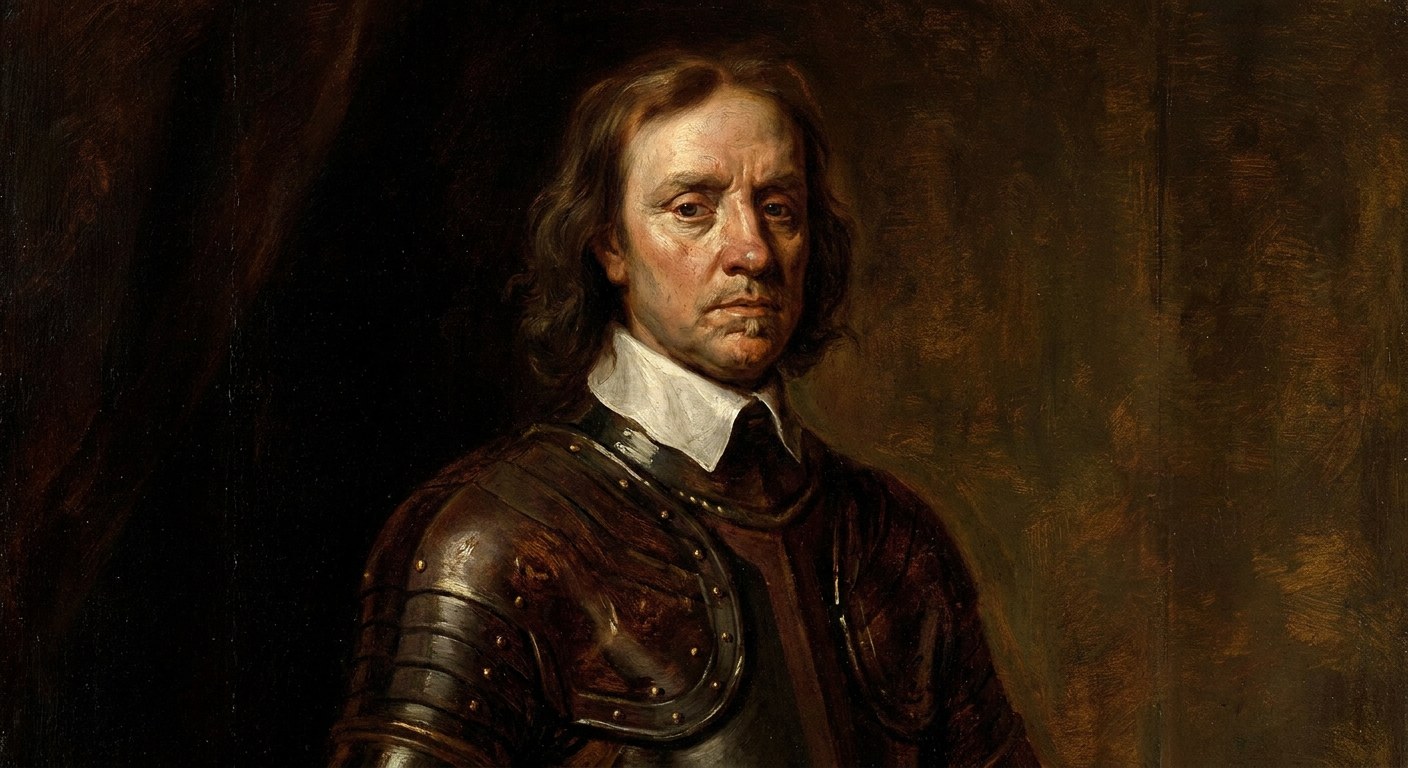
Oliver Cromwell
1599 – 1658 · English · Statesman & Military Commander
Recommended Audiobooks
Listen next from Marcus Alden

Life Lessons from Frederic Chopin
Marcus Alden · 54 min

Life Lessons from John Wesley
Marcus Alden · 52 min
Introduction
Oliver Cromwell was one of the most consequential and controversial figures in British and Irish history. A relatively obscure landowner for much of his early life, he rose during the civil wars of the 1640s to become a gifted cavalry commander, a central figure in the execution of King Charles I, and ultimately lord protector of the republican Commonwealth of England, Scotland and Ireland.
Cromwell’s career unfolded amid the Wars of the Three Kingdoms, a series of interconnected conflicts driven by disputes over religion, taxation, political authority and the relationship among the kingdoms ruled by the Stuart monarchy. He helped transform Parliament’s military fortunes, supported the creation of the New Model Army and played a decisive role in the defeat of royalism. After the king’s execution in 1649, Cromwell led brutal campaigns in Ireland and a successful conquest of Scotland. He then became head of state under England’s first written national constitution, the Instrument of Government.
To admirers, Cromwell was a courageous soldier, an advocate of Protestant liberty and a ruler who brought order after years of war. To critics, he was a regicide, military dictator and religious zealot whose forces committed atrocities—especially in Ireland. His governments experimented with constitutional rule and limited toleration, yet they also relied heavily on the army and imposed strict moral regulation.
Cromwell remains difficult to classify. He opposed arbitrary monarchy but acquired powers resembling those of a king. He championed “liberty of conscience” for many Protestants but denied equal freedom to Catholics and some other religious groups. He repeatedly claimed to follow divine providence while making pragmatic political compromises. His life embodies the aspirations, contradictions and violence of the seventeenth-century revolutionary era.
Quick Facts
| Category | Details |
|---|---|
| Full name | Oliver Cromwell |
| Born | 25 April 1599 |
| Birthplace | Huntingdon, England |
| Died | 3 September 1658 |
| Place of death | Whitehall, London, England |
| Age at death | 59 |
| Parents | Robert Cromwell and Elizabeth Steward |
| Spouse | Elizabeth Bourchier |
| Children | Nine, including Richard and Henry Cromwell |
| Education | Huntingdon Grammar School; Sidney Sussex College, Cambridge |
| Religion | Puritan Protestant; generally identified with the Independent tradition |
| Political affiliation | Parliamentarian; later a leader of the Commonwealth and Protectorate |
| Military rank | Lieutenant-general of horse in the New Model Army; later captain-general |
| Principal offices | Member of Parliament; lord lieutenant of Ireland; lord protector |
| Term as lord protector | 16 December 1653–3 September 1658 |
| Major battles | Marston Moor, Naseby, Preston, Dunbar and Worcester |
| Best known for | Defeating royalism, supporting the trial of Charles I and ruling the Protectorate |
| Successor as lord protector | Richard Cromwell |
| Burial history | Buried in Westminster Abbey in 1658; exhumed and posthumously executed in 1661 |
Early Life & Background
Oliver Cromwell was born in Huntingdon on 25 April 1599. His family belonged to the lesser landed gentry rather than the highest ranks of the aristocracy. His father, Robert Cromwell, owned property in and around Huntingdon but was one of the younger sons of Sir Henry Williams, also known as Cromwell. The family had adopted the surname of its famous relation Thomas Cromwell, chief minister to Henry VIII.
Cromwell’s mother, Elizabeth Steward, came from a prosperous local family. Claims that she descended from the royal House of Stuart are unsupported, although her surname later encouraged that legend. Oliver was the only one of his parents’ sons to survive infancy, and he grew up with several sisters.
He attended Huntingdon Grammar School, where the Puritan clergyman Thomas Beard was headmaster. In April 1616 Cromwell entered Sidney Sussex College, Cambridge, an institution with a strong Protestant character. He left in 1617 without taking a degree, probably because his father had died and he needed to help manage family affairs. A later tradition holds that he studied law at Lincoln’s Inn, but firm evidence is lacking.
On 22 August 1620 Cromwell married Elizabeth Bourchier at St Giles-without-Cripplegate in London. Her father, Sir James Bourchier, was a wealthy leather merchant with useful connections among London’s Puritan commercial community. The marriage appears to have been affectionate and durable.
Cromwell entered the House of Commons as member for Huntingdon in 1628. His first parliamentary career was brief because Charles I dissolved Parliament in March 1629 and began eleven years of personal rule. During the 1630s Cromwell experienced financial and emotional difficulties. He sold much of his Huntingdon property and moved first to St Ives and then, after receiving an inheritance, to Ely.
At some point in this period he underwent an intense religious conversion. His surviving letters suggest that he came to see himself as a sinner rescued by God’s grace. This experience gave him a powerful sense of divine purpose. Like many Puritans, he opposed elaborate Anglican ceremony and feared that reforms promoted by Archbishop William Laud were moving the Church of England toward Roman Catholicism.
By the late 1630s Cromwell was a respected landowner in the Fens, but there was little to suggest that he would soon become a national leader.
Rise to Prominence
Cromwell returned to Parliament in April 1640 as member for Cambridge in the Short Parliament and again in November for the Long Parliament. He was associated with critics of Charles I’s religious and political policies and supported measures to restrict episcopal power. Contemporaries initially found his dress plain and his manner rough, but he quickly gained attention for his energy and forceful convictions.
Relations between the king and Parliament collapsed during 1641–1642. Disputes over control of the armed forces, the Church and royal ministers culminated in civil war. When Charles raised his standard at Nottingham on 22 August 1642, Cromwell was already organizing troops for Parliament.
Although he had little or no formal military experience, he proved unusually capable at recruiting, training and motivating cavalry. He understood that Parliament needed disciplined soldiers committed to its cause rather than gentlemen chosen solely for social status. His troop of horse expanded into a regiment known for cohesion and religious seriousness. The later nickname “Ironsides” was originally associated with Cromwell himself or his cavalry before being applied more broadly.
Cromwell fought at Edgehill in October 1642, though his role was limited, and distinguished himself in campaigns across eastern England. Working within the Eastern Association under Edward Montagu, 2nd Earl of Manchester, he helped secure East Anglia for Parliament. His cavalry played a major role at Gainsborough in July 1643 and at Winceby that October.
His reputation was established nationally at the Battle of Marston Moor near York on 2 July 1644. Parliamentarian and Scottish Covenanter forces defeated Prince Rupert’s royalist army in one of the largest battles fought on English soil. Cromwell’s cavalry attacked effectively on the allied left, regrouped after the initial charge and helped turn the battle into a decisive royalist defeat.
Cromwell then quarreled with Manchester, whom he accused of lacking determination. He supported military reorganization and the separation—at least in principle—of parliamentary command from political office. The Self-Denying Ordinance of 1645 required many members of Parliament to resign military commands. Cromwell was repeatedly exempted because his services were considered indispensable.
Under Sir Thomas Fairfax, the newly created New Model Army introduced centralized command, regular pay and promotion based more heavily on competence. Cromwell became lieutenant-general of horse. At Naseby on 14 June 1645, his cavalry helped destroy Charles I’s principal field army. The First Civil War effectively ended the following year.
Major Achievements
Cromwell’s foremost military achievement was his contribution to the creation and success of the New Model Army. He was not its sole architect—Fairfax, Philip Skippon and parliamentary organizers were equally important—but he exemplified its emphasis on discipline, ability and religious commitment. The army became one of Europe’s most effective forces.
He also played an important role in destroying royalist military power. Victories at Marston Moor and Naseby were followed by the reduction of royalist strongholds. During the Second Civil War of 1648, Cromwell defeated a Scottish-engaged royalist army at Preston between 17 and 19 August. The victory convinced many army leaders that Charles I could not be trusted to reach a stable settlement.
As lord lieutenant of Ireland, Cromwell led the 1649–1650 campaign that broke the main Royalist-Confederate coalition. His campaign was militarily successful but accompanied by devastating violence and confiscation. After leaving Ireland, he defeated the Scottish Covenanters at Dunbar on 3 September 1650. Exactly one year later, at Worcester, he crushed the army of Charles II. Cromwell called Worcester his “crowning mercy.”
As lord protector, Cromwell presided over an attempt to construct a durable post-monarchical state. The Instrument of Government, adopted in December 1653, was the first and only fully written constitution applied to England, Scotland and Ireland as a unified polity. It divided authority among the lord protector, Council of State and Parliament, although practice often diverged from constitutional theory.
His government promoted a measure of religious toleration unprecedented in English national policy. Various Protestant Independents, Baptists, Congregationalists and other nonconformists were generally allowed to worship, provided that they did not threaten public order. In 1657 Cromwell received Menasseh ben Israel, a rabbi and advocate for Jewish resettlement. No formal proclamation of readmission was issued, but Jews were permitted to worship and establish communities in England after centuries of official exclusion.
In foreign policy, Cromwell’s regime increased English naval influence. The First Anglo-Dutch War, begun before he became protector, ended with the Treaty of Westminster in 1654. War against Spain produced the seizure of Jamaica in 1655 and the capture of Dunkirk in 1658 by Anglo-French forces. Jamaica became strategically and economically important, although its acquisition also contributed to England’s expanding role in colonial slavery.
Cromwell’s government also supported persecuted Protestants abroad. His diplomatic intervention on behalf of the Waldensians after the 1655 massacres in Piedmont demonstrated both genuine religious concern and the Protectorate’s growing international confidence.
Defining Moments
One defining moment was Cromwell’s religious conversion in the 1630s. It shaped his language, self-understanding and politics. He interpreted victories and setbacks as signs of providence, often pausing after major events to consider what God intended.
The Battle of Marston Moor transformed him from a regional commander into a national military figure. Naseby then confirmed the superiority of the New Model Army and gave Parliament possession of Charles I’s private correspondence, which was used to portray the king as duplicitous and willing to seek foreign support.
The crisis of 1647–1649 was equally decisive. After the First Civil War, Parliament, the army and the captured king could not agree on a constitutional settlement. The army itself became politicized, with soldiers and Leveller spokesmen demanding broader reforms. Cromwell tried at different times to negotiate with Charles, moderate army radicalism and preserve unity. The king’s support for renewed war destroyed what remained of Cromwell’s confidence in him.
In December 1648 Colonel Thomas Pride excluded or arrested members of Parliament likely to oppose the king’s trial. Cromwell was not present at the beginning of Pride’s Purge, but he accepted its outcome. He served on the High Court of Justice and was the third signatory of Charles I’s death warrant. The king was beheaded outside the Banqueting House in Whitehall on 30 January 1649. Cromwell’s participation made him permanently associated with regicide.
The storming of Drogheda on 11 September 1649 became the darkest symbol of his Irish campaign. After the garrison refused to surrender and the town was breached, Parliamentarian soldiers killed large numbers of defenders, including men who had surrendered or sought refuge. Civilians were also killed, although historians debate their number. A similar massacre followed the capture of Wexford in October. Cromwell justified the violence as divine judgment and as a means of preventing prolonged resistance.
Another defining moment came on 20 April 1653, when Cromwell used troops to dissolve the Rump Parliament. Frustrated by its delays and self-interest, he denounced its members and ended the surviving remnant of the Long Parliament by force. This action revealed the central contradiction of his career: he had fought royal arbitrary government but now used military authority against a representative assembly.
On 16 December 1653 Cromwell became lord protector. In 1657 Parliament offered him the crown through the Humble Petition and Advice. He refused the title of king, partly because of opposition within the army, but accepted a revised constitutional settlement and a ceremonial second installation. His refusal preserved the formal republic while leaving him with monarchical powers.
Timeline
| Year | Event |
|---|---|
| 1599 | Born at Huntingdon on 25 April |
| 1616 | Entered Sidney Sussex College, Cambridge |
| 1617 | Left Cambridge following his father’s death |
| 1620 | Married Elizabeth Bourchier on 22 August |
| 1628 | Elected MP for Huntingdon |
| 1629 | Charles I dissolved Parliament and began his personal rule |
| 1631 | Sold property in Huntingdon and moved to St Ives |
| 1636 | Inherited property in Ely and became a more prosperous landowner |
| 1640 | Elected MP for Cambridge in the Short and Long Parliaments |
| 1642 | Raised cavalry for Parliament as the First Civil War began |
| 1643 | Fought at Gainsborough and Winceby |
| 1644 | Played a leading role at Marston Moor |
| 1645 | Became lieutenant-general of horse in the New Model Army and fought at Naseby |
| 1646 | First Civil War ended with Charles I in Parliament’s custody |
| 1647 | Participated in negotiations among the king, Parliament and army |
| 1648 | Defeated royalist and Scottish forces at Preston |
| 1649 | Signed Charles I’s death warrant; appointed lord lieutenant of Ireland; captured Drogheda and Wexford |
| 1650 | Left Ireland; defeated the Scots at Dunbar on 3 September |
| 1651 | Defeated Charles II at Worcester on 3 September |
| 1653 | Dissolved the Rump Parliament; installed as lord protector on 16 December |
| 1654 | First Protectorate Parliament met; peace concluded with the Dutch Republic |
| 1655 | Major-generals appointed to govern English regions; English forces seized Jamaica |
| 1657 | Refused the crown but accepted the Humble Petition and Advice |
| 1658 | Anglo-French forces won at the Battle of the Dunes; Cromwell died on 3 September |
| 1661 | Body exhumed, subjected to posthumous execution and decapitated |
Personal Life
Oliver and Elizabeth Cromwell had nine children: Robert, Oliver, Bridget, Richard, Henry, Elizabeth, James, Mary and Frances. Three—Robert, the first Oliver and James—died young. The deaths of his sons Robert and Oliver caused Cromwell profound grief. His surviving correspondence shows strong affection for his family, concern about his children’s marriages and a capacity for warmth not always visible in his public image.
His daughters married into prominent political and military families. Bridget married first Henry Ireton, a leading army officer and republican, and later Charles Fleetwood. Elizabeth married John Claypole. Mary married Thomas Belasyse, 2nd Viscount Fauconberg, while Frances eventually married Robert Rich and, after his death, Sir John Russell.
Cromwell’s son Henry governed Ireland with considerable ability. Richard, the elder surviving son, succeeded his father as lord protector in September 1658. Lacking his father’s military authority and political experience, Richard resigned in May 1659.
Cromwell enjoyed music, hunting, horses and informal company. Foreign diplomats reported that he could be humorous and approachable in private. He was capable of tears, sudden anger and intense emotional displays. Physically, he was recognizable by his prominent nose, rough features and facial warts. He reportedly told the painter Sir Peter Lely to portray him truthfully, “warts and everything,” although the exact wording is a later recollection.
His marriage endured until his death. Letters to Elizabeth contain affectionate expressions, though their long separations during military campaigns placed strains on family life. Elizabeth survived him and died in 1665.
Beliefs & Philosophy
Cromwell’s worldview was rooted in Puritan Christianity. He believed that salvation came through God’s grace rather than human merit and that the events of history revealed divine providence. Military victory was not merely strategic success to him; it could be evidence that God had approved a cause. This conviction gave him resilience, but it could also encourage certainty that violent actions served a sacred purpose.
He favored a broad Protestant national church rather than complete separation of religion and state. Under the Protectorate, “Triers” examined candidates for parish ministry, while “Ejectors” removed ministers judged immoral or doctrinally unsuitable. The system opened the ministry to some non-Anglican Protestants but subjected religious life to state supervision.
His idea of liberty of conscience was substantial for its time but limited. He defended many Protestant sects from persecution and resisted attempts to impose a single rigid form of church government. Yet he did not extend equal toleration to Roman Catholics, whose faith he associated with political tyranny, foreign powers and massacres of Protestants. Anglicans also faced restrictions, particularly when suspected of royalism.
Cromwell distrusted radical democratic proposals. During the Putney Debates of 1647, Leveller-influenced soldiers argued for a greatly expanded male franchise and legal equality. Cromwell and his allies feared that sweeping political reform would destroy property rights and social order. He accepted that ordinary soldiers could possess spiritual gifts and military ability, but not that all men should have an equal political voice.
His constitutional thought was pragmatic rather than systematic. He wanted government by law and representative institutions, yet he believed those institutions must advance what he considered the godly cause. When parliaments resisted his priorities, he dissolved them. His rule therefore combined sincere constitutional experimentation with repeated coercion.
Challenges & Controversies
The greatest controversy surrounding Cromwell is his conduct in Ireland. The Confederate Wars had begun with the 1641 rebellion, during which Protestant settlers were killed or expelled. Reports of these atrocities—often exaggerated in England—deeply influenced Cromwell. By 1649 Irish Catholic Confederates, English Royalists and others had formed a loose coalition against the Commonwealth.
At Drogheda, Cromwell ordered that no quarter be given to many of the garrison after its commanders rejected surrender terms. Royalist commander Sir Arthur Aston was killed, as were Catholic clergy and soldiers who had laid down their arms. Cromwell reported approximately 3,000 deaths. At Wexford, Parliamentarian troops carried out widespread killing after entering the town during confused negotiations. The sack also destroyed an important port and caused severe civilian suffering.
Whether these acts violated the accepted laws of war has been debated. Early modern conventions sometimes permitted the killing of a garrison after it refused a summons and a fortress was taken by storm. Nevertheless, the extent of the slaughter, the killing of captives and civilians, and Cromwell’s language of divine vengeance make the episodes morally and historically notorious.
The wider conquest was even more destructive. Warfare, famine, disease, executions, transportation and land confiscation devastated Ireland. Much of the land owned by Catholics was transferred to English creditors, soldiers and Protestant settlers. Although not all later policies were devised or personally administered by Cromwell, his name became shorthand in Irish memory for conquest and dispossession.
His role in the execution of Charles I remains another central controversy. The trial asserted that a king could be held accountable to the people, an idea of enormous constitutional significance. Yet the court had been created by a purged Parliament, the House of Lords rejected the proceedings, and the king’s conviction was effectively predetermined.
Cromwell’s dissolution of Parliament in 1653 and the later Rule of the Major-Generals also support accusations of military dictatorship. From 1655 to 1657 England and Wales were divided into districts overseen by army officers. The major-generals enforced security, collected a tax from former royalists and promoted moral reform. Their regulation of alehouses, gambling, entertainment and Sabbath observance was widely resented.
The Protectorate never achieved stable relations between executive power, Parliament and the army. Cromwell dissolved the First Protectorate Parliament in January 1655 and the Second Protectorate Parliament in 1658. His government permitted debate only within limits and excluded members it considered dangerous.
Foreign policy produced mixed results. The seizure of Jamaica ultimately proved valuable to England, but the failed attack on Hispaniola—the “Western Design”—was costly and humiliating. English expansion in the Caribbean intensified colonial warfare, plantation development and racial slavery.
Famous Quotes
Some sayings associated with Cromwell survive in contemporary records, while others were reconstructed or popularized later.
“I had rather have a plain russet-coated captain that knows what he fights for, and loves what he knows, than that which you call a gentleman and is nothing else.”
Cromwell expressed this preference for commitment and ability over social rank in a 1643 letter to Sir William Spring.
“I beseech you, in the bowels of Christ, think it possible you may be mistaken.”
He wrote this famous appeal to the General Assembly of the Church of Scotland on 3 August 1650, urging its members to reconsider their support for Charles II.
“You have sat too long here for any good you have been doing lately.”
This is traditionally associated with Cromwell’s dissolution of the Rump Parliament in April 1653. The exact speech survives only in later accounts and should not be treated as a verbatim transcript.
“A few honest men are better than numbers.”
The sentiment reflects Cromwell’s emphasis on committed, disciplined soldiers, although versions of the wording vary among sources.
“Peace is our profession, though war has been our practice.”
Cromwell used this formulation in addressing Parliament in 1654, presenting peace as the intended goal of a regime born in war.
“No one rises so high as he who knows not whither he is going.”
Frequently attributed to Cromwell, this quotation lacks secure contemporary documentation and may be apocryphal.
The phrase “warts and all” is also linked to Cromwell’s supposed instruction that Sir Peter Lely paint him without flattery. The story is based on a later account rather than a surviving statement by Cromwell.
Legacy & Influence
Cromwell died at Whitehall on 3 September 1658, probably from a combination of malarial fever and a urinary or kidney infection. The date was symbolically important: it was the anniversary of his victories at Dunbar and Worcester. He received an elaborate state funeral and was buried in Westminster Abbey.
Richard Cromwell inherited the protectorship but could not reconcile the army and civilian politicians. The Protectorate collapsed, the monarchy was restored in 1660, and Charles II returned to England. In January 1661 the bodies of Cromwell, Henry Ireton and John Bradshaw were exhumed from Westminster Abbey. They were hanged and decapitated at Tyburn. Cromwell’s head was displayed on a spike at Westminster Hall and passed through several private collections before being buried at Sidney Sussex College in 1960.
Royalist writers portrayed Cromwell as a hypocritical tyrant. Republicans remembered him more ambivalently: some admired his destruction of monarchy, while others condemned him for suppressing parliamentary and democratic movements. In Ireland, memories of Cromwellian conquest became central to narratives of colonial oppression, land loss and sectarian violence.
During the nineteenth century, Thomas Carlyle’s edition of Cromwell’s letters and speeches helped rehabilitate him for a British audience. Carlyle depicted him as a sincere, heroic Puritan rather than a calculating hypocrite. Later liberals, imperialists, nonconformists and nationalists all constructed different versions of Cromwell to serve their own political purposes.
A statue of Cromwell by Hamo Thornycroft was erected outside the Palace of Westminster in 1899, despite opposition from Irish nationalists and others. Its location symbolizes his enduring paradox: a man who forcibly dissolved parliaments stands beside the building that houses the British Parliament.
Constitutionally, Cromwell’s career contributed to the destruction of the idea that English kings were politically untouchable. The Commonwealth and Protectorate demonstrated that Britain could be governed without a monarch, although their instability also helped make a restored, limited monarchy attractive. The settlement achieved after the Glorious Revolution of 1688 owed little directly to Cromwell’s institutions, but it developed in a political world permanently altered by the civil wars and regicide.
His advocacy of limited Protestant toleration anticipated later movement toward religious pluralism. The informal resettlement of Jews was particularly important. Yet these advances must be considered alongside exclusion, censorship, coercive moral regulation and anti-Catholic persecution.
Cromwell’s reputation therefore remains divided. He was neither simply a champion of freedom nor merely a dictator. He was a revolutionary soldier-statesman whose pursuit of godly government opened new political possibilities while producing authoritarian rule and immense suffering.
Interesting Facts
- Cromwell was 43 when the First English Civil War began, unusually old for someone starting a major military career.
- He had no substantial battlefield experience before 1642.
- His family was related to Thomas Cromwell, Henry VIII’s minister, through Thomas’s sister Katherine.
- Cromwell represented Cambridge in the Long Parliament, not Cambridge University.
- “Old Ironsides” was associated with Cromwell before the name was widely applied to Parliamentarian cavalry.
- He was wounded in the neck at Marston Moor but returned to the fighting.
- Cromwell did not personally devise every feature of the New Model Army, despite often receiving primary credit for it.
- The Protectorate used two written constitutions: the Instrument of Government and the Humble Petition and Advice.
- He refused the formal title of king in 1657 but accepted a quasi-monarchical installation and the right to nominate his successor.
- Christmas celebrations were restricted under Puritan-dominated governments, though the policy was not simply a personal decree by Cromwell.
- His government allowed a Jewish community to reestablish itself in England without passing a formal readmission law.
- Cromwell’s preserved head was authenticated through historical and anatomical study before its burial in 1960.
- The precise location of his head’s grave within Sidney Sussex College remains private.
- His son Richard was mocked as “Tumbledown Dick” after losing power.
- Cromwell has been portrayed on screen by actors including Richard Harris and Tim Roth.
Frequently Asked Questions
Was Oliver Cromwell a king?
No. Cromwell ruled as lord protector, not king. Parliament offered him the crown in 1657, but he refused it. Nevertheless, his second installation resembled a coronation, and the revised constitution allowed him to nominate his successor. His court and powers consequently appeared monarchical to many contemporaries.
Why did Cromwell fight against Charles I?
Cromwell believed that Charles had endangered Protestant religion, violated political trust and used war against his own subjects. Cromwell initially sought a negotiated settlement, but the Second Civil War convinced him that the king was responsible for continued bloodshed and could not be trusted.
Did Cromwell personally execute Charles I?
Cromwell did not wield the executioner’s axe, but he was a commissioner of the High Court of Justice, took part in the proceedings and signed the death warrant. He therefore bore direct political and legal responsibility for the execution.
What happened at Drogheda?
Cromwell’s army stormed Drogheda on 11 September 1649 after its Royalist garrison refused to surrender. Parliamentarian troops killed most of the defenders and some civilians and clergy. Several men were killed after surrendering or seeking sanctuary. The event became the most infamous episode of Cromwell’s Irish campaign.
Did Cromwell ban Christmas?
Parliamentary and Puritan authorities prohibited traditional Christmas observances during the 1640s, before Cromwell became lord protector. His regime continued a culture of strict Sabbath observance and opposition to feast-day customs. It is therefore misleading to describe the ban as Cromwell’s personal invention, though he supported the religious outlook behind it.
Was Cromwell a dictator?
He exercised dictatorial powers at important moments, particularly when using the army to dissolve Parliament and when governing through the major-generals. Yet he also worked within written constitutions, summoned elected parliaments and accepted legal restraints. “Military dictator” captures part of his rule but does not fully describe its constitutional complexity.
What religion was Oliver Cromwell?
He was a Puritan Protestant usually associated with the Independent or Congregational tradition. He favored a broad Protestant settlement and liberty of conscience for many Protestant groups, but he opposed Roman Catholicism and restricted some Anglican practices.
Why is Cromwell hated in Ireland?
He is associated with the massacres at Drogheda and Wexford, the Parliamentarian conquest, population displacement and large-scale transfer of Catholic-owned land. Even policies implemented after his departure were linked to the Cromwellian regime, making his name a lasting symbol of conquest.
How did Oliver Cromwell die?
He died at Whitehall on 3 September 1658 after suffering from fever, probably connected with recurring malaria and complications from a urinary or kidney disorder. The recent death of his favorite daughter, Elizabeth Claypole, may have worsened his condition emotionally.
Who ruled after Cromwell?
His son Richard Cromwell succeeded him as lord protector but resigned in May 1659. After further military and parliamentary instability, General George Monck facilitated the Restoration of Charles II in 1660.
Lessons from Oliver Cromwell
- Talent can emerge late: Cromwell began his military career in middle age and rose rapidly through ability, conviction and circumstance.
- Merit improves institutions: His preference for capable, disciplined officers helped create a highly effective army.
- Religious certainty can inspire and endanger: Faith gave Cromwell courage and purpose, but providential confidence also helped justify repression and violence.
- Opposing tyranny does not prevent authoritarianism: Cromwell resisted royal absolutism yet repeatedly used military force against elected institutions.
- Military victory cannot by itself create political stability: The New Model Army defeated its enemies, but the regime struggled to build lasting legitimacy.
- Tolerance may remain selective: Cromwell expanded freedom for many Protestants and facilitated Jewish resettlement while excluding Catholics and restricting Anglicans.
- Constitutional language matters only when supported by practice: Written frameworks could not resolve conflicts among protector, Parliament and army.
- Historical reputation depends on perspective: English nonconformist, royalist, republican and Irish traditions remember Cromwell in profoundly different ways.
- Ends do not erase means: The destruction of arbitrary monarchy and promotion of religious pluralism cannot be separated from regicide, conquest and coercion.
- Power exposes contradictions: Cromwell’s transition from rebel to ruler forced him to confront the same problems of authority and consent that had undermined Charles I.
Further Reading
- Antonia Fraser, Cromwell: Our Chief of Men
- Barry Coward, Oliver Cromwell
- John Morrill, Oliver Cromwell
- Peter Gaunt, Oliver Cromwell
- Ronald Hutton, The Making of Oliver Cromwell
- Ronald Hutton, The Illusion of Power: The Rise and Fall of Oliver Cromwell
- Martyn Bennett, Oliver Cromwell
- David L. Smith, Cromwell and the Interregnum
- Austin Woolrych, Britain in Revolution, 1625–1660
- Blair Worden, The Rump Parliament, 1648–1653
- Christopher Hill, God’s Englishman: Oliver Cromwell and the English Revolution
- Ian Gentles, The New Model Army
- Micheál Ó Siochrú, God’s Executioner: Oliver Cromwell and the Conquest of Ireland
- James Scott Wheeler, Cromwell in Ireland
- C. H. Firth, ed., The Memoirs of Edmund Ludlow
- Thomas Carlyle, ed., Oliver Cromwell’s Letters and Speeches
- The Writings and Speeches of Oliver Cromwell, edited by Wilbur Cortez Abbott
- The Cromwell Association’s educational resources and primary-source guides
- The History of Parliament Online biographies of Oliver Cromwell and his contemporaries