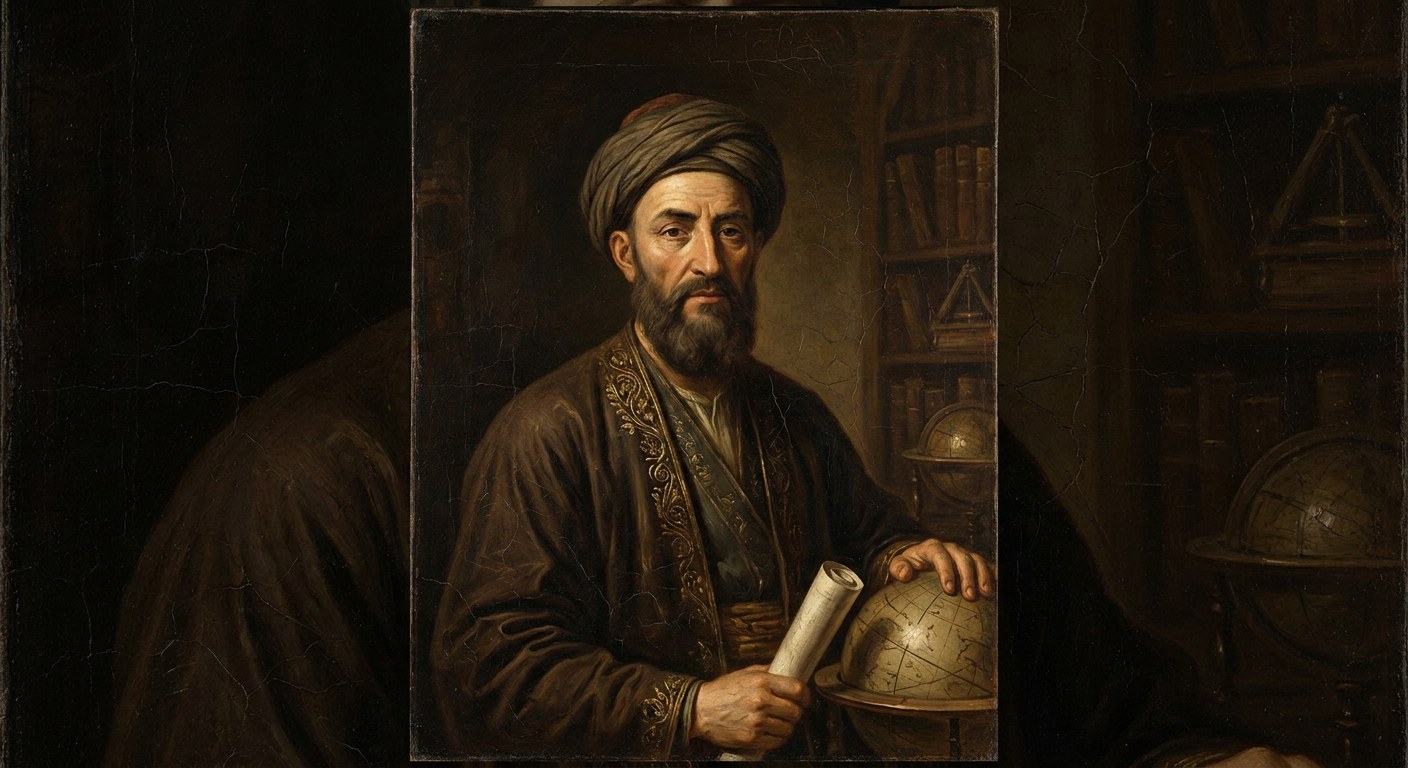
Omar Khayyam
1048 – 1131 · Persian · Mathematician, Astronomer & Poet
Recommended Audiobooks
Listen next from Marcus Alden

Life Lessons from Frederic Chopin
Marcus Alden · 54 min

Life Lessons from John Wesley
Marcus Alden · 52 min
1. Introduction
Omar Khayyam was a Persian mathematician, astronomer, philosopher and poet whose reputation spans two very different worlds. To historians of science, he was a major scholar of the Islamic Golden Age: an innovative algebraist who systematically investigated cubic equations, a critic and interpreter of Euclid, and an astronomer associated with one of the most sophisticated calendar reforms of the medieval period. To millions of general readers, however, he is best known as the voice behind the Rubáiyát of Omar Khayyám, a collection of Persian quatrains made internationally famous through Edward FitzGerald’s nineteenth-century English adaptation.
Khayyam lived during the age of the Great Seljuk Empire, when Persian and Arabic scholarship flourished under courtly patronage. Arabic was the principal language of his scientific and philosophical writings, while Persian was the language of the verses traditionally connected with his name. His work demonstrates the close relationship among mathematics, astronomy, philosophy and theology in medieval Islamic intellectual culture.
His mathematical achievements were substantial. Khayyam classified cubic equations according to their algebraic forms and showed how many could be solved geometrically through the intersections of conic sections. Although he did not possess the symbolic notation or general algebraic formulas developed in early modern Europe, his systematic treatment marked an important stage in the history of algebra. He also examined irrational ratios and challenged difficulties in Euclid’s theory of parallels.
Khayyam’s poetic identity is more complicated. Hundreds—and eventually more than a thousand—quatrains were attributed to him, but relatively few can be traced to early manuscripts. Modern scholars therefore distinguish the historical Khayyam from the enlarged poetic persona created by centuries of manuscript transmission and translation. Even so, the themes associated with the Rubáiyát—mortality, fate, doubt, wine, love and the urgency of the present moment—have made his name one of the most recognizable in Persian literature.
2. Quick Facts
| Fact | Details |
|---|---|
| Born | Traditionally 18 May 1048, Nishapur, Khurasan |
| Died | Traditionally 4 December 1131, Nishapur |
| Nationality | Persian; a subject of the Seljuk realms |
| Known For | Algebra, cubic equations, astronomy, the Jalali calendar and the Rubáiyát |
| Occupation | Mathematician, astronomer, philosopher, scholar and poet |
| Era | Islamic Golden Age; Great Seljuk period |
The precise birth and death dates commonly printed for Khayyam depend on later biographical and calendrical reconstruction. The years 1048 and 1131 are widely accepted, but the exact days should not be regarded as beyond dispute.
3. Early Life and Education
Omar Khayyam was born in Nishapur, a prosperous city in the region of Khurasan in northeastern Iran. His full name is usually given as Ghiyath al-Din Abu al-Fath Umar ibn Ibrahim al-Khayyami, although medieval sources preserve variations. The name Khayyam means “tentmaker” and may indicate the occupation of an ancestor rather than Khayyam’s own profession.
Nishapur was a major center of trade, religious learning and Persian culture. Located along important routes connecting Iran with Central Asia, the city supported scholars of law, theology, medicine, mathematics and literature. Khayyam grew up at a time when the Seljuk Turks were consolidating political authority over much of Iran and the Middle East while relying heavily on Persian administrators and intellectuals.
Reliable information about his family and childhood is scarce. Later stories portray him as a precocious student trained by eminent masters, but many biographical details were recorded long after his death. It is nevertheless clear from his surviving writings that he received an advanced education. He mastered Arabic, the international scholarly language of the Islamic world, and studied Greek mathematical and philosophical traditions through Arabic translations and commentaries.
His intellectual formation included arithmetic, algebra, geometry, astronomy and philosophy. Euclid’s Elements was central to his geometrical education, while the works of Aristotle and Ibn Sina—known in Latin Europe as Avicenna—shaped his philosophical outlook. Khayyam later referred to Ibn Sina as his philosophical master, although this probably meant intellectual discipleship rather than direct personal instruction: Ibn Sina died in 1037, before Khayyam was born.
Khayyam is sometimes said to have studied with Nizam al-Mulk, the future Seljuk vizier, and Hasan-i Sabbah, later leader of the Nizari Ismailis. According to a famous tale, the three schoolfellows promised to share their fortunes if any of them achieved power. The story is almost certainly legendary. Their ages, backgrounds and known movements make such a youthful association highly improbable. Its popularity reflects later attempts to connect three striking personalities of the Seljuk age rather than dependable biography.
As a young scholar, Khayyam probably traveled in search of education and patronage. Balkh, Bukhara and Samarkand were important intellectual centers within his wider cultural world. By the late 1060s or early 1070s, he was working in Samarkand, where he obtained the support of Abu Tahir, the city’s chief judge. This relationship gave him the stability necessary to undertake his influential research in algebra.
4. Rise to Prominence
Khayyam’s rise began through mathematics rather than poetry. At Samarkand he composed his Treatise on Demonstration of Problems of Algebra and Balancing. The work displayed an unusual degree of organization and ambition. Instead of presenting only a collection of computational procedures, Khayyam classified equations and sought rigorous geometrical demonstrations for their solutions.
His growing reputation brought him into contact with powerful patrons. Around 1074, Sultan Malik-Shah I and the vizier Nizam al-Mulk invited him to Isfahan, the Seljuk capital. There he joined scholars assembled to conduct astronomical observations and reform the calendar. Some accounts refer to an observatory established under Malik-Shah, although its precise organization and physical form remain uncertain.
The Isfahan period was probably the most secure and productive stage of Khayyam’s career. Court support gave him access to instruments, colleagues and the prolonged observations required for calendrical work. He continued his mathematical studies while participating in a commission charged with determining the solar year and regulating the date of Nowruz, the Persian New Year.
The resulting calendar is known as the Jalali calendar, named for Malik-Shah’s honorific Jalal al-Dawla. Its era began in 1079. It was solar and closely connected to the astronomical determination of the vernal equinox. Modern claims sometimes state that Khayyam personally invented a fixed 33-year leap-year cycle or produced a calendar categorically more accurate than the Gregorian calendar. The historical reality is subtler: the medieval Jalali system relied substantially on observation, and Khayyam was one distinguished member of a larger commission. Later Iranian calendars drew on related principles but were not necessarily identical to the original arrangement.
By the 1070s, Khayyam had become sufficiently respected to be consulted on difficult scientific and philosophical questions. His writings suggest confidence in mathematical demonstration and a willingness to criticize inherited authorities where their arguments seemed incomplete. At the same time, his career remained dependent on courtly protection—a vulnerability that became evident after the political upheavals of 1092.
5. Major Achievements and Contributions
Algebra and cubic equations
Khayyam’s most celebrated mathematical achievement was his systematic analysis of equations of the third degree. Medieval algebra was usually expressed rhetorically, without modern symbols, negative numbers or a general concept of polynomial degree. Equations were described through combinations of “numbers,” “roots,” “squares” and “cubes,” and only positive solutions were ordinarily considered meaningful.
Within those conventions, Khayyam classified numerous forms of linear, quadratic and cubic equations. Quadratic equations could be solved using methods inherited and developed from earlier mathematicians such as al-Khwarizmi. Cubics posed a greater challenge. Khayyam recognized that purely arithmetic procedures then known were insufficient for a general treatment, so he constructed solutions through geometry.
He used intersections among circles, parabolas and hyperbolas to identify lengths satisfying particular cubic equations. His treatment did not provide the general algebraic formula for cubic equations discovered in sixteenth-century Italy, nor did it encompass negative or complex roots. Nevertheless, it represented a major conceptual advance because it organized cubic problems into types and supplied demonstrations grounded in Greek geometry.
Khayyam also perceived the possibility of multiple positive solutions in some constructions, although his analysis of all such cases was incomplete. His work helped bridge classical geometry and the later development of algebraic thinking.
Euclidean geometry and the parallel postulate
In his Explanations of the Difficulties in the Postulates of Euclid, completed around 1077, Khayyam examined logical problems in Euclid’s foundations. He was especially concerned with the theory of parallels and with definitions involving ratios and proportional magnitudes.
Khayyam attempted to prove Euclid’s parallel postulate from principles he considered more intuitive. His argument employed a quadrilateral with equal sides perpendicular to a base, a figure now often associated with both Khayyam and the eighteenth-century mathematician Giovanni Saccheri. Khayyam rejected alternatives that would eventually be recognized as related to non-Euclidean geometries. He did not discover non-Euclidean geometry, but his careful analysis exposed the distinctive logical status of the parallel postulate and became part of the long historical path toward later breakthroughs.
His discussion of ratios also sought to reconcile numerical and geometrical conceptions of magnitude. Historians have viewed this work as an important contribution to medieval debates about irrational quantities and continuity.
Astronomy and calendar reform
Khayyam’s astronomical fame rests chiefly on the Jalali calendar project. Determining the length of the tropical year—the interval governing the recurrence of the seasons—required precise observation and mathematical calculation. The commission’s reform fixed Nowruz in relation to the vernal equinox and produced an exceptionally effective solar calendar.
The popular statement that the Jalali calendar loses only one day in several thousand years is based on later assumptions about leap-year cycles and should be treated carefully. An observational calendar cannot be evaluated in exactly the same way as a permanently fixed arithmetic rule. Still, the reform demonstrated the high standard of Seljuk astronomy and its practical importance for taxation, agriculture, administration and ritual timekeeping.
A set of astronomical tables known as the Zij-i Malik-Shahi, or Malik-Shah Astronomical Tables, was associated with the project. Only fragments or references survive, preventing a full assessment of Khayyam’s individual role.
Philosophy
Khayyam wrote short philosophical treatises on existence, necessity, knowledge and the order of creation. His thought belonged broadly to the Aristotelian and Avicennian tradition. He reasoned that contingent beings depend on a necessary first cause and treated the universe as an intelligible hierarchy.
This philosophical Khayyam does not always resemble the skeptical hedonist imagined by some readers of the Rubáiyát. His prose works use the vocabulary of Islamic philosophy and generally affirm God as the source of existence. Yet they also reveal an independent mind concerned with the limitations of human knowledge. Whether individual skeptical quatrains represent his personal beliefs remains difficult to establish because poetic authorship is uncertain and Persian verse often uses deliberately ambiguous voices.
Persian poetry
The quatrain, or ruba‘i, consists of four lines, usually with an AABA rhyme pattern. The verses attributed to Khayyam compress large questions into a small form: Why are humans created if they must die? Can fate be understood? Should uncertain promises about the future outweigh immediate beauty? Is wine literal, symbolic or both?
Khayyam was known as a poet not long after his lifetime, but early sources attribute only a small number of verses to him. As manuscripts circulated, the collection expanded. Quatrains by other poets, anonymous compositions and verses expressing “Khayyamic” themes were absorbed under his prestigious name. Consequently, there is no universally accepted canon of authentic Khayyam poems.
6. Key Works / Battles / Ideas
Treatise on Demonstration of Problems of Algebra and Balancing
Khayyam’s algebraic masterpiece classified equations and solved cubic cases through conic sections. It is one of the most important works in the history of medieval algebra. Its combination of systematic classification and geometrical proof distinguished it from purely practical manuals.
Explanations of the Difficulties in the Postulates of Euclid
This work addressed the parallel postulate, ratios and the foundations of geometry. Although Khayyam’s attempted proof of the parallel postulate was unsuccessful, the method he used anticipated later investigations into the assumptions underlying Euclidean geometry.
Jalali calendar and Zij-i Malik-Shahi
Khayyam participated in the astronomical commission sponsored by Malik-Shah. The calendar’s epoch began in 1079, and the associated tables bore the sultan’s name. Khayyam should be understood as a leading contributor rather than necessarily the project’s sole creator.
Philosophical treatises
Works attributed with varying degrees of confidence to Khayyam include treatises on existence, necessity, the universality of being and the problem of knowledge. They place him within the tradition of Ibn Sina and show that contemporaries regarded him as more than a technical mathematician.
Nowruz-nama
The Nowruz-nama, a Persian work on the history and customs of the Persian New Year, is traditionally attributed to Khayyam. It discusses royal practices, seasonal symbolism and aspects of pre-Islamic Iranian culture. Scholars continue to debate whether he wrote it in its surviving form.
The Rubáiyát
The Rubáiyát is not a single securely transmitted book prepared by Khayyam. It is a fluctuating body of quatrains attributed to him across different manuscripts. Edward FitzGerald’s 1859 English Rubáiyát was a highly creative selection and adaptation rather than a literal translation of one fixed Persian text.
FitzGerald reorganized, combined and reshaped verses to create a sustained meditation on mortality and pleasure. The first edition attracted little notice, but later editions became extraordinarily popular in Britain and the United States. Its success transformed Khayyam into a global literary icon while often obscuring his scientific career and the complexities of the Persian manuscript tradition.
7. Timeline of Key Events
| Year | Event |
|---|---|
| 1048 | Traditional year of Khayyam’s birth in Nishapur, Khurasan. |
| c. 1060s | Studies mathematics, astronomy, philosophy and the Arabic scholarly tradition. |
| c. 1070 | Works in Samarkand under the patronage of the judge Abu Tahir and develops his algebraic treatise. |
| 1074 | Invited to Isfahan under Sultan Malik-Shah I and Vizier Nizam al-Mulk. |
| 1077 | Completes his treatise on difficulties in Euclid’s postulates. |
| 1079 | The epoch of the Jalali solar calendar begins. |
| 1092 | Nizam al-Mulk is assassinated and Malik-Shah dies; Khayyam loses his principal patrons. |
| c. 1090s | Leaves the secure environment of Isfahan; later reports associate him with a pilgrimage to Mecca. |
| Early 1100s | Returns to or spends extended periods in Khurasan, including Nishapur and possibly Merv. |
| c. 1118 | Associated in later accounts with the courtly world of Sultan Sanjar. |
| 1131 | Traditional year of his death in Nishapur. |
| 1859 | Edward FitzGerald anonymously publishes the first English edition of the Rubáiyát. |
| Late 1800s | The Rubáiyát becomes an international literary phenomenon. |
8. Personal Life and Character
Very little reliable evidence survives about Khayyam’s domestic life. Sources do not securely identify a wife or children, and modern claims about romantic relationships are generally speculative. The absence of information should not be mistaken for proof that he never married; medieval biographers were more interested in scholarly reputation, religious standing and memorable anecdotes than in private household details.
Contemporaries and near-contemporaries described Khayyam as exceptionally learned. The historian al-Bayhaqi praised his command of philosophy and mathematics, while Nizami Aruzi, who said he met Khayyam, remembered him as an astronomer capable of making striking predictions. One famous story reports that Khayyam foretold that his grave would stand where blossoms fell over it each spring. Years later, Nizami Aruzi claimed to have found the grave beside a garden wall covered by flowering branches. The account may contain literary embellishment, but it helped establish Khayyam’s posthumous image as a sage in intimate contact with nature and fate.
His prose suggests an exacting and analytical temperament. He valued demonstrative proof, criticized inadequate arguments and distinguished carefully among kinds of equations. In philosophy, he expressed frustration with shallow scholarship and sectarian quarrels. Later tradition sometimes portrayed him as aloof, proud or dangerously skeptical, but such portraits often reflect reactions to poems of uncertain authorship.
Wine appears constantly in the Khayyam tradition. It may represent literal wine, worldly pleasure, mystical ecstasy, rebellion against hypocrisy or several meanings at once. It is therefore unsafe to reconstruct his daily habits directly from the poetry. Persian literary convention allowed poets to adopt voices that were not straightforward autobiography.
9. Challenges and Controversies
Khayyam’s career depended heavily on political patronage. This arrangement gave him unusual opportunities but exposed him to abrupt changes in power. In 1092, Nizam al-Mulk was assassinated, probably by an Ismaili agent, and Malik-Shah died soon afterward. Their deaths triggered succession struggles and weakened the institutional support surrounding Khayyam’s astronomical work.
Later accounts suggest that he faced criticism from religious opponents who considered aspects of philosophy suspect. A pilgrimage to Mecca has sometimes been interpreted as an attempt to demonstrate religious conformity and silence accusations of unbelief. The evidence is limited, and pilgrimage was itself a normal act of devotion, so historians cannot confidently assign it a defensive motive.
The greatest controversy concerns the poetry. The number of quatrains attributed to Khayyam increased dramatically over time. Early witnesses preserve only a modest group, whereas later collections contain hundreds. There is no authorial manuscript, and scribes frequently transferred verses among poets. Scholars using manuscript age, vocabulary, style and external attribution have proposed different authentic cores, but no complete consensus exists.
This uncertainty affects interpretations of Khayyam’s religion. Depending on which verses are accepted, he can appear as an orthodox philosopher, a Sufi mystic, an agnostic, a materialist, a fatalist or a celebrant of wine. These labels often say as much about editors and translators as about the historical man. His authenticated philosophical prose is broadly compatible with Avicennian metaphysics, though not necessarily with every position favored by religious traditionalists.
FitzGerald’s adaptation created another debate. Its beauty and historical importance are undeniable, but it reflects Victorian literary taste and FitzGerald’s personal skepticism. It is not a transparent reproduction of a stable Persian original. Orientalist readers sometimes treated its speaker as the definitive voice of an exotic, pleasure-loving East, simplifying both Khayyam and Persian culture.
Even his scientific achievements have been exaggerated on occasion. He did not invent Pascal’s triangle, although numerical arrangements and binomial ideas related to it were known in the Islamic world and have sometimes been associated with his lost writings. He did not discover a general symbolic solution to cubic equations. Nor can the modern Iranian calendar simply be identified in every detail with the eleventh-century Jalali reform. Recognizing these limits does not diminish him; it places his genuine achievements in their correct historical setting.
10. Death and Immediate Aftermath
Khayyam died in Nishapur, traditionally in 1131. A later biographical account states that on his final day he was reading the section on metaphysics in Ibn Sina’s Book of Healing. He reportedly marked his place, prayed and died after making his final testament. Like many medieval deathbed narratives, this story may have been shaped to present an ideal end for a philosopher.
He was buried in Nishapur. Nizami Aruzi’s account of visiting the grave describes it beside a garden where pear and peach blossoms fell across the burial place. Khayyam’s modern mausoleum, completed in 1963 and designed by the Iranian architect Houshang Seyhoun, uses interlocking geometric forms that evoke his mathematics, astronomy and poetry.
Khayyam did not immediately become the world-famous poet familiar today. Among medieval scholars, his reputation rested substantially on mathematics, astronomy and philosophy. His algebra circulated in manuscript and influenced later Islamic mathematicians, although it did not become widely known in Latin Europe during the Middle Ages. The poetic tradition attached to his name continued to grow more gradually.
11. Legacy and Influence Today
Khayyam occupies a distinguished place in the history of mathematics. His geometrical treatment of cubic equations represents one of the most systematic premodern investigations of the subject. Historians value his ability to classify problems, recognize the limits of existing arithmetic methods and unite algebraic questions with conic geometry.
His analysis of Euclid is significant in the history of foundational thought. Although he intended to defend Euclidean geometry, the quadrilateral and hypotheses he examined became part of the centuries-long investigation that eventually led mathematicians to understand that non-Euclidean geometries were logically possible.
In Iran, Khayyam is celebrated as a national cultural figure whose life connects Persian literary heritage with scientific achievement. His tomb in Nishapur is an important memorial, and his name has been given to schools, institutions, streets and scientific organizations. A lunar crater and the asteroid 3095 Omarkhayyam also commemorate him.
The literary afterlife of the Rubáiyát has been vast. FitzGerald’s adaptation inspired illustrated editions, musical settings, paintings, theatrical works and popular sayings. “The Moving Finger writes” entered English-language culture as a proverbial image of irreversible fate. Khayyam clubs formed in Britain and the United States, and lavishly decorated copies became prized objects of book design.
His reception also demonstrates the power and risk of translation. FitzGerald ensured Khayyam’s global fame but created an English poetic sequence that partly belongs to FitzGerald himself. Newer translators have tried to work more directly from Persian sources, while textual scholars continue to distinguish early attestations from later additions.
Today Khayyam matters because he resists confinement to a single category. He was a rigorous mathematician remembered through lyrical meditations; a Persian intellectual who wrote science in Arabic; a medieval philosopher repeatedly reimagined as a modern skeptic; and a court-supported astronomer whose poems question the reliability of worldly power. The tensions within his reputation make him not less important but more revealing of how knowledge and cultural memory travel across centuries.
12. Famous Quotes
No individual quatrain can be assigned to Khayyam with absolute certainty. The following famous lines are genuine quotations from Edward FitzGerald’s Rubáiyát of Omar Khayyám and are therefore part of Khayyam’s reception, but they should not be treated as literal English statements securely written by the historical Khayyam.
“A Book of Verses underneath the Bough, / A Jug of Wine, a Loaf of Bread—and Thou.”
—Edward FitzGerald, Rubáiyát of Omar Khayyám, fifth edition
“The Moving Finger writes; and, having writ, / Moves on.”
—Edward FitzGerald, Rubáiyát of Omar Khayyám
“Ah, Love! could you and I with Fate conspire / To grasp this sorry Scheme of Things entire.”
—Edward FitzGerald, Rubáiyát of Omar Khayyám
“The Bird of Time has but a little way / To flutter—and the Bird is on the Wing.”
—Edward FitzGerald, Rubáiyát of Omar Khayyám
“Some for the Glories of This World; and some / Sigh for the Prophet’s Paradise to come.”
—Edward FitzGerald, Rubáiyát of Omar Khayyám
A statement securely associated with Khayyam’s mathematical writing is often translated as follows:
“Whoever thinks algebra is a trick in obtaining unknowns has thought it in vain. No attention should be paid to the fact that algebra and geometry are different in appearance. Algebras are geometric facts.”
—Omar Khayyam, Treatise on Demonstration of Problems of Algebra and Balancing, in modern translation
13. Frequently Asked Questions
Who was Omar Khayyam?
Omar Khayyam was an eleventh- and twelfth-century Persian mathematician, astronomer, philosopher and poet. He worked in the Seljuk Empire and is remembered scientifically for his research on cubic equations, Euclidean geometry and calendar reform. His international literary fame arose largely from Edward FitzGerald’s English Rubáiyát.
Was Omar Khayyam primarily a poet or a scientist?
During his lifetime, he appears to have been known principally as a scholar of mathematics, astronomy and philosophy. His modern popular image as a poet developed through the expanding Persian manuscript tradition and, especially, FitzGerald’s nineteenth-century adaptation.
Did Khayyam solve cubic equations?
He solved many classified forms of cubic equations geometrically by finding intersections of conic sections. He did not discover the later general algebraic formula, and his methods focused on positive magnitudes rather than the full range of negative and complex roots used in modern algebra.
Did Omar Khayyam invent the Jalali calendar?
He was a leading member of the commission that developed the Jalali calendar under Sultan Malik-Shah I. Calling him its sole inventor oversimplifies a collaborative project involving several astronomers and extensive observations.
Is the modern Persian calendar Khayyam’s calendar?
The modern Solar Hijri calendar belongs to the same broad tradition of equinox-based Persian solar timekeeping, but it should not be treated as identical in every technical detail to the original Jalali system of 1079.
Did Khayyam write every poem in the Rubáiyát?
No. The Rubáiyát is a changing collection of quatrains attributed to him, not a securely preserved authorial book. Some verses may be authentic, but many were added or transferred from other poets over the centuries.
Was Omar Khayyam an atheist?
There is insufficient evidence to call him an atheist. His philosophical writings refer to God and employ Avicennian metaphysics. Skeptical or irreverent poems attributed to him are textually uncertain and may also use conventional literary symbolism rather than express a simple personal creed.
Where is Omar Khayyam buried?
He is buried in Nishapur, Iran. His modern geometric mausoleum, designed by Houshang Seyhoun and completed in 1963, celebrates the mathematical and poetic dimensions of his legacy.
14. Lessons We Can Learn
-
Combine disciplines rather than isolating them. Khayyam used geometry to answer algebraic questions and astronomical observation to solve practical calendrical problems. Creative advances often emerge where fields intersect.
-
Recognize the limits of current methods. He understood that the arithmetic techniques available to him could not solve every cubic equation and deliberately sought a different geometrical approach.
-
Question inherited authority constructively. Khayyam respected Euclid but did not accept every foundation without examination. Intellectual progress requires both knowledge of tradition and willingness to test it.
-
Treat famous reputations critically. The historical Khayyam and the poetic figure created by later manuscripts and translations overlap, but they are not identical. Sources, dates and transmission histories matter.
-
Remember the value of time. Whether or not every quatrain is authentic, the Khayyamic tradition confronts mortality and the uncertainty of the future. It encourages attentiveness to knowledge, friendship and the present world.
15. Further Reading
- Mehdi Aminrazavi, The Wine of Wisdom: The Life, Poetry and Philosophy of Omar Khayyam. Oneworld, 2005.
- Roshdi Rashed and Bijan Vahabzadeh, Omar Khayyam, the Mathematician. Bibliotheca Persica Press, 2000.
- B. A. Rosenfeld and A. P. Youschkevitch, Omar Khayyam. Birkhäuser, 2000.
- Peter Avery and John Heath-Stubbs, trans., The Ruba‘iyat of Omar Khayyam. Penguin Classics, 1981.
- Edward FitzGerald, Rubáiyát of Omar Khayyám: A Critical Edition, edited by Christopher Decker. University Press of Virginia, 1997.
Watch and Learn
The Mathematical Secrets of Pascal’s Triangle · TED-Ed