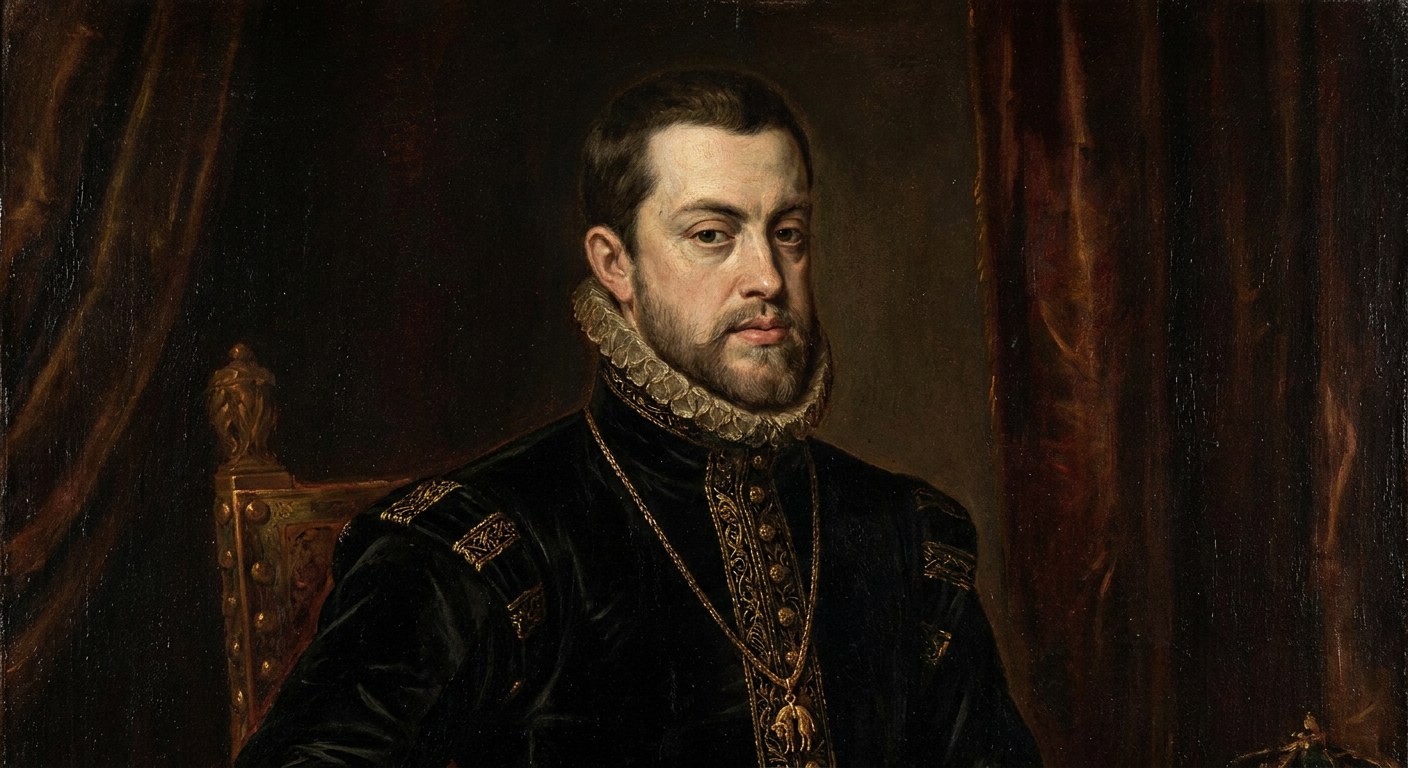
Philip II of Spain
1527 – 1598 · Spanish · King of Spain
Recommended Audiobooks
Listen next from Marcus Alden

Life Lessons from Frederic Chopin
Marcus Alden · 54 min

Life Lessons from John Wesley
Marcus Alden · 52 min
Introduction
Philip II of Spain (21 May 1527–13 September 1598) was one of the most powerful monarchs of the sixteenth century. During a reign extending from 1556 to 1598, he governed a vast composite monarchy that included the kingdoms of Spain, territories in Italy and the Low Countries, and an expanding overseas empire in the Americas and Asia. After becoming king of Portugal in 1580, he also ruled Portuguese possessions in Africa, Asia, and Brazil. His dominions stretched across several continents, giving rise to the observation that the sun never set on his monarchy.
A son of the Habsburg emperor Charles V and Isabella of Portugal, Philip inherited immense resources but also formidable obligations. He defended Catholicism during the Reformation, fought the Ottoman Empire, confronted rebellion in the Netherlands, intervened in France, and attempted to overthrow Protestant England through the Spanish Armada. Under his government, Spanish and allied forces won the celebrated Battle of Lepanto in 1571, Portugal was united with the Spanish monarchy, and the transpacific route between the Americas and Asia became a durable component of global commerce.
Philip was neither a battlefield monarch nor a flamboyant public figure. He preferred palaces, councils, memoranda, and written reports. His painstaking approach earned him the later nickname “the Paper King.” Admirers regarded him as conscientious, disciplined, and devoted to justice and religion; critics portrayed him as inflexible, suspicious, and excessively committed to confessional uniformity. His reign was consequently an age of both imperial achievement and mounting strain.
Understanding Philip requires moving beyond simple images of a Spanish tyrant or Catholic champion. He ruled not a unified nation-state but a collection of kingdoms and provinces, each possessing its own laws, privileges, institutions, and political traditions. His successes and failures helped shape Spain, Portugal, the Netherlands, England, the Mediterranean world, and the early history of globalization.
Quick Facts
| Category | Details |
|---|---|
| Full name | Philip of Habsburg, commonly known as Philip II of Spain |
| Born | 21 May 1527, Valladolid, Crown of Castile |
| Died | 13 September 1598, El Escorial, near Madrid |
| Parents | Charles V, Holy Roman Emperor, and Isabella of Portugal |
| House | Habsburg |
| King of Spain | 16 January 1556–13 September 1598 |
| King of Portugal | 1580–1598, as Philip I |
| King of England and Ireland | 1554–1558, jointly with his wife Mary I |
| Principal residences | Madrid, Aranjuez, El Pardo, and El Escorial |
| Religion | Roman Catholicism |
| Spouses | Maria Manuela of Portugal; Mary I of England; Elisabeth of Valois; Anna of Austria |
| Heir | Philip III of Spain |
| Major conflicts | Italian Wars, Ottoman-Habsburg wars, Dutch Revolt, Anglo-Spanish War, French Wars of Religion |
| Notable victory | Battle of Lepanto, 7 October 1571 |
| Major defeat | Failure of the Spanish Armada, 1588 |
| Burial place | Royal Crypt, Monastery of San Lorenzo de El Escorial |
Early Life & Background
Philip was born in Valladolid on 21 May 1527. His father, Charles V, was Holy Roman Emperor as well as ruler of Spain, the Low Countries, parts of Italy, and extensive American possessions. His mother, Isabella of Portugal, frequently acted as regent in Spain while Charles traveled through his European dominions. Philip grew up primarily in Castile and identified strongly with its language, court culture, and religious traditions.
His education was designed to prepare him for government. Tutors including Juan Martínez Silíceo and the humanist Juan Cristóbal Calvete de Estrella taught him Latin, history, geography, mathematics, and Catholic theology. Philip read widely, collected books and works of art, and developed interests in architecture, gardens, music, and natural history. Although he learned some Portuguese and Latin, he never acquired the linguistic range of his cosmopolitan father.
Philip’s childhood was marked by loss. Isabella died in Toledo in 1539 following childbirth, when Philip was twelve. Charles subsequently gave his son detailed instructions on kingship, warning him to choose advisers carefully, hear competing opinions, and preserve his own authority. These instructions helped reinforce Philip’s guarded personality and preference for controlled, documentary government.
In 1543, at the age of sixteen, Philip married his double first cousin Maria Manuela of Portugal. That same year, Charles appointed him regent of Spain while the emperor was abroad. Philip therefore gained practical administrative experience unusually early. Maria Manuela gave birth to their son, Don Carlos, in July 1545 but died a few days later. The prince survived with serious physical and psychological difficulties that later became a grave political and personal problem.
Philip’s first period as regent introduced him to the councils governing Castile, Aragon, finance, war, the Inquisition, and the overseas territories. It also taught him that royal authority depended on negotiation with representative institutions, aristocrats, churchmen, municipal elites, and officeholders. Even a powerful Habsburg monarch could not simply command every part of his dominions in the same manner.
Rise to Prominence
Between 1548 and 1551, Philip traveled through Italy, Germany, and the Low Countries in a journey intended to introduce him to the territories he might inherit. His reserved Spanish court manners did not always appeal to Netherlandish or German elites, but the journey expanded his political experience. He observed the religious divisions of the Holy Roman Empire and the difficulties involved in ruling culturally distinct provinces.
In 1554, Philip married Mary I, the Catholic queen of England. Under the marriage settlement, he became King of England and Ireland in his wife’s lifetime, although his authority was restricted and he could not treat England as a Habsburg dependency. The marriage was intended to strengthen Catholic rule and tie England to the Habsburg alliance. It produced no child, despite Mary’s apparent pregnancies, and Philip spent comparatively little time in England.
Charles V gradually abdicated his many titles. In October 1555, Philip received the Netherlands, and in January 1556 he inherited the Spanish kingdoms and their overseas possessions. Charles’s brother Ferdinand received the imperial title, separating the Spanish and Austrian branches of the Habsburg dynasty.
Philip began his reign amid war with France. Spanish-Habsburg forces, commanded by Emmanuel Philibert, Duke of Savoy, defeated the French at Saint-Quentin on 10 August 1557. Another victory followed at Gravelines in 1558. The Peace of Cateau-Cambrésis in April 1559 ended decades of Italian warfare and confirmed Spanish predominance in Italy.
As part of the settlement, Philip married Elisabeth of Valois, daughter of Henry II of France. He returned to Spain in 1559 and never again left the Iberian Peninsula. In 1561 he established his court permanently at Madrid, whose central location made it a useful administrative capital. From there, Philip governed through councils, secretaries, viceroys, governors, and an enormous flow of correspondence.
Major Achievements
Philip’s greatest territorial success was his acquisition of Portugal. After the death of the childless King Sebastian at the Battle of Alcácer Quibir in Morocco in 1578, and the brief reign of Cardinal-King Henry, several claimants contested the succession. Philip had a strong hereditary claim through his mother. When negotiations failed to secure universal recognition, the Duke of Alba led a Spanish army into Portugal and defeated the forces of António, Prior of Crato, at Alcântara in August 1580.
Philip was recognized as Philip I of Portugal by the Cortes of Tomar in 1581. He promised to respect Portuguese laws, offices, coinage, and imperial administration. The union was therefore dynastic rather than a complete political merger. It placed the Spanish and Portuguese empires under one ruler, creating a worldwide monarchy with territories in Europe, the Americas, Africa, and Asia.
Another major achievement was resistance to Ottoman expansion. After Ottoman forces captured Cyprus from Venice, Philip joined Pope Pius V and Venice in the Holy League. Its fleet, commanded by Philip’s half-brother Don John of Austria, defeated the Ottomans at Lepanto on 7 October 1571. The victory did not end Ottoman power, but it checked immediate pressure in the western Mediterranean and became a defining symbol of Catholic military unity.
Philip’s reign also witnessed the consolidation of Spain’s Pacific empire. Miguel López de Legazpi established a lasting Spanish settlement at Cebu in 1565 and founded Manila in 1571. The Manila galleon route connected the Philippines with Acapulco in New Spain. American silver was exchanged for Chinese silk, porcelain, spices, and other Asian goods, creating one of the earliest sustained systems of transoceanic trade.
At home, Philip strengthened royal administration without abolishing the distinct institutions of his kingdoms. Specialized councils examined matters of state, war, finance, Italy, Portugal, the Indies, Castile, and Aragon. Philip personally reviewed reports and annotated documents. This method increased the monarch’s knowledge of government but also slowed decisions and encouraged excessive central dependence on the king.
Philip was an important patron of architecture and the arts. His greatest project was the Royal Monastery of San Lorenzo de El Escorial, built northwest of Madrid principally between 1563 and 1584. Designed first by Juan Bautista de Toledo and then by Juan de Herrera, the complex served as monastery, palace, church, library, college, and royal mausoleum. Its austere monumental style expressed Philip’s vision of Catholic monarchy, learning, discipline, and dynastic memory.
Defining Moments
The revolt in the Netherlands became the central political crisis of Philip’s reign. The seventeen provinces possessed strong local privileges and contained growing Protestant communities, particularly Calvinists. Opposition intensified over taxation, the reorganization of bishoprics, the prosecution of heresy, and fears that traditional liberties were being eroded.
In 1566, Calvinist iconoclasts attacked Catholic images and churches during the Beeldenstorm, or Iconoclastic Fury. Philip responded by sending Fernando Álvarez de Toledo, Duke of Alba, with an army. Alba established the Council of Troubles, called the “Council of Blood” by its enemies, and executed prominent nobles including Counts Egmont and Horn in 1568. Repression, taxation, and military occupation broadened resistance.
William of Orange emerged as the revolt’s principal leader. The capture of Brielle by the Sea Beggars in 1572 gave the rebels a durable foothold. Spanish troops later mutinied because of unpaid wages and sacked Antwerp in November 1576, an atrocity known as the Spanish Fury. The northern provinces formed the Union of Utrecht in 1579 and repudiated Philip in the Act of Abjuration in 1581. Although Spanish forces under Alexander Farnese recovered much of the south, the Dutch Republic survived.
A second defining crisis concerned Don Carlos, Philip’s eldest son. The prince was physically impaired, emotionally unstable, and increasingly hostile to his father. After Carlos discussed leaving Spain and may have sought involvement in the Netherlands, Philip ordered his arrest in January 1568. Carlos died in confinement on 24 July, probably after illness worsened by fasting and erratic behavior. Philip’s enemies claimed that he had murdered his son, but no reliable evidence supports that allegation.
The Spanish Armada of 1588 became the most famous failure of Philip’s reign. Relations with Elizabeth I’s England had deteriorated because of English support for Dutch rebels, attacks on Spanish shipping by privateers such as Francis Drake, and the execution of Mary, Queen of Scots, in 1587. Philip planned to send a fleet through the English Channel, join Farnese’s army from the Netherlands, and invade England.
The Armada sailed under the Duke of Medina Sidonia. English attacks disrupted its formation near Calais, while fireships forced it from anchorage. At Gravelines on 8 August 1588, the English inflicted damage but did not destroy the fleet. Unable to rendezvous with Farnese, the Armada sailed around Scotland and Ireland, where storms, navigational difficulties, disease, and shipwreck caused severe losses. The defeat damaged Spanish prestige but did not immediately end Spain’s naval or imperial power.
Timeline
| Year | Event |
|---|---|
| 1527 | Born at Valladolid on 21 May |
| 1539 | His mother, Isabella of Portugal, dies |
| 1543 | Marries Maria Manuela of Portugal and becomes regent of Spain |
| 1545 | Birth of Don Carlos; Maria Manuela dies |
| 1548–1551 | Tours Italy, Germany, and the Low Countries |
| 1554 | Marries Mary I and becomes king consort of England and Ireland |
| 1555 | Receives the Netherlands from Charles V |
| 1556 | Becomes king of Spain following Charles V’s abdication |
| 1557 | Habsburg forces defeat France at Saint-Quentin |
| 1558 | Mary I dies; Philip’s English kingship ends |
| 1559 | Peace of Cateau-Cambrésis; marries Elisabeth of Valois |
| 1561 | Establishes the permanent royal court at Madrid |
| 1563 | Construction of El Escorial begins |
| 1566 | Iconoclastic Fury intensifies unrest in the Netherlands |
| 1568 | Don Carlos is imprisoned and dies; Morisco Revolt begins |
| 1570 | Marries Anna of Austria |
| 1571 | Holy League wins the Battle of Lepanto; Manila is founded |
| 1572 | Dutch rebels capture Brielle |
| 1575 | Spanish Crown suspends debt payments |
| 1576 | Mutinous troops sack Antwerp |
| 1579 | Unions of Arras and Utrecht divide the Netherlands |
| 1580 | Philip’s army occupies Portugal |
| 1581 | Recognized as king of Portugal; Dutch Act of Abjuration |
| 1584 | El Escorial is substantially completed |
| 1588 | Spanish Armada fails to invade England |
| 1591 | Royal forces suppress disturbances in Aragon |
| 1596 | Cádiz is captured and sacked by an Anglo-Dutch fleet |
| 1598 | Peace of Vervins with France; Philip dies on 13 September |
Personal Life
Philip married four times, with each marriage serving dynastic as well as personal purposes. His first wife, Maria Manuela of Portugal, died in 1545 after giving birth to Don Carlos. His second wife, Mary I of England, was eleven years older than Philip. Their marriage was politically significant but childless, and Mary’s death in 1558 ended Philip’s formal connection to the English crown.
His third marriage, to Elisabeth of Valois in 1559, appears to have become affectionate despite its diplomatic origin. They had two surviving daughters: Isabella Clara Eugenia and Catherine Michelle. Elisabeth died in 1568 after a miscarriage. Later romantic legends linking her to Don Carlos have no credible historical foundation.
In 1570 Philip married his niece Anna of Austria. Their children included the future Philip III, born in 1578. Anna died in 1580, and Philip did not remarry. He maintained a close relationship with his daughters, especially Isabella Clara Eugenia, who assisted him with correspondence during his declining years and later governed the Spanish Netherlands with her husband, Archduke Albert.
Philip’s public image was solemn, restrained, and emotionally controlled. He dressed largely in the severe black associated with the Spanish Habsburg court, although black dye of high quality was itself expensive and prestigious. In private, he enjoyed art, music, gardens, collecting, and architecture. His collections included works by Titian, Hieronymus Bosch, and other major European artists.
In later life, Philip suffered severely from gout, fever, and limited mobility. He spent his final months at El Escorial and died there on 13 September 1598, aged seventy-one. His son succeeded him as Philip III.
Beliefs & Philosophy
Philip regarded kingship as a sacred responsibility imposed by God. He believed that a ruler must protect the Catholic faith, dispense justice, defend inherited rights, and preserve dynastic possessions. Personal success was less important, in his view, than fulfilling obligations for which he would ultimately answer before God.
His Catholicism was sincere, disciplined, and deeply influenced by the Counter-Reformation. He supported the decrees of the Council of Trent, religious orders, missionary activity, and stricter clerical standards. He also supported the Spanish Inquisition and laws against Protestantism. These measures reflected the era’s close connection between religion and political loyalty, but they imposed harsh penalties on dissenters and restricted intellectual and confessional freedom.
Philip did not seek administrative uniformity in every territory. He generally accepted that Castile, Aragon, Portugal, Naples, Sicily, Milan, and the Netherlandish provinces had different legal systems. His political philosophy was therefore dynastic and jurisdictional rather than national in the modern sense. Conflict emerged when royal policies appeared to violate local privileges or when Philip considered those privileges subordinate to religion, security, or sovereign authority.
His style of government emphasized consultation. Councils and advisers prepared written opinions, known as consultas, for his review. Yet Philip often postponed decisions while seeking more information. His commitment to personal oversight gave government consistency but produced bottlenecks that became increasingly serious as his dominions expanded.
Challenges & Controversies
Philip’s monarchy faced chronic financial instability. Castile supplied much of his revenue, supplemented by taxes, church contributions, loans, and American silver. Yet warfare consumed enormous sums. The Crown suspended payments to creditors in 1557, 1560, 1575, and 1596. These episodes were restructurings of sovereign debt rather than proof that Spain had simply “run out” of wealth, but they disrupted credit and exposed the limits of royal resources.
Inflation, military expenditure, unequal taxation, and dependence on borrowed money burdened the Castilian economy. American silver expanded Philip’s purchasing power but also flowed rapidly to bankers, suppliers, and foreign markets. The monarchy’s global reach repeatedly exceeded its capacity to coordinate revenue, transport, and military commitments.
Religious persecution remains one of the darkest aspects of the reign. Protestants were prosecuted in Spain, while pressure on the Moriscos—Muslims who had been compelled to convert to Christianity—helped provoke the Revolt of the Alpujarras in 1568. After the revolt was suppressed in 1571, many Moriscos were dispersed from Granada to other parts of Castile.
The Netherlands demonstrated the dangers of inflexibility and poor communication. Philip viewed concessions on religion as both sinful and politically ruinous. His opponents saw his policies as foreign tyranny. Atrocities occurred on both sides, but Alba’s repression and the actions of unpaid Spanish troops did lasting damage to Habsburg legitimacy.
The case of Antonio Pérez, Philip’s former secretary, created another scandal. Pérez was implicated in the 1578 murder of Juan de Escobedo, secretary to Don John of Austria. After years of detention, Pérez escaped to Aragon in 1590 and invoked Aragonese legal protections. Philip’s attempt to use the Inquisition against him contributed to unrest in Zaragoza in 1591. Royal troops restored control, while Pérez fled abroad and published attacks on Philip.
These accusations fed the “Black Legend,” a tradition depicting Spain as uniquely cruel, fanatical, and despotic. Some criticisms rested on real repression and warfare, but Protestant, Dutch, English, and anti-Habsburg propaganda frequently exaggerated Philip’s personal role or repeated unsupported stories. Modern historians generally offer a more balanced assessment without minimizing the violence of his policies.
Famous Quotes
Many sayings associated with Philip are preserved in later accounts rather than secure contemporary transcripts. They should therefore be treated cautiously.
“I never knowingly committed an injustice.”
This statement is traditionally associated with Philip’s reflections near the end of his life and summarizes his conviction that he had governed conscientiously. Whether every word is authentic is uncertain.
“Time and I against any two.”
Frequently attributed to Philip, this aphorism captures his patience and preference for delay, documentation, and long-term strategy. Its exact origin is unclear.
“I sent my ships to fight against men, not against the winds and waves.”
Philip is traditionally said to have made this remark after the Armada’s failure. The wording is probably apocryphal, although he did interpret the disaster with notable religious resignation and did not publicly blame Medina Sidonia.
“God, whose cause it is, will guide it.”
This sentiment, found in varying forms in Philip’s correspondence, reflects his tendency to view political and military enterprises through the language of providence.
Legacy & Influence
Philip left his successor the largest aggregation of territories yet ruled by the Spanish Habsburgs. Spain remained a leading European and global power well into the seventeenth century. The Iberian union survived until 1640, while Portugal formally regained independence in 1668. Spanish rule in the Philippines lasted until 1898, and Manila continued to serve as a crucial link between Asian and American markets.
His reign contributed decisively to the political division of the Netherlands. The southern provinces remained under Habsburg rule and developed broadly along the path of modern Belgium and Luxembourg, while the northern Dutch Republic became an independent Protestant and commercial power. Philip did not recognize Dutch independence, which was formally acknowledged only in 1648.
The Armada’s defeat acquired greater symbolic significance than its immediate strategic effect. England celebrated it as evidence of Protestant deliverance, while later histories portrayed it as the beginning of Spanish decline and English maritime supremacy. In reality, Spain rebuilt its fleet, continued to protect most American treasure convoys, and remained militarily formidable.
Philip’s cultural legacy is visible above all at El Escorial. The complex remains one of Europe’s most important royal and religious monuments. Madrid’s status as Spain’s political center likewise dates from his decision to establish the court there in 1561.
Historiographically, Philip has been interpreted as saintly defender, cold-blooded despot, diligent bureaucrat, and tragic imperial overreacher. Modern scholarship emphasizes the structural difficulties of governing a dispersed composite monarchy. It also recognizes both his exceptional work ethic and his inability to reconcile confessional certainty with political compromise.
Interesting Facts
- The Philippines were named in Philip’s honor while he was still a prince.
- He ruled Portugal as Philip I, not Philip II.
- Philip was king consort of England and Ireland during Mary I’s reign.
- He governed largely through handwritten annotations on official papers.
- El Escorial contained a palace, monastery, basilica, library, school, and royal burial complex.
- He owned major paintings by Titian and collected works by Hieronymus Bosch.
- Despite ruling numerous European territories, he never returned to the Netherlands after becoming king.
- He moved the royal court to Madrid in 1561, helping transform it into a major capital.
- His half-brother Don John of Austria commanded the victorious Holy League fleet at Lepanto.
- Philip’s empire used routes across both the Atlantic and Pacific oceans.
- The Armada of 1588 was not Spain’s only naval expedition against England; later armadas sailed in 1596 and 1597 but were also frustrated, principally by storms and logistical problems.
- His final peace with France, the Treaty of Vervins, was concluded only months before his death.
Frequently Asked Questions
Why was Philip II important?
Philip ruled one of history’s first truly global monarchies. His decisions influenced the Reformation, Mediterranean warfare, the Dutch Revolt, England’s development, Portuguese history, and transpacific trade. His reign represents both the height of Spanish Habsburg power and the emergence of serious long-term strains.
What countries did Philip II rule?
He ruled the kingdoms comprising Spain, Portugal after 1580, Naples, Sicily, Sardinia, Milan, the Spanish Netherlands, and overseas territories in the Americas and Asia. These lands were not a single unified state; they retained different institutions and laws.
Was Philip II king of England?
Yes, but only through his marriage to Mary I. From 1554 until Mary’s death in 1558, he held the title King of England and Ireland jointly with her. The marriage settlement restricted his independent authority, and he lost the title when Mary died.
Why did Philip II send the Spanish Armada?
Philip sought to stop English support for the Dutch rebels, English privateering against Spanish interests, and Elizabeth I’s Protestant policies. The execution of Mary, Queen of Scots, reinforced his decision. His plan was to secure the English Channel and transport the Duke of Parma’s army from the Netherlands into England.
Did storms alone defeat the Armada?
No. English attacks, fireships, communication failures, unsuitable anchorages, Spanish logistical problems, and the inability to join Parma’s army had already caused the invasion plan to fail. Storms and shipwrecks then inflicted additional losses during the fleet’s return around Scotland and Ireland.
Did Philip II murder his son Don Carlos?
There is no reliable evidence that he did. Philip imprisoned Carlos because he considered him unstable and politically dangerous. Carlos died in custody in July 1568 after serious illness and self-destructive behavior. Stories of murder became part of anti-Spanish propaganda and later romantic literature.
Was Philip II an absolute monarch?
Not in the modern sense. His authority was extensive, but each territory had laws, representative bodies, privileges, and administrative traditions. Philip frequently had to negotiate taxation and policy with local institutions. He was strongest in Castile and faced greater constitutional limits elsewhere.
Why did the Netherlands revolt?
The revolt resulted from a combination of religious persecution, resistance to taxation, defense of provincial privileges, resentment of royal officials and troops, and the spread of Calvinism. Repressive responses, especially under the Duke of Alba, transformed unrest into a prolonged war.
What was Philip II’s greatest victory?
The Battle of Lepanto in 1571 was his most celebrated military victory, although the conquest of Portugal in 1580–1581 had greater territorial consequences. The Peace of Cateau-Cambrésis also confirmed Spanish predominance in Italy.
How did Philip II die?
Philip died at El Escorial on 13 September 1598 after prolonged illness, including severe gout and fever. He was buried in the royal monastery he had built and was succeeded by his son Philip III.
Lessons from Philip II of Spain
- Vast power requires effective delegation: Philip’s personal oversight promoted accountability but also delayed decisions.
- Military strength cannot overcome logistical failure: The Armada demonstrated the importance of communication, weather, supply, and realistic coordination.
- Religious certainty can obstruct political compromise: Philip’s refusal to tolerate Protestant worship intensified the Dutch conflict.
- Composite states depend on local consent: Attempts to override provincial laws and privileges can transform opposition into rebellion.
- Financial resources are not unlimited: Even abundant silver could not compensate for simultaneous wars and structural fiscal weakness.
- Propaganda shapes historical memory: The Black Legend shows how real abuses can become intertwined with exaggeration and myth.
- Cultural patronage can outlast political campaigns: El Escorial and Philip’s collections remain enduring parts of his legacy.
- Short-term victories may carry long-term costs: Spain won major battles yet accumulated debt, enemies, and difficult commitments.
- Global rule demands global coordination: Philip’s monarchy pioneered worldwide administration but struggled with distance and slow communication.
- Historical judgment requires balance: Philip was both a diligent ruler and an architect of harsh repression; neither fact should erase the other.
Further Reading
- Geoffrey Parker, Imprudent King: A New Life of Philip II
- Geoffrey Parker, The Grand Strategy of Philip II
- Henry Kamen, Philip of Spain
- Patrick Williams, Philip II
- John Lynch, Spain 1516–1598: From Nation State to World Empire
- J. H. Elliott, Imperial Spain, 1469–1716
- Fernand Braudel, The Mediterranean and the Mediterranean World in the Age of Philip II
- James D. Tracy, The Founding of the Dutch Republic: War, Finance, and Politics in Holland, 1572–1588
- Garrett Mattingly, The Armada
- Hugh Thomas, World Without End: Spain, Philip II, and the First Global Empire