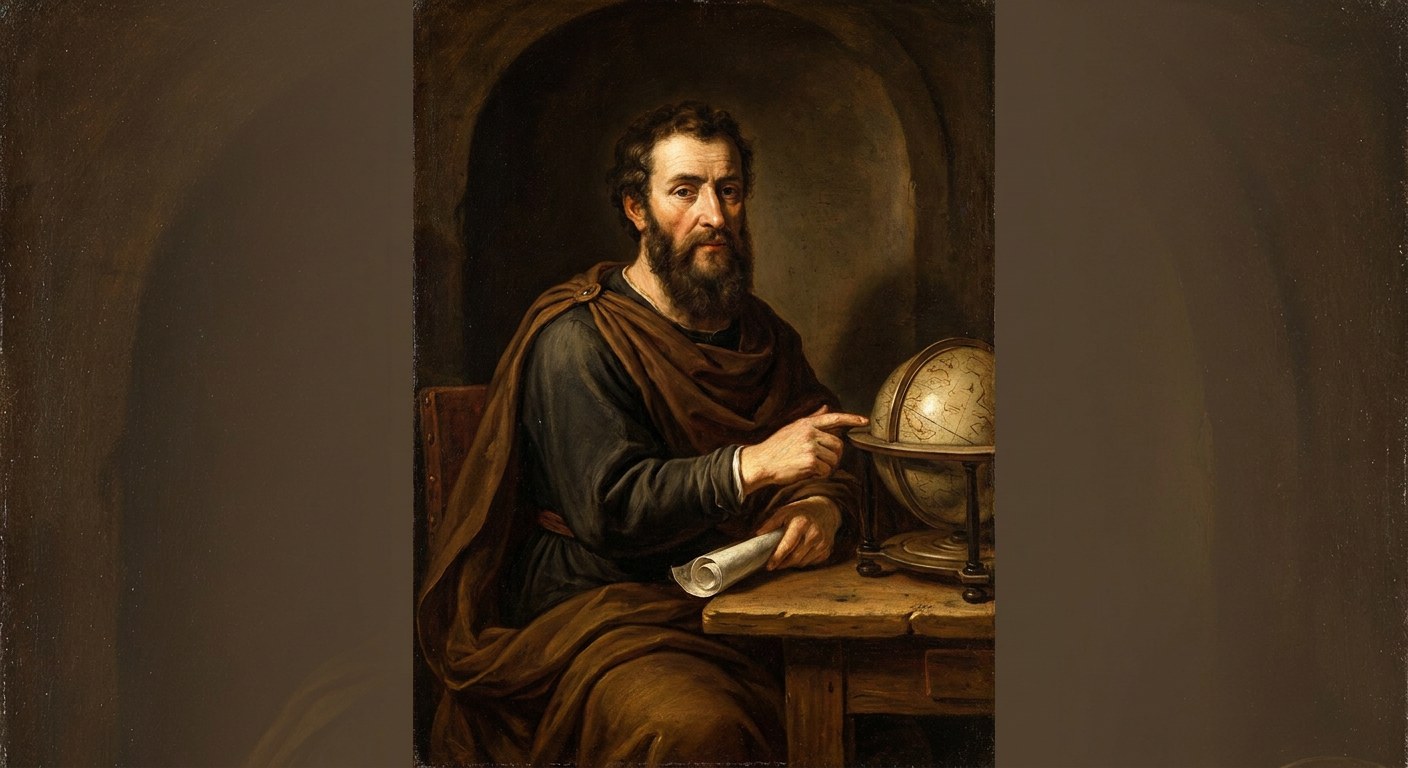
Claudius Ptolemy
100 – 170 · Greco-Roman Egyptian · Astronomer & Mathematician
Recommended Audiobooks
Listen next from Marcus Alden

Life Lessons from Frederic Chopin
Marcus Alden · 54 min

Life Lessons from John Wesley
Marcus Alden · 52 min
Introduction
Claudius Ptolemy—known in Greek as Klaudios Ptolemaios and in Latin as Claudius Ptolemaeus—was one of antiquity’s most influential astronomers, mathematicians, geographers, astrologers, and theorists of music. Active in Roman Egypt during the second century CE, he created systematic works that shaped scientific learning in the Mediterranean world, the Islamic Middle East, and medieval and Renaissance Europe.
Ptolemy is best known for the Mathematical Syntaxis, later called the Almagest, a comprehensive account of mathematical astronomy. In it, he presented a geocentric model of the cosmos: a stationary, spherical Earth stood near the center while the Moon, Sun, planets, and fixed stars moved around it. Using combinations of circles—including deferents, epicycles, and the device now called the equant—Ptolemy produced calculations capable of predicting planetary positions with impressive accuracy for his time.
His influence extended far beyond astronomy. The Geography established a mathematical framework for mapping the known world through coordinates, projections, latitude, and longitude. The Tetrabiblos gave astrology a systematic philosophical and technical foundation. The Harmonics investigated relationships among musical intervals, mathematics, and perception. Other writings addressed optics, chronology, mechanics, and the design of astronomical instruments.
Very little is known about Ptolemy’s personal life. He was not a member of the earlier Ptolemaic dynasty that ruled Egypt after Alexander the Great, and no reliable ancient biography survives. Most knowledge of him comes from his own books and recorded observations. Those works reveal a scholar rooted in Alexandria’s traditions of mathematical science, deeply indebted to predecessors such as Hipparchus, yet willing to reorganize inherited knowledge into powerful new systems.
Some of Ptolemy’s conclusions were eventually superseded, especially after the development of heliocentric astronomy. His geography also contained serious errors, while his use of earlier astronomical data has generated scholarly controversy. Nevertheless, his importance rests not merely on whether individual conclusions proved correct. Ptolemy demonstrated how complex natural phenomena could be represented mathematically, compared with observations, organized into tables, and transmitted in a form usable by later scholars. For more than a millennium, his books served as essential reference works across several civilizations.
Quick Facts
| Category | Details |
|---|---|
| Full name | Claudius Ptolemy; Greek: Klaudios Ptolemaios; Latin: Claudius Ptolemaeus |
| Common name | Ptolemy |
| Born | Probably around 100 CE |
| Birthplace | Unknown; traditionally associated with Roman Egypt |
| Died | Probably around 170 CE |
| Place of death | Unknown, possibly Alexandria |
| Historical period | Roman Empire, second century CE |
| Main center of activity | Alexandria, Egypt |
| Fields | Astronomy, mathematics, geography, cartography, astrology, optics, music theory |
| Best-known work | Almagest |
| Other major works | Geography, Tetrabiblos, Harmonics, Optics, Planetary Hypotheses |
| Astronomical framework | Geocentric mathematical model |
| Recorded observations | Mainly 127–141 CE |
| Major intellectual influence | Hipparchus of Nicaea |
| Lasting contribution | Systematic mathematical models and reference works used for more than 1,000 years |
| Not to be confused with | The Ptolemaic kings of Egypt |
Early Life & Background
Almost nothing certain is known about Ptolemy’s childhood, family, education, or social position. His approximate lifetime must be reconstructed from the dates of observations in his works and from later references. He probably lived from about 100 to about 170 CE, during the reigns of the Roman emperors Trajan, Hadrian, Antoninus Pius, and Marcus Aurelius.
His name reflects the multicultural setting of Roman Egypt. “Ptolemaios” was Greek and common in Egypt after the Macedonian conquest, while “Claudius” was Roman. The combination may indicate that Ptolemy or an ancestor possessed Roman citizenship, perhaps acquired when citizenship was granted by an emperor of the Claudian dynasty. It does not establish his ethnicity or ancestry. Claims that he was Greek, Egyptian, or of mixed background remain possible but unproven.
The astronomer is sometimes linked with Ptolemais Hermiou, a city in Upper Egypt, because of an ancient description that may identify him as “Ptolemy of Ptolemais.” The evidence is ambiguous, however, and Alexandria is far more securely associated with his scientific work. His astronomical tables employ the meridian of Alexandria, and several observations were made there.
Second-century Alexandria was an exceptional intellectual environment. Founded by Alexander the Great in 331 BCE, it had long been a center of Greek-language scholarship. Its scholarly traditions included Euclidean geometry, mathematical astronomy, medicine, mechanics, textual criticism, and geography. Although the famous Library and Mouseion had undergone political and institutional changes by Ptolemy’s lifetime, Alexandrian scientific culture remained vigorous.
Ptolemy’s writings show advanced training in geometry, arithmetic, astronomical observation, and Greek philosophical terminology. He knew the work of Aristotle and other philosophers, but his methods were especially indebted to the mathematical astronomy of Hipparchus of Nicaea, who worked during the second century BCE. Hipparchus had developed solar and lunar models, compiled star observations, studied eclipses, and discovered the precession of the equinoxes. Ptolemy treated him as his most important predecessor.
The lack of biographical evidence has encouraged legends. Medieval portraits often represented Ptolemy as a crowned king, partly because he shared a name with Egypt’s Ptolemaic rulers. He was almost certainly not royal. Nor is there reliable evidence that he served as a priest, directed the Library of Alexandria, or held a formal imperial office.
Rise to Prominence
Ptolemy’s rise cannot be traced through appointments, patrons, or public events. Instead, it appears in the sequence of observations and books associated with him. The earliest dated observation he records was made in Alexandria on 26 March 127 CE. His surviving astronomical observations continue into the reign of Antoninus Pius, with several dated to 141 CE.
These observations formed part of a larger program: to construct an integrated mathematical description of the heavens. Greek astronomers had long accepted a spherical Earth within a spherical cosmos, while mathematical modelers used combinations of uniform circular motions to reproduce celestial appearances. Ptolemy inherited this tradition but gave it an unprecedented degree of organization.
His first major achievement was to synthesize geometry, observational data, and earlier theory into the thirteen-book Mathematical Syntaxis. It later became known as the “Great Syntaxis.” Arabic-speaking scholars called it al-Majisti, “the Greatest,” from which the Latin title Almagest developed.
The work established Ptolemy as the leading systematic astronomer of antiquity. It offered readers not merely general claims about the cosmos but procedures for computation. It included trigonometric tools, models of the Sun and Moon, eclipse calculations, a star catalogue, a discussion of precession, and theories for the five planets visible to the naked eye.
Ptolemy also transformed other fields through similar acts of synthesis. In the Geography, he assembled methods for mapping the inhabited world and provided coordinates for thousands of locations. In the Tetrabiblos, he attempted to distinguish reasoned celestial influence from popular superstition. In the Harmonics, he joined numerical ratios to the evidence of hearing.
His prominence in his own lifetime is difficult to measure. No contemporary account describes his reputation, pupils, or institutional position. Yet the scope and polished structure of his books suggest an experienced author addressing technically educated readers. Later Greek commentators treated his works as authoritative, and translations carried them into Syriac, Arabic, Latin, and other scholarly languages.
Major Achievements
The Almagest
The Almagest was Ptolemy’s greatest scientific synthesis. Its thirteen books begin with foundational assumptions: the heavens are spherical, the Earth is spherical and located near the center, and the Earth is effectively motionless relative to the celestial sphere. Ptolemy supported these propositions with physical and observational arguments considered plausible in ancient science.
To facilitate calculation, he produced a table of chords, a predecessor of modern trigonometric tables. A chord in a circle is related to the sine function, and Ptolemy’s table enabled solutions to geometrical problems essential for astronomy.
His solar model represented the Sun as moving nonuniformly around the Earth, mathematically described through an eccentric circle. His lunar theory was more complicated and helped predict the Moon’s varying speed, conjunctions, oppositions, and eclipses. For the planets, he used deferents and epicycles: a planet moved on a smaller circle whose center moved along a larger circle.
A particularly important device was the equant. In an equant model, the center of an epicycle appears to move uniformly not from the center of its deferent but as seen from another point. This improved agreement between mathematical prediction and observed planetary motion. Later astronomers, including Nicolaus Copernicus, regarded the equant as mathematically effective but physically troubling because it departed from strict uniform motion around a true center.
The Almagest also contains a catalogue of more than 1,000 stars arranged into constellations, with positions and brightness classifications. Much of its underlying material may derive from Hipparchus, but Ptolemy presented it within a complete astronomical system. The catalogue became a fundamental reference for later astronomers.
Mathematical Geography and Cartography
Ptolemy’s eight-book Geography, or Geographia, sought to represent the inhabited world mathematically. He distinguished geography—the mapping of the world as a whole—from chorography, the detailed depiction of individual regions.
The work explained how places could be located using latitude and longitude. Latitude might be derived from the length of the longest day or the altitude of celestial bodies. Longitude was harder to determine because accurate portable clocks did not exist. Ptolemy adopted a prime meridian through the “Fortunate Islands,” usually identified with the Canary Islands or nearby Atlantic islands.
He supplied coordinates for roughly 8,000 places, including cities, river mouths, mountains, regions, and islands. He also discussed map projections for transferring the curved surface of the spherical Earth onto a flat plane.
The Geography contained substantial errors. Ptolemy underestimated the Earth’s circumference relative to the accurate calculation traditionally associated with Eratosthenes. He also exaggerated the longitudinal extent of Eurasia and relied on inconsistent reports from travelers, merchants, and earlier geographers. Yet his coordinate-based method was revolutionary in its capacity to organize spatial information.
Astrology and Natural Causation
The four-book Tetrabiblos became one of history’s most influential astrological texts. Ptolemy argued that celestial bodies could affect terrestrial conditions, just as the Sun visibly produced heat and seasonal change and the Moon was associated with moisture and tides. He treated astrology as a probabilistic study of natural influences rather than a source of absolute predictions.
The work discusses planetary characteristics, zodiacal signs, weather, regions, births, temperament, health, occupation, marriage, and length of life. Ptolemy acknowledged uncertainty, emphasizing that celestial configurations interacted with heredity, environment, customs, and individual circumstances.
Modern science rejects natal astrology as a reliable predictive discipline. Historically, however, the Tetrabiblos mattered because it provided astrology with a coherent Aristotelian-style framework and separated elite mathematical astrology from magical or sensational practices.
Optics and Vision
Ptolemy’s Optics survives incompletely, principally through a medieval Latin translation derived from Arabic. It examined sight, color, reflection, and refraction. Ptolemy adopted an extramission theory of vision, according to which visual rays proceeded from the eye—an idea later displaced by more accurate accounts of light entering the eye.
Despite that mistaken foundation, his study of refraction was empirical. He reported measurements of how rays bend when passing between air, water, and glass. His numerical relationships were not fully accurate, but the attempt to compare measured angles reflected a significant experimental tendency.
Music Theory
In the Harmonics, Ptolemy analyzed musical intervals, tuning systems, and the relationship between mathematical ratios and auditory judgment. He engaged critically with both Pythagorean theorists, who emphasized number, and Aristoxenian theorists, who emphasized perception.
Ptolemy argued that reason and hearing should correct and support one another. He extended harmonic ideas to the human soul and the cosmos, reflecting the ancient conviction that numerical order could connect music, psychology, and astronomy.
Instruments and Models
Ptolemy described or inspired astronomical tables, observational instruments, armillary arrangements, and models of planetary motion. The Planetary Hypotheses attempted to give physical dimensions and spatial ordering to the planetary system described mathematically in the Almagest. In doing so, he helped transform computational devices into a more concrete cosmology of nested celestial mechanisms.
Defining Moments
One defining moment was Ptolemy’s adoption and refinement of Hipparchus’s mathematical legacy. Rather than treating earlier results as isolated discoveries, he combined them into a single instructional framework. This act of synthesis gave ancient astronomy a standard reference work.
A second was his introduction—or at least systematic use—of the equant in planetary theory. The equant allowed a model based on circles to reproduce nonuniform motion more successfully. It represented a characteristic Ptolemaic compromise: preserving the geometry of circular motion while adjusting its center of uniformity to fit observations.
A third was the completion of the Almagest, probably around the middle of the second century. Its publication marked the emergence of the most comprehensive astronomical system available before the early modern period. Greek commentators, Islamic astronomers, and European university scholars repeatedly studied, corrected, and adapted it.
Ptolemy’s Geography created another defining shift. By treating maps as projections generated from coordinates, he presented geography as a mathematical science rather than merely a literary description of peoples and places. Even where his data were wrong, his framework made correction possible in principle.
Finally, the translation movements of later centuries transformed Ptolemy from an Alexandrian author into a global intellectual authority. His works passed through Greek, Syriac, Arabic, and Latin scholarly communities. This long transmission ensured that Ptolemaic astronomy became both the foundation that later astronomers used and the system they eventually challenged.
Timeline
| Year | Event |
|---|---|
| c. 100 CE | Approximate birth of Claudius Ptolemy, probably in Roman Egypt |
| 26 March 127 | Earliest observation explicitly dated by Ptolemy, made at Alexandria |
| 127–141 | Principal period of Ptolemy’s recorded astronomical observations |
| 132 | Ptolemy records observations used in his lunar and planetary analyses |
| 139 | Observations associated with the construction or testing of planetary models |
| 141 | Latest group of observations commonly associated with the Almagest |
| c. 145–150 | Probable period for the completion or circulation of the Almagest |
| 147–148 | Approximate date associated with the Canobic Inscription, a summary of astronomical parameters attributed to Ptolemy |
| Mid-2nd century | Composition of works including the Tetrabiblos, Planetary Hypotheses, and Geography |
| c. 150–160 | Probable period of Ptolemy’s mature writing on geography, harmonics, and optics |
| c. 170 | Traditional approximate date of Ptolemy’s death |
| 8th–9th centuries | Ptolemy’s astronomical works are translated and studied in the Islamic world |
| c. 827 | An Arabic translation of the Almagest is produced under Abbasid patronage |
| 12th century | Gerard of Cremona translates the Almagest from Arabic into Latin |
| 1406 | Jacopo d’Angelo completes an influential Latin translation of the Geography from Greek |
| 1477 | The first printed edition of the Geography containing maps appears in Bologna |
| 1543 | Copernicus publishes On the Revolutions, retaining many Ptolemaic mathematical techniques within a heliocentric system |
| 17th century | Keplerian ellipses and telescopic discoveries decisively replace Ptolemaic planetary astronomy |
Personal Life
No trustworthy evidence identifies Ptolemy’s parents, spouse, children, teachers, or pupils. His writings are technical and rarely autobiographical. The respectful dedication of the Almagest to a man named Syrus suggests an intellectual associate, patron, or student, but Syrus’s identity is unknown.
Ptolemy appears to have spent much of his working life in or near Alexandria. The city’s libraries, scholarly traditions, observational opportunities, and access to reports from across the Roman Empire would have supported his research. His geographical project in particular required extensive written sources rather than personal travel to every region described.
Later traditions embellished his life. Some depicted him as a king of Egypt, while others assigned him a grand public role at Alexandria. These claims arose from confusion with the Ptolemaic dynasty or from the prestige of his books. The historical Ptolemy is better understood as a mathematical scholar of Roman Alexandria whose private circumstances remain almost entirely hidden.
Even his appearance is unknown. Renaissance and early modern portraits are imaginary. They typically show a bearded philosopher, sometimes wearing a crown and holding an astronomical instrument. Such images reflect later perceptions of his authority, not eyewitness testimony.
Beliefs & Philosophy
Ptolemy’s scientific philosophy combined mathematical rigor, empirical observation, and a search for rational order. He regarded mathematics as especially valuable because its demonstrations possessed a stability that ethics and natural philosophy often lacked. Astronomy, in his view, trained the mind to contemplate regularity and divine order.
His cosmology was geocentric, but it should not be reduced to the crude claim that “everything circles Earth in simple loops.” Ptolemy’s system was a sophisticated mathematical construction designed to account for changing speeds, retrograde motion, brightness variations, eclipses, and seasonal inequalities.
He believed that the Earth was spherical and extremely small compared with the celestial sphere. He rejected a rotating Earth partly because, within ancient physics, rapid rotation seemed as though it should produce observable effects on falling bodies, clouds, and projectiles. The later development of inertia and improved mechanics answered objections that Ptolemy could not resolve with the concepts available to him.
Ptolemy generally sought to “save the phenomena”—to construct models reproducing observed appearances. Historians debate how literally he interpreted the machinery of deferents and epicycles. The Planetary Hypotheses shows that he did attempt to relate mathematical models to a physically structured cosmos, although the relationship between his computational astronomy and physical cosmology remains complex.
In astrology, he adopted a qualified determinism. Celestial influences created tendencies, not unavoidable destinies. Local environment, ancestry, education, and custom also affected outcomes. This position allowed him to acknowledge uncertainty while preserving astrology as a branch of natural inquiry.
His Harmonics expresses a broader conviction that numerical relationships connect different levels of reality. Musical consonance, the structure of the soul, and celestial order could all be analyzed through proportion. For Ptolemy, mathematical science was not merely practical calculation; it cultivated intellectual and moral harmony.
Challenges & Controversies
Ptolemy faced the central technical challenge of ancient astronomy: how to reconcile irregular celestial appearances with a cosmos supposedly governed by orderly motion. Planets sometimes slow down, stop, move backward against the stars, and then resume direct motion. His layered circular models were responses to this problem.
The accuracy and originality of his observations have generated controversy. In the twentieth century, physicist and historian Robert R. Newton accused Ptolemy of fabricating observations and adjusting data to match theory. Most historians consider such sweeping charges excessive, but many accept that Ptolemy sometimes relied on earlier data, transformed reported observations, or presented theoretically derived values as though they had observational status.
The star catalogue is particularly disputed. Scholars have long investigated whether its positions were largely copied from Hipparchus and adjusted for precession. The catalogue probably incorporates substantial Hipparchan material, but debate continues over the extent of Ptolemy’s independent observation and revision.
His geographical errors had major consequences. By underestimating the Earth’s circumference and stretching Asia too far eastward, the Ptolemaic tradition made the westward distance from Europe to Asia appear smaller than it really was. Christopher Columbus later drew on geographical ideas shaped partly by Ptolemaic and medieval calculations, though his plans also depended on other sources and additional errors.
Ptolemy’s map of the Indian Ocean treated it as enclosed by land to the south, while his representation of Africa and eastern Asia contained distortions arising from limited reports. These shortcomings illustrate the weakness of a coordinate system when its source data are unreliable.
His astrology is another enduring controversy. It was intellectually respected for centuries, but its assumptions do not meet modern standards of controlled testing and predictive reliability. Likewise, his extramission theory of vision was incorrect, even though some of his optical measurements were significant.
The replacement of geocentrism is sometimes portrayed as a simple victory of reason over ignorance. The historical transition was more complicated. Copernicus used epicycles and geometrical techniques inherited from Ptolemy. Tycho Brahe proposed a geoheliocentric alternative, and Johannes Kepler’s elliptical orbits finally offered a more accurate physical geometry. Ptolemy’s system endured because it was technically powerful, not because later scholars refused to think critically.
Famous Quotes
Translations of Ptolemy’s Greek vary, and some famous wording survives through later textual traditions.
“Mortal as I am, I know that I am born for a day; but when I follow at my pleasure the serried multitude of the stars in their circular course, my feet no longer touch the earth.”
—Epigram traditionally attributed to Ptolemy
“For everything that is hard to attain is easily assailed by the generality of men.”
—Almagest, Book I, in a traditional English translation
“Astronomy alone can bring about this result, making men seeing and constant followers of order, symmetry, and absence of arrogance.”
—Almagest, Book I, wording varying by translation
“We should not think that everything happens to mankind as the result of the heavenly cause.”
—Tetrabiblos, expressing Ptolemy’s rejection of absolute astrological determinism
“It is a good thing to make the investigation of nature contribute to the love of the divine.”
—A sentiment associated with the philosophical introduction to the Almagest, with wording dependent on translation
Legacy & Influence
Ptolemy’s most immediate legacy was the creation of authoritative textbooks. The Almagest became the principal framework for advanced astronomy from late antiquity through the Middle Ages. Commentators such as Pappus of Alexandria and Theon of Alexandria studied it, and its methods entered Byzantine scholarship.
Its reception in the Islamic world was especially important. From the eighth century onward, Ptolemy’s works were translated into Arabic under Abbasid patronage. Astronomers including al-Battani, al-Sufi, Ibn al-Haytham, al-Biruni, Nasir al-Din al-Tusi, and Ibn al-Shatir examined, corrected, or challenged Ptolemaic astronomy.
Islamic scholars did not merely preserve Ptolemy. Al-Sufi revised stellar descriptions; Ibn al-Haytham criticized the physical implausibility of Ptolemaic mechanisms; and astronomers at Maragha developed new geometrical devices that eliminated or replaced aspects of the equant. Their tables and models became essential parts of the later astronomical tradition.
In Latin Europe, the Almagest became widely accessible through Gerard of Cremona’s twelfth-century translation from Arabic. It entered university curricula and informed astronomical tables, calendars, astrology, and navigation. European astronomers learned planetary theory through a Ptolemaic framework even when they sought to improve it.
Copernicus’s heliocentric model represented a profound break, but it also depended on Ptolemy’s questions, observations, and mathematical vocabulary. Copernicus retained circular motions and epicycles while relocating Earth among the planets. Kepler’s use of elliptical orbits and Galileo’s telescopic observations later undermined essential features of traditional Ptolemaic cosmology.
The Geography had a separate Renaissance revival. Its Greek text reached Western Europe, and Jacopo d’Angelo completed a Latin translation around 1406. Printed editions encouraged cartographers to construct gridded maps using projection methods. Ptolemy’s specific picture of the world soon became outdated, but his coordinate-based approach helped shape Renaissance cartography.
The Tetrabiblos remained a foundational astrological authority in Arabic, Byzantine, and Latin cultures. Its influence reached courts, medical practice, weather prediction, and university discussions of natural philosophy. Although astrology later lost scientific legitimacy, the work remains essential for understanding ancient and medieval cosmology.
Ptolemy’s deepest legacy lies in method. He assembled observations, identified mathematical variables, constructed models, published tables, acknowledged predecessors, and offered procedures that others could test. His errors became productive because they were organized precisely enough to be criticized. Scientific progress often advances not only through correct answers, but through explicit systems that later thinkers can examine and replace.
Interesting Facts
- Ptolemy was not one of the Ptolemaic pharaohs, despite frequent medieval depictions of him wearing a crown.
- The title Almagest combines the Arabic definite article al- with a form derived from the Greek word for “greatest.”
- His works were written in Greek, the principal language of scholarship in Roman Alexandria.
- Ptolemy recognized that the Earth was spherical; geocentrism did not imply belief in a flat Earth.
- His star catalogue listed more than 1,000 stars in 48 constellations.
- He used a base-60, or sexagesimal, numerical system inherited from Babylonian astronomy.
- Modern divisions of angles into degrees, minutes, and seconds reflect the same sexagesimal tradition.
- His table of chords performed a role similar to later sine tables.
- The lunar model in the Almagest predicted an unrealistically large variation in the Moon’s apparent distance, a physical weakness visible even within his system.
- The Geography supplied instructions for drawing maps, but surviving ancient manuscripts do not prove that every map traditionally associated with it was drawn by Ptolemy himself.
- His Optics survives only incompletely and passed through Arabic before reaching medieval Latin readers.
- The Canobic Inscription, found near ancient Canopus in Egypt, preserves astronomical parameters associated with an earlier stage of his system.
- A lunar crater, a Martian crater, and the asteroid 4001 Ptolemaeus bear his name.
- The “Ptolemaic system” was not a single unchanging diagram; later astronomers modified its parameters and mechanisms repeatedly.
- Ptolemy’s works influenced scholars in Greek, Syriac, Arabic, Persian, Hebrew, Latin, and Renaissance European intellectual traditions.
Frequently Asked Questions
Who was Ptolemy?
Ptolemy was a second-century mathematician, astronomer, geographer, astrologer, music theorist, and optical writer active in Alexandria under Roman rule. He is best known for the Almagest and Geography.
When did Ptolemy live?
He probably lived from about 100 to about 170 CE. His securely dated astronomical activity falls mainly between 127 and 141 CE.
Was Ptolemy Egyptian or Greek?
His precise ancestry is unknown. He lived in Roman Egypt, wrote in Greek, bore a Greek personal name, and had the Roman name Claudius. Labels such as Greek, Egyptian, Greco-Egyptian, or Roman Alexandrian may describe aspects of his context, but none can be proven as a complete ethnic identification.
Was Ptolemy a king of Egypt?
No. He lived centuries after the Ptolemaic dynasty began and more than a century after its final ruler, Cleopatra VII, died in 30 BCE. Medieval artists sometimes crowned him because they confused the astronomer with the kings who shared his name.
What was Ptolemy’s model of the universe?
Ptolemy placed a stationary spherical Earth near the center of the cosmos. The Sun, Moon, planets, and fixed stars moved around it through combinations of circular motions. His models used eccentrics, deferents, epicycles, and equants to reproduce observed celestial patterns.
Did Ptolemy invent geocentrism?
No. Earth-centered cosmologies existed long before him. His achievement was to produce the most comprehensive and mathematically effective geocentric astronomical system of antiquity.
Why was the Ptolemaic system accepted for so long?
It agreed reasonably well with naked-eye observations, supported useful calculations, built upon respected Greek physics, and was presented in a detailed technical form. For centuries, no alternative model clearly surpassed it in both predictive performance and physical plausibility.
What did Ptolemy contribute to geography?
He developed a systematic account of latitude, longitude, map projections, and coordinate-based cartography. He also compiled thousands of place coordinates, although many were inaccurate.
Did Ptolemy believe in astrology?
Yes, but he treated astrological effects as tendencies rather than absolute destiny. He believed celestial conditions interacted with heredity, environment, and custom. Modern science does not accept his astrological system as empirically reliable.
How did Copernicus differ from Ptolemy?
Ptolemy placed Earth at rest near the cosmic center. Copernicus made Earth a rotating planet orbiting the Sun. Nevertheless, Copernicus inherited many geometrical techniques, observations, and problems from the Ptolemaic tradition.
Were Ptolemy’s observations fraudulent?
Some scholars have accused him of fabricating or manipulating data. The strongest accusations remain disputed. It is likely that he reused earlier observations and sometimes presented calculated or adjusted values in ways that would not satisfy modern standards, but this does not reduce his entire work to fraud.
Why is Ptolemy still important?
He exemplifies the construction of large-scale scientific systems. His works connected observation with mathematical modeling and remained central to astronomy, geography, and related disciplines for more than a millennium.
Lessons from Ptolemy
- Organize knowledge systematically: Ptolemy’s influence came partly from turning scattered findings into coherent, teachable systems.
- Make theories computational: A model becomes more useful when it produces specific predictions that can be compared with observations.
- Build on earlier scholarship: Ptolemy’s dependence on Hipparchus shows that major achievements often synthesize generations of prior work.
- Distinguish models from reality: A mathematical device may predict successfully even when its physical interpretation remains uncertain.
- Preserve methods, not only answers: Ptolemy explained procedures and supplied tables, allowing later scholars to reproduce and criticize his results.
- Recognize uncertainty: His qualified treatment of astrology, though scientifically obsolete, acknowledged that complex outcomes cannot always be reduced to one cause.
- Use both reason and experience: In music and optics, Ptolemy sought interaction between mathematical analysis and sensory evidence.
- Expect authoritative systems to be revised: A theory may dominate for centuries and still be replaced when better evidence and concepts emerge.
- Treat errors as historically informative: Ptolemy’s geographical and astronomical mistakes reveal the limitations of ancient instruments, data networks, and physical assumptions.
- Value cross-cultural transmission: His legacy depended on translators and scholars working in Greek, Arabic, Latin, and other languages.
- Question without caricaturing: Understanding why the Ptolemaic system succeeded is more instructive than dismissing it simply because it was later superseded.
- Create work others can improve: Ptolemy’s explicit models gave critics a clear foundation from which to advance astronomy.
Further Reading
- G. J. Toomer, trans., Ptolemy’s Almagest.
- J. Lennart Berggren and Alexander Jones, Ptolemy’s Geography: An Annotated Translation of the Theoretical Chapters.
- Alexander Jones, ed., Ptolemy in Perspective: Use and Criticism of His Work from Antiquity to the Nineteenth Century.
- Liba Chaia Taub, Ptolemy’s Universe: The Natural Philosophical and Ethical Foundations of Ptolemy’s Astronomy.
- Olaf Pedersen, A Survey of the Almagest.
- James Evans, The History and Practice of Ancient Astronomy.
- Otto Neugebauer, A History of Ancient Mathematical Astronomy.
- Ptolemy, Tetrabiblos, translated by F. E. Robbins.
- Ptolemy, Harmonics, translated and commented upon by Jon Solomon.
- A. Mark Smith, Ptolemy’s Theory of Visual Perception: An English Translation of the Optics.
- N. M. Swerdlow, “Ptolemy’s Theories of the Latitude of the Planets in the Almagest, Handy Tables, and Planetary Hypotheses.”
- George Saliba, A History of Arabic Astronomy: Planetary Theories During the Golden Age of Islam.
- Jamil Ragep, Nasir al-Din al-Tusi’s Memoir on Astronomy.
- Encyclopaedia Britannica, “Ptolemy.”
- Stanford Encyclopedia of Philosophy, entries concerning ancient astronomy, scientific models, and Greek philosophy of science.