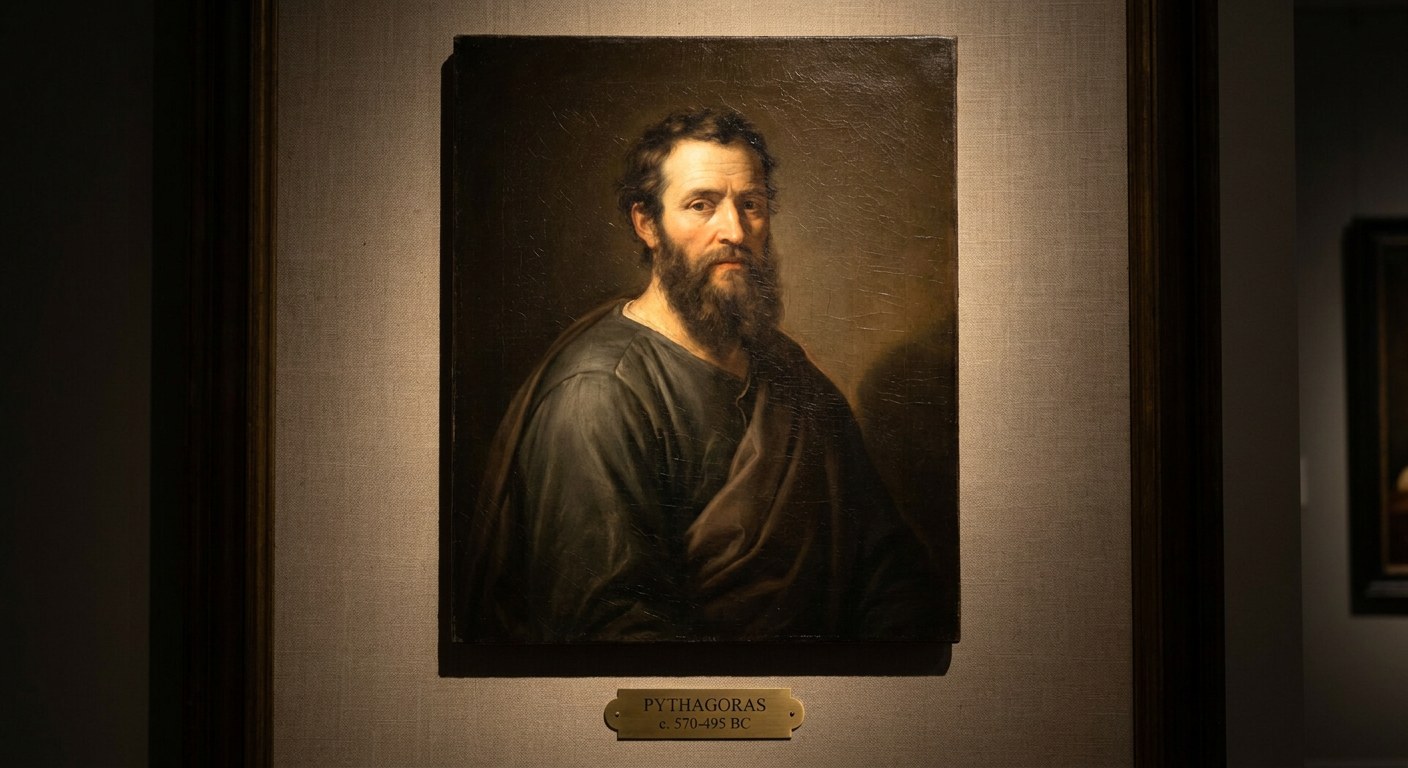
Pythagoras
570 BC – 495 BC · Ancient Greek · Philosopher & Mathematician
Recommended Audiobooks
Listen next from Marcus Alden

Life Lessons from Frederic Chopin
Marcus Alden · 54 min

Life Lessons from John Wesley
Marcus Alden · 52 min
Introduction
Pythagoras of Samos was an ancient Greek philosopher, religious teacher and mathematical thinker whose name became inseparable from one of geometry's most famous propositions: the Pythagorean theorem. Yet the historical Pythagoras was far more than a mathematician. He founded a disciplined community in southern Italy whose members treated philosophy as a complete way of life, combining the study of number, music and the heavens with moral purification, communal loyalty and belief in the transmigration of souls.
Pythagoras lived during the sixth and early fifth centuries BCE, before philosophy, mathematics, religion and natural science had become separate fields. For him and his followers, numerical relationships were not merely useful tools. They appeared to reveal the hidden structure of reality. Musical harmony could be expressed through ratios; geometrical forms embodied order; and the regular movements of the cosmos suggested an intelligible universe governed by proportion.
Establishing exactly what Pythagoras himself taught is exceptionally difficult. He left no securely identifiable writings, and the earliest substantial accounts of his life were composed centuries after his death. His followers also tended to attribute discoveries to their master or to the school collectively. As a result, historians must distinguish among the historical Pythagoras, early Pythagorean communities and later legends created around his name.
Even with these uncertainties, Pythagoras remains one of the formative figures in Western intellectual history. Pythagorean ideas influenced Plato and Aristotle, shaped ancient mathematics and music theory, contributed to philosophical arguments about an ordered cosmos, and survived through Neoplatonism into medieval and Renaissance thought. His career also represents an enduring ideal: the thinker who seeks unity among reason, ethics, nature and the conduct of everyday life.
Quick Facts
| Fact | Details |
|---|---|
| Born | c. 570 BCE, probably on Samos in the eastern Aegean |
| Died | c. 495 BCE, traditionally at Metapontum in southern Italy |
| Nationality | Ancient Greek |
| Known For | Pythagoreanism, the Pythagorean theorem, numerical harmony, transmigration of souls and the community at Croton |
| Occupation | Philosopher, religious teacher and mathematical thinker |
| Era | Archaic Greece; Presocratic philosophy |
Early Life and Education
Pythagoras was probably born around 570 BCE on Samos, a Greek island close to the coast of Asia Minor. Ancient authors identified his father as Mnesarchus, sometimes described as a gem engraver or merchant. His mother was variously named Pythais or Parthenis in later traditions. These details cannot be independently confirmed, but Pythagoras's association with Samos is well established in the ancient record.
Samos was a prosperous maritime and commercial center. Its location connected the Greek world with Anatolia, Egypt and the eastern Mediterranean. During Pythagoras's youth, Greek intellectual culture was changing rapidly. Thinkers such as Thales, Anaximander and Anaximenes, working in nearby Miletus, sought natural explanations for the structure of the world. Poets and religious movements also explored the soul, divine justice and the fate of human beings after death.
Later biographies claim that Pythagoras studied with several famous teachers. Thales supposedly encouraged him to visit Egypt, while Anaximander may have introduced him to geometry and cosmology. The chronology makes some contact with the Milesian intellectual world possible, but individual teacher-student relationships are uncertain.
Ancient writers also described extensive travels. According to these accounts, Pythagoras spent years among Egyptian priests, learned from Babylonian scholars after being carried east during the Persian conquest of Egypt, and encountered Phoenician, Chaldean or even Indian wisdom. Egypt and Babylonia possessed sophisticated traditions of practical mathematics and astronomy, so some eastern influence is historically plausible. Greek travelers did visit Egypt, and Samos maintained overseas connections. Nevertheless, the elaborate travel narratives were written long after Pythagoras's lifetime and often served to portray him as heir to the wisdom of many ancient civilizations.
It is therefore safest to say that Pythagoras emerged from the interconnected intellectual environment of the eastern Mediterranean. He may have encountered Egyptian or Near Eastern practices, directly or indirectly, but no detailed reconstruction of his education can be treated as certain.
Tradition holds that Pythagoras eventually left Samos because of the rule of the tyrant Polycrates. Political opposition may have influenced his departure, although personal ambition, travel or the search for a suitable community could also have played a role. By approximately 530 BCE, he had moved west to Croton, a wealthy Greek city in southern Italy.
Rise to Prominence
Croton, situated in the region the Romans later called Magna Graecia, provided the setting in which Pythagoras became an influential teacher. Ancient accounts say that he addressed the city's political leaders, young men, women and children, urging discipline, moderation, respect within families and moral reform. His reputation for wisdom and unusual personal authority attracted a substantial following.
Pythagoras founded a community whose members shared religious practices, ethical rules and intellectual interests. It was not a school in the modern sense. It more closely resembled a philosophical brotherhood, ritual association and political network combined. Members may have undergone periods of testing and silence before receiving deeper instruction. Some sources say that property was held in common, reflected in the maxim that friends share all things.
Later writers distinguished between two groups of followers. The akousmatikoi, or hearers, concentrated on oral sayings, rules and ritual practices, while the mathematikoi, or learners, pursued mathematical and philosophical explanations. Scholars debate whether this division existed during Pythagoras's own lifetime or arose after disagreements among later Pythagoreans.
The community's teachings addressed the whole conduct of life. Members practiced self-examination, cultivated loyalty and followed dietary or ritual prohibitions. They accepted the transmigration of souls—the belief that a soul could pass through successive human and animal bodies. This doctrine encouraged purification and may have supported restrictions on killing or eating animals, although evidence concerning a universal Pythagorean vegetarian diet is inconsistent.
Pythagorean influence extended into civic life. Members belonged to aristocratic circles in Croton and other cities of southern Italy, and they appear to have supported forms of government led by disciplined elites. Their cohesion and secrecy generated suspicion. To supporters, they were a community devoted to virtue and order; to opponents, they could look like an exclusive political faction.
Pythagoras's fame grew not only through teaching but through a carefully cultivated image of exceptional wisdom. Ancient stories credited him with miraculous memory, prophetic insight and the ability to recall previous lives. Some followers allegedly regarded him as more than an ordinary human being. Such stories cannot be used as straightforward biography, but they demonstrate the charisma associated with his name.
Major Achievements and Contributions
Establishing the Pythagorean way of life
Pythagoras's most secure historical achievement was the creation of a durable intellectual and religious movement. Pythagoreanism made philosophical inquiry part of an organized way of living. Knowledge was linked to moral character, friendship, restraint and purification. This approach profoundly influenced later Greek conceptions of philosophy as a vocation rather than simply a collection of theories.
Number as a principle of order
Early Pythagoreans assigned fundamental importance to number. Aristotle, writing in the fourth century BCE, reported that Pythagorean thinkers considered the principles of mathematics to be the principles of existing things. Numbers and ratios seemed to explain musical harmony, geometrical form and cosmic order.
It is unclear whether Pythagoras himself literally taught that all things are numbers. That formulation may better represent later members of the school. Nevertheless, the tradition originating around him treated numerical structure as a path to understanding reality. This was a decisive step toward mathematical approaches to nature.
The Pythagoreans also organized reality through paired opposites, such as limited and unlimited, odd and even, one and plurality, right and left, rest and motion, light and darkness, and square and oblong. These classifications combined arithmetic, cosmology and symbolism. They do not correspond to modern science, but they reveal an effort to explain diversity through ordered principles.
The Pythagorean theorem
The theorem bearing Pythagoras's name states that, in a right triangle, the square constructed on the hypotenuse has an area equal to the sum of the areas of the squares on the other two sides. In modern notation, if the perpendicular sides have lengths a and b and the hypotenuse has length c, then a² + b² = c².
Knowledge of numerical cases related to this relationship existed before Pythagoras. Babylonian tablets show familiarity with Pythagorean triples more than a thousand years earlier, and ancient Indian geometric texts also contain versions of the relationship. What, if anything, Pythagoras personally contributed remains disputed.
A late tradition credited him with discovering or proving the theorem and sacrificing an ox in celebration. No contemporary evidence confirms that story. Some historians consider it possible that Pythagoras or early members of his school produced a general geometrical demonstration. Others argue that the attribution arose because the later Pythagorean school was famous for mathematical research. Euclid supplied a proof in the Elements centuries later, but he did not name Pythagoras.
Thus, the theorem is appropriately called Pythagorean by historical convention, while the claim that Pythagoras personally discovered its first proof should be presented cautiously.
Mathematical music theory
One of the most influential Pythagorean contributions was the investigation of musical consonance through numerical ratios. The octave corresponds to the ratio 2:1, the perfect fifth to 3:2 and the perfect fourth to 4:3. These relationships showed that pleasing musical intervals could be associated with simple proportions.
A famous legend says that Pythagoras discovered these ratios after hearing hammers of different weights in a blacksmith's workshop. Experiments show that hammer weight alone does not produce the intervals described, so the story is not credible as literal history. Research with strings, pipes or other sounding bodies provides a more plausible context.
Whether Pythagoras himself conducted the decisive experiments is unknown, but music became central to Pythagorean thought. Numerical harmony offered a bridge between sensory experience and abstract reasoning. It also encouraged the conviction that the cosmos itself was harmoniously arranged.
Cosmology and astronomy
Pythagorean cosmology treated the universe as an ordered whole. The Greek word kosmos can imply arrangement or order, and later tradition associated Pythagoras with its application to the universe. This attribution is uncertain, but it fits the movement's emphasis on proportion.
The famous concept of the harmony or music of the spheres developed from the idea that celestial bodies move according to mathematically related intervals. Pythagoras was later said to possess the extraordinary ability to hear this cosmic harmony. More developed astronomical theories, including Philolaus's system in which Earth and other bodies moved around a central fire, belonged to fifth-century Pythagoreans rather than securely to Pythagoras himself.
Immortality and transmigration of souls
Pythagoras taught, or was at least strongly associated with, the survival and migration of the soul. Xenophanes, a near-contemporary, mocked him in a story in which Pythagoras supposedly recognized the voice of a dead friend in the cry of a beaten puppy. Because the anecdote comes from an early source, it provides important evidence that belief in transmigration was attached to Pythagoras during or soon after his lifetime.
The doctrine placed humans and animals within a shared cycle of life. Through purification, wisdom and disciplined behavior, the soul could improve its condition. Similar beliefs appeared in Orphic and other Greek religious currents, though the exact relationship among them remains debated.
Mathematical research by the school
Later Pythagoreans made substantial contributions to arithmetic, geometry, proportion and the classification of numbers. They studied odd and even numbers, polygonal numbers and geometrical constructions. The discovery that the diagonal of a square is incommensurable with its side—equivalent to recognizing the irrationality of the square root of two—was especially significant.
A dramatic legend claims that Hippasus revealed the secret of irrational magnitudes and was drowned as punishment. The story is late and exists in conflicting forms. The mathematical discovery was real, but the alleged execution should not be accepted as historical fact.
Key Works / Battles / Ideas
Pythagoras wrote no surviving book, and most modern scholars doubt that he wrote any philosophical treatise. Several works circulated under his name in antiquity, but they were generally products of later Pythagorean or pseudonymous traditions. His teaching was primarily oral, and secrecy may have limited its early transmission.
The akousmata and symbola
The earliest Pythagorean teachings were preserved as brief oral sayings known as akousmata, meaning things heard, or symbola, meaning tokens or signs. Some were direct ethical instructions, while others were enigmatic rules requiring symbolic interpretation. Examples include prohibitions against stepping over a balance, stirring a fire with a knife or eating one's heart. Later interpreters read these metaphorically: do not violate justice, do not provoke an angry person, and do not consume oneself with grief.
The tetractys
The tetractys was a triangular arrangement of the first four numbers:
1 + 2 + 3 + 4 = 10.
Ten was treated as a complete or perfect number. The ratios among the first four integers also produce the principal musical consonances. Pythagoreans reportedly swore oaths by the tetractys, describing it as the source of enduring nature. It became a compact symbol of arithmetic, geometry, music and cosmic order.
Harmony and proportion
Pythagorean thought emphasized that unity can arise from difference through proportion. A musical chord joins distinct sounds into harmony; geometrical ratios establish stable relationships; and ethical order restrains excess. This principle influenced Greek music theory, medicine, political philosophy and aesthetics.
Purification of the soul
The Pythagorean life sought to free the soul from disorder. Practices may have included dietary restraint, ritual observances, silence, memory exercises, music and nightly moral examination. Members were reportedly instructed to review their actions before sleep, asking where they had failed, what they had accomplished and what duties remained undone.
The Golden Verses
The Golden Verses is a short ethical poem traditionally attributed to Pythagoras. It advises reverence, self-control, friendship, careful reflection and purification. The text is valuable evidence for later Pythagorean spirituality, but it was composed long after Pythagoras and is not considered his authentic work.
Timeline of Key Events
| Year | Event |
|---|---|
| c. 570 BCE | Pythagoras is born, probably on the island of Samos. |
| c. 550s–540s BCE | Traditional period of education and travel; alleged visits to Egypt and the Near East remain uncertain. |
| c. 538–522 BCE | Polycrates rules Samos; later sources connect Pythagoras's departure with opposition to tyranny. |
| c. 530 BCE | Pythagoras settles at Croton in southern Italy and attracts followers. |
| c. 530–510 BCE | The Pythagorean community develops religious, ethical, mathematical and political influence. |
| Late 6th century BCE | Teachings on transmigration, disciplined communal life and numerical harmony become associated with Pythagoras. |
| c. 510 BCE | Croton defeats neighboring Sybaris; some traditions connect prominent Pythagoreans with Croton's leadership. |
| Early 5th century BCE | Anti-Pythagorean political unrest breaks out in southern Italy; the date and sequence are disputed. |
| c. 500–495 BCE | Pythagoras reportedly leaves Croton and takes refuge at Metapontum. |
| c. 495 BCE | Traditional approximate date of Pythagoras's death. |
| 5th century BCE | Pythagorean thinkers such as Philolaus develop mathematical and cosmological doctrines. |
| 4th century BCE | Plato and Aristotle engage deeply with Pythagorean ideas; biographies and legends multiply. |
Personal Life and Character
Reliable information about Pythagoras's private life is scarce. Later sources identified Theano as his wife, student or prominent follower. She was credited with works on virtue, marriage and Pythagorean philosophy, but surviving texts under her name are generally considered later pseudonymous compositions. Some traditions instead made Theano the wife of the Pythagorean Brontinus.
Pythagoras was said to have had children, commonly named Telauges, Mnesarchus, Myia and Arignote, although lists differ. Myia became a model of Pythagorean womanhood in later literature. These family traditions may preserve genuine memories, but they cannot be securely verified.
The participation of women in Pythagorean circles is noteworthy. Ancient lists include several female Pythagoreans, and later accounts say that Pythagoras addressed women publicly at Croton. Although the evidence is filtered through later idealization, the movement appears to have offered women a more visible intellectual and religious role than many other early Greek philosophical groups.
Descriptions of Pythagoras's character emphasize dignity, calmness, self-control and persuasive speech. Followers supposedly treated his pronouncements with such respect that the phrase autos epha—he himself said it—became a mark of authority. Critics, however, regarded this reverence as excessive and accused Pythagoreans of secrecy, elitism and unquestioning loyalty.
Stories about his appearance and supernatural abilities belong mainly to legend. He was said to possess a golden thigh, to appear in two places on the same day and to remember several previous incarnations, including a life as the Trojan warrior Euphorbus. Such tales show how quickly the historical teacher became a sacred or semidivine figure.
Challenges and Controversies
The greatest challenge in studying Pythagoras is the nature of the evidence. Near-contemporary references are brief. Xenophanes associated him with transmigration; Heraclitus criticized his extensive learning; and Herodotus mentioned related religious practices without providing a biography. Aristotle discussed Pythagorean doctrines but usually spoke of the Pythagoreans collectively rather than attributing precise theories to Pythagoras.
The principal biographies were written by Diogenes Laertius, Porphyry and Iamblichus between roughly seven and nine centuries after Pythagoras lived. They drew on earlier works now lost but also incorporated miracle stories, moral anecdotes and rival traditions. Their testimony must therefore be evaluated rather than simply repeated.
Authorship is another controversy. Since Pythagoras left no authenticated writing, it is difficult to separate his ideas from those of Philolaus, Archytas and other later Pythagoreans. Mathematical results popularly credited to Pythagoras may have been discovered collectively or attached to him retrospectively.
His movement's political activity was also divisive. Pythagorean groups appear to have formed influential associations across southern Italy. Their exclusivity and aristocratic connections provoked opposition. Ancient accounts describe attacks on Pythagorean meeting places, including the house of a man named Milo. Some stories place the uprising during Pythagoras's lifetime; others describe later waves of violence. The chronology remains unsettled.
The prohibition on beans is among the most famous puzzles. Sources offer numerous explanations: beans resembled human organs, were connected with the dead, interfered with digestion, symbolized political voting, or were ritually impure. Some reports contradict the prohibition entirely. The variety of interpretations suggests that later writers no longer understood the original rule, if a universal rule ever existed.
Modern portrayals also tend to make Pythagoras either a purely rational scientist or an irrational mystic. Both images are misleading. In archaic Greek culture, mathematical speculation, religious purification, music and cosmology could form parts of one intellectual project. His importance lies partly in that synthesis.
Death and Immediate Aftermath
The circumstances of Pythagoras's death are uncertain. The most common tradition says that political hostility forced him to leave Croton and withdraw to Metapontum, another Greek city in southern Italy. There he reportedly died around 495 BCE, perhaps after fasting or simply from old age.
More dramatic versions claim that enemies attacked a Pythagorean meeting. According to one story, Pythagoras escaped until he reached a field of beans; refusing to cross it because of his prohibition, he was caught and killed. Other accounts say that he died in the burning meeting house or survived the violence only to starve himself in grief. These narratives are inconsistent and probably shaped by symbolism.
Anti-Pythagorean movements did not immediately erase the school. Some followers were killed or dispersed, while others relocated to mainland Greece or continued teaching in Italy. Pythagorean communities underwent further political persecution during the fifth century BCE, but their ideas survived through figures such as Philolaus, Lysis and Archytas.
Metapontum later honored Pythagoras's memory. Ancient tradition held that his house became a sanctuary and that the street where he lived was called sacred. Whatever the exact facts of his death, he was soon remembered not merely as a local teacher but as the founder of an enduring philosophical lineage.
Legacy and Influence Today
Pythagoras's most visible legacy is mathematical. Students throughout the world learn the relationship a² + b² = c², which is fundamental to geometry, trigonometry, surveying, architecture, engineering, navigation, physics and computer graphics. The theorem has hundreds of known proofs. Its historical name preserves Pythagoras's association with the emergence of demonstrative Greek mathematics, even though the relationship was known in earlier cultures and his own role cannot be established conclusively.
His broader mathematical legacy lies in the conviction that nature can be understood through quantitative relationships. The study of musical intervals provided an especially powerful example: an aesthetic experience could be connected to ratios. This insight anticipated the mathematical modeling that later became central to science.
Plato was deeply influenced by Pythagorean themes, including the immortality of the soul, the moral significance of mathematics and the idea of an intelligibly ordered cosmos. The Timaeus presents the universe through mathematical harmony, while the curriculum in the Republic assigns arithmetic, geometry, astronomy and harmonics a role in turning the mind toward truth. Plato was not simply a Pythagorean, but Pythagorean traditions helped shape his intellectual environment.
Aristotle criticized and preserved Pythagorean thought. His reports remain indispensable for reconstructing the movement's number symbolism, cosmology and table of opposites. Later Platonists increasingly portrayed Plato and Pythagoras as members of one harmonious philosophical tradition.
During the first centuries BCE and CE, Neopythagorean thinkers revived Pythagorean ethics, ascetic practices and number symbolism. Porphyry and Iamblichus presented Pythagoras as an ideal sage whose disciplined life offered a model of spiritual ascent. Through Neoplatonism, these themes influenced Christian, Jewish and Islamic intellectual traditions.
Medieval scholars inherited Pythagorean musical theory through the quadrivium: arithmetic, geometry, music and astronomy. Renaissance writers renewed interest in cosmic harmony. Johannes Kepler explicitly drew on Pythagorean and Platonic ideals in searching for mathematical patterns in planetary motion, even as his work transformed those ideals through observation and calculation.
Pythagoras also left a lasting cultural image. He appears as mathematician, mystic, vegetarian, lawgiver and founder of a secret brotherhood. Some of these images reflect ancient legend more than historical evidence, yet they demonstrate his unusual reach across disciplines.
Today, responsible accounts of Pythagoras emphasize both influence and uncertainty. He should not be credited uncritically with every Pythagorean discovery. Nor should he be reduced to a name attached to a school formula. His deepest significance is as the founder of a tradition that joined mathematical order, ethical discipline and spiritual transformation in a single vision of philosophy.
Famous Quotes
No verbatim writings by Pythagoras survive. The following sayings are genuinely attributed to him in ancient Pythagorean tradition, but none can be authenticated as his exact words; English wording varies by translation.
Friends have all things in common.
—Attributed to Pythagoras by Diogenes Laertius and other ancient sources.
Life is like a festival: some come to compete, some to trade, and the best come as spectators.
—A traditional Pythagorean comparison reported in ancient biographical literature.
Do not stir the fire with a knife.
—One of the Pythagorean symbola, usually interpreted as advice not to provoke an angry person.
Do not step over the beam of a balance.
—A Pythagorean symbolon, interpreted as an instruction not to violate justice or fairness.
Do not eat your heart.
—A traditional Pythagorean saying interpreted as a warning against consuming oneself with grief.
When you rise from bed, roll up the bedding and smooth out the place where you lay.
—A Pythagorean precept transmitted among the akousmata, possibly concerning discipline or the removal of traces.
Frequently Asked Questions
Who was Pythagoras?
Pythagoras was an ancient Greek philosopher and religious teacher born on Samos around 570 BCE. He later founded an influential community at Croton in southern Italy. His movement combined mathematics, music, cosmology, ethics and belief in the transmigration of souls.
Did Pythagoras discover the Pythagorean theorem?
It cannot be proved that he did. Babylonian mathematicians knew numerical examples of the relationship long before his birth, and similar knowledge appeared in other cultures. Pythagoras or his school may have developed a general proof, but the earliest surviving explicit proof is in Euclid's later Elements.
Did Pythagoras write any books?
No authentic writing by Pythagoras survives, and most scholars believe that his teaching was oral. Texts later published under his name, including various treatises and the Golden Verses, are not considered his own compositions.
What did Pythagoras believe about the soul?
He was associated with metempsychosis, or transmigration: the belief that souls survive death and enter other human or animal bodies. This doctrine encouraged purification, moral discipline and a sense of kinship among living beings.
Was Pythagoras a vegetarian?
Ancient sources connect Pythagoreanism with abstention from animal flesh and ritual killing, but the evidence is inconsistent. Some accounts allow particular sacrifices or types of meat. It is safer to say that diet and purity were important within the movement than to claim that every Pythagorean followed strict modern vegetarianism.
Why did Pythagoreans study music?
They found that major musical intervals correspond to simple numerical ratios. This supported their belief that number and proportion organize both sensory harmony and the wider cosmos. Music was also believed to have ethical and therapeutic effects on the soul.
Why were the Pythagoreans persecuted?
Their communities were secretive, closely organized and politically influential, with ties to aristocratic leadership in several southern Italian cities. Opponents viewed them as an exclusive faction. Political unrest led to attacks on Pythagorean meeting places and the dispersal of members, although the chronology is uncertain.
Why were beans forbidden to Pythagoreans?
No explanation is certain. Ancient writers proposed religious, physiological, symbolic and political reasons. The conflicting reports may indicate that the original meaning was lost or that not all Pythagorean groups observed the same prohibition.
Lessons We Can Learn
-
Treat knowledge as interconnected. Pythagoreanism linked mathematics, music, ethics and cosmology, reminding us that discoveries in one field can illuminate questions in another.
-
Distinguish evidence from tradition. Pythagoras's biography demonstrates how legends accumulate around famous people. Historical claims should be weighed according to the date, purpose and reliability of their sources.
-
Look for patterns beneath appearances. The study of ratios in music showed that observable experiences may possess an underlying mathematical structure.
-
Make learning part of daily conduct. Pythagorean philosophy required reflection, discipline and responsibility rather than treating knowledge as detached from character.
-
Give credit carefully. The history of the Pythagorean theorem spans several civilizations and generations. Intellectual progress is often collective, even when later tradition associates it with one celebrated name.
Further Reading
- Christoph Riedweg, Pythagoras: His Life, Teaching, and Influence. Cornell University Press, 2005.
- Carl A. Huffman, Pythagoras: A Very Short Introduction. Oxford University Press, 2023.
- Leonid Zhmud, Pythagoras and the Early Pythagoreans. Oxford University Press, 2012.
- Charles H. Kahn, Pythagoras and the Pythagoreans: A Brief History. Hackett Publishing, 2001.
- Kitty Ferguson, The Music of Pythagoras: How an Ancient Brotherhood Cracked the Code of the Universe and Lit the Path from Antiquity to Outer Space. Walker & Company, 2008.
Watch and Learn
The Presocratics: Crash Course History of Science #2 · CrashCourse