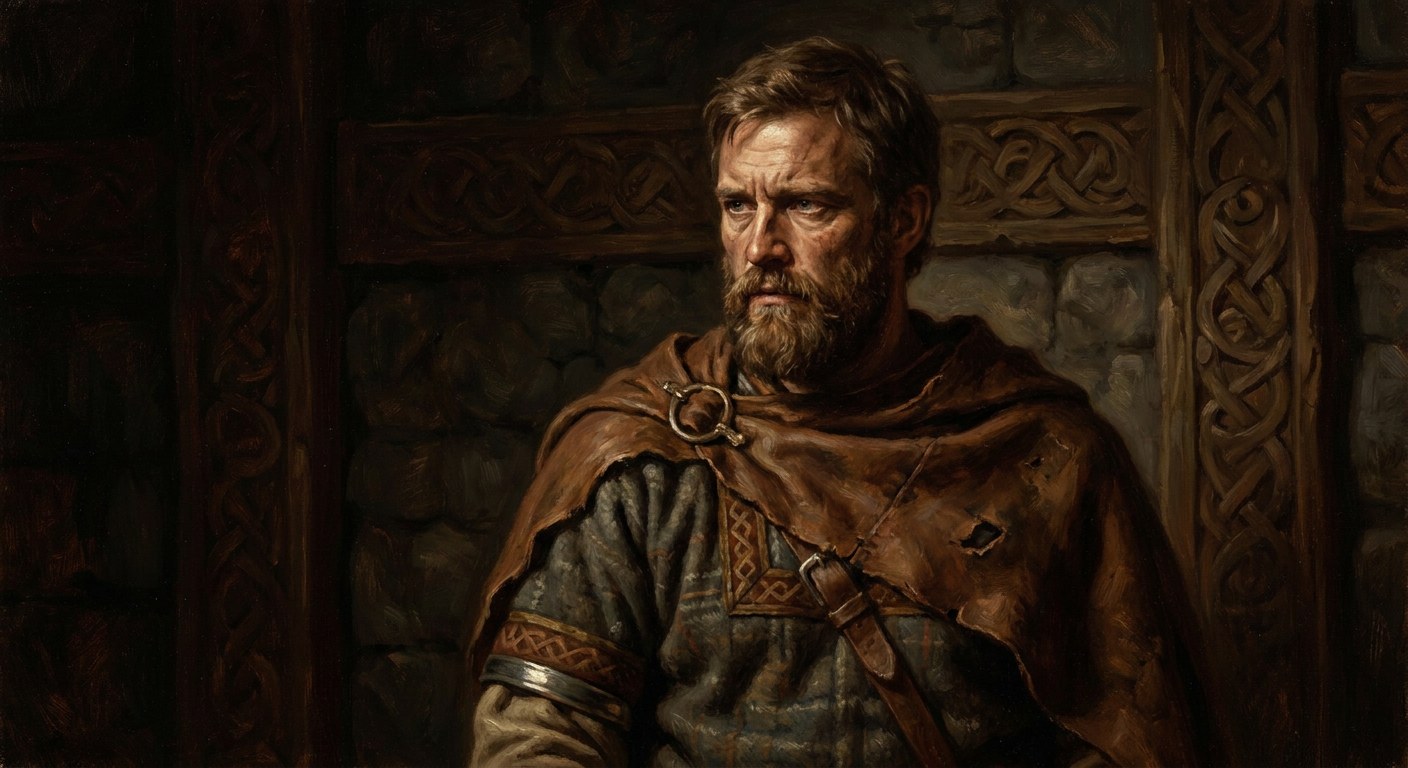
Ragnar Lodbrok
d. 865 · Norse (Danish) · Viking Leader & Legendary King
Recommended Audiobooks
Listen next from Marcus Alden

Life Lessons from Frederic Chopin
Marcus Alden · 54 min

Life Lessons from John Wesley
Marcus Alden · 52 min
Introduction
Ragnar Lodbrok—also written Ragnar Lothbrok, Regner Lodbrog, or Ragnarr loðbrók—is one of the most celebrated and elusive figures of the Viking Age. In medieval Scandinavian tradition, he was a Danish or Swedish warrior-king who fought across northern Europe, married formidable women, fathered famous Viking leaders, and ultimately died in a pit of snakes at the command of King Ælla of Northumbria. His adventures became the material of sagas, poetry, chronicles, and, many centuries later, novels, films, television dramas, and video games.
Yet the historical Ragnar is difficult to recover. No surviving contemporary source presents a complete biography of a Viking named Ragnar Lodbrok. The fullest narratives were written centuries after the period in which he supposedly lived. These include Saxo Grammaticus’s Gesta Danorum, composed around 1200; the Icelandic Saga of Ragnar Lodbrok, probably written in the thirteenth century; and the related Tale of Ragnar’s Sons. These works combine oral tradition, heroic legend, dynastic genealogy, folklore, and memories of genuine ninth-century events.
Some historians have attempted to identify Ragnar with “Reginherus,” the Viking leader who attacked Paris in 845. Others believe the legendary Ragnar is a composite of several historical commanders, perhaps including the Danish ruler Horik I’s warrior Reginherus, the Irish Sea Viking Ragnall, and unnamed raiders remembered through the exploits of their descendants. Still others consider Ragnar primarily a literary ancestor created to connect famous Viking leaders such as Ivar the Boneless, Björn Ironside, Halfdan, and Sigurd Snake-in-the-Eye.
Ragnar should therefore be studied on two levels. He is a possible historical Viking commander associated with the turbulent politics of ninth-century Scandinavia and the Carolingian world. At the same time, he is a legendary hero whose story reveals how medieval Scandinavians understood courage, kingship, family, fate, and fame. His importance lies not only in what he may have done, but also in what later generations believed he represented.
Quick Facts
| Category | Details |
|---|---|
| Full name | Ragnar Lodbrok; Old Norse: Ragnarr loðbrók |
| Name variants | Ragnar Lothbrok, Regner Lodbrog, Ragnarr Loðbrók |
| Meaning of epithet | Usually interpreted as “hairy-breeches” or “shaggy trousers” |
| Probable period | Early to mid-ninth century, if historical |
| Traditional status | Danish or Scandinavian king, Viking commander, and legendary hero |
| Possible historical counterpart | Reginherus, leader of the Viking attack on Paris in 845 |
| Traditional father | Sigurd Ring, a legendary Scandinavian ruler |
| Traditional wives | Lagertha, Thora Town-Hart, and Aslaug/Kráka; accounts vary by source |
| Traditional sons | Ivar the Boneless, Björn Ironside, Sigurd Snake-in-the-Eye, Hvitserk, Ubba, Halfdan, and others, depending on the tradition |
| Major associated event | Viking siege and sack of Paris in 845 |
| Traditional enemy | King Ælla of Northumbria |
| Traditional death | Executed in a snake pit in Northumbria, often placed before 865 |
| Main literary sources | Gesta Danorum, Saga of Ragnar Lodbrok, Tale of Ragnar’s Sons, and Krákumál |
| Historical certainty | Uncertain; probably a legendary or composite figure based partly on real people and events |
| Lasting significance | Archetypal Viking hero and legendary ancestor of major Viking leaders |
Early Life & Background
Ragnar’s supposed early life belongs almost entirely to legend. The sagas make him the son of Sigurd Ring, a ruler connected with Denmark and Sweden. Sigurd himself is a semi-legendary figure said to have defeated his uncle Harald Wartooth at the great Battle of Brávellir. Neither the battle nor Sigurd’s career can be dated or verified securely from contemporary evidence.
By presenting Ragnar as Sigurd’s son, medieval writers placed him within a prestigious Scandinavian royal lineage. Genealogy mattered deeply in heroic literature: noble ancestry established a warrior’s right to command, linked local rulers to a shared legendary past, and helped later dynasties claim political legitimacy.
The world in which a historical Ragnar would have lived was less unified than the sagas imply. Ninth-century Scandinavia contained shifting kingdoms, regional rulers, competing aristocratic families, and mobile war bands. Denmark was emerging as a significant power, but royal authority was contested. Kings such as Godfrid and Horik I appear in Frankish sources, yet their control over Danish territory was neither modern nor absolute.
Beyond Scandinavia, the Carolingian Empire offered both danger and opportunity. After Charlemagne’s death in 814, disputes among his heirs weakened imperial coordination. The empire was divided by the Treaty of Verdun in 843, creating political fractures that Viking commanders exploited. Monasteries, ports, river settlements, and royal centers contained portable wealth, while navigable waterways gave Scandinavian fleets access far inland.
Ragnar’s epithet, loðbrók, is usually translated as “hairy breeches,” “shaggy trousers,” or “hairy trousers.” According to the Saga of Ragnar Lodbrok, he acquired the name while fighting a serpent that guarded Thora, the daughter of a local ruler. Ragnar protected himself with trousers coated in tar and sand or fashioned from shaggy material. The episode resembles a folktale more than a historical report, but it gave the hero a memorable identity and connected him to the widespread dragon-slayer tradition.
Saxo Grammaticus offers a different structure for Ragnar’s youth and relationships. His account emphasizes warfare, royal marriage, and the hero’s involvement in Scandinavian politics. The differences between Saxo and the Icelandic sagas demonstrate that there was no single fixed Ragnar tradition. Instead, storytellers adapted his life to different audiences and purposes.
Rise to Prominence
In the medieval narratives, Ragnar rises through a combination of inherited status, personal bravery, strategic marriage, and military success. Saxo portrays him as a Danish ruler who campaigns throughout the Baltic and North Atlantic worlds. The Icelandic tradition focuses more heavily on heroic tests, including his defeat of the serpent and his marriage to Thora.
The strongest possible connection between the legendary Ragnar and recorded history is the Viking attack on Paris in 845. Frankish annals identify the Scandinavian commander as Reginherus, a Latinized name compatible with Ragnar. He appears to have been associated with the Danish king Horik I, although his precise rank and political position remain uncertain.
In March 845, a Viking fleet traditionally said to number 120 ships entered the River Seine. Frankish sources report that the force included thousands of warriors, though medieval numerical estimates are often unreliable. King Charles the Bald attempted to defend the region by dividing his army between both banks of the river. The Vikings defeated one Frankish contingent and, according to the Annals of Saint-Bertin, executed 111 prisoners in a conspicuous act of terror.
The fleet reached Paris around Easter. The city of the ninth century was concentrated largely on the Île de la Cité and was far smaller than modern Paris, but it possessed churches, religious treasures, and immense symbolic value. Charles the Bald ultimately paid the attackers 7,000 pounds of silver and gold to withdraw. This payment became an early and notorious example of the tributes later associated with Viking warfare.
If Reginherus and Ragnar were the same person, the Paris expedition explains how a real commander could become legendary. The raid combined strategic skill, spectacular violence, royal humiliation, and extraordinary profit. These were precisely the qualities most likely to survive in oral memory.
There are reasons for caution, however. The name Ragnar was not unique, and no contemporary Frankish source calls Reginherus “Lodbrok.” Nor do contemporary English sources identify the father of Ivar, Halfdan, or other leaders of the Great Heathen Army as Ragnar. The identification remains plausible but unproven.
Major Achievements
Ragnar’s achievements differ depending on whether he is treated as a historical commander or a literary hero.
His most credible possible achievement was the successful Seine campaign of 845. The attackers demonstrated the operational strengths of Viking fleets: speed, shallow-draft vessels, disciplined mobility, and an ability to exploit divisions among European rulers. By forcing Charles the Bald to negotiate and pay an enormous ransom, Reginherus achieved both financial and political success.
Legendary sources attribute a much broader range of conquests to Ragnar. Saxo describes campaigns against rival Scandinavian rulers, Baltic peoples, and communities around the North Sea. He presents Ragnar not simply as a raider but as an expansionist king defending or rebuilding Danish authority. The Saga of Ragnar Lodbrok similarly gives him a reputation extending across northern Europe.
Ragnar’s greatest dynastic achievement, according to tradition, was fathering a generation of remarkable Viking leaders. Björn Ironside became associated with Sweden and ambitious expeditions into the western Mediterranean. Ivar the Boneless emerged as a major commander in England and may be related to Ímar, founder of a powerful Viking dynasty centered on Dublin, though that identification is debated. Halfdan appears in the Anglo-Saxon Chronicle as a leader of the Great Heathen Army and later operated in Northumbria. Sigurd Snake-in-the-Eye became a figure in Danish royal genealogy.
The father-son relationships are not securely established by contemporary records. Nevertheless, medieval writers used Ragnar to bind historically significant Viking commanders into one heroic family. This literary genealogy was itself influential: it supplied later Scandinavian rulers and communities with a prestigious foundation narrative.
Ragnar also achieved extraordinary cultural longevity. Unlike many historically better-documented rulers, he became a symbol of the Viking Age as a whole. His name evokes exploration, raiding, heroic defiance, and the pursuit of reputation beyond death.
Defining Moments
The serpent episode is the first major defining moment in Ragnar’s legendary career. Thora’s father has promised her to the man who can destroy the monster encircling or guarding her dwelling. Ragnar prepares protective clothing, kills the serpent, and claims Thora as his bride. The tale establishes his courage, ingenuity, and epithet while presenting marriage as the reward for heroic action.
A second defining moment is his meeting with Aslaug. In the saga, Aslaug is the daughter of the dragon-slayer Sigurd and the valkyrie Brynhild, heroes of the Völsung tradition. Raised in obscurity and called Kráka, she encounters Ragnar while dressed as a poor woman. He tests her intelligence by ordering her to come neither clothed nor naked, neither fasting nor having eaten, and neither alone nor accompanied. She arrives wrapped in a fishing net, having bitten an onion, and accompanied by a dog. Her solution proves her wisdom.
The connection to Aslaug elevates Ragnar’s family into the highest realm of Germanic heroic legend. Their children inherit not merely Ragnar’s royal blood but the prestige of Sigurd and Brynhild. The story is literary and genealogical rather than verifiable history.
The attack on Paris, if connected to Ragnar, was the decisive moment of his historical career. It showed that a Scandinavian fleet could strike one of the most prestigious cities in the Frankish world and compel a Carolingian king to pay for peace.
Ragnar’s final expedition to England is his most famous legendary failure. According to later tradition, he attacks Northumbria with only a small force, perhaps because he wishes to surpass the accomplishments of his sons. King Ælla defeats and captures him. Ragnar is then cast into a pit filled with venomous snakes.
In Krákumál, a skaldic-style death poem placed in Ragnar’s mouth, the condemned hero recalls his battles and faces death without fear. He anticipates feasting in Odin’s hall and predicts that his sons will avenge him. The poem ends with the famous sentiment that he dies laughing.
Ragnar’s death supposedly inspires his sons to invade England. Medieval legend therefore interprets the arrival of the Great Heathen Army in 865 as a campaign of vengeance. Historically, the army was more likely motivated by land, wealth, political opportunity, and the established pattern of Scandinavian activity in Britain. Even so, Ragnar’s death supplied later storytellers with a powerful personal explanation for a complex geopolitical event.
Timeline
| Year | Event |
|---|---|
| c. 800 | Approximate era in which a historical Ragnar may have been born; no reliable birth date survives. |
| Early ninth century | Legendary traditions place Ragnar’s youth, serpent-slaying, and marriage to Thora in this period. |
| c. 830s–840s | A possible historical Ragnar may have served or competed within the political sphere of Danish king Horik I. |
| 843 | Treaty of Verdun divides the Carolingian Empire, increasing vulnerabilities later exploited by Viking fleets. |
| 845 | Reginherus leads a major Viking fleet up the Seine, defeats Frankish forces, occupies Paris, and receives 7,000 pounds of silver and gold from Charles the Bald. |
| 845 | Frankish accounts report that disease struck the returning Viking force; Reginherus may have died soon afterward, though the evidence is uncertain. |
| c. 850s | Legendary chronology assigns Ragnar further campaigns and the growing fame of his sons to the mid-ninth century. |
| Before 865 | Traditional date range for Ragnar’s defeat by King Ælla and death in a snake pit; the event is not confirmed by contemporary sources. |
| 865 | The Great Heathen Army arrives in England, led by commanders including Ivar and Halfdan. Later tradition presents the invasion as vengeance for Ragnar. |
| 866 | The Viking army captures York. |
| 867 | King Ælla and his rival Osberht are killed while attempting to retake York. |
| 869 | King Edmund of East Anglia is killed by the Viking army. |
| c. 12th century | Krákumál, the poem recounting Ragnar’s heroic death, is probably composed. |
| c. 1200 | Saxo Grammaticus completes much of the Gesta Danorum, including an extensive account of Ragnar. |
| 13th century | The Icelandic Saga of Ragnar Lodbrok and related traditions take written form. |
| 21st century | Television and popular media transform Ragnar into one of the world’s most recognizable Viking characters. |
Personal Life
Ragnar’s personal life is preserved in contradictory literary traditions. His marriages function as dynastic and symbolic episodes rather than dependable biographical records.
Saxo Grammaticus identifies Lagertha as Ragnar’s first wife. She is described as a skilled warrior who helps Ragnar defeat a Swedish ruler responsible for humiliating and abusing Norwegian women. Impressed by her courage, Ragnar courts her despite the dangerous animals guarding her home. Saxo later portrays her as an independent ruler who rescues Ragnar in battle. There is no contemporary evidence for a historical Lagertha, and her story may draw upon traditions of shield-maidens, valkyries, or the Norse goddess Thorgerd.
Thora Town-Hart, also called Thora Borgarhjört, is central to the hairy-breeches legend. She is the daughter of a powerful man—named Herraud in the Icelandic saga—and becomes Ragnar’s wife after he kills the serpent guarding her. Some traditions name their sons as Erik and Agnar. Thora dies young, leaving Ragnar to continue his campaigns.
Aslaug, also called Kráka or Randalin, is Ragnar’s most important wife in the Icelandic tradition. Her hidden identity as the daughter of Sigurd and Brynhild links two major legendary cycles. She is portrayed as intelligent, prophetic, and politically perceptive. When Ragnar ignores her warning about an ill-prepared invasion of England, the decision leads toward his death.
The sons attributed to Ragnar vary considerably. Ivar the Boneless, Björn Ironside, Hvitserk, Sigurd Snake-in-the-Eye, Ubba, Halfdan, Erik, Agnar, and others appear in different combinations. Some were probably real ninth-century Viking leaders, but their common parentage cannot be demonstrated.
The nickname “Boneless” has inspired theories that Ivar had a disability, unusual flexibility, impotence, or a metaphorical quality such as ruthlessness. None can be proved. Hvitserk, meaning “white shirt,” may be a nickname or a literary double for Halfdan. Such uncertainties show the difficulty of converting saga families into historical pedigrees.
Ragnar’s relationships nevertheless perform an important narrative role. His wives test his judgment, strengthen his claims, and connect him to different regions or heroic lineages. His sons continue his fame but also overshadow him, making the struggle between generations a recurring feature of his story.
Beliefs & Philosophy
No reliable evidence preserves Ragnar’s personal beliefs. If he lived in early ninth-century Scandinavia, he probably inhabited a religious culture shaped by pre-Christian Norse traditions, ancestor veneration, ritual exchange, and belief in powers associated with gods such as Odin, Thor, Freyr, and Freyja. Scandinavian rulers and warriors also interacted extensively with Christian societies, and religious boundaries could be politically flexible.
The Ragnar of literature embodies an aristocratic heroic ethic. Courage matters because death is unavoidable; reputation matters because fame can survive the body. A leader proves himself through generosity, military success, loyalty, and the willingness to face danger. Shame lies less in dying than in behaving fearfully.
Krákumál gives Ragnar an explicitly Odinic death. He expects to enter the hall of Odin, drink ale with the gods, and join heroic companions. This is not an eyewitness record of ninth-century belief. The poem was probably composed several centuries later, when authors were preserving and reshaping pagan imagery in a Christian literary world.
Fate is another central idea. Ragnar’s death is presented as foreknown but not necessarily avoidable. Aslaug warns him, omens surround his expedition, and the hero recognizes that every life reaches its appointed end. His task is to meet that end in a manner worthy of remembrance.
Ragnar’s philosophy can therefore be summarized as heroic fatalism: destiny limits human control, but individuals control the courage and dignity with which they confront it. That ideal, whether historically his or not, explains much of his enduring appeal.
Challenges & Controversies
The greatest controversy is whether Ragnar Lodbrok existed as a single historical person. The evidence permits several possibilities:
- He was a genuine ninth-century Danish commander whose exploits were later embellished.
- He was Reginherus, the leader of the 845 Paris raid.
- His legend combines the careers of multiple Viking leaders.
- He was chiefly a literary ancestor developed to organize traditions about famous Viking dynasties.
The chronological gap between Ragnar’s supposed lifetime and the main written narratives is substantial. Saxo and the Icelandic saga authors wrote roughly three to four centuries after the mid-ninth century. Oral tradition can preserve genuine memories, but it also compresses generations, merges names, imports folktales, and reshapes events according to later political needs.
The death in the snake pit is especially doubtful. No contemporary Northumbrian or Anglo-Saxon source records King Ælla executing Ragnar in this way. The Anglo-Saxon Chronicle describes the Great Heathen Army and Ælla’s death in 867 but does not connect either event to Ragnar’s execution.
The traditional vengeance narrative is similarly late. The Viking invasion beginning in 865 involved large forces and long-term ambitions. Reducing it to filial revenge obscures the economic, political, and military conditions that encouraged Scandinavian settlement and conquest.
Ragnar’s alleged family also presents chronological problems. The leaders called his sons operated across different regions and may not all have belonged to one generation or household. Medieval genealogies often united prestigious figures to legitimize later rulers.
Modern popular culture creates an additional challenge. Dramatic portrayals frequently combine events separated by decades, invent relationships, and place figures such as Rollo, Floki, Lagertha, and King Ecbert into a single intimate circle. Such storytelling can inspire interest in the Viking Age, but it should not be mistaken for documentary reconstruction.
Famous Quotes
No quotation can be authenticated as the spoken words of the historical Ragnar. The following lines come from later literary traditions, especially Krákumál, and translations vary.
“We struck with our swords.”
This recurring refrain in Krákumál introduces Ragnar’s memories of battle and emphasizes the warrior identity through which he interprets his life.
“The young pigs would grunt if they knew the old boar’s suffering.”
Tradition places this statement before Ragnar’s death. The “young pigs” are his sons, while Ragnar is the “old boar.” The line predicts their anger and revenge.
“I have no fear of death.”
This widely circulated formulation summarizes Ragnar’s literary posture, although it is not a securely preserved verbatim statement from a contemporary source.
“Gladly shall I drink ale in the high seat with the Æsir.”
Translations differ, but Krákumál depicts Ragnar anticipating his reception among the Norse gods and heroes.
“Laughing shall I die.”
The concluding sentiment of Krákumál expresses the ideal of meeting an inevitable death defiantly. Its fame helped define Ragnar as the archetype of the fearless Viking warrior.
Legacy & Influence
Ragnar’s earliest legacy was dynastic. Medieval Scandinavian and Icelandic writers remembered him as the father of conquerors. By placing Ivar, Björn, Sigurd, and other leaders within one family, they transformed scattered Viking campaigns into a multigenerational heroic epic.
His legend also connected Scandinavian regional histories. Denmark, Sweden, Norway, England, Francia, the Baltic, and the Irish Sea world could all be incorporated into stories about Ragnar and his descendants. This geographic breadth made him an ideal symbol of Viking mobility.
In medieval literature, Ragnar stands at the intersection of saga, chronicle, heroic poetry, and genealogy. Saxo used him in a Latin history of Denmark intended to celebrate the antiquity and power of the Danish realm. Icelandic authors placed him beside the Völsung heroes, integrating Viking-Age memories with an older legendary past. Krákumál turned his death into a meditation on courage, fame, and heroic identity.
Ragnar also influenced perceptions of Viking religion. His supposed welcome into Odin’s hall has become one of the best-known images of Valhalla. Yet the literary scene reflects later poetic construction as much as ninth-century practice.
Modern nationalism and Romanticism renewed interest in Ragnar during the eighteenth and nineteenth centuries. Translations of Old Norse literature introduced European readers to a supposedly raw, heroic northern past. Artists and writers used Viking figures to explore ancestry, masculinity, freedom, and national identity.
In contemporary culture, Ragnar has reached an unprecedented audience. The television series Vikings, first broadcast in 2013, portrayed him as a farmer, explorer, raider, king, husband, and father. Actor Travis Fimmel’s performance shaped the public image of Ragnar for millions of viewers. The series was historical drama rather than literal biography, freely rearranging chronology and relationships.
Ragnar appears in novels, comics, strategy games, role-playing games, music, and online culture. His image ranges from thoughtful explorer to brutal conqueror. These representations often reveal more about modern attitudes toward leadership, rebellion, family, and violence than about the ninth century itself.
For historians, Ragnar’s legacy is methodological as well as cultural. He demonstrates why medieval sources must be read critically but not dismissed. Legends can preserve names, places, social ideals, and echoes of real events even when their plots are not factual. The task is to distinguish historical probability from literary meaning without destroying the value of either.
Interesting Facts
- Ragnar’s surname was not a hereditary family name. Lodbrok was an epithet, probably meaning “hairy breeches.”
- The only strong contemporary candidate for Ragnar is Reginherus, who led the Seine expedition of 845.
- Paris in 845 was much smaller than the modern city and centered largely on the Île de la Cité.
- Charles the Bald paid the Viking attackers 7,000 pounds of silver and gold to leave.
- Frankish sources report that disease afflicted the Viking force after the Paris campaign.
- The snake-pit execution is absent from contemporary English records.
- Lagertha appears prominently in Saxo Grammaticus but not as Ragnar’s wife in every tradition.
- Aslaug’s legendary parents, Sigurd and Brynhild, belong to the same heroic world as the Völsunga saga and the German Nibelungenlied tradition.
- Björn Ironside may reflect a historical Viking leader involved in a Mediterranean expedition during the 850s and 860s.
- Ivar the Boneless is historically attested as a major Viking leader, but Ragnar’s paternity is not.
- The Great Heathen Army arrived in England in 865 and captured York the following year.
- King Ælla died in battle at York in 867; the later “blood eagle” account is not securely supported by contemporary evidence.
- Krákumál was probably written centuries after Ragnar’s supposed death.
- Medieval writers did not preserve one consistent version of Ragnar’s life.
- Modern images of Ragnar often combine legendary material with the careers of several historical Vikings.
Frequently Asked Questions
Was Ragnar Lodbrok a real person?
Possibly, but his existence cannot be established with certainty. He may preserve the memory of a real Danish commander, especially Reginherus, who attacked Paris in 845. The legendary biography, however, almost certainly combines historical events with folklore and material from multiple figures.
When was Ragnar Lodbrok born?
No reliable birth date is known. If Ragnar was connected with the Paris expedition of 845, he may have been born around the end of the eighth century or beginning of the ninth. Dates commonly given online are estimates rather than documented facts.
Did Ragnar Lodbrok really raid Paris?
A Viking commander named Reginherus raided Paris in 845. Many historians consider Reginherus a possible historical basis for Ragnar Lodbrok, but no contemporary source identifies him by the epithet Lodbrok. It is therefore more accurate to call the connection plausible rather than certain.
How did Ragnar Lodbrok die?
Legend says King Ælla of Northumbria threw him into a pit of venomous snakes. No contemporary source confirms this account. Some Frankish evidence suggests the leader of the 845 Paris raid may have died from illness not long afterward, but even that report cannot be connected conclusively to Ragnar Lodbrok.
Who was Ragnar Lodbrok’s most famous wife?
Aslaug is his principal wife in the Icelandic saga tradition, while Lagertha became especially famous through Saxo Grammaticus and modern television. Thora is crucial to the origin of Ragnar’s “hairy-breeches” epithet. None can be securely documented as his historical spouse.
Who were Ragnar Lodbrok’s sons?
Tradition names Ivar the Boneless, Björn Ironside, Sigurd Snake-in-the-Eye, Hvitserk, Ubba, Halfdan, Erik, and Agnar, among others. Several were based on real Viking leaders, but their common descent from Ragnar is uncertain.
Did Ragnar’s sons invade England to avenge him?
Later stories say the Great Heathen Army invaded England in 865 to avenge Ragnar’s execution. Contemporary records do not give revenge as the army’s motive. The invasion was more likely driven by the search for territory, tribute, political power, and settlement opportunities.
Was Ragnar a king of Denmark?
Medieval sources describe him as a Danish or Scandinavian king. Contemporary ninth-century records do not list Ragnar Lodbrok among securely attested Danish rulers. If he was historical, he may instead have been a commander, subordinate king, exile, or aristocratic war leader.
What does “Lodbrok” mean?
The Old Norse loðbrók is commonly interpreted as “hairy breeches” or “shaggy trousers.” Saga tradition explains that Ragnar wore specially prepared trousers while fighting a serpent.
Is the television version of Ragnar historically accurate?
The television portrayal draws upon sagas, chronicles, and genuine Viking-Age events, but it substantially compresses chronology and invents personal relationships. It is best understood as historical drama inspired by tradition, not as a verified biography.
Lessons from Ragnar Lodbrok
- Distinguish history from legend. A compelling story may contain historical memories without being literally factual.
- Reputation can outlive evidence. Ragnar became more famous than many rulers whose lives are much better documented.
- Adaptability creates opportunity. Viking success depended on mobility, intelligence, and rapid responses to political weakness.
- Boldness carries risk. Ragnar’s legendary career celebrates courage but also portrays pride and overconfidence as causes of disaster.
- Leadership is inseparable from strategy. The Paris campaign succeeded through planning and exploitation of divided defenses, not courage alone.
- Family narratives shape political identity. Ragnar’s legendary sons transformed his story into a dynastic foundation myth.
- Sources must be compared critically. Saxo, the Icelandic sagas, Frankish annals, and English chronicles were written in different periods for different purposes.
- Defeat can become part of a powerful legacy. Ragnar’s legendary death became more culturally influential than many victories.
- Stories reveal the societies that preserve them. Medieval accounts of Ragnar illuminate ideals of kingship, fate, masculinity, marriage, and fame.
- Popular culture should inspire further study. Dramatization can open the door to history, but primary sources and modern scholarship are needed to understand the past responsibly.
Further Reading
- Saxo Grammaticus, The History of the Danes, Books I–IX, translated by Peter Fisher and edited by Hilda Ellis Davidson.
- The Saga of the Volsungs: The Norse Epic of Sigurd the Dragon Slayer, translated by Jesse L. Byock.
- The Saga of the People of Laxardal and Other Sagas, for broader context on Icelandic saga literature.
- Ben Waggoner, trans., The Sagas of Ragnar Lodbrok.
- Simon Coupland, studies of Carolingian responses to Viking incursions and the Viking attack on Paris.
- Peter Sawyer, The Age of the Vikings.
- Else Roesdahl, The Vikings.
- Neil Price, Children of Ash and Elm: A History of the Vikings.
- Judith Jesch, The Viking Diaspora.
- Clare Downham, Viking Kings of Britain and Ireland: The Dynasty of Ívarr to A.D. 1014.
- Cat Jarman, River Kings: A New History of the Vikings from Scandinavia to the Silk Roads.
- The Annals of Saint-Bertin, for a near-contemporary Frankish account of the 845 attack on Paris.
- The Anglo-Saxon Chronicle, for the Great Heathen Army, the capture of York, and the death of King Ælla.
- Rory McTurk, Studies in Ragnars Saga Loðbrókar and Its Major Scandinavian Analogues.
- John Haywood, Northmen: The Viking Saga, 793–1241.