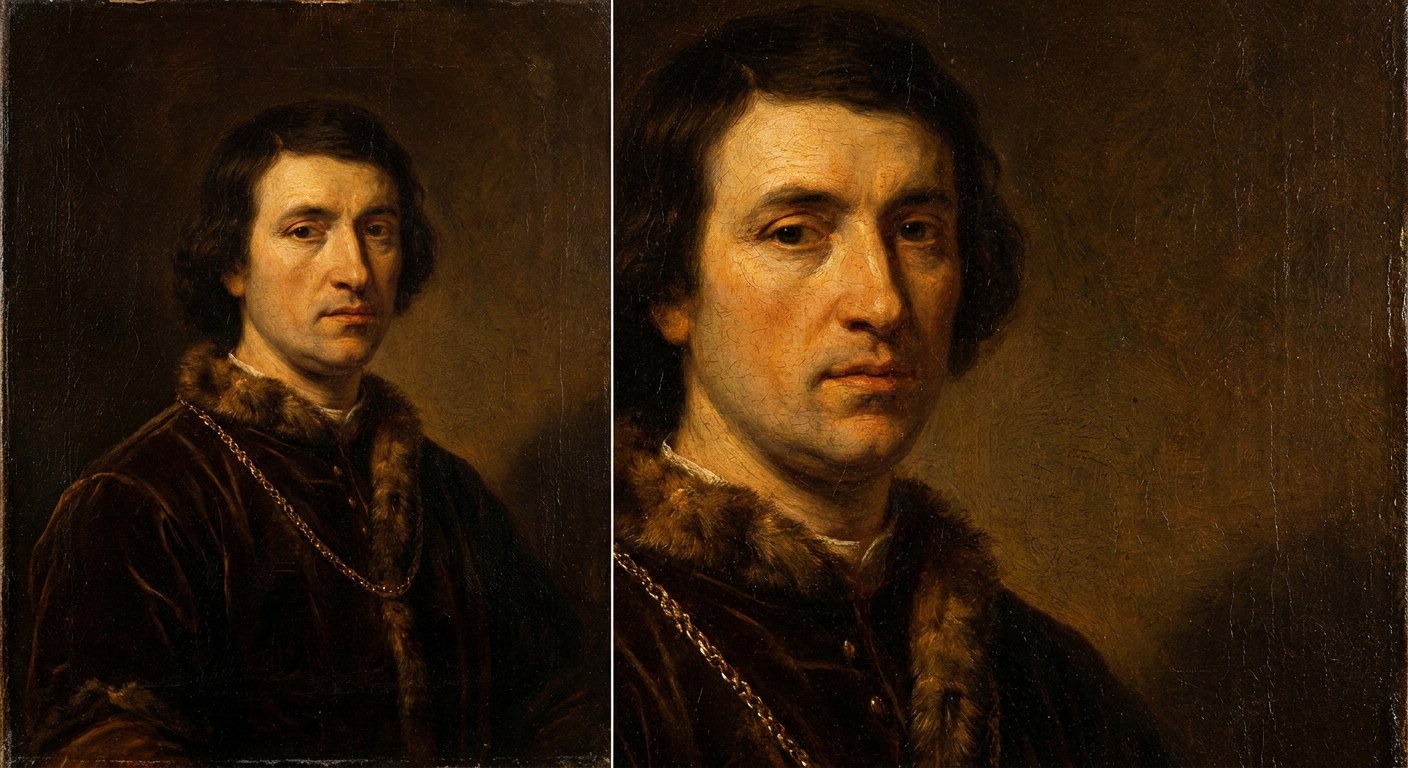
Richard III
1452 – 1485 · English · King of England
Recommended Audiobooks
Listen next from Marcus Alden

Life Lessons from Frederic Chopin
Marcus Alden · 54 min

Life Lessons from John Wesley
Marcus Alden · 52 min
Introduction
Richard III was king of England from 26 June 1483 until his death at the Battle of Bosworth Field on 22 August 1485. His reign lasted only twenty-six months, yet few English monarchs have inspired more enduring controversy. To admirers, Richard was an energetic administrator, a capable soldier and a ruler unusually concerned with accessible justice. To critics, he was a ruthless usurper whose seizure of the throne was followed by the disappearance—and probable murder—of his young nephews, Edward V and Richard, Duke of York.
Born into the House of York during the Wars of the Roses, Richard spent much of his life serving his elder brother, Edward IV. As Duke of Gloucester, he became Edward’s principal lieutenant in northern England and won distinction in the campaign against Scotland that recovered Berwick-upon-Tweed in 1482. His reputation for loyalty to Edward was transformed after the king’s sudden death in April 1483. Appointed lord protector for the twelve-year-old Edward V, Richard arrested the young king’s leading maternal relatives, assumed control of the government and accepted the crown after Edward IV’s children were declared illegitimate.
Richard’s reign was troubled from the beginning. The disappearance of the “Princes in the Tower” gravely damaged his legitimacy. A rebellion led by Henry Stafford, Duke of Buckingham, erupted in October 1483, while Henry Tudor emerged as the principal Lancastrian claimant. Richard defeated Buckingham but was unable to prevent Tudor from invading England in 1485. At Bosworth, Richard fought with conspicuous courage but was killed after making a direct attack on Tudor’s position. He was the last English king to die in battle and the final monarch of the Plantagenet dynasty.
The image familiar to later generations was shaped above all by Tudor-era writers and William Shakespeare, who portrayed Richard as a deformed, scheming tyrant. Modern scholarship has challenged many elements of that portrait without resolving the central question of the princes’ fate. The rediscovery of Richard’s remains beneath a Leicester car park in 2012 added remarkable physical evidence to an already complex historical record.
Quick Facts
| Category | Details |
|---|---|
| Full name | Richard Plantagenet |
| Title before accession | Duke of Gloucester |
| Born | 2 October 1452 |
| Birthplace | Fotheringhay Castle, Northamptonshire, England |
| Parents | Richard, Duke of York, and Cecily Neville |
| Dynasty | House of York, a branch of the Plantagenets |
| Reign | 26 June 1483–22 August 1485 |
| Coronation | 6 July 1483, Westminster Abbey |
| Predecessor | Edward V |
| Successor | Henry VII |
| Wife | Anne Neville |
| Legitimate child | Edward of Middleham, Prince of Wales |
| Known illegitimate children | John of Gloucester and Katherine Plantagenet |
| Major offices before becoming king | Constable and Lord High Admiral of England; chief royal lieutenant in the north |
| Major military actions | Battles of Barnet and Tewkesbury; invasion of Scotland; Battle of Bosworth Field |
| Personal motto | Loyaulte me lie—“Loyalty binds me” |
| Died | 22 August 1485 |
| Place of death | Bosworth Field, near Market Bosworth, Leicestershire |
| Original burial | Church of the Greyfriars, Leicester |
| Reinterment | Leicester Cathedral, 26 March 2015 |
Early Life & Background
Richard was born at Fotheringhay Castle on 2 October 1452. He was the eleventh of the twelve children of Richard, Duke of York, and Cecily Neville, although several of his siblings died young. His father descended from Edward III through both the male and female lines and possessed a powerful claim to the English throne. His mother belonged to the extensive Neville family, one of the most influential aristocratic networks in fifteenth-century England.
Richard’s childhood coincided with the breakdown of royal government under Henry VI. The king’s periods of mental incapacity, the weakness of his administration and competition among noble factions contributed to the Wars of the Roses. Richard’s father became leader of the Yorkist cause against Henry VI’s Lancastrian government.
The conflict brought personal catastrophe. On 30 December 1460, Richard’s father and his elder brother Edmund, Earl of Rutland, were killed following the Battle of Wakefield. Their heads were displayed above Micklegate Bar in York. Richard was only eight. The family’s fortunes recovered when his eldest surviving brother defeated the Lancastrians and was proclaimed King Edward IV in March 1461.
Richard was created Duke of Gloucester later that year. During part of his adolescence he lived in the household of his cousin Richard Neville, Earl of Warwick, known as “the Kingmaker,” probably at Middleham Castle in Yorkshire. There he received the aristocratic education expected of a nobleman: training in arms, horsemanship, hunting, estate management, ceremony and household administration.
The surviving evidence suggests Richard developed scoliosis during adolescence. His spine curved sideways, leaving one shoulder higher than the other, but he was not the hunchbacked or withered monster depicted by later hostile writers. Examination of his remains showed no withered arm, and his military career demonstrates that he could ride, wear armour and fight effectively.
In 1469–71, Warwick and Richard’s brother George, Duke of Clarence, rebelled against Edward IV. Richard remained loyal to the king. When Edward was temporarily driven from England in 1470, Richard accompanied him into exile in the Burgundian Netherlands. This loyalty became a defining feature of Richard’s early political identity.
Rise to Prominence
Richard returned to England with Edward IV in March 1471. Still only eighteen, he participated in the decisive Yorkist victories that restored his brother to the throne. At the Battle of Barnet on 14 April, Richard commanded part of Edward’s army against Warwick. The earl was killed, ending his dramatic challenge to Edward.
Richard also fought at the Battle of Tewkesbury on 4 May 1471, where the Lancastrian army was defeated and Edward of Westminster, the only son of Henry VI, was killed. Richard’s conduct in these campaigns established him as a trusted military commander. Henry VI died in the Tower of London shortly afterward, almost certainly murdered on Edward IV’s orders or with his approval.
Richard married Warwick’s younger daughter, Anne Neville, probably in 1472. The marriage strengthened his connection with the Neville inheritance and brought him extensive interests in northern England. Anne had previously been married to Edward of Westminster, making her both a former Lancastrian princess and the wife of a leading Yorkist.
A bitter dispute followed over the Neville estates. George, Duke of Clarence, had married Anne’s elder sister, Isabel, and resisted dividing the inheritance with Richard. Edward IV eventually imposed a settlement. Richard obtained significant lands and authority in the north, while Clarence retained other portions. Clarence later fell out with Edward and was executed for treason in 1478.
Richard built his regional power around Yorkshire and the northeast. Middleham Castle became one of his principal residences. Edward IV appointed him to major offices, including constable and admiral of England, and relied upon him to defend the Scottish border. Richard cultivated connections among northern nobles, knights, urban communities and gentry families, creating an affinity whose members looked to him for leadership and patronage.
His northern administration enhanced his reputation as a firm and accessible lord. In 1480–82, renewed war with Scotland gave Richard the opportunity to demonstrate his military and political ability. He commanded Edward IV’s forces in the 1482 invasion, which briefly installed Edward’s ally, Alexander Stewart, Duke of Albany, in Edinburgh. Although the attempt to control the Scottish government failed, Richard secured the surrender of Berwick-upon-Tweed. The town and castle remained permanently under English rule.
By the beginning of 1483, Richard was among the most powerful men in England. His authority, however, remained largely regional and depended upon his relationship with Edward IV. The king’s unexpected death on 9 April 1483 radically altered Richard’s position.
Major Achievements
Richard’s most substantial achievements occurred both before and during his brief reign.
As Duke of Gloucester, he provided relatively stable government in northern England. He supervised defence against Scotland, settled disputes and maintained a network capable of mobilizing troops. His capture of Berwick in 1482 was a lasting territorial gain and one of the clearest English successes in the Anglo-Scottish wars of the period.
As king, Richard summoned his only Parliament in January 1484. Its legislation included reforms intended to protect subjects from abuses in the legal system. Parliament restricted the practice of seizing property before a defendant had been convicted and condemned forced financial exactions known as benevolences. It also addressed corruption, commercial regulation and the interests of English merchants.
Richard’s government promoted the translation of statutes from French into English. Although English had long been widely spoken, much official legal material remained inaccessible to ordinary subjects. The publication of legislation in English reflected a broader concern with communicating royal justice more clearly.
The king expanded the use of the Council of Requests, which heard petitions from people unable to obtain effective remedies through the ordinary courts. It would be an exaggeration to describe Richard as a modern democrat or universal champion of the poor, but his administration showed a genuine interest in presenting royal authority as a source of impartial justice.
Richard also granted a charter to the College of Arms in 1484, giving the heralds a corporate home and institutional privileges. The modern College of Arms traces its formal incorporation to this act, although Henry VII later revoked Richard’s grant and reorganized the institution.
His royal progress through England after his coronation was carefully staged to establish authority. At York on 8 September 1483, Richard and Anne participated in a major ceremonial entry, and their son Edward was invested as Prince of Wales. The splendour of the occasion demonstrated Richard’s special relationship with the north, even as suspicion and opposition grew elsewhere.
Defining Moments
The first defining moment of Richard’s life was the destruction of his father’s cause at Wakefield in 1460. The experience placed his family’s survival at the centre of his childhood and helped create a political world in which defeat could mean death.
His loyalty during Edward IV’s exile and restoration in 1470–71 established him as the king’s dependable brother. Richard gained offices, estates and authority because Edward trusted him. Unlike Clarence and Warwick, he had not deserted the king during the crisis.
The most consequential episode began after Edward’s death in April 1483. The late king’s eldest son, Edward V, was then at Ludlow under the supervision of his maternal uncle Anthony Woodville, Earl Rivers. Richard had been designated lord protector, but the Woodville family appeared positioned to control the young king and government.
Richard met Edward’s party at Stony Stratford on 30 April. Rivers, the king’s half-brother Richard Grey and Sir Thomas Vaughan were arrested. Edward was escorted to London and lodged in the Tower, then still used as a royal residence as well as a prison. His younger brother, Richard, Duke of York, joined him there in June.
On 13 June, Richard accused William, Lord Hastings, of conspiracy and had him summarily executed at the Tower. Rivers, Grey and Vaughan were executed at Pontefract on 25 June. These actions removed influential figures who might have opposed Richard, but their speed and lack of normal judicial process severely damaged his claim to lawful government.
A sermon delivered at Paul’s Cross and a petition presented to Richard argued that Edward IV’s marriage to Elizabeth Woodville had been invalid because Edward had previously promised marriage to Lady Eleanor Butler. Under canon law, a binding precontract could invalidate a later marriage. Consequently, Edward IV’s children were declared illegitimate. Parliament later embodied this argument in the act known as Titulus Regius.
Richard accepted the crown on 26 June 1483 and was crowned with Anne at Westminster Abbey on 6 July. Edward V was never crowned. The two princes were seen less frequently during the summer and then disappeared from public view. Their fate remains unknown, but many contemporaries came to believe that they had been killed.
In October 1483, the Duke of Buckingham, who had helped Richard seize power, joined a broad rebellion. The rebels intended to free or avenge the princes and increasingly supported Henry Tudor. Severe storms and flooding disrupted their plans. Buckingham was captured and executed at Salisbury on 2 November.
Richard’s dynastic position worsened when his only legitimate son, Edward of Middleham, died in April 1484. Queen Anne died on 16 March 1485. Rumours alleged that Richard had poisoned her so that he could marry his niece Elizabeth of York, but there is no persuasive evidence that he murdered Anne. He publicly denied any intention of marrying Elizabeth.
The final defining moment came at Bosworth. Henry Tudor landed at Mill Bay in Pembrokeshire on 7 August 1485 and marched through Wales and the Midlands. On 22 August, his army confronted Richard’s near Market Bosworth. The neutrality and eventual intervention of the Stanley family proved decisive. Seeing an opportunity to kill Henry directly, Richard led a mounted charge toward him. Richard killed Henry’s standard-bearer, Sir William Brandon, but was surrounded and slain after Sir William Stanley’s forces entered the battle for Tudor.
Timeline
| Year | Event |
|---|---|
| 1452 | Richard is born at Fotheringhay Castle on 2 October. |
| 1460 | His father and brother Edmund are killed after the Battle of Wakefield. |
| 1461 | Edward IV becomes king; Richard is created Duke of Gloucester. |
| 1465–68 | Richard spends part of his youth in the household of the Earl of Warwick at Middleham. |
| 1470 | Richard accompanies Edward IV into exile after Warwick restores Henry VI. |
| 1471 | He fights at Barnet and Tewkesbury during Edward IV’s restoration. |
| c. 1472 | Richard marries Anne Neville. |
| 1473–76 | Their son Edward of Middleham is probably born during this period. |
| 1478 | Richard’s brother George, Duke of Clarence, is executed for treason. |
| 1482 | Richard commands the Scottish campaign and secures Berwick-upon-Tweed. |
| 1483 | Edward IV dies on 9 April; Richard takes custody of Edward V on 30 April. |
| 1483 | Lord Hastings is executed on 13 June. |
| 1483 | Richard accepts the crown on 26 June and is crowned on 6 July. |
| 1483 | Edward V and his brother disappear from public view. |
| 1483 | Buckingham’s rebellion fails; Buckingham is executed on 2 November. |
| 1484 | Richard’s only legitimate son dies in April. |
| 1484 | Richard’s Parliament passes legal and commercial reforms. |
| 1485 | Queen Anne dies on 16 March. |
| 1485 | Richard is killed at Bosworth Field on 22 August. |
| 2012 | Archaeologists discover his remains beneath a Leicester car park. |
| 2013 | The University of Leicester announces the remains have been identified as Richard’s. |
| 2015 | Richard is reinterred in Leicester Cathedral on 26 March. |
Personal Life
Richard’s marriage to Anne Neville united two people whose lives had been shaped by civil war. Anne was the daughter of the Earl of Warwick and Anne Beauchamp. Before marrying Richard, she had been the wife of the Lancastrian heir Edward of Westminster. No reliable evidence supports later stories that Richard forced her into marriage.
Richard and Anne’s only surviving legitimate child, Edward of Middleham, was born at an uncertain date, probably between 1473 and 1476. He was created Prince of Wales in 1483 but died at Middleham in April 1484. Contemporary reports described Richard and Anne as overwhelmed by grief. The child’s death deprived the king of a direct legitimate heir.
Richard acknowledged at least two children born outside marriage. John of Gloucester, sometimes called John of Pontefract, received royal appointments during Richard’s reign. Katherine Plantagenet married William Herbert, Earl of Huntingdon, in 1484. The identities of their mother or mothers are unknown.
After Edward’s death, Richard designated his nephew John de la Pole, Earl of Lincoln—the son of his sister Elizabeth—as an important heir and political associate, although the precise legal status of this arrangement remains debated.
Richard appears to have enjoyed books, music, religious observance and the ceremonial culture of late medieval kingship. Surviving volumes associated with him include devotional and chivalric works. His household combined the military character of a northern affinity with the piety and magnificence expected of a prince.
Beliefs & Philosophy
Richard’s personal motto, Loyaulte me lie, expressed the ideal that “loyalty binds me.” It suited the public identity he developed under Edward IV, when he presented himself as a faithful brother and servant. The events of 1483, however, created a lasting contradiction between that motto and his displacement of Edward’s son.
Like other late medieval rulers, Richard understood monarchy as a sacred office established by God and limited by law, custom and the king’s duty to provide justice. His proclamations portrayed him as the defender of peace, morality and the “common weal.” Such language was conventional, but his parliamentary programme suggests that access to justice mattered to his conception of good rule.
Richard was conventionally devout. He supported religious institutions, planned a large collegiate foundation at York Minster and maintained clergy within his household. There is no sound basis for Shakespeare’s portrayal of him as a cynical unbeliever who treated religion solely as a political disguise.
His political philosophy was nevertheless authoritarian. Richard believed order required decisive royal action, and in 1483 he used arrest, execution and propaganda to overcome his opponents. His career illustrates how medieval ideals of lawful kingship could coexist with ruthless measures taken in the name of security.
Challenges & Controversies
The central controversy is the fate of Edward V and Richard, Duke of York. They disappeared while in Richard’s custody, and Richard had the strongest immediate motive to prevent their becoming the focus of rebellion. No surviving document records an order for their deaths, no conclusively identified bodies have been found, and the date and method of any killing remain uncertain.
Several suspects have been proposed, including Buckingham and, less plausibly, Henry Tudor. Yet Richard was king and controlled the Tower. His failure to produce the princes alive when rumours of their murder spread is difficult to explain if they were still living. Most modern historians consider it probable that they died during his reign and that Richard was responsible, directly or indirectly, while acknowledging that the case cannot be proven beyond doubt.
Richard’s title to the throne presents another controversy. Titulus Regius asserted that Edward IV’s children were illegitimate because of a precontract with Eleanor Butler. The claim may have been supported by Robert Stillington, Bishop of Bath and Wells, but it surfaced only after Richard had taken control of Edward V. The political circumstances make it impossible to treat the process as impartial. Henry VII repealed the act and ordered copies destroyed because his claim depended partly upon marrying Edward IV’s daughter Elizabeth of York.
Richard’s executions of Hastings, Rivers, Grey, Vaughan and Buckingham reinforced his reputation for brutality. Some were formally accused of treason, but Hastings was executed without a conventional trial. These acts intimidated opponents while weakening confidence in Richard’s promises of justice.
His physical appearance has also been controversial. Tudor writers exaggerated his bodily difference into a visible sign of moral corruption. The skeleton discovered in Leicester confirmed scoliosis but disproved depictions of a hunchback, withered arm or grotesquely deformed body. Richard’s condition would have produced uneven shoulders, probably disguised by tailored clothing and armour.
Historians continue to debate whether Richard was a reforming ruler prevented by circumstances from fulfilling his potential or a usurper whose useful legislation cannot outweigh the violence of his accession. These interpretations are not mutually exclusive: he could be an able administrator and still bear responsibility for grave political crimes.
Famous Quotes
Richard’s authentic words survive mainly in formal documents. His most famous historical phrase is his personal motto:
Loyaulte me lie.
Usually translated as “Loyalty binds me,” the motto appeared in books and objects associated with Richard before he became king.
A formal royal document would identify him in the conventional language of medieval sovereignty:
“Richard, by the grace of God, King of England and of France and Lord of Ireland.”
The best-known “Richard III” quotations are not historical statements by the king but lines written more than a century later by William Shakespeare:
“Now is the winter of our discontent
Made glorious summer by this sun of York.”
In the play, Shakespeare’s Richard opens by announcing his alienation and ambitions. The speech profoundly influenced the king’s popular image.
“A horse! A horse! My kingdom for a horse!”
Shakespeare gives Richard this line during the Battle of Bosworth. There is no evidence that the historical king said it. Contemporary accounts instead emphasize that Richard rejected opportunities to flee and continued fighting.
“Conscience is but a word that cowards use.”
This is another Shakespearean line rather than an authentic quotation. It captures the dramatist’s portrait of Richard as a deliberate villain, not a reliably documented belief of the historical monarch.
Legacy & Influence
Richard’s immediate legacy was shaped by the Tudor victory. Henry Tudor was crowned Henry VII and married Elizabeth of York, symbolically uniting Lancastrian and Yorkist claims. Parliament condemned Richard as a traitor from the day before Bosworth, allowing Henry to present his own forces as the lawful king’s army. Titulus Regius was repealed, restoring Elizabeth’s legitimacy.
Early Tudor historians depicted Richard as a tyrant. Thomas More’s unfinished History of King Richard III, written in the early sixteenth century, offered a vivid account of a physically and morally distorted usurper. More’s work influenced the chronicles of Edward Hall and Raphael Holinshed, which in turn supplied material for Shakespeare’s Richard III.
Shakespeare’s play created one of literature’s most memorable villains: witty, theatrical, manipulative and physically deformed. This Richard murders his way to the throne and is finally destroyed by conscience and divine justice. The drama is artistically powerful but not a neutral historical biography. It combines Tudor political assumptions, dramatic invention and stories that had developed after Richard’s death.
From the seventeenth century onward, revisionist writers questioned the traditional account. Horace Walpole’s Historic Doubts on the Life and Reign of King Richard the Third argued in 1768 that the evidence against Richard was unreliable. The Richard III Society, founded in its present form in 1924, has promoted research and challenged what it regards as unjust Tudor propaganda.
The discovery of Richard’s remains transformed public engagement with his life. Archaeologists working with the University of Leicester located the lost Greyfriars church in 2012. A skeleton found in the choir showed battle injuries and scoliosis. Radiocarbon dating, archaeological context, physical evidence and mitochondrial DNA comparison with descendants of Richard’s sister Anne of York supported the identification. It was announced in February 2013.
Analysis showed that Richard suffered multiple wounds around the time of death, including severe injuries to the skull. Some wounds may have been inflicted after death as acts of humiliation. His body had been buried without the elaborate tomb appropriate to a king.
Richard was reinterred at Leicester Cathedral on 26 March 2015 following a week of commemorative events. The ceremony renewed debate about his character but also encouraged a more nuanced public understanding. He is now studied neither simply as Shakespeare’s monster nor as an innocent hero, but as a talented, forceful and deeply controversial ruler formed by the violent politics of fifteenth-century England.
Interesting Facts
- Richard III was the last king of the Plantagenet dynasty, which had ruled England since Henry II’s accession in 1154.
- He was the last English monarch to die in battle.
- Richard’s reign lasted approximately two years and two months.
- His recovery of Berwick-upon-Tweed in 1482 gave England permanent possession of the strategically important border town.
- Richard and Anne Neville were first cousins once removed through the Neville family.
- His coronation was attended by a notably large gathering of English peers.
- The crown found after Bosworth was traditionally said to have been placed on Henry Tudor’s head near the battlefield, although details of the story are uncertain.
- Richard’s remains revealed eleven injuries occurring at or near the time of death, nine of them to the skull.
- His scoliosis was significant but would not necessarily have prevented an active military life.
- Facial reconstruction based on his skull suggests a relatively slender face resembling surviving late medieval portraits.
- The Greyfriars church where he was buried was demolished during the English Reformation, and its exact location was forgotten.
- The modern College of Arms traces an important stage of its institutional history to Richard’s 1484 charter.
- Richard’s name remains central to historical debates about propaganda, memory and the limits of evidence.
- Josephine Tey’s 1951 novel The Daughter of Time popularized the argument that Richard had been falsely accused of murdering the princes.
Frequently Asked Questions
Why did Richard III become king instead of serving as protector?
Richard initially acted as lord protector for Edward V. During May and June 1483, however, he eliminated the Woodville leadership and Hastings, then supported the claim that Edward IV’s marriage was invalid. This made Edward V and his siblings illegitimate under the argument later recorded in Titulus Regius. Richard accepted the crown on 26 June. Whether he had planned to become king from the beginning or decided during the developing crisis remains debated.
Did Richard III murder the Princes in the Tower?
There is no surviving order, confession or conclusive physical evidence proving that Richard ordered their deaths. Nevertheless, the princes disappeared while under his authority, and their survival threatened his throne. Most historians judge Richard the most likely person responsible, either by direct command or through agents, but the case remains circumstantial.
Was Richard III really a hunchback?
No. His remains showed adolescent-onset scoliosis, producing a sideways curvature of the spine and uneven shoulders. He did not have a true hunchback, and there was no evidence of a withered arm. He was capable of riding and fighting in armour.
Was Richard III a good king?
The answer depends on the criteria used. His government passed valuable legal reforms, supported petitioners and attempted to improve administration. Yet his accession involved coercion, executions and the displacement of a child king. His brief reign also failed to achieve political stability. Richard was an able administrator, but that does not resolve the moral and legal problems surrounding his rule.
How did Richard III die?
Richard was killed at Bosworth Field on 22 August 1485 while attacking Henry Tudor’s position. He suffered several wounds, including devastating blows to the skull. Evidence suggests he had lost or removed his helmet during the final combat.
Why did Richard lose the Battle of Bosworth?
Henry Tudor benefited from the uncertain loyalty of major nobles, especially Thomas, Lord Stanley, and Sir William Stanley. Richard possessed the larger royal army, but parts of it did not engage decisively. Sir William Stanley’s intervention on Henry’s side overwhelmed Richard during his final charge.
Where was Richard III buried?
Franciscan friars buried him in the Greyfriars church at Leicester. The church later disappeared, and the site became part of an urban development that included a car park. His remains were found there in 2012 and reinterred in Leicester Cathedral in 2015.
Did Richard intend to marry Elizabeth of York?
Rumours circulated after Queen Anne’s death that Richard intended to marry his niece. He publicly denied the plan. Some evidence suggests he considered a Portuguese marriage for himself and another for Elizabeth. No conclusive proof shows that he seriously intended to marry her.
Who succeeded Richard III?
Henry Tudor succeeded him as Henry VII. Henry founded the Tudor dynasty and married Elizabeth of York in January 1486, strengthening his claim and symbolically reconciling the rival houses.
Lessons from Richard III
- Political legitimacy requires more than legal arguments. Richard obtained parliamentary recognition, but the suspicious circumstances of his accession continued to undermine him.
- Control of information cannot eliminate uncertainty. The unexplained disappearance of the princes became more damaging than a clear public account might have been.
- Administrative ability does not erase political violence. Richard’s legal reforms must be considered alongside his executions and seizure of power.
- Personal loyalty can conflict with ambition and survival. His motto celebrated loyalty, yet his conduct toward Edward IV’s heirs remains his defining controversy.
- Reputation is shaped by later storytellers. Tudor historians and Shakespeare influenced Richard’s image more powerfully than most surviving contemporary records.
- Propaganda may contain both invention and truth. Hostile descriptions exaggerated Richard’s body, but that does not automatically make every accusation against him false.
- Historical judgment should tolerate uncertainty. The evidence about the princes is incomplete, making probability more responsible than absolute claims.
- Archaeology can transform biography. The discovery of Richard’s remains corrected misconceptions about his appearance and revealed how he died.
- Courage does not guarantee victory. Richard’s final charge at Bosworth was personally brave but strategically unsuccessful.
- Short reigns can have long afterlives. Richard ruled for barely two years, yet his contested memory has endured for more than five centuries.
Further Reading
- Chris Skidmore, Richard III: Brother, Protector, King
- Charles Ross, Richard III
- Rosemary Horrox, Richard III: A Study of Service
- Michael Hicks, Richard III: The Self-Made King
- John Ashdown-Hill, The Last Days of Richard III
- Matthew Lewis, Richard III: Loyalty Binds Me
- A. J. Pollard, Richard III and the Princes in the Tower
- Annette Carson, Richard III: The Maligned King
- Thomas More, The History of King Richard III
- William Shakespeare, Richard III
- Josephine Tey, The Daughter of Time
- Philippa Langley and Michael Jones, The King’s Grave: The Search for Richard III
- The University of Leicester, publications from the Richard III archaeological and genetic identification project
- The Richard III Society, research resources and editions of primary documents