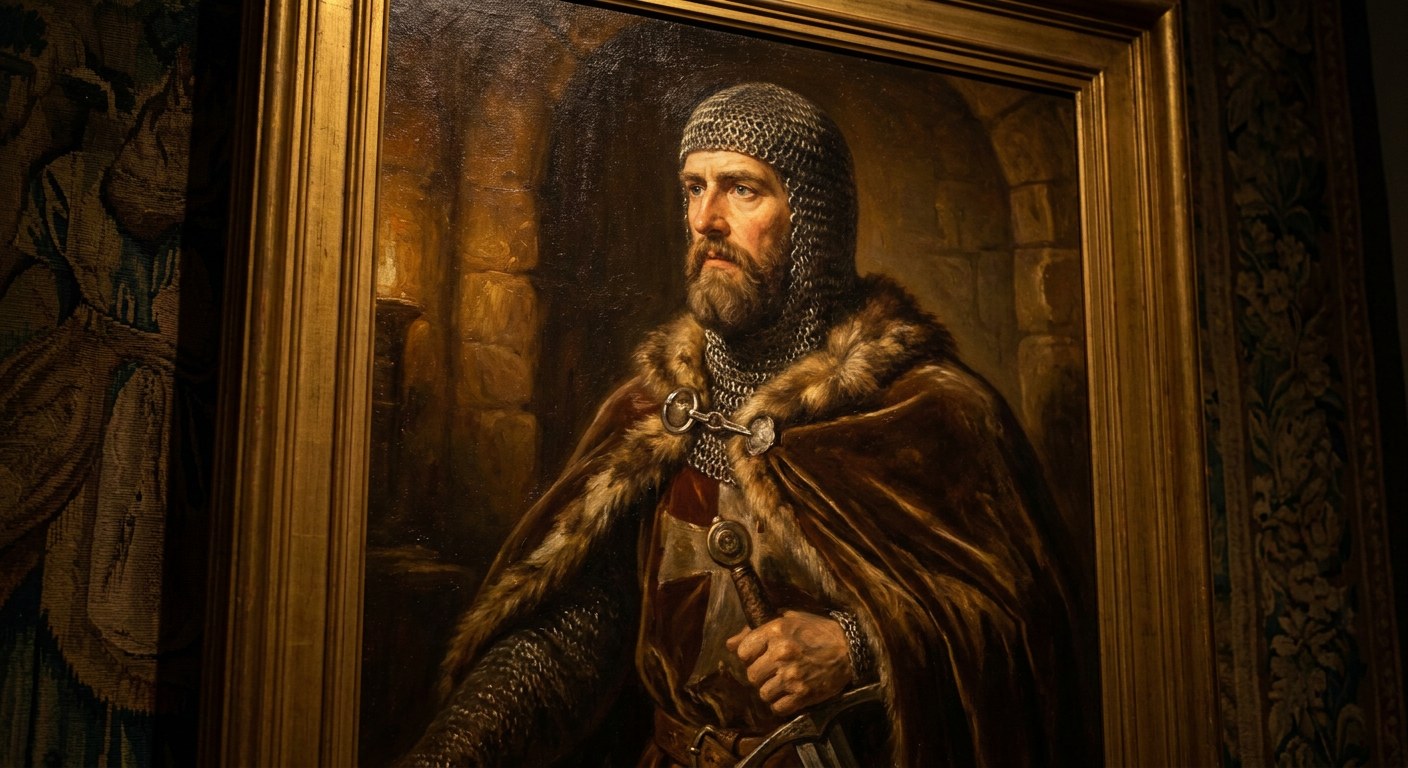
Robert the Bruce
1274 – 1329 · Scottish · King & Military Leader
Recommended Audiobooks
Listen next from Marcus Alden

Life Lessons from Frederic Chopin
Marcus Alden · 54 min

Life Lessons from John Wesley
Marcus Alden · 52 min
Introduction
Robert the Bruce—more formally Robert I of Scotland—was one of the most consequential rulers in medieval British history. Born into a powerful Anglo-Norman and Gaelic aristocratic family, he became king during Scotland’s prolonged struggle against English domination. His path to the throne was violent and uncertain: he changed political allegiances, quarreled with rival Scottish leaders, killed John Comyn inside a church, suffered military defeat, and was driven into hiding. Yet he recovered with remarkable speed, rebuilt his forces, destroyed or captured key English-held castles, and established effective control over most of Scotland.
Bruce’s greatest military success came at the Battle of Bannockburn, fought on 23–24 June 1314, where his smaller army defeated the forces of Edward II of England. Bannockburn did not immediately end the war, but it transformed Bruce’s authority and became an enduring symbol of Scottish independence.
Political and diplomatic achievements were equally important. The Declaration of Arbroath of 1320 defended Scotland’s status as an independent kingdom, while the Treaty of Edinburgh–Northampton in 1328 compelled the English government to recognize Robert as king and Scotland as sovereign.
Robert died in 1329, leaving an independent but still vulnerable realm. Remembered as a military commander, political survivor, lawgiver, and nation-building monarch, he remains central to Scotland’s historical identity.
Quick Facts
| Category | Details |
|---|---|
| Full name | Robert de Brus; later Robert I of Scotland |
| Common name | Robert the Bruce |
| Born | 11 July 1274 |
| Probable birthplace | Turnberry Castle, Carrick, Ayrshire; the exact location is uncertain |
| Parents | Robert de Brus, 6th Lord of Annandale, and Marjorie, Countess of Carrick |
| Dynasty | House of Bruce |
| Reign | 25 March 1306–7 June 1329 |
| Coronation | Scone, March 1306 |
| Main rival | John Comyn III of Badenoch; later Edward I and Edward II of England |
| Major victory | Battle of Bannockburn, 23–24 June 1314 |
| Spouses | Isabella of Mar; Elizabeth de Burgh |
| Successor | David II |
| Died | 7 June 1329, at Cardross in present-day West Dunbartonshire |
| Burial | Dunfermline Abbey; his heart was eventually buried at Melrose Abbey |
Early Life & Background
Robert was born on 11 July 1274, probably at Turnberry Castle in the earldom of Carrick. His father, also named Robert, was lord of Annandale and belonged to a landholding family with estates in Scotland and England. His mother, Marjorie, Countess of Carrick, was heiress to a major Gaelic lordship in southwestern Scotland. Through her, the younger Robert inherited the title Earl of Carrick in 1292.
The Bruces were of Anglo-Norman origin but had become deeply integrated into Scottish political society. Robert probably grew up in a multilingual environment in which French, Gaelic, Scots, and Latin all had practical uses. His Carrick upbringing may have exposed him to Gaelic traditions of lordship and warfare, while his paternal family connected him to the aristocratic culture of England and northern Europe.
Robert’s claim to the Scottish throne came through his father’s family. His grandfather, Robert de Brus, 5th Lord of Annandale, descended from David, Earl of Huntingdon, a grandson of King David I. When King Alexander III died in 1286 and his granddaughter Margaret, the Maid of Norway, died in 1290, Scotland entered a succession crisis.
The leading claimants were John Balliol and Robert’s grandfather. In 1292, after being asked to judge the competing claims, Edward I of England selected Balliol as king. Edward then exploited his role as arbitrator to assert authority over Scotland. Balliol’s reign collapsed after the Scots allied with France and Edward invaded in 1296.
The Bruce family did not initially stand at the forefront of resistance. Because the Balliol and Comyn families were their chief dynastic rivals, the Bruces sometimes cooperated with Edward I. This political inheritance shaped Robert’s early career: his commitment to Scottish kingship developed alongside a determined effort to secure his family’s own claim.
Rise to Prominence
Robert entered public life during the wars that followed Edward I’s invasion of Scotland. In 1296, Edward defeated the Scots at Dunbar, forced John Balliol to abdicate, and removed the Stone of Scone to England. Robert’s father remained broadly loyal to Edward, but the younger Bruce joined the Scottish rising of 1297 associated with William Wallace and Andrew Murray.
His allegiances remained fluid. In 1298, after Wallace’s defeat at Falkirk, Bruce became a Guardian of Scotland alongside John Comyn of Badenoch. Cooperation between the two men was difficult because their families represented competing political interests. Bruce resigned the guardianship by 1300 and submitted to Edward I in 1302, apparently fearing that the restoration of Balliol would destroy Bruce ambitions.
By 1304, organized resistance had largely collapsed. Yet Bruce continued preparing for a possible bid for power. He reached a secret agreement with William Lamberton, bishop of St Andrews, pledging mutual support. His principal obstacle remained John Comyn, an influential noble with close connections to the Balliol cause.
On 10 February 1306, Bruce and Comyn met at the Franciscan church at Dumfries. During a confrontation near the high altar, Bruce stabbed Comyn; Bruce’s companions then completed the killing. Comyn’s uncle, Sir Robert Comyn, was also killed. The precise cause of the argument remains uncertain. Later chronicles claimed that Comyn had betrayed an agreement with Bruce, but these accounts may reflect Bruce propaganda.
The killing was both a political assassination and a grave act of sacrilege. It made compromise nearly impossible and led to Bruce’s excommunication. Bruce responded by moving rapidly. Supported by bishops, relatives, and regional allies, he was crowned at Scone on 25 March 1306. Isabella MacDuff, Countess of Buchan, arrived to perform the traditional role of her family in Scottish coronations, probably in a second ceremony shortly afterward.
His new kingship nearly ended at once. On 19 June 1306, Aymer de Valence, Earl of Pembroke, defeated Bruce at Methven. Later that year Bruce was also defeated near Dalry by forces associated with the MacDougalls of Argyll. He fled westward, while English forces captured members of his family. His brothers Thomas, Alexander, and Neil were executed. His wife Elizabeth, his daughter Marjorie, his sister Mary, and the Countess of Buchan endured years of captivity.
Bruce’s location during the winter of 1306–07 is uncertain. Tradition places him in a cave where he watched a spider repeatedly attempt to spin its web, but no contemporary evidence supports the story. He may have sheltered in the Hebrides, Ireland, or the western Scottish islands.
In early 1307, Bruce returned to Carrick. He won an important victory over Pembroke at Loudoun Hill on 10 May, using prepared terrain to neutralize the English cavalry. Edward I marched north but died at Burgh by Sands on 7 July 1307. His son, Edward II, lacked his father’s consistency and military authority.
Bruce then conducted a determined campaign against his Scottish enemies. He defeated the Comyn interest in the northeast, won at Inverurie in 1308, and devastated Buchan in the campaign remembered as the Herschip, or Harrying, of Buchan. He also defeated the MacDougalls at the Pass of Brander and expanded his control across western Scotland. By 1309, he could hold a parliament at St Andrews and act increasingly as an established king rather than a fugitive claimant.
Major Achievements
Restoration of an Independent Scottish Monarchy
Bruce’s most important achievement was the restoration of effective Scottish kingship. In 1306 his authority rested on a narrow coalition, but by the early 1310s he controlled most of the kingdom. He redistributed lands confiscated from opponents and rewarded loyal families, creating a political elite whose fortunes depended on the survival of his regime.
Military Transformation
Bruce adapted his strategy to Scotland’s circumstances. Rather than rely on conventional battles against larger English armies, he used raids, ambushes, scorched-earth tactics, and rapid movement. English-held castles were captured and frequently dismantled so that they could not be reused by invading armies.
His troops made effective use of schiltrons, dense formations of spearmen. Under Bruce, these formations became more mobile and tactically flexible than those used at the Battle of Falkirk.
Victory at Bannockburn
The Battle of Bannockburn was Bruce’s defining military achievement. In 1313, his brother Edward Bruce agreed that the English garrison of Stirling Castle would surrender unless relieved by midsummer 1314. Edward II responded with a major invasion.
Near Bannockburn, south of Stirling, Robert’s army used restricted and marshy terrain to limit the effectiveness of English cavalry. On the first day, Bruce famously killed the English knight Henry de Bohun in single combat. On the second, the Scottish schiltrons advanced and compressed the English army against difficult ground. The English formation collapsed, and Edward II fled.
The victory secured Stirling Castle, enhanced Bruce’s prestige, and greatly weakened the position of Scottish nobles who still opposed him.
Diplomacy and Recognition
The Declaration of Arbroath, dated 6 April 1320, was sent by Scottish barons to Pope John XXII. It defended Scotland’s historical independence and presented Robert as the king who had liberated the realm. Although it did not immediately end papal pressure, it became one of medieval Europe’s most famous statements of political community.
In 1324, the pope addressed Robert as king, a significant diplomatic advance. Final English recognition came through the Treaty of Edinburgh–Northampton in 1328. England renounced claims of overlordship, recognized Robert as king, and accepted Scotland as a separate realm. The settlement was reinforced by the marriage of Robert’s son David to Joan of the Tower, sister of Edward III.
Defining Moments
The Killing of John Comyn
The killing at Dumfries forced Bruce into open rebellion. It eliminated a major rival but stained his reputation and divided Scotland. Bruce could no longer retreat into cautious negotiation: he had to become king or face destruction.
Defeat and Recovery in 1306–07
Bruce’s recovery after Methven was extraordinary. His cause appeared lost, his family was imprisoned, and several brothers had been executed. His return demonstrated resilience, tactical adaptability, and an ability to retain loyalty under extreme pressure.
The Destruction of Domestic Opposition
Bruce’s victories over the Comyns and MacDougalls were as important as his campaigns against England. The struggle was not simply Scotland against England; it was also a Scottish civil war over kingship, land, and allegiance. Bruce prevailed by defeating rival networks and redistributing their estates.
Bannockburn
Bannockburn transformed Robert from a contested ruler into the dominant king of Scotland. It did not immediately produce peace, but it made an English reconquest far more difficult and gave Bruce the authority to pursue war beyond Scotland’s borders.
The Peace of 1328
The Treaty of Edinburgh–Northampton represented the fulfillment of Bruce’s political objective. Recognition by England carried practical importance that battlefield victories alone could not provide. Robert had converted military survival into diplomatic legitimacy.
Timeline
| Year | Event |
|---|---|
| 1274 | Robert is born on 11 July, probably at Turnberry Castle in Carrick. |
| 1286 | Alexander III dies, beginning a Scottish succession crisis. |
| 1290 | Margaret, Maid of Norway, dies before reaching Scotland. |
| 1292 | John Balliol becomes king; Robert inherits the earldom of Carrick through his mother. |
| 1296 | Edward I invades Scotland and forces Balliol to abdicate. |
| 1297 | Bruce supports the Scottish rising against English rule. |
| 1298 | After Falkirk, Bruce becomes a Guardian of Scotland with John Comyn. |
| 1300 | Bruce leaves the guardianship amid conflict within the Scottish leadership. |
| 1302 | He submits to Edward I. |
| 1304 | Bruce enters a secret alliance with Bishop William Lamberton. |
| 1306 | On 10 February, Bruce kills John Comyn at Dumfries; on 25 March, he is crowned at Scone. |
| 1306 | Bruce is defeated at Methven and Dalry and driven into flight. |
| 1307 | He returns, wins at Loudoun Hill, and resumes his campaign; Edward I dies in July. |
| 1308 | Bruce defeats enemies at Inverurie and the Pass of Brander. |
| 1309 | He holds a parliament at St Andrews. |
| 1310–1313 | Bruce’s forces capture and dismantle many English-held fortresses. |
| 1314 | Scots defeat Edward II at Bannockburn on 23–24 June. |
| 1315 | Edward Bruce invades Ireland and is proclaimed high king there. |
| 1318 | Berwick-upon-Tweed falls to the Scots; Edward Bruce is killed at Faughart in Ireland. |
| 1320 | Scottish nobles issue the Declaration of Arbroath. |
| 1322 | Bruce defeats or evades another major English invasion and raids northern England. |
| 1323 | Scotland and England agree to a long truce. |
| 1324 | Pope John XXII recognizes Robert’s royal title. |
| 1326 | The Scottish parliament at Cambuskenneth approves taxation to support the crown. |
| 1327 | Scottish forces conduct the Weardale campaign in northern England. |
| 1328 | The Treaty of Edinburgh–Northampton recognizes Scottish independence and Robert’s kingship. |
| 1329 | Robert dies at Cardross on 7 June and is buried at Dunfermline Abbey. |
| 1330 | Sir James Douglas dies carrying Bruce’s heart on campaign in Spain; the heart is returned to Scotland. |
Personal Life
Robert first married Isabella of Mar, daughter of Donald, Earl of Mar. She died around 1296, probably soon after giving birth to their daughter Marjorie Bruce. Marjorie later married Walter Stewart, 6th High Steward of Scotland. Their son became Robert II, the first monarch of the Stewart dynasty.
Around 1302, Bruce married Elizabeth de Burgh, daughter of Richard de Burgh, Earl of Ulster. Captured by the English in 1306, she remained a prisoner until 1314. Robert and Elizabeth had several children, including David II, who succeeded his father, and a second son, John, who died in childhood. Elizabeth died in 1327.
Robert also had several illegitimate children, among them Sir Robert Bruce, Neil Bruce, Margaret Bruce, Elizabeth Bruce, and Christina Bruce, although the details of their maternity and birth dates are uncertain.
His closest political and military companions included his brother Edward Bruce, Thomas Randolph, Earl of Moray, and Sir James Douglas, remembered as the “Good Sir James.” Their loyalty was essential to his success.
Beliefs & Philosophy
Robert left no systematic statement of political philosophy, so his beliefs must be reconstructed from laws, charters, diplomacy, religious patronage, and contemporary chronicles.
His kingship combined hereditary claim, sacred coronation, military leadership, and the idea that a ruler must defend the community of the realm. The Declaration of Arbroath famously suggested that kingship depended on the king’s defense of Scottish freedom. This was not modern democracy, but it expressed a medieval theory of conditional political loyalty.
Robert was conventionally pious and supported churches, monasteries, and religious institutions. The killing of Comyn in a church troubled his relationship with the papacy, and he sought absolution and reconciliation. Before his death, he asked that his heart be carried on crusade, reflecting both religious devotion and aristocratic ideals of penance.
His conduct was also intensely pragmatic. He changed allegiance when circumstances demanded, rewarded supporters with confiscated lands, negotiated truces, and used severe force against enemies. His guiding principle appears to have been the survival of his dynasty and the independence of his kingdom.
Challenges & Controversies
Bruce’s reputation as a national hero can obscure the moral and political complexity of his career. He did not consistently oppose Edward I from the beginning. Like many nobles with property on both sides of the border, he shifted allegiance as he assessed the prospects of the Bruce, Balliol, and English causes.
The murder of John Comyn remains the greatest controversy of his life. It took place in a consecrated church and violated both religious law and aristocratic custom. Accounts written under Bruce or Stewart rule often sought to justify the killing by portraying Comyn as a traitor. The surviving evidence does not establish exactly what passed between them.
Bruce’s consolidation of Scotland could also be ruthless. The Harrying of Buchan involved widespread destruction intended to break Comyn power. Communities associated with his enemies suffered, while forfeitures transformed patterns of landholding for generations.
His invasion of Ireland in 1315 was ambitious but disastrous. Edward Bruce attempted to establish a Bruce kingdom in Ireland while weakening English power. The campaign coincided with famine and brought severe hardship. Edward was killed at the Battle of Faughart in 1318, and the project collapsed.
Nor did Bannockburn end the war. Scottish armies conducted destructive raids into northern England, partly to force English recognition. These operations enriched commanders and pressured Edward II’s government but caused extensive suffering among civilians.
Finally, the nature of Bruce’s illness remains disputed. Later writers often claimed that he died of leprosy, but the evidence is inconclusive. Other chroniclers used terms that could refer to various chronic skin or systemic diseases. Modern attempts to diagnose him from limited records cannot provide certainty.
Famous Quotes
Few words can be securely identified as Robert’s own. Many celebrated “Bruce quotations” come from later literary works or from documents issued collectively in his reign.
“For, as long as a hundred of us remain alive, never will we on any conditions be brought under English rule.”
This comes from the Declaration of Arbroath of 1320. The document was issued in the name of the Scottish political community, not as Robert’s personal speech.
“It is in truth not for glory, nor riches, nor honours that we are fighting, but for freedom—for that alone, which no honest man gives up but with life itself.”
Also from the Declaration of Arbroath, this is among the most famous formulations of medieval Scottish independence.
“Freedom is a noble thing.”
The line appears in John Barbour’s fourteenth-century poem The Brus. It reflects the values associated with Bruce’s struggle but is spoken by Barbour as narrator rather than recorded as a direct statement by the king.
“If at first you don’t succeed, try, try again.”
Frequently connected to the legend of Bruce and the spider, this wording is not a documented quotation from Robert. The spider story itself appeared centuries after his lifetime.
Legacy & Influence
Robert’s immediate legacy was an independent monarchy recognized by England and the papacy. Yet the settlement remained fragile. His son David II was only five years old when Robert died, and supporters of Edward Balliol soon renewed civil war with English assistance.
Even so, Bruce’s dynasty endured indirectly. His daughter Marjorie’s descendants founded the Stewart royal house, which ruled Scotland from 1371 and later inherited the English and Irish crowns in 1603.
Bannockburn became one of Scotland’s most powerful sites of national memory. Medieval chroniclers such as John Barbour presented Bruce as a model warrior-king, while later historians, poets, novelists, and political movements reshaped his image for their own eras. He has been represented as a chivalric hero, guerrilla commander, constitutional monarch, and champion of national liberty.
The Declaration of Arbroath has also acquired an influence far beyond its original diplomatic setting. Although it should not be interpreted as a modern declaration of popular sovereignty, its language about political community and freedom has resonated internationally.
Archaeology and historical research have refined this heroic tradition. Modern scholarship emphasizes that the wars were not a simple national conflict between united peoples. They involved civil war, cross-border aristocratic interests, dynastic rivalry, and shifting loyalties. Bruce’s greatness lay partly in his ability to turn this fragmented political landscape into a workable and durable kingship.
Interesting Facts
- Robert was approximately 39 years old at Bannockburn.
- He killed Henry de Bohun with an axe during an encounter before the main battle.
- Bruce ordered many captured castles dismantled rather than garrisoned.
- The famous spider story has no known medieval source and became popular much later.
- His body was buried at Dunfermline Abbey, but his heart was removed separately.
- Sir James Douglas carried Bruce’s heart toward the crusading frontiers but was killed in Spain in 1330.
- The heart was returned and traditionally identified with a burial at Melrose Abbey.
- Robert’s tomb at Dunfermline was rediscovered in 1818.
- His grandson Robert II founded the royal Stewart dynasty.
- “The Bruce” derives from the family name and is not a formal royal title.
Frequently Asked Questions
Why is Robert called “the Bruce”?
“Bruce” was his family name, derived from the Norman place-name Brix, associated with the family’s origins in Normandy. Medieval forms included Brus and de Brus. “The Bruce” became a conventional way of identifying the leading member of the family, but during his reign he was formally Robert, king of Scots.
Was Robert the Bruce related to William Wallace?
They were not close relatives. Both participated in resistance to English rule, but their careers and social positions differed. Wallace was a lesser landholder who became Guardian of Scotland after the uprising of 1297. Bruce was an earl and royal claimant. There is limited evidence of direct cooperation between them.
Did Robert betray William Wallace?
There is no reliable evidence that Bruce personally betrayed Wallace. Bruce’s political conduct was inconsistent, and he submitted to Edward I in 1302, but later stories exaggerating personal conflict between Bruce and Wallace are largely fictional.
Why did Robert kill John Comyn?
The exact reason is unknown. They were political and dynastic rivals, and later sources claimed that Comyn had betrayed a secret agreement. The confrontation at Dumfries may have concerned plans for rebellion or the Scottish crown. What is certain is that Bruce stabbed Comyn in the Greyfriars church on 10 February 1306.
Did Robert the Bruce really watch a spider in a cave?
Probably not. The story says that Bruce, while hiding after defeat, watched a spider repeatedly fail and finally succeed in spinning or anchoring its web. It became a lesson in perseverance, but no contemporary or medieval source connects the story to him.
How did Robert win the Battle of Bannockburn?
He chose ground that restricted English cavalry, organized his spearmen into disciplined schiltrons, and maintained unity of command. The Scottish advance on 24 June compressed Edward II’s larger army into an unsuitable area near marshes and waterways. English morale and coordination then collapsed.
Did Bannockburn make Scotland independent?
Bannockburn secured Bruce’s position and greatly weakened English control, but it did not formally end the war. England recognized Robert’s kingship and Scotland’s independence only in the Treaty of Edinburgh–Northampton in 1328.
What illness killed Robert the Bruce?
The evidence is insufficient for a firm diagnosis. Some chroniclers described a serious long-term illness, later interpreted as leprosy. Other conditions are possible, and modern examinations have not produced a definitive answer. He died at Cardross on 7 June 1329.
Where is Robert the Bruce buried?
His body was buried before the high altar of Dunfermline Abbey in Fife. His heart was removed according to his wishes and carried abroad by Sir James Douglas. After Douglas’s death, it was returned to Scotland and traditionally buried at Melrose Abbey.
Who succeeded Robert the Bruce?
His five-year-old son succeeded him as David II. Because David was a child, Scotland was governed by guardians. His minority exposed the kingdom to renewed invasion and the rival claim of Edward Balliol.
Lessons from Robert the Bruce
- Adapt after failure: Bruce abandoned tactics that had failed and adopted mobile warfare, surprise attacks, and strategic castle destruction.
- Legitimacy requires more than force: Military victory had to be supported by coronation, parliament, diplomacy, law, and international recognition.
- Choose terrain carefully: Bannockburn demonstrated how preparation and geography can offset numerical disadvantage.
- Build durable alliances: Bruce’s success depended on commanders, clergy, nobles, and regional communities rather than individual courage alone.
- Political choices carry moral costs: The killing of Comyn and the devastation of enemy territories remained inseparable from Bruce’s rise.
- Persistence matters, but so does strategy: His recovery after 1306 resulted not merely from determination but from organization and tactical change.
- Heroic traditions should be examined critically: Bruce’s genuine achievements are best understood alongside the civil conflict, shifting loyalties, and violence of his age.
Further Reading
- G. W. S. Barrow, Robert Bruce and the Community of the Realm of Scotland
- Michael Penman, Robert the Bruce: King of the Scots
- Geoffrey W. S. Barrow, The Kingdom of the Scots
- Fiona Watson, Under the Hammer: Edward I and Scotland, 1286–1306
- Colm McNamee, Robert Bruce: Our Most Valiant Prince, King and Lord
- Ronald McNair Scott, Robert the Bruce: King of Scots
- John Barbour, The Brus, translated by A. A. M. Duncan
- The Declaration of Arbroath, edited and translated in modern scholarly editions
- Michael Brown, The Wars of Scotland, 1214–1371
- David Cornell, Bannockburn: The Triumph of Robert the Bruce