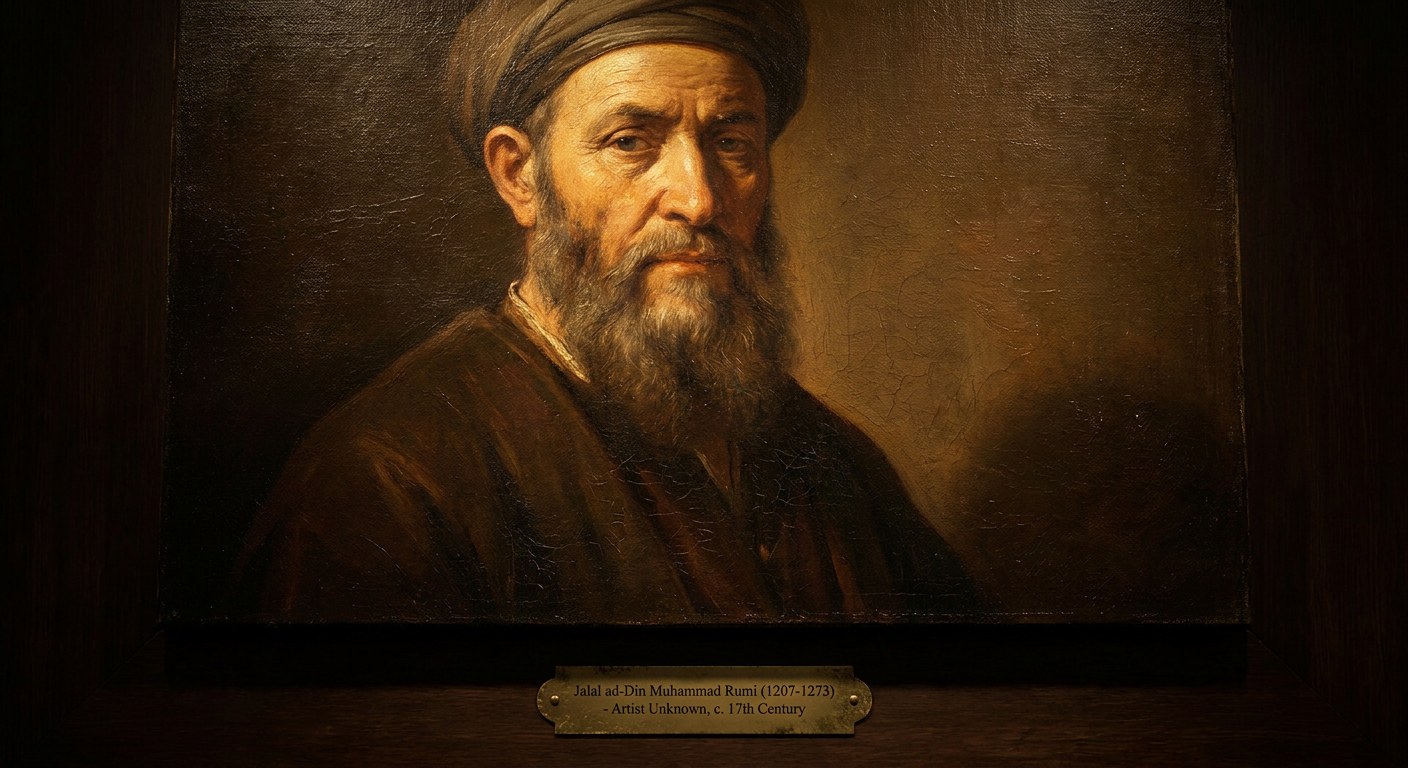
Rumi
1207 – 1273 · Persian · Poet, Sufi Mystic & Theologian
Recommended Audiobooks
Listen next from Marcus Alden

Life Lessons from Frederic Chopin
Marcus Alden · 54 min

Life Lessons from John Wesley
Marcus Alden · 52 min
Introduction
Jalal al-Din Muhammad Rumi, usually known simply as Rumi, was a 13th-century Persian poet, Muslim scholar, jurist, preacher and Sufi mystic. His writings—especially the six-volume Masnavi-ye Ma'navi, or Spiritual Couplets—stand among the most influential works of Persian literature and Islamic spirituality. Composed largely in Persian but enriched by Arabic, Greek and Turkish words and phrases, Rumi's poetry explores divine love, moral transformation, separation and reunion, the discipline of the ego and humanity's longing for its spiritual source.
Rumi lived during an age of upheaval. His family left the eastern Iranian world during the period of the Mongol conquests and eventually settled in Konya, a major city of the Seljuk Sultanate of Rum in Anatolia. There he inherited his father's position as a religious teacher. Initially respected as a jurist and preacher, Rumi underwent a profound transformation after meeting the wandering mystic Shams al-Din of Tabriz in 1244. Their intense spiritual companionship redirected Rumi's life toward ecstatic devotion and poetry.
Although later audiences have sometimes presented him as a detached universal philosopher, Rumi was deeply rooted in Islam. The Qur'an, the life of the Prophet Muhammad, Islamic law, theology and Sufi tradition permeate his work. At the same time, his poetry repeatedly crosses social and confessional boundaries by emphasizing the common human search for truth. This combination of religious specificity and universal imaginative power has allowed his writings to travel across languages, cultures and centuries.
Rumi's followers developed the Mevlevi Sufi order, popularly associated with the whirling ceremony of the sema. Today he is honored across Iran, Afghanistan, Tajikistan, Turkey and the wider world. His poetry remains central to Persian literary culture and has found an enormous modern readership in translation.
Quick Facts
| Fact | Details |
|---|---|
| Born | 30 September 1207, traditionally identified as Balkh or its wider region, in present-day Afghanistan |
| Died | 17 December 1273, Konya, Sultanate of Rum, in present-day Turkey |
| Nationality | Persian; modern national categories are anachronistic for his period |
| Known For | Sufi poetry, the Masnavi, the Divan of Shams of Tabriz and teachings on divine love |
| Occupation | Poet, jurist, Islamic scholar, preacher and Sufi teacher |
| Era | 13th century; medieval Islamic world and Seljuk Anatolia |
Early Life and Education
Rumi's full name is commonly given as Jalal al-Din Muhammad Balkhi. The title Mawlana or Mevlana, meaning approximately “our master,” became one of the most familiar ways of referring to him. The name Rumi means “Roman” or “of Rum,” reflecting his long residence in Anatolia, a region formerly ruled by the Eastern Roman Empire and known in Islamic geography as Rum.
He was born in 1207 within the broader cultural world of Khurasan. Medieval sources connect his family with Balkh, although scholars continue to debate whether his birth occurred in the city itself or in a nearby locality such as Wakhsh, then part of the wider Balkh cultural region. Modern countries consequently emphasize different elements of his heritage, but Rumi wrote predominantly in Persian and belonged to the Persianate intellectual tradition.
His father, Baha al-Din Walad, was a respected preacher, theologian and religious teacher. Later Mevlevi tradition portrayed him as a celebrated mystic known as the Sultan of the Scholars. The family left its eastern homeland while Rumi was still a child. The precise reasons are uncertain. The approaching Mongol invasions almost certainly formed part of the historical background, although disagreements involving local rulers or scholars may also have contributed.
The family's westward journey became an important part of Rumi's later biography. Traditional accounts say they visited Nishapur, where the young Rumi encountered the celebrated poet Farid al-Din Attar. Whether every detail is historical cannot be established, but Attar's mystical poetry unquestionably belonged to the tradition Rumi inherited. The family also traveled through Baghdad and may have performed the pilgrimage to Mecca before living in parts of Syria and Anatolia.
After a period in Laranda, now Karaman in Turkey, the family settled in Konya, capital of the Seljuk Sultanate of Rum, around 1228. Konya was a cosmopolitan center inhabited by Muslims, Christians and Jews and connected to Persian, Arabic, Greek, Armenian and Turkish cultures. Persian served as an important language of literature and courtly life.
Rumi received a rigorous religious education. He studied the Qur'an, prophetic traditions, Arabic grammar, jurisprudence, theology and the established disciplines of Islamic scholarship. Following his father's death in 1231, one of Baha al-Din's disciples, Burhan al-Din Muhaqqiq Tirmidhi, helped guide Rumi's intellectual and spiritual formation. Rumi reportedly pursued advanced study in Aleppo and Damascus, two of the foremost educational centers of the age.
By his early adulthood, he possessed the credentials of a conventional scholar. He taught religious law, delivered sermons and instructed students. His later mystical poetry did not represent the abandonment of learning; rather, it transformed formal knowledge into a language of spiritual experience.
Rise to Prominence
Rumi first became prominent in Konya as a preacher, jurist and teacher. After his father's death, he inherited a community of students and admirers. He lectured in religious schools and offered legal and moral guidance. Contemporary society would initially have recognized him less as a poet than as an authoritative member of the learned class.
The decisive event in his life occurred on 29 November 1244, when he met Shams al-Din Muhammad of Tabriz. Shams was an unconventional wandering dervish whose forceful personality challenged comfortable assumptions about scholarship and religious status. Later narratives dramatized their meeting in different ways, sometimes describing a startling theological question posed by Shams. The exact conversation is impossible to reconstruct, but its effect on Rumi was profound.
Rumi and Shams entered an intense period of spiritual companionship. They spent long intervals in private conversation and contemplative retreat. To Rumi, Shams became a mirror in which divine love and the limitations of the self were revealed. Their closeness disturbed some of Rumi's students and family members, who resented the newcomer's influence and their own reduced access to their teacher.
Shams left Konya for Damascus, probably in 1246, but returned after Rumi sent appeals and dispatched his son Sultan Walad to find him. In 1247 or 1248, Shams disappeared permanently. Some later traditions claim that jealous members of Rumi's circle murdered him, possibly with the involvement of Rumi's son Ala al-Din. Evidence is inconclusive, and historians cannot determine Shams's fate with certainty.
The loss transformed Rumi's grief into poetry. He searched for Shams outwardly and then came to express the idea that the beloved had been found within his own transformed consciousness. Many lyric poems were written under Shams's name, producing the collection known as the Divan-e Shams-e Tabrizi. By speaking through or as Shams, Rumi blurred the distinction between lover and beloved, teacher and disciple, and human personality and divine illumination.
Rumi's public influence continued to grow. He formed close spiritual friendships with Salah al-Din Zarkub, a goldsmith, and later Husam al-Din Chalabi. Husam encouraged him to compose the Masnavi, the vast instructional poem that became his masterpiece. Thus Rumi's prominence rested on a rare combination: formal scholarship, charismatic teaching, lyric genius and the creation of a durable spiritual community.
Major Achievements and Contributions
Rumi's foremost achievement was the creation of one of the greatest poetic bodies in the Persian language. His writing combines lyric intensity, storytelling, humor, scriptural interpretation, philosophical reflection and practical spiritual counsel. Rather than presenting a rigid system, he frequently teaches through parables, interruptions, paradoxes and shifts of voice.
The Masnavi-ye Ma'navi contains roughly 25,000 rhyming couplets arranged in six books. It draws on the Qur'an, prophetic traditions, folklore, history, everyday life and earlier Sufi literature. Stories lead into other stories, while the narrator pauses to interpret their spiritual meanings. The work teaches that human beings are separated from their origin and must be purified of pride, greed and illusion before returning consciously to God.
Rumi also transformed Persian lyric poetry. His ghazals, collected in the Divan of Shams, communicate longing through images of wine, music, dancing, fire, sunlight and intoxication. In Sufi poetry such images often function on several levels at once. Earthly love may symbolize divine love, wine may represent spiritual ecstasy, and the tavern may signify a place beyond respectable self-righteousness.
Another achievement was his creative integration of Islamic scholarship with mystical experience. Rumi did not reject reason, but he argued that unaided reason reaches limits when confronting divine reality. Discursive knowledge must be joined to love, ethical discipline and direct spiritual awareness. His work repeatedly criticizes knowledge used for vanity while praising learning that transforms character.
Rumi's teaching also contributed to the development of the Mevlevi tradition. The organized order took shape after his death under Sultan Walad and later successors, but it drew inspiration from Rumi's use of poetry, music and turning movement in devotional practice. Mevlevi communities became influential in Ottoman religious and cultural life, producing poets, musicians, calligraphers and statesmen.
Finally, Rumi created an unusually inclusive moral imagination. He acknowledged religious differences yet sought the divine source underlying sincere spiritual aspiration. This has helped make him a figure of interfaith interest, although understanding his inclusiveness requires recognizing, rather than erasing, his Islamic vocabulary and commitments.
Key Works / Battles / Ideas
Masnavi-ye Ma'navi
Usually translated as the Spiritual Couplets or The Masnavi, this six-book poem was dictated over many years to Husam al-Din Chalabi. It is sometimes respectfully described as “the Qur'an in Persian,” not because Muslims regard it as scripture, but because of its extraordinary authority within Persian-speaking Sufi culture. Its opening song of the reed flute presents the soul as a reed cut from its bed, lamenting separation from its source.
Divan-e Shams-e Tabrizi
The Divan, also called the Divan-e Kabir, is a large collection of lyric poems and quatrains associated with Rumi. Many poems bear the name of Shams in the closing signature. More ecstatic than the generally instructional Masnavi, the collection dramatizes the annihilation of the separate self in love.
Fihi Ma Fihi
Meaning “In It Is What Is in It,” this prose work preserves talks and conversations attributed to Rumi. It offers valuable insight into his teaching style and discusses faith, conduct, interpretation and spiritual psychology in a more conversational form than his poetry.
Majalis-e Sab'a
The Seven Sermons preserve examples of Rumi's formal preaching. They demonstrate his foundation in Qur'anic exegesis and religious scholarship and help correct the misconception that his mystical period was disconnected from his earlier role as an Islamic preacher.
Makatib
Rumi's surviving letters address relatives, disciples, officials and patrons. They reveal him participating in the practical affairs of his community, requesting assistance for others and maintaining relationships with Anatolia's political elite.
Divine love
For Rumi, love is not merely an emotion. It is a force that strips away false identity and draws creation toward God. Human love can become a school in which the lover learns selflessness, but attachment must ultimately open toward its divine source.
Separation and return
The image of separation structures much of Rumi's thought. Like the reed removed from the reed bed, the human soul experiences exile. Spiritual life is the process of remembering its origin and returning to it with awakened understanding.
Annihilation and subsistence
Rumi inherited the Sufi concepts of fana, the passing away of the ego's imagined independence, and baqa, enduring in God. His ecstatic language about losing the self does not normally mean physical destruction; it signifies the transformation of selfish consciousness.
Music, poetry and movement
Rumi viewed rhythm and music as possible vehicles of remembrance. Mevlevi tradition later formalized the sema, in which controlled turning symbolizes cosmic order and spiritual ascent. The modern label “whirling dervishes” describes its visible feature but can obscure the ceremony's disciplined religious meaning.
Timeline of Key Events
| Year | Event |
|---|---|
| 1207 | Born in the wider Balkh region of the eastern Persianate world |
| c. 1210s–1220s | Leaves the region with his family and travels westward |
| 1220s | Family lives in Laranda; Rumi marries Gowhar Khatun |
| c. 1228 | Settles in Konya under Seljuk patronage |
| 1231 | His father Baha al-Din Walad dies; Rumi succeeds him as a teacher |
| 1230s | Studies further under Burhan al-Din Tirmidhi and in Syria |
| 1244 | Meets Shams of Tabriz in Konya |
| 1246 | Shams leaves for Damascus before later returning |
| 1247–1248 | Shams disappears permanently; his fate remains uncertain |
| c. 1249 | Salah al-Din Zarkub becomes one of Rumi's closest companions |
| 1250s | Rumi composes many lyrics associated with the Divan of Shams |
| c. 1258–1261 | Begins dictating the Masnavi to Husam al-Din Chalabi |
| 1273 | Dies in Konya on 17 December |
| 13th–14th centuries | Sultan Walad and successors consolidate the Mevlevi order |
Personal Life and Character
Rumi married Gowhar Khatun while his family was living in Laranda. Their children included Sultan Walad and Ala al-Din Muhammad. After Gowhar's death, Rumi married a second wife, commonly known as Kira Khatun, with whom he had additional children. Sultan Walad later became essential to preserving his father's memory and institutionalizing the Mevlevi community.
Sources portray Rumi as intellectually learned, emotionally intense and capable of deep personal attachment. His poetry reveals a playful as well as solemn character. He used jokes, animal fables, domestic scenes and deliberately earthy stories to expose hypocrisy or illustrate spiritual lessons. Some passages can surprise readers expecting only refined devotional verse.
Rumi maintained relationships with political officials and wealthy patrons but often warned against pride, greed and dependence upon status. His letters show that he interceded with authorities on behalf of disciples and acquaintances. He was therefore not an isolated recluse; he participated actively in Konya's social life.
His strongest recorded bonds were spiritual friendships. Shams awakened his ecstatic poetic voice, Salah al-Din offered stabilizing companionship, and Husam al-Din inspired and recorded the Masnavi. Rumi's tendency to focus intensely on a chosen companion sometimes generated jealousy, but it also reflects the Sufi ideal that spiritual development occurs through transformative relationships.
Challenges and Controversies
The greatest challenge of Rumi's lifetime was repeated loss. Migration separated him from his ancestral homeland, his father died while Rumi was still establishing himself, and Shams's disappearance caused a spiritual and emotional crisis. His response was not to deny grief but to convert absence into a language of inward presence.
The fate of Shams remains controversial. Mevlevi narratives include allegations of murder, yet the available accounts were written after the event and contain legendary elements. It is possible that Shams was killed, but it is also possible that he departed voluntarily and died elsewhere. Claims of certainty exceed the evidence.
Rumi's modern national identity is another contested issue. Afghanistan emphasizes his association with Balkh; Tajik communities recognize him as part of a shared Persian heritage; Iran claims him as a foundational Persian poet; and Turkey honors him as Mevlana of Konya. These connections are all historically meaningful, but no modern nationality maps neatly onto the 13th-century Persianate and Islamic worlds.
His reception in English has also generated debate. Popular adaptations, especially versions associated with Coleman Barks, helped make Rumi one of the best-selling poets in the United States. Barks does not read Persian and worked from earlier translations, reshaping them into contemporary American free verse. Admirers praise their immediacy, while critics argue that they often remove Qur'anic references, Islamic terminology and historical context. Many lines circulated online as Rumi quotations are loose adaptations, paraphrases or misattributions.
Scholars also caution against interpreting Rumi and Shams solely through modern categories of romantic or sexual identity. Their poetry employs the language of passionate love, as Persian Sufi literature commonly does, but the surviving evidence does not permit confident claims about a physical relationship. Reducing the bond either to modern romance or to emotionless instruction misses its spiritual, literary and historical complexity.
Death and Immediate Aftermath
Rumi became seriously ill in December 1273 and died in Konya on 17 December 1273, aged 66. Accounts describe widespread mourning among the city's diverse population. Muslims, Christians and Jews were said to have joined his funeral procession, each community recognizing something of its own spiritual inheritance in his teaching.
His death anniversary became known in Mevlevi tradition as Şeb-i Arûs, the “Wedding Night.” The expression presents death not simply as an ending but as reunion with the divine beloved. Annual commemorations continue in Konya, although modern public ceremonies combine devotional, cultural and touristic dimensions.
Rumi was buried near his father. His tomb became the center of a complex that developed into the Mevlana lodge and is now the Mevlana Museum. Leadership of his circle passed first to Husam al-Din Chalabi and later to Sultan Walad. Through Sultan Walad and subsequent leaders, Rumi's teachings were shaped into the Mevlevi order.
Legacy and Influence Today
Rumi's influence is immense across Persian-speaking societies. His verses are memorized, sung, quoted in conversation and studied as literature and spiritual instruction. The Masnavi generated centuries of commentary in Persian, Ottoman Turkish, Arabic and South Asian languages. It influenced major writers and thinkers from Anatolia to Mughal India.
The Mevlevi order became one of the Ottoman Empire's most culturally distinguished Sufi institutions. Its lodges supported sophisticated traditions of music, poetry and calligraphy. Although Turkey closed Sufi lodges in 1925 as part of republican secular reforms, Mevlevi heritage survived through families, private practice and cultural organizations. Public sema performances later returned, sometimes as religiously informed ceremonies and sometimes as staged cultural presentations.
Rumi's global reputation expanded through translations by scholars such as Reynold A. Nicholson and A. J. Arberry. Later poetic adaptations introduced him to a much broader English-speaking audience. His language of love, longing and transformation appeals to readers from many religious backgrounds and to people who identify with no formal faith.
That popularity creates both opportunity and risk. Rumi can facilitate interreligious understanding, but a generalized image of him as a secular prophet of love may conceal the Qur'anic and Islamic framework of his thought. The most responsible modern reading recognizes both dimensions: he was a committed Muslim scholar and Sufi whose poetic imagination communicates far beyond the boundaries of his original community.
UNESCO commemorated the 800th anniversary of Rumi's birth in 2007, and international events celebrated his contribution to world culture. His tomb remains a major pilgrimage and heritage site. Musicians, novelists, psychologists and spiritual teachers continue to reinterpret his work, while academic researchers study his manuscripts, historical setting and reception.
Rumi endures because he joined intellectual depth to dramatic imagery. His poems do not merely state that transformation is possible; they enact the confusion, pain, humor and exhilaration of the journey. For readers confronting alienation or loss, the reed's song of separation remains immediately recognizable.
Famous Quotes
Translations vary, and Rumi quotations online are frequently misattributed. The following passages come from works genuinely associated with him, though their English wording depends on the named translators.
“Listen to the reed how it tells a tale, complaining of separations.”
— Masnavi, Book I, line 1, translated by Reynold A. Nicholson
“Every one who is left far from his source wishes back the time when he was united with it.”
— Masnavi, Book I, translated by Reynold A. Nicholson
“The religion of Love is apart from all religions: the lovers of God have no religion but God alone.”
— Masnavi, Book II, translated by Reynold A. Nicholson
“Sell your cleverness and buy bewilderment; cleverness is mere opinion, bewilderment intuition.”
— Masnavi, Book IV, translated by Reynold A. Nicholson
“The lamps are different, but the Light is the same.”
— Fihi Ma Fihi, commonly translated as Discourses of Rumi
“This is Love: to fly heavenward, to rend, every instant, a hundred veils.”
— Masnavi, Book VI, translated by Reynold A. Nicholson
“What is to be done, O Moslems? for I do not recognise myself. I am neither Christian, nor Jew, nor Gabr, nor Moslem.”
— Divan of Shams of Tabriz, translated by Reynold A. Nicholson; the poem proceeds toward mystical self-transcendence rather than a simple rejection of religion
Frequently Asked Questions
What was Rumi's real name?
His name was Jalal al-Din Muhammad. He is also called Mawlana Jalal al-Din Muhammad Balkhi and Mawlana Jalal al-Din Rumi. “Rumi” identifies him with Rum, the medieval name for Anatolia, where he spent most of his adult life.
Where was Rumi born?
Traditional biographies associate his birth with Balkh in 1207. Some scholars argue for Wakhsh or another locality within the broader Balkh cultural region. The area belonged to the eastern Persianate world and does not fit neatly into modern national boundaries.
Was Rumi Afghan, Iranian or Turkish?
None of these modern labels is fully adequate. He was born in a region now associated with Afghanistan or neighboring Central Asia, wrote mainly in Persian, and lived and died in present-day Turkey. He is best described historically as a Persian poet of the medieval Islamic world.
Was Rumi a Muslim?
Yes. Rumi was a Muslim jurist, Qur'anic interpreter, preacher and Sufi teacher. His universal appeal should not obscure the central role of Islam, the Qur'an and the Prophet Muhammad in his writings.
Who was Shams of Tabriz?
Shams was a wandering mystic who met Rumi in 1244 and became his most transformative spiritual companion. His disappearance inspired intense grief and a large body of lyric poetry. His ultimate fate is unknown.
What is Rumi's most important book?
The Masnavi-ye Ma'navi is generally considered his masterpiece. Its six books combine stories, scriptural commentary and spiritual guidance. The Divan of Shams is equally important for understanding his ecstatic lyric poetry.
Did Rumi invent the whirling dance?
Not in its later formalized form. Rumi participated in devotional movement and responded deeply to music, but the structured Mevlevi sema developed gradually among his followers after his death.
Why are some popular Rumi quotations disputed?
Many English quotations are modern adaptations rather than direct translations, while others have no identifiable Persian source. Reliable editions identify the original work, poem or passage and name the translator.
Lessons We Can Learn
-
Loss can be transformed rather than merely endured. Rumi turned exile and the disappearance of Shams into creative and spiritual insight without pretending that grief was painless.
-
Knowledge should change character. He valued scholarship but criticized learning used for pride or social display. Education reaches its purpose when it produces wisdom, humility and service.
-
Relationships can awaken hidden capacities. Rumi's encounters with Shams, Salah al-Din and Husam show how friendship and mentorship can redirect an entire life.
-
Tradition and openness need not be opposites. Rumi spoke from within a definite Islamic tradition while addressing questions recognizable across cultures and religions.
-
Humility creates room for growth. His recurring call to surrender the ego is a reminder that certainty, reputation and cleverness can become obstacles when they prevent honest self-examination.
Further Reading
- Franklin D. Lewis, Rumi: Past and Present, East and West — a comprehensive scholarly biography and study of Rumi's reception.
- Annemarie Schimmel, I Am Wind, You Are Fire: The Life and Work of Rumi — an accessible study by a leading scholar of Islamic mysticism.
- Reynold A. Nicholson, trans., The Mathnawi of Jalalu'ddin Rumi — the classic complete English translation with notes and Persian text.
- Jawid Mojaddedi, trans., The Masnavi — a clear modern translation published in multiple volumes by Oxford University Press.
- William C. Chittick, The Sufi Path of Love: The Spiritual Teachings of Rumi — a thematic explanation supported by extensive translations from Rumi's works.
Watch and Learn
The Mystical Poetry of Rumi · TED-Ed