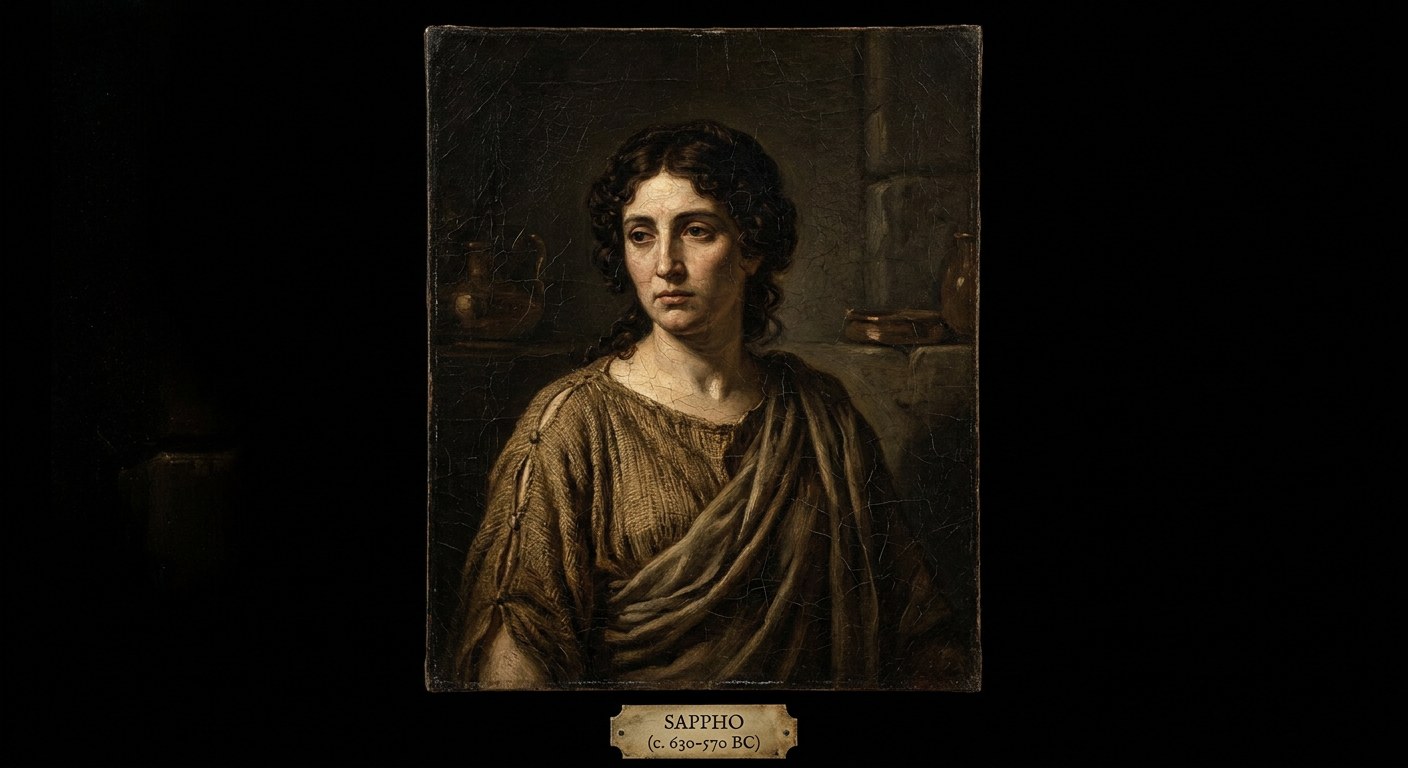
Sappho
630 BC – 570 BC · Ancient Greek · Lyric Poet
Recommended Audiobooks
Listen next from Marcus Alden

Life Lessons from Frederic Chopin
Marcus Alden · 54 min

Life Lessons from John Wesley
Marcus Alden · 52 min
Introduction
Sappho was an archaic Greek lyric poet whose intensely musical writing transformed the expression of desire, memory, beauty, worship, and personal emotion. She lived primarily on the island of Lesbos around the late seventh and early sixth centuries BCE. Although only one of her poems survives complete, the remaining fragments reveal a writer of extraordinary precision and emotional power. Ancient readers ranked her among the greatest poets in the Greek language, sometimes calling her the “Tenth Muse.”
Unlike epic poets such as Homer, who narrated the deeds of heroes and gods on a monumental scale, Sappho often concentrated on intimate moments: the trembling caused by desire, the pain of separation, a prayer offered to Aphrodite, the remembered beauty of an absent woman, or the flowers and ceremonial objects surrounding a wedding. Her poems were composed to be sung, probably with accompaniment from a lyre or related stringed instrument. They belonged to a performance culture in which poetry, music, ritual, and social life were inseparable.
Sappho is also one of the most important women in literary history. Her surviving work offers rare access to a female poetic voice from archaic Greece, though it should not be treated as straightforward autobiography. Her poetry frequently expresses love or desire for women, and her association with Lesbos gave rise to the modern words “lesbian” and “sapphic.” These later terms testify to her influence, but modern categories of sexual identity cannot simply be projected onto a society that understood gender and desire differently.
Much about Sappho’s life remains uncertain. Ancient biographies mixed fact, inference, comedy, and legend, while most of her poetry disappeared during the long transmission from papyrus roll to medieval manuscript. Nevertheless, quotations preserved by ancient authors, scraps recovered from Egyptian sands, and discoveries published as recently as the twenty-first century continue to expand knowledge of her art. Sappho matters not merely because she survived in fragments, but because those fragments helped define what lyric poetry could accomplish.
Quick Facts
| Category | Details |
|---|---|
| Born | About 630 BCE, probably on Lesbos, ancient Greece |
| Died | About 570 BCE; date and circumstances uncertain |
| Nationality | Ancient Greek, specifically Lesbian—that is, from Lesbos |
| Known For | Personal and ceremonial lyric poetry, especially the “Ode to Aphrodite” and poems of love and longing |
| Occupation | Lyric poet and musical composer-performer |
| Era | Archaic Greece, late seventh to early sixth century BCE |
Early Life and Education
No contemporary prose biography of Sappho survives. Most information about her life must be reconstructed from her poems, later ancient testimonies, inscriptions, and historical context. Even her name appears in variant forms in ancient sources, although “Sappho” became standard. She was probably born around 630 BCE on Lesbos, a large Aegean island near the coast of Asia Minor. Mytilene is most often named as her city, though the town of Eresos also claimed an association with her.
Lesbos occupied a prosperous and strategically important position within the Greek world. Its aristocratic families participated in maritime trade, religious festivals, local rivalries, and competition for political power. The island also developed a distinguished musical and poetic culture. Sappho’s contemporary Alcaeus, another major lyric poet, came from Mytilene, while the legendary musician Arion was associated with nearby Methymna.
Later sources give different names for Sappho’s father, a sign that reliable knowledge had already been lost. One tradition calls him Scamandronymus. A poem discovered on papyrus confirms that Sappho had brothers, including Charaxos and Larichos; another brother, Eurygios, appears in later accounts. Charaxos apparently engaged in overseas trade, while Larichos served as a wine-pourer in the civic hall of Mytilene, an honorable role generally assigned to a handsome young man from an elite family. Such details suggest that Sappho belonged to an aristocratic or affluent household.
Formal education in archaic Greece was not organized like a modern school system, and evidence for women’s education is limited. Sappho’s mastery of myth, ritual language, music, meter, and poetic tradition nevertheless implies extensive cultural training. She knew the Homeric epics but adapted inherited myths for a different scale and perspective. Where epic celebrated battlefield glory, Sappho could declare that the most beautiful thing on earth was whatever a person loved.
Sappho composed in the Lesbian or Aeolic dialect of Greek. Her poems were songs rather than silent texts: meter, melody, and performance shaped their meaning. She is especially associated with the Sapphic stanza, consisting of three long lines followed by a shorter line called an Adonic. Although the form may predate her, her use of it became so authoritative that it bears her name.
A once-popular interpretation presented Sappho as the head of a school or academy for unmarried girls. Some scholars imagined a formal institution in which young women learned music and prepared for marriage. Her poems do refer to groups of women, choruses, festivals, weddings, and relationships involving instruction or mentorship. However, no ancient evidence clearly establishes a school in the modern sense. Her social setting may instead have been an aristocratic circle connected by kinship, ritual, performance, companionship, and competition.
Rise to Prominence
Sappho’s reputation probably began in the performance culture of Lesbos. Her songs may have been presented at religious festivals, weddings, private gatherings, and communal celebrations. Some were designed for a solo singer, while others may have been choral. The surviving corpus contains prayers, wedding songs, hymns, invective, family poems, reflections on aging, and expressions of love or absence.
She lived during political conflict among the aristocratic factions of Mytilene. Alcaeus’s poetry vividly records struggles involving leading families, tyrants, and exiles. The Parian Chronicle, a Hellenistic chronological inscription, reports that Sappho went into exile in Sicily during a period conventionally dated between about 604 and 595 BCE. The report is brief but plausible in the context of Lesbian factional politics. A later statue at Syracuse was said to commemorate her connection with Sicily, although its evidentiary value is uncertain.
Her fame spread well beyond Lesbos. A vase painted around the late sixth century BCE depicts Sappho holding an instrument and identifies her by name, demonstrating that she had become recognizable within a few generations. Greek performers and readers continued to circulate her compositions, and Hellenistic scholars at Alexandria eventually edited them into a collected corpus.
The Alexandrian edition was traditionally arranged in eight or nine books, probably according to meter. The first book reportedly contained poems in Sapphic stanzas and may have included more than 1,300 lines. Altogether, Sappho’s ancient collection probably comprised thousands of verses. Only a small percentage survives today.
Her standing in antiquity was exceptional. She was included among the canonical Nine Lyric Poets, alongside figures such as Alcaeus, Pindar, and Anacreon. An epigram attributed to Plato calls her the “Tenth Muse,” though the attribution to Plato is doubtful. The compliment nevertheless reflects the reverence later Greeks felt for her poetry.
Major Achievements and Contributions
Sappho’s foremost achievement was the refinement of lyric poetry into an instrument capable of capturing immediate psychological experience. Her speakers do not merely state that they love, fear, remember, or grieve. They register those emotions through bodily sensation and concentrated images. In Fragment 31, for example, desire produces a broken voice, fire beneath the skin, blurred sight, ringing ears, sweat, trembling, and pallor. The poem’s influence can be traced through Catullus, Renaissance lyric, Romanticism, and modern poetry.
She also reshaped myth. Sappho’s gods are not distant decorations. Aphrodite can be addressed as a powerful but familiar ally, summoned into an intimate crisis. Helen of Troy becomes an illustration of how desire overturns social expectations. Tithonus, granted immortality but not eternal youth, becomes a vehicle for reflecting on aging. Sappho inherited traditional stories but redirected them toward emotional and ethical questions.
Her language is celebrated for its vivid sensuality. Moonlight, stars, violets, roses, apples, garlands, incense, fabrics, and human voices create a world in which beauty is both physical and fleeting. These images are rarely ornamental alone. A sweet apple left high on a branch, for instance, can signify a desired young woman who remains difficult to reach—not forgotten by harvesters, but inaccessible.
Sappho contributed significantly to wedding poetry. Ancient commentators associated her with epithalamia, songs performed during marriage rituals. Surviving fragments address brides and bridegrooms, describe ceremonial movement, or joke about physical features and household transitions. These works suggest her versatility: she could be solemn, affectionate, erotic, playful, or sharply comic.
Her poems are invaluable evidence for women’s voices and relationships in ancient Greece. They depict women as desiring subjects, performers, worshippers, companions, and remembered individuals. Named figures such as Anactoria, Atthis, Gongyla, and Gyrinno appear in settings whose exact social meaning remains debated. Whatever their historical identities, the poems grant female beauty and attachment a central place in high literature.
Sappho’s work also influenced the vocabulary of sexuality. “Sapphic” came to describe both her poetic meter and love between women. “Lesbian,” originally meaning an inhabitant of Lesbos, acquired its modern sexual meaning through her literary association with female desire. This later reception has made her an enduring cultural figure for women who love women and for broader LGBTQ+ history.
Key Works / Battles / Ideas
“Ode to Aphrodite” — Fragment 1
The “Ode to Aphrodite” is the only poem by Sappho to survive complete. It was preserved because Dionysius of Halicarnassus quoted it as an example of polished composition. The speaker calls on Aphrodite not to overwhelm her with anguish but to come as she has before. The goddess arrives in a chariot drawn by sparrows and asks who has wronged Sappho and whom persuasion must bring back to love.
The poem combines formal hymn structure with striking personal intimacy. Traditional invocations remind a deity of previous assistance before making a request; Sappho follows that pattern but dramatizes Aphrodite almost as an amused confidante. The final prayer asks the goddess to become the speaker’s ally in love.
Fragment 31
Fragment 31 begins with a speaker observing a man seated near a woman whose voice and laughter arouse overwhelming emotion. The man seems “equal to the gods,” not necessarily because he is beloved, but because he can remain composed in the woman’s presence. The speaker then catalogs the physical effects of desire.
The poem survives because the critic Longinus cited it in On the Sublime. Its exact dramatic context is unknown, and interpretations involving jealousy, marriage, longing, or performance remain contested. Its importance lies in the fusion of body and mind: passion becomes an event experienced through every sense.
Fragment 16
Fragment 16 challenges conventional ideas of beauty and value. Some people call cavalry, infantry, or fleets of ships the finest sight on earth; the speaker replies that the finest thing is whatever one loves. Helen, who left family and homeland for Troy, demonstrates desire’s power. The speaker then remembers the absent Anactoria and prefers her radiant movement and face to military spectacle.
The contrast with heroic values is profound. Sappho does not deny the grandeur of armies; she relocates value within individual desire. The fragment is therefore both a love poem and a meditation on perception.
The Tithonus Poem
The “Tithonus Poem,” substantially reconstructed after publication of a papyrus in 2004, reflects on aging. The speaker urges younger women to cherish the Muses’ gifts and acknowledges her own weakening body and whitening hair. She recalls Tithonus, whom the dawn goddess Eos loved and made immortal but could not preserve from old age.
Rather than offering a simple lament, the poem balances loss with artistic continuity. Aging is unavoidable even for one loved by a goddess, yet music and remembered beauty remain meaningful.
The Brothers Poem
Published in 2014 from a papyrus in a private collection, the “Brothers Poem” refers to Charaxos and Larichos. Its speaker criticizes anxious speculation about Charaxos’s return and recommends prayer to Hera for his safe arrival. She also hopes Larichos will become a man and free the family from distress.
The fragment corroborates ancient traditions about Sappho’s brothers and reveals her engagement with household fortune, maritime travel, religion, and family status. Questions surrounding the papyrus’s provenance have also contributed to modern debates about the antiquities trade.
Poetic Ideas
Several recurring ideas define Sappho’s work:
- Desire as a physical force: Love alters speech, sight, temperature, hearing, and self-control.
- Memory as survival: Absent people remain present through song and recollection.
- Beauty as subjective: What one loves surpasses socially approved displays of power.
- Divine-human intimacy: Gods influence private feeling as well as public destiny.
- Art against transience: Youth and beauty fade, but poetry can preserve a name.
Timeline of Key Events
| Year | Event |
|---|---|
| c. 630 BCE | Sappho is probably born on Lesbos, perhaps in Mytilene or Eresos. |
| c. 620–610 BCE | She receives aristocratic cultural training in music, myth, ritual, and poetic composition. |
| Late 7th century BCE | Sappho begins composing and performing lyric poetry in the Aeolic dialect. |
| c. 604–595 BCE | According to the Parian Chronicle, she is exiled to Sicily amid political conflict on Lesbos. |
| Early 6th century BCE | Poems concerning love, worship, weddings, family, and aging circulate throughout the Greek world. |
| c. 570 BCE | Approximate traditional date of Sappho’s death; the circumstances are unknown. |
| Late 6th century BCE | Athenian vase painting identifies Sappho by name, demonstrating her early fame. |
| 3rd–2nd centuries BCE | Alexandrian scholars edit her poetry into books organized largely by meter. |
| 1st century BCE–2nd century CE | Critics including Dionysius and Longinus preserve major poems by quoting them. |
| Medieval period | Most of Sappho’s corpus disappears as papyrus books cease to be recopied. |
| 1890s onward | Papyrus excavations in Egypt recover numerous fragments of her poetry. |
| 2004 | A papyrus allows scholars to reconstruct much of the “Tithonus Poem.” |
| 2014 | The “Brothers Poem” and related fragments are published, renewing scholarly and public interest. |
Personal Life and Character
Sappho’s poems create an impression of emotional directness, but the poetic “I” should not automatically be equated with the historical author. Archaic lyric could be performed by different singers and could adopt ritual, dramatic, or conventional voices. Even apparently personal poems may have been shaped for public or communal performance.
Later ancient sources say that Sappho’s mother was named Cleïs. One surviving fragment refers tenderly to a child called Cleïs, “like golden flowers” in appearance. Many readers infer that Sappho had a daughter named after her mother, but the Greek word used can also mean a young girl or child without proving biological maternity.
Ancient biographical tradition also gave Sappho a husband named Kerkylas of Andros. Most scholars regard this as a comic invention: the name can be interpreted as a sexual pun resembling “Mr. Penis from the Isle of Man.” It probably originated in later parody rather than reliable history.
Sappho’s relationships with women are central to her reception. Her poems express longing, admiration, tenderness, resentment, and remembrance toward female figures. These emotions cannot be dismissed as purely ceremonial, yet the surviving evidence does not permit a complete modern biography of her sexuality. Terms such as lesbian, bisexual, queer, or heterosexual belong to later systems of identity. It is historically safest to say that Sappho’s poetry includes unmistakably erotic and affectionate language directed toward women and that this aspect of her work has had immense cultural significance.
Her poetic character appears observant, sensuous, religious, self-aware, and capable of irony. She could write movingly about abandonment while also portraying Aphrodite teasing her over repeated romantic troubles. She praised elegance and cultural refinement, attacked rivals, worried about family reputation, and faced aging without surrendering her attachment to music.
Challenges and Controversies
The greatest challenge in studying Sappho is the fragmentary state of her work. Of thousands of original lines, only the “Ode to Aphrodite” survives complete. Some fragments consist of nearly whole poems; others preserve a phrase, word, or isolated letters. Modern editions must combine quotations, papyri, parchment, potsherds, and even strips of papyrus reused in mummy cartonnage.
Her disappearance was probably not the result of a single organized campaign of destruction. Sappho wrote in an archaic dialect that became difficult for later readers, and her books were transmitted on papyrus rolls at a time when literature was gradually transferred into the codex format. Works not repeatedly copied were lost. Moral discomfort may have affected her reputation in some periods, but stories that church authorities systematically burned all her poems are unsupported or exaggerated.
Her sexuality has generated centuries of reinterpretation. Some nineteenth- and early twentieth-century scholars minimized the erotic content of her poems or portrayed her solely as a respectable schoolmistress. Others treated every first-person utterance as literal confession. More recent scholarship generally recognizes female desire in the poetry while emphasizing the difference between archaic social practices and modern sexual identities.
Another controversy concerns the legend that Sappho fell in love with a ferryman named Phaon and leapt to her death from the Leucadian cliffs after he rejected her. This story became enormously popular in Roman and later European literature. It conflicts with her association with women and helped remake her into a conventionally tragic heterosexual heroine. There is no dependable evidence that the suicide occurred. Phaon had mythological connections with Aphrodite, and the tale may have developed from comedy, ritual, or confusion between poetic fiction and biography.
Modern papyrus discoveries create ethical issues as well. Scholars must ask where fragments were found, whether they were legally exported, and whether their ownership histories are documented. The provenance of the papyrus containing the “Brothers Poem” has been disputed and revised. Such cases demonstrate that gaining new knowledge about an ancient poet can be entangled with opaque collecting practices and the commercial antiquities market.
Translation poses a final challenge. Sappho’s Aeolic Greek is compressed and musical, while papyrus gaps make syntax uncertain. Translators must decide whether to mark every missing word, reconstruct likely phrases, or create readable poetry. As a result, familiar quotations can vary greatly without any version being deliberately inaccurate.
Death and Immediate Aftermath
The date of Sappho’s death is unknown. A conventional estimate places it around 570 BCE, based on ancient chronological traditions and her apparent relationship to events involving Alcaeus and rulers of the period. Claims that she lived into extreme old age or died at a particular location cannot be confirmed.
The famous Leucadian leap is best treated as legend, not history. Later writers connected Sappho with Phaon and the cliff at Cape Leucas, where desperate lovers supposedly sought relief by jumping into the sea. Ovid gave the story lasting influence in a poetic letter attributed to Sappho, but he wrote roughly six centuries after her lifetime.
Her literary reputation survived immediately and powerfully. Songs continued to be performed, copied, and studied. Greek vase painters represented her, comic dramatists used her as a character, and literary critics cited her as a supreme stylist. By the Hellenistic period, scholars had assembled a major edition of her works. Her posthumous standing was not that of a marginal poet but of a canonical master.
Legacy and Influence Today
Sappho’s influence extends across more than 2,500 years. The Roman poet Catullus adapted Fragment 31 into Latin and named his beloved “Lesbia,” signaling both literary admiration and erotic sophistication. Horace adopted Sapphic stanzas for Latin lyric, and the form later appeared in medieval hymns, Renaissance poetry, and modern verse.
European writers repeatedly reinvented Sappho. Renaissance humanists recovered quotations from ancient critics. Romantic and Victorian authors imagined her as a genius consumed by passion. Operas, paintings, plays, novels, and poems dramatized the Phaon legend, often portraying her death at Leucas. These works reveal as much about later attitudes toward female creativity and sexuality as they do about archaic Greece.
For women writers, Sappho became both predecessor and symbol. Her authority challenged the assumption that the classical canon was exclusively male. Poets including H.D., Amy Lowell, Renée Vivien, Yosano Akiko, and many others translated, adapted, or invoked her. Modernist writers were especially drawn to the fragmentary form of her surviving poetry, finding in its gaps a powerful aesthetic of absence.
Sappho’s importance to LGBTQ+ culture is equally profound. “Sapphic” now provides an inclusive term for love and attraction between women, while “lesbian” carries the geographic memory of her island. Artists and activists have treated her as an ancestor, even while historians caution against assigning an exact modern identity to an ancient person.
Her influence also reaches feminist scholarship, classics, papyrology, translation studies, and the history of the book. Every newly identified fragment raises questions about authorship, reconstruction, ownership, and interpretation. The incomplete condition of her work has become part of its modern meaning: broken lines seem to embody the fragility of cultural memory.
Yet Sappho’s survival should not be romanticized only as loss. Enough remains to reveal her command of structure, sound, image, and emotional movement. She continues to be read because her poetry makes private feeling intelligible without reducing its mystery. Love can be ecstatic, comic, humiliating, sacred, and painful at once. Beauty disappears, but language can briefly hold it.
Famous Quotes
Because translations differ, the wording below represents widely used English renderings of genuine fragments attributed to Sappho rather than fixed English originals.
“Someone, I tell you, will remember us, even in another time.”
— Fragment 147
“Some say an army of horsemen, others an army on foot, and others a fleet of ships is the most beautiful thing on the dark earth; but I say it is whatever one loves.”
— Fragment 16
“Sweet mother, I cannot weave the loom; I am overcome with longing for a boy because of slender Aphrodite.”
— Fragment 102
“The moon has set, and the Pleiades; it is midnight, time passes, and I sleep alone.”
— Fragment 168B, traditionally attributed to Sappho
“Like the sweet apple reddening high on the highest branch, which the apple-pickers forgot—no, they did not forget it, but could not reach it.”
— Fragment 105A
“You came, and I longed for you; you cooled my heart that was burning with desire.”
— Fragment 48
“What is beautiful is good, and whoever is good will soon also be beautiful.”
— Fragment 50
Frequently Asked Questions
When and where was Sappho born?
Sappho was probably born around 630 BCE on Lesbos, an Aegean island near the coast of present-day Turkey. Ancient traditions connect her with both Mytilene and Eresos, though Mytilene is more commonly identified as her home.
Why is Sappho so famous?
She is famous for bringing remarkable psychological intensity, musical skill, and vivid imagery to Greek lyric poetry. Ancient critics ranked her among the greatest poets, and her representations of love, longing, memory, and female experience have influenced writers for more than two millennia.
Was Sappho a lesbian in the modern sense?
Sappho wrote poems expressing erotic or affectionate desire toward women, and her association with Lesbos ultimately produced the modern term “lesbian.” However, the ancient Greeks did not classify sexuality through precisely the same identity categories used today. Her poetry is central to lesbian and sapphic cultural history, but her complete personal identity cannot be reconstructed.
How much of Sappho’s poetry survives?
Only one poem, the “Ode to Aphrodite,” survives complete. Several substantial poems and many shorter fragments remain, ranging from nearly continuous passages to single words. These represent only a small portion of the thousands of lines known in antiquity.
Did Sappho really kill herself over Phaon?
There is no reliable evidence that she did. The story that she leapt from the Leucadian cliffs because of unrequited love for Phaon developed long after her death and was popularized by later Greek and Roman writers. Most historians regard it as literary legend.
Did Sappho run a school for girls?
Possibly, but the evidence does not establish a formal school. Her poetry reflects female groups, musical training, ritual activity, and relationships among women of different ages. These may have belonged to an aristocratic circle or ceremonial community rather than an institution resembling a modern academy.
What is a Sapphic stanza?
A Sapphic stanza is a metrical form associated with Sappho. In its classical pattern, three longer lines are followed by a short Adonic line. Latin poets such as Horace adapted it, and poets in many later languages continued to experiment with the form.
Why were most of Sappho’s works lost?
Her poems were written on perishable papyrus and in a dialect that became increasingly unfamiliar. During the transition from scrolls to codices, many works that were not recopied disappeared. Deliberate moral censorship may have played a role in some periods, but there is no good evidence for a single systematic destruction of her complete works.
Lessons We Can Learn
-
Personal experience can illuminate universal truths. Sappho focused on particular voices, bodies, memories, and absences, yet her poetry still communicates across vast distances of time and culture.
-
Art can challenge established values. By placing the beloved above armies and fleets, she questioned heroic standards of prestige and showed that individual perception shapes what people call beautiful.
-
Fragments can retain extraordinary power. Even damaged works can transform literature. Cultural survival is rarely complete, but incomplete evidence still deserves careful preservation and interpretation.
-
Historical people should not be forced into simple categories. Sappho is important to modern lesbian and queer history, yet responsible interpretation also respects the differences between ancient and modern ideas of identity.
-
Creativity can outlast political and personal instability. Exile, factional conflict, aging, family anxiety, and textual loss did not erase Sappho’s voice. Her poetry demonstrates how artistic form can carry human feeling far beyond its original setting.
Further Reading
- Anne Carson, If Not, Winter: Fragments of Sappho (Vintage, 2002).
- Diane J. Rayor and André Lardinois, Sappho: A New Translation of the Complete Works (Cambridge University Press, revised edition, 2023).
- David A. Campbell, Greek Lyric, Volume I: Sappho and Alcaeus (Harvard University Press, Loeb Classical Library, 1982).
- Denys Page, Sappho and Alcaeus: An Introduction to the Study of Ancient Lesbian Poetry (Oxford University Press, 1955).
- Joan DeJean, Fictions of Sappho, 1546–1937 (University of Chicago Press, 1989).
Watch and Learn
History's First Author · TED-Ed