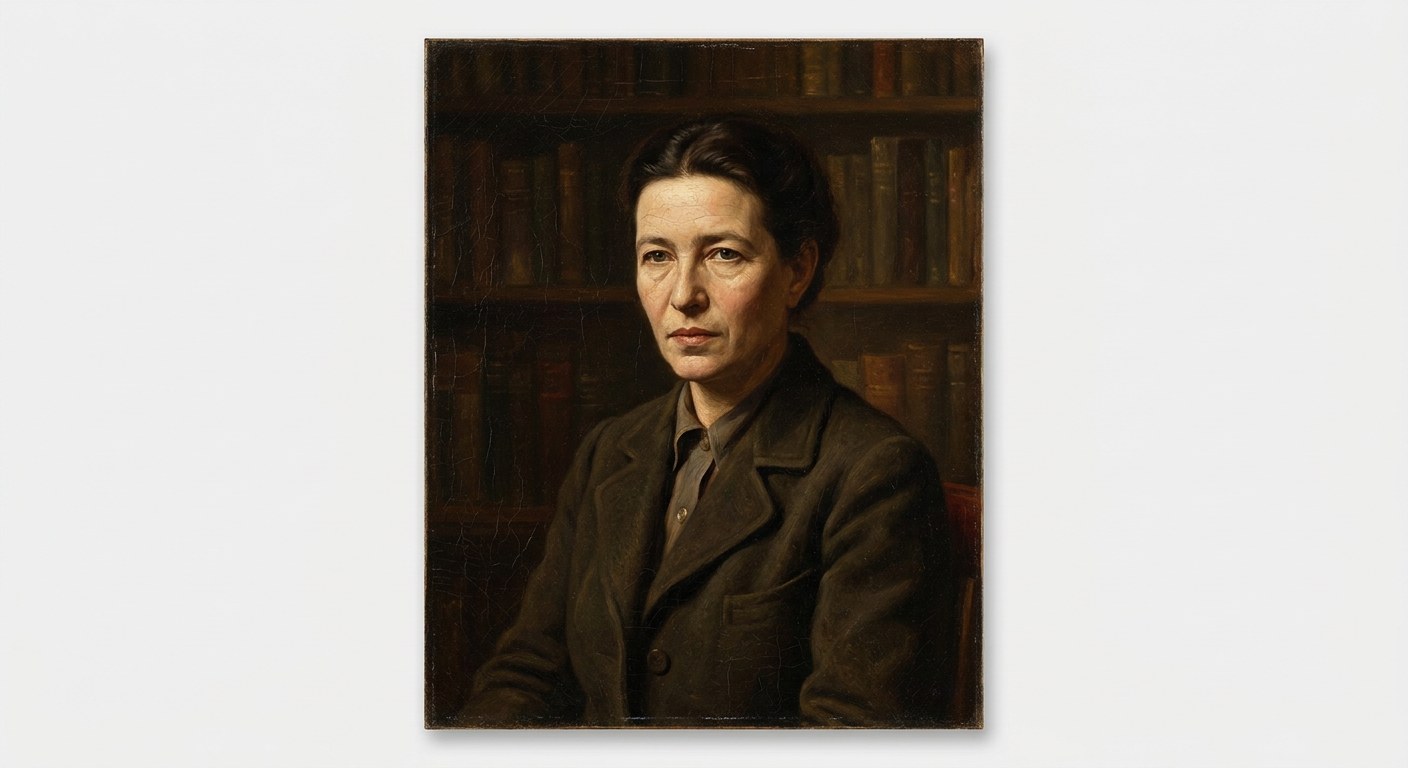
Simone de Beauvoir
1908 – 1986 · French · Philosopher & Writer
Recommended Audiobooks
Listen next from Marcus Alden

Life Lessons from Frederic Chopin
Marcus Alden · 54 min

Life Lessons from John Wesley
Marcus Alden · 52 min
Introduction
Simone de Beauvoir was a French philosopher, novelist, memoirist, political activist, and pioneering feminist thinker whose work transformed modern understandings of freedom, gender, oppression, and personal responsibility. Best known for her monumental 1949 study The Second Sex, she argued that womanhood was not simply a fixed biological destiny but a social and historical condition. Her most famous proposition—“One is not born, but rather becomes, woman”—became a foundation of modern feminist thought.
De Beauvoir belonged to the intellectual movement known as existentialism, although she sometimes resisted being confined by that label. Alongside Jean-Paul Sartre, Maurice Merleau-Ponty, Albert Camus, and other postwar French thinkers, she examined how human beings create meaning through choices made in an uncertain world. Her distinctive contribution was to show that freedom is never merely abstract: it is lived through the body, shaped by relationships, and constrained by political and social circumstances.
Her writings crossed traditional boundaries between philosophy and literature. In philosophical works such as The Ethics of Ambiguity, she developed an ethics based on freedom, reciprocity, and responsibility. In novels including She Came to Stay and The Mandarins, she explored jealousy, love, political commitment, and self-deception. Her multivolume memoirs documented both her own life and the intellectual culture of twentieth-century France.
De Beauvoir was also a prominent public intellectual. She opposed French colonialism in Algeria, supported abortion rights, defended women subjected to sexual violence and torture, and participated in campaigns for social justice. Yet her legacy is not without controversy. Her unconventional relationships, conduct toward some younger women, and support for petitions concerning sexual laws have generated serious ethical criticism.
Despite these complications, de Beauvoir remains indispensable to philosophy, feminist theory, literature, political thought, and gender studies. Her central questions—How can people become free? How does society turn one group into the “Other”? What responsibilities accompany freedom?—continue to shape debate around the world.
Quick Facts
| Fact | Details |
|---|---|
| Born | 9 January 1908, Paris, France |
| Died | 14 April 1986, Paris, France |
| Nationality | French |
| Known For | The Second Sex, existentialist ethics, feminist philosophy, novels, and memoirs |
| Occupation | Philosopher, writer, teacher, memoirist, and political activist |
| Era | Twentieth-century philosophy and literature |
Early Life and Education
Simone Lucie Ernestine Marie Bertrand de Beauvoir was born in Paris on 9 January 1908. She was the elder daughter of Georges Bertrand de Beauvoir, a legal secretary and amateur actor, and Françoise Brasseur de Beauvoir, a devoutly Catholic woman from a prosperous banking family. Her younger sister, Hélène, later became a painter.
The family initially enjoyed bourgeois respectability, but its finances deteriorated after the First World War. Georges had hoped for a son and took pride in Simone's intelligence, reportedly remarking that she thought “like a man,” a revealing expression of the gender assumptions surrounding her childhood. Because there was no substantial dowry to secure an advantageous marriage, education and professional independence became especially important to both Simone and Hélène.
De Beauvoir was raised in a strict Catholic environment and attended the private Cours Désir school for girls. As a child she was intensely religious and at one point considered becoming a nun. During adolescence, however, she lost her faith. Her rejection of Christianity was intellectually and emotionally decisive: she concluded that the world contained no divinely ordained moral plan and that individuals had to take responsibility for giving meaning to their lives.
An important early friendship was with Élisabeth Lacoin, known as Zaza. Brilliant and rebellious, Zaza struggled against the restrictive expectations of her conservative family. She died in 1929, at the age of twenty-one, after a sudden illness. De Beauvoir believed that social and familial pressures had contributed to her friend's destruction. Zaza's experience became an enduring symbol for her of the ways bourgeois convention could limit women's freedom. Decades later, de Beauvoir's unpublished early novel about the friendship appeared as The Inseparables.
De Beauvoir studied mathematics, literature, languages, and philosophy at several Parisian institutions, including the Institut Catholique, the Institut Sainte-Marie, and the Sorbonne. She earned certificates in subjects such as ethics, psychology, logic, Latin, and the history of philosophy. Her studies brought her into contact with future intellectual figures including Maurice Merleau-Ponty, René Maheu, and Jean-Paul Sartre.
In 1929 she took the highly competitive agrégation examination in philosophy. At twenty-one, she was the youngest candidate to pass that year. Sartre ranked first and de Beauvoir second, although the precise evaluation of their performances has been discussed by biographers. Their meeting began one of the most famous intellectual and personal partnerships of the twentieth century.
Sartre gave her the lifelong nickname “Castor,” meaning “beaver,” a pun on her surname and a reference to her disciplined capacity for work. The two shared a rejection of bourgeois marriage and agreed upon a relationship that distinguished their “essential” bond from “contingent” relationships with others. This arrangement promised candor and freedom, but in practice it produced jealousy, emotional pain, and unequal power dynamics.
Rise to Prominence
After passing the agrégation, de Beauvoir taught philosophy at secondary schools in Marseille, Rouen, and Paris. Teaching gave her financial independence and exposed her to lives beyond the sheltered social environment of her youth. During these years, she developed relationships with several women and men while maintaining her partnership with Sartre.
Her teaching career ended amid controversy. A complaint involving her relationship with a young woman, Natalie Sorokine, contributed to her suspension from the national education system in 1943. The historical record has been interpreted in different ways, but the episode remains central to later criticism of de Beauvoir's use of authority and her involvement with younger women. She was reinstated after the Second World War but chose not to return to school teaching.
De Beauvoir's literary breakthrough came with the 1943 novel She Came to Stay. Loosely inspired by her complex relationships with Sartre and sisters Olga and Wanda Kosakiewicz, the novel explored jealousy, possessiveness, freedom, and the struggle to recognize other people as independent consciousnesses. Its philosophical background owed much to phenomenology and existentialism, especially the problem of conflict between self and other.
During the German occupation of France, de Beauvoir remained in Paris. She wrote, taught privately, and participated in intellectual circles connected to Sartre. The extent and nature of her wartime resistance activity have sometimes been exaggerated. She was associated with the short-lived intellectual group Socialism and Freedom, but she was not a major member of the organized armed Resistance. She later reflected critically on her earlier political detachment and the moral shock caused by war and occupation.
In 1945 de Beauvoir, Sartre, and their associates founded the journal Les Temps modernes. It became a major platform for existentialism, left-wing politics, anti-colonialism, literature, and social criticism. De Beauvoir served as an editor and contributed essays on politics, ethics, literature, and women's condition.
Her early philosophical essays established her as a thinker in her own right. Pyrrhus and Cineas considered action, freedom, and the need to engage with others. The Ethics of Ambiguity, published in 1947, offered one of the most systematic ethical statements associated with existentialism. Two years later, The Second Sex made her internationally famous and deeply controversial.
Major Achievements and Contributions
Transforming feminist thought
De Beauvoir's greatest achievement was her comprehensive analysis of women's oppression in The Second Sex. Drawing on biology, psychoanalysis, history, anthropology, economics, literature, and personal experience, she examined how patriarchal societies defined men as the neutral human standard and women as the secondary or inessential “Other.”
Her claim that “One is not born, but rather becomes, woman” did not deny the existence of biological sex. Instead, it distinguished bodily facts from the social meanings, expectations, habits, and limitations imposed upon people classified as women. Girls were taught to become passive, dependent, pleasing, and oriented toward male approval, while men were encouraged to act, create, and transcend existing conditions.
This analysis anticipated later distinctions between sex and gender, though de Beauvoir's exact relation to those concepts remains debated. Her treatment of embodiment also influenced feminist phenomenology: the body is not merely an object but the situation through which a person experiences and acts in the world.
Developing existentialist ethics
De Beauvoir argued that human existence is ambiguous. People are both free subjects and material objects, both separate individuals and beings dependent upon others. No eternal authority can remove the burden of choice. Yet freedom does not mean doing whatever one wants without regard for consequences.
In The Ethics of Ambiguity, she maintained that genuine freedom seeks the freedom of others. Oppression is morally wrong because it reduces people to objects, blocks their projects, and prevents them from participating fully in the creation of meaning. Ethics therefore requires action against conditions that deny human agency.
Her account corrected a common caricature of existentialism as individualistic or nihilistic. Freedom is situated rather than limitless: poverty, racism, sexism, colonialism, age, and political violence shape the options available to individuals. People remain agents, but they do not all possess equal power to act.
Uniting philosophy and literature
De Beauvoir did not treat novels as secondary illustrations of philosophical theories. Fiction allowed her to portray ambiguity, conflict, and self-deception in concrete lives. She Came to Stay, The Blood of Others, All Men Are Mortal, and The Mandarins examined responsibility and interpersonal struggle without reducing characters to simple moral examples.
The Mandarins, published in 1954, won the prestigious Prix Goncourt. Set among French intellectuals after the Second World War, the novel addressed political commitment, disillusionment with communism, journalism, love, and the responsibilities of writers. Elements of its characters and relationships were inspired by Sartre, Camus, de Beauvoir, and the American novelist Nelson Algren, although it should not be read as straightforward autobiography.
Redefining autobiography
De Beauvoir's memoirs are among the major autobiographical projects of the twentieth century. Beginning with Memoirs of a Dutiful Daughter, she reconstructed her development from a Catholic bourgeois child into an independent intellectual. Later volumes covered war, fame, politics, friendships, travel, aging, and Sartre's death.
These books combined personal testimony with social history. They also shaped her public image, which makes them both invaluable and selective sources. Scholars compare the memoirs with her letters, diaries, and accounts written by people around her to understand what she emphasized, altered, or omitted.
Political activism
De Beauvoir became increasingly politically engaged after the war. She criticized colonialism and French military conduct during the Algerian War. With the lawyer Gisèle Halimi, she publicized the case of Djamila Boupacha, an Algerian activist who reported being tortured and raped by French forces. Their campaign exposed sexual violence as a weapon of colonial repression.
In 1971 de Beauvoir signed and helped publicize the Manifesto of the 343, in which women declared that they had undergone abortions when abortion was illegal in France. Her visibility helped make reproductive freedom a major national issue. France legalized abortion under specified conditions through the 1975 Veil Law.
She worked with the French women's liberation movement, supported campaigns against sexual violence, and used her reputation to amplify activists who lacked access to the press. Her late political engagement helped connect The Second Sex to the practical demands of second-wave feminism.
Key Works / Battles / Ideas
The Second Sex (1949)
Published in two volumes, The Second Sex remains de Beauvoir's most influential work. Its famous description of woman as “Other” explains how a dominant group presents itself as universal while defining another group as secondary and different. De Beauvoir investigated myths of femininity, childhood socialization, sexuality, marriage, motherhood, work, and independence.
The book was attacked by conservatives, Catholic authorities, and some left-wing critics. The Vatican placed it on the Index of Forbidden Books. Its frank discussion of sexuality, lesbianism, menstruation, abortion, and marriage was considered scandalous. The first English translation, produced by H. M. Parshley in 1953, was heavily abridged and sometimes distorted philosophical terminology. A complete translation by Constance Borde and Sheila Malovany-Chevallier appeared in 2009, although that version also prompted scholarly debate.
The Ethics of Ambiguity (1947)
This work argues that ethics begins with the contradictory condition of being human: people are free, yet finite; conscious subjects, yet physical objects; independent, yet bound to others. De Beauvoir described several ways people flee from freedom, including the attitudes of the “sub-man,” the “serious man,” the nihilist, and the adventurer.
The ethically mature person recognizes ambiguity rather than escaping it. For de Beauvoir, one cannot consistently will one's own freedom while treating the freedom of others as meaningless. The book remains important in existentialist ethics, political philosophy, and theories of oppression.
Immanence and transcendence
De Beauvoir used “transcendence” to describe the human capacity to go beyond existing conditions through projects, creativity, and action. “Immanence” referred to confinement within repetitive, enclosed, or passive existence. Patriarchal societies traditionally allowed men to pursue transcendence while assigning women to domestic repetition and dependence.
She did not claim that caregiving or household work was inherently worthless. Her criticism focused on conditions in which women were denied reciprocity, independence, recognition, and the ability to choose broader projects.
Situated freedom
Unlike theories that imagine every person as equally free in all circumstances, de Beauvoir emphasized that freedom is situated. A person acts from within a body, society, historical moment, and network of material constraints. This idea became essential to later feminist, postcolonial, disability, and critical theories, even when later scholars criticized limitations in her own account.
Aging and mortality
In The Coming of Age—also translated as Old Age—de Beauvoir analyzed how modern societies marginalize older people. She treated aging as both a bodily reality and a socially produced form of exclusion. Her account anticipated later work in gerontology, age studies, and the ethics of care.
Her memoir A Very Easy Death described the final illness of her mother with unsparing precision. In Adieux: A Farewell to Sartre, she chronicled Sartre's declining health and death. These works extended her philosophy of embodiment to illness, dependency, grief, and mortality.
Timeline of Key Events
| Year | Event |
|---|---|
| 1908 | Born in Paris on 9 January to Georges and Françoise de Beauvoir. |
| 1927 | Earned a degree in philosophy from the Sorbonne. |
| 1929 | Passed the philosophy agrégation and began her lifelong partnership with Jean-Paul Sartre. |
| 1931 | Began teaching philosophy in Marseille after earlier work at a lycée in Rouen. |
| 1943 | Published her first major novel, She Came to Stay; her teaching career ended amid a disciplinary controversy. |
| 1945 | Helped establish Les Temps modernes and published The Blood of Others. |
| 1947 | Published The Ethics of Ambiguity and began an important relationship with Nelson Algren. |
| 1949 | Published The Second Sex, provoking international debate. |
| 1954 | Won the Prix Goncourt for The Mandarins. |
| 1958 | Published Memoirs of a Dutiful Daughter, the first volume of her major memoir sequence. |
| 1960 | Publicly opposed the Algerian War and supported the cause of Djamila Boupacha. |
| 1964 | Published A Very Easy Death, about her mother's final illness. |
| 1970 | Published The Coming of Age, a major study of aging. |
| 1971 | Signed the Manifesto of the 343 in support of abortion rights. |
| 1980 | Sartre died; de Beauvoir later published an account of his final years. She also legally adopted Sylvie Le Bon. |
| 1981 | Published Adieux: A Farewell to Sartre. |
| 1986 | Died in Paris on 14 April and was buried beside Sartre. |
Personal Life and Character
De Beauvoir's relationship with Sartre lasted for more than fifty years. They never married, maintained separate residences for much of their lives, and did not have children. Their partnership was intellectual as well as emotional: they read and criticized each other's manuscripts, discussed philosophical problems, traveled together, and participated in shared political causes.
Their agreement permitted other relationships. De Beauvoir formed significant attachments to both women and men, while Sartre did the same. One of her most important relationships was with Nelson Algren, the American author of The Man with the Golden Arm. They met in 1947 and conducted a passionate transatlantic affair. De Beauvoir wore a ring from Algren for many years, but she would not abandon her life with Sartre in France. Algren later resented the public use of their relationship in her writing.
De Beauvoir was extraordinarily disciplined. She maintained demanding routines of reading and writing, often working for hours in cafés and at home. Friends described her as intellectually formidable, energetic, loyal, curious, and capable of intense enjoyment. She loved travel, hiking, conversation, food, and social life. At the same time, critics and former intimates described controlling behavior, emotional detachment, or a willingness to subordinate other people's privacy to literature.
Her relationship with Sylvie Le Bon began in the 1960s. De Beauvoir legally adopted her as an adult in 1980, making Le Bon-de Beauvoir her literary heir. Le Bon later edited and published de Beauvoir's letters, diaries, and other posthumous writings.
Although de Beauvoir rejected conventional domestic roles, she did not claim that every woman should live as she did. Her broader argument was that women should possess the material independence and social freedom necessary to make genuine choices.
Challenges and Controversies
De Beauvoir encountered intense hostility as a woman writing openly about philosophy, sexuality, and power. The Second Sex was dismissed by some reviewers as immoral, unfeminine, or personally embittered. Critics often focused on her appearance and private life rather than engaging with her arguments. Such reactions demonstrated the very structures of gendered judgment that she analyzed.
More substantial controversies concern her relationships with younger women, including some who had been her students. Natalie Sorokine's family filed a complaint that helped bring about de Beauvoir's removal from teaching in 1943. Bianca Lamblin, formerly Bianca Bienenfeld, later wrote that she had been emotionally and sexually exploited by de Beauvoir and Sartre when she was a student. Letters and diaries published after de Beauvoir's death revealed discrepancies between the private record and the more controlled narrative of her memoirs.
These accounts have prompted reassessment of the celebrated Sartre–de Beauvoir compact. What was presented as radical freedom could involve secrecy, manipulation, unequal status, and the circulation of young partners between two famous intellectuals. Recognizing these ethical failures does not invalidate de Beauvoir's entire philosophical achievement, but it complicates claims that her personal life consistently embodied her ethics of reciprocal freedom.
Another major controversy involves her signature on French petitions during the 1970s challenging laws governing sexual relations between adults and minors. Some of these campaigns arose amid criticism of inconsistent age-of-consent laws and prolonged pretrial detention, but their language went beyond those issues and is now widely condemned for minimizing the danger of adult exploitation of children. De Beauvoir's participation forms a troubling part of her political record.
Her feminism has also faced important scholarly criticism. Some readers argue that The Second Sex treats male-coded transcendence, paid work, and individual autonomy as standards of liberation while undervaluing pregnancy, motherhood, care, and interdependence. Others identify limitations in its treatment of race, colonial difference, and non-Western women. Black, postcolonial, queer, and materialist feminists have both challenged and productively extended her framework.
De Beauvoir's relationship to communism was similarly complex. She and Sartre often cooperated with communist causes but never joined the French Communist Party. At times they were slow to condemn repression in communist states, though de Beauvoir became more critical after evidence of Soviet abuses and after the suppression of the Hungarian uprising in 1956.
Death and Immediate Aftermath
Simone de Beauvoir died of pneumonia in Paris on 14 April 1986. She was seventy-eight. Her health had declined, and Sartre's death six years earlier had marked the end of the partnership that had structured much of her adult life.
Thousands of mourners reportedly followed her funeral procession to Montparnasse Cemetery. She was buried in the same grave as Sartre. The shared resting place reflected their public association, though later scholarship increasingly emphasized that de Beauvoir was not merely Sartre's companion or interpreter but an original philosopher with an independent body of work.
After her death, Sylvie Le Bon-de Beauvoir managed her literary estate and published selections from her diaries, correspondence with Sartre and Algren, and other writings. These materials deepened understanding of her creative process and political development while also exposing painful aspects of her private relationships.
The publication of private documents contributed to a broad reassessment. Philosophers began recovering de Beauvoir's early essays as original contributions rather than derivative versions of Sartrean existentialism. Feminist scholars examined her accounts of embodiment and oppression, while biographers confronted the gap between her ethical principles and some of her conduct.
Legacy and Influence Today
De Beauvoir's influence extends across philosophy, feminist theory, literary studies, sociology, history, political science, theology, psychology, and gender studies. The Second Sex remains a central text in discussions of how identity is socially produced and how dominant groups define marginalized people as different or inferior.
Her account of woman as “Other” helped establish a language for analyzing oppression. Later thinkers adapted the idea to questions of race, sexuality, disability, nationality, and colonial power. Although these adaptations sometimes reveal what de Beauvoir herself overlooked, they demonstrate the generative power of her framework.
Judith Butler's theory of gender performativity developed in critical dialogue with de Beauvoir's statement that one becomes a woman. Feminist phenomenologists such as Iris Marion Young expanded her analysis of how social expectations shape bodily movement and self-perception. Scholars including Margaret Simons helped recover de Beauvoir as a philosopher whose ideas had too often been credited to Sartre.
Her concept of situated freedom remains particularly relevant. Contemporary debates about inequality often turn on the relationship between personal choice and structural constraint. De Beauvoir helps explain why formal rights alone are insufficient when people lack money, education, bodily security, political power, or social recognition.
Her work on aging has acquired renewed importance as populations live longer and societies confront elder care, isolation, medical inequality, and age discrimination. Her writings on death and illness continue to be read for their clear-eyed treatment of dependency and grief.
De Beauvoir also helped define the modern role of the public intellectual. She treated writing as a form of action, using essays, journalism, petitions, testimony, and literature to intervene in political life. Her anti-colonial activism and reproductive-rights campaigning demonstrated how intellectual fame could be placed at the service of collective struggles.
Her legacy nevertheless demands critical rather than devotional reading. The allegations concerning former students, the ethical problems in her relationships, and her support for unacceptable sexual-law petitions cannot be dismissed as irrelevant to her thought. They force readers to confront a question central to de Beauvoir's own philosophy: how should a person's claims about freedom be judged against the effects of that person's actions on the freedom of others?
Today de Beauvoir endures because she offers no easy refuge from ambiguity. Human beings are neither absolutely free nor merely determined. They inherit bodies, institutions, histories, and unequal circumstances, yet they remain responsible for what they make of those situations and for whether they enlarge or restrict the possibilities of others.
Famous Quotes
“One is not born, but rather becomes, woman.” — The Second Sex
“To will oneself moral and to will oneself free are one and the same decision.” — The Ethics of Ambiguity
“The body is not a thing, it is a situation.” — The Second Sex
“Representation of the world, like the world itself, is the work of men; they describe it from their own point of view, which they confuse with absolute truth.” — The Second Sex
“It is in the knowledge of the genuine conditions of our lives that we must draw our strength to live and our reasons for acting.” — The Ethics of Ambiguity
“Life is occupied in both perpetuating itself and in surpassing itself; if all it does is maintain itself, then living is only not dying.” — The Ethics of Ambiguity
“I tore myself away from the safe comfort of certainties through my love for truth—and truth rewarded me.” — Memoirs of a Dutiful Daughter
Frequently Asked Questions
Why is Simone de Beauvoir important?
De Beauvoir transformed feminist philosophy by explaining how women are socially constituted as subordinate “Others.” She also developed a major existentialist ethics based on situated freedom, responsibility, and reciprocity. Her novels, memoirs, political activism, and studies of aging widened her influence far beyond academic philosophy.
What did Simone de Beauvoir mean by “One is not born, but rather becomes, woman”?
She meant that biology alone does not determine the roles, behavior, status, and identity associated with womanhood. Societies train girls and women to conform to expectations of femininity. Becoming a woman, in this sense, is a social and historical process lived through the body.
Was Simone de Beauvoir an existentialist?
Yes, she is widely regarded as a major existentialist philosopher, although she did not always welcome rigid labels. Her work shares existentialism's concern with freedom, choice, responsibility, and the absence of predetermined meaning, while emphasizing embodiment, social inequality, and dependence on others.
What is The Second Sex about?
The Second Sex is a wide-ranging investigation of women's oppression. It examines biology, history, myths, childhood, sexuality, marriage, motherhood, work, and aging to explain how male-dominated societies define women as secondary beings rather than autonomous subjects.
Were Simone de Beauvoir and Jean-Paul Sartre married?
No. They maintained a lifelong intellectual and romantic partnership but rejected marriage and conventional monogamy. Each had other relationships. Their arrangement was presented as a model of freedom, though evidence from letters and former partners shows that it also caused harm and involved serious power imbalances.
Did Simone de Beauvoir win the Nobel Prize?
No. She never received the Nobel Prize. She did win the Prix Goncourt, France's most prestigious literary award, in 1954 for her novel The Mandarins.
What political causes did she support?
De Beauvoir opposed French colonialism in Algeria, supported Djamila Boupacha's case, campaigned for abortion rights, participated in the French women's liberation movement, and advocated for victims of political and sexual violence. Some of her other interventions, particularly petitions concerning sexual laws and minors, are now strongly criticized.
How did Simone de Beauvoir die?
She died from pneumonia in Paris on 14 April 1986 at the age of seventy-eight. She was buried beside Jean-Paul Sartre in Montparnasse Cemetery.
Lessons We Can Learn
-
Freedom depends on material and social conditions. Legal freedom has limited meaning when poverty, discrimination, violence, or dependency prevents people from acting.
-
Identity is shaped rather than simply given. Many qualities treated as natural are reinforced through education, customs, institutions, and repeated expectations.
-
Our freedom is connected to the freedom of others. Personal liberation cannot be ethically separated from resistance to systems that reduce other people to objects.
-
Ideas should be tested against conduct. De Beauvoir's controversies remind us that eloquent ethical theories do not excuse harmful behavior or eliminate the need for accountability.
-
Ambiguity must be confronted, not escaped. Human life contains uncertainty, limitation, and contradiction. Responsible action requires making choices without pretending that perfect certainty is possible.
Further Reading
- Deirdre Bair, Simone de Beauvoir: A Biography — A comprehensive account based on extensive interviews and archival research.
- Kate Kirkpatrick, Becoming Beauvoir: A Life — A modern philosophical biography drawing on diaries and correspondence.
- Margaret A. Simons, Beauvoir and The Second Sex: Feminism, Race, and the Origins of Existentialism — An influential study of de Beauvoir's philosophical originality.
- Toril Moi, Simone de Beauvoir: The Making of an Intellectual Woman — A major feminist interpretation of her life, literature, and intellectual reputation.
- Hazel Rowley, Tête-à-Tête: Simone de Beauvoir and Jean-Paul Sartre — A detailed examination of their partnership and relationships.
Watch and Learn
The Philosophy of Simone de Beauvoir · TED-Ed