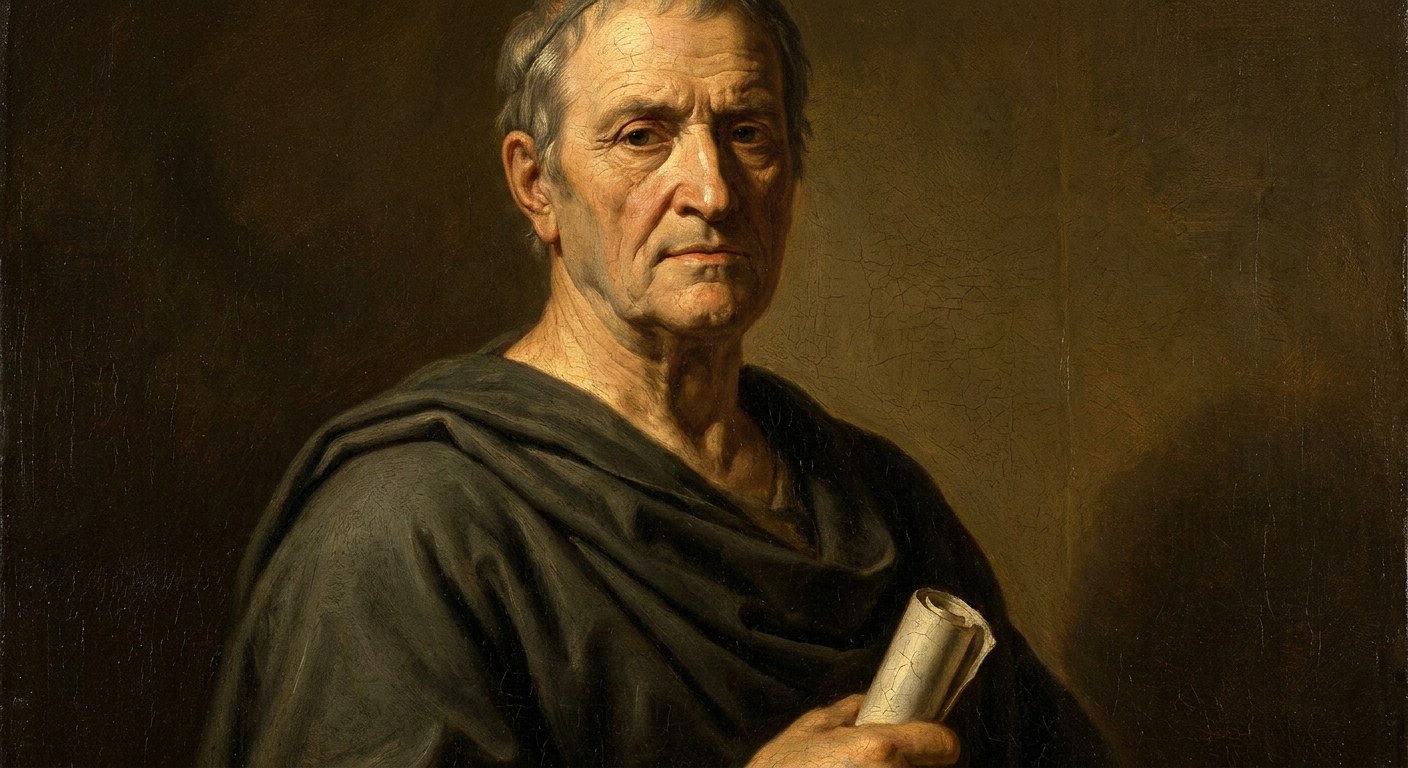
Sophocles
496 BC – 406 BC · Ancient Greek · Playwright & Statesman
Recommended Audiobooks
Listen next from Marcus Alden

Life Lessons from Frederic Chopin
Marcus Alden · 54 min

Life Lessons from John Wesley
Marcus Alden · 52 min
Introduction
Sophocles was one of the three great tragedians of classical Athens whose plays survive, alongside Aeschylus and Euripides. Born around 497 or 496 BCE and active during most of the fifth century BCE, he helped transform Greek tragedy into a form capable of exploring the most difficult questions of human existence: How far are people free to shape their lives? What happens when political authority conflicts with moral obligation? Can intelligence protect anyone from ignorance, suffering, or fate?
Although ancient sources credited Sophocles with approximately 123 plays, only seven tragedies survive complete. They include Ajax, Antigone, Women of Trachis, Oedipus Rex, Electra, Philoctetes, and Oedipus at Colonus. Their small number is deceptive. These works became foundational texts of Western drama and remain central to theatre, literature, philosophy, political theory, psychology, and education.
Sophocles was not an isolated literary figure. He belonged to the civic and religious life of democratic Athens, served in financial and military offices, and lived through the city’s rise after the Persian Wars and its destructive conflict with Sparta in the Peloponnesian War. His tragedies were created for public religious festivals, where dramatic competitions were part of Athenian civic culture.
The power of Sophocles lies partly in his refusal to offer simple moral formulas. Antigone may be courageous, but she is also unyielding. Creon defends civic order, yet destroys his family through arrogance. Oedipus is intelligent and determined to save his city, yet his search for truth exposes a reality he cannot bear. Sophocles presents human beings as dignified but limited—capable of courage and insight, yet vulnerable to error, time, divine power, and incomplete knowledge.
Quick Facts
| Fact | Details |
|---|---|
| Born | c. 497/496 BCE, Colonus Hippius, near Athens |
| Died | 406/405 BCE, Athens, aged about 90 |
| Nationality | Ancient Greek, specifically Athenian |
| Known For | Oedipus Rex, Antigone, and major innovations in Greek tragedy |
| Occupation | Tragic playwright, poet, public official, and military commander |
| Era | Classical Greece; fifth-century BCE Athens |
Early Life and Education
Sophocles was born at Colonus Hippius, a rural deme just outside Athens. He later made this landscape—the home of sacred groves and cult sites—the setting of Oedipus at Colonus. His father, Sophillus, appears to have been prosperous. Ancient accounts describe him as an artisan or manufacturer, sometimes specifically as a maker of weapons or armor. The evidence does not establish the exact nature of the family business, but Sophocles clearly grew up with the resources needed for an elite Athenian education.
That education probably included poetry, music, dance, athletics, and the memorization and performance of older literature, especially Homer. Drama in classical Athens united verse, song, movement, mythology, and public ritual; Sophocles’ preparation in music and choral performance therefore mattered directly to his later career.
According to an ancient biographical tradition, the sixteen-year-old Sophocles was chosen to lead a boys’ chorus celebrating the Greek victory at Salamis in 480 BCE. The story cannot be independently verified, but it places him symbolically at the beginning of the confident postwar generation. Aeschylus had fought at Marathon and probably at Salamis; Sophocles came of age as Athens was converting victory over Persia into maritime power, artistic ambition, and democratic self-confidence.
Ancient writers praised the young Sophocles for beauty, athletic ability, and musical talent. The surviving biography known as the Life of Sophocles says that he studied music under Lamprus, a respected musician. Such details come from sources written long after his death and must be treated cautiously. Nevertheless, they fit what is known of the education expected of a wealthy Athenian youth.
Sophocles may originally have acted in his own dramas, as early playwrights commonly did. Tradition says that he eventually stopped because his voice was not strong enough for sustained performance. Whether or not that explanation is correct, his withdrawal from acting would have allowed him to concentrate on composition, production, and public service.
Rise to Prominence
Sophocles achieved his first recorded dramatic victory at the City Dionysia in 468 BCE. He defeated Aeschylus, the most celebrated tragedian of the previous generation. Plutarch preserves a colorful account in which the regular judging procedure was disrupted by intense rivalry, leading the statesman Cimon and his fellow generals to decide the competition. The anecdote may have been embellished, but Sophocles’ victory itself was remembered as a major event in Athenian theatrical history.
Greek tragedies were not presented as private commercial entertainment. They were performed at festivals honoring Dionysus, especially the City Dionysia. A wealthy citizen financed each chorus, public officials selected competitors, and citizen judges awarded prizes. A dramatist normally presented a group consisting of three tragedies and a satyr play. Success brought extraordinary prestige because the audience included citizens, visitors, allies, and representatives from across the Greek world.
Sophocles became one of the most successful competitors in the history of this institution. The Byzantine encyclopedia known as the Suda credits him with 123 dramas and about 24 victories. Other ancient calculations give a slightly lower total, but all agree that he won frequently and was never placed third, or last, in a three-man competition.
His career spanned more than six decades. This longevity allowed him to work during the later career of Aeschylus and throughout that of Euripides. Sophocles was influenced by the established grandeur of Aeschylean tragedy, but he also helped create the dramatic world to which Euripides responded. His surviving plays resist any simple narrative of stylistic development because the dates of several are uncertain. Even so, they reveal sustained experimentation with character, recognition, irony, stage action, lyric expression, and moral conflict.
Major Achievements and Contributions
Sophocles’ greatest achievement was the refinement of tragic drama around complex characters placed under extreme pressure. His heroes and heroines are rarely ordinary in temperament. Ajax, Antigone, Oedipus, Electra, and Philoctetes possess intense commitments that make them admirable while also isolating them from their communities.
Aristotle credited Sophocles with introducing a third actor and scene painting into tragedy. The addition of a third speaking performer—if the innovation was indeed his—expanded the possibilities for confrontation, deception, recognition, and shifting alliances. It reduced the playwright’s dependence on extended exchanges between a single actor and the chorus. Sophocles was also traditionally credited with increasing the chorus from twelve to fifteen members.
These innovations should not be understood as a modern movement toward realism. Sophoclean tragedy remained highly formal. Performers wore masks, roles were played by men, and speech alternated with choral song. Yet the larger number of actors enabled denser dramatic situations. In Oedipus Rex, for example, testimony emerges through a sequence of encounters involving Oedipus, Tiresias, Jocasta, a Corinthian messenger, and a Theban shepherd. Each new speaker narrows the range of possible explanations until Oedipus recognizes himself as the source of the pollution he seeks to remove.
Sophocles also appears to have favored presenting tragedies with separate plots rather than composing a tightly connected trilogy of the kind represented by Aeschylus’ Oresteia. Because most fifth-century plays are lost, this contrast should not be made absolute. Nevertheless, Sophocles’ surviving dramas are individually concentrated structures, each built around a particular crisis.
His use of dramatic irony became especially influential. An audience familiar with the myth often understands the significance of words and actions before the characters do. Oedipus curses the unknown killer of Laius without knowing that he curses himself. Creon believes that inflexibility will protect the city, while the audience watches it destroy his household. This distance between knowledge and ignorance creates pity, fear, and intellectual tension.
Sophocles was also an important public servant. He served as a hellenotamias, one of the treasurers responsible for the finances of Athens’ alliance, in 443/442 BCE. He was elected one of the ten Athenian generals and served with Pericles during the revolt of Samos in 441/440 BCE. Later traditions may connect him with additional military duties, although the evidence is less certain. After the disastrous Sicilian Expedition, he apparently served in 413 BCE as one of the elderly commissioners called probouloi, who were appointed to advise the state during the emergency.
These positions demonstrate that Athenians regarded Sophocles as more than a writer. They do not prove that his tragedies communicate a fixed political program. Rather, they show that his reflections on law, authority, war, leadership, and civic responsibility came from someone directly involved in the institutions of the polis.
Key Works / Battles / Ideas
Ajax
Probably one of the earlier surviving plays, Ajax dramatizes the downfall of the great warrior after the armor of the dead Achilles is awarded to Odysseus. In madness, Ajax attacks livestock while believing that he is punishing his enemies. Once restored to sanity, he cannot endure the humiliation and kills himself.
The play does not end with his death. A dispute follows over whether Ajax deserves burial. Odysseus, once his rival, argues that even an enemy’s dignity must be respected. The tragedy therefore moves from heroic rage and shame toward a debate about mercy, burial, and the obligations owed to the dead.
Antigone
Usually dated to around 442 or 441 BCE, Antigone begins after a civil war in Thebes. Creon orders that Eteocles be buried with honor but forbids burial for his brother Polyneices, whom he labels a traitor. Antigone defies the decree because she believes that divine and familial obligations require burial.
The play has often been reduced to a contest between a righteous individual and a tyrannical state. Sophocles’ treatment is more difficult. Creon’s concern for civic stability is understandable after civil conflict, while Antigone’s devotion has an uncompromising severity. Both elevate one valid claim until it excludes other duties. Their rigidity produces deaths that leave Creon alive but devastated.
Women of Trachis
Women of Trachis, also called The Trachiniae, focuses on Deianeira, the wife of Heracles. Fearing that her husband has abandoned her for the captive Iole, Deianeira sends him a garment treated with what she believes is a love charm. The substance is actually the poisoned blood of the centaur Nessus. Her attempt to recover Heracles’ love causes his unbearable agony and her suicide.
The tragedy is a study of mistaken knowledge rather than malicious intention. Deianeira acts from insecurity and incomplete information. Heracles, famous for superhuman strength, is rendered helpless by pain. Sophocles turns heroic myth into an examination of marriage, isolation, violence, and unintended consequences.
Oedipus Rex
Known in Greek as Oedipus Tyrannus, this tragedy was probably produced in the 420s BCE, although its precise date is disputed. A plague afflicts Thebes, and King Oedipus promises to identify and punish the murderer of the former king, Laius. His investigation reveals that he himself unknowingly killed Laius, his father, and married Jocasta, his mother.
The play’s greatness does not depend merely on its shocking recognition. Oedipus is destroyed by qualities that also make him a strong ruler: intelligence, courage, impatience with uncertainty, and determination to discover the truth. He did not knowingly commit incest or patricide, yet he cannot escape the consequences. The tragedy raises enduring questions about responsibility when action, intention, knowledge, and fate do not align.
Aristotle later treated the play as an outstanding example of tragic construction, particularly its reversal and recognition. In the modern period it became central to psychoanalysis through Sigmund Freud’s theory of the Oedipus complex, although Freud’s interpretation differs significantly from the drama’s own concerns.
Electra
Sophocles’ Electra, of uncertain date, dramatizes the return of Orestes and the revenge killing of Clytemnestra and Aegisthus for the murder of Agamemnon. Its story overlaps with Aeschylus’ Libation Bearers and Euripides’ Electra, allowing comparison among the three tragedians.
Sophocles places intense emphasis on Electra’s grief, endurance, and desire for vengeance. Orestes falsely reports his own death, creating one of the play’s most painful scenes when Electra mourns him while unknowingly holding the urn said to contain his ashes. The recognition that follows brings emotional relief, but the revenge remains morally unsettling.
Philoctetes
First performed in 409 BCE, Philoctetes won first prize. The Greeks abandoned the wounded Philoctetes on Lemnos, but an oracle later declares that Troy cannot be taken without him and the bow of Heracles. Odysseus orders the young Neoptolemus to deceive Philoctetes and obtain the weapon.
Neoptolemus becomes divided between military necessity and personal honor. His developing sympathy for the isolated sufferer makes the play an extraordinary study of persuasion, manipulation, loyalty, and moral education. Heracles appears at the end to resolve the impasse, but the ethical transformation of Neoptolemus remains central.
Oedipus at Colonus
Written near the end of Sophocles’ life and produced posthumously in 401 BCE, Oedipus at Colonus presents the blinded and exiled Oedipus arriving at the sacred grove of the Eumenides. Rather than depicting him simply as a polluted criminal, the play gradually reveals that his mysterious death will bring protection to the land that receives him.
The setting honors Sophocles’ birthplace, Colonus, and the drama has often been read as his poetic farewell to Athens. Oedipus remains angry and formidable, but he achieves a sacred transformation. His disappearance offers neither conventional happiness nor complete explanation; it grants dignity to a sufferer whose life had seemed defined by horror.
Surviving Fragments and the Satyr Play Trackers
Thousands of lines from Sophocles’ lost plays survive only as quotations or papyrus fragments. The most substantial remnant is Ichneutae, or Trackers, a satyr play about the theft of Apollo’s cattle by the infant Hermes. A papyrus discovered in the early twentieth century preserved a significant portion of it. The work is important because only one complete satyr play, Euripides’ Cyclops, survives from antiquity.
Timeline of Key Events
| Year | Event |
|---|---|
| c. 497/496 BCE | Born at Colonus Hippius near Athens |
| 480 BCE | Traditionally said to have led a boys’ chorus celebrating the victory at Salamis |
| 468 BCE | Wins his first recorded dramatic victory, defeating Aeschylus |
| c. 450s–440s BCE | Probable period in which Ajax was produced |
| 443/442 BCE | Serves as a treasurer of the Athenian alliance |
| c. 442/441 BCE | Antigone is probably performed |
| 441/440 BCE | Serves as a general with Pericles during the Samian revolt |
| c. 429–425 BCE | Approximate possible range for the production of Oedipus Rex |
| 413 BCE | Probably serves among the emergency commissioners appointed after the Sicilian disaster |
| 409 BCE | Philoctetes is produced and wins first prize |
| 406/405 BCE | Dies in or near Athens at about ninety years of age |
| 405 BCE | Aristophanes commemorates the recently deceased tragedians in Frogs |
| 401 BCE | Oedipus at Colonus is produced posthumously by Sophocles’ grandson |
Personal Life and Character
Sophocles lived to approximately ninety, an exceptional lifespan for the ancient world. His long public career encouraged later writers to portray him as fortunate, gracious, attractive, religiously observant, and socially accomplished. Such portraits often idealize famous poets, but his repeated election to office and success in competition suggest that he was respected by fellow Athenians.
He had at least two sons. Iophon, the son of his Athenian wife Nicostrate, became a tragedian. Ariston, reportedly born to a woman named Theoris from Sicyon, was the father of another playwright conventionally called Sophocles the Younger. This grandson staged Oedipus at Colonus after the elder Sophocles’ death.
A famous story claims that Iophon took his elderly father to court on the grounds that he was no longer competent to manage his affairs. Sophocles supposedly answered by reading a passage from the still-unproduced Oedipus at Colonus, after which the judges immediately dismissed the case. Cicero and other ancient authors repeat versions of the anecdote. It is memorable but cannot be treated as secure biography.
Sophocles was associated with Athenian religious life. Ancient tradition linked him with the introduction or reception of the healing god Asclepius at Athens. Later reports say that he hosted the god’s sacred image or serpent while a sanctuary was being prepared and that he was honored after death under the heroic name Dexion, meaning the Receiver. The precise details are uncertain, but the tradition indicates a reputation for piety.
Anecdotes also attribute romantic relationships and strong erotic interests to Sophocles. These stories come largely from later collections of memorable sayings and gossip. They reveal how antiquity imagined the poet but provide limited evidence about his private conduct.
Challenges and Controversies
The greatest challenge in writing Sophocles’ biography is the condition of the evidence. The surviving ancient life was compiled centuries after his death and mixes records, literary interpretation, anecdotes, and legend. Even the dates of most surviving plays remain uncertain. Scholars must reconstruct his life from inscriptions, historians, comic poets, later biographers, and comments scattered across ancient literature.
The extent of Sophocles’ theatrical innovations is also debated. Aristotle states that he introduced the third actor and scene painting, while other sources credit him with enlarging the chorus. These reports are important, but the evolution of performance was probably gradual and collaborative. Ancient authors sometimes attached broad cultural developments to celebrated individuals.
Sophocles’ politics cannot be neatly classified. His service with Pericles might suggest support for democratic imperial Athens, yet tragedy is not a political manifesto. Antigone criticizes inflexible rulership, but it also shows the danger of private absolutism. Oedipus Rex portrays a forceful ruler whose intelligence is both valuable and limited. Modern attempts to label Sophocles conservative, democratic, authoritarian, or anti-imperialist usually capture only part of the evidence.
Interpretations of his plays remain controversial. Some readers see Oedipus Rex as a tragedy of fate; others emphasize Oedipus’ choices, temper, or determination to know. Debates over Antigone ask whether Antigone, Creon, or both occupy the moral center. Feminist, psychoanalytic, theological, postcolonial, and political readings have revealed new dimensions while sometimes imposing later categories on an ancient Athenian context.
The plays also emerged from a society that excluded women from citizenship and depended heavily on enslaved labor. Female characters such as Antigone, Electra, Deianeira, and Tecmessa speak with extraordinary dramatic power, but their roles were written by a male citizen and performed by male actors. Modern productions frequently use that tension to investigate gender, power, and exclusion.
Death and Immediate Aftermath
Sophocles died in 406 or early 405 BCE, shortly after Euripides and only a few years before Athens surrendered to Sparta. Ancient sources invented several contradictory accounts of his death. One says that he choked on a grape; another that he exhausted himself reciting a long passage; a third that he died from joy after winning a dramatic victory. Such stories are typical legendary endings and are not historically reliable.
A later tradition relates that Spartan forces occupying the region initially prevented his burial at his family tomb, but that the commander Lysander received a divine warning and allowed the funeral to proceed. This account, too, is difficult to verify.
The comic playwright Aristophanes acknowledged the recent deaths of Sophocles and Euripides in Frogs, performed in 405 BCE. In that comedy, Dionysus travels to the underworld to retrieve a great tragedian who might save Athens. The central contest is between Aeschylus and Euripides, while Sophocles is represented as so courteous that he willingly yields precedence to Aeschylus. The portrayal reflects an established image of Sophocles as dignified and agreeable.
His work continued immediately through his theatrical family. In 401 BCE, Sophocles the Younger produced Oedipus at Colonus. The posthumous drama joined the repertory through which the Athenians preserved and reperformed the masterpieces of fifth-century tragedy.
Legacy and Influence Today
Sophocles became a central author in ancient education and literary criticism. Aristotle’s Poetics repeatedly uses Oedipus Rex to illustrate effective tragic structure. For Aristotle, the play’s recognition and reversal arise naturally from the plot rather than being artificially imposed. This judgment profoundly influenced later ideas about dramatic unity and tragedy.
The seven complete plays survived through medieval manuscript transmission because teachers, scholars, and copyists continued to value them. During the Renaissance, renewed study of Greek brought Sophocles into European humanist culture. Translations and adaptations influenced neoclassical drama, Romantic literature, opera, poetry, and modern theatre.
His political influence has been especially strong through Antigone. The play has been adapted to address resistance to dictatorship, war, occupation, racial injustice, colonialism, and conflicts between conscience and the state. Jean Anouilh’s version, first performed in occupied Paris in 1944, became one of the most famous modern adaptations. Seamus Heaney’s The Burial at Thebes connected the story to contemporary debates about power and political rhetoric.
Oedipus Rex transformed modern intellectual history through Freud, who used Oedipus’ story to name the Oedipus complex. Yet psychoanalysis is only one stage in the play’s reception. Philosophers have examined its treatment of self-knowledge; political theorists have studied leadership and civic crisis; epidemiologists and historians have discussed its plague; and dramatists have reworked it in settings ranging from colonial societies to modern police investigations.
Sophocles also influenced theories of tragedy developed by G. W. F. Hegel. Hegel’s discussion of Antigone emphasized a collision between competing ethical powers—family and state—rather than a simple battle of good against evil. Although later scholars have challenged aspects of this interpretation, the idea of tragedy as conflict between legitimate but incompatible claims remains highly influential.
Contemporary productions demonstrate the plays’ flexibility. Directors may use traditional masks, modern clothing, dance, multimedia, or community choruses. Translations range from close scholarly versions to adaptations using contemporary speech. The myths remain recognizable because Sophocles built them around recurring human experiences: grief, wounded pride, political fear, divided loyalty, bodily suffering, and the desire to know the truth.
His work also offers an enduring warning about leadership. Sophoclean rulers often fail not because they lack intelligence but because they cannot listen, revise judgments, or recognize limits soon enough. At the same time, his isolated heroes show that integrity without flexibility can become destructive. This refusal to divide humanity neatly into heroes and villains is one reason his tragedies continue to feel modern.
Famous Quotes
Translations of ancient Greek vary. The following are genuine lines from surviving Sophoclean plays, spoken by dramatic characters or choruses rather than recorded as the playwright’s personal statements.
“Wonders are many, and none is more wonderful than man.”
— Antigone, the Chorus
“I was born to join in love, not hate.”
— Antigone, Antigone
“Time, which sees all things, has found you out.”
— Oedipus Rex, the Chorus
“Count no mortal happy until he has passed the final limit of his life secure from pain.”
— Oedipus Rex, the Chorus
“Not to be born is, beyond all estimation, best.”
— Oedipus at Colonus, the Chorus
“One must wait until the evening to see how splendid the day has been.”
— Women of Trachis, attributed in translation to Deianeira’s reflection on fortune
“It is not right to learn from enemies; but it is right to learn what is right.”
— Ajax, in the debate over Ajax’s burial
Frequently Asked Questions
When and where was Sophocles born?
Sophocles was born around 497 or 496 BCE at Colonus Hippius, a deme near Athens. The area later became the setting of his final play, Oedipus at Colonus.
How many plays did Sophocles write?
Ancient sources credit him with approximately 123 plays. Only seven complete tragedies survive, along with substantial fragments of the satyr play Trackers and smaller fragments from numerous lost works.
What are the seven surviving plays of Sophocles?
They are Ajax, Antigone, Women of Trachis, Oedipus Rex, Electra, Philoctetes, and Oedipus at Colonus. Their exact chronological order is uncertain because only a few production dates are securely or approximately known.
What was Sophocles’ most important theatrical innovation?
Aristotle credited him with introducing a third actor and scene painting. The third actor greatly expanded the possibilities for dialogue and conflict. Sophocles was also traditionally credited with increasing the tragic chorus from twelve to fifteen performers.
Did Sophocles believe that fate controls everything?
No personal statement by Sophocles provides a simple answer. His dramas depict prophecy and divine power, but they also emphasize choice, temperament, responsibility, and incomplete knowledge. Their force comes from the interaction of human agency with circumstances beyond human control.
Was Sophocles involved in Athenian politics?
Yes. He served as a financial official, was elected a general during the Samian revolt, and probably served as an emergency commissioner after the Sicilian Expedition. He was therefore an active member of Athenian civic life as well as a dramatist.
Did Antigone make Sophocles a general?
Some later traditions connect the popularity of Antigone with his election as general. The chronology makes a connection possible, but there is no decisive evidence that the play directly caused his election. His wealth, family standing, and public reputation would also have mattered.
How did Sophocles die?
The true cause is unknown. Ancient stories claiming that he choked on a grape, overexerted himself while reciting, or died from joy are legendary. He most likely died naturally at an advanced age in 406 or early 405 BCE.
Lessons We Can Learn
-
Intelligence must be joined to humility. Oedipus solves difficult problems, but his confidence prevents him from recognizing how little he knows about himself.
-
Leadership requires the ability to listen. Creon receives warnings from Antigone, Haemon, the chorus, and Tiresias. His refusal to reconsider until too late turns political authority into catastrophe.
-
Moral conflicts are rarely simple. Sophocles shows that family, religion, law, honor, and public security can make legitimate but incompatible demands.
-
Good intentions do not eliminate consequences. Deianeira means to recover her husband’s affection, while Oedipus seeks to rescue Thebes. Their motives cannot protect them from the results of mistaken action.
-
Human dignity can survive suffering. Ajax, Philoctetes, Antigone, and the aged Oedipus endure humiliation or isolation, yet Sophocles grants their suffering moral and dramatic significance.
Further Reading
- Lloyd-Jones, Hugh. Sophocles. Oxford University Press, 1994.
- Scodel, Ruth. Sophocles. Twayne Publishers, 1984.
- Winnington-Ingram, R. P. Sophocles: An Interpretation. Cambridge University Press, 1980.
- Segal, Charles. Sophocles’ Tragic World: Divinity, Nature, Society. Harvard University Press, 1995.
- Finglass, P. J., ed. The Cambridge Companion to Sophocles. Cambridge University Press, 2024.
Watch and Learn
Thespis, Athens, and the Origins of Greek Drama · CrashCourse