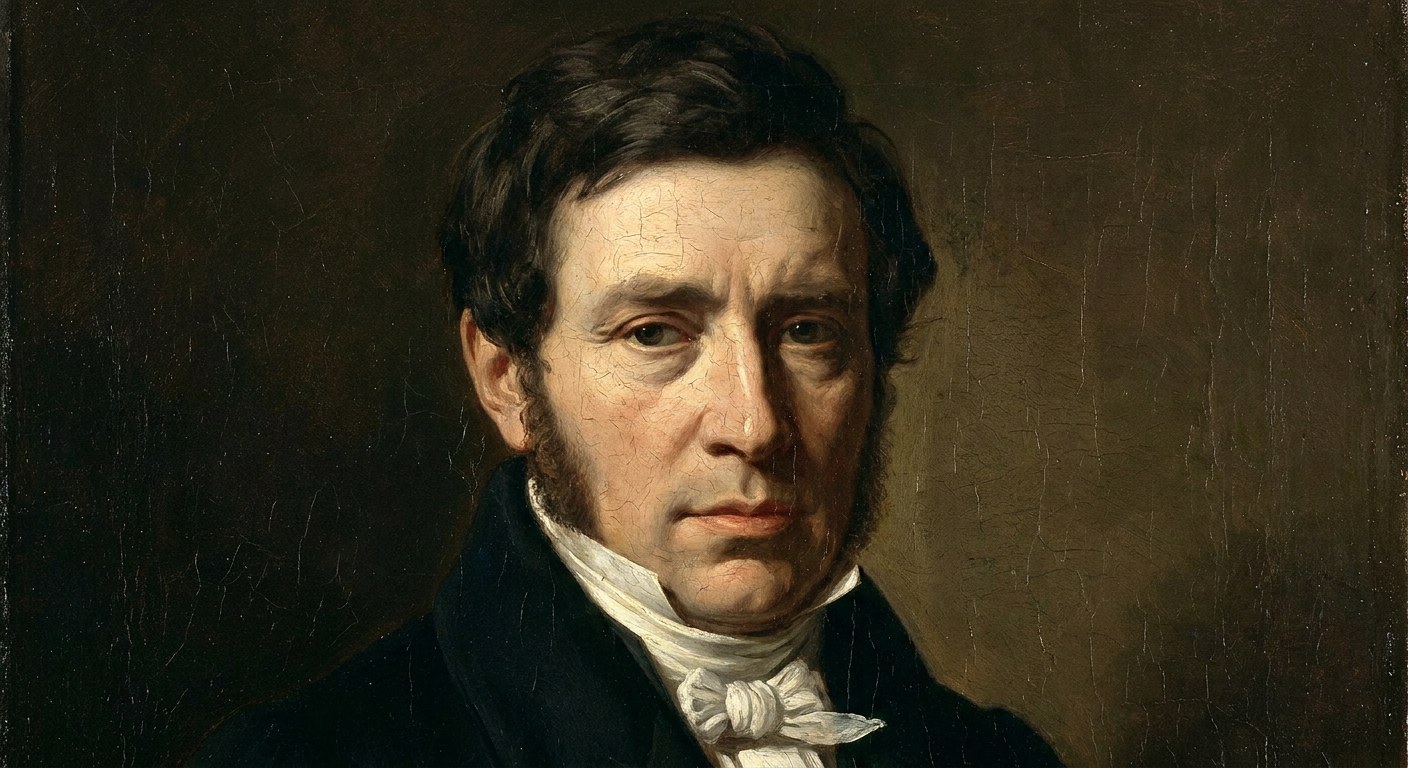
Søren Kierkegaard
1813 – 1855 · Danish · Philosopher & Theologian
Recommended Audiobooks
Listen next from Marcus Alden

Life Lessons from Frederic Chopin
Marcus Alden · 54 min

Life Lessons from John Wesley
Marcus Alden · 52 min
Introduction (Why He Matters)
Søren Aabye Kierkegaard (1813–1855) was a Danish philosopher, theologian, social critic, and religious author whose exploration of anxiety, choice, despair, faith, and individuality helped lay the foundations of existentialist thought. Writing in an age dominated by ambitious philosophical systems and an established national church, he insisted that the most important truths of human existence could not be reduced to abstract formulas. They had to be lived by concrete individuals who chose, suffered, loved, believed, and accepted responsibility for their lives.
Kierkegaard challenged both the speculative philosophy associated with Georg Wilhelm Friedrich Hegel and the comfortable Christianity of nineteenth-century Denmark. He believed that a person could understand Christian doctrine intellectually without actually living as a Christian. Authentic faith, in his view, demanded inward commitment, ethical seriousness, and a willingness to stand as a single individual before God.
His books were as unconventional as his ideas. Kierkegaard wrote under numerous pseudonyms, each representing a distinct outlook rather than simply concealing the author's identity. Through fictional editors, seducers, judges, poets, psychologists, and religious thinkers, he staged arguments about competing ways of life. Works such as Either/Or, Fear and Trembling, The Concept of Anxiety, Philosophical Fragments, The Sickness unto Death, and Works of Love combined philosophy, theology, psychology, satire, and literary experimentation.
Kierkegaard received limited international attention during his lifetime, and his final years were consumed by a fierce attack on the Danish state church. After his death, however, his work influenced theology, philosophy, psychology, literature, and political thought. Thinkers as different as Martin Heidegger, Karl Jaspers, Jean-Paul Sartre, Simone de Beauvoir, Karl Barth, Paul Tillich, Ludwig Wittgenstein, and Martin Buber engaged with his writings. Today Kierkegaard is widely regarded as a father of existentialism and one of the most original Christian thinkers of the modern era.
Quick Facts
| Fact | Details |
|---|---|
| Born | 5 May 1813, Copenhagen, Denmark–Norway |
| Died | 11 November 1855, Copenhagen, Denmark |
| Nationality | Danish |
| Known For | Early existentialism; analyses of anxiety, despair, choice, faith, and individuality; critique of established Christianity |
| Occupation | Philosopher, theologian, author, social critic |
| Era | Nineteenth-century philosophy; Danish Golden Age |
Early Life and Education
Søren Aabye Kierkegaard was born in Copenhagen on 5 May 1813. He was the youngest of seven children of Michael Pedersen Kierkegaard, a prosperous retired wool merchant, and Ane Sørensdatter Lund Kierkegaard, who had previously worked in the family household. Although materially comfortable, the Kierkegaard home was marked by intense Lutheran piety, intellectual seriousness, guilt, and an awareness of death.
Michael Kierkegaard had risen from poverty in rural Jutland. According to an account later recorded by his son, the elder Kierkegaard once cursed God while suffering as a lonely shepherd boy. He subsequently interpreted his prosperity and his family's misfortunes through a religious framework of sin, punishment, and providence. Five of Søren's six siblings died before their father, reinforcing the family's atmosphere of mortality. Søren and his older brother Peter Christian Kierkegaard, who later became a bishop and government minister, were the only siblings to outlive Michael.
Kierkegaard's physical appearance and health contributed to his sense of difference. Contemporary descriptions portray him as slight, sharp-featured, and physically frail, with a noticeable curvature of the spine or stooped posture. At school he was intellectually gifted and verbally agile, although he did not always distinguish himself through disciplined study. He developed a talent for irony and argument that could amuse friends but also wound opponents.
In 1830 Kierkegaard enrolled at the University of Copenhagen to study theology, the conventional preparation for a clerical career. His education included philosophy, theology, classical languages, history, and literature. He was especially interested in Socrates, German Romanticism, and contemporary debates surrounding Hegelian philosophy. Yet his student years were unsettled. He attended cafés and theatrical performances, accumulated debts, experimented with the life of a fashionable young man, and delayed completing his degree.
This period was also one of spiritual and intellectual searching. Kierkegaard's surviving journals reveal a young writer trying to discover a truth that could orient his own existence. In an often-cited journal entry from 1835, he expressed the desire to find an idea for which he could live and die. He did not mean that facts were irrelevant; rather, he sought a personally appropriated purpose capable of shaping action.
His relationship with his father was central to his development. It included affection, intellectual companionship, fear, and conflict. A reconciliation between them occurred before Michael Kierkegaard's death in 1838. The inheritance Søren received gave him financial independence and allowed him to pursue the unusual vocation of a private author rather than depend upon an academic or clerical post.
Kierkegaard completed his theological degree in 1840. In 1841 he defended his dissertation, On the Concept of Irony with Continual Reference to Socrates. The study examined Socratic irony while also criticizing aspects of Romantic irony. Socrates remained a model for Kierkegaard: an unsettling individual who questioned complacent assumptions without replacing them with a convenient philosophical system.
Rise to Prominence
The decisive personal event of Kierkegaard's early adulthood was his relationship with Regine Olsen. He became engaged to the eighteen-year-old Regine in September 1840 but soon doubted whether he could fulfill the ordinary obligations of marriage. In August 1841 he returned her ring. He then behaved in ways apparently intended to convince her that he was frivolous or unworthy, hoping she would release him rather than blame herself.
The reasons for the broken engagement remain debated. Kierkegaard referred to his melancholy, his secretive nature, his religious vocation, and his fear that marriage would burden Regine with his inner conflicts. There is no reliable evidence that one hidden scandal fully explains his choice. He continued to love her, and the relationship left a deep imprint on his writings. Regine married Johan Frederik Schlegel in 1847 and later accompanied him to the Danish West Indies when he became governor there.
After ending the engagement, Kierkegaard traveled to Berlin and attended lectures by the philosopher Friedrich Wilhelm Joseph Schelling. He initially hoped Schelling would provide an alternative to Hegelian speculation, but he became disappointed. Returning to Copenhagen, Kierkegaard began an extraordinary period of literary productivity.
In 1843 he published Either/Or, a large two-volume work issued under the pseudonymous editorship of Victor Eremita. It contrasts an aesthetic mode of life—represented through essays, aphorisms, and the disturbing Diary of a Seducer—with the ethical outlook defended by Judge William. The book attracted considerable attention in Copenhagen because of its literary brilliance, psychological insight, and enigmatic construction.
The same year brought Fear and Trembling, published as Johannes de Silentio, and Repetition, attributed to Constantin Constantius. He also released signed religious discourses. This parallel publication was crucial to his method: pseudonymous works explored possibilities of existence indirectly, while signed discourses addressed religious edification more openly.
Kierkegaard's productivity continued with Philosophical Fragments and The Concept of Anxiety in 1844, Stages on Life's Way in 1845, and Concluding Unscientific Postscript in 1846. By then he had become one of Copenhagen's most conspicuous authors. His fame, however, was accompanied by ridicule following his confrontation with the satirical newspaper The Corsair.
Major Achievements and Contributions
Kierkegaard's foremost achievement was to redirect philosophical attention toward lived existence. He opposed the tendency to treat human beings primarily as components of historical, social, or metaphysical systems. A system might explain logical relations, he argued, but an existing person must still decide how to live. Existence involves uncertainty, time, passion, and responsibility—features that cannot be viewed adequately from a supposedly detached, all-encompassing standpoint.
This emphasis helped inspire existentialism, although Kierkegaard did not use the later movement's label and differed sharply from many secular existentialists. He was a Christian author whose ultimate concern was the individual's relationship with God. Nevertheless, his analyses of freedom, anxiety, absurdity, alienation, choice, and selfhood became fundamental resources for both religious and nonreligious thinkers.
He also transformed philosophical writing. Rather than presenting a single doctrine in his own voice, Kierkegaard practiced what he called indirect communication. His pseudonyms embodied limited perspectives. Johannes de Silentio, for example, admires Abraham's faith in Fear and Trembling but does not claim to possess it. Johannes Climacus examines the problem of becoming a Christian while describing himself as outside Christianity. Readers must therefore interpret not only an argument but also the standpoint and limitations of its speaker.
Kierkegaard's contribution to psychology was equally important. Decades before existential psychology emerged as a discipline, he analyzed anxiety as a condition associated with possibility and freedom. He described despair not merely as sadness but as a disorder in the relation that constitutes the self. His account recognizes forms of despair that may remain hidden beneath social success and apparent happiness.
In Christian ethics, Kierkegaard emphasized love as a duty rather than merely a preference or emotion. Works of Love distinguishes Christian neighbor-love from romantic attraction and selective friendship without simply dismissing those relationships. To love one's neighbor is to recognize every person as equally significant before God.
Finally, Kierkegaard offered a far-reaching critique of mass society. His phrase “the crowd is untruth” did not mean that every group is necessarily wrong. It warned that anonymity and public opinion can dissolve personal responsibility. Newspapers, fashionable opinion, and abstract talk about humanity may allow individuals to avoid answering for their own conduct.
Key Works / Battles / Ideas
Either/Or and the spheres of existence
Either/Or explores a conflict between the aesthetic and ethical orientations. The aesthete seeks pleasure, novelty, imagination, and escape from boredom. Judge William argues that genuine personality emerges through commitment, responsibility, work, and marriage. Kierkegaard did not reduce the book to a simple command to choose conventional respectability; even the ethical life may encounter guilt and a need for religious transformation.
Later writings describe aesthetic, ethical, and religious spheres or stages of existence. These are not fixed sociological categories or steps everyone automatically follows. They are orientations defined by what a person treats as ultimate. Movement between them requires qualitative choice rather than the mere accumulation of information.
Fear and Trembling and faith
In Fear and Trembling, Kierkegaard's pseudonym Johannes de Silentio meditates on the biblical story in which Abraham prepares to sacrifice Isaac. Abraham acts by virtue of his absolute relationship with God, yet his action cannot be made intelligible through universal ethical language. The book asks whether there can be a “teleological suspension of the ethical” and whether an absolute duty to God exists.
The work is not a general defense of violence committed in religion's name. Its disturbing power comes from refusing to make Abraham's ordeal safe or easily comprehensible. The text distinguishes the “knight of infinite resignation,” who gives up the finite, from the “knight of faith,” who paradoxically expects to receive the finite back by virtue of the absurd.
The popular expression “leap of faith” is commonly associated with Kierkegaard, but that exact English phrase does not function as one of his standard formulas. He wrote about qualitative transition, decision, and a leap, especially in relation to faith and historical uncertainty. His point was not that belief should be accepted without thought, but that objective evidence cannot eliminate the personal risk of commitment.
Subjectivity and truth
In Concluding Unscientific Postscript, Johannes Climacus declares that “subjectivity is truth” and “truth is subjectivity.” This claim is often misunderstood as saying that any belief becomes true if sincerely held. Kierkegaard did not deny objective facts. He was addressing existential and religious truth: the decisive issue is how an individual relates to a truth and whether it transforms life.
A person may accurately explain Christianity as a historical or doctrinal phenomenon while remaining existentially indifferent to it. Conversely, inward passion does not make a false factual claim true. Kierkegaard's concern was the mode of appropriation appropriate to ethical and religious existence.
Anxiety, freedom, and sin
The Concept of Anxiety, published under the name Vigilius Haufniensis, examines anxiety as the “dizziness of freedom.” Anxiety arises because human beings confront possibility: they can act, but their freedom does not tell them automatically what to choose. Kierkegaard connects this condition with the biblical story of Adam and with the emergence of sin, while insisting that sin cannot be explained away as a necessary stage in a rational process.
Unlike fear, which normally has a definite object, anxiety can be indefinite. It is both threatening and educative, revealing that a person is free. This account profoundly influenced existential philosophy, psychoanalysis, and later existential psychotherapy.
Despair and the self
The Sickness unto Death appeared in 1849 under the pseudonym Anti-Climacus. It defines the self as a relation that relates itself to itself and, in doing so, relates itself to the power that established it. Despair occurs when this relation is disordered.
One person may despair by refusing to be a self; another may defiantly insist on being a self entirely through personal power. A person can also be unaware of being in despair. For Kierkegaard, the resolution ultimately requires transparent selfhood grounded in God. His analysis combines theology with an unusually subtle account of identity and self-deception.
The attack on Christendom
Kierkegaard distinguished Christianity from “Christendom,” the social and political arrangement in which virtually every Danish citizen was officially considered Christian. He believed this system made Christianity too easy. When baptism, respectability, and citizenship were treated as sufficient, the demanding imitation of Christ disappeared.
His criticism intensified after Bishop Jakob Peter Mynster died in 1854. Hans Lassen Martensen described Mynster as a “witness to the truth.” Kierkegaard objected that this title belonged to people who suffered for the faith, not powerful church officials honored by society. In newspaper articles and the pamphlet series The Moment, he attacked the established church, its clergy, and what he regarded as their complacent distortion of the New Testament.
Timeline of Key Events
| Year | Event |
|---|---|
| 1813 | Born in Copenhagen on 5 May. |
| 1830 | Enters the University of Copenhagen to study theology. |
| 1835 | Records his search for a guiding idea and personal truth in his journal. |
| 1837 | Meets Regine Olsen. |
| 1838 | Reconciles with his father, Michael, who dies later that year. |
| 1840 | Completes his theological degree and becomes engaged to Regine Olsen. |
| 1841 | Breaks the engagement; defends On the Concept of Irony; travels to Berlin. |
| 1843 | Publishes Either/Or, Fear and Trembling, Repetition, and religious discourses. |
| 1844 | Publishes Philosophical Fragments and The Concept of Anxiety. |
| 1845 | Publishes Stages on Life's Way. |
| 1846 | Publishes Concluding Unscientific Postscript and becomes the target of The Corsair. |
| 1847 | Publishes Works of Love; Regine marries Johan Frederik Schlegel. |
| 1848 | Experiences a period of heightened religious conviction and publishes Christian Discourses. |
| 1849 | Publishes The Sickness unto Death. |
| 1850 | Publishes Practice in Christianity. |
| 1854 | Begins public controversy over Bishop Mynster's religious legacy. |
| 1855 | Publishes The Moment, collapses in October, and dies on 11 November. |
Personal Life and Character
Kierkegaard spent nearly his entire life in Copenhagen, then a compact capital in which authors, clergy, officials, and ordinary citizens frequently encountered one another. He was often seen walking through the city, conversing with people from different social backgrounds. Walking was part of his creative method; he composed ideas mentally before developing them at his desk.
He never married and held no permanent academic or ecclesiastical office. His inheritance financed his authorship, book publication, housing, servants, café visits, and carriage rides. By the end of his life much of the fortune had been spent. This independence gave him unusual freedom, although it also separated him from the everyday professional obligations that he discussed in his ethical writings.
Kierkegaard possessed a complex character. He could be witty, sociable, compassionate, and attentive, but also combative, proud, and exceptionally sensitive to criticism. His journals reveal recurrent melancholy, physical distress, religious guilt, and intense self-scrutiny. They also show strategic confidence in his vocation as an author.
Regine Olsen remained emotionally central to him long after their separation. He incorporated transformed versions of courtship, seduction, loss, marriage, and sacrifice into his books. Yet it would be misleading to interpret every female character or romantic theme as a direct transcription of their relationship. His pseudonymous literature deliberately complicates autobiography.
His faith was demanding rather than consoling in a simple sense. He valued worship and Christian teaching but distrusted the assumption that religious identity could be inherited without decision. He admired monastic renunciation in some respects, although he did not become a monk and resisted turning one exceptional form of life into a universal social program.
Challenges and Controversies
Kierkegaard's break with Regine has generated ethical criticism as well as romantic legend. His effort to make himself appear blameworthy may have deepened her pain. Some readers regard the sacrifice as essential to his vocation; others see it as an avoidable failure of openness and mutual responsibility.
His use of pseudonyms creates another interpretive challenge. Statements made by his fictional authors are frequently quoted as though they expressed Kierkegaard's final position. He later explained the structure of his authorship, but he did not eliminate its ambiguities. Responsible interpretation must distinguish between pseudonymous viewpoints, signed discourses, journals, and explicitly Christian works.
The Corsair affair damaged his public life. The satirical weekly had initially praised him, but Kierkegaard objected to its methods and indirectly challenged it to criticize him. Beginning in 1846, the newspaper published caricatures and jokes about his appearance, clothing, voice, and habits. Children and strangers reportedly mocked him in the streets. The episode strengthened his hostility toward the press, anonymous opinion, and the cruelty of the crowd.
His late attack on the Danish church was even more confrontational. Kierkegaard accused professional clergy of turning Christianity into secure employment and of proclaiming ideals they did not attempt to embody. Critics replied that his standard was impossibly severe, that he undervalued ordinary congregational life, and that he attacked individuals unfairly. His polemics remain controversial because they combine prophetic moral force with sweeping denunciation.
Modern readers also debate his treatment of gender and marriage. Some writings reproduce patriarchal assumptions common in nineteenth-century Europe, while others contain complex accounts of love, equality before God, and the ethical demands of relationship. Likewise, political interpreters disagree over whether his “single individual” encourages social responsibility or excessive withdrawal from collective action.
Death and Immediate Aftermath
On 2 October 1855, amid his campaign against the established church, Kierkegaard collapsed in the street. He was taken to Frederiks Hospital in Copenhagen. His health had long been fragile, but the exact cause of his final illness remains uncertain. Historical suggestions include a spinal or neurological disorder; retrospective diagnoses cannot be established with confidence.
During his hospitalization, Kierkegaard reportedly refused communion from an ordained state-church pastor. He was willing to receive it from a layperson but did not wish his final act to validate an institution he had publicly condemned. He died on 11 November 1855 at the age of forty-two.
Kierkegaard was buried in the family plot at Assistens Cemetery in Copenhagen. The funeral became controversial when his nephew, the physician Henrik Lund, protested the established church's role in the ceremony, arguing that it contradicted Kierkegaard's final position. The dispute demonstrated how difficult it was for either church or family to absorb his uncompromising protest.
His death ended The Moment after ten issues, but it did not immediately make him internationally famous. His writings were in Danish, many were stylistically intricate, and his pseudonymous method discouraged easy summary. A smaller circle of Danish readers preserved and debated his work until translations and theological controversies expanded his audience.
Legacy and Influence Today
Kierkegaard's international reputation grew substantially in the late nineteenth and early twentieth centuries, especially after translations into German. He became a major precursor of existential philosophy. Karl Jaspers and Martin Heidegger drew upon his analyses of existence, anxiety, decision, and individuality, although Heidegger recast these themes outside Kierkegaard's explicitly Christian framework.
Jean-Paul Sartre and Simone de Beauvoir shared his concern with freedom, choice, and self-deception but rejected his theological resolution. Sartre's concept of bad faith has clear affinities with Kierkegaardian analyses of evading responsibility, even though their philosophical foundations differ. Albert Camus engaged critically with Kierkegaard's response to absurdity, regarding his turn to faith as a philosophical surrender rather than a solution.
Kierkegaard's effect on modern theology was enormous. Karl Barth and other dialectical theologians found in him a weapon against liberal attempts to domesticate Christianity within culture. Paul Tillich, Rudolf Bultmann, Dietrich Bonhoeffer, Reinhold Niebuhr, and later Christian existentialists responded to his accounts of faith, decision, sin, and revelation. Jewish thinkers, notably Martin Buber, also engaged with his emphasis on personal relation, while challenging aspects of his Christian assumptions.
His psychological influence extends through depth psychology, existential psychotherapy, and pastoral counseling. Ludwig Binswanger, Rollo May, Viktor Frankl, and later therapists found his descriptions of anxiety and despair useful for understanding how people confront possibility, meaning, guilt, and identity. Kierkegaard was not a clinical psychologist, but his phenomenological descriptions remain strikingly relevant.
Writers including Henrik Ibsen, Franz Kafka, W. H. Auden, Walker Percy, and many others encountered his themes or methods. His use of masks, unreliable voices, diaries, fragments, and fictional editors anticipated techniques associated with modernist and postmodern literature.
Kierkegaard is also increasingly discussed in relation to media culture. His criticism of “the public”—an abstraction created and sustained by the press—appears prophetic in an era of social media, viral outrage, and anonymous judgment. His central question remains urgent: will a person hide within collective opinion, or accept responsibility for choosing and acting as an individual?
His legacy cannot be reduced to the slogan “father of existentialism.” Kierkegaard was simultaneously a literary innovator, critic of modernity, interpreter of Christian existence, psychologist of self-deception, and defender of individual responsibility. His work endures because it does not merely offer conclusions. It confronts readers with the uncomfortable task of examining how they live.
Famous Quotes
The wording of Kierkegaard's quotations varies among English translations. The following are genuine statements from his published works or journals.
“Life can only be understood backwards; but it must be lived forwards.”
— Journals and Papers, 1843 journal entry
“Anxiety is the dizziness of freedom.”
— The Concept of Anxiety
“Subjectivity is truth.”
— Concluding Unscientific Postscript
“The crowd is untruth.”
— “The Single Individual,” in The Point of View for My Work as an Author
“Purity of heart is to will one thing.”
— Upbuilding Discourses in Various Spirits
“The most common form of despair is not being who you are.”
— The Sickness unto Death, in a widely used English translation
“To love another person is to help them love God.”
— Works of Love, translation-dependent formulation
Frequently Asked Questions
Why is Søren Kierkegaard called the father of existentialism?
Kierkegaard placed the existing individual, rather than an abstract philosophical system, at the center of inquiry. His analyses of freedom, anxiety, despair, choice, commitment, and authenticity anticipated the central concerns of twentieth-century existentialism. The label is retrospective, however: Kierkegaard understood his project primarily as Christian and did not found an existentialist school.
What did Kierkegaard mean by the “leap of faith”?
The familiar phrase summarizes his view that religious commitment cannot be produced by objective proof alone. Evidence and reflection matter, but they cannot remove all uncertainty or make the decision for the individual. Faith involves a qualitative transition and passionate commitment. Kierkegaard did not advocate believing any claim arbitrarily or abandoning rational thought.
What are Kierkegaard's aesthetic, ethical, and religious stages?
They are broad orientations toward existence. The aesthetic life pursues pleasure, novelty, or possibility; the ethical life emphasizes commitment, duty, and continuity of character; the religious life centers on an individual's relation to God. They are not rigid developmental steps, and Kierkegaard explores tensions within each orientation.
Why did Kierkegaard use pseudonyms?
He used pseudonyms to create independent voices with distinct assumptions and limitations. This method of indirect communication prevented readers from treating his works as a ready-made doctrine. It required them to judge different possibilities and confront their own position. His pseudonyms should therefore not automatically be equated with Kierkegaard himself.
Did Kierkegaard marry Regine Olsen?
No. They became engaged in 1840, but Kierkegaard ended the engagement in 1841. He believed his melancholy, secretiveness, and religious vocation made marriage impossible or unfair to her. Regine married Johan Frederik Schlegel in 1847. Kierkegaard continued to regard her as profoundly important to his life and authorship.
Was Kierkegaard opposed to Christianity?
No. He was a deeply Christian thinker. His target was “Christendom,” the social system that identified Danish citizenship and respectable behavior with genuine Christianity. He argued that following Christ demanded inward transformation, sacrifice, and personal responsibility rather than merely formal church membership.
What is the best Kierkegaard book for beginners?
Fear and Trembling is short and famous but also difficult and easily misunderstood. The Sickness unto Death offers a powerful introduction to his account of the self, while Works of Love presents his ethics more directly. Readers seeking a broad overview may begin with selected discourses or a scholarly introduction before approaching the major pseudonymous works.
How did Kierkegaard die?
He collapsed in Copenhagen in October 1855 and died in Frederiks Hospital on 11 November. The exact medical cause remains uncertain, although he had experienced long-standing physical problems. During his final illness he maintained his protest against the established church and reportedly refused communion from one of its ordained pastors.
Lessons We Can Learn
-
Personal responsibility cannot be delegated. Social approval, institutions, and expert theories may guide us, but they cannot make our deepest moral decisions on our behalf.
-
Freedom inevitably brings anxiety. Anxiety is not always evidence of failure. It may reveal that genuine possibilities are open and that a meaningful choice must be made.
-
Knowledge must be connected to life. Understanding an ethical or religious teaching intellectually is different from embodying it through action, habit, and commitment.
-
Commitment gives continuity to the self. A life devoted only to novelty can become fragmented. Promises, duties, and sustained relationships help transform possibility into character.
-
Institutions should be measured against their ideals. Kierkegaard's attack on Christendom warns that successful organizations can preserve the language of a mission while avoiding its most demanding implications.
Further Reading
- Alastair Hannay, Kierkegaard: A Biography (Cambridge University Press, 2001).
- Joakim Garff, Søren Kierkegaard: A Biography, translated by Bruce H. Kirmmse (Princeton University Press, 2005).
- C. Stephen Evans, Kierkegaard: An Introduction (Cambridge University Press, 2009).
- Patrick Gardiner, Kierkegaard: A Very Short Introduction (Oxford University Press, 2002).
- Clare Carlisle, Philosopher of the Heart: The Restless Life of Søren Kierkegaard (Allen Lane/Farrar, Straus and Giroux, 2019).
Watch and Learn
The Philosophy of Søren Kierkegaard · TED-Ed