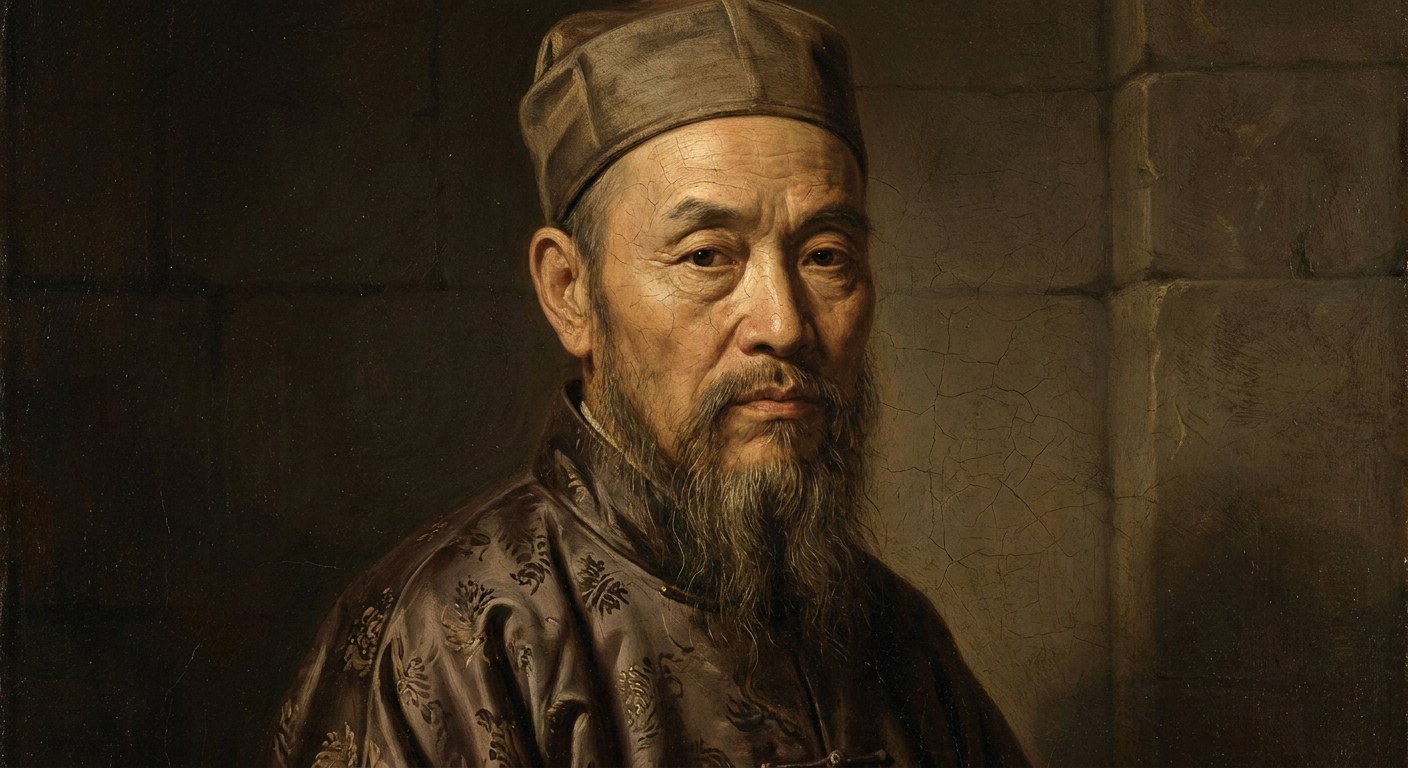
Sun Tzu
544 BC – 496 BC · Chinese · Military Strategist & Philosopher
Recommended Audiobooks
Listen next from Marcus Alden

Life Lessons from Frederic Chopin
Marcus Alden · 54 min

Life Lessons from John Wesley
Marcus Alden · 52 min
1. Introduction
Sun Tzu—also written Sunzi, meaning Master Sun—is the traditional author of The Art of War, the most influential surviving work of military theory from ancient China. His concise analysis of strategy, intelligence, leadership, deception, logistics and political calculation has shaped military thought for more than two thousand years. Although composed for rulers and commanders in an age of warring states, the book is now studied by soldiers, diplomats, political leaders, athletes and business executives around the world.
The historical Sun Tzu is difficult to separate from later tradition. Conventional accounts identify him as Sun Wu, a strategist who lived during the late Spring and Autumn period and served King Helü of Wu in the late sixth century BCE. Traditional dates place his life around 544–496 BCE. Yet the earliest detailed biography of him was written centuries later, and some modern scholars argue that The Art of War reached its present form during the Warring States period, perhaps through the work of multiple generations of military thinkers.
These uncertainties do not diminish the historical importance of the text associated with his name. Sun Tzu presented warfare not as a contest of courage alone, but as a complex political activity governed by information, preparation, geography, psychology and economic limits. His ideal commander avoids unnecessary destruction, disrupts an opponent's plans and wins at the lowest possible cost. The highest form of strategic excellence, he taught, was to overcome resistance without having to fight a prolonged war.
Sun Tzu matters because he transformed strategy into a disciplined subject of study. He demanded realistic assessment rather than wishful thinking, flexibility rather than obedience to fixed formulas, and careful calculation rather than reckless heroism. Those principles continue to influence how people think about conflict, competition and decision-making.
2. Quick Facts
| Category | Details |
|---|---|
| Born | Traditionally c. 544 BCE, probably in the state of Qi; date and place uncertain |
| Died | Traditionally c. 496 BCE; circumstances uncertain |
| Nationality | Ancient Chinese, associated with the states of Qi and Wu |
| Known For | Traditional authorship of The Art of War and foundational ideas about strategy |
| Occupation | Military strategist, theorist and traditionally a general of Wu |
| Era | Late Spring and Autumn period of the Eastern Zhou dynasty |
3. Early Life and Education
Reliable information about Sun Tzu's childhood is almost nonexistent. The principal traditional source for his life is the Shiji, or Records of the Grand Historian, compiled by Sima Qian around the late second and early first centuries BCE—roughly four centuries after the period in which Sun Tzu supposedly lived. Sima Qian calls him Sun Wu and states that he was a native of Qi who gained an audience with King Helü of Wu because of his writings on warfare.
Qi occupied part of what is now Shandong Province and was one of the most powerful states of eastern China. It possessed a developed political culture and a long tradition of military organization. If Sun Tzu was born there, he may have belonged to the educated warrior or aristocratic class, since the literacy, political knowledge and technical vocabulary visible in The Art of War would have required substantial training.
Some later genealogical traditions connect him to a family of military officials and identify his ancestors in detail. Such claims are difficult to verify. Even his personal name presents questions: Sun is the family name, Wu the personal name and Tzu—or zi in modern pinyin—an honorific meaning master. He is therefore often called Master Sun rather than simply Sun Wu.
The education of an elite man in the Eastern Zhou era could include ritual, history, administration, chariotry, archery and the interpretation of political precedents. The author or authors behind The Art of War also understood troop organization, marching, terrain, siege operations, supply, diplomacy and espionage. Whether acquired through formal instruction, direct military service or accumulated traditions, this knowledge reflects a sophisticated professional environment.
The China of Sun Tzu's traditional lifetime was politically fragmented. The Zhou king remained a symbolic figure, but regional states conducted their own diplomacy and fought for territory and prestige. Warfare was changing from relatively limited aristocratic contests into larger, more organized struggles involving infantry, fortified cities and substantial resources. Such conditions encouraged systematic thinking about how wars could be won without exhausting the state that fought them.
4. Rise to Prominence
According to Sima Qian, Sun Tzu came to the attention of King Helü of Wu after presenting thirteen chapters on military affairs. Wu was a rising state in the lower Yangtze region and faced powerful rivals, especially Chu to the west and Yue to the south. A ruler seeking to expand Wu's influence had reason to value innovative military advice.
Sima Qian illustrates Sun Tzu's discipline through the famous story of the palace women. The king allegedly asked whether Sun Tzu's methods could be demonstrated using women from the royal household. Sun Tzu organized 180 women into two companies and appointed the king's favorite concubines as officers. When the women laughed instead of obeying commands, he explained the orders again. After they continued to disobey, he had the two company leaders executed despite the king's objections. The remaining women then performed the drill correctly.
The episode concludes with Sun Tzu declaring that once a commander has received authority in the field, some royal commands may be disregarded if they conflict with military necessity. The king supposedly recognized his ability and appointed him a general.
This dramatic anecdote has often been repeated as biography, but it cannot be independently confirmed. It serves an obvious literary purpose: it demonstrates clarity of orders, command responsibility, impartial enforcement and the need for operational independence. It may therefore reveal more about ancient Chinese ideals of command than about an actual event.
Tradition associates Sun Tzu with Wu's military expansion during King Helü's reign. The kingdom's leading political and military figure was Wu Zixu, an exile from Chu who helped reform Wu and encouraged campaigns against his former state. In 506 BCE, Wu won a major victory over Chu at the Battle of Boju and briefly occupied the Chu capital of Ying. Some later sources and popular biographies assign Sun Tzu a central role in this campaign. Contemporary evidence, however, does not clearly name him as its commander. Any account of his participation must therefore remain cautious.
Whether he personally directed Wu's armies or became attached to the kingdom through later tradition, Sun Tzu's reputation was linked to the image of a smaller state defeating a stronger opponent through speed, planning and intelligent maneuver. That model closely resembles the strategic principles expressed in The Art of War.
5. Major Achievements and Contributions
Sun Tzu's greatest contribution was the formulation of a coherent theory of war. Instead of treating victory as the product of bravery, numbers or divine favor, The Art of War emphasizes factors that can be studied and controlled. These include moral cohesion, command quality, climate, terrain, discipline, organization, intelligence and logistical capacity.
A central achievement of the work is its insistence that warfare serves political objectives. War is a matter of survival for the state and must therefore be examined carefully before it begins. A ruler should not mobilize from anger, and a general should not fight merely to satisfy pride. The expected benefits must justify the human and material costs.
Sun Tzu also recognized that prolonged warfare can ruin the victor as well as the defeated. Large armies consume food, transport and revenue. Long campaigns burden civilians and weaken state finances. For that reason, effective strategy aims at rapid decision and the preservation of resources. Capturing an enemy army, city or state intact is preferable to destroying it.
Another major contribution is the concept usually translated as deception. Sun Tzu argues that commanders should manipulate the enemy's perception: appear distant when near, weak when strong and inactive when preparing to move. This is not deception for its own sake. Its purpose is to create favorable conditions, divide opposing forces and encourage mistakes.
He likewise elevated intelligence to a fundamental instrument of policy. The final chapter of The Art of War discusses several types of spies and explains how advance knowledge can prevent wasteful campaigns. Information must come from human sources familiar with the enemy's circumstances; it cannot be obtained through superstition or detached speculation alone.
Sun Tzu's method is also notable for its flexibility. There is no single formation, tactic or rule that guarantees victory under all conditions. An army should adapt to circumstances as water shapes its course around terrain. The skilled commander recognizes changes early and refuses to cling to methods that no longer fit the situation.
Finally, the work helped establish military study as an intellectual discipline. It influenced generations of Chinese strategists, officials and commentators. During the Song dynasty it was included among the Seven Military Classics, a canonical group of texts studied by military officials and candidates for state examinations.
6. Key Works / Battles / Ideas
The Art of War
The Art of War, known in Chinese as the Sunzi Bingfa, consists in its received form of thirteen compact chapters. Each addresses a major dimension of military activity:
- Laying Plans, or Initial Assessments
- Waging War
- Attack by Stratagem, or Planning Offensives
- Tactical Dispositions
- Energy, Force or Strategic Power
- Weak Points and Strong
- Maneuvering
- Variation in Tactics
- The Army on the March
- Terrain
- The Nine Situations, or Nine Grounds
- Attack by Fire
- The Use of Spies
Chapter titles vary among translations because classical Chinese terms can carry several meanings. The text itself is terse, repetitive in places and built from maxims, comparisons and technical observations rather than a continuous argument.
Winning Without Destructive Battle
Sun Tzu's best-known ideal is that the highest excellence lies in overcoming opposition without costly fighting. This does not make him a pacifist. He accepts war as a sometimes necessary tool of statecraft, but he ranks methods according to their cost. Attacking an enemy's plans is better than attacking its armies; disrupting alliances is better than besieging cities. Siege warfare is treated as a last resort because it consumes time, equipment and lives.
Knowledge of Self and Enemy
Accurate assessment is essential. Commanders must understand both their own capabilities and those of their opponents. This includes numbers, morale, training, objectives, internal divisions and environmental conditions. Knowledge reduces uncertainty but does not eliminate the need for judgment.
Strategic Deception
The statement that warfare is based on deception summarizes an operational principle: conceal intentions while learning those of the enemy. Feints, unexpected routes, false appearances and controlled disorder can disrupt an opponent's calculations. Successful deception depends on discipline and intelligence, not theatrical trickery alone.
Shi: Strategic Advantage
A key Chinese concept in the work is shi, variously translated as force, potential, configuration or strategic advantage. It refers to the power created by arranging circumstances so that success becomes highly probable. Sun Tzu compares this potential to water rushing downhill or a drawn crossbow releasing its trigger. The strategist does not rely only on individual heroism; he shapes the situation so that organized force produces decisive effects.
Terrain and Adaptation
Physical and human environments affect every operation. Sun Tzu classifies terrain and strategic situations according to their opportunities and dangers. A commander must consider distance, accessibility, escape routes, supply and the likely behavior of troops. Fixed doctrine is dangerous because circumstances continually change.
Leadership and Discipline
An effective commander combines wisdom, sincerity, benevolence, courage and strictness. Soldiers must understand orders and trust the system in which they serve, but discipline must be consistent. If instructions are unclear, the commander bears responsibility; if clear instructions are deliberately ignored, officers must enforce them.
Espionage
The final chapter presents spies as indispensable because intelligence can shorten wars and save resources. Sun Tzu distinguishes among local, inward, converted, doomed and surviving spies. Especially important is the converted spy—an enemy agent persuaded to serve one's own side—because that person can help identify other sources and transmit controlled information.
The Battle of Boju
The Battle of Boju in 506 BCE is frequently associated with Sun Tzu. Wu's forces defeated the larger army of Chu in a rapid campaign and entered its capital. The operation's speed and use of maneuver fit principles later connected with Sun Tzu. Nevertheless, the surviving early narratives emphasize King Helü, Wu Zixu and other commanders, and they do not securely establish Sun Tzu's role. The battle should be regarded as part of his traditional military context rather than an unquestioned personal achievement.
Authorship and Textual Development
Many scholars believe that The Art of War contains material from a later period than the traditional Sun Tzu. Its terminology and picture of military organization often seem compatible with the Warring States era, when armies became larger and warfare more bureaucratic. One possibility is that a historical Sun Wu began a body of teachings that disciples and editors expanded. Another is that Master Sun functioned as an authoritative name for a developing strategic tradition.
Bamboo-slip manuscripts discovered in 1972 at Yinqueshan in Shandong confirmed that texts attributed to Sun Tzu circulated by the early Han dynasty. They also included a separate work associated with Sun Bin, a strategist traditionally described as Sun Tzu's descendant. This discovery helped resolve earlier confusion between the two Masters Sun while demonstrating the antiquity of the received strategic tradition.
7. Timeline of Key Events
| Year | Event |
|---|---|
| c. 544 BCE | Traditional date of Sun Tzu's birth, commonly placed in the state of Qi |
| c. 512 BCE | According to later tradition, Sun Tzu presents his military writings to King Helü of Wu and enters his service |
| Late 6th century BCE | Traditionally advises or commands forces during Wu's rise as a regional power |
| 506 BCE | Wu defeats Chu at the Battle of Boju; Sun Tzu's participation is traditionally claimed but historically uncertain |
| c. 496 BCE | Traditional date of Sun Tzu's death or disappearance from the historical narrative |
| c. 4th–3rd centuries BCE | Probable period in which portions of The Art of War were edited or developed into something close to their surviving form |
| c. 2nd–1st centuries BCE | Sima Qian records the earliest substantial surviving biography of Sun Tzu in the Shiji |
| 3rd century CE | The statesman and commander Cao Cao writes an influential commentary on The Art of War |
| 1080 CE | The Art of War is canonized as one of the Seven Military Classics under the Song dynasty |
| 1972 CE | Yinqueshan bamboo manuscripts of Sun Tzu and Sun Bin are discovered in Shandong |
| 20th–21st centuries | The work becomes globally influential in military education, politics, business and popular culture |
8. Personal Life and Character
No reliable ancient source provides detailed information about Sun Tzu's marriage, children, household or private relationships. Later genealogies sometimes identify descendants, most notably by connecting him to Sun Bin. The historical accuracy of a direct family relationship remains uncertain.
It is equally difficult to reconstruct his personality. The character commonly attributed to him comes largely from The Art of War and Sima Qian's palace-women story. These sources depict a person who was controlled, analytical, demanding and willing to enforce discipline regardless of status. Yet a text's teaching voice cannot automatically be treated as a literal portrait of its author.
The strategic ideal associated with Sun Tzu is not that of a warrior seeking personal glory. It is that of a restrained professional who calculates consequences, avoids emotional decisions and protects both the state and the army. Good leadership requires humanity as well as severity. Troops should be cared for, but affection without authority produces disorder. Conversely, punishment without established loyalty makes an army ineffective.
Sun Tzu's intellectual character is most visible in his hostility to rigid thinking. He repeatedly uses paradox: apparent weakness may conceal strength, retreat may create opportunity and the greatest victory may be almost invisible. These ideas suggest a worldview in which indirect action and sensitivity to changing conditions are often more effective than dramatic force.
9. Challenges and Controversies
The central controversy surrounding Sun Tzu is whether he existed exactly as later tradition described him. Sima Qian wrote centuries after Sun Tzu's supposed lifetime, and earlier narrative histories do not clearly document the strategist's service in Wu. Scholars have therefore proposed several possibilities: Sun Wu was a genuine late-sixth-century commander; he was a historical teacher whose ideas were expanded by followers; or he was a partly legendary figure to whom a later military text was attributed.
The dating of The Art of War presents a related problem. Some features fit the Spring and Autumn period, while others appear to reflect the mass infantry warfare and administrative sophistication of the Warring States era. Modern estimates often place the text's main formation between the fifth and third centuries BCE, though there is no universal agreement.
Translation creates another challenge. Classical Chinese is compact and context-dependent. Terms such as dao, shi, qi and zheng cannot always be represented by one English equivalent. Consequently, translations differ in both vocabulary and interpretation. Familiar English quotations may reflect the wording of a particular translator rather than a single unambiguous original sentence.
Sun Tzu's modern reputation has also produced oversimplification. Business manuals sometimes reduce the text to slogans about defeating competitors, while popular culture portrays it as a handbook of ruthless manipulation. In fact, the work repeatedly warns against unnecessary conflict, uncontrolled anger, economic exhaustion and destruction without political purpose.
A further ethical controversy concerns deception and espionage. Sun Tzu treats both as legitimate tools of statecraft. Critics may see this as morally troubling, especially when the principles are transferred into personal or commercial life. Historically, however, his argument is partly humanitarian and practical: if intelligence and misdirection can prevent a long war, they may reduce overall suffering.
Claims that Sun Tzu personally planned specific battles should also be treated carefully. The victory at Boju is the most prominent example. It is reasonable to discuss the campaign alongside his ideas, but the evidence does not justify presenting him as its undisputed commander.
10. Death and Immediate Aftermath
The date, place and manner of Sun Tzu's death are unknown. Traditional chronologies often give approximately 496 BCE, the year King Helü died after being wounded during conflict with Yue. There is no dependable account showing that Sun Tzu died in that year, however. He simply disappears from the later narrative constructed around Wu's campaigns.
Wu remained powerful for a time but eventually fell to Yue in 473 BCE. The political order of ancient China continued to fragment, and warfare intensified during the Warring States period. In this environment, strategic expertise became increasingly important. The body of military teaching associated with Master Sun was copied, discussed and probably revised.
By the Han dynasty, Sun Tzu possessed an established reputation. Sima Qian included him in the Shiji, placing him within a lineage of famous strategists. Later scholars wrote commentaries that preserved and interpreted the text. The most influential early commentator was Cao Cao, the third-century CE warlord, statesman and poet whose concise notes helped shape subsequent readings of The Art of War.
Thus Sun Tzu's immediate personal fate is obscure, but his intellectual survival is clear. His name became inseparable from strategic wisdom, and the text attributed to him entered the permanent literature of the Chinese state and military tradition.
11. Legacy and Influence Today
Within China, The Art of War influenced commanders, court officials and political thinkers across successive dynasties. Its inclusion in the Seven Military Classics during the Song dynasty gave it official status. Commentators compared different interpretations, clarified technical language and adapted its principles to changing military conditions.
The work also traveled throughout East Asia. It was studied in Japan, Korea and Vietnam, where scholars and military leaders incorporated Chinese strategic literature into their own traditions. Japanese samurai-era thinkers read Sun Tzu alongside local works on command and warfare. The text's emphasis on intelligence, timing and indirect action proved adaptable to many political and military settings.
European knowledge of Sun Tzu expanded after the French Jesuit Jean Joseph Marie Amiot published a French rendering in 1772. English-language readership grew substantially in the twentieth century, especially after Lionel Giles issued his influential 1910 translation. Later versions by Samuel B. Griffith, Ralph D. Sawyer, Roger T. Ames and others introduced different scholarly and philosophical interpretations.
Modern Chinese leaders and revolutionaries engaged with the broader strategic tradition in which Sun Tzu held a central place. Mao Zedong's writings on guerrilla warfare contain ideas that resemble Sun Tzu's emphasis on intelligence, mobility, political conditions and avoiding the enemy's strength, although Mao also drew on modern revolutionary experience and Marxist theory.
Military academies around the world continue to assign The Art of War. Its value lies less in providing specific battlefield instructions than in encouraging commanders to ask enduring questions: What political purpose does the conflict serve? What does the opponent believe? What are the true costs? Which conditions can be shaped before fighting begins? How can success be achieved without creating greater problems?
Outside the military, Sun Tzu has become a major figure in management and leadership literature. Executives apply his ideas to competition, negotiation, organizational planning and risk assessment. Such uses can be insightful when treated as analogies, but commerce is not war, and literal application can encourage hostility toward ordinary competitors or colleagues.
His ideas have also entered diplomacy, law, sports, cybersecurity, intelligence analysis and game theory. Cybersecurity specialists, for example, recognize the relevance of concealment, reconnaissance, asymmetry and misleading signals. Coaches value preparation and exploiting mismatches. Negotiators study interests, leverage and the option of achieving goals without direct confrontation.
Sun Tzu's broadest legacy is a style of thought. It begins with sober assessment, seeks advantage before action, treats information as a strategic resource and rejects force as the automatic solution to every problem. Even readers who never command an army can learn from his insistence that successful action depends on understanding systems, incentives, people and changing circumstances.
12. Famous Quotes
The following genuine passages are quoted from Lionel Giles's 1910 English translation of The Art of War. Wording differs in other translations.
“All warfare is based on deception.”
“Hence to fight and conquer in all your battles is not supreme excellence; supreme excellence consists in breaking the enemy's resistance without fighting.”
“If you know the enemy and know yourself, you need not fear the result of a hundred battles.”
“In war, then, let your great object be victory, not lengthy campaigns.”
“He will win who knows when to fight and when not to fight.”
“The clever combatant imposes his will on the enemy, but does not allow the enemy's will to be imposed on him.”
“Water shapes its course according to the nature of the ground over which it flows; the soldier works out his victory in relation to the foe whom he is facing.”
13. Frequently Asked Questions
Was Sun Tzu a real person?
Possibly, but the evidence is incomplete. Chinese tradition identifies him as Sun Wu, a strategist from Qi who served King Helü of Wu in the late sixth century BCE. The earliest detailed biography was written about four centuries later. Many historians accept that a historical figure may stand behind the tradition while questioning parts of the conventional story.
When was Sun Tzu born?
His traditional birth date is approximately 544 BCE. This date is not established by contemporary records and should be treated as conventional rather than certain.
Did Sun Tzu write The Art of War by himself?
Traditional accounts say that he did, but modern scholarship often views the book as a layered text. A historical Sun Tzu may have created its core teachings, while disciples or later editors expanded and organized them during the Warring States period.
How many chapters are in The Art of War?
The received text contains thirteen chapters. They cover planning, the costs of war, offensive strategy, positioning, maneuver, terrain, fire attacks and espionage, among other subjects.
Did Sun Tzu command at the Battle of Boju?
Later tradition often credits him with helping Wu defeat Chu at Boju in 506 BCE. Surviving early accounts do not conclusively establish his command role. Wu Zixu and other leaders are more clearly connected to the campaign.
What did Sun Tzu mean by winning without fighting?
He meant that the best strategist achieves political objectives while avoiding unnecessary destruction. Diplomacy, alliance-building, intelligence, deterrence and disruption of an opponent's plans may produce a better result than a costly battle. He did not claim that combat could always be avoided.
Are all popular Sun Tzu quotations authentic?
No. Many sayings circulating online are paraphrases, altered translations or statements with no basis in The Art of War. Even authentic passages vary because translators interpret classical Chinese differently. Quotations should therefore identify a translation when possible.
Why is The Art of War still relevant?
Its central subjects—uncertainty, intelligence, leadership, incentives, logistics, adaptability and the cost of conflict—remain relevant. The book offers a framework for strategic judgment rather than a fixed set of tactics, which allows it to be applied across different periods and fields.
14. Lessons We Can Learn
-
Understand before acting. Decisions improve when they are based on knowledge of one's own capabilities, the opposing side and the surrounding environment rather than assumption or emotion.
-
Seek the lowest-cost path to the objective. Winning is not enough if success consumes more resources than it produces. Negotiation, deterrence and preparation may achieve more than direct confrontation.
-
Remain flexible. Conditions change, and methods that worked previously may become liabilities. Effective strategy responds to reality instead of defending a favored plan.
-
Build advantage before the decisive moment. Training, information, logistics, positioning and alliances often determine outcomes before visible action begins. Preparation reduces dependence on luck or individual heroism.
-
Control anger and ego. Conflict undertaken for pride or revenge can damage everyone involved. Leaders should connect action to a clear purpose and judge success by lasting results, not dramatic gestures.
15. Further Reading
- Sun Tzu, The Art of War, translated by Samuel B. Griffith. Oxford University Press, 1963.
- Sun Tzu, The Art of War, translated with commentary by Roger T. Ames. Ballantine Books, 1993.
- Sun Tzu, The Art of War: The Denma Translation. Shambhala, 2001.
- Ralph D. Sawyer, The Seven Military Classics of Ancient China. Basic Books, 1993.
- Michael Nylan, The Art of War: A New Translation. W. W. Norton, 2020.
Watch and Learn
The Art of War – Sun Tzu · TED-Ed