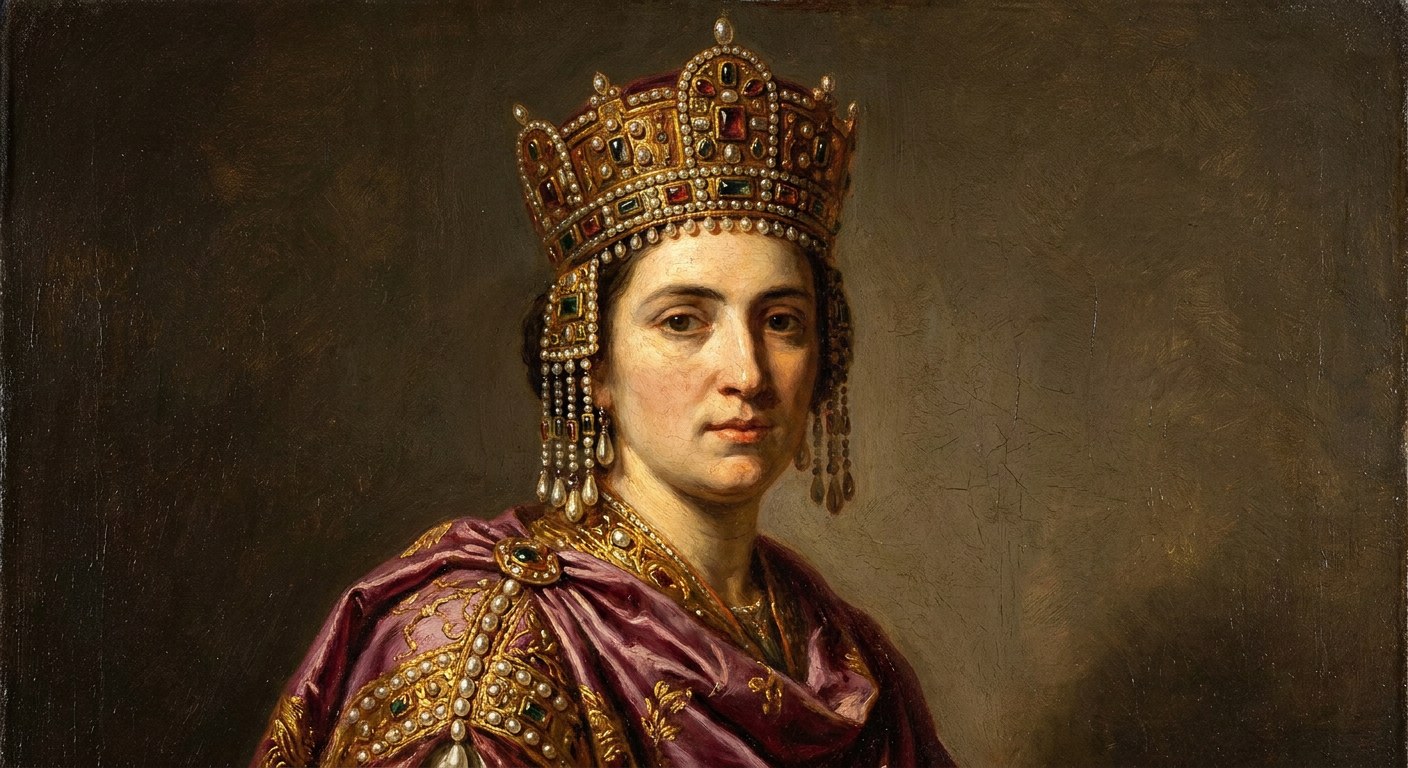
Theodora
500 – 548 · Byzantine · Empress
Recommended Audiobooks
Listen next from Marcus Alden

Life Lessons from Frederic Chopin
Marcus Alden · 54 min

Life Lessons from John Wesley
Marcus Alden · 52 min
Introduction
Theodora (c. 497–28 June 548) was Byzantine empress from 527 until her death and one of the most powerful women in the history of the Roman Empire. The wife and political partner of Emperor Justinian I, she rose from the popular entertainment world of Constantinople—an environment regarded as socially disreputable by the empire’s elite—to occupy the imperial throne. Her career was extraordinary in a society in which birth, status, gender, and profession sharply limited social advancement.
Theodora’s influence extended across court politics, diplomacy, religious policy, law, and imperial patronage. During the Nika riots of January 532, she reportedly persuaded Justinian and his advisers not to abandon Constantinople, helping preserve the dynasty at a moment of grave danger. She supported legislation intended to protect women from forced prostitution and exploitation, participated in appointments and dismissals, cultivated networks of loyal officials, and offered protection to Miaphysite Christians when imperial policy officially favored the decisions of the Council of Chalcedon.
Much of what is known about Theodora comes from the historian Procopius of Caesarea. His works present sharply contrasting portraits. In The Wars and The Buildings, he depicts the imperial couple with varying degrees of respect and praise. In the scandalous Secret History, however, he describes Theodora as sexually depraved, vindictive, and tyrannical. Modern historians therefore treat his accusations cautiously, comparing them with laws, chronicles, church histories, inscriptions, and material evidence.
Theodora’s importance does not depend upon accepting either the hostile or the idealized image. She was a capable political actor who helped shape the reign of Justinian, one of late antiquity’s most consequential emperors. Her image in the mosaics of San Vitale at Ravenna—crowned, jeweled, and surrounded by her court—remains one of the most recognizable representations of imperial power.
Quick Facts
| Category | Details |
|---|---|
| Full name | Theodora |
| Born | c. 497; exact date and birthplace uncertain |
| Possible birthplace | Constantinople is most commonly accepted; Cyprus and Syria also appear in later traditions |
| Died | 28 June 548 |
| Place of death | Constantinople, Byzantine Empire |
| Age at death | Approximately 50 or 51 |
| Title | Augusta; Byzantine, or Eastern Roman, empress |
| Reign as empress | 527–548 |
| Spouse | Justinian I |
| Father | Acacius, traditionally described as a bear keeper for Constantinople’s Green circus faction |
| Mother | Name unknown; associated with the theatrical world in Procopius’s account |
| Dynasty | Justinianic dynasty |
| Religion | Christian; personally sympathetic to Miaphysite or non-Chalcedonian Christians |
| Known for | Political influence, role in the Nika riots, religious patronage, legal and social measures affecting women |
| Principal contemporary source | Procopius of Caesarea |
| Burial place | Church of the Holy Apostles, Constantinople; tomb no longer survives |
Early Life & Background
Theodora’s origins are uncertain because surviving accounts were written by authors with political or religious agendas. Procopius states that her father, Acacius, cared for bears belonging to the Green faction at Constantinople’s Hippodrome. The Greens and Blues were not merely sporting clubs: they organized chariot-racing teams, maintained large urban followings, and sometimes became involved in patronage, public disorder, and political demonstrations.
According to Procopius, Acacius died while Theodora and her sisters, Comitona and Anastasia, were young. Their mother remarried and sought to have her new husband appointed to Acacius’s position. When the Greens rejected the family’s appeal, she presented her daughters before the crowds in the Hippodrome. The Blue faction allegedly offered assistance. Procopius uses this episode to explain Theodora’s later support for the Blues and hostility toward the Greens, although the neat political symmetry may reflect literary shaping.
Theodora entered the theatrical profession, as did at least one of her sisters. In the sixth-century Roman world, actresses occupied a low and morally suspect social category. Theater was associated by Christian moralists with sexual display, and female performers could be treated legally and socially as prostitutes even when their work included mime, dance, comedy, and acrobatics. Procopius’s Secret History gives an explicitly sexualized account of Theodora’s performances. Some details may preserve knowledge of the coarse popular theater of Constantinople, but the work’s pornographic exaggeration and invective make it unsafe to read as straightforward biography.
At some point, Theodora became associated with a man named Hecebolus, who was appointed governor of Pentapolis in North Africa. She apparently accompanied him there but later separated from him under difficult circumstances. Procopius says she traveled through Alexandria and other eastern cities before returning to Constantinople. Later religious traditions connect her time in Alexandria with conversion or deepened sympathy toward anti-Chalcedonian Christianity, possibly through contact with Bishop Timothy III of Alexandria or the cleric Severus of Antioch. The evidence is suggestive rather than conclusive.
By the time she returned to Constantinople, Theodora may have abandoned the stage and supported herself by spinning wool. This detail, also reported by Procopius, echoes conventional stories of moral reform and should be treated cautiously. Nevertheless, her return marked the beginning of a dramatic transformation: she met Justinian, nephew and heir of Emperor Justin I.
Rise to Prominence
Justinian was probably in his forties when he met Theodora. He was already one of the empire’s leading political figures and exercised considerable influence during the reign of his uncle. Theodora’s intelligence, force of personality, and knowledge of urban society may have attracted him as much as her appearance. Their relationship soon encountered a legal and social obstacle: Roman law prohibited men of senatorial rank from marrying actresses or women who had formerly worked on the stage.
A law issued during Justin I’s reign removed this restriction under certain conditions. It allowed repentant actresses who had received imperial approval to marry men of high rank. Although the law was expressed in general terms, it was almost certainly designed to make Justinian’s marriage possible. Justinian and Theodora married around 525.
The marriage reportedly faced opposition from Empress Euphemia, Justin I’s wife, but it took place after her death. Theodora was granted the rank of patrician, formally elevating her standing. When Justinian became co-emperor in April 527, Theodora was crowned Augusta. After Justin I died on 1 August 527, Justinian became sole emperor and Theodora his imperial consort.
Theodora did not rule independently, nor was she formally Justinian’s constitutional equal. Yet evidence from laws, diplomatic correspondence, and narrative sources shows that she exercised unusual authority. Justinian referred to her in one law as his “partner in deliberations,” a phrase indicating recognized participation in government. Petitioners approached her, foreign rulers corresponded with her, and senior officials knew that her support—or hostility—could determine careers.
Her rise also altered the composition of the court. Theodora cultivated relationships with women, eunuchs, churchmen, military families, and officials whose loyalty linked them directly to the palace. Antonina, wife of the general Belisarius, became one of her closest associates. Through such networks, the empress could gather information, promote allies, intervene in disputes, and conduct missions that complemented Justinian’s government.
Major Achievements
Theodora’s most visible political achievement was her contribution to the survival of Justinian’s regime during the Nika riots. Her broader importance, however, lay in sustained participation in imperial government.
She was associated with legislation addressing the vulnerability of women, especially those involved in prostitution. Justinianic laws prohibited the coercion of women into prostitution, restricted the activities of procurers, and provided penalties for those who exploited female poverty. The government established a refuge in a former palace known as Metanoia, or “Repentance,” intended for women removed from brothels. Procopius presents the institution as oppressive, claiming that some residents tried to escape. Even if implementation was imperfect, the measures recognized trafficking and forced prostitution as matters for state intervention.
Laws of Justinian’s reign also improved some aspects of women’s status in marriage, property, and criminal justice. Penalties for rape were strengthened, and women received greater protection in certain disputes involving dowries and widowhood. It would be inaccurate to attribute the entire legal program to Theodora or to describe her as a feminist in the modern sense. The laws emerged from Roman legal traditions, Christian moral policy, Justinian’s priorities, and the work of jurists such as Tribonian. Nevertheless, several measures addressed conditions with which Theodora may have had personal familiarity, and contemporary tradition associated her with the protection of disadvantaged women.
Theodora also participated in ecclesiastical politics. The Council of Chalcedon in 451 had declared Christ to be acknowledged in two natures, divine and human. Many Christians in Egypt, Syria, and Armenia rejected Chalcedon, preferring a theological formula emphasizing the unity of Christ’s incarnate nature. They are often called Miaphysites, though their opponents labeled them Monophysites.
While Justinian publicly defended Chalcedonian orthodoxy and sought reconciliation across the empire, Theodora protected prominent anti-Chalcedonian clergy. She sheltered churchmen in the Palace of Hormisdas complex, maintained contact with Severus of Antioch, and supported religious communities under pressure. Her patronage helped preserve a hierarchy that might otherwise have been broken by persecution.
Around 542 or 543, with support from the Arab ruler al-Harith ibn Jabalah, Theodora helped secure the consecration of Jacob Baradaeus as a bishop. Jacob traveled widely, ordaining clergy and organizing non-Chalcedonian communities. His activity contributed decisively to the survival of the Syriac Orthodox tradition, sometimes called “Jacobite” after him. Theodora’s intervention therefore had religious consequences lasting far beyond her lifetime.
Architectural patronage was another expression of her authority. The imperial couple sponsored churches, monasteries, hospices, fortifications, and charitable institutions. Theodora was commemorated in buildings across the empire, although Procopius’s Buildings often credits Justinian collectively for imperial projects. Her most famous surviving image appears in the Church of San Vitale in Ravenna, completed in 547. In the mosaic, she carries a chalice and stands beneath an architectural canopy, clothed in purple and jewels. Although she probably never visited Ravenna, her portrait asserted imperial and sacred authority in the reconquered Italian city.
Defining Moments
The defining crisis of Theodora’s career occurred during the Nika riots of January 532. The disturbances began after supporters of the Blues and Greens demanded clemency for arrested faction members. When Justinian refused, the factions united under the cry “Nika,” meaning “Conquer!” or “Win!” The unrest expanded into a broad rebellion fueled by hostility toward taxes, unpopular officials, and imperial centralization.
Crowds burned large areas of Constantinople, including the earlier Church of Hagia Sophia. Senators hostile to Justinian supported Hypatius, a nephew of former emperor Anastasius I, as a rival emperor. With the palace threatened, Justinian’s advisers considered escape by sea.
Procopius attributes to Theodora a speech opposing flight. She reportedly argued that exile was intolerable and concluded that “royal purple is the noblest shroud.” Whether these were her exact words is unknowable; ancient historians frequently composed speeches for major figures. Yet the account is plausible in its essential claim that Theodora urged resistance.
The government acted decisively. The eunuch commander Narses used money and political influence to divide the factions, while the generals Belisarius and Mundus led troops into the Hippodrome. Thousands were killed—Procopius gives a figure of about 30,000, though exact numbers cannot be verified. Hypatius was executed, and Justinian’s authority survived. Theodora’s reputation for courage rests above all on this moment.
A second defining feature of her career was her ability to manage court rivalries. She opposed John the Cappadocian, Justinian’s powerful praetorian prefect, whose fiscal administration made him widely feared. In 541, Antonina helped lure John into a compromising meeting that could be represented as treasonous. John was removed, exiled, and stripped of much of his wealth. The episode illustrates Theodora’s political methods: personal intelligence networks, carefully staged accusations, and reliance on trusted intermediaries.
Her involvement in papal politics was more controversial. Pope Silverius was deposed in 537 during the Gothic siege of Rome, while Belisarius and Antonina controlled the city. Later sources accused Theodora of arranging his removal because he would not restore the deposed anti-Chalcedonian patriarch Anthimus of Constantinople. Vigilius replaced Silverius. The evidence is complicated, and some accounts were written to condemn Vigilius or imperial interference. Theodora was almost certainly interested in the matter, but the exact promises, instructions, and responsibility for Silverius’s fate remain disputed.
Her death on 28 June 548 was another turning point. The cause was described by the chronicler Victor of Tunnuna as cancer, possibly breast cancer, though certainty is impossible. Justinian was deeply affected and never remarried. He continued to honor her memory in ceremonies, legislation, and charitable foundations.
Timeline
| Year | Event |
|---|---|
| c. 497 | Theodora is born, probably in Constantinople, though her birthplace remains uncertain. |
| c. 500s | Her father Acacius, described as a bear keeper for the Greens, dies while his daughters are young. |
| c. 510s | Theodora enters Constantinople’s theatrical and mime profession. |
| Early 520s | She accompanies Hecebolus to Pentapolis in North Africa and later separates from him. |
| Early to mid-520s | Travels through the eastern Mediterranean, possibly including Alexandria and Antioch, before returning to Constantinople. |
| c. 522–525 | Meets Justinian, nephew and political heir of Emperor Justin I. |
| c. 525 | Marries Justinian after a legal change permits high-ranking men to marry former actresses. |
| 1 April 527 | Justinian is crowned co-emperor; Theodora receives the rank and title of Augusta around this time. |
| 1 August 527 | Justin I dies; Justinian becomes sole emperor, with Theodora as empress. |
| 529–534 | Compilation and revision of Justinian’s major legal collections; Theodora is associated with elements of the reign’s social legislation. |
| 13–18 January 532 | Nika riots devastate Constantinople; Theodora reportedly persuades the imperial council not to flee. |
| 532 | Belisarius, Mundus, and imperial forces suppress the uprising in the Hippodrome. |
| 532 onward | Reconstruction of Constantinople begins, including the new Hagia Sophia. |
| 535–536 | Religious controversy intensifies over Anthimus, patriarch of Constantinople; Theodora protects anti-Chalcedonian clergy. |
| 537 | Pope Silverius is deposed in Rome and replaced by Vigilius amid accusations of imperial and Theodoran intervention. |
| 27 December 537 | Justinian’s new Hagia Sophia is dedicated in Constantinople. |
| 541 | Theodora helps bring about the fall of the praetorian prefect John the Cappadocian. |
| 542–543 | She supports the consecration and mission of Jacob Baradaeus, strengthening the Miaphysite church in Syria. |
| 547 | San Vitale in Ravenna is consecrated; its mosaics portray Theodora and Justinian. |
| 28 June 548 | Theodora dies in Constantinople, probably from cancer. |
| 548 | She is buried in the Church of the Holy Apostles. |
| 565 | Justinian dies without remarrying and is buried near Theodora. |
Personal Life
Theodora’s marriage to Justinian appears to have been a close political and personal partnership. No surviving private correspondence reveals their intimate relationship, but Justinian’s public acknowledgment of her advice, his trust in her political activities, and his continued commemoration of her after her death suggest deep attachment.
They had no known surviving children together. Procopius alleges that Theodora had a daughter before meeting Justinian and that a son named John claimed to be her child, but these stories are uncorroborated. Theodora’s sister Comitona married the general Sittas, linking her family to the military elite. Theodora also took an interest in arranging marriages within the extended imperial household, sometimes using them to secure alliances or exercise control.
Antonina, the wife of Belisarius, was her most prominent female associate. Their relationship blended friendship, patronage, and political utility. Antonina assisted Theodora against John the Cappadocian and may have carried out other sensitive assignments. Procopius portrays both women in deeply hostile terms, making it difficult to separate genuine political activity from misogynistic scandal.
Theodora’s court was governed by elaborate Roman ceremonial. As Augusta, she received dignitaries, issued commands through officials, and possessed her own household and estates. Procopius claims that senators had to prostrate themselves before both Justinian and Theodora, presenting this as evidence of despotism. Such practices reflected the increasingly sacral character of late Roman monarchy, although the prominence granted to an empress may have especially offended traditional elites.
Beliefs & Philosophy
Theodora’s worldview was rooted in Christianity, imperial monarchy, and the conviction that religious and political authority were interconnected. She did not write theological works, so her beliefs must be reconstructed from her patronage and alliances.
She strongly sympathized with Miaphysite Christians. Miaphysitism taught that in the incarnate Christ, divinity and humanity were united in one composite nature without confusion or separation. This differed in terminology and emphasis from the Chalcedonian definition of Christ “in two natures,” but Miaphysites rejected the accusation that they denied Christ’s humanity.
Theodora protected Miaphysite clergy even when Justinian’s public policy supported Chalcedon. This apparent division may have reflected genuine disagreement between the couple, a coordinated attempt to keep non-Chalcedonian subjects connected to the empire, or both. By maintaining communication with dissident leaders, Theodora provided the government with channels for negotiation.
Her social policies expressed a Christian ideal of imperial guardianship. Measures against trafficking and forced prostitution combined moral regulation with concern for vulnerable women. Yet her approach was paternalistic rather than egalitarian. The imperial government sought to reform behavior, preserve marriage, punish sexual offenses, and impose Christian standards on society.
Politically, Theodora believed in firm centralized monarchy. During the Nika crisis, she preferred death with imperial dignity to survival in exile. Her conduct in court rivalries similarly suggests that she regarded loyalty to the throne as paramount and saw severe punishment as legitimate when imperial security was threatened.
Challenges & Controversies
The greatest challenge in writing Theodora’s biography is the nature of the evidence. Procopius’s Secret History, probably written in the 550s and not circulated publicly during Justinian’s lifetime, attacks the imperial couple in extreme language. It alleges that Theodora performed obscene acts onstage, had numerous sexual partners, practiced cruelty, manipulated marriages, imprisoned enemies, and dominated Justinian.
Some of these accusations may preserve court gossip or genuine grievances. Others employ established conventions of Roman invective, particularly attacks on women through claims of sexual excess and attacks on rulers by portraying them as slaves to women, demons, or enemies of social order. Procopius’s descriptions of Theodora’s early performances are so theatrically exaggerated that many historians interpret them as hostile literary constructions rather than reliable eyewitness reporting.
Her political conduct could nevertheless be ruthless. The fall of John the Cappadocian involved entrapment. Officials and churchmen who opposed her sometimes faced exile, imprisonment, or loss of office. Procopius reports that Praetorian Prefect Theodotus and others suffered because of her hostility. Individual claims are difficult to verify, but there is little reason to imagine that Theodora’s exercise of power was gentler than that of other sixth-century rulers.
Her intervention in church affairs generated lasting controversy. Chalcedonian critics regarded her protection of Miaphysites as support for heresy. The deposition of Pope Silverius became a particularly damaging episode in Western tradition. Silverius was sent into exile and died in 537, while Vigilius’s accession appeared compromised by Byzantine political pressure.
Theodora’s policies toward women also require careful assessment. She helped create protections for women facing coercion, but the state’s reform institutions could themselves be restrictive. The Metanoia refuge may have offered security to some women while confining others against their wishes. It combined charity with coercive moral discipline.
Finally, modern portrayals sometimes turn Theodora into either a democratic heroine or an entirely self-made feminist reformer. Such descriptions detach her from the autocratic and hierarchical society she governed. She challenged gendered expectations by wielding extraordinary authority, but she did so as an empress committed to dynasty, Christianity, and centralized imperial rule.
Famous Quotes
Theodora’s most famous words come from the speech attributed to her by Procopius during the Nika riots. The precise wording is probably literary rather than a verbatim transcript.
“As for the belief that a man must not die who has once been born, it is impossible, but for one who has reigned it is intolerable to be an exile.”
—Attributed to Theodora in Procopius, Wars
“If flight were the only means of safety, still I should not care to fly.”
—Attributed to Theodora during the imperial council of January 532
“Royal purple is the noblest shroud.”
—Traditional rendering of Theodora’s concluding declaration; also translated as “the purple makes a fine winding-sheet”
These quotations should be understood as Procopius’s representation of Theodora’s position. Ancient historians commonly reconstructed speeches to express what they believed a speaker had said or ought to have said.
Legacy & Influence
Theodora’s immediate legacy was inseparable from Justinian’s reign. Together they presided over an ambitious attempt to restore Roman power, codify Roman law, rebuild cities, enforce religious unity, and reconquer former western territories. Theodora did not direct all these policies, but she formed part of the governing partnership that sustained them.
Her support was crucial to the survival of Miaphysite Christianity. By sheltering clergy and enabling new episcopal ordinations, she helped non-Chalcedonian institutions endure periods of persecution. The Syriac Orthodox Church and related traditions remember her more favorably than many Chalcedonian sources. Some Oriental Orthodox churches honor her as a saint.
Her image at San Vitale has become central to the study of Byzantine art. She appears frontally, wearing a jeweled crown and purple cloak, with a halo emphasizing sacred imperial authority. The hem of her garment depicts the Magi presenting gifts to Christ, visually connecting her offering of the chalice with biblical kingship. Her position, attendants, and architectural setting present her not simply as the emperor’s wife but as a sovereign participant in Christian rulership.
In legal history, Theodora is often associated with reforms protecting women. The extent of her personal authorship cannot be demonstrated, but her reign marked significant efforts to address sexual exploitation, marriage, dowry rights, and the legal position of actresses. Her own ascent helped make possible a more flexible law concerning women from the stage.
Later generations repeatedly reinvented her. Medieval writers remembered her as either a pious protector or a dangerous heretic. Early modern and nineteenth-century authors were fascinated by the contrast between actress and empress. Plays, novels, paintings, films, and operas often emphasized sexuality and spectacle, drawing heavily on Procopius’s hostile account. Modern scholarship has produced a more balanced interpretation, recognizing both her social origins and her formidable role in government while resisting sensationalism.
Theodora remains compelling because her life exposes the tensions of the Byzantine world: Roman law and Christian morality, social exclusion and mobility, male political structures and female authority, official orthodoxy and religious pluralism. Few empresses left such a visible mark on law, church history, political memory, and art.
Interesting Facts
- “Byzantine Empire” is a modern term. Theodora and her contemporaries understood their state as the Roman Empire and called themselves Romans.
- Her exact birthplace is unknown, though Constantinople is the most likely location.
- Her father’s reported work with bears connected her family to the entertainment culture of the Hippodrome.
- The law permitting Justinian to marry her was an exceptional example of imperial legislation changing the consequences of social stigma.
- Theodora’s title Augusta placed her at the highest level of female imperial rank.
- She appears in the San Vitale mosaic with a halo, a visual sign of sacred imperial status rather than formal canonization.
- Theodora probably never visited Ravenna, despite the city containing her best-known portrait.
- Her famous Nika speech survives only through Procopius’s historical narrative.
- Hagia Sophia was rebuilt after the Nika riots and dedicated in 537, during her lifetime.
- She supported Jacob Baradaeus, whose missionary work helped organize the Syriac Orthodox Church.
- She and Justinian had no securely documented surviving children.
- Justinian never remarried after her death in 548.
- Theodora was buried in Constantinople’s Church of the Holy Apostles, which was later destroyed after the Ottoman conquest.
- Her reputation varies sharply among religious traditions: some condemned her as a heretic, while others venerated her as a protector of the faith.
- The contrasting portraits in Procopius’s works make her one of antiquity’s most challenging figures to reconstruct.
Frequently Asked Questions
Who was Empress Theodora?
Theodora was the wife of Justinian I and Byzantine empress from 527 to 548. She was an influential participant in imperial politics, religious policy, court appointments, and social legislation. She is especially remembered for her reported role during the Nika riots.
Was Theodora really an actress?
Yes, the broad claim that she worked as an actress or mime performer is generally accepted. In sixth-century Constantinople, actresses held low social status and were often associated with prostitution. The explicit sexual stories told by Procopius, however, are difficult to verify and may be exaggerated invective.
Where was Theodora born?
Her birthplace is uncertain. Constantinople is the most commonly proposed location, largely because her family was connected to the city’s Hippodrome. Later traditions also associated her with Cyprus or Syria, but these claims are less secure.
How did Theodora meet Justinian?
No reliable source gives a detailed account of their first meeting. She appears to have met Justinian after returning to Constantinople from travels in North Africa and the eastern Mediterranean. Justinian became devoted to her and secured a legal change that allowed them to marry.
Why was their marriage controversial?
Roman law barred senators and other high-ranking men from marrying actresses or former actresses. Theodora’s background therefore created both legal and social obstacles. A law issued under Justin I permitted rehabilitated former actresses to marry men of high status with imperial approval.
What did Theodora do during the Nika riots?
According to Procopius, she opposed plans to flee Constantinople and delivered a forceful speech arguing that imperial dignity was worth dying for. Her intervention encouraged Justinian’s government to remain and suppress the rebellion. Although her exact words may be literary, historians generally accept that she played an important role in the decision.
Did Theodora rule alongside Justinian?
She was not formally a co-emperor, but she possessed exceptional influence. Justinian called her his “partner in deliberations,” and she participated in appointments, received petitions, corresponded with rulers, and developed her own political and religious networks.
Did Theodora create laws protecting women?
She is associated with measures against forced prostitution, trafficking, rape, and exploitation, as well as with institutions intended to shelter former prostitutes. The precise degree of her personal authorship is uncertain because laws were issued in Justinian’s name and prepared by imperial jurists.
Was Theodora a Miaphysite?
She was strongly sympathetic to Miaphysite Christianity and protected its clergy. Whether she should be assigned a precise doctrinal label is debated, but her patronage of Severus of Antioch, Anthimus, and Jacob Baradaeus demonstrates a sustained commitment to non-Chalcedonian Christians.
Did Justinian and Theodora have children?
They had no securely documented surviving children together. Procopius reports that Theodora had children before her marriage, but his claims lack independent confirmation.
How did Theodora die?
Theodora died in Constantinople on 28 June 548. A contemporary chronicler identified the cause as cancer. Some historians have suggested breast cancer, but the surviving evidence is not detailed enough for certainty.
Is Theodora considered a saint?
She is honored as a saint in some Oriental Orthodox traditions because of her support for Miaphysite clergy and communities. Chalcedonian writers, by contrast, often criticized her religious policies.
How reliable is Procopius’s Secret History?
It is indispensable but highly problematic. Procopius had access to court information, yet the work uses scandal, sexual slander, and conventional political invective. Its claims must be tested against his other writings and independent legal, archaeological, and ecclesiastical evidence.
Lessons from Theodora
- Origins do not determine historical influence. Theodora crossed unusually rigid social boundaries to reach the imperial court.
- Courage can alter political outcomes. Her stand during the Nika riots helped prevent the collapse of Justinian’s government.
- Informal authority may rival formal office. She lacked the title of emperor but exercised power through access, counsel, patronage, and personal networks.
- Historical sources require critical reading. Procopius demonstrates how bias, genre, gender expectations, and political hostility shape reputations.
- Reform can combine compassion and control. Theodora’s social policies assisted vulnerable women while also reflecting the coercive morality of her age.
- Religious patronage can have long-term consequences. Her support for Miaphysite clergy helped preserve institutions that survive today.
- Powerful women are often judged through sexualized narratives. The treatment of Theodora illustrates a recurring pattern in historical writing.
- Political resilience depends on alliances. Her relationships with Antonina, court officials, clergy, and provincial leaders expanded her influence.
- Legacy is rarely simple. Theodora could be protective and ruthless, orthodox in Christian commitment yet resistant to official religious uniformity.
- Responsible biography must distinguish evidence from legend. Her life is most meaningful when neither scandal nor admiration replaces careful analysis.
Further Reading
- Procopius, The Wars of Justinian, especially the account of the Nika riots.
- Procopius, The Secret History, translated with attention to its polemical and literary character.
- Procopius, The Buildings, for imperial construction and ideology.
- James Allan Evans, The Empress Theodora: Partner of Justinian.
- Robert Browning, Justinian and Theodora.
- Averil Cameron, Procopius and the Sixth Century.
- Judith Herrin, Women in Purple: Rulers of Medieval Byzantium.
- David Potter, Theodora: Actress, Empress, Saint.
- Peter Sarris, Justinian: Emperor, Soldier, Saint.
- John Moorhead, Justinian.
- Geoffrey Greatrex, “The Nika Riot: A Reappraisal,” for analysis of the uprising and its political context.
- The Codex Justinianus and Novellae Constitutiones, for the legislation of Justinian’s reign.
- John of Ephesus, Lives of the Eastern Saints, for non-Chalcedonian religious history and Theodora’s patronage.
- Leslie Brubaker and other scholars of Byzantine visual culture on the imperial mosaics of San Vitale in Ravenna.