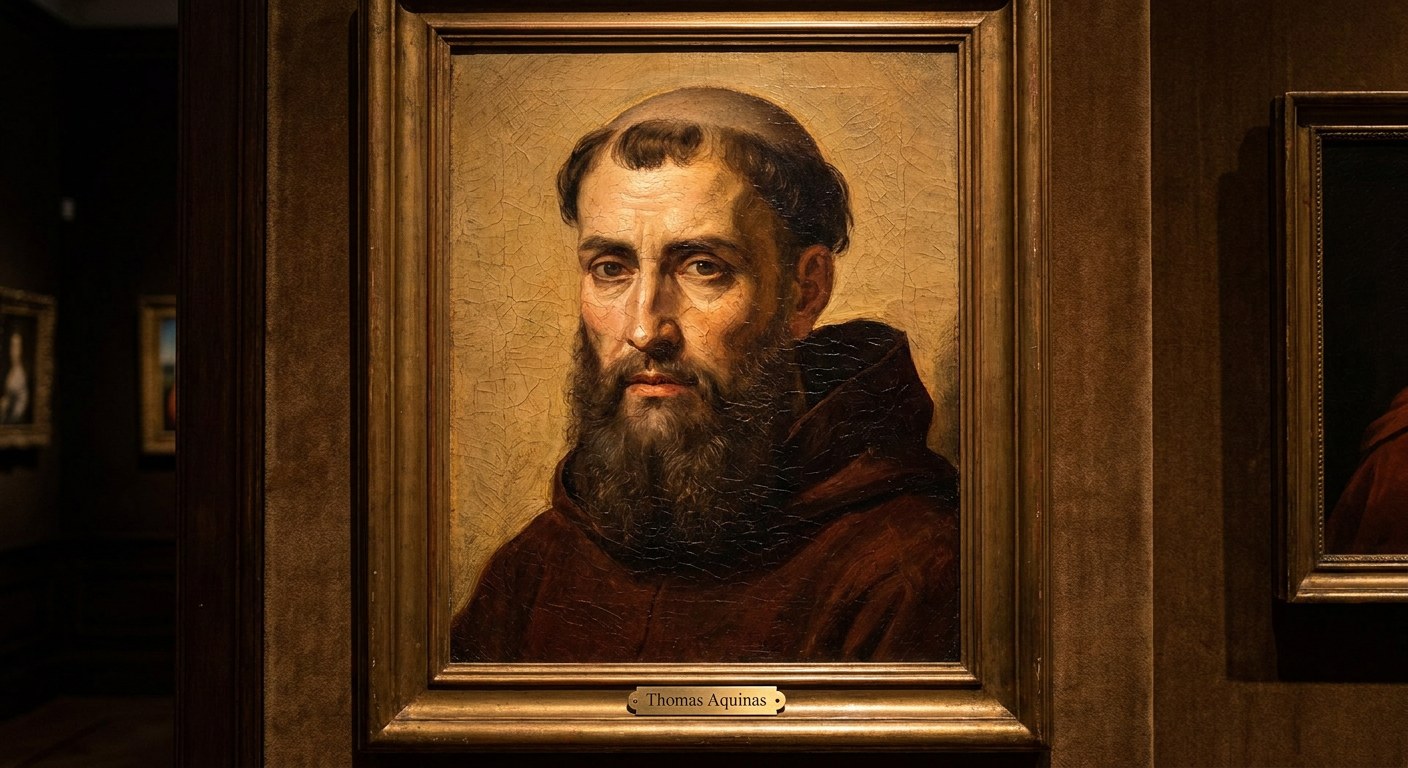
Thomas Aquinas
1225 – 1274 · Italian · Philosopher & Theologian
Recommended Audiobooks
Listen next from Marcus Alden

Life Lessons from Frederic Chopin
Marcus Alden · 54 min

Life Lessons from John Wesley
Marcus Alden · 52 min
Introduction
Thomas Aquinas was one of the most influential philosophers and Christian theologians of the Middle Ages. A Dominican friar, university teacher and prolific author, he developed a systematic account of reality, knowledge, ethics, law and theology that helped shape Western intellectual history. His writings remain central to Roman Catholic thought, but their influence extends far beyond the Church into philosophy, political theory, jurisprudence and the study of religion.
Aquinas lived during the thirteenth century, when European scholars were rediscovering major works of Aristotle through Greek, Arabic and Latin sources. Many Christian thinkers regarded this intellectual transformation with suspicion. Aristotle's writings appeared to offer a comprehensive explanation of nature that did not depend directly on Christian revelation, while some interpretations of Aristotle seemed incompatible with doctrines such as creation, providence and personal immortality.
Rather than reject the new philosophy, Aquinas sought to distinguish what reason could establish from what humanity knew through revelation. He argued that faith and reason, properly understood, could not ultimately contradict one another because both truth and the human capacity for understanding originated in God. Philosophy possessed genuine independence, yet theology completed human knowledge by addressing truths inaccessible to unaided reason.
His best-known work, the Summa Theologiae, became one of the foundational texts of Catholic education. Its discussions range from the existence and attributes of God to human psychology, moral virtues, law, politics, the person of Christ and the sacraments. Aquinas is also famous for the “Five Ways,” five concise arguments intended to show that rational reflection on change, causation, contingency, degrees of perfection and natural order leads toward recognition of God.
Aquinas was canonized in 1323 and declared a Doctor of the Church in 1567. Often called the “Angelic Doctor,” he continues to attract admirers and critics because of the breadth, precision and ambition of his thought. His work represents one of history's most sustained attempts to unite rigorous reasoning, empirical attention to the natural world and religious faith.
Quick Facts
| Category | Information |
|---|---|
| Born | c. 1225, Roccasecca, Kingdom of Sicily |
| Died | 7 March 1274, Fossanova Abbey, Papal States |
| Nationality | Italian; born in the medieval Kingdom of Sicily |
| Known For | Scholastic philosophy, the Summa Theologiae, natural law and the Five Ways |
| Occupation | Dominican friar, philosopher, theologian, teacher and writer |
| Era | High Middle Ages; Scholasticism |
Early Life and Education
Thomas was born around 1225 at Roccasecca, a castle near Aquino, roughly midway between Rome and Naples. The exact year remains uncertain, with dates from 1224 to 1226 appearing in historical discussions. He belonged to a family of the lesser nobility connected to the political world of the Kingdom of Sicily. His father, Landulf of Aquino, was a knight or military official, while his mother, Theodora, came from a noble family.
As a younger son, Thomas was apparently expected to pursue an ecclesiastical career. At about five years old, he was sent to the nearby Benedictine abbey of Monte Cassino. His family may have hoped that he would eventually become abbot there, a position carrying religious prestige and considerable political influence. At the monastery he received instruction in Latin, scripture, grammar and the basic disciplines of medieval education.
Monte Cassino occupied a vulnerable position in the conflict between Emperor Frederick II and Pope Gregory IX. Political and military disturbances eventually led Thomas to leave. Around 1239 he went to the University of Naples, an institution established by Frederick II. Naples exposed him to a broader intellectual environment than he had known at the monastery. He studied the liberal arts and encountered Aristotelian philosophy, probably under teachers such as Peter of Ireland. He also became familiar with works transmitted or interpreted by Muslim and Jewish thinkers, including Avicenna, Averroes and Maimonides.
While in Naples, Thomas met members of the Order of Preachers, commonly known as the Dominicans. Founded only a few decades earlier, the order combined poverty, study, preaching and active engagement with urban intellectual life. Its ideals attracted him more than the secure and prestigious Benedictine career envisioned by his family.
Thomas entered the Dominican Order around 1244. His decision provoked fierce opposition from his relatives, who considered membership in a mendicant order inappropriate for someone of noble birth. As the Dominicans attempted to send him northward, probably toward Paris, members of his family intercepted him. He was detained for approximately a year at family properties, though later accounts embellished this episode with dramatic stories.
According to a famous tradition, his brothers arranged for a woman to tempt him into abandoning his vocation. Thomas supposedly drove her away with a burning brand and marked a cross on the wall. The historical details cannot be independently verified, but the story became important to later portrayals of his chastity and determination. What is clear is that family pressure failed. Thomas remained committed to the Dominicans and was eventually allowed to rejoin the order.
Around 1245 he traveled to Paris, the leading center of theological study in Latin Christendom. There he studied under Albert the Great, a Dominican scholar noted for his wide-ranging engagement with Aristotle and the natural sciences. A later anecdote claims that fellow students called the quiet, heavyset Thomas the “Dumb Ox.” Albert allegedly predicted that the bellowing of this ox would one day be heard throughout the world. Whether literally true or not, the story reflects Thomas's reputation for quietness as a student and his later intellectual fame.
Thomas accompanied Albert to Cologne in 1248 and continued his philosophical and theological training there. Under Albert's guidance, he learned that careful study of pagan and non-Christian thinkers need not threaten Christian doctrine. This openness to multiple intellectual traditions became a defining feature of his mature method.
Rise to Prominence
Aquinas returned to Paris around 1252 to begin advanced theological teaching. Medieval university candidates commonly lectured on the Sentences of Peter Lombard, the standard theological textbook of the period. Thomas's commentary on the Sentences displayed his ability to organize difficult questions, identify competing arguments and formulate carefully qualified conclusions.
His academic advancement occurred amid a bitter dispute at the University of Paris. Some secular clergy opposed the growing influence of the Dominican and Franciscan mendicant orders, arguing that friars should not control university teaching positions. The controversy delayed Thomas's formal recognition as a master of theology. He nevertheless received his license and became a master around 1256, at approximately the same time as the Franciscan thinker Bonaventure.
During his first period as a master in Paris, Aquinas lectured, preached and conducted formal academic debates. Medieval disputation required a teacher to consider objections to a proposition before presenting a response and answering each objection. Aquinas adopted this structure throughout the Summa Theologiae, giving his work its characteristic rhythm: question, objections, counterstatement, reasoned answer and replies.
In 1259 he left Paris and spent the next decade working at various Dominican and papal centers in Italy, including Naples, Orvieto, Rome and Viterbo. He taught younger friars, advised church officials and wrote extensively. During this productive period he completed much of the Summa contra Gentiles, began the Summa Theologiae and composed biblical commentaries, philosophical treatises and disputed questions.
Aquinas also worked in an environment connected to the papal court. This brought him into contact with major ecclesiastical debates and with scholars such as William of Moerbeke, whose highly literal translations of Greek philosophical texts gave Latin readers improved access to Aristotle and his commentators. Aquinas's use of these translations helped him distinguish Aristotle's own positions from later interpretations attributed to him.
In 1269 Aquinas returned to Paris for a second period as a university master. This was an unusually demanding assignment. The university was embroiled in conflicts over Aristotelian philosophy, especially interpretations associated with Averroes. Some Parisian thinkers appeared to teach that there was only one intellect shared by all human beings or that philosophical conclusions might be true even when they contradicted Christian faith. Aquinas opposed such positions while also defending the legitimate use of Aristotle.
His writings from this period—including On the Unity of the Intellect against the Averroists—demonstrated his growing prominence as both a theologian and a philosopher. He debated Franciscans over questions such as the eternity of the world and the nature of divine illumination, while insisting that disagreements should be addressed through argument rather than denunciation.
In 1272 he returned to Naples to establish a Dominican center of study. By then he was among the most respected theologians in Europe, and his writings circulated widely even though his greatest work remained unfinished.
Major Achievements and Contributions
The synthesis of faith and reason
Aquinas's most celebrated achievement was his integration of Christian theology with Aristotelian philosophy. He did not simply insert Aristotle into an existing theological framework. Instead, he reworked ideas drawn from Aristotle, Augustine, Neoplatonism, Islamic philosophy, Jewish philosophy and Christian scripture into a distinctive synthesis.
For Aquinas, truths discovered by sound reasoning could not genuinely conflict with revelation. Human reason could demonstrate some truths about God, including that God exists, but doctrines such as the Trinity and Incarnation could be known only because God revealed them. Theology therefore did not abolish philosophy. Each discipline had its own principles, methods and proper scope.
Metaphysics of being
Aquinas developed an influential account of the relationship between essence and existence. The essence of a thing answers what it is; its existence answers whether it is. In created beings, essence and existence are distinct: nothing about the essence of a horse, tree or human being explains why that particular being must exist. Created things receive existence and depend upon a cause.
God, by contrast, is not one being among others. Aquinas described God as subsistent being itself—ipsum esse subsistens. In God alone, essence and existence are identical. This doctrine became central to the Thomistic understanding of creation and divine simplicity.
Aquinas also used Aristotle's distinction between act and potency. Change occurs when a potentiality is actualized: wood potentially hot becomes actually hot. This framework helped him explain change, causality and the dependence of finite beings without treating God as merely the first event in a chronological sequence.
The Five Ways
In the Summa Theologiae, Aquinas offered five brief approaches to demonstrating God's existence. They begin with features of experience: change, efficient causation, contingency, gradations of qualities and goal-directed order in nature. Each argues toward a first or sustaining principle identified as God.
The Five Ways are often described as proofs, but Aquinas did not intend them to supply a complete doctrine of God in isolation. They form the opening stage of a larger inquiry into divine attributes. They also differ from the modern caricature that “everything has a cause.” Aquinas did not argue that everything has a cause; he maintained that dependent or actualized beings require an explanatory source and that an essentially ordered causal series cannot explain itself indefinitely.
Natural law and ethics
Aquinas's moral philosophy begins with the idea that all action seeks some perceived good. Human beings ultimately desire happiness or fulfillment, but perfect happiness cannot be found in wealth, power, pleasure or honor. Complete fulfillment consists in the vision of God, although a measure of genuine happiness is possible through virtuous life in this world.
Drawing on Aristotle, Aquinas emphasized stable virtues such as prudence, justice, courage and temperance. He combined these cardinal virtues with the theological virtues of faith, hope and charity. Grace perfects rather than destroys human nature, enabling a form of union with God beyond natural human powers.
His theory of natural law became especially influential. Natural law is the rational creature's participation in the eternal law by which God orders creation. Its first principle is that good should be pursued and evil avoided. From natural human inclinations, reason identifies goods such as preserving life, forming families, seeking truth and living peacefully in society. Human laws should apply these general principles to particular communities and should serve the common good.
Later Catholic moral theology, early modern theories of rights and contemporary legal philosophy all engaged with this account. Although modern natural-law theories often differ from Aquinas, they continue to use questions he formulated about reason, human flourishing, justice and legitimate authority.
Psychology and the human person
Aquinas rejected the view that the soul is a separate person merely trapped inside a body. Following Aristotle, he described the soul as the form of the living body—the principle that makes a body a living human organism. A human being is therefore a unity of body and soul, not two complete substances accidentally joined.
At the same time, he argued that intellectual activity cannot be reduced entirely to a bodily organ. The rational soul can therefore subsist after bodily death, although it remains naturally oriented toward embodiment. Resurrection, rather than permanent disembodiment, completes the Christian destiny of the human person.
His theory of knowledge likewise begins with sensory experience. The intellect abstracts universal concepts from particular things perceived through the senses. Aquinas thus rejected the idea that ordinary human knowledge depends on a separate stock of innate concepts, while recognizing the intellect's active role in understanding.
Theology and sacramental thought
Aquinas systematically discussed the Trinity, creation, providence, angels, human action, grace, Christ and the sacraments. His explanation of the Eucharist employed the distinction between substance and accidents: the substance of bread and wine becomes the body and blood of Christ, while sensible appearances remain. This account became a standard Catholic explanation of transubstantiation.
Tradition also associates Aquinas with the liturgical office for the feast of Corpus Christi, prepared at the request of Pope Urban IV. Eucharistic hymns attributed to him include Pange Lingua, whose final stanzas form the Tantum Ergo, as well as Adoro Te Devote. Questions remain about the precise authorship history of some texts, but his influence on Catholic Eucharistic devotion is unquestionable.
Key Works / Battles / Ideas
Summa Theologiae
Aquinas began the Summa Theologiae in the 1260s as an organized introduction for students of theology. It is divided into three broad parts: God and creation; human action, virtue, law and grace; and Christ and the sacraments. Despite its enormous scale, Aquinas called it a work for beginners. It remained unfinished at his death; the later “Supplement” was assembled largely from his earlier commentary on Peter Lombard.
Summa contra Gentiles
Written mainly during the 1250s and 1260s, the Summa contra Gentiles examines truths accessible to natural reason and doctrines known through revelation. Its exact intended audience is debated. Although sometimes portrayed as a handbook for missionaries to Muslims, Jews and non-Christians, it is better understood as a systematic defense and exposition of Christian truth.
On Being and Essence
This compact early treatise explores essence, existence, matter, form and individuation. It reveals Aquinas's debt to Aristotle, Avicenna and other philosophical traditions while introducing themes that remained central to his metaphysics.
On the Unity of the Intellect against the Averroists
Aquinas wrote this polemical treatise in 1270 during the Paris controversy over interpretations of Aristotle. He opposed the thesis that all humans share a single possible intellect. Such a view, he argued, undermined individual thought, moral responsibility and personal immortality.
Biblical commentaries and disputed questions
Aquinas wrote commentaries on books including Job, Isaiah, Matthew, John and several Pauline letters. He also produced commentaries on Aristotle and large collections of disputed questions, including On Truth, On Evil, On the Soul and On the Power of God. These works frequently provide fuller arguments than the concise articles of the Summa Theologiae.
Analogy and religious language
Aquinas argued that words applied to both God and creatures are usually neither wholly univocal nor wholly equivocal. Calling God “good” does not mean exactly what calling a human action good means, but neither is the term unrelated. Language about God works analogically: created perfections reflect their divine source in limited ways.
Just war and political authority
Building upon earlier Christian thought, Aquinas identified conditions for a just war: legitimate authority, a just cause and rightful intention. His treatment was brief compared with later just-war theories, but it became foundational. He also taught that political authority is natural to human social life and should seek the common good. Tyrannical rule, by contrast, directs public power toward a ruler's private benefit.
Timeline of Key Events
| Year | Event |
|---|---|
| c. 1225 | Born at Roccasecca in the Kingdom of Sicily |
| c. 1230 | Sent to the Benedictine abbey of Monte Cassino |
| 1239 | Begins studies at the University of Naples |
| c. 1244 | Joins the Dominican Order against his family's wishes |
| 1244–1245 | Detained by relatives seeking to prevent his Dominican vocation |
| 1245 | Travels to Paris and studies under Albert the Great |
| 1248 | Accompanies Albert to Cologne |
| 1252 | Returns to Paris and begins lecturing on Peter Lombard's Sentences |
| 1256 | Becomes a master of theology at Paris |
| 1259 | Leaves Paris for teaching and service in Italy |
| c. 1259–1265 | Composes much of the Summa contra Gentiles |
| c. 1265 | Begins the Summa Theologiae |
| 1260s | Associated with the Corpus Christi liturgy and Eucharistic hymns |
| 1269 | Returns to Paris for a second period as master |
| 1270 | Writes On the Unity of the Intellect against the Averroists |
| 1272 | Moves to Naples to establish a Dominican school |
| 6 December 1273 | Experiences a profound spiritual event and ceases major writing |
| 1274 | Sets out for the Second Council of Lyon |
| 7 March 1274 | Dies at Fossanova Abbey |
| 1323 | Canonized by Pope John XXII |
| 1369 | Remains transferred to the Dominican church in Toulouse |
| 1567 | Proclaimed a Doctor of the Church by Pope Pius V |
| 1879 | Pope Leo XIII promotes Thomism in Aeterni Patris |
Personal Life and Character
As a Dominican friar, Aquinas did not marry and lived under vows of poverty, chastity and obedience. His daily existence revolved around prayer, study, teaching, preaching and communal religious life. Although he served near centers of ecclesiastical power, he never became a bishop or major church administrator.
Early biographers portrayed him as physically large, quiet, contemplative and remarkably focused. Stories describe him dictating different works to several secretaries in rapid succession. Given the quantity of material produced during a career of roughly two decades, he must have possessed extraordinary powers of memory, organization and sustained concentration.
His writings display confidence without suggesting that he considered himself intellectually self-sufficient. Aquinas regularly credited earlier authorities and engaged seriously with thinkers outside Christianity. Aristotle was “the Philosopher,” while Averroes was “the Commentator.” He also used arguments from Avicenna, Maimonides, Augustine, Pseudo-Dionysius and numerous patristic sources.
Aquinas's method was notably charitable by the standards of medieval controversy. He attempted to state objections in strong form and acknowledged partial truths even in positions he rejected. This did not make him indecisive: he could be forceful and polemical, particularly when he believed that an interpretation endangered personal immortality or moral responsibility.
Prayer and mystical experience were as important to him as logical analysis. Accounts from his canonization process describe intense devotion during Mass and extended periods of contemplation. For Aquinas, theology was not merely an academic profession. Its purpose was deeper knowledge and love of God.
Challenges and Controversies
Aquinas's career unfolded amid institutional and intellectual conflict. The first major challenge was his family's opposition to his Dominican vocation. His detention illustrates the social tensions surrounding the new mendicant orders, which rejected traditional routes to ecclesiastical status and property.
At Paris, he confronted hostility toward Dominican and Franciscan teachers. Secular masters accused the friars of violating university privileges and competing unfairly for students and positions. Aquinas defended the legitimacy of religious orders devoted to teaching and preaching.
His use of Aristotle was equally controversial. Some theologians feared that Aristotelian natural philosophy encouraged determinism, denied creation or undermined the soul's immortality. Radical interpretations associated with Latin Averroism intensified these concerns. Aquinas tried to steer between rejecting Aristotle and accepting every Aristotelian claim.
In 1277, three years after Aquinas's death, Bishop Étienne Tempier of Paris condemned 219 propositions. Some propositions touched ideas taught by Aquinas or his followers, especially claims about individuation, angelic nature and the limits of divine power. The condemnation did not declare Aquinas a heretic, and scholars debate exactly how many censured propositions were genuinely his. Nevertheless, the event shows that his later authority was not immediate or uncontested.
Some of his conclusions remain controversial today. Using Aristotelian embryology, Aquinas appears to have accepted delayed rational ensoulment, although he still regarded deliberate abortion as gravely wrong. He also denied the doctrine later defined as the Immaculate Conception, while affirming Mary's complete sanctification. These positions demonstrate that later Catholic teaching did not simply reproduce every conclusion he reached.
His discussions of heresy, non-Christian communities, gender and social hierarchy reflect medieval assumptions that modern readers often reject. Aquinas defended coercive penalties for obstinate heresy under the legal and religious conditions of Christendom. He repeated some inherited restrictions concerning Jews, although he also opposed forced baptism of Jewish children against their parents' wishes. Historical interpretation requires neither concealing these views nor isolating them from their thirteenth-century context.
Philosophers also dispute whether his arguments succeed. Critics challenge the Five Ways, divine simplicity, natural-law reasoning and his account of mind and body. Others argue that modern objections sometimes target simplified versions rather than Aquinas's actual claims. This continuing disagreement is itself evidence of his intellectual importance.
Death and Immediate Aftermath
On 6 December 1273, while celebrating Mass in Naples, Aquinas underwent an intense spiritual experience. Afterward he largely stopped writing, leaving the Summa Theologiae unfinished. When his secretary and friend Reginald of Piperno urged him to continue, Thomas reportedly replied that he could not because everything he had written seemed like straw compared with what had been revealed to him.
The statement is sometimes interpreted as a rejection of scholarship, but that conclusion is unlikely. Aquinas had devoted his life to teaching and writing, and “straw” may have referred to the unavoidable inadequacy of human language before divine reality. Illness, exhaustion or a neurological episode has also been proposed, though no diagnosis can be established.
In early 1274 Pope Gregory X summoned him to the Second Council of Lyon. Aquinas set out from Naples but became seriously ill during the journey, perhaps after striking his head on a tree branch. He was taken to the Cistercian abbey of Fossanova. There he reportedly provided the monks with a commentary on the Song of Songs and received the sacraments before dying on 7 March 1274. He was about forty-nine years old.
His death was widely mourned in Dominican and university circles. Reginald and other disciples preserved and organized his writings. Because the Summa ended during its discussion of penance, followers later compiled a Supplement from his earlier works to complete its treatment of the sacraments and last things.
Aquinas's reputation grew despite early controversies. Pope John XXII canonized him at Avignon on 18 July 1323. According to a famous report, when objections were raised that Thomas had performed too few miracles, the pope emphasized that every theological article he wrote was itself a miracle.
Legacy and Influence Today
Aquinas became the preeminent theologian of the Dominican Order and eventually one of the principal intellectual authorities of Roman Catholicism. He received the title Doctor Angelicus, the Angelic Doctor. In 1567 Pope Pius V declared him a Doctor of the Church, placing him among the select teachers whose writings possess exceptional importance for Catholic doctrine.
The Council of Trent, held between 1545 and 1563, relied extensively on scholastic categories associated with Aquinas, particularly in discussions of the sacraments and justification. A later tradition claimed that the Summa Theologiae was placed on the council altar alongside scripture and papal decrees. The literal accuracy of that story is uncertain, but it captures his standing in early modern Catholic thought.
In the nineteenth century, Pope Leo XIII's encyclical Aeterni Patris encouraged a revival of Christian philosophy grounded in Aquinas. This neo-Thomist movement shaped Catholic seminaries, universities and social thought well into the twentieth century. Thinkers influenced by Thomism included Jacques Maritain, Étienne Gilson, Josef Pieper and Bernard Lonergan, although each interpreted Aquinas differently.
His political and legal influence extends beyond explicitly religious institutions. Natural-law theorists continue to debate his account of objective moral goods, practical reason and the common good. His ideas inform arguments about human rights, constitutional government, bioethics, war, economic justice and the relationship between law and morality.
Analytic philosophers have renewed interest in his philosophy of action, metaphysics and mind. His distinction between essence and existence, account of causation and understanding of intentional action are discussed in contemporary philosophical language. Scholars in the philosophy of religion continue to reconstruct and criticize his arguments for God's existence and divine attributes.
Aquinas also remains important in debates over science and religion. He did not treat scripture as a substitute for natural investigation. Because truth could not contradict truth, reliable discoveries about nature required interpretation rather than denial. His principle that divine grace perfects nature presupposes that the natural world possesses its own intelligibility and integrity.
The Second Vatican Council did not impose a single philosophical school, but it continued to commend Aquinas as a model for theological inquiry. His liturgical commemoration in the Roman Catholic Church is celebrated on 28 January, the date chosen after his original feast day of 7 March commonly fell during Lent.
Today, Aquinas is studied by Catholics, Protestants, Orthodox Christians, Jews, Muslims, atheists and secular historians. Some approach him as a saint, others as a philosopher, and still others as a representative of medieval institutions requiring critical examination. His lasting significance lies not in providing universally accepted answers, but in demonstrating how a thinker can bring theology, metaphysics, ethics, psychology, politics and natural philosophy into sustained conversation.
Famous Quotes
“Grace does not destroy nature, but perfects it.”
— Summa Theologiae, I, question 1, article 8, reply to objection 2
“It is better to illuminate than merely to shine, to deliver to others contemplated truths than merely to contemplate.”
— Summa Theologiae, II–II, question 188, article 6
“The study of philosophy is not about knowing what individuals thought, but about how the truth of things stands.”
— Commentary on Aristotle's On the Heavens, Book I, lecture 22
“Whatever is received is received according to the mode of the receiver.”
— Summa Theologiae, I, question 75, article 5; a principle used repeatedly in Aquinas's works
“Good is to be done and pursued, and evil is to be avoided.”
— Summa Theologiae, I–II, question 94, article 2
“Law is an ordinance of reason for the common good, made by him who has care of the community, and promulgated.”
— Summa Theologiae, I–II, question 90, article 4
“We must love them both: those whose opinions we follow, and those whose opinions we reject; for both have labored in the search for truth and both have helped us in finding it.”
— Commentary on Aristotle's Metaphysics, Book XII, lecture 9
“Nothing is in the intellect that was not first in the senses.”
— Disputed Questions on Truth, question 2, article 3, objection 19; a scholastic principle accepted with qualification by Aquinas
Frequently Asked Questions
Who was Thomas Aquinas?
Thomas Aquinas was a thirteenth-century Italian Dominican friar, philosopher and theologian. He is best known for combining Christian theology with Aristotelian philosophy and for writing the Summa Theologiae.
When and where was Thomas Aquinas born?
He was born around 1225 at Roccasecca, near Aquino, in the Kingdom of Sicily. The territory is now part of Italy. His exact birth date is unknown.
What are Aquinas's Five Ways?
The Five Ways are arguments from change, efficient causation, contingency, degrees of perfection and natural order. Aquinas presented them as ways of demonstrating that observable reality depends upon a first and ultimate source called God.
Did Aquinas believe that faith opposed reason?
No. He distinguished truths accessible to natural reason from mysteries known through revelation, but held that genuine faith and correct reasoning could never ultimately contradict each other because all truth has one source.
Why is the Summa Theologiae important?
The Summa systematically examines God, creation, human nature, ethics, law, virtue, Christ and the sacraments. Its question-and-answer structure became a model of scholastic reasoning and profoundly influenced Catholic education and Western philosophy.
Why did Aquinas stop writing?
After a spiritual experience during Mass on 6 December 1273, Aquinas said that he could no longer continue because his writings seemed like straw compared with what he had experienced. The precise nature of the event remains unknown.
Was Thomas Aquinas immediately accepted by the Church?
No. His ideas faced criticism during and after his lifetime, and some propositions related to his teaching were implicated in the Paris condemnation of 1277. His authority increased over time, leading to his canonization in 1323 and recognition as a Doctor of the Church in 1567.
Is Thomism still influential?
Yes. Thomism remains important in Catholic theology, natural-law ethics, jurisprudence, metaphysics and philosophy of religion. Contemporary Thomists include several distinct schools that disagree about how Aquinas should be interpreted and applied.
Lessons We Can Learn
-
Reason and faith need not be enemies. Aquinas showed that intellectual investigation and religious commitment can challenge, clarify and enrich one another when neither is reduced to slogans.
-
Engage opposing arguments at their strongest. His disputed-question method began with serious objections rather than caricatures. Productive disagreement requires understanding why intelligent people hold different views.
-
Learn across cultural and religious boundaries. Aquinas drew from Greek, Muslim, Jewish and Christian thinkers. His achievements depended upon translations, inherited debates and the willingness to recognize truth outside his own tradition.
-
Knowledge should serve the common good. For Aquinas, study was not merely private achievement. Teaching, law and political authority were justified when they helped people and communities flourish.
-
Intellectual humility matters. Despite producing an extraordinary body of work, Aquinas recognized the limits of human concepts before ultimate reality. Rigorous learning can deepen awareness of what remains unknown.
Further Reading
- Jean-Pierre Torrell, Saint Thomas Aquinas, Volume 1: The Person and His Work. The Catholic University of America Press, 1996.
- G. K. Chesterton, Saint Thomas Aquinas: The Dumb Ox. First published in 1933; an influential and lively literary portrait.
- Brian Davies, The Thought of Thomas Aquinas. Oxford University Press, 1992.
- Eleonore Stump, Aquinas. Routledge, 2003.
- Denys Turner, Thomas Aquinas: A Portrait. Yale University Press, 2013.
Watch and Learn
Thomas Aquinas · The School of Life