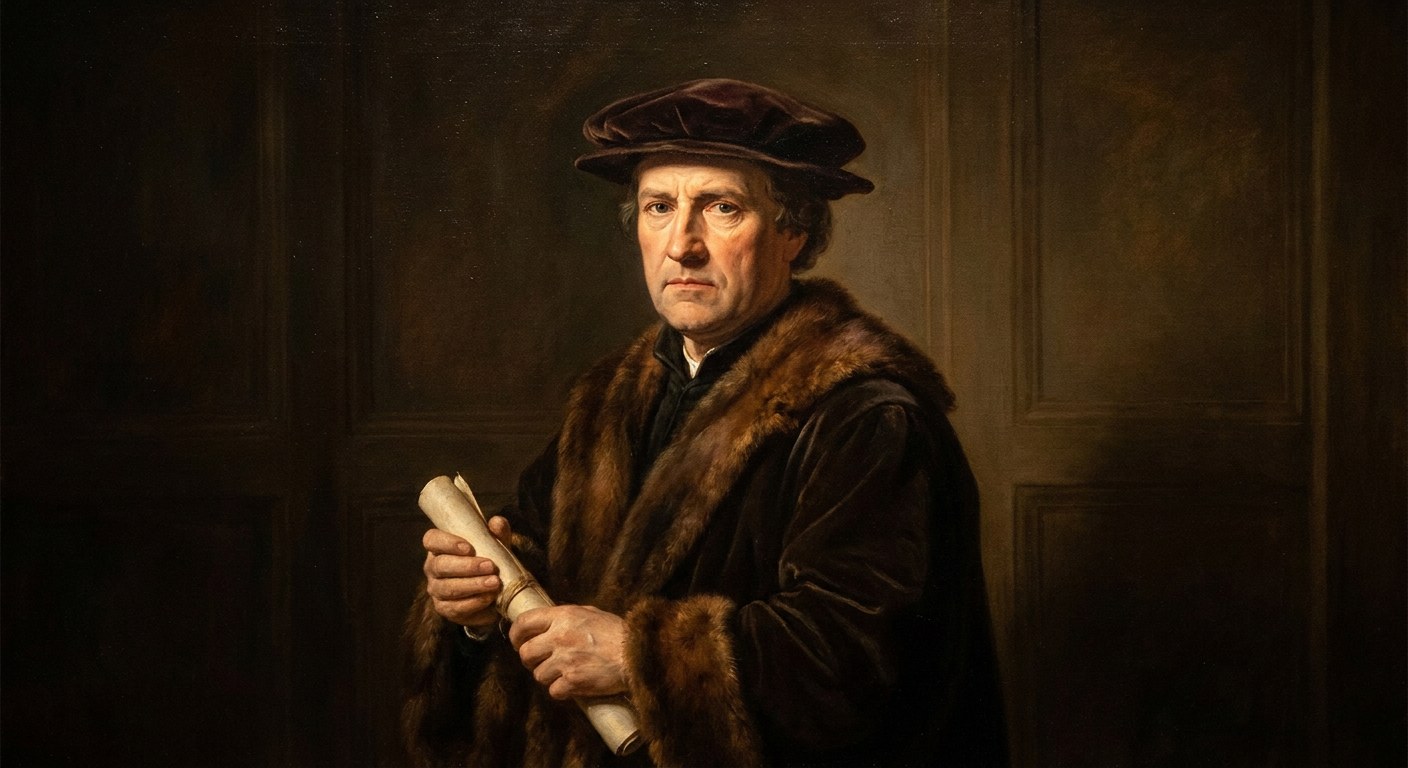
Thomas Cromwell
1485 – 1540 · English · Statesman & Lawyer
Recommended Audiobooks
Listen next from Marcus Alden

Life Lessons from Frederic Chopin
Marcus Alden · 54 min

Life Lessons from John Wesley
Marcus Alden · 52 min
Introduction
Thomas Cromwell, 1st Earl of Essex (c. 1485–1540), was one of the most consequential—and controversial—statesmen of Tudor England. Rising from modest origins in Putney to become the chief minister of King Henry VIII, Cromwell helped transform the English monarchy, Parliament, Church, and machinery of government. His career was inseparable from the upheavals of the English Reformation: the annulment of Henry VIII’s marriage to Catherine of Aragon, the repudiation of papal authority, the royal supremacy over the Church of England, and the dissolution of the monasteries.
Unlike many leading figures at the Tudor court, Cromwell did not come from an aristocratic family. He acquired influence through intelligence, legal expertise, commercial experience, hard work, and an exceptional ability to turn royal wishes into legislation and administrative action. His years abroad exposed him to European trade, diplomacy, Renaissance culture, and new religious ideas. In England he served Cardinal Thomas Wolsey before transferring his loyalty and talents to Henry VIII.
Cromwell was not solely an executor of royal commands. He possessed a distinctive vision of a more centralized, legally articulated state governed through statutes, councils, courts, records, and officials. Under his direction, Parliament became a crucial instrument of the Tudor revolution in government and religion. He promoted the English Bible, authorized parish registers, supervised surveys of ecclesiastical wealth, and reorganized the management of royal revenue.
These achievements came at enormous human and cultural cost. Cromwell helped construct a system that punished opposition to the royal supremacy as treason. He participated in the destruction of Anne Boleyn, oversaw the suppression of monasteries and religious houses, and responded severely to rebellion. His political methods made him both indispensable and widely hated.
His fall was as dramatic as his ascent. The failure of Henry VIII’s marriage to Anne of Cleves weakened Cromwell at the moment when conservative courtiers and religious opponents were moving against him. Arrested in June 1540, he was condemned by an act of attainder without an ordinary public trial and executed on Tower Hill on 28 July 1540.
Thomas Cromwell remains difficult to categorize. To some, he was a ruthless opportunist who enriched the Crown and himself through religious destruction. To others, he was an innovative administrator, a patron of reform, and a self-made political genius. Both interpretations reflect important aspects of a man whose work permanently altered England.
Quick Facts
| Category | Details |
|---|---|
| Full name | Thomas Cromwell |
| Title | 1st Earl of Essex |
| Born | c. 1485 |
| Birthplace | Putney, Surrey, England |
| Died | 28 July 1540 |
| Place of death | Tower Hill, London, England |
| Cause of death | Execution by beheading |
| Father | Walter Cromwell |
| Mother | Traditionally identified as Katherine Meverell, though the evidence is uncertain |
| Spouse | Elizabeth Wyckes |
| Known children | Gregory, Anne, and Grace Cromwell |
| Principal patron | Cardinal Thomas Wolsey |
| Monarch served | Henry VIII |
| Major offices | Master of the King’s Jewels, Chancellor of the Exchequer, Principal Secretary, Master of the Rolls, Vicegerent in Spirituals, Lord Privy Seal, Lord Great Chamberlain |
| Highest peerage title | Earl of Essex, created 17 April 1540 |
| Best known for | Royal supremacy, Reformation legislation, dissolution of the monasteries, and governmental reform |
| Arrested | 10 June 1540 |
| Condemned | By act of attainder, June 1540 |
| Executed | 28 July 1540 |
| Burial | Chapel Royal of St Peter ad Vincula, Tower of London |
Early Life & Background
Thomas Cromwell was born around 1485 in Putney, then a village in Surrey on the south bank of the River Thames. His father, Walter Cromwell, was a tradesman associated with brewing, blacksmithing, fulling cloth, and property dealings. Walter also held minor local offices but appeared repeatedly before local courts for such matters as violating brewing regulations and encroaching on common land. The family was respectable enough to participate in local economic life, but it belonged far below the aristocratic world that Thomas would later enter.
Stories of Cromwell’s youth are difficult to separate from later legend. George Cavendish, who served Cardinal Wolsey and disliked Cromwell, portrayed him as a wild young man who fled an abusive or disorderly home. Cromwell himself reportedly acknowledged having been a “ruffian” in his youth. Such descriptions may contain truth, but they were also shaped by the moral conventions and political hostility of Tudor biography.
As a young man, Cromwell left England and spent time on the European continent. Later accounts placed him as a soldier in French service during the Italian Wars, possibly at the Battle of the Garigliano in 1503. He was also traditionally associated with the Battle of Novara, although the chronology and details of his military experience remain uncertain.
More securely, Cromwell developed connections with the Italian banking house of Frescobaldi and spent time in Florence. He also worked in the commercially sophisticated Low Countries, probably in Antwerp, where he acquired knowledge of trade, credit, bookkeeping, languages, and international networks. His continental experience distinguished him from many English lawyers and courtiers. He learned Italian and French, understood at least some Latin, and became familiar with the methods of European merchants and financiers.
By about 1512 Cromwell had returned to England. He became involved in legal and commercial work and undertook business for merchants operating between England, the Low Countries, and Italy. In 1514 he traveled to Rome in connection with a campaign by the Guild of Our Lady at St Botolph’s Church in Boston, Lincolnshire, to secure or renew papal indulgences. His success demonstrated the combination of negotiation, legal understanding, and personal adaptability that would characterize his career.
Cromwell married Elizabeth Wyckes, probably around 1515. She was the widow of Thomas Williams, a yeoman of the Guard, and the daughter of the cloth merchant Henry Wyckes. The marriage connected Cromwell to London’s mercantile world. He established a household in the city and increasingly practiced as a lawyer and business agent.
He entered Gray’s Inn and became skilled in land law, conveyancing, litigation, and parliamentary procedure. These were not merely technical accomplishments. In Tudor government, where political power was exercised through grants, statutes, property transfers, and legal instruments, mastery of such mechanisms was a path to influence.
Rise to Prominence
Cromwell’s decisive career opportunity came through the service of Cardinal Thomas Wolsey, Henry VIII’s lord chancellor and chief minister. He was acting for Wolsey by the early 1520s and became one of the cardinal’s trusted legal and administrative agents.
Wolsey planned to establish educational foundations at Oxford and Ipswich. To finance them, he obtained papal permission to dissolve a number of small monasteries considered financially weak or poorly governed. Cromwell handled much of the legal and financial work. The experience gave him detailed knowledge of ecclesiastical property and demonstrated how religious houses could be dissolved through coordinated legal and administrative procedures. A decade later, he would apply such methods on a vastly larger scale.
Cromwell sat in the Parliament of 1523, although the constituency he represented is uncertain. He displayed a sophisticated understanding of taxation and the relationship between the Crown and the Commons. His parliamentary knowledge later became central to Henry VIII’s campaign against papal jurisdiction.
Wolsey fell from power in 1529 after failing to secure the annulment of Henry’s marriage to Catherine of Aragon. Cromwell might easily have been ruined with his patron. Instead, he defended Wolsey’s interests, entered the Parliament summoned in 1529, and attracted royal notice. His ability to survive without immediately repudiating Wolsey revealed both courage and political skill.
By 1531 Cromwell had entered the king’s council. In 1532 he became Master of the King’s Jewels, and in 1533 he was appointed Chancellor of the Exchequer. He became Principal Secretary and Master of the Rolls in 1534. These offices gave him influence over royal correspondence, finance, legal administration, patronage, and parliamentary business.
The central problem facing Henry VIII was that the pope would not declare his marriage to Catherine of Aragon invalid. Earlier efforts had focused on obtaining a favorable decision from Rome. Cromwell helped advance a different solution: England could deny the pope’s jurisdiction and declare that the king possessed supreme authority within his own realm.
This strategy was implemented through Parliament. The Act in Restraint of Appeals of 1533 declared that “this realm of England is an empire” and prohibited appeals from English ecclesiastical courts to Rome. Archbishop Thomas Cranmer could therefore hear the royal marriage case in England. Cranmer declared Henry’s marriage to Catherine invalid, and Anne Boleyn was recognized as queen.
Cromwell’s influence continued to grow. The Act of Supremacy of 1534 recognized Henry VIII as “Supreme Head on earth of the Church of England.” The Treasons Act of the same year made certain forms of opposition to the royal supremacy punishable as treason. Parliamentary statutes, royal proclamations, clerical submissions, and administrative enforcement together completed England’s institutional break with papal authority.
In January 1535 Cromwell was appointed the king’s Vicegerent in Spirituals. This extraordinary office placed a layman above the bishops in the administration of the Church under the monarch. By 1536 he was Lord Privy Seal. He had become Henry VIII’s leading minister.
Major Achievements
Cromwell’s greatest achievement was his role in giving the English Reformation a durable legal and administrative structure. Earlier English kings had quarreled with popes, but Cromwell helped transform a royal marital dispute into a constitutional redefinition of authority. Through statutes enacted by the Crown in Parliament, England rejected papal jurisdiction and placed the national Church under royal control.
He also strengthened the importance of Parliament. Cromwell did not create parliamentary government in the modern democratic sense, nor did he intend to restrict royal power. Instead, he used Parliament to express and reinforce that power. Major religious and constitutional changes were embodied in statutes, giving them greater authority and permanence than isolated royal commands.
From 1535 Cromwell organized a nationwide visitation of monasteries and religious institutions. Commissioners collected evidence concerning finances, discipline, relics, pilgrimages, and alleged misconduct. At the same time, the Valor Ecclesiasticus produced a comprehensive valuation of ecclesiastical income. The scale of the inquiry reflected Cromwell’s preference for government based on written information.
The Suppression of Religious Houses Act of 1536 dissolved monasteries with annual incomes below £200, subject to royal discretion. A second act in 1539 confirmed the surrender and dissolution of the remaining houses. Hundreds of monasteries, nunneries, friaries, and priories disappeared. Their lands, buildings, valuables, and revenues passed to the Crown, although much property was subsequently sold or granted to nobles, courtiers, officials, and local landowners.
Cromwell helped establish new financial institutions to manage the resulting wealth, notably the Court of Augmentations in 1536. Other specialized courts and administrative bodies dealt with first fruits and tenths, wards, and royal lands. Historians have debated whether this amounted to a “revolution in government,” but there is broad agreement that Cromwell encouraged more bureaucratic, departmental, and record-based forms of administration.
He was also involved in the Laws in Wales Acts of 1535 and 1542, the first passed during his ascendancy. These measures integrated Wales more fully into the English legal and administrative system, divided it into counties, extended English law, and provided parliamentary representation. The acts advanced centralization, though they also imposed English institutions and language at the expense of distinct Welsh legal traditions.
Cromwell promoted the circulation of Scripture in English. He supported Miles Coverdale’s English Bible and worked with Thomas Cranmer to make an authorized English Bible available. In 1538 royal injunctions required every parish church to obtain a large English Bible. The Great Bible, first published in 1539, was therefore sometimes called “Cromwell’s Bible,” although its production involved Coverdale, Cranmer, printers, patrons, and royal authorization.
His 1538 injunctions also ordered parishes to keep registers of baptisms, marriages, and burials. These records became invaluable to local administration and, centuries later, to historians and genealogists.
Cromwell was an extensive patron. He advanced lawyers, administrators, diplomats, artists, scholars, evangelical reformers, relatives, and household servants. The German-born artist Hans Holbein the Younger benefited from the courtly environment Cromwell helped sustain and produced the famous portrait showing the minister seated at a table, surrounded by documents and symbols of office.
Defining Moments
One defining moment was Cromwell’s survival after Wolsey’s fall in 1529. Rather than disappearing with his patron, he used Parliament, legal argument, and personal access to make himself useful to the king. This marked the transformation of Cromwell from a minister’s servant into an independent political figure.
The passage of the Act in Restraint of Appeals in 1533 was another turning point. Its claim that England was an “empire” provided the legal foundation for handling the king’s marriage within England. It also articulated a far-reaching theory: no foreign authority, including the pope, possessed jurisdiction superior to that of the English Crown.
The executions of opponents of the royal supremacy revealed the coercive side of the new order. In 1535 the Carthusian priors John Houghton, Robert Lawrence, and Augustine Webster were executed after refusing to accept the supremacy. Bishop John Fisher and Sir Thomas More were also beheaded. Cromwell participated in the governmental process that investigated, prosecuted, and eliminated such opposition. His admirers cannot separate his administrative achievements from this machinery of repression.
Cromwell’s role in the fall of Anne Boleyn in 1536 remains one of the most debated episodes of his career. His relationship with Anne had deteriorated over policy, patronage, foreign alliances, and the distribution of monastic wealth. When Henry VIII turned against the queen, Cromwell organized the investigation that resulted in accusations of adultery, incest, and conspiracy. Anne, her brother George Boleyn, and four other men were executed. The evidence against them is widely regarded as deeply unreliable, and Cromwell’s management of the case has permanently damaged his reputation.
Later in 1536, the dissolution program and other grievances helped provoke the Pilgrimage of Grace, a vast uprising in northern England. Rebels demanded the restoration of religious houses, the removal of certain royal counselors—especially Cromwell—and changes in royal policy. The government initially negotiated, but after renewed unrest the following year, leading participants, including Robert Aske, were executed.
Cromwell reached the height of his power in the late 1530s. He was made Baron Cromwell in 1536, appointed a Knight of the Garter in 1537, and created Earl of Essex in April 1540. Yet these honors concealed his vulnerability. Henry VIII’s religious policy remained inconsistent, and Cromwell’s evangelical sympathies alarmed conservatives such as Thomas Howard, 3rd Duke of Norfolk, and Bishop Stephen Gardiner.
His last major diplomatic project was the king’s marriage to Anne of Cleves. Cromwell favored a marital alliance with a German principality linked to Protestant powers. Hans Holbein painted Anne’s portrait, and the marriage took place on 6 January 1540. Henry disliked his new wife and soon insisted that the union be annulled.
Although Cromwell managed the annulment process, the failed marriage gave his enemies an opportunity. On 10 June 1540 he was arrested during a council meeting and taken to the Tower of London. He was accused of treason, corruption, protecting heretics, and exceeding his authority. An act of attainder condemned him without a conventional trial. The king ignored his pleas for mercy.
Timeline
| Year | Event |
|---|---|
| c. 1485 | Thomas Cromwell is born in Putney, Surrey. |
| c. 1500s | Travels on the European continent; traditionally associated with military service in Italy. |
| c. 1508–1512 | Works in Italian and Low Countries commercial networks, including connections with the Frescobaldi family. |
| c. 1512 | Returns to England and develops a legal and mercantile career. |
| 1514 | Travels to Rome on behalf of the Guild of Our Lady at Boston, Lincolnshire. |
| c. 1515 | Marries Elizabeth Wyckes. |
| 1520s | Enters the service of Cardinal Thomas Wolsey. |
| 1523 | Sits in Parliament; his constituency is uncertain. |
| 1524–1528 | Helps dissolve small monasteries to finance Wolsey’s educational foundations. |
| 1529 | Wolsey falls; Cromwell enters the Reformation Parliament and begins his rise in royal service. |
| 1531 | Becomes a member of Henry VIII’s council. |
| 1532 | Appointed Master of the King’s Jewels. |
| 1533 | Becomes Chancellor of the Exchequer; Act in Restraint of Appeals ends appeals to Rome. |
| 1534 | Becomes Principal Secretary and Master of the Rolls; Act of Supremacy recognizes Henry as head of the English Church. |
| 1535 | Appointed Vicegerent in Spirituals; monastic visitations and the Valor Ecclesiasticus proceed. |
| 1536 | Smaller monasteries are suppressed; Anne Boleyn is executed; Cromwell becomes Lord Privy Seal and Baron Cromwell. |
| 1536–1537 | Pilgrimage of Grace challenges the government’s religious policies. |
| 1537 | Cromwell is admitted to the Order of the Garter; his son Gregory marries Elizabeth Seymour. |
| 1538 | Injunctions require parish registers and English Bibles in churches. |
| 1539 | Parliament confirms the dissolution of the larger monasteries; the Great Bible is published. |
| 1540 | Henry VIII marries Anne of Cleves on 6 January. |
| 17 April 1540 | Cromwell is created Earl of Essex and appointed Lord Great Chamberlain. |
| 10 June 1540 | Arrested at a meeting of the royal council. |
| June 1540 | Condemned through an act of attainder. |
| 28 July 1540 | Executed on Tower Hill; Henry VIII marries Catherine Howard the same day. |
Personal Life
Cromwell married Elizabeth Wyckes, a merchant’s daughter and widow, around 1515. Their known children were Gregory, Anne, and Grace. Elizabeth died in 1529, probably during an outbreak of sweating sickness. The daughters also died young, apparently around the same period, leaving Gregory as Cromwell’s surviving legitimate heir.
Little direct evidence survives concerning Cromwell’s emotional life, but his household papers reveal a man embedded in extensive family, patronage, and business networks. He supported relatives, dependents, servants, scholars, and young men seeking advancement. His household became both a domestic establishment and a training ground for administrators.
In 1537 Gregory Cromwell married Elizabeth Seymour, sister of Queen Jane Seymour. The marriage connected the Cromwell family to the king’s third wife and to the increasingly influential Seymour family. After Thomas Cromwell’s execution, Gregory was eventually created Baron Cromwell in his own right in December 1540, suggesting that Henry VIII did not intend to destroy the entire family.
Cromwell’s nephew Richard Williams adopted the surname Cromwell and became a prosperous courtier and landowner. Richard’s descendants included Oliver Cromwell, the seventeenth-century soldier and lord protector. Thomas Cromwell was therefore a collateral ancestor of one of the central figures of the English Civil Wars.
Cromwell accumulated considerable wealth and property, including a major London residence at Austin Friars. He spent lavishly on construction, hospitality, clothing, gifts, and patronage. His fortune reflected royal favor and officeholding but also contributed to accusations that he had exploited political power for personal enrichment.
Beliefs & Philosophy
Cromwell’s private religious convictions cannot be reconstructed with complete certainty. He was not a systematic theologian, and his conduct was shaped by service to a monarch whose own beliefs remained doctrinally conservative. Nevertheless, Cromwell clearly favored important elements of evangelical reform.
He supported vernacular Scripture, cultivated contacts with English reformers, and protected some individuals suspected of religious innovation. He opposed claims of papal jurisdiction and encouraged attacks on allegedly superstitious shrines, relics, pilgrimages, and images. The destruction of the shrine of Thomas Becket at Canterbury in 1538 symbolized the government’s assault on religious traditions considered incompatible with royal supremacy.
At the same time, Cromwell did not simply advocate unlimited Protestant reform. He enforced Henry VIII’s policies even when they did not fully match evangelical hopes. The king retained belief in many traditional doctrines, and the Six Articles Act of 1539 reaffirmed teachings including transubstantiation and clerical celibacy. Cromwell remained in office despite this conservative reaction.
His political philosophy emphasized the sovereignty of the Crown, the force of statute, and the duty of subjects to obey legally constituted royal authority. He believed government should collect information, preserve records, supervise institutions, and act through trained officials. His methods were practical rather than abstract, but they contributed to a stronger and more centralized state.
Cromwell also appears to have valued education, literacy, and merit. His own ascent demonstrated that ability and service could elevate a man of comparatively humble birth. Yet he did not seek social equality. He pursued noble status, accumulated land, arranged an advantageous marriage for his son, and operated within the hierarchies of Tudor society.
Challenges & Controversies
Cromwell’s reputation is dominated by the tension between administrative innovation and political brutality. He made government more effective, but effectiveness also enabled persecution, confiscation, and repression.
The dissolution of the monasteries was his most socially and culturally disruptive policy. Some religious houses suffered from debt, weak discipline, or declining membership, but official reports often exaggerated scandal to justify suppression. Monasteries provided worship, education, hospitality, employment, medical care, and charitable relief. Their destruction displaced monks and nuns, removed ancient institutions, and led to the loss of libraries, artworks, shrines, and buildings.
The Crown gained immense property but did not retain all of it. Much monastic land was sold to finance government and war or granted to politically useful subjects. This redistribution strengthened a class of landowners with a material interest in the Reformation settlement.
Cromwell’s role in treason prosecutions is equally controversial. The legislation surrounding royal supremacy broadened the practical reach of political crime. The executions of More, Fisher, Carthusian monks, and others demonstrated that conscientious religious opposition could be treated as an attack on the state.
The case against Anne Boleyn is especially troubling. Cromwell later indicated that he had taken a principal role in the investigation. The charges were assembled rapidly, and several alleged offenses were chronologically or geographically implausible. Whether he believed some accusations, invented them, or shaped evidence to satisfy the king remains disputed. His conduct nevertheless shows his willingness to use judicial forms for political ends.
His personal wealth and patronage also attracted criticism. Like other Tudor ministers, he accepted gifts and used office to benefit clients and relatives. Some accusations against him were politically motivated, but his position gave him exceptional opportunities to acquire property.
Finally, Cromwell misjudged the security of royal favor. He was highly skilled at identifying and implementing Henry’s objectives, but he could not control the king’s emotions, marriages, or doctrinal preferences. His rapid fall demonstrated that Tudor ministers remained servants of a personal monarchy. Administrative brilliance could not protect a counselor once Henry decided that he had failed.
Famous Quotes
The wording of Cromwell’s remarks survives through letters, chronicles, and reports, so some quotations reflect contemporary transcription rather than a verbatim record.
“Most gracious Prince, I cry for mercy, mercy, mercy.”
—Postscript to Cromwell’s final appeal to Henry VIII from the Tower of London, 1540.
“Written at the Tower this Wednesday, the last of June, with the heavy heart and trembling hand of your Highness’ most heavy and most miserable prisoner and poor slave.”
—Conclusion of Cromwell’s letter to Henry VIII after his arrest.
“I am come hither to die, and not to purge myself, as may happen, in this manner.”
—Reported opening of Cromwell’s scaffold speech, 28 July 1540.
“I die in the Catholic faith, not doubting in any article of my faith, no nor doubting in any sacrament of the Church.”
—Reported by the chronicler Edward Hall as part of Cromwell’s scaffold speech. “Catholic” here could mean adherence to the universal Christian faith and should not automatically be read as a repudiation of reform.
“He that will live in a court must needs be deaf and blind.”
—Traditionally attributed to Cromwell by George Cavendish, reflecting the dangers of service in Henry VIII’s court.
Legacy & Influence
Cromwell’s institutional legacy survived his execution. England did not return to papal obedience under Henry VIII, and the royal supremacy remained a defining feature of the Tudor state. Although Mary I temporarily restored communion with Rome, the supremacy and a Protestant religious settlement returned under Elizabeth I.
His use of Parliament had long-term consequences. The Reformation Parliament demonstrated that fundamental changes in religion, property, and jurisdiction could be enacted through statute. Cromwell intended legislation to strengthen the monarchy, but the enlarged authority of statute later supplied arguments that law and Parliament possessed a central role in governing the realm.
The administrative bodies created or developed during his ascendancy helped the Crown manage unprecedented quantities of land and revenue. Historians once described this as a “Tudor revolution in government,” particularly through the work of G. R. Elton. Later scholars have qualified that thesis, emphasizing continuity, collaboration, household government, and the role of Henry VIII himself. Even so, Cromwell’s commitment to records, councils, specialized courts, and statutory authority remains unmistakable.
Religiously, he helped make English Scripture a public institution. The requirement that churches display an English Bible encouraged lay engagement with biblical texts and strengthened reforming culture. Parish registers initiated under his authority became a lasting feature of English local life.
His cultural legacy is more ambiguous. Monastic dissolution transferred wealth, transformed landscapes, and created new opportunities for landowners, but it also destroyed institutions that had shaped English society for centuries. Ruined abbeys across England remain visible monuments to the policies he administered.
Cromwell’s posthumous reputation has repeatedly changed. Catholic writers often portrayed him as a heretical destroyer, while Protestant traditions praised his attacks on papal power. Victorian historians commonly treated him as an unscrupulous instrument of tyranny. Twentieth-century scholarship, especially Elton’s, presented him as an architect of modern bureaucratic government.
More recently, Hilary Mantel’s novels Wolf Hall, Bring Up the Bodies, and The Mirror and the Light transformed Cromwell in the popular imagination. Mantel depicted him as intelligent, observant, loyal, emotionally complex, and shaped by violence without being reducible to it. The portrayal is literary rather than documentary, but it encouraged renewed public interest in the historical Cromwell.
His enduring importance lies in the combination of mobility, intellect, reform, and coercion embodied by his career. Cromwell showed how a talented commoner could master the systems of Tudor power—and how quickly those systems could destroy him.
Interesting Facts
- Cromwell was born the son of a Putney tradesman but died as Earl of Essex and Lord Great Chamberlain.
- His continental career probably included work in Italy and the Low Countries as a soldier, merchant, accountant, or agent.
- He had close connections with international merchants long before entering royal service.
- His work dissolving small monasteries for Cardinal Wolsey anticipated the nationwide dissolutions of the 1530s.
- Hans Holbein’s portrait presents him as a working administrator surrounded by papers rather than as a glamorous courtier.
- Cromwell’s 1538 injunctions helped establish systematic parish records of baptisms, marriages, and burials.
- The Great Bible was sometimes called “Cromwell’s Bible” because of his role in securing its official distribution.
- He was raised to the earldom of Essex less than three months before his execution.
- He was arrested during a council meeting, reportedly after the Duke of Norfolk tore the badge of the Order of the Garter from him.
- Henry VIII married Catherine Howard on the day Cromwell was executed.
- Cromwell’s nephew Richard adopted the Cromwell surname and became the great-grandfather of Oliver Cromwell.
- The executioner’s performance is sometimes described as badly botched, but the most dramatic versions rest on later and hostile accounts.
Frequently Asked Questions
Why is Thomas Cromwell historically important?
Cromwell helped engineer England’s legal break with papal authority and gave the royal supremacy a statutory foundation. He also supervised monastic dissolution, reorganized royal finance, expanded record-based administration, promoted the English Bible, and used Parliament to enact fundamental constitutional and religious changes.
Was Thomas Cromwell a Protestant?
The label must be used cautiously because English religious identities were still developing. Cromwell favored evangelical reform, vernacular Scripture, and opposition to papal jurisdiction. However, he served Henry VIII, who retained many traditional doctrines, and Cromwell sometimes enforced policies that disappointed more radical reformers.
Did Cromwell invent the Church of England?
No single person invented it. Henry VIII supplied royal authority and personal impetus; Thomas Cranmer provided ecclesiastical and theological leadership; Parliament enacted key laws; and many officials implemented them. Cromwell was nevertheless one of the principal architects of the legal and administrative break with Rome.
Why did Cromwell dissolve the monasteries?
The government cited corruption, poor discipline, and religious reform. Monastic wealth was also extremely attractive to the Crown. Dissolution increased royal resources, weakened institutions tied to traditional religion, rewarded supporters, and made a return to the old order more difficult.
Did Cromwell frame Anne Boleyn?
Cromwell organized the investigation and prosecution that led to Anne’s execution. Most modern historians consider the charges against her unconvincing. It remains uncertain whether Cromwell fabricated the case outright, shaped allegations supplied by others, or acted primarily in response to Henry VIII’s wishes.
Why did Henry VIII execute Cromwell?
The failed marriage to Anne of Cleves weakened Cromwell and enabled conservative enemies to attack him. He was accused of treason, heresy, corruption, and abusing royal authority. The deeper cause was the loss of Henry’s confidence in a court where ministerial survival depended on the king’s personal favor.
Did Cromwell receive a fair trial?
No. He was condemned by an act of attainder rather than through a normal public trial in which evidence could be tested and witnesses challenged. This process allowed Parliament and the Crown to declare him guilty legislatively.
Was Thomas Cromwell related to Oliver Cromwell?
Thomas had no direct line of descent to Oliver through his surviving son. Oliver descended from Thomas Cromwell’s sister Katherine and her son Richard Williams, who adopted the surname Cromwell.
Where is Thomas Cromwell buried?
He was buried in the Chapel Royal of St Peter ad Vincula within the Tower of London, where several other prominent Tudor prisoners were interred.
Did Henry VIII regret Cromwell’s execution?
Reports suggest that Henry later complained that he had executed his most faithful servant because of false accusations made by Cromwell’s enemies. The exact wording and sincerity are uncertain, but the king soon recognized the administrative difficulty of replacing such an capable minister.
Lessons from Thomas Cromwell
- Expertise can overcome social disadvantage: Cromwell’s command of law, finance, languages, and administration enabled an extraordinary rise.
- Information is a form of power: Surveys, reports, registers, and correspondence were central to his control of government.
- Institutions can outlast their creators: Cromwell died in disgrace, but many of the changes he promoted survived him.
- Political usefulness does not guarantee security: Service under an autocratic ruler depended on continuing personal favor.
- Reform can produce both progress and destruction: English Bibles and administrative modernization accompanied persecution and cultural loss.
- Legal procedures are not automatically just: Cromwell used statutes and courts effectively, but legality could be manipulated to achieve predetermined political outcomes.
- Patronage creates influence and enemies: His networks advanced many people while threatening established aristocratic and clerical interests.
- Rapid advancement increases vulnerability: Cromwell’s accumulation of offices and honors made him powerful but also conspicuous.
- Historical figures rarely fit simple moral categories: He was simultaneously a reformer, bureaucratic innovator, loyal servant, political survivor, persecutor, and victim.
- Power exercised without safeguards can turn on anyone: Cromwell helped strengthen coercive instruments that were ultimately used against him.
Further Reading
- Diarmaid MacCulloch, Thomas Cromwell: A Revolutionary Life.
- John Schofield, The Rise and Fall of Thomas Cromwell: Henry VIII’s Most Faithful Servant.
- Robert Hutchinson, Thomas Cromwell: The Rise and Fall of Henry VIII’s Most Notorious Minister.
- G. R. Elton, The Tudor Revolution in Government.
- G. R. Elton, England Under the Tudors.
- Stanford E. Lehmberg, The Reformation Parliament, 1529–1536.
- Michael Everett, The Rise of Thomas Cromwell: Power and Politics in the Reign of Henry VIII, 1485–1534.
- Peter Marshall, Heretics and Believers: A History of the English Reformation.
- Eamon Duffy, The Stripping of the Altars: Traditional Religion in England, 1400–1580.
- Susan Brigden, London and the Reformation.
- Geoffrey Moorhouse, The Pilgrimage of Grace.
- Hilary Mantel, Wolf Hall, Bring Up the Bodies, and The Mirror and the Light—historical novels rather than scholarly biographies, but influential modern interpretations of Cromwell’s life.