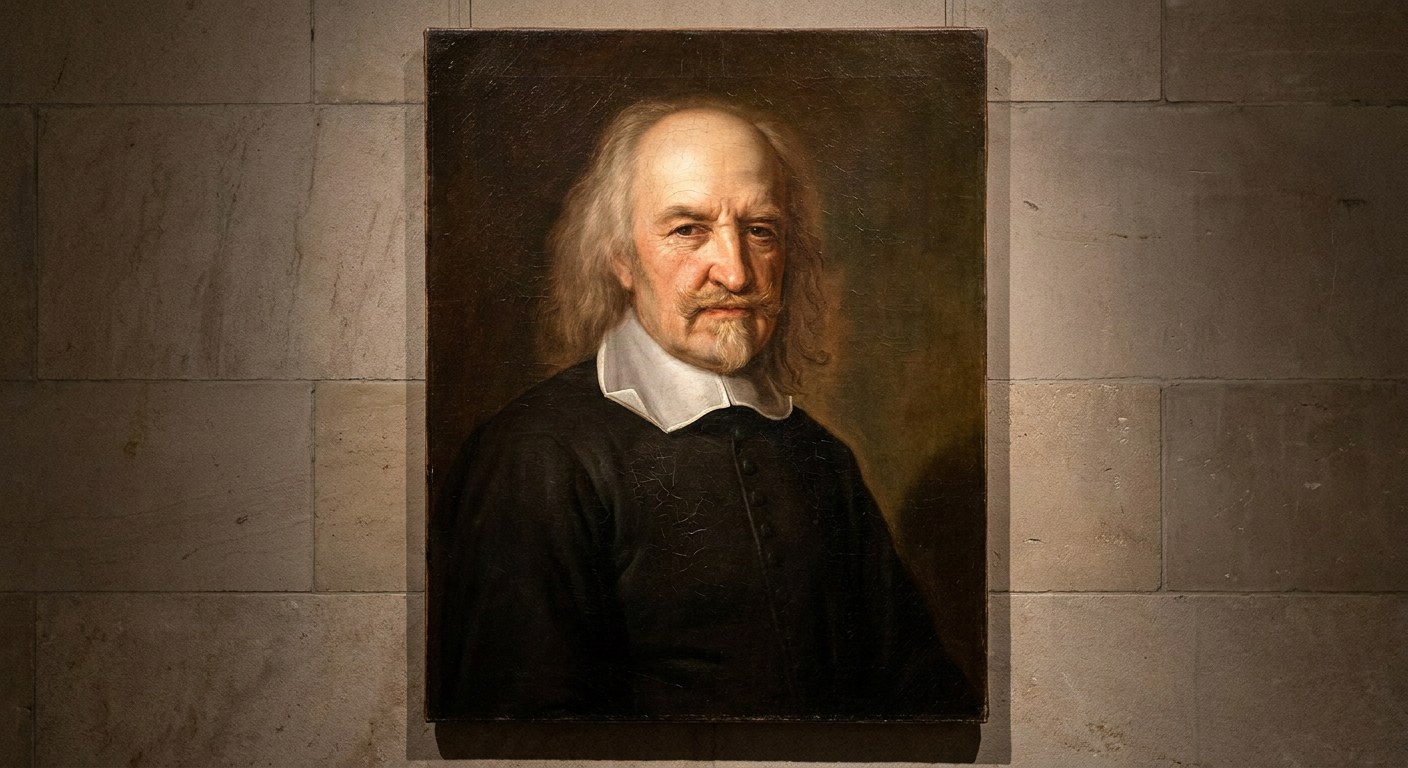
Thomas Hobbes
1588 – 1679 · English · Philosopher & Political Theorist
Recommended Audiobooks
Listen next from Marcus Alden

Life Lessons from Frederic Chopin
Marcus Alden · 54 min

Life Lessons from John Wesley
Marcus Alden · 52 min
Introduction
Thomas Hobbes (1588–1679) was an English philosopher whose stark analysis of fear, power, authority, and social order transformed political thought. Best known for Leviathan (1651), he argued that human beings establish government through a social covenant because life without a common authority would leave them dangerously insecure. His famous description of life in such a condition as “solitary, poor, nasty, brutish, and short” remains one of the most recognizable passages in Western philosophy.
Hobbes wrote during an age of civil war, religious conflict, scientific discovery, and political revolution. The English Civil Wars of the 1640s were not merely background events for him: they appeared to confirm his belief that divided sovereignty and competing claims to authority could lead to violence. Yet his philosophy was more than a defense of strong government. It was a systematic attempt to explain human beings, morality, religion, law, and political society through matter and motion rather than through the traditional framework of medieval scholasticism.
His political theory begins with individuals who are naturally equal in vulnerability and motivated by desires, fears, and a powerful wish for self-preservation. From these premises, Hobbes sought to derive the need for a sovereign capable of enforcing peace. Although he preferred monarchy, his theory allowed sovereignty to reside in an assembly. The decisive requirement was that sovereign power be undivided and effective.
Hobbes helped establish the modern concepts of the state, social contract, political representation, and individual authorization. His work influenced later thinkers even when they rejected his conclusions. John Locke, Jean-Jacques Rousseau, David Hume, Jeremy Bentham, John Austin, Carl Schmitt, and John Rawls all engaged, directly or indirectly, with questions Hobbes had formulated with unusual force. Today, his ideas remain central to debates about state power, public security, political obligation, international conflict, and the balance between liberty and order.
Quick Facts
| Fact | Details |
|---|---|
| Born | 5 April 1588, Westport, near Malmesbury, Wiltshire, England |
| Died | 4 December 1679, Hardwick Hall, Derbyshire, England |
| Nationality | English |
| Known For | Leviathan, social contract theory, the state of nature, theories of sovereignty and materialism |
| Occupation | Philosopher, political theorist, translator, tutor, and writer |
| Era | Early modern philosophy; Scientific Revolution and English Civil War era |
Early Life and Education
Thomas Hobbes was born on 5 April 1588 in Westport, then a small settlement adjoining Malmesbury in Wiltshire. According to a story he later encouraged, his mother went into premature labor after hearing reports that the Spanish Armada was approaching England. Hobbes wrote that fear and he were born as twins, an autobiographical image that later seemed particularly appropriate for a philosopher who made fear a foundation of political society.
His father, also named Thomas Hobbes, was a poorly paid clergyman serving Westport and the nearby parish of Charlton. After becoming involved in a quarrel with another clergyman, reportedly ending in a physical confrontation, the elder Hobbes abandoned the area. Responsibility for the family consequently fell to his prosperous uncle, Francis Hobbes, a glover who paid for the boy’s education.
Hobbes displayed an early talent for languages. He attended schools in Westport and Malmesbury before studying under Robert Latimer, a university-educated teacher who instructed him in Latin and Greek. A later account claimed that Hobbes translated Euripides’ Medea into Latin verse while still a young student. Whether every detail of that story is exact, his command of classical literature became one of the foundations of his intellectual career.
Around 1603, Hobbes entered Magdalen Hall, Oxford, later associated with Hertford College. Oxford education remained dominated by Aristotelian logic and scholastic philosophy. Hobbes learned the established curriculum but later became a fierce critic of the university system, arguing that it relied too heavily on obscure terminology and inherited authority. He received his bachelor’s degree in 1608.
Soon afterward, Hobbes became tutor to William Cavendish, the future second Earl of Devonshire. This appointment shaped his entire life. The Cavendish family provided employment, access to books, political connections, and a measure of financial security. Hobbes became more than a hired instructor: he served at various times as secretary, adviser, traveling companion, and intellectual associate to several generations of the family.
In 1610, Hobbes accompanied his pupil on a continental tour. Travel exposed him to European languages and intellectual currents beyond Oxford. After his pupil inherited the Devonshire title, Hobbes continued to move within circles that included politicians, scholars, and writers. He was associated for a time with the intellectual world surrounding Francis Bacon, and he may have assisted Bacon with translating or recording some of his work. Bacon’s criticism of scholasticism and emphasis on a new science of nature helped shape the environment in which Hobbes developed, although Hobbes eventually adopted a more deductive method than Bacon’s experimental approach.
Rise to Prominence
Hobbes’s first major publication was his 1629 English translation of Thucydides’ History of the Peloponnesian War. He admired Thucydides for exposing the effects of ambition, demagoguery, faction, and fear on political communities. The translation was also a political intervention: Hobbes believed Thucydides demonstrated the dangers that irresponsible popular leaders and unstable assemblies could pose to public order.
After the second Earl of Devonshire died in 1628, Hobbes briefly entered the service of another aristocratic family. During a journey through Europe, he encountered Euclid’s geometry. The experience was decisive. Hobbes was impressed by the way geometrical conclusions appeared to follow necessarily from clear definitions and initial principles. He came to believe that moral and political philosophy could be constructed through a similarly rigorous method.
By 1631 he had returned to the Cavendish household as tutor to the third Earl of Devonshire. Further continental travel between 1634 and 1637 brought him into contact with leading representatives of the new science. In Paris he participated in the intellectual circle of the theologian and mathematician Marin Mersenne, an important intermediary among European scholars. Hobbes also visited Galileo Galilei in or near Florence in 1636. These encounters strengthened his ambition to create a unified philosophy explaining physical nature, human beings, and political society in terms of matter and motion.
Hobbes initially planned a philosophical system in three parts: body, human nature, and the political commonwealth. Events in England forced him to address politics first. Conflict between King Charles I and Parliament intensified during the late 1630s. In 1640 Hobbes circulated The Elements of Law, Natural and Politic in manuscript. It defended strong, undivided sovereignty while offering a systematic account of sensation, motivation, natural law, and political obligation.
Fearing that his royalist associations and arguments might expose him to prosecution, Hobbes left England for Paris late in 1640. He remained in France for approximately eleven years. There he wrote De Cive (On the Citizen), first issued privately in 1642 and published in a revised public edition in 1647. Its presentation of liberty, authority, and civil obligation established Hobbes as a major political philosopher.
During his exile, Hobbes also participated in debates over René Descartes’s Meditations. His objections revealed fundamental differences between them. Descartes defended a distinction between mind and body, whereas Hobbes moved toward an uncompromising materialism. Hobbes argued that thought must be understood as a bodily process rather than as the activity of an immaterial substance.
Hobbes briefly served as mathematics tutor to the exiled Prince of Wales, the future Charles II. Nevertheless, the publication of Leviathan in 1651 damaged his standing among royalist exiles. The book defended powerful sovereignty, but it also suggested that subjects might submit to a successful conquering authority when their former protector could no longer defend them. Its criticism of clerical independence and unconventional interpretation of Christianity angered religious conservatives. Facing hostility in France, Hobbes returned to England near the end of 1651 and submitted to the Commonwealth government.
Major Achievements and Contributions
Hobbes’s greatest achievement was the construction of a political theory beginning not with divine-right monarchy or an organic hierarchy, but with separate individuals. These individuals possess desires, aversions, natural liberty, and a fundamental concern for survival. Political authority arises when they authorize a sovereign to act on their behalf. This approach helped establish the social contract as a central framework of modern political philosophy.
His “state of nature” was an analytical model of life without a common authority. It did not necessarily describe a single prehistoric period. In that condition, people would be sufficiently equal in physical and mental vulnerability that no one could enjoy lasting security. Competition, distrust, and the pursuit of reputation could produce conflict. Even a cautious person might attack preemptively if there were no reliable power to enforce agreements.
The resulting “war of every man against every man” did not mean uninterrupted combat. It meant a continuing condition in which the threat of violence made stable industry, trade, culture, and cooperation unsafe. Hobbes compared it to bad weather: war consists not only in actual fighting but also in a known disposition toward conflict.
Reason, however, reveals “laws of nature.” The first is to seek peace when peace is possible. The second is to surrender enough natural liberty, provided others do the same, to make mutual security possible. A third requires people to keep valid covenants. Because agreements cannot reliably enforce themselves, individuals establish a sovereign with sufficient power to punish violations.
Hobbes’s sovereign was not a party to the original covenant among the subjects. It therefore could not be accused of breaking that covenant. Sovereignty had to remain undivided because rival final authorities—king, parliament, church, courts, or local powers—would recreate the insecurity that government was designed to overcome. Hobbes preferred monarchy because he thought it offered greater consistency and secrecy, but his definition of sovereignty also encompassed aristocratic and democratic assemblies.
At the same time, Hobbes did not erase individuality. Subjects retained an inalienable liberty to resist direct threats to their lives. A person could not genuinely covenant away the impulse toward self-preservation. Hobbes also defined civil liberty as freedom in areas where the law is silent. His system therefore combined formidable government with a recognizable account of individual rights and legal freedom.
His theory of representation was equally innovative. A commonwealth becomes one political “person” because the multitude authorizes a representative—an individual ruler or an assembly—to speak and act in its name. This concept helped shape later understandings of public authority and the impersonal modern state.
Beyond politics, Hobbes developed a systematic materialist philosophy. He regarded reality as bodily and explained sensation, imagination, memory, and reasoning through motion. Reasoning was a form of calculation with names and propositions. He rejected immaterial substances as unintelligible, although he continued to present his arguments within a Christian vocabulary and denied that he was an atheist.
Hobbes also contributed to moral psychology. He treated human action as driven by appetites and aversions rather than by an independent faculty of free will. “Good” commonly named what a person desired, and “evil” what that person disliked. Happiness was not a final state of perfect satisfaction but continued success in obtaining desired ends. This dynamic theory of motivation influenced later psychology, ethics, and economics.
Key Works / Battles / Ideas
The Translation of Thucydides (1629)
Hobbes’s translation of Thucydides introduced English readers to a classic analysis of war, political rhetoric, imperial ambition, and democratic instability. His choice reflected his lifelong concern with civil disorder and the manipulation of public opinion.
The Elements of Law, Natural and Politic (1640)
Originally circulated in manuscript, this was Hobbes’s first sustained presentation of psychology and political theory. It already contained his arguments about fear, consent, natural law, sovereignty, and the need for a coercive public authority.
De Cive (1642; revised 1647)
De Cive, or On the Citizen, was the political section of Hobbes’s planned philosophical system. Written in Latin for an international scholarly audience, it examined liberty, government, religion, and the duties of subjects. Its opening image of human relations emphasized both aggression and mutual vulnerability.
Leviathan (1651)
Hobbes’s masterpiece is divided into four parts: “Of Man,” “Of Commonwealth,” “Of a Christian Commonwealth,” and “Of the Kingdom of Darkness.” It combines psychology, logic, politics, biblical interpretation, and an attack on institutions that claimed authority independent of the civil sovereign.
Its title comes from the immense biblical creature described in the Book of Job. The famous frontispiece depicts a gigantic crowned ruler whose body consists of numerous individual subjects. The image captures Hobbes’s theory of representation: the state is an artificial person constructed from the authorization of many individuals.
Hobbes’s political argument was inseparable from his religious argument. He denied that churches should exercise independent coercive authority and subjected claims about spirits and supernatural powers to skeptical analysis. These positions led many contemporaries to regard the book as impious.
De Corpore (1655) and De Homine (1658)
These works completed the other principal sections of Hobbes’s philosophical system. De Corpore addressed logic, method, geometry, motion, and body. De Homine considered optics and human faculties. Together with De Cive, they embodied his ambition to unite natural and political philosophy.
Hobbes’s mathematical claims proved much weaker than his political philosophy. He repeatedly attempted to solve classical geometrical problems, including squaring the circle. Mathematician John Wallis exposed errors in his demonstrations, producing an acrimonious controversy that continued for years.
Behemoth
Written mainly in the late 1660s, Behemoth analyzed the causes of the English Civil Wars. Hobbes blamed religious rivalry, clerical ambition, misguided classical education, political faction, and failures of sovereign authority. Charles II withheld permission for publication; an authorized edition appeared only after Hobbes’s death, in 1682, following an unauthorized edition in 1679.
Core Ideas
Hobbes’s most influential concepts include the state of nature, natural equality, the right of self-preservation, laws of nature, covenant, authorization, representation, indivisible sovereignty, civil liberty, and the state as an artificial person. His philosophy also advanced determinism and materialism, denying a traditional form of free will while maintaining that an action can be free when it is not externally obstructed.
Timeline of Key Events
| Year | Event |
|---|---|
| 1588 | Born at Westport near Malmesbury on 5 April, during the year of the Spanish Armada |
| c. 1603 | Entered Magdalen Hall, Oxford |
| 1608 | Received his bachelor’s degree and became tutor to William Cavendish |
| 1610 | Traveled through continental Europe with Cavendish |
| 1629 | Published his English translation of Thucydides |
| c. 1630 | Encountered Euclidean geometry, influencing his philosophical method |
| 1634–1637 | Toured Europe and joined scientific networks associated with Mersenne and Galileo |
| 1640 | Circulated The Elements of Law and fled to Paris |
| 1642 | Issued the first version of De Cive |
| 1646 | Became mathematics tutor to the future Charles II |
| 1647 | Published a revised edition of De Cive |
| 1651 | Published Leviathan and returned to England |
| 1655 | Published De Corpore |
| 1656 | Engaged publicly in controversy with John Wallis over mathematics |
| 1658 | Published De Homine |
| 1660 | Charles II was restored; Hobbes regained royal favor |
| 1666 | Faced renewed suspicion when Parliament investigated atheism and profaneness |
| 1675 | Published translations of parts of Homer; completed versions followed in 1676 |
| 1679 | Died at Hardwick Hall on 4 December, aged 91 |
| 1681–1682 | Important works, including A Dialogue Between a Philosopher and a Student of the Common Laws and an authorized Behemoth, appeared posthumously |
Personal Life and Character
Hobbes never married and had no known children. His enduring personal attachment was to the Cavendish family, whose patronage gave his career unusual continuity. He lived in their households for much of his adult life and served successive generations as tutor, adviser, and companion.
Descriptions collected by his friend and biographer John Aubrey portray Hobbes as energetic, witty, cautious, and disciplined. He maintained habits of regular walking and intellectual work into old age. He had a reputation for lively conversation and possessed literary talents beyond formal philosophy, composing Latin verse and translating both Thucydides and Homer.
Fear was central to his public image, partly because of his Armada birth story and partly because opponents interpreted his flight to France as cowardice. Hobbes did not treat fear as shameful. For him, fear—especially fear of violent death—was a rational force capable of directing people toward peace. Prudence in the face of danger was consistent with his theory of self-preservation.
He valued clarity but wrote in markedly different styles. His Latin works often addressed scholarly readers through formal argument, while Leviathan displayed metaphor, satire, scriptural commentary, and sharp attacks on intellectual opponents. Its memorable prose helped ensure that Hobbes remained read outside specialist philosophy.
Hobbes’s religious beliefs continue to be debated. He called himself a Christian and discussed scripture at great length, but his materialism left little room for conventional ideas about immaterial souls or spirits. Friends and patrons sometimes protected him from accusations of atheism, while critics treated his theology as a disguise for unbelief. The surviving evidence does not justify reducing his position to a simple label.
Challenges and Controversies
The central challenge of Hobbes’s life was political instability. He lived through conflict between Crown and Parliament, civil war, regicide, republican government, military rule, restoration, and recurring religious controversy. His insistence on undivided sovereignty emerged from this experience, but it also left him vulnerable under nearly every regime.
Royalists objected that Leviathan could justify obedience to the English Commonwealth after the monarchy’s defeat. Parliamentary and republican readers, meanwhile, could regard Hobbes as an advocate of absolutism. Hobbes’s theory was therefore not comfortably aligned with a single party. It demanded obedience to an effective sovereign while criticizing any institution that divided final authority.
Religious controversy posed a greater personal danger. Hobbes denied that clergy possessed coercive authority independent of the state and argued that the civil sovereign had final authority over public doctrine. He interpreted many biblical passages in ways that challenged prevailing beliefs about spirits, hell, prophecy, and the afterlife. Critics such as Bishop John Bramhall accused him of atheism, fatalism, and moral corruption.
In 1666, following the plague and Great Fire of London, the House of Commons ordered a committee to consider legislation against atheism and profaneness, with attention directed toward books associated with Hobbes. No successful prosecution followed, but the threat was serious. Hobbes prepared defensive writings and examined whether English law allowed a charge of heresy. He became more cautious about publishing controversial work in England.
His determinism produced another major dispute. Hobbes argued that every voluntary action has sufficient causes. Human freedom, in his view, means an absence of external impediments, not freedom from causation. Bramhall defended a more traditional doctrine of free will, and their exchange became increasingly hostile.
Hobbes also quarreled with the mathematician John Wallis. Hobbes believed that his geometrical method demonstrated the power of philosophical reasoning, but several of his proposed solutions were erroneous. Wallis criticized him publicly and sometimes mercilessly. Hobbes refused to concede defeat, damaging his scientific reputation even as his political influence grew.
The label “Hobbesian” has often been used to describe an excessively cynical view of humanity. That description is incomplete. Hobbes did not argue that people are always cruel or selfish in a narrow sense. He recognized curiosity, generosity, sociability, compassion, and the desire for peace. His darker conclusion was that good intentions alone cannot provide dependable security when no common power exists to settle disputes.
Death and Immediate Aftermath
Hobbes remained intellectually active into his late eighties, producing an autobiography in Latin verse and English translations of Homer. In 1679, while staying on Cavendish family property, his health deteriorated. After suffering a disabling illness, probably involving a stroke, he died at Hardwick Hall in Derbyshire on 4 December 1679. He was 91, an exceptional age for the period.
He was buried in the church of St John the Baptist at Ault Hucknall, near Hardwick Hall. Aubrey later reported that Hobbes had anticipated death as a final journey into darkness, but the exact status of supposed last words is uncertain.
Hobbes died famous but deeply controversial. Admirers recognized the originality and power of Leviathan, while critics continued to treat “Hobbism” as a threat to religion and morality. Several significant writings appeared after his death, including his dialogue on English common law and authorized editions of works that had faced censorship.
Legacy and Influence Today
Hobbes helped change the vocabulary of politics. Government, in his account, was not simply an inherited hierarchy ordained by custom. It was an artificial institution justified by what it accomplishes: peace, defense, predictable law, and the conditions of cooperative life. This focus on individuals, authorization, and institutional function contributed to the emergence of modern political theory.
Later social contract thinkers revised his premises. Locke defended limited government and a right of revolution; Rousseau sought a form of collective self-rule compatible with freedom; Rawls used an imagined choice situation to formulate principles of justice. Despite their differences, all addressed a broadly Hobbesian problem: how can legitimate public rules arise among free and equal individuals?
Hobbes also influenced legal positivism. His insistence that civil law receives authority from the sovereign, rather than from its moral content alone, anticipated aspects of Jeremy Bentham and John Austin. Modern legal theorists generally reject or refine Hobbes’s command model, but his distinction between what law is and what morality requires remains important.
In international relations, the absence of a global sovereign is often compared with Hobbes’s state of nature. Realist theorists use Hobbesian language to explain arms races, deterrence, alliances, and security dilemmas among states. Hobbes himself did not claim that conflict was inevitable at every moment, but his analysis shows how mutual fear can generate hostility even among actors who would prefer peace.
Economists, political scientists, and game theorists have likewise used Hobbes’s ideas to study collective-action problems. Individuals may all benefit from cooperation but fail to cooperate without trust, enforcement, or credible institutions. The Hobbesian solution—a power capable of enforcing shared rules—remains one influential answer.
His relevance is especially visible during emergencies. Terrorism, pandemics, civil disorder, cyberwarfare, and environmental crises raise questions about how much authority governments need to protect the public. Hobbes reminds readers that liberty depends on security, but his critics remind them that concentrated power can itself become dangerous. The continuing tension explains why Leviathan remains both compelling and disturbing.
Hobbes’s materialist psychology also anticipated later naturalistic approaches to mind and behavior. Although his science is outdated, his demand that mental life be explained as part of nature rather than as a separate supernatural realm remains philosophically significant.
Above all, Hobbes endures because he identified a permanent political dilemma. Human beings need authority to make peaceful cooperation reliable, yet authority powerful enough to protect them may also dominate them. Modern constitutionalism often seeks a solution Hobbes distrusted: a state strong enough to preserve order but divided and limited enough to prevent abuse. Even where his answer is rejected, the problem he posed remains unavoidable.
Famous Quotes
“The life of man, solitary, poor, nasty, brutish, and short.” — Leviathan, Chapter 13
“The condition of man ... is a condition of war of every one against every one.” — Leviathan, Chapter 14
“The right of nature ... is the liberty each man hath, to use his own power, as he will himself, for the preservation of his own nature.” — Leviathan, Chapter 14
“Covenants, without the sword, are but words, and of no strength to secure a man at all.” — Leviathan, Chapter 17
“Science is the knowledge of consequences, and dependence of one fact upon another.” — Leviathan, Chapter 5
“Words are wise men’s counters, they do but reckon by them; but they are the money of fools.” — Leviathan, Chapter 4
“Leisure is the mother of philosophy.” — Leviathan, Chapter 46
Frequently Asked Questions
What is Thomas Hobbes best known for?
Hobbes is best known for Leviathan and his theory that people establish sovereign government to escape the insecurity of a state of nature. He is also famous for his account of social contract, political representation, materialism, and undivided sovereignty.
Did Hobbes believe human beings are naturally evil?
Not exactly. Hobbes believed people pursue desired ends, avoid danger, and are roughly equal in their ability to threaten one another. Conflict arises from competition, distrust, and concern for reputation, especially when no authority enforces rules. His argument depends more on insecurity than on the claim that everyone is morally evil.
What did Hobbes mean by the state of nature?
The state of nature is a condition without a common political authority capable of enforcing law. Because agreements are insecure and people cannot depend on protection, the persistent possibility of violence undermines cooperation. It is primarily a philosophical model, not necessarily a literal account of one historical era.
Did Hobbes support absolute monarchy?
Hobbes preferred monarchy and defended extremely broad sovereign powers. However, he did not argue that sovereignty had to belong to a king. An assembly could also be sovereign. His central requirement was that final authority be unified, effective, and capable of maintaining peace.
Did Hobbes believe subjects had any rights against the sovereign?
Yes, although his protections were limited. A subject retained the liberty to resist direct attacks on life, avoid self-destruction, and refuse certain dangerous acts. Subjects also enjoyed freedom wherever civil law had not regulated their conduct. Hobbes did not, however, recognize a general constitutional right to overthrow an effective sovereign for governing badly.
Was Thomas Hobbes an atheist?
Hobbes denied the accusation and identified himself as a Christian. Nevertheless, his materialism, criticism of clerical authority, and unconventional biblical interpretations caused many contemporaries to call him an atheist. Scholars continue to debate whether his theology was sincere, strategically cautious, or philosophically unorthodox Christianity.
How did the English Civil War influence Hobbes?
The conflict reinforced his belief that rival claims to supreme authority produce insecurity and bloodshed. His political works sought to explain why subjects need a common power and why sovereignty cannot safely be divided among competing political and religious institutions.
How is Hobbes relevant today?
Hobbes remains relevant to debates about public security, emergency powers, political obedience, international anarchy, legal authority, and collective-action problems. His work asks how order is possible among vulnerable individuals and what powers a state may legitimately use to preserve peace.
Lessons We Can Learn
-
Stable institutions make cooperation possible. Trust and goodwill are valuable, but shared rules and credible enforcement often enable cooperation among people who do not know or trust one another.
-
Fear can create conflict as well as prevent it. Mutual insecurity may lead individuals or states to act aggressively even when all sides would prefer peace. Reducing uncertainty can therefore be as important as condemning aggression.
-
Political authority requires a justification. Hobbes grounded government in the needs of individuals rather than relying solely on tradition or divine right. Power should be judged partly by whether it provides peace and protection.
-
Security and liberty are interdependent but in tension. Without security, meaningful freedom may collapse; without limits or scrutiny, protective power may become oppressive. Responsible politics must confront both dangers.
-
Clear definitions matter. Hobbes’s conclusions remain disputed, but his effort to define liberty, law, rights, covenant, and sovereignty demonstrates the importance of conceptual clarity in political debate.
Further Reading
- Richard Tuck, Hobbes: A Very Short Introduction (Oxford University Press, 2002).
- A. P. Martinich, Hobbes: A Biography (Cambridge University Press, 1999).
- Quentin Skinner, Hobbes and Republican Liberty (Cambridge University Press, 2008).
- Noel Malcolm, Aspects of Hobbes (Oxford University Press, 2002).
- Thomas Hobbes, Leviathan, edited by Noel Malcolm (Oxford University Press, 2012).
Watch and Learn
Hobbes & Moral Positivism: Crash Course Philosophy #36 · CrashCourse