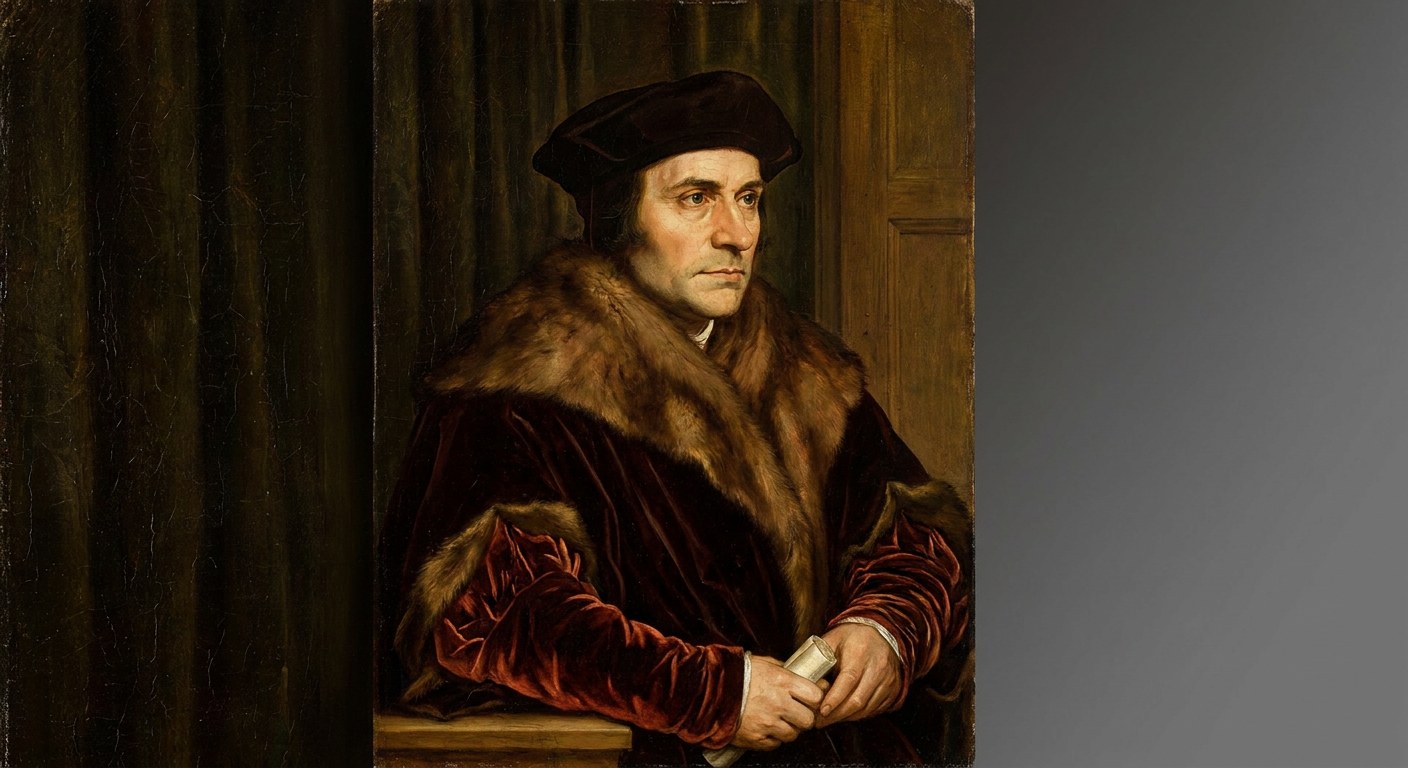
Thomas More
1478 – 1535 · English · Statesman & Humanist
Recommended Audiobooks
Listen next from Marcus Alden

Life Lessons from Frederic Chopin
Marcus Alden · 54 min

Life Lessons from John Wesley
Marcus Alden · 52 min
Introduction
Thomas More—lawyer, humanist, statesman, author, religious controversialist, and Catholic martyr—was one of the most remarkable figures of Renaissance England. Born in London on 7 February 1478, he rose from a prosperous legal family to become Lord Chancellor under King Henry VIII, the highest political office held by a lay subject. Yet More is remembered less for his years in power than for the crisis that ended them: his refusal to recognize Henry VIII as supreme head of the Church in England.
More’s life united several worlds that were increasingly difficult to reconcile. He was a classically educated Christian humanist and a close friend of the Dutch scholar Desiderius Erasmus. He wrote Utopia—one of the most influential works of political imagination in European history—while also building a successful career in royal service. He valued conscience, scholarship, family education, and legal order, but he also defended Catholic orthodoxy with an intensity that placed him in direct conflict with early English Protestants.
His opposition to the king’s ecclesiastical supremacy led to his imprisonment in the Tower of London, conviction for high treason, and execution on 6 July 1535. The Catholic Church canonized him in 1935, while later writers and dramatists portrayed him as a symbol of principled resistance to state power. Modern historians, however, also examine his participation in the persecution of religious dissenters and the tensions between his advocacy of conscience and his intolerance of teachings he regarded as heretical.
Thomas More therefore remains both inspirational and controversial: a brilliant Renaissance intellectual, a devoted family man, a formidable government servant, and a defender of a religious order that was beginning to fracture around him.
Quick Facts
| Category | Details |
|---|---|
| Full name | Sir Thomas More |
| Born | 7 February 1478 |
| Birthplace | Milk Street, London, England |
| Died | 6 July 1535, aged 57 |
| Place of death | Tower Hill, London |
| Parents | Sir John More and Agnes Graunger More |
| Education | St Anthony’s School; University of Oxford; New Inn; Lincoln’s Inn |
| Occupations | Lawyer, judge, diplomat, author, humanist, royal councillor, statesman |
| Major offices | Under-sheriff of London; privy councillor; Speaker of the House of Commons; Chancellor of the Duchy of Lancaster; Lord Chancellor |
| Lord Chancellor | October 1529–May 1532 |
| Best-known work | Utopia (1516) |
| Spouses | Jane Colt; Alice Middleton |
| Children | Margaret, Elizabeth, Cecily, and John More |
| Religion | Roman Catholic |
| Imprisoned | Tower of London, 17 April 1534–6 July 1535 |
| Cause of death | Beheading after conviction for high treason |
| Canonized | 19 May 1935 by Pope Pius XI |
| Feast day | 22 June, shared in the Catholic calendar with John Fisher |
| Patronage | Statesmen, politicians, and public servants |
Early Life & Background
Thomas More was born on Milk Street in the City of London on 7 February 1478. His father, John More, was a successful lawyer who later became a judge of the Court of King’s Bench. His mother, Agnes Graunger, came from a London mercantile family. The Mores belonged to the prosperous professional class rather than the hereditary aristocracy, giving Thomas both social opportunity and firsthand knowledge of the law as a path to advancement.
He attended St Anthony’s School in London, one of the city’s leading grammar schools. There he received a rigorous education in Latin, rhetoric, and grammar. As a young adolescent, he entered the household of John Morton, Archbishop of Canterbury and Lord Chancellor under Henry VII. Service in a great household was an important form of practical education, exposing More to politics, administration, and courtly life.
Morton reportedly recognized the boy’s unusual intelligence and predicted that he would become an exceptional man. He also appears in Utopia as an admired churchman and statesman, suggesting the lasting influence he had on More.
Around 1492, More went to the University of Oxford, probably studying at Canterbury Hall or an associated institution. At Oxford he encountered the new humanist learning, including classical literature and Greek. Among the scholars connected with his education were Thomas Linacre and William Grocyn, both important figures in the revival of classical studies in England.
More’s father, concerned that humanist scholarship might distract him from a practical profession, directed him toward the law. More left Oxford without taking a degree and studied first at New Inn before entering Lincoln’s Inn, one of London’s Inns of Court. He was called to the bar around 1501.
During these years, More experienced a prolonged religious struggle over his vocation. He lived near the London Charterhouse and participated in some of the Carthusian monks’ spiritual exercises. He wore a hair shirt, practiced fasting, and considered becoming a priest, a Carthusian, or a Franciscan. Ultimately, he concluded that he was called to marriage and public life rather than a monastery. Nevertheless, habits of prayer, self-discipline, and penitence remained central to his religious identity.
More also joined the circle of English and continental humanists who hoped to renew Christian society through education, biblical scholarship, and moral reform. His friendship with Desiderius Erasmus became especially important. Erasmus stayed in More’s home during visits to England and dedicated The Praise of Folly to him; its Latin title, Moriae Encomium, playfully referred to More’s surname.
Rise to Prominence
More’s legal ability, learning, wit, and reputation for integrity rapidly advanced his career. He entered Parliament in 1504, during the reign of Henry VII. According to an early biographical tradition, he helped oppose a royal financial demand, drawing the king’s displeasure. Although some details of this episode are uncertain, More clearly developed an early reputation for independence.
After Henry VIII came to the throne in 1509, More’s public career accelerated. In 1510 he became one of the two under-sheriffs of the City of London, a demanding judicial and administrative office. He held the position until 1518 and was praised for accessibility and fairness. His work brought him into regular contact with merchants, foreign traders, litigants, and civic officials.
More also undertook diplomatic and commercial missions. In 1515 he traveled to the Low Countries as part of an English delegation negotiating trade disputes. During an interval in the negotiations, he began writing the second book of Utopia, which describes an imaginary commonwealth. He completed the work after returning to England, and it was published in Latin at Leuven in 1516.
Cardinal Thomas Wolsey, Henry VIII’s chief minister, recognized More’s usefulness, while the king appreciated his intelligence and conversation. More entered royal service more fully in 1518 as a member of the king’s council. Despite misgivings about court life, he became one of Henry’s trusted servants.
He accompanied diplomatic missions, assisted in receiving foreign envoys, and drafted official documents. In 1521 he was knighted and appointed under-treasurer of the Exchequer. That same year he helped Henry prepare the royal attack on Martin Luther titled Defence of the Seven Sacraments. Pope Leo X rewarded Henry with the title “Defender of the Faith.”
In 1523 More was elected Speaker of the House of Commons. His opening address included a celebrated request that members be allowed to speak freely without fear of royal anger, though parliamentary freedom in Tudor England remained sharply limited. In 1525 he became Chancellor of the Duchy of Lancaster, an office with extensive administrative and judicial responsibilities.
By the late 1520s, More stood near the center of English government. Yet his promotion coincided with the crisis that would destroy both his career and his life: Henry VIII’s determination to end his marriage to Catherine of Aragon and marry Anne Boleyn.
Major Achievements
More’s most enduring literary achievement is Utopia, first published in Latin in 1516. The book takes the form of a dialogue involving a fictional traveler, Raphael Hythloday, who describes an island society with communal property, broad education, organized labor, religious toleration, and no private accumulation of gold or silver.
The title draws on Greek wordplay: it can suggest both “no place” and “good place.” More did not present Utopia as a simple political program. Its customs include practices he may have admired, practices he found disturbing, and ironic criticisms of European society. The work challenges readers to reconsider poverty, punishment, war, property, political counsel, and social injustice. Its title gave rise to the modern word “utopian.”
More also made a major contribution to English Renaissance humanism. He encouraged the study of Greek and Latin, supported educational reform, and corresponded with leading European scholars. His own household became a center of learning. In an era when advanced education was often reserved for boys, he ensured that his daughters received the same rigorous instruction as his son. His eldest daughter, Margaret Roper, became one of the most learned women in Tudor England.
As a lawyer and civic officer, More acquired a reputation for disciplined administration. His years as under-sheriff, privy councillor, parliamentary speaker, diplomat, and judge demonstrated his mastery of Tudor government. On 25 October 1529, following Cardinal Wolsey’s fall, More became Lord Chancellor. He was the first layman to hold the office in more than a century.
More was also a prolific religious writer. His works included Responsio ad Lutherum (1523), A Dialogue Concerning Heresies (1529), The Confutation of Tyndale’s Answer (1532–1533), and The Apology of Sir Thomas More (1533). These writings defended Catholic teaching, the authority of the Church, the sacraments, and traditional interpretations of Scripture against Protestant reformers such as Luther and William Tyndale.
During his final imprisonment, More produced some of his most spiritually powerful writing. A Dialogue of Comfort Against Tribulation reflects on fear, suffering, persecution, and perseverance. His unfinished The Sadness of Christ, a meditation on Christ’s agony in Gethsemane, reveals his effort to confront his own fear of death through the example of Christ.
Defining Moments
More’s appointment as Lord Chancellor in 1529 marked the peak of his public career. He succeeded Wolsey after the cardinal failed to secure papal annulment of Henry VIII’s marriage to Catherine of Aragon. More accepted office while privately doubting the legal and theological foundations of the king’s proposed divorce.
He attempted to serve without directly endorsing Henry’s case. That position became increasingly impossible as the king and Parliament attacked papal jurisdiction and expanded royal control over the English Church. More believed that the unity and authority of the Catholic Church could not be altered by one kingdom or monarch.
In 1532 the English clergy submitted to the king through the “Submission of the Clergy,” accepting severe restrictions on their independent legislative authority. More regarded the development as a decisive threat to the Church. He resigned as Lord Chancellor on 16 May 1532, officially citing poor health. The resignation cost his family much of its income and signaled his withdrawal from royal policy.
More did not attend Anne Boleyn’s coronation in 1533. Although he acknowledged Parliament’s power to regulate the royal succession, he would not accept the religious implications attached to Henry’s new marriage and supremacy.
In April 1534 More was ordered to swear an oath associated with the First Succession Act. He was willing to accept Anne’s children as lawful heirs in practice, but he objected to the oath’s repudiation of papal authority. He refused to explain his reasoning fully, relying on silence as legal protection. On 17 April he was imprisoned in the Tower of London.
More spent more than fourteen months in confinement. His books and writing materials were gradually removed, and pressure was placed on him through official interrogations and family visits. He remained silent on the supremacy, arguing that no person could lawfully be convicted merely for withholding an opinion.
Parliament then passed the Treasons Act of 1534, making it treason maliciously to deny the king’s title as supreme head of the Church of England. More was tried in Westminster Hall on 1 July 1535. The decisive testimony came from Richard Rich, the solicitor general, who claimed that More had explicitly denied Parliament’s power to make the king head of the Church. More accused Rich of perjury, but the jury convicted him.
After judgment, More openly declared that royal supremacy over the Church was contrary to the law and unity of Christendom. He was sentenced to death and beheaded on Tower Hill on 6 July 1535. According to later accounts, he told the executioner that his beard had committed no treason and moved it away from the block. His head was displayed on London Bridge before Margaret Roper reportedly recovered and preserved it.
Timeline
| Year | Event |
|---|---|
| 1478 | Born on 7 February in Milk Street, London |
| c. 1490 | Enters the household of Archbishop John Morton |
| c. 1492–1494 | Studies at Oxford and encounters Renaissance humanism |
| c. 1494 | Begins formal legal training in London |
| c. 1501 | Called to the bar at Lincoln’s Inn |
| 1504 | Serves in Parliament during Henry VII’s reign |
| 1505 | Marries Jane Colt |
| 1509 | Henry VIII becomes king |
| 1510 | Becomes under-sheriff of London |
| 1511 | Jane More dies; More marries Alice Middleton |
| 1515 | Travels to the Low Countries on a diplomatic-commercial mission |
| 1516 | Utopia is published at Leuven |
| 1518 | Enters Henry VIII’s council |
| 1521 | Knighted and appointed under-treasurer of the Exchequer |
| 1523 | Serves as Speaker of the House of Commons; publishes Responsio ad Lutherum |
| 1525 | Becomes Chancellor of the Duchy of Lancaster |
| 1529 | Appointed Lord Chancellor on 25 October |
| 1529 | Publishes A Dialogue Concerning Heresies |
| 1532 | Resigns as Lord Chancellor on 16 May |
| 1533 | Declines to attend Anne Boleyn’s coronation |
| 1534 | Refuses the succession oath and is imprisoned on 17 April |
| 1535 | Tried for high treason on 1 July |
| 1535 | Executed on Tower Hill on 6 July |
| 1886 | Beatified with other English martyrs by Pope Leo XIII |
| 1935 | Canonized by Pope Pius XI |
| 2000 | Declared patron of statesmen and politicians by Pope John Paul II |
Personal Life
More married Jane Colt in 1505. Erasmus later wrote that More chose Jane from among several sisters, partly because he did not wish the eldest to suffer the embarrassment of seeing a younger sister married first. The couple had four children: Margaret, Elizabeth, Cecily, and John.
Jane died in 1511, probably in connection with childbirth. Within weeks, More married Alice Middleton, a wealthy widow several years older than he was. The speed of the marriage may appear surprising, but a household with four young children required immediate management. Alice also had a daughter, commonly called Alice, from her previous marriage.
More’s household eventually settled at Chelsea, then outside central London. It included children, relatives, servants, scholars, and dependents. The family prayed, studied, read Scripture, practiced music, and discussed literature. More maintained affectionate but intellectually demanding relationships with his children.
His bond with Margaret Roper was especially close. Fluent in Latin and knowledgeable in Greek, Margaret translated Erasmus and corresponded with major scholars. During More’s imprisonment, she visited him and attempted to persuade him to take the oath. Their final public meeting after his condemnation became one of the most emotionally charged episodes in Tudor biography.
More’s personality contained striking contrasts. Friends described him as witty, sociable, generous, and fond of jokes. He enjoyed music, animals, conversation, and domestic life. At the same time, he practiced severe private devotions, including fasting and the wearing of a hair shirt. He sought to combine worldly responsibility with spiritual discipline.
Beliefs & Philosophy
More’s worldview was shaped by Christian humanism. He believed that classical learning, careful reasoning, and education could support the renewal of Christian life. Like Erasmus, he criticized clerical ignorance, vanity, greed, and superstition. Yet reform, in his understanding, had to occur within the historic Catholic Church rather than through separation from it.
Conscience was central to More’s final stand, but he did not understand conscience as purely personal preference. For him, a sound conscience had to be informed by reason, Scripture, tradition, law, and the teaching of the universal Church. He resisted Henry’s supremacy because he believed that accepting it would place national legislation above the spiritual authority recognized throughout Western Christendom.
More also valued law as a restraint on arbitrary power. During his trial, he used statutes, precedent, and the principle that silence implied consent. His legal strategy did not save him, but it demonstrated his conviction that even a king’s government should act through established law.
Utopia reveals his concern with the social causes of crime and poverty. In one famous passage, the enclosure of farmland for sheep is blamed for displacing rural communities—sheep are said to “devour men.” The book criticizes a system that executes thieves while tolerating conditions that drive people to theft.
At the same time, More was not a modern liberal democrat. He accepted monarchy, hierarchy, and a religiously unified society. His imagined Utopians tolerate multiple religions, but not unlimited public denial of divine providence or immortality. His thought belongs to the moral and political debates of the early sixteenth century, even when it anticipates later arguments about justice and social organization.
Challenges & Controversies
The greatest controversy surrounding More concerns his treatment of religious dissenters. As Lord Chancellor, he regarded Protestant teaching as a mortal danger to souls, social peace, and Christian unity. He investigated heresy, authorized searches for prohibited books, interrogated suspects, and defended the use of coercive measures.
Six people convicted of heresy were burned during his chancellorship. More did not personally pronounce these ecclesiastical sentences, and executions required cooperation between church and secular authorities. Nevertheless, as the kingdom’s chief officer, he supported the legal system under which convicted and unrepentant heretics were put to death.
More denied allegations that he had tortured suspects in his Chelsea home, though he acknowledged using physical punishment in certain cases. Historians continue to debate particular accusations, but there is no serious doubt that he approved of suppressing heresy and considered execution legitimate in extreme cases. His polemical writings could also be harsh, insulting, and violent in tone.
This record complicates later depictions of More as an uncomplicated champion of religious freedom. His defense of his own conscience did not lead him to support a general right to religious dissent. He distinguished between private conscience, which required careful formation, and the public promotion of doctrines he believed destructive.
His political conduct is also debated. Some interpretations portray him as a consistent opponent of royal tyranny. Others emphasize that he served Henry VIII loyally for many years and helped strengthen Tudor government before royal policy crossed a boundary he could not accept.
The trial itself has long been criticized. Richard Rich’s disputed testimony was essential because More’s silence had frustrated earlier efforts to establish treason. The rapid verdict, political setting, and predetermined character of Tudor state trials make the proceedings appear deeply unjust by modern standards.
A balanced assessment must therefore hold together two realities: More became the victim of coercive religious politics, but he had previously helped administer a system that coerced others. This contradiction is essential to understanding both the man and his century.
Famous Quotes
Because More wrote primarily in Latin and early modern English, wording varies among translations and editions. Some popular sayings attributed to him come from later biographies or dramatic portrayals rather than his surviving writings.
“I die the King’s good servant, and God’s first.”
This traditional account of More’s final words expresses the principle for which he became famous: loyalty to civil authority had limits when it conflicted with duty to God.
“For if a man lose anything for God’s cause, he shall find it again an hundred fold.”
From his prison writings, this statement reflects More’s conviction that worldly loss could become spiritual gain.
“The things, good Lord, that we pray for, give us also the grace to labour for.”
This line from More’s prayer asks that desire be joined to disciplined action.
“You must not abandon the ship in a storm because you cannot control the winds.”
A common translation of an argument in Utopia, this passage concerns whether a philosopher should withdraw from politics or work pragmatically within an imperfect government.
“No man’s life, liberty, or property are safe while the legislature is in session.”
This quotation is frequently attributed to More but is not authentic. It is generally traced to the nineteenth-century American writer Gideon J. Tucker and should not be cited as More’s words.
Legacy & Influence
More’s reputation began forming almost immediately after his death. Catholic contemporaries regarded him and Bishop John Fisher, executed on 22 June 1535, as martyrs to papal authority and the unity of the Church. More’s family and admirers preserved his letters and writings, while early biographies emphasized his learning, humor, devotion, and courage.
His literary influence has been immense. Utopia founded or named an entire tradition of imagined societies. Later writers used utopian and dystopian fiction to explore political ideals, economic systems, scientific progress, authoritarianism, and human freedom. The work remains central to political philosophy, Renaissance studies, literary criticism, and the history of social thought.
More also became a symbol of conscience under pressure. Pope Leo XIII beatified him in 1886, and Pope Pius XI canonized him on 19 May 1935. His Catholic feast day is celebrated on 22 June with John Fisher. In 2000 Pope John Paul II declared him the patron saint of statesmen and politicians.
Outside Catholic devotion, More’s public image was powerfully shaped by Robert Bolt’s play A Man for All Seasons, first staged in 1960, and its Academy Award-winning 1966 film adaptation. Bolt portrayed him as a defender of law and individual conscience against political absolutism. The drama is historically selective but has strongly influenced modern perceptions.
More’s name survives in schools, churches, universities, legal societies, and institutions around the world. His former home at Chelsea no longer stands, but his connection with the area remains commemorated. His body was buried in the Chapel Royal of St Peter ad Vincula within the Tower of London, while the location of his preserved head is traditionally associated with the Roper family vault at St Dunstan’s Church in Canterbury.
Modern scholarship presents a more complex More than either Protestant villain or Catholic hero. His brilliance, courage, and devotion coexist with intolerance and polemical severity. That complexity ensures his continued importance: he embodies both the promise of Renaissance humanism and the destructive confessional conflicts of the Reformation.
Interesting Facts
- The title Utopia is a Greek pun suggesting both “no place” and “good place.”
- Erasmus wrote The Praise of Folly while staying with More and used its Latin title, Moriae Encomium, as a joke on More’s name.
- More promoted advanced classical education for his daughters as well as his son, an unusually progressive practice in Tudor England.
- His daughter Margaret Roper became a respected scholar and translator.
- He kept a variety of animals at his Chelsea home and reportedly enjoyed observing their behavior.
- More’s first major diplomatic visit to the Low Countries helped inspire Utopia.
- He was the first lay Lord Chancellor of England since the fifteenth century.
- His immediate predecessor as chancellor was Cardinal Thomas Wolsey; his successor was Thomas Audley.
- More and Anne Boleyn were executed less than a year apart, although for very different alleged offenses.
- His execution was changed from hanging, drawing, and quartering to beheading by royal command.
- His body was buried at the Tower of London, but his head was displayed on London Bridge.
- The phrase “a man for all seasons” originated in Robert Whittington’s early description of More and was later popularized by Robert Bolt.
- A popular quotation about laws protecting the Devil comes from Bolt’s play, not directly from More’s authenticated writings.
- More appears as a character in the historical play Sir Thomas More, portions of which may have been written by William Shakespeare.
- His feast day, 22 June, marks John Fisher’s execution rather than More’s own death on 6 July.
Frequently Asked Questions
Why is Thomas More famous?
Thomas More is famous as the author of Utopia, a leading Renaissance humanist, Lord Chancellor under Henry VIII, and a Catholic martyr. He was executed after refusing to accept the king’s supremacy over the Church in England.
What was Utopia about?
Utopia describes an imaginary island society organized around communal property, universal work, public welfare, education, and regulated religious diversity. It also criticizes European poverty, warfare, criminal justice, and political corruption. Scholars debate which Utopian customs More seriously endorsed and which he intended ironically.
Why did Thomas More oppose Henry VIII?
More opposed the religious consequences of Henry VIII’s effort to annul his marriage to Catherine of Aragon. He could not accept that Parliament or the king possessed authority to make the English monarch supreme head of the Church or to override the wider Catholic Church.
Did More oppose Anne Boleyn personally?
More did not base his resistance primarily on personal hostility to Anne Boleyn. His objection concerned the validity of Henry’s first marriage, papal authority, and royal supremacy. He avoided Anne’s coronation, but he tried to remain silent rather than publicly attack her.
Why did Thomas More resign as Lord Chancellor?
He resigned on 16 May 1532 after the Submission of the Clergy strengthened royal control over the English Church. More believed he could no longer hold high office without appearing to approve policies contrary to his conscience.
Why was Thomas More executed?
He was convicted of high treason under legislation protecting Henry VIII’s title as supreme head of the Church of England. The prosecution relied chiefly on Richard Rich’s claim that More had explicitly denied Parliament’s power to grant that title.
Was Thomas More an advocate of religious freedom?
Not in the modern sense. Although Utopia depicts significant religious toleration and More defended the integrity of his own conscience, he supported the legal suppression of Protestant heresy. He believed religious error could threaten both salvation and public order.
Did Thomas More persecute Protestants?
Yes, More participated in the campaign against Protestant writings and believers. As Lord Chancellor, he investigated suspected heretics and supported the laws under which several were executed. Claims about specific acts of torture remain disputed, but his approval of coercive anti-heresy policy is well documented.
Is A Man for All Seasons historically accurate?
Robert Bolt’s drama is based on real events but simplifies them for theatrical purposes. It accurately emphasizes More’s legal intelligence and refusal to violate his conscience, while giving less attention to his anti-heresy activities, theology, and commitment to Catholic institutional authority.
Where is Thomas More buried?
His body was buried in the Chapel Royal of St Peter ad Vincula at the Tower of London. His head, displayed after execution, was reportedly recovered by Margaret Roper and is traditionally believed to rest in the Roper family vault at St Dunstan’s Church in Canterbury.
Lessons from Thomas More
- Conscience requires preparation: More’s final decision emerged from decades of study, prayer, legal thought, and moral discipline.
- Public service involves moral limits: Loyalty to government does not necessarily require obedience to every command.
- Law can restrain power, but only when institutions respect it: More relied on legal protections that a determined regime ultimately overcame.
- Education should be broadly available: His equal intellectual expectations for his daughters challenged the gender assumptions of his age.
- Political engagement is often imperfect: Utopia asks whether principled people should withdraw from flawed governments or work within them.
- Courage does not eliminate fear: More’s prison writings show that moral courage can coexist with anxiety, loneliness, and uncertainty.
- Historical heroes require critical examination: Admiration for More’s final stand should not obscure his support for persecuting religious dissent.
- Humor can sustain resilience: Even near death, More’s reported wit helped him preserve dignity and composure.
- Ideas can outlive political power: His chancellorship lasted less than three years, but Utopia has influenced readers for more than five centuries.
- Tolerance must be applied consistently: More’s life warns against defending liberty of conscience for oneself while denying it to others.
Further Reading
- Thomas More, Utopia, edited and translated by George M. Logan and Robert M. Adams.
- Thomas More, A Dialogue of Comfort Against Tribulation.
- Thomas More, The Sadness of Christ.
- Thomas More, The Correspondence of Sir Thomas More, edited by Elizabeth Frances Rogers.
- R. W. Chambers, Thomas More.
- Peter Ackroyd, The Life of Thomas More.
- John Guy, Thomas More.
- Richard Marius, Thomas More: A Biography.
- E. E. Reynolds, The Trial of St Thomas More.
- Joanne Paul, Thomas More.
- Nicholas Harpsfield, The Life and Death of Sir Thomas More.
- William Roper, The Life of Sir Thomas More, an early biography written by More’s son-in-law.
- Robert Bolt, A Man for All Seasons, an influential dramatic interpretation rather than a comprehensive historical biography.