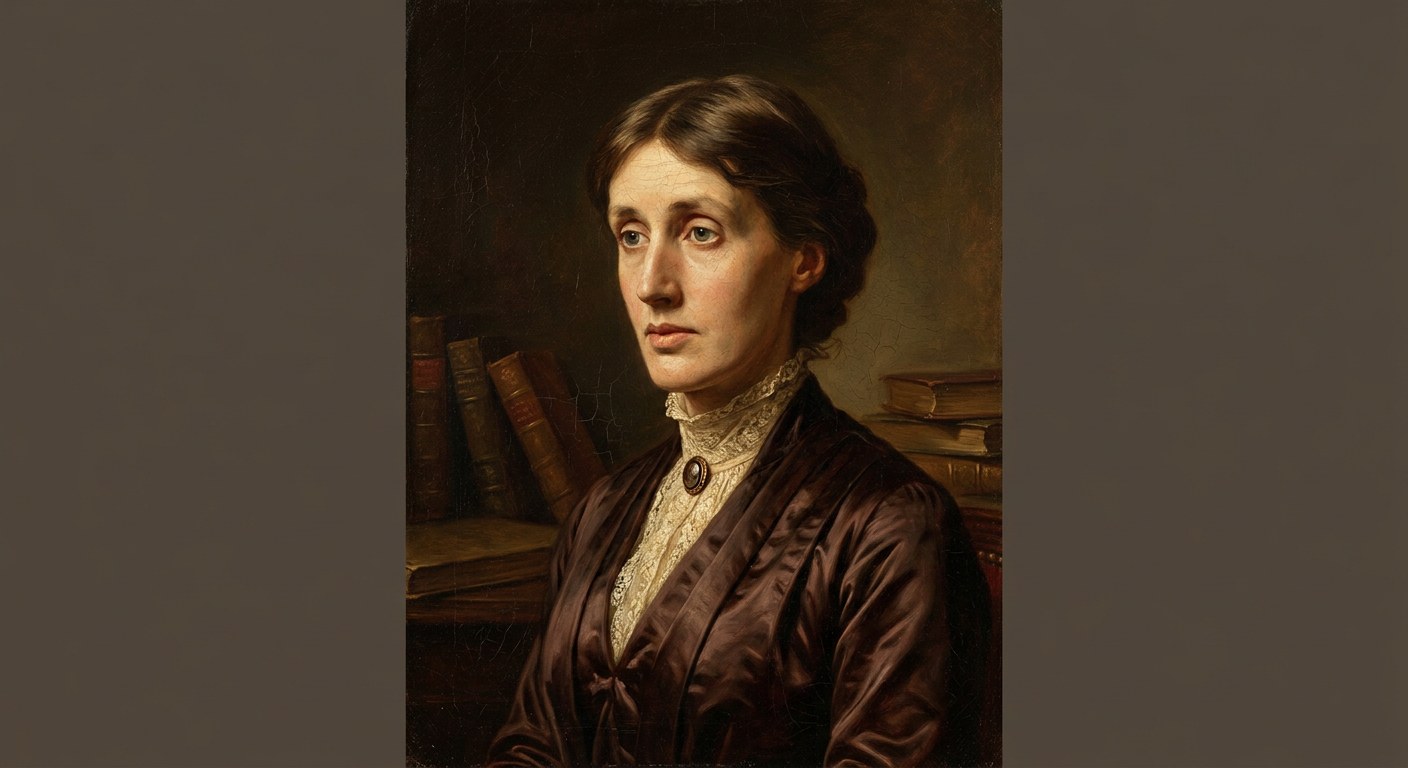
Virginia Woolf
1882 – 1941 · British · Novelist & Essayist
Recommended Audiobooks
Listen next from Marcus Alden

Life Lessons from Frederic Chopin
Marcus Alden · 54 min

Life Lessons from John Wesley
Marcus Alden · 52 min
Introduction
Virginia Woolf was one of the most innovative writers of the twentieth century and a central figure in literary modernism. Through novels such as Mrs Dalloway, To the Lighthouse, Orlando, and The Waves, she transformed the representation of consciousness, memory, time, and identity in fiction. Her essays, especially A Room of One's Own and Three Guineas, also made her an enduring influence on feminist thought, literary criticism, and debates about education, economic independence, war, and political power.
Woolf rejected the idea that a novel should merely report external events in chronological order. She sought instead to capture what she called the luminous halo of life: the shifting impressions, memories, sensations, and private associations through which human beings experience reality. Her prose moves fluidly among minds, allowing an ordinary walk through London, a family dinner, or preparations for a party to reveal complex inner worlds.
Her importance extends beyond formal experimentation. Woolf examined the restrictions imposed on women by patriarchal institutions, exposed the social hierarchies of class and empire, and challenged fixed categories of gender and sexuality. As a publisher with the Hogarth Press, she helped bring significant modernist and international writing into print. At the same time, her life was marked by severe episodes of mental illness, complicated family relationships, bereavement, and the pressures of living through two world wars.
Woolf's work remains admired because it combines intellectual daring with emotional precision. She showed that the seemingly ordinary could contain an entire history of desire, grief, conflict, and beauty. Her writing continues to shape fiction, feminist scholarship, queer studies, biography, cultural criticism, and discussions of mental health.
Quick Facts
| Fact | Details |
|---|---|
| Born | 25 January 1882, Kensington, London, England |
| Died | 28 March 1941, near Lewes, Sussex, England |
| Nationality | British |
| Known For | Modernist fiction, feminist essays, literary criticism, and the Hogarth Press |
| Occupation | Novelist, essayist, critic, biographer, and publisher |
| Era | Modernism; early twentieth century |
Early Life and Education
Virginia Woolf was born Adeline Virginia Stephen at 22 Hyde Park Gate in Kensington, London. She was the daughter of Sir Leslie Stephen, an influential author, critic, editor, and mountaineer, and Julia Prinsep Stephen, a celebrated beauty who had worked as a model for artists associated with the Pre-Raphaelites. Both parents had previously been married, creating a large blended household.
Virginia's full siblings were Vanessa, Thoby, and Adrian Stephen. The household also included her half-siblings from her parents' earlier marriages: Laura Stephen, and George, Gerald, and Stella Duckworth. The family moved within an elite intellectual and artistic world. Visitors included prominent writers, scholars, and public figures, while Leslie Stephen's extensive library gave Virginia access to English literature, history, philosophy, and biography from an early age.
Unlike her brothers, who attended Cambridge University, Virginia did not receive a conventional university education. This inequality later informed her analysis of women's exclusion from educational and professional institutions. She was taught at home by her parents and tutors, studied Greek and Latin, and took courses in subjects including history and German through the Ladies' Department of King's College London between 1897 and 1901. Yet much of her education was self-directed through intensive reading and family conversation.
The Stephens spent many summers at Talland House in St Ives, Cornwall. The landscape there—the sea, the bay, and Godrevy Lighthouse—became deeply embedded in Virginia's imagination. Decades later, memories of St Ives helped shape the Ramsays' summer house and distant lighthouse in To the Lighthouse.
Her childhood contained affection, intellectual stimulation, and privilege, but it was also shadowed by trauma and loss. Woolf later wrote that her half-brothers Gerald and George Duckworth sexually abused her. Scholars have debated the nature and extent of these experiences, but her own accounts are an essential part of the biographical record. They influenced later interpretations of her sensitivity to power, bodily autonomy, secrecy, and the vulnerability of children and women within respectable households.
Julia Stephen died in 1895, when Virginia was thirteen. Her half-sister Stella, who temporarily assumed a maternal role, died in 1897. Woolf experienced serious mental crises after these losses. Leslie Stephen's death in 1904 was followed by another breakdown. The death of her beloved brother Thoby from typhoid fever in 1906 brought further grief. These bereavements ended the apparent security of her Victorian childhood and became recurring sources of memory in her fiction.
Rise to Prominence
After Leslie Stephen's death, Virginia, Vanessa, Thoby, and Adrian left conservative Kensington for Bloomsbury, then a less fashionable district of central London. Their home became a meeting place for Thoby's Cambridge friends, including Lytton Strachey, Clive Bell, Saxon Sydney-Turner, and Leonard Woolf. Along with figures such as John Maynard Keynes, Roger Fry, and E. M. Forster, they formed the loosely connected Bloomsbury Group.
Bloomsbury was not an organization with formal membership. It was a network of writers, artists, economists, and intellectuals united by friendship, argument, and a willingness to question Victorian conventions. Its members valued personal relationships, aesthetic experience, freedom of thought, and—in varying degrees—sexual and social experimentation. Virginia's sharp intelligence and conversational wit made her one of its leading personalities.
In 1905, Woolf began reviewing books for the Times Literary Supplement. Journalism provided income, discipline, and a public platform. She wrote hundreds of reviews and essays over her career, developing a critical voice notable for its learning, irony, and attention to the material conditions under which literature is produced.
In 1910, Virginia and several friends participated in the Dreadnought hoax. Disguised as supposed Abyssinian dignitaries, they deceived the Royal Navy into giving them a ceremonial tour of HMS Dreadnought. The prank embarrassed the Admiralty and brought the group considerable publicity. It also remains controversial because the disguises relied on racial impersonation.
Virginia married Leonard Woolf in 1912. Leonard was a writer and former colonial administrator who became her closest collaborator and primary caregiver. Her first novel, The Voyage Out, appeared in 1915 after a difficult period of composition and revision. It follows Rachel Vinrace, a sheltered young woman whose journey abroad becomes an encounter with sexuality, society, and mortality. Although more conventional than Woolf's later fiction, the novel already questioned established ideas about marriage, empire, and women's development.
In 1917, Virginia and Leonard founded the Hogarth Press, initially operating a small hand press from their home, Hogarth House in Richmond. Printing offered Virginia absorbing manual work and gave the couple editorial independence. The press gradually developed into an important publishing enterprise. It issued Woolf's experimental fiction as well as work by T. S. Eliot, Katherine Mansfield, E. M. Forster, and Sigmund Freud in English translation.
Woolf's second novel, Night and Day, appeared in 1919. Her decisive artistic breakthrough came with Jacob's Room in 1922. Instead of building its absent central character through continuous narration, the novel presents Jacob Flanders indirectly through fragments, impressions, rooms, possessions, and the perceptions of others. Published in the aftermath of the First World War, it is haunted by the disappearance of a generation of young men.
The sequence of Mrs Dalloway in 1925, To the Lighthouse in 1927, and Orlando in 1928 established Woolf as a major modernist writer. These books combined formal innovation with wide emotional and intellectual range, earning both serious critical attention and a growing readership.
Major Achievements and Contributions
Woolf's most celebrated achievement was her redefinition of narrative perspective. Rather than relying primarily on an all-knowing narrator, she moved among the perceptions of multiple characters. Thoughts mingle with sensory impressions, memories interrupt the present, and apparently minor details open into reflections on love, aging, death, or history. Although often described as stream of consciousness, her technique is carefully structured and differs from the methods used by contemporaries such as James Joyce and Dorothy Richardson.
She also transformed fictional time. Mrs Dalloway unfolds during a single day, but memories stretch its psychological range across decades. In To the Lighthouse, the brief central section titled Time Passes compresses approximately ten years, a world war, deaths, and the decay of a house into a remarkably impersonal interlude. Woolf demonstrated that narrative duration need not correspond to clock time: a moment might fill many pages, while years could pass in a few sentences.
Another contribution was her sustained attention to ordinary existence. Woolf argued that fiction should not be restricted to dramatic plots or socially prominent subjects. Shopping, eating dinner, sewing, looking from a window, or crossing a city could become artistically significant when represented with sufficient depth. Her novels reveal how public history enters private life and how private memories shape perceptions of the present.
As a feminist thinker, Woolf analyzed the relationship between artistic freedom and economic power. In A Room of One's Own, developed from lectures delivered at the University of Cambridge's women's colleges, she argued that a woman needs money and private space to write fiction. The room is both literal and symbolic: it represents independence, education, leisure, privacy, and freedom from interruption. Her imaginary figure Judith Shakespeare illustrates how talent can be suppressed when institutions deny women training, autonomy, and opportunity.
In Three Guineas, Woolf connected patriarchy, professional exclusion, nationalism, authoritarianism, and war. Her argument was deliberately provocative: social systems that train men to dominate women also help create militarized cultures based on hierarchy and obedience. Although later feminists have challenged some of her assumptions, the essay remains important for linking gender inequality to political violence.
Woolf was also a distinguished literary critic. Collections such as The Common Reader rescued neglected writers, reconsidered established authors, and defended reading as a creative encounter. Her essays on Jane Austen, George Eliot, the Brontës, Daniel Defoe, and Russian literature combine historical insight with a novelist's attention to form. She helped establish women's literary history as a serious field of inquiry.
Through the Hogarth Press, Virginia and Leonard Woolf also influenced the infrastructure of modern literature. The press allowed experimental writing to reach readers without depending entirely on conservative commercial publishers. Its list helped circulate modernism, psychoanalysis, political commentary, translation, and new fiction.
Key Works / Battles / Ideas
Mrs Dalloway (1925)
The novel follows Clarissa Dalloway as she prepares for an evening party in postwar London. Her story is interwoven with that of Septimus Warren Smith, a veteran suffering from what was then called shell shock. Big Ben measures public time, while memory produces a more fluid inner chronology. Clarissa and Septimus never meet, yet their parallel experiences connect social performance, isolation, trauma, mortality, and the desire to preserve moments of intense life. Woolf's unsympathetic physicians, Sir William Bradshaw and Dr. Holmes, reflect her distrust of coercive medical authority.
To the Lighthouse (1927)
Frequently regarded as Woolf's masterpiece, To the Lighthouse portrays the Ramsay family and their guests during visits to the Isle of Skye before and after the First World War. Mr. and Mrs. Ramsay contain elements of Leslie and Julia Stephen, although they are imaginative creations rather than simple portraits. The painter Lily Briscoe struggles to complete a canvas while resisting assumptions about women's creative limitations. The novel explores family love, resentment, artistic form, loss, and the effort to create order without denying impermanence.
Orlando (1928)
Written partly as a tribute to Woolf's friend and lover Vita Sackville-West, Orlando is a playful fictional biography. Its protagonist lives for centuries, begins life as a male nobleman during the Elizabethan period, and later becomes a woman without losing continuity of identity. The book satirizes biography, property law, literary fashion, and rigid gender categories. Its treatment of gender fluidity and same-sex desire has made it especially influential in queer and transgender readings, though its historical and imaginative contexts resist reduction to a single modern category.
A Room of One's Own (1929)
This extended essay blends argument, fiction, history, and personal observation. Woolf asks why literary history contains comparatively few celebrated women and rejects claims that the imbalance reflects inferior ability. Women, she argues, were systematically denied education, income, privacy, and freedom of movement. The work became foundational to feminist literary criticism, even as scholars later noted that its imagined speaker's relative privilege does not encompass all women's experiences.
The Waves (1931)
Woolf considered The Waves an experimental work rather than a conventional novel. Six speakers—Bernard, Susan, Rhoda, Neville, Jinny, and Louis—deliver patterned soliloquies from childhood to old age. A seventh figure, Percival, is known only through the others. Interludes describing the sun crossing the sky and waves reaching the shore frame the human voices. The book investigates whether individual identity can be separated from relationships, language, and recurring natural rhythms.
Three Guineas (1938)
Published as fascism advanced in Europe, Three Guineas answers a fictional request for help preventing war. Woolf considers how women, historically excluded from universities, professions, churches, and government, might oppose militarism without simply joining the institutions that produced it. Photographs, documentary evidence, and polemical argument give the essay a harsher tone than A Room of One's Own.
Biography, the self, and historical truth
Woolf repeatedly questioned traditional biography. Orlando mocks the genre's confidence in facts, while Flush narrates aspects of Elizabeth Barrett Browning's life through the perspective of her dog. In Roger Fry, Woolf attempted a more conventional biography of her late friend. Her autobiographical writings, later collected as Moments of Being, distinguish routine, everyday non-being from sudden moments when reality seems intensely meaningful. Across these works, she treats identity not as fixed but as created through memory, relationships, sensation, and storytelling.
Timeline of Key Events
| Year | Event |
|---|---|
| 1882 | Born Adeline Virginia Stephen in Kensington, London, on 25 January. |
| 1895 | Her mother, Julia Stephen, dies; Virginia experiences a serious mental crisis. |
| 1897 | Her half-sister Stella Duckworth dies. |
| 1897–1901 | Studies courses through the Ladies' Department of King's College London. |
| 1904 | Leslie Stephen dies; the Stephen siblings move from Kensington to Bloomsbury. |
| 1905 | Begins contributing reviews to the Times Literary Supplement. |
| 1906 | Her brother Thoby Stephen dies from typhoid fever. |
| 1910 | Takes part in the Dreadnought hoax. |
| 1912 | Marries Leonard Woolf. |
| 1915 | Publishes her first novel, The Voyage Out. |
| 1917 | Virginia and Leonard establish the Hogarth Press. |
| 1919 | Publishes Night and Day. |
| 1922 | Publishes Jacob's Room, a major step toward her mature modernism. |
| 1925 | Publishes Mrs Dalloway and the first series of The Common Reader. |
| 1927 | Publishes To the Lighthouse. |
| 1928 | Publishes Orlando. |
| 1929 | Publishes A Room of One's Own. |
| 1931 | Publishes The Waves. |
| 1933 | Publishes Flush. |
| 1937 | Publishes The Years, one of her best-selling novels during her lifetime. |
| 1938 | Publishes Three Guineas. |
| 1940 | Publishes Roger Fry while Britain is at war with Nazi Germany. |
| 1941 | Dies by suicide on 28 March; Between the Acts is published posthumously. |
Personal Life and Character
Virginia Woolf was known among friends for brilliance, humor, mimicry, and conversational daring. She could also be reserved, exacting, and acutely sensitive to criticism. Her diaries and letters reveal rapid changes of mood: delight in friendship and artistic discovery could coexist with anxiety, exhaustion, and self-doubt. Writing was both an intense vocation and an organizing force in her life.
Her marriage to Leonard Woolf was intellectually productive and emotionally close. Leonard managed much of the Hogarth Press, monitored Virginia's health, arranged periods of rest, and supported her career. Their relationship did not fit simple conventional categories. They had no children, partly because doctors advised against pregnancy given Virginia's health. Virginia expressed affection and gratitude toward Leonard throughout her life, while also forming powerful emotional and romantic relationships with women.
The most famous of these relationships was with Vita Sackville-West, the aristocratic writer whom Woolf met in 1922. Their friendship became a love affair and later evolved into a lasting attachment. Sackville-West's ancestry, style, bisexuality, and inability as a woman to inherit her ancestral home, Knole, helped inspire Orlando. Vita's son Nigel Nicolson later described the novel as an exceptionally elaborate literary love letter.
Woolf was also deeply connected to her sister Vanessa Bell, a painter who married Clive Bell and later had a long relationship with artist Duncan Grant. Virginia and Vanessa sometimes experienced jealousy or tension, but their bond endured. Family houses in Sussex, including Charleston and Monk's House, became important centers of Bloomsbury life.
Virginia and Leonard purchased Monk's House in the village of Rodmell in 1919. Its garden and writing lodge provided Virginia with a valued workspace. She followed a disciplined routine, often writing fiction in the morning and recording her thoughts in diaries. Walking was another essential part of her creative process, whether through London streets or the Sussex countryside.
Challenges and Controversies
Woolf experienced recurrent episodes of severe mental illness throughout adulthood. Symptoms described in letters, diaries, and family accounts included profound depression, agitation, insomnia, inability to concentrate, suicidal impulses, and at times hallucinations or delusional beliefs. Modern commentators have proposed diagnoses including bipolar disorder, but retrospective diagnosis is necessarily uncertain and should not replace the complexity of the historical evidence.
Medical treatment in Woolf's time was limited. Doctors frequently prescribed bed rest, isolation from intellectual work, and heavy eating. She often experienced such treatment as controlling and humiliating. Her portrayals of physicians in Mrs Dalloway partly reflect these experiences. Leonard's care was devoted, but it also required decisions about work, food, rest, and social activity that could create tension between protection and autonomy.
Her suicide attempts and eventual death have sometimes caused readers to interpret all her writing through illness. This can obscure her humor, political thought, technical discipline, and commercial skill. Mental suffering was a major part of her life, but it was not the sole source of her creativity or identity.
Woolf's attitudes toward class, race, and empire are also subjects of continuing criticism. Born into an elite family and supported by domestic servants, she sometimes wrote about working-class people in patronizing or caricatured terms. Certain diary entries and letters contain racist, colonial, or antisemitic language. The antisemitism is particularly troubling given that Leonard Woolf was Jewish and that Virginia opposed fascism and Nazi persecution. Her work can critique hierarchy while still reproducing prejudices embedded in her social environment.
The Dreadnought hoax is similarly reassessed today. Although conceived as satire against military authority, the participants' costumes and invented speech depended on racial stereotypes. Historical context explains the prank's assumptions but does not remove their offensiveness.
Critics have also debated Woolf's feminism. A Room of One's Own offers a powerful account of gender and material inequality, yet its central example focuses mainly on educated women seeking literary careers. Later scholars have extended or challenged Woolf by emphasizing race, colonialism, disability, sexuality, and working-class experience. Such criticism has not made her irrelevant; rather, it has placed her ideas within a broader and more inclusive intellectual conversation.
Death and Immediate Aftermath
By early 1941, Woolf feared that another severe mental collapse was beginning. The Second World War intensified the strain. The Woolfs' London home had been damaged during German bombing, invasion appeared possible, and Leonard's Jewish identity placed the couple at particular risk if Nazi Germany occupied Britain. Virginia was also exhausted after completing Between the Acts and worried that she could no longer read or write effectively.
On 28 March 1941, she left Monk's House, walked toward the River Ouse, placed a large stone in her coat pocket, and drowned herself. She was fifty-nine. Before leaving, she wrote letters to Leonard and Vanessa expressing love and explaining that she believed her illness was returning. Her body was recovered on 18 April. Leonard buried her ashes beneath an elm in the garden at Monk's House.
Her death produced grief throughout the literary world. Some contemporary reports framed it chiefly as a private tragedy, while later accounts placed greater emphasis on mental illness and wartime fear. Leonard oversaw the posthumous publication of Between the Acts in July 1941. Set around a village pageant shortly before the Second World War, the novel reflects on English history, community, aggression, and the uncertain boundary between art and life.
Leonard also protected and edited Virginia's literary estate. Selections from her diaries, letters, essays, and autobiographical writings gradually made a much larger body of work available. These publications revealed not only the suffering behind her death but the sustained labor, humor, curiosity, and intellectual range of her daily life.
Legacy and Influence Today
Virginia Woolf is now recognized as a defining figure of modernist literature alongside writers such as James Joyce, Marcel Proust, T. S. Eliot, Katherine Mansfield, and William Faulkner. Her innovations in perspective and time influenced generations of novelists, including Elizabeth Bowen, Jean Rhys, Doris Lessing, Toni Morrison, Margaret Atwood, Michael Cunningham, and many others. Writers continue to draw on her ability to move between public life and private consciousness.
Her feminist legacy is equally substantial. The image of a woman needing money and a room of her own remains a concise expression of the material requirements of creative freedom. Feminist critics in the later twentieth century used Woolf to recover neglected women writers and examine the formation of literary canons. Scholars have also challenged her limitations, creating productive debates about privilege, intersectionality, and the varied conditions under which women write.
Woolf has become an important figure in queer literary history. Her relationship with Vita Sackville-West, the gender transformation in Orlando, and her resistance to fixed identity have inspired queer authors, filmmakers, and scholars. Orlando has been adapted repeatedly for stage and screen, most famously in Sally Potter's 1992 film starring Tilda Swinton.
Her representation of Septimus Smith contributed to cultural understanding of combat trauma and the failures of unsympathetic medical systems. Discussions of Woolf's own illness have encouraged more open conversations about depression, suicide, creativity, and caregiving, though responsible treatment avoids romanticizing suffering or presenting suicide as artistically inevitable.
Woolf's influence extends into popular culture. Michael Cunningham's novel The Hours, and its film adaptation, reimagined connections among Woolf, Mrs Dalloway, and later readers. Her books are taught around the world, while Monk's House is preserved by the National Trust. The surviving manuscripts, diaries, letters, and Hogarth Press publications continue to support new research.
Above all, Woolf remains compelling because her experiments serve recognizably human questions. How do people know one another? What survives after death? How does society enter the most private regions of thought? Who receives the freedom to create? Her work offers no simple answers. Instead, it teaches readers to notice the unstable, interconnected, and often beautiful movement of life itself.
Famous Quotes
A woman must have money and a room of her own if she is to write fiction.
— A Room of One's Own
One cannot think well, love well, sleep well, if one has not dined well.
— A Room of One's Own
Fiction is like a spider's web, attached ever so lightly perhaps, but still attached to life at all four corners.
— A Room of One's Own
As a woman I have no country. As a woman I want no country. As a woman, my country is the whole world.
— Three Guineas
On or about December 1910 human character changed.
— Mr Bennett and Mrs Brown
Life is not a series of gig lamps symmetrically arranged; life is a luminous halo, a semi-transparent envelope surrounding us from the beginning of consciousness to the end.
— Modern Fiction
Books are the mirrors of the soul.
— Between the Acts
Frequently Asked Questions
Why is Virginia Woolf important?
Woolf helped revolutionize the modern novel by representing thought, memory, sensation, and time in new ways. She was also a major feminist essayist whose arguments about education, income, and creative independence remain influential. As co-founder of the Hogarth Press, she contributed directly to modern literary publishing.
What is Virginia Woolf's most famous book?
Her most widely known works include Mrs Dalloway, To the Lighthouse, and A Room of One's Own. Mrs Dalloway is often the most recognizable novel, while many critics regard To the Lighthouse as her greatest artistic achievement. A Room of One's Own is her most famous work of nonfiction.
Was Virginia Woolf a stream-of-consciousness writer?
Yes, although the label needs qualification. Woolf represented the continuous movement of thought and association, but her prose was highly edited and structurally controlled. She often used free indirect discourse, shifting between a narrator's language and a character's perceptions without explicit transitions.
What was the Bloomsbury Group?
The Bloomsbury Group was an informal network of British writers, artists, economists, and intellectuals active mainly during the early twentieth century. Members and associates included Virginia Woolf, Vanessa Bell, Leonard Woolf, E. M. Forster, John Maynard Keynes, Lytton Strachey, Roger Fry, Clive Bell, and Duncan Grant.
What was Virginia Woolf's relationship with Vita Sackville-West?
They were friends, literary colleagues, and lovers. Their romantic relationship was strongest during the 1920s, but their friendship continued afterward. Sackville-West inspired Woolf's Orlando, whose centuries-spanning protagonist changes sex and inherits many aspects of Vita's personality and family history.
Did Virginia Woolf attend university?
She did not attend university in the same way her brothers did. She received an extensive home education and took courses through the Ladies' Department of King's College London. Her exclusion from the educational opportunities available to men later shaped her feminist arguments.
Why did Virginia Woolf found the Hogarth Press?
Virginia and Leonard Woolf began the press partly as a practical hobby and partly to gain publishing freedom. It allowed them to print experimental work, control aspects of production, and support important contemporary authors. The press eventually became a significant independent publisher.
How did Virginia Woolf die?
Woolf died by suicide on 28 March 1941 by drowning in the River Ouse near her Sussex home. She had experienced recurrent severe mental illness and believed another crisis was beginning. Wartime destruction and fear also contributed to the circumstances surrounding her death.
Lessons We Can Learn
-
Creative freedom requires material support. Talent alone is often insufficient; education, income, time, privacy, and access to institutions strongly affect who can produce art.
-
Ordinary life deserves serious attention. Woolf demonstrated that a walk, a meal, or a passing sensation can reveal profound truths about memory, society, and human relationships.
-
Innovation begins by questioning inherited forms. Her novels show how artists can reshape established conventions when those conventions fail to represent experience adequately.
-
Great thinkers can remain products of their circumstances. Woolf challenged sexism and militarism but sometimes reproduced class and racial prejudices. Reading critically means recognizing achievement without ignoring limitation.
-
Mental suffering should be met with care, not romanticization. Woolf's life illustrates both the reality of serious illness and the danger of reducing a person's achievements to that illness alone.
Further Reading
- Hermione Lee, Virginia Woolf — A comprehensive and influential scholarly biography attentive to Woolf's writing, family, health, and historical environment.
- Quentin Bell, Virginia Woolf: A Biography — The classic two-volume biography written by Woolf's nephew, valuable for its family perspective and access to personal sources.
- Alexandra Harris, Virginia Woolf — A concise, accessible study combining biography with literary interpretation.
- Virginia Woolf, Moments of Being, edited by Jeanne Schulkind — A collection of Woolf's autobiographical writings, including reflections on childhood and memory.
- Anne Olivier Bell and Andrew McNeillie, editors, The Diary of Virginia Woolf — The authoritative multivolume edition of Woolf's diaries and an indispensable record of her creative life.
Watch and Learn
Why should you read Virginia Woolf? · TED-Ed