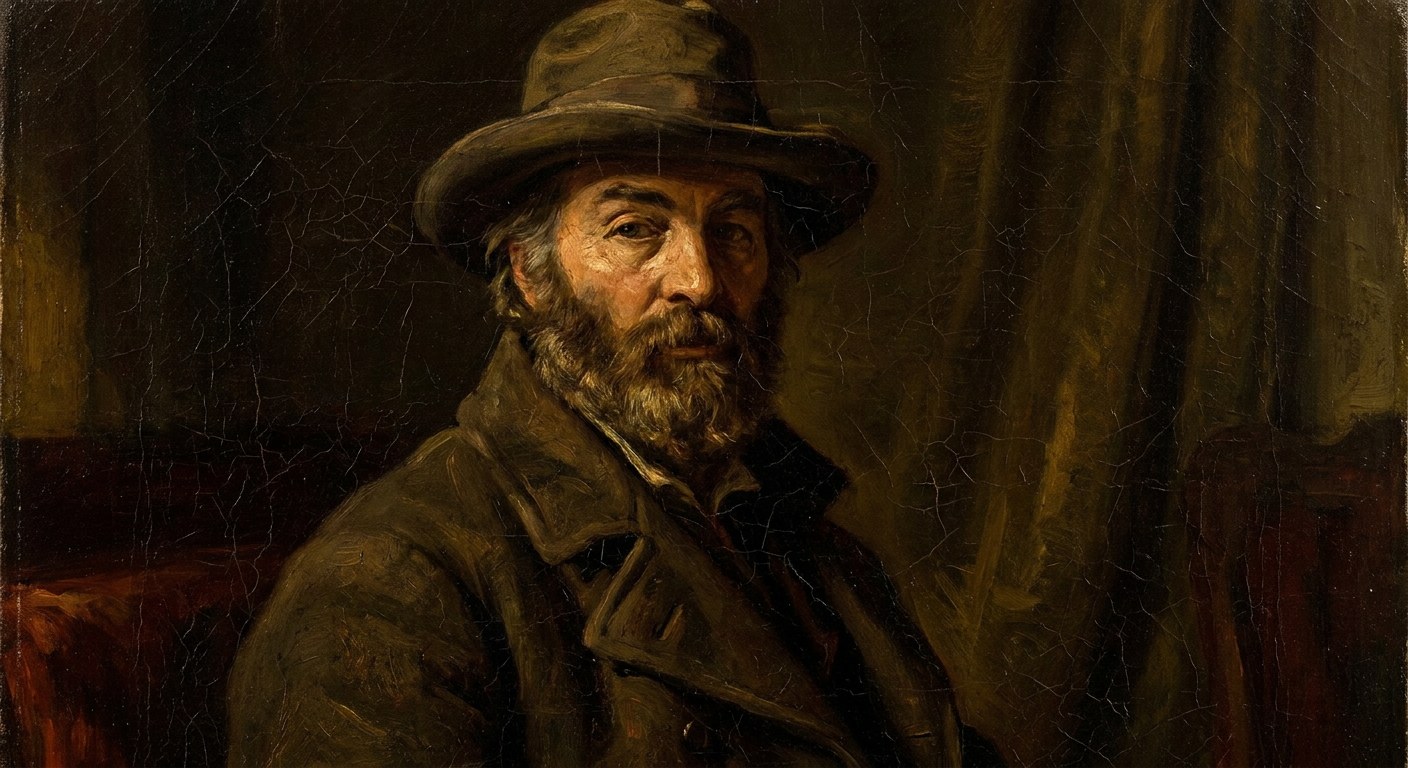
Walt Whitman
1819 – 1892 · American · Poet, Essayist & Journalist
Recommended Audiobooks
Listen next from Marcus Alden

Life Lessons from Frederic Chopin
Marcus Alden · 54 min

Life Lessons from John Wesley
Marcus Alden · 52 min
Introduction
Walt Whitman was one of the most revolutionary and influential poets in American literature. At a time when respectable English-language poetry generally favored regular meter, rhyme, elevated diction, and inherited European forms, Whitman developed a long-lined, expansive style capable of embracing ordinary speech, physical experience, political argument, and the crowded diversity of the United States. His central project, Leaves of Grass, grew from a slim collection of twelve poems in 1855 into the continuously revised work of a lifetime.
Whitman presented himself as a poet of democracy: a representative voice who could sing of laborers, enslaved people, immigrants, women, lovers, soldiers, cities, landscapes, and the human body. In poems such as “Song of Myself,” “Crossing Brooklyn Ferry,” and “I Sing the Body Electric,” he treated the individual self not as isolated but as connected to other people, nature, history, and the cosmos. His poetry combined confidence with contradiction, spirituality with sensuality, and public prophecy with intimate confession.
The American Civil War profoundly changed Whitman's writing and life. After searching for his wounded brother, he spent years visiting sick and injured soldiers in Washington hospitals. The experience produced some of the century's most moving war poems and prose, including Drum-Taps, “The Wound-Dresser,” and the Lincoln elegy “When Lilacs Last in the Dooryard Bloom'd.”
Whitman was controversial during his lifetime. Critics attacked his unconventional form, candid treatment of sexuality, celebration of the body, self-promotion, and shifting political attitudes. Questions concerning race, nationalism, and the meaning of the intensely affectionate poems in the “Calamus” cluster remain central to scholarship. Yet his willingness to imagine poetry as a democratic encounter transformed the possibilities of literary expression. He is now widely regarded as a founder of modern American poetry and one of the major poets of the nineteenth century.
Quick Facts
| Fact | Details |
|---|---|
| Born | May 31, 1819, West Hills, Long Island, New York, United States |
| Died | March 26, 1892, Camden, New Jersey, United States |
| Nationality | American |
| Known For | Leaves of Grass, “Song of Myself,” free-verse innovation, and Civil War poetry |
| Occupation | Poet, journalist, editor, essayist, teacher, and government clerk |
| Era | Nineteenth-century American literature; American Renaissance |
Early Life and Education
Walter Whitman Jr., later known simply as Walt Whitman, was born on May 31, 1819, in West Hills, a rural community near Huntington on Long Island. He was the second of nine children born to Walter Whitman Sr., a farmer and carpenter, and Louisa Van Velsor Whitman. His father's family had long roots on Long Island and was influenced by democratic politics and freethinking religious traditions. His mother, to whom Whitman remained deeply attached, came from a Dutch American farming family.
Several of the Whitman children were named for national heroes, including George Washington, Thomas Jefferson, and Andrew Jackson. The naming reflected the family's intense interest in the American republic, an interest that would later inform Whitman's poetic identity. His parents were not wealthy, and his father's attempts at farming, carpentry, and speculative housebuilding brought limited stability.
When Whitman was about four, the family moved to Brooklyn, which was rapidly changing from a small town into an urban center. He attended public schools but received only a modest formal education. At approximately eleven, he left school to help support the household. Much of his education afterward was self-directed through newspapers, libraries, lectures, theater, public debate, and close observation of the metropolitan world around him.
Whitman first worked as an office boy for Brooklyn lawyers. He then entered the printing trade, learning typesetting and becoming familiar with the material production of newspapers and books. Printing gave him practical skills that later proved crucial when he helped design, typeset, finance, and publicize editions of Leaves of Grass. A major fire damaged New York's printing district in 1835, reducing opportunities and contributing to his search for other employment.
Between 1836 and 1841, Whitman taught intermittently in rural schools on Long Island. He disliked the harsh discipline and rote instruction common in many classrooms, although the experience brought him into contact with varied communities. In 1838 he founded and briefly ran the Long-Islander, a Huntington newspaper. He reportedly delivered copies himself, gaining firsthand experience in nearly every part of local journalism.
During the early 1840s, Whitman wrote fiction, essays, reviews, and political commentary. His temperance novel, Franklin Evans; or, The Inebriate, appeared in 1842. Written quickly for popular consumption, it warned against alcohol abuse and became one of his most commercially successful publications, though Whitman later disparaged it.
These years exposed him to working-class life, urban crowds, ferry travel, popular entertainment, electoral politics, and the expanding newspaper culture of New York. Rather than receiving a university education, Whitman formed himself through print, conversation, travel, and experience—the democratic schoolroom that would become one of his poetry's governing ideas.
Rise to Prominence
Whitman worked for several newspapers and became editor of the influential Brooklyn Daily Eagle in 1846. His journalism reflected his involvement in Democratic Party politics, but his opposition to the expansion of slavery increasingly brought him into conflict with party leaders. In 1848 he lost his position at the Eagle, at least partly because of political disagreements.
That year Whitman traveled with his brother Jeff to New Orleans, where he briefly worked for the New Orleans Crescent. The journey gave him a broader view of the country and exposed him directly to the slaveholding South. Although Whitman opposed the extension of slavery into western territories and became associated with Free Soil politics, his views did not consistently embrace full racial equality. His attitudes contained prejudices common among many white Americans of his era, creating a significant tension between his democratic ideals and political statements.
After returning to Brooklyn, Whitman continued journalism, worked in printing and construction, and gradually developed a radically new kind of poetry. He read widely in the Bible, Shakespeare, Homer, Dante, European Romantic poetry, popular science, political oratory, and contemporary American literature. Ralph Waldo Emerson's call for an independent American poet was especially important, though Whitman's voice was unmistakably his own.
In 1855 Whitman privately printed the first edition of Leaves of Grass. The book contained twelve untitled poems and opened with an engraved portrait of Whitman dressed casually as a workingman, rather than as a conventionally genteel author. His name did not appear on the title page, but the text announced “Walt Whitman, an American, one of the roughs, a kosmos.” The long poem later titled “Song of Myself” dominated the collection.
Whitman sent copies to prominent writers, including Emerson. Emerson responded with a private letter praising the book as an extraordinary achievement and greeting Whitman “at the beginning of a great career.” Whitman publicized the endorsement without first obtaining Emerson's permission, even printing part of it on the spine of the 1856 edition. The action demonstrated his skill at literary self-promotion but also offended standards of private correspondence.
Early reviews ranged from admiration to disgust. Some anonymous favorable notices were written by Whitman himself, another example of his aggressive campaign to create an audience. Critics objected to the book's lack of conventional meter and its frank references to the body and sexuality. Nevertheless, the controversy gave Whitman visibility, and Leaves of Grass became the organizing work of his career.
Major Achievements and Contributions
Whitman's greatest achievement was the creation and lifelong transformation of Leaves of Grass. Rather than treating a book as finished, he repeatedly revised, reordered, expanded, and reinterpreted it. Major editions appeared in 1855, 1856, 1860, 1867, 1871–72, 1881–82, and the final 1891–92 “deathbed edition.” The original twelve poems eventually became a collection of nearly four hundred poems.
His poetry helped popularize free verse, though the term can conceal the deliberate structure of his writing. Whitman's lines often rely on biblical parallelism, repetition, catalogues, syntactic balance, alliteration, and rhythms modeled on speech, oratory, opera, and scripture. He rejected fixed meters without rejecting rhythm. The result was a flexible form suited to enumeration, meditation, dramatic address, and sudden shifts of scale.
Whitman also reimagined the subject of poetry. Mechanics, boatmen, mothers, prostitutes, farmers, firefighters, enslaved people, immigrants, and wounded soldiers entered his poems alongside stars, oceans, grass, death, and the soul. He insisted that the body was worthy of poetic celebration and that physical existence could not be neatly separated from spiritual life. This position challenged inherited moral and literary conventions.
His democratic poetics were equally innovative. Whitman's poetic “I” is personal, but it also reaches outward, inviting readers to recognize themselves within it. “Song of Myself” presents identity as plural, changing, and relational. The poet absorbs the nation, yet he also asks the reader to complete the poem through an imaginative encounter across time.
The Civil War gave Whitman's democratic vision a more somber and concrete form. In December 1862 he saw his brother George's name on a list of soldiers wounded at Fredericksburg. Whitman traveled south and found George alive with a relatively minor facial wound. The sight of amputated limbs and suffering soldiers, however, transformed him. He soon moved to Washington, D.C., where he visited military hospitals for several years.
Whitman was not formally employed as a military nurse, but he acted as a volunteer visitor and caregiver. He brought fruit, stationery, tobacco, small gifts, and money; wrote letters for soldiers; listened to their stories; and offered companionship. He estimated that he made hundreds of hospital visits and attended to thousands of patients. The work exhausted him physically but deepened his understanding of war beyond patriotic abstraction.
His wartime collection Drum-Taps appeared in 1865. A sequel added poems responding to Abraham Lincoln's assassination, including “When Lilacs Last in the Dooryard Bloom'd” and “O Captain! My Captain!” The latter, written in conventional rhyme and meter, became Whitman's most popular poem during his lifetime, though he eventually tired of being asked to recite it.
Whitman also made major contributions to prose. Democratic Vistas examined the moral and cultural challenges facing American democracy after the Civil War. Specimen Days combined autobiography, hospital memories, nature writing, and observations of national life. His essays and notebooks illuminate the creative process behind his public poetic persona.
Key Works / Battles / Ideas
Leaves of Grass
Whitman's masterwork was not a single stable text but an evolving poetic project. Its successive editions recorded changes in his language, politics, reputation, health, and historical circumstances. The title links the ordinary and individual—each blade or “leaf”—with a larger organic whole. “Grass” could also mean writing of supposedly humble value, while “leaves” referred to pages.
“Song of Myself”
Originally untitled in 1855 and later divided into fifty-two sections, “Song of Myself” is Whitman's defining poem. It celebrates the self while dissolving the boundaries between self and others. Its catalogues move across occupations, regions, races, genders, landscapes, and states of consciousness. The poem addresses death without treating it as final annihilation and ends with the poet imagining himself beneath the reader's feet.
“I Sing the Body Electric”
This poem declares that the body and soul are inseparable and equally sacred. Its detailed celebration of physical form was daring in the moral climate of nineteenth-century America. The poem also confronts slavery through an auction scene, insisting upon the immeasurable value of the person being sold, although modern readers continue to debate the limits of Whitman's racial imagination.
“Crossing Brooklyn Ferry”
Drawing on Whitman's regular travel between Brooklyn and Manhattan, this poem creates fellowship among commuters separated by generations. Water, sunlight, buildings, and the ferry become bridges between the poet and future readers. It is one of his clearest statements that shared perception can overcome historical distance.
The “Calamus” Poems
First published as a cluster in the 1860 edition of Leaves of Grass, the “Calamus” poems explore intense affection, comradeship, emotional vulnerability, and love between men. They are foundational texts in the history of queer literature. Scholars debate how directly they should be read as autobiography, but their same-sex emotional and erotic meanings are difficult to separate from Whitman's significance today.
Drum-Taps and the Civil War Poems
The war poems move from early martial excitement toward grief, tenderness, exhaustion, and reconciliation. “The Wound-Dresser” recalls Whitman's hospital visits through restrained descriptions of injured bodies. “Vigil Strange I Kept on the Field One Night” depicts a soldier keeping watch beside a dead comrade. Together these poems reject heroic simplification and preserve the intimate human cost of battle.
Lincoln Elegies
Whitman admired Abraham Lincoln as a symbolic embodiment of Union and democratic leadership, although the two men apparently never met. “When Lilacs Last in the Dooryard Bloom'd” uses recurring images of lilacs, a western star, and a hermit thrush to transform national mourning into an extended meditation on death. “O Captain! My Captain!” represents the nation as a ship whose captain dies just as victory is achieved.
Democratic Individualism
Whitman's central idea was that individual dignity and collective democracy depend on one another. His poetry seeks unity without erasing difference. Yet his work also demonstrates how difficult that ideal is to sustain: the inclusive speaker sometimes becomes possessive, and celebrations of America sometimes obscure exclusion, conquest, and inequality.
Timeline of Key Events
| Year | Event |
|---|---|
| 1819 | Born at West Hills on Long Island, New York, on May 31. |
| 1823 | Moves with his family to the growing city of Brooklyn. |
| 1830 | Leaves formal schooling at about age eleven and begins working. |
| 1836–1841 | Teaches intermittently in Long Island schools. |
| 1838 | Founds the Long-Islander newspaper in Huntington. |
| 1842 | Publishes the temperance novel Franklin Evans. |
| 1846 | Becomes editor of the Brooklyn Daily Eagle. |
| 1848 | Works briefly in New Orleans and becomes associated with Free Soil politics. |
| 1855 | Self-publishes the first edition of Leaves of Grass. |
| 1856 | Publishes an expanded second edition featuring Emerson's endorsement. |
| 1860 | Issues the important third edition, including the “Calamus” poems. |
| 1862 | Travels to Virginia after learning that his brother George was wounded. |
| 1863–1865 | Visits wounded and sick soldiers in Washington military hospitals. |
| 1865 | Publishes Drum-Taps; writes major elegies after Lincoln's assassination; is dismissed from the Interior Department. |
| 1867 | Publishes the fourth edition of Leaves of Grass. |
| 1871 | Publishes Democratic Vistas. |
| 1873 | Suffers a serious stroke and moves to Camden, New Jersey; his mother dies that year. |
| 1881–1882 | The Boston edition of Leaves of Grass is challenged for alleged obscenity. |
| 1882 | Publishes Specimen Days. |
| 1884 | Purchases a house at 328 Mickle Street in Camden. |
| 1891–1892 | Prepares the final “deathbed edition” of Leaves of Grass. |
| 1892 | Dies in Camden on March 26 and is buried in Harleigh Cemetery. |
Personal Life and Character
Whitman cultivated a carefully recognizable public image. In the 1855 portrait he appeared with open collar, broad-brimmed hat, and hand on hip—the democratic workingman rather than the formal literary gentleman. In later life, his gray beard, plain clothing, and calm manner supported the image of the benevolent “Good Gray Poet.” This persona was genuine in some respects but also deliberately constructed.
Friends described Whitman as sociable, affectionate, observant, and capable of making people feel heard. His hospital work demonstrated patience and practical compassion. At the same time, he could be vain, evasive, and highly strategic about his reputation. He saved documents, shaped biographical accounts, encouraged disciples, and blurred the line between private identity and poetic myth.
Whitman never married and had no verified children. His most significant known attachments included close relationships with men such as Peter Doyle, a former Confederate soldier and Washington streetcar conductor, and Harry Stafford, a younger man from New Jersey. His notebooks, letters, and “Calamus” poems attest to the importance of male companionship and desire in his emotional life. Modern scholars frequently describe Whitman as gay or queer, although nineteenth-century identities and terminology do not correspond exactly to modern categories.
He was also close to several women, including the English writer Anne Gilchrist, who published a passionate defense of Leaves of Grass and later moved to the United States with hopes connected to Whitman. He valued her deeply but did not return her romantic expectations in the same way.
Whitman's strongest lifelong family bond was with his mother. He also supported siblings who experienced financial instability, disability, and mental illness. Family obligations, friendship, and care were central to his life, even as his poetry projected a fiercely independent self.
Challenges and Controversies
The explicit physicality of Leaves of Grass made Whitman notorious. Some readers praised his candor, while others considered the poems indecent. In 1865 Secretary of the Interior James Harlan dismissed Whitman from a government clerkship, apparently after discovering and disapproving of Leaves of Grass. Whitman's friend William Douglas O'Connor responded with The Good Gray Poet, a vigorous pamphlet portraying him as a persecuted literary genius.
A larger obscenity dispute arose in 1881–82 when Boston district attorney Oliver Stevens, acting through the publisher, demanded changes to passages in Leaves of Grass. Whitman refused to make the required alterations. The Boston publisher stopped issuing the book, but a Philadelphia firm released it, and the publicity helped increase sales.
Whitman's racial politics remain a serious subject of criticism. He opposed slavery's expansion and celebrated an interracial democratic nation in important poems. He cared for soldiers regardless of region and expressed hope for national reconciliation. Yet some of his journalistic and private comments repeated racist assumptions, and he did not consistently support equal civil and political rights for Black Americans. His writings can therefore be inclusive in aspiration while reflecting the hierarchies of his time.
His nationalism is similarly complex. Whitman celebrated continental expansion and imagined the United States as historically destined for greatness. Such confidence could overlook the displacement of Indigenous peoples, the violence of expansion, and economic inequality. Later works such as Democratic Vistas are more anxious, warning that political institutions alone cannot sustain democracy without a corresponding ethical and cultural transformation.
Whitman's methods of self-promotion also drew criticism. He wrote anonymous reviews praising his own book, circulated Emerson's private endorsement, and encouraged a heroic account of his career. These tactics helped an unconventional poet survive in a difficult literary marketplace, but they complicate the spontaneous, natural image he projected.
Finally, the interpretation of his sexuality has generated debate. Earlier biographers often minimized the erotic force of the “Calamus” poems or treated them only as abstract democratic comradeship. Later scholarship restored same-sex love to the center of his work. It remains important, however, to distinguish historical evidence from unsupported claims and to recognize that Whitman sometimes concealed, revised, or redirected questions about his private life.
Death and Immediate Aftermath
A stroke in 1873 left Whitman partially paralyzed and began a long period of declining health. He settled in Camden, initially living with his brother George and sister-in-law Louisa. In 1884 he purchased a modest house at 328 Mickle Street, where friends and caregivers assisted him as his mobility deteriorated.
Whitman completed the final arrangement of Leaves of Grass, known as the “deathbed edition,” shortly before his death. He died at his Camden home on March 26, 1892, aged seventy-two, after prolonged illness involving severe respiratory and other health problems.
Thousands visited his body during the public viewing. Whitman was buried in a large, self-designed granite tomb in Harleigh Cemetery, Camden, where several members of his family were also interred. Obituaries recognized his fame but continued to debate whether he was a great national poet or a disruptive eccentric.
Legacy and Influence Today
Whitman's influence extends across American poetry and far beyond it. Later poets learned from his long line, conversational address, catalogues, bodily imagery, urban subject matter, and combination of private identity with public history. His heirs include Hart Crane, William Carlos Williams, Langston Hughes, Allen Ginsberg, Pablo Neruda, Federico García Lorca, Adrienne Rich, June Jordan, and many others, even when they challenged his assumptions.
Modernist and Beat poets found in him permission to reject inherited formal restraints. Ginsberg's “A Supermarket in California,” for example, directly addresses Whitman as a poetic ancestor while questioning the promises of American abundance and freedom. Hughes adapted Whitman's democratic singing to insist that Black voices belonged at the center of the national poem.
Whitman also occupies an important place in LGBTQ+ literary history. The “Calamus” poems offered later readers a language of same-sex affection at a time when such expression was often hidden or criminalized. His work has become a source of recognition, debate, and creative reinterpretation for queer writers and scholars.
His Civil War writings remain indispensable records of caregiving, trauma, mourning, and reconciliation. They are studied not merely as patriotic literature but as testimony to the bodily and emotional consequences of war. His notebooks and letters preserve voices and experiences that conventional military histories may overlook.
Whitman's democratic claims continue to inspire because they remain unfinished. Readers can admire his effort to include multitudes while questioning whom his imagined nation excluded. That tension makes him more than a monument to national confidence: it makes his work an ongoing argument about equality, identity, citizenship, sexuality, race, and the responsibilities of art.
The Walt Whitman Birthplace in New York and the Walt Whitman House in Camden preserve major sites associated with his life. His poetry is taught worldwide, quoted in political and cultural settings, adapted in music and film, and translated into numerous languages. More than a century after his death, his direct address still makes readers feel that the poet is speaking across time to them personally.
Famous Quotes
“I celebrate myself, and sing myself.”
—“Song of Myself”
“Do I contradict myself? / Very well then I contradict myself, / (I am large, I contain multitudes.)”
—“Song of Myself”
“I sound my barbaric yawp over the roofs of the world.”
—“Song of Myself”
“Not I, nor anyone else can travel that road for you. / You must travel it for yourself.”
—“Song of Myself”
“O Captain! my Captain! our fearful trip is done.”
—“O Captain! My Captain!”
“That the powerful play goes on, and you may contribute a verse.”
—“O Me! O Life!”
“Resist much, obey little.”
—“To the States”
Frequently Asked Questions
Why is Walt Whitman important?
Whitman transformed American poetry by developing an expansive free-verse style and treating democracy, sexuality, labor, the body, cities, nature, and ordinary people as major poetic subjects. His work helped establish a distinctively American literary voice and influenced generations of poets around the world.
What is Walt Whitman's most famous work?
His most important work is Leaves of Grass, a collection he revised throughout his life. Its best-known poems include “Song of Myself,” “I Sing the Body Electric,” “Crossing Brooklyn Ferry,” “When Lilacs Last in the Dooryard Bloom'd,” and “O Captain! My Captain!”
Did Walt Whitman invent free verse?
Whitman did not single-handedly invent poetry without regular rhyme or meter; earlier traditions and writers had used flexible forms. He did, however, become one of free verse's most influential pioneers in English. His long lines, parallel structures, catalogues, and speechlike rhythms opened new possibilities for modern poetry.
Was Walt Whitman a Civil War nurse?
He is often called a Civil War nurse, but he did not hold a formal nursing appointment. He was a volunteer hospital visitor and caregiver who brought supplies, wrote letters, talked with soldiers, and comforted the sick and wounded. His sustained service had many nursing functions and profoundly shaped his writing.
Did Walt Whitman know Abraham Lincoln?
Whitman admired Lincoln and saw him on several occasions, but there is no evidence that they personally met. Lincoln became an important symbol in Whitman's imagination. After the president's assassination, Whitman wrote major elegies including “When Lilacs Last in the Dooryard Bloom'd” and “O Captain! My Captain!”
Was Walt Whitman gay?
Whitman's writings and documented relationships show that love, desire, and intimacy between men were central to his life and poetry. Many modern scholars describe him as gay or queer. Because modern sexual identity categories were not used in precisely the same way during his lifetime, responsible biographies also acknowledge the historical difference while not minimizing the evidence.
Why was Leaves of Grass considered controversial?
The book rejected conventional poetic forms and spoke openly about the body, desire, and sexuality. Critics considered some passages obscene, and government and legal authorities challenged the work. Whitman's self-promotion, political claims, and unconventional presentation also offended many nineteenth-century readers.
How did Walt Whitman's poetry change after the Civil War?
Before the war, Whitman's verse often expressed exuberant confidence in the unity of the self and the nation. His hospital experiences introduced greater grief, restraint, and attention to individual suffering. The later poetry did not abandon democracy, but it tested democratic ideals against death, division, and traumatic memory.
Lessons We Can Learn
-
Create forms equal to new experiences. Whitman did not merely imitate established models. He reshaped poetic rhythm and structure to represent crowds, movement, democracy, and modern life.
-
Attention can be an act of care. His hospital service shows the value of listening, writing for others, and offering practical companionship when dramatic solutions are impossible.
-
Identity can contain contradiction. Whitman's “multitudes” remind readers that human beings are complex and changing. Contradiction can produce insight when it is honestly examined rather than ignored.
-
Great ideals require critical scrutiny. Whitman's democratic vision was inspiring, but his racial prejudices and expansionist assumptions reveal gaps between universal language and actual equality. Admiration should not prevent criticism.
-
Art can remain a lifelong project. By revising Leaves of Grass for nearly four decades, Whitman demonstrated that creative work can evolve with history, experience, and self-understanding.
Further Reading
- David S. Reynolds, Walt Whitman's America: A Cultural Biography (1995).
- Justin Kaplan, Walt Whitman: A Life (1980).
- Jerome Loving, Walt Whitman: The Song of Himself (1999).
- Gay Wilson Allen, The Solitary Singer: A Critical Biography of Walt Whitman (revised edition, 1967).
- Ed Folsom and Kenneth M. Price, Re-Scripting Walt Whitman: An Introduction to His Life and Work (2005).
Watch and Learn
Why should you read Walt Whitman? · TED-Ed