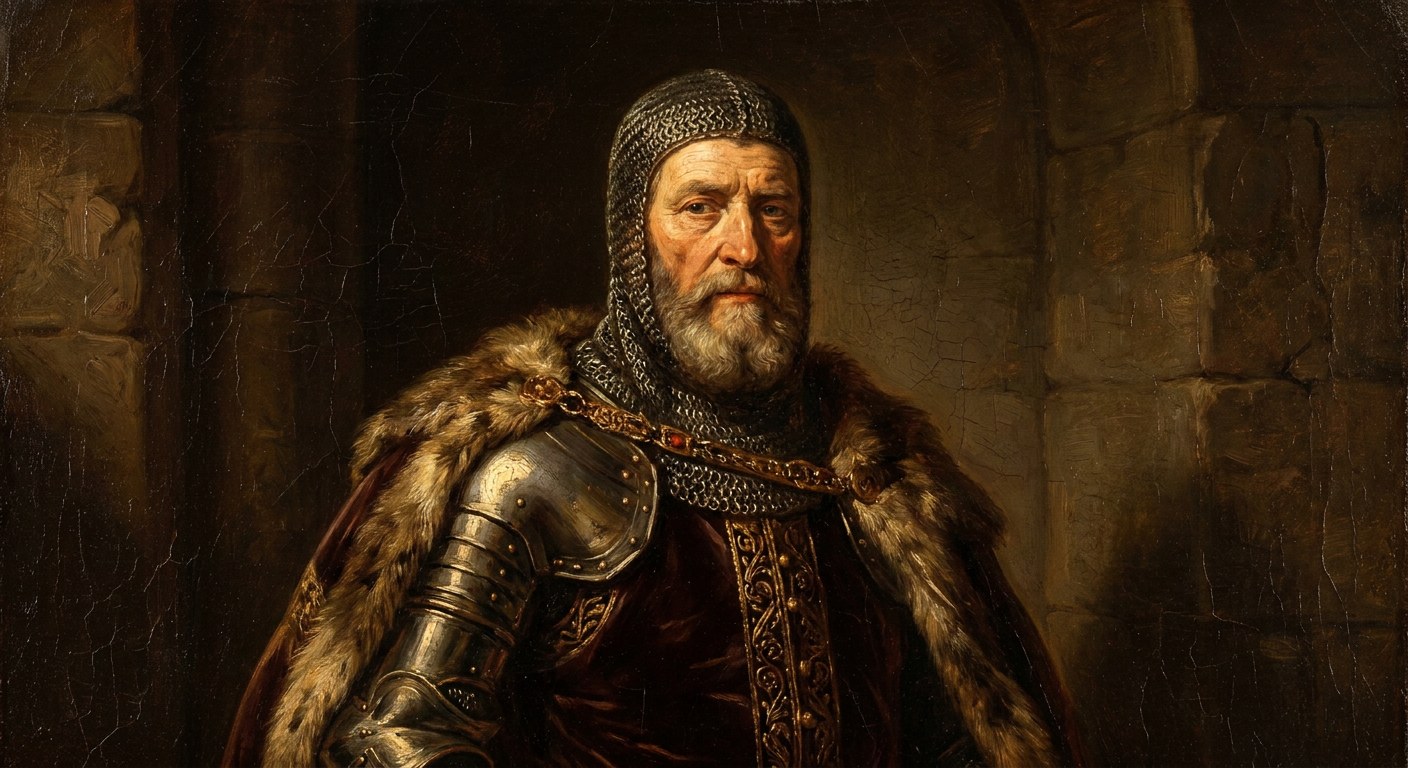
William Marshal
1146 – 1219 · English · Knight & Statesman
Recommended Audiobooks
Listen next from Marcus Alden

Life Lessons from Frederic Chopin
Marcus Alden · 54 min

Life Lessons from John Wesley
Marcus Alden · 52 min
Introduction
William Marshal, 1st Earl of Pembroke (c. 1147–14 May 1219), was one of the most celebrated knights, commanders and statesmen of medieval Europe. Rising from the comparatively modest position of a younger son, he served five English kings—Henry II, the “Young King” Henry, Richard I, John and Henry III—and became one of the wealthiest and most powerful magnates in the Angevin world.
Marshal’s career encompassed almost every major arena of aristocratic life in the 12th and early 13th centuries. He won fame on the tournament circuit, fought in France and England, guarded royal heirs, negotiated between rebellious barons and kings, acquired extensive estates through marriage, helped manage the English monarchy and, in his seventies, led a decisive cavalry charge at the Battle of Lincoln. After King John’s death in 1216, Marshal served as regent for the nine-year-old Henry III and helped preserve the Plantagenet dynasty during a civil war and French invasion.
Much of what is known about him comes from the Histoire de Guillaume le Maréchal—The History of William Marshal—a long Anglo-Norman verse biography commissioned by his family shortly after his death. Although written to celebrate him, it provides an unusually detailed portrait of aristocratic society, warfare, tournaments, loyalty and political culture in the High Middle Ages.
Later tradition called Marshal “the greatest knight that ever lived.” That judgment is romanticized, but it reflects the extraordinary range of his achievements. He was not merely a warrior: he was also a landholder, diplomat, household administrator, husband, father and guardian of a kingdom.
Quick Facts
| Field | Details |
|---|---|
| Full name | William Marshal, or William le Marshal |
| Born | c. 1147, probably in Wiltshire or Berkshire, England |
| Died | 14 May 1219 |
| Place of death | Caversham, near Reading, Berkshire |
| Burial place | Temple Church, London |
| Father | John Marshal |
| Mother | Sibyl of Salisbury |
| Spouse | Isabel de Clare, married in 1189 |
| Title | 1st Earl of Pembroke |
| Principal lordships | Pembroke, Striguil, Leinster, Longueville and extensive estates in England, Wales, Ireland and Normandy |
| Known for | Tournament success, royal service, military leadership and the regency of Henry III |
| Kings served | Henry II, Henry the Young King, Richard I, John and Henry III |
| Major battle | Battle of Lincoln, 20 May 1217 |
| Political role | Regent and guardian of Henry III, 1216–1219 |
| Primary medieval source | The History of William Marshal |
| Religious affiliation | Latin Christianity; admitted to the Knights Templar before death |
Early Life & Background
William was born around 1147, though the exact year and location remain uncertain. He was the younger son of John Marshal, an important royal household official and landholder, and Sibyl of Salisbury, daughter of Walter of Salisbury. The surname “Marshal” originated in a hereditary court office associated with responsibility for horses, stables and the organization of the royal household. By William’s lifetime, the family’s duties and influence extended well beyond those practical origins.
His childhood unfolded during the Anarchy, the civil war between King Stephen and Empress Matilda over the English succession. John Marshal supported Matilda and her son, the future Henry II, though his allegiance, like that of many barons, was shaped by local conditions and political survival.
In 1152, when William was about five or six, King Stephen besieged John Marshal at Newbury Castle. William was handed over as a hostage to guarantee a truce. John reportedly used the respite to strengthen the castle rather than surrender it. According to Marshal’s later biography, when Stephen threatened to hang the child, John declared that he still possessed “the hammer and the anvils” with which to forge better sons. The story may have been embellished, but it captures the brutality of civil war and the vulnerability of aristocratic children used as political guarantees.
Stephen did not kill William. The king is said to have been charmed by the boy’s fearlessness and protected him during the siege. This episode became the first dramatic scene in the Marshal legend: a child seemingly marked for death who survived to become guardian of the English crown.
As a younger son, William could not expect to inherit the bulk of his father’s property. Around 1160, he was sent to Normandy to train in the household of William de Tancarville, a relative of his mother and hereditary chamberlain of Normandy. Such fosterage was a standard path into knighthood. William learned horsemanship, weaponry, hunting, courtly behavior and the management of aristocratic households.
He was probably knighted in 1166. At first, however, he possessed little beyond his equipment, training and connections. His subsequent rise depended on military skill, personal reputation and the patronage of powerful lords.
Rise to Prominence
William’s early career combined warfare with tournaments. In 1167, he participated in fighting in Normandy, where his courage attracted attention even though he had yet to acquire wealth. Medieval knights needed horses, armor, servants and ransom money, and bravery alone did not guarantee financial security.
In 1168, Marshal entered the service of Patrick, Earl of Salisbury, his maternal uncle. While escorting Queen Eleanor of Aquitaine through Poitou, the party was ambushed by forces associated with the Lusignan family. Patrick was killed, and William fought fiercely before being wounded and captured. He was eventually ransomed by Eleanor, an act that brought him into the orbit of the Angevin royal family.
By 1170, Henry II had appointed William to the household of his eldest surviving son, Henry the Young King. The younger Henry had been crowned during his father’s lifetime but possessed little independent authority. Marshal became his military tutor, companion and eventually one of the leading figures in his household.
When the Young King and his brothers rebelled against Henry II in 1173–1174, Marshal remained loyal to his immediate lord. He claimed to have knighted the Young King during the rebellion. After the revolt failed, the prince was reconciled with his father, and Marshal’s career survived.
During the later 1170s, William became famous in tournaments across northern France and the Low Countries. These were not yet the carefully regulated jousts of later medieval romance. They were large, dangerous mock battles in which groups of knights fought over extensive terrain, capturing opponents and claiming their horses, armor and ransoms.
Marshal excelled in this environment. He formed partnerships with other knights, most notably Roger de Gaugi, and combined physical skill with tactical judgment. His biography records that he and a companion calculated they had taken more than 100 knights in a relatively short period. Such success made him wealthy and internationally renowned.
In 1182, Marshal was accused of improper intimacy with Margaret of France, the Young King’s wife. The allegation was probably political, intended to damage his influence. William denied it and reportedly offered to defend himself in judicial combat, but he was dismissed from the prince’s household.
The estrangement did not last. In 1183, the Young King rebelled again and then fell ill with dysentery near Martel in the Limousin. Marshal returned to his service before his death on 11 June. The dying prince charged him with carrying his crusading cloak, or cross, to Jerusalem. William fulfilled the vow on his lord’s behalf, traveling to the Holy Land around 1184–1186. Details of the journey are scarce, though it strengthened his religious and chivalric reputation.
After returning, Marshal entered the service of Henry II. His loyalty during the king’s final years brought him closer to the center of royal government and prepared the way for his transformation from household knight into great magnate.
Major Achievements
William Marshal’s most remarkable achievement was the scale of his social ascent. Born a land-poor younger son, he became an earl with estates spread across several realms. This advancement rested partly on his martial reputation, but also on his ability to retain royal trust across successive reigns.
During Henry II’s final conflict with Richard, Count of Poitou, and King Philip II of France in 1189, Marshal commanded part of the royal rearguard. In a famous encounter near Le Mans, he confronted Richard. According to the History, Marshal could have killed him but instead drove his lance into Richard’s horse. When Richard later reproached him, William replied that he had spared the prince’s life.
Henry II died at Chinon on 6 July 1189. Despite Marshal’s opposition to him, Richard recognized his value. The new king confirmed Henry’s promise that William could marry Isabel de Clare, the wealthy heiress of Richard de Clare, known as “Strongbow,” and Aoife of Leinster. Their marriage in August 1189 gave William control of extensive estates in England, Wales, Normandy and Ireland.
Through Isabel, he acquired the lordship of Striguil, centered on Chepstow Castle; lands in Pembrokeshire; the lordship of Leinster; and the Norman honor of Longueville. Although his precise use of the title developed over time, by the reign of John he was recognized as Earl of Pembroke.
Under Richard I, Marshal served as a royal councillor and military supporter. During Richard’s absence on the Third Crusade and subsequent captivity, Marshal aligned himself with the government led by the justiciar Hubert Walter and resisted the ambitions of Prince John. His position required careful judgment: he opposed John’s disloyal actions without making reconciliation impossible.
When Richard died in 1199, Marshal supported John’s claim to the English throne over that of Arthur of Brittany, the son of John’s elder brother Geoffrey. Marshal’s backing helped John secure power in England, though Arthur retained considerable support in Brittany, Anjou and among King Philip II’s allies.
Marshal also transformed his Irish lordship. During periods of royal disfavor, particularly after 1205, he spent more time in Leinster. He reorganized estates, founded towns, supported religious institutions and developed castles, including the great stronghold at Kilkenny. His administration contributed to the consolidation of Anglo-Norman power in southeastern Ireland.
His crowning public achievement came after John’s death in 1216. Elected guardian of the young Henry III and leader of the royalist government, Marshal rescued a monarchy threatened by civil war, baronial rebellion and invasion by Prince Louis of France.
Defining Moments
Marshal’s childhood survival at Newbury gave his life a legendary beginning, but his defining moments repeatedly involved choices between competing loyalties.
The first was his service to Henry the Young King. Marshal’s fidelity to a rebellious prince might appear inconsistent with loyalty to Henry II. In feudal and household culture, however, personal service to one’s immediate lord could coexist uneasily with broader obligations to the king. Marshal’s actions reflected a world in which political loyalty was layered rather than absolute.
A second defining moment came in 1189, when he spared Richard’s life while resisting his advance. Whether the encounter occurred exactly as described or was later dramatized, it illustrated an ideal central to Marshal’s reputation: courage moderated by restraint.
His marriage to Isabel de Clare was equally transformative. It converted reputation into lasting landed power. Unlike many politically arranged aristocratic marriages, theirs appears to have become a strong partnership. Isabel played an important role in protecting the family’s rights in Ireland and transmitting the de Clare inheritance to their children.
Another critical period followed King John’s loss of Normandy in 1204. Marshal held lands on both sides of the Channel. To preserve his Norman estates, he paid homage to Philip II of France. John regarded such divided allegiance with suspicion. Their disagreement led to years of tension, demands for hostages and pressure on Marshal’s followers.
Marshal nevertheless returned to the center of English politics during the crisis that produced Magna Carta. In June 1215, he helped negotiate between John and the rebel barons at Runnymede. He remained loyal to the king, but his credibility with both sides made him a valuable intermediary.
After John repudiated the charter, civil war resumed. The rebels invited Prince Louis, son of Philip II, to take the English crown. Louis landed in Kent in May 1216 and gained control of London and much of eastern England. John died at Newark Castle on 19 October 1216, leaving his nine-year-old son Henry in a perilous position.
Marshal, then about seventy, accepted responsibility as guardian of the king and kingdom. Henry III was crowned at Gloucester on 28 October using a simple circlet because the royal regalia had been lost or remained inaccessible. Marshal’s government reissued Magna Carta in November 1216, omitting its most contentious provisions and presenting the royal minority as an opportunity for reconciliation.
On 20 May 1217, Marshal led royalist forces at the Battle of Lincoln. Rebel and French troops occupied much of the city while besieging Lincoln Castle, held for Henry by Nicola de la Haie. Marshal’s army attacked, penetrated the city and defeated the opposing force. Despite his age, he reportedly fought near the front and led a cavalry charge. The victory broke the military strength of Louis’s cause.
A royalist naval victory off Sandwich in August further weakened the French. The resulting Treaty of Lambeth, also called the Treaty of Kingston, ended the invasion in September 1217. Marshal favored relatively lenient terms, seeking to restore peace rather than permanently dispossess the rebels.
In November 1217, the government again reissued Magna Carta and issued the Charter of the Forest. These documents helped establish the principle that royal government could be constrained and stabilized through written concessions made in the king’s name.
Timeline
| Year | Event |
|---|---|
| c. 1147 | William Marshal is born, the younger son of John Marshal and Sibyl of Salisbury. |
| 1152 | He is given to King Stephen as a hostage during the siege of Newbury Castle. |
| c. 1160 | Sent to Normandy to train in the household of William de Tancarville. |
| 1166 | Probably knighted; begins active military service. |
| 1168 | Patrick, Earl of Salisbury, is killed in an ambush in Poitou; William is wounded and captured. |
| 1170 | Joins the household of Henry the Young King as tutor and companion. |
| 1173–1174 | Supports the Young King in the revolt against Henry II. |
| 1170s | Builds a celebrated reputation on the tournament circuit. |
| 1182 | Dismissed from the Young King’s household after allegations concerning Queen Margaret. |
| 1183 | Reconciled with the Young King shortly before the prince’s death at Martel. |
| c. 1184–1186 | Travels to the Holy Land to fulfill the Young King’s crusading vow. |
| 1187 | Returns to Angevin service under Henry II. |
| 1189 | Fights in Henry II’s final campaign; Richard I succeeds; William marries Isabel de Clare. |
| 1190–1194 | Helps support royal government during Richard I’s crusade and captivity. |
| 1199 | Supports John’s accession after Richard’s death. |
| 1204 | The English crown loses Normandy to Philip II of France. |
| 1205–1207 | Falls into dispute with John over homage to the French king and control of his cross-Channel estates. |
| 1207–1213 | Spends substantial periods in Ireland developing the lordship of Leinster. |
| 1215 | Acts as an intermediary during the negotiations leading to Magna Carta at Runnymede. |
| 1216 | John dies; Marshal becomes guardian of the nine-year-old Henry III and regent of England. |
| 20 May 1217 | Leads the royalist victory at the Battle of Lincoln. |
| September 1217 | Helps negotiate the Treaty of Lambeth, ending Prince Louis’s campaign in England. |
| November 1217 | Oversees the reissue of Magna Carta and the issue of the Charter of the Forest. |
| 1218 | Continues governing in Henry III’s name while managing disputes within the royal council. |
| 14 May 1219 | Dies at Caversham. |
| 20 May 1219 | Buried in Temple Church, London. |
Personal Life
William married Isabel de Clare in August 1189. She was approximately seventeen, while he was in his early forties. The age difference was not unusual in a high-ranking political marriage, especially one involving a major heiress.
Isabel was the daughter of Richard de Clare, Earl of Pembroke, and Aoife, daughter of Diarmait Mac Murchada, king of Leinster. Her inheritance made her one of the richest women in the Angevin dominions. William’s authority over the estates derived substantially from her hereditary rights, making the marriage the foundation of the Marshal family’s greatness.
The couple had ten children—five sons and five daughters:
- William Marshal, 2nd Earl of Pembroke
- Richard Marshal, 3rd Earl of Pembroke
- Gilbert Marshal, 4th Earl of Pembroke
- Walter Marshal, 5th Earl of Pembroke
- Anselm Marshal, 6th Earl of Pembroke
- Matilda Marshal
- Isabel Marshal
- Sibyl Marshal
- Eva Marshal
- Joan Marshal
All five sons inherited the earldom in succession, but none left legitimate surviving children. After Anselm’s death in 1245, the Marshal inheritance was divided among the descendants of the five daughters.
Through those daughters, William became an ancestor of numerous noble and royal families. Matilda married first Hugh Bigod and later William de Warenne. Isabel married Gilbert de Clare and later Richard of Cornwall, brother of Henry III. Sibyl married William de Ferrers, Earl of Derby; Eva married William de Braose; and Joan married Warin de Munchensi.
The History of William Marshal presents William and Isabel’s marriage as affectionate and cooperative. At the end of his life, Isabel and their children gathered around him at Caversham. She survived him by less than a year, dying in 1220.
Beliefs & Philosophy
William left no personal treatise, so his beliefs must be reconstructed from his actions and from the values promoted by his biography. Those values included loyalty, courage, reputation, generosity, household solidarity and service to a legitimate lord.
His concept of loyalty was practical rather than simplistic. He served successive rulers whose interests sometimes conflicted, and he occasionally had obligations to both the English and French crowns. His aim was generally to preserve honor while avoiding irreparable breaches with powerful opponents.
Marshal’s conduct also reflected the aristocratic Christian culture of his age. He undertook a journey to the Holy Land on behalf of the Young King, patronized religious institutions and prepared carefully for death. Shortly before dying, he was admitted to the Knights Templar, an order he had respected for decades. He was buried in Temple Church, the Templars’ London church, where his effigy remains.
His approach to government emphasized restoration over revenge. As regent, he offered moderate terms to former rebels and reissued Magna Carta. This policy was not democratic in the modern sense; it was designed to restore aristocratic cooperation and secure the dynasty. Nevertheless, it demonstrated his belief that stable rule depended on negotiated consent, credible promises and limits on arbitrary retaliation.
Challenges & Controversies
Marshal’s career was celebrated, but it was not free from controversy. His loyalty to Henry the Young King during the rebellion of 1173–1174 placed him on the side of a son fighting his crowned father. Later writers interpreted this as honorable fidelity to his immediate lord, though contemporaries could also view it as rebellion.
The allegation that he had an affair with Margaret of France remains impossible to verify. Most historians treat it as a courtly slander devised by rivals, particularly because no convincing evidence survives and Marshal openly challenged his accusers.
His relationship with King John was deeply ambiguous. Marshal remained loyal during the baronial revolt, even when John distrusted and humiliated him. Yet he also defended his own interests, paid homage to Philip II for his Norman lands and resisted some royal demands. John at times required members of Marshal’s family or household as hostages and attempted to undermine his position in Ireland.
Marshal was also a conqueror and colonial lord in Ireland. His development of Leinster strengthened Anglo-Norman settlement at the expense of existing Irish political structures and communities. Older heroic biographies often treated castle construction and estate expansion purely as administrative achievements. Modern scholarship places them within the wider history of conquest, displacement and contested sovereignty.
The History of William Marshal itself must be used critically. It was commissioned by his family, probably initiated by his eldest son, and composed to defend his reputation. Its author had access to eyewitnesses and household memories, but the work is not neutral. It emphasizes Marshal’s loyalty and courage, minimizes failures and shapes events according to chivalric ideals.
Even his famous title as “the greatest knight” requires qualification. The precise phrase is often linked to the judgment of the English churchman Stephen Langton, but its popular modern form owes much to later historical writing. Marshal was unquestionably exceptional, yet his reputation was consciously constructed by descendants, retainers, chroniclers and modern biographers.
Famous Quotes
No securely authenticated collection of William Marshal’s spoken words survives. The following statements come from, or are traditionally associated with, the medieval History of William Marshal and are given in modern English translation.
“I could have killed you, but I did not. I killed your horse.”
Traditionally presented as Marshal’s response to Richard after their encounter during Henry II’s final campaign in 1189.
“I have given myself to God.”
A sentiment attributed to Marshal during his final illness, when he renounced secular concerns and prepared for admission to the Knights Templar.
“The king is in your care; I can do no more.”
Words associated in later translations with Marshal’s final transfer of responsibility for Henry III and the kingdom to the papal legate Pandulf Verraccio and other royal advisers.
The best-known saying connected with Marshal was spoken not by him, but allegedly by his father during the siege of Newbury:
“I still have the hammer and the anvils with which to forge still better sons.”
Its survival in Marshal’s family biography turned his childhood ordeal into a powerful story of danger, endurance and destiny.
Legacy & Influence
William Marshal’s immediate legacy was the survival of Henry III’s monarchy. In October 1216, the royalist cause appeared close to collapse. Much of England was controlled by rebels or French forces, royal finances were strained and the new king was a child. Marshal’s prestige persuaded many nobles that Henry’s government was viable.
The victory at Lincoln, the naval success at Sandwich and the Treaty of Lambeth ended Prince Louis’s bid for the throne. Marshal’s policy of allowing former rebels to recover lands in exchange for renewed allegiance helped heal the kingdom more quickly than a program of wholesale punishment might have done.
His regency also influenced the constitutional history of England. The reissues of Magna Carta in 1216 and 1217 detached the charter from the immediate rebellion against John and made it part of the new king’s legitimate government. The 1217 Charter of the Forest addressed royal control over forest law and became an important companion to Magna Carta.
Marshal’s family did not retain its male-line power for long. All five of his sons died without legitimate heirs, and the vast inheritance was partitioned. Yet his daughters spread Marshal ancestry among leading aristocratic families, including the Clares, Bigods, Warennes, Ferrers and Braoses. Through these lines, he became an ancestor of later English and Scottish monarchs.
His physical memorial is the effigy in Temple Church, traditionally identified as William’s. The church was damaged during the Second World War, but the monument remains among the most recognizable survivals associated with medieval knighthood.
Literarily, the History of William Marshal is one of the earliest substantial secular biographies in a European vernacular. Its roughly 19,000 lines provide rare insight into tournaments, ransom practices, household politics, warfare, marriage and royal service. William’s fame today owes much to the rediscovery and publication of this text in the 19th and 20th centuries.
Marshal’s enduring appeal comes from the combination of romantic and political elements in his life. He was a tournament champion who became a statesman, a younger son who married a great heiress, and an elderly knight who led an army to preserve a child’s throne. His career illustrates both the ideals and the realities of medieval aristocratic power.
Interesting Facts
- William’s surname referred originally to his family’s hereditary office rather than to a modern military rank.
- He survived being used as a hostage by King Stephen when he was only about five or six years old.
- His knightly education took place mainly in Normandy rather than England.
- Tournament victories could be highly profitable because captured knights, horses and equipment were ransomed.
- He served five crowned kings if Henry the Young King is counted alongside Henry II, Richard I, John and Henry III.
- Marshal traveled to the Holy Land before the Third Crusade, fulfilling a vow made by the Young King.
- His marriage made him lord of territories in England, Wales, Ireland and Normandy.
- Chepstow Castle became one of the principal centers of his power.
- He was around seventy years old when he fought at the Battle of Lincoln.
- Nicola de la Haie’s defense of Lincoln Castle was essential to the royalist victory in 1217.
- William joined the Knights Templar shortly before his death.
- His surviving effigy in Temple Church depicts a recumbent armored knight.
- All five of his sons became Earl of Pembroke, but the male line ended in 1245.
- The historian Georges Duby used Marshal’s life as a lens through which to examine medieval chivalry and aristocratic society.
- The sole medieval manuscript of the History of William Marshal was rediscovered in the 19th century.
Frequently Asked Questions
Why was William Marshal called “the greatest knight”?
The phrase reflects his extraordinary reputation for tournament success, courage, loyalty and military leadership. He rose from a younger son with limited prospects to become Earl of Pembroke and regent of England. Although the title is partly a product of family commemoration and later romantic tradition, his career was exceptional by medieval standards.
When was William Marshal born?
He was probably born around 1147. Neither the exact date nor the exact birthplace is securely documented.
How many kings did William Marshal serve?
He served Henry II, Henry the Young King, Richard I, John and Henry III. The Young King was crowned during his father’s lifetime but never ruled independently, so he is not always included in conventional lists of English monarchs.
Did William Marshal sign Magna Carta?
Medieval charters were authenticated by seals rather than modern signatures. Marshal was one of King John’s leading loyalists and intermediaries at Runnymede in June 1215. He was closely involved in the settlement and later oversaw revised reissues of Magna Carta during Henry III’s minority.
Did William Marshal defeat the French?
He led the royalist army that defeated French and rebel forces at Lincoln on 20 May 1217. A subsequent naval victory near Sandwich cut off French reinforcements. Together, these victories compelled Prince Louis to negotiate and abandon his claim to the English throne.
Why did William Marshal support King John?
Marshal believed in preserving lawful royal succession and had benefited from royal patronage. He also feared the instability that could result from rebellion and foreign intervention. His support was not uncritical: he defended his estates, mediated with the barons and sometimes resisted John’s demands.
Who was William Marshal’s wife?
His wife was Isabel de Clare, daughter and heiress of Richard de Clare, Earl of Pembroke, and Aoife of Leinster. Their 1189 marriage brought William immense territorial wealth and the basis of his earldom.
Did William Marshal have descendants?
Yes. He and Isabel had ten children. Although their five sons left no legitimate surviving heirs, their five daughters married into major noble families. Through those female lines, William has many later aristocratic and royal descendants.
Where is William Marshal buried?
He was buried in Temple Church in London on 20 May 1219. An effigy there is traditionally identified as his monument.
How reliable is The History of William Marshal?
It is indispensable but partisan. It was composed soon after Marshal’s death using testimony from people who knew him, making it unusually valuable. However, it was commissioned by his family and designed to celebrate and defend his reputation, so historians compare it with charters, chronicles and administrative records.
Lessons from William Marshal
- Reputation can become political capital. Marshal’s tournament fame helped him gain patrons, trust and advancement.
- Skill must be joined to judgment. His success came not only from physical courage but from restraint, negotiation and awareness of changing political circumstances.
- Loyalty can be complex. Marshal navigated overlapping duties to household lords, kings, family members and cross-Channel estates.
- Reconciliation may be more effective than revenge. His lenient treatment of former rebels helped restore stability after civil war.
- Institutions matter more than individuals alone. Reissuing Magna Carta strengthened Henry III’s government by linking royal authority to recognized obligations.
- Leadership is possible late in life. Marshal’s most consequential military and political work occurred when he was around seventy.
- Primary sources require critical reading. His biography preserves priceless detail, but its celebratory purpose must always be remembered.
- Marriage and inheritance were central to medieval power. Marshal’s rise cannot be understood without Isabel de Clare’s rights and estates.
- Personal courage has its greatest value when directed toward public stability. Marshal’s enduring fame rests less on tournament victories than on his defense of the young Henry III’s kingdom.
- Historical heroes remain morally complicated. His achievements coexisted with aristocratic privilege, warfare and the expansion of Anglo-Norman lordship in Ireland.
Further Reading
- David Crouch, William Marshal: Knighthood, War and Chivalry, 1147–1219.
- David Crouch, The English Aristocracy at War: From the Welsh Wars of Edward I to the Battle of Bannockburn.
- Georges Duby, William Marshal: The Flower of Chivalry.
- Thomas Asbridge, The Greatest Knight: The Remarkable Life of William Marshal, the Power Behind Five English Thrones.
- Sidney Painter, William Marshal: Knight-Errant, Baron, and Regent of England.
- A. J. Holden, S. Gregory and D. Crouch, eds. and trans., History of William Marshal.
- David Carpenter, Magna Carta.
- David Carpenter, The Minority of Henry III.
- Ralph V. Turner, King John: England’s Evil King?
- John Gillingham, Richard I.
- Nicholas Vincent, Magna Carta: A Very Short Introduction.
- Catherine A. Armstrong, The Marshals: The History of a Medieval Family.