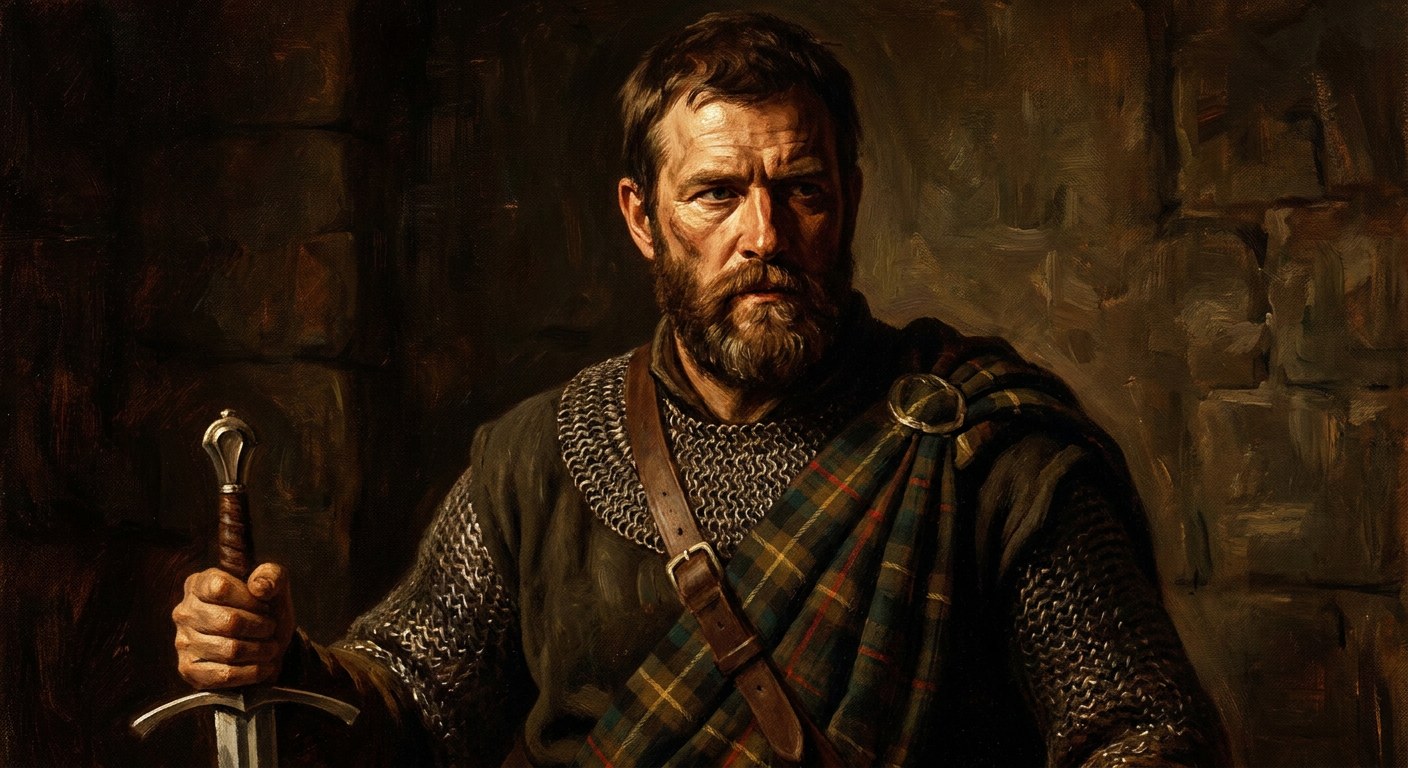
William Wallace
1270 – 1305 · Scottish · Knight & Rebel Leader
Recommended Audiobooks
Listen next from Marcus Alden

Life Lessons from Frederic Chopin
Marcus Alden · 54 min

Life Lessons from John Wesley
Marcus Alden · 52 min
Introduction
Sir William Wallace was a Scottish knight, military commander and resistance leader who became the most enduring symbol of Scotland’s struggle against English rule. His public career lasted only a few years—from the uprising of 1297 to his capture and execution in 1305—but it unfolded during one of the most consequential periods in medieval British history: the Wars of Scottish Independence.
Wallace emerged after King Edward I of England exploited a Scottish succession crisis, deposed King John Balliol and imposed direct control over Scotland. In 1297, Wallace and Andrew Moray led a popular and aristocratic rebellion that culminated in a dramatic victory at the Battle of Stirling Bridge. Wallace subsequently served as Guardian of the Kingdom of Scotland in the name of the deposed Balliol. His defeat at Falkirk in 1298 ended his guardianship, but not his commitment to Scottish independence.
Much about Wallace’s early life remains uncertain. Contemporary documents reveal relatively little, while later traditions—especially the fifteenth-century poem by Blind Harry—combined historical memory, patriotic storytelling and legend. The Wallace of reliable medieval records was not the isolated peasant rebel sometimes portrayed in popular culture. He was probably a member of the lesser landed elite, possessed a seal, moved among nobles and churchmen, commanded organized armies, conducted diplomatic business and operated within the political framework of the Scottish kingdom.
Captured near Glasgow in August 1305, Wallace was taken to London, condemned as a traitor and executed with exceptional brutality. His death did not end the conflict. Within months, Robert the Bruce launched a new bid for the throne, and Scotland’s resistance eventually secured a lasting military and diplomatic victory.
Wallace’s historical importance lies not only in what he achieved but also in what he represented: resistance to conquest, defense of an independent kingdom and refusal to submit to a ruler he did not recognize as his lawful sovereign.
Quick Facts
| Category | Details |
|---|---|
| Full name | William Wallace |
| Common title | Sir William Wallace |
| Born | Probably in the 1270s; traditionally around 1270 |
| Birthplace | Disputed; traditionally Elderslie in Renfrewshire, with Ellerslie in Ayrshire also proposed |
| Nationality | Scottish |
| Social background | Probably the son of a minor Scottish landholder or knight |
| Father | A surviving seal identifies him as Alan Wallace’s son; later tradition names Malcolm Wallace |
| Known for | Leading resistance to English occupation during the First War of Scottish Independence |
| Principal ally in 1297 | Andrew Moray |
| Greatest victory | Battle of Stirling Bridge, 11 September 1297 |
| Major defeat | Battle of Falkirk, 22 July 1298 |
| Political office | Guardian of the Kingdom of Scotland, approximately 1297–1298 |
| Monarch represented | King John Balliol |
| Captured | 5 August 1305, near Glasgow |
| Executed | 23 August 1305, Smithfield, London |
| Cause of death | Hanged, drawn, beheaded and quartered |
| Burial | No intact burial; his remains were displayed in several towns |
| Historical era | Wars of Scottish Independence |
| Legacy | Scottish national hero and international symbol of resistance to oppression |
Early Life & Background
William Wallace’s early life is poorly documented. No contemporary chronicle provides a reliable date of birth, and the details later attached to his childhood were recorded long after his death. He was probably born during the 1270s, although around 1270 is often given as a conventional estimate.
His birthplace is disputed. The best-known tradition identifies Elderslie, near Paisley in Renfrewshire. Another interpretation favors Ellerslie—possibly an earlier form of the same place-name—in Ayrshire. The surviving evidence does not settle the question decisively.
Wallace’s family belonged to the lower ranks of Scotland’s landholding society. The surname probably derived from a term meaning “Welshman” or “Briton” and was already established in parts of western Scotland. Wallace is often described as the younger son of Sir Malcolm Wallace of Elderslie, but this identification depends heavily on later tradition. More immediate evidence comes from Wallace’s seal, attached to the 1297 letter sent to Lübeck. Its Latin inscription identified him as the son of Alan Wallace. An Alan Wallace appears among Scottish crown tenants in Ayrshire, making him a plausible candidate for William’s father.
Although Wallace was not one of the kingdom’s great magnates, he was probably not a landless commoner. His ability to use a seal, command armed followers and interact with prominent nobles suggests a minor gentry or knightly background. Later accounts claim that he was educated by clerical relatives, but there is no firm contemporary evidence for his schooling. He may nevertheless have acquired some familiarity with aristocratic, military and administrative culture.
Wallace grew up during a period of relative stability under King Alexander III. That stability ended abruptly when Alexander died after a riding accident in March 1286. His only surviving descendant, Margaret, Maid of Norway, died in 1290 while traveling to Scotland. With no uncontested heir, the kingdom entered the succession dispute known as the Great Cause.
Scottish political leaders invited Edward I of England to arbitrate among the claimants. Edward used the opportunity to demand recognition as Scotland’s feudal overlord. In 1292 he selected John Balliol as king, but repeatedly interfered in Balliol’s government. When the Scots entered an alliance with France and resisted Edward’s demands for military service, Edward invaded in 1296.
The English army captured Berwick-upon-Tweed in March 1296 and defeated the Scots at Dunbar in April. Balliol was stripped of his royal insignia and forced to abdicate. Edward removed the Stone of Scone, carried away Scottish governmental records and installed English officials across the kingdom. It was within this atmosphere of occupation, political humiliation and local resentment that Wallace entered history.
Rise to Prominence
Wallace’s first firmly recognizable public activity belongs to 1297, when rebellions erupted across Scotland. Resistance was not confined to one leader or social class. Andrew Moray raised the north; nobles such as James Stewart, Robert Wishart, Bishop of Glasgow, and Robert Bruce, the future king, participated in or maneuvered around resistance in the south and west.
According to later sources, Wallace’s uprising began when he killed William de Heselrig, the English sheriff of Lanark, in May 1297. Blind Harry claimed that Wallace acted in revenge after Heselrig caused the death of Wallace’s wife, Marion Braidfute. This romantic narrative cannot be confirmed, and Marion herself is not securely documented. Nevertheless, the killing of Heselrig is generally accepted as having occurred and marked Wallace as a major insurgent leader.
Wallace gathered followers and attacked English officials and their Scottish collaborators. He was associated with actions around Lanark, Scone, Perthshire and the region south of the Forth. Later tradition credited him with attacking the English justiciar William Ormesby at Scone, forcing him to flee. Wallace also appears to have threatened Dundee while Andrew Moray advanced from the north.
By late summer 1297, the two uprisings converged. Wallace and Moray joined their forces near Stirling, a strategic gateway between northern and southern Scotland. Their army included experienced men-at-arms but depended heavily on infantry armed with spears. Opposing them was an English force commanded by John de Warenne, Earl of Surrey, and Hugh de Cressingham, Edward I’s treasurer in Scotland.
The English commanders attempted to cross the River Forth by the narrow wooden Stirling Bridge. Wallace and Moray waited until part of the English army had crossed, then attacked before the remainder could support it. Trapped between the river, marshy ground and the Scottish formations, the English vanguard was destroyed on 11 September 1297. Cressingham was killed, while Warenne withdrew and ordered the bridge destroyed.
Stirling Bridge transformed Wallace from a regional rebel into a national leader. Andrew Moray was wounded and died, probably in November 1297, leaving Wallace as the most visible commander of the victorious movement.
Major Achievements
Wallace’s foremost military achievement was the victory at Stirling Bridge. The battle demonstrated that disciplined infantry, intelligently deployed and supported by favorable terrain, could defeat a larger feudal army containing heavily armored cavalry. It overturned the psychological effects of the Scottish defeat at Dunbar and shattered English authority across much of Scotland.
Following the victory, Wallace and Moray issued documents in the name of “the leaders of the army of the kingdom of Scotland and the community of the same kingdom.” This language is important. Wallace did not initially claim to be fighting for personal power. He presented the resistance as the action of the political community of an established kingdom.
In October 1297, Wallace and Moray sent a letter to the merchants of Lübeck and Hamburg announcing that Scotland had been recovered from English power and reopened for trade. The document shows that the leaders were concerned not only with warfare but also with restoring international commerce. Its surviving copy, preserved in Lübeck, is among the most valuable contemporary records of Wallace’s career.
During the winter of 1297–1298, Wallace led a raid into northern England, striking parts of Northumberland and Cumberland. The campaign sought supplies, damaged English resources and demonstrated that the Scots could carry the war beyond their border. It also involved plunder and destruction, illustrating the harsh realities of medieval warfare.
At some point after Stirling Bridge, Wallace was knighted and appointed Guardian of the Kingdom. The identity of the person who knighted him is uncertain. Some historians have suggested that the ceremony may have been performed under the authority of a leading Scottish magnate. Whatever the precise circumstances, Wallace exercised governmental and military leadership in the name of King John Balliol, who remained in English custody.
As Guardian, Wallace attempted to mobilize the kingdom’s military resources, maintain the war effort and present a unified Scottish position. His elevation was remarkable because he lacked the hereditary status of the great earls and barons. It reflected both his military success and the temporary political vacuum created by Balliol’s removal.
Wallace’s strategic accomplishments did not produce permanent liberation during his lifetime. Yet his 1297 campaign preserved organized resistance at a moment when English conquest had appeared complete. Without the revival associated with Wallace and Moray, the later success of the independence movement would have been far less likely.
Defining Moments
The first defining moment of Wallace’s career was the 1297 outbreak at Lanark. Whether motivated by personal revenge, political resistance or both, the attack on Heselrig placed him in open rebellion against Edward I’s government. It also linked Wallace’s name with the wider dissatisfaction produced by English military occupation.
The Battle of Stirling Bridge was the decisive moment of his rise. Wallace and Moray did not simply overwhelm their opponents through courage. They exploited the bridge’s narrowness, the river and the restricted terrain. Their timing prevented the English army from deploying its full strength. The victory established Wallace’s reputation as a commander and made possible his guardianship.
A third defining moment was the death of Andrew Moray. Contemporary evidence suggests that Moray was at least Wallace’s equal in leadership during 1297. His death deprived the Scottish cause of an experienced northern commander and left Wallace carrying greater responsibility. Later legend often minimized Moray’s role, but modern scholarship has restored his importance.
Wallace’s great reversal came at the Battle of Falkirk on 22 July 1298. Edward I personally led a large army into Scotland. Wallace deployed his infantry in dense circular or rounded spear formations commonly called schiltrons. The formations resisted direct cavalry attack, but Scottish cavalry withdrew or was driven away, and the archers between the schiltrons were overwhelmed. Edward’s Welsh and English longbowmen then weakened the packed spear formations, allowing cavalry and infantry to break them.
Falkirk was a severe defeat, but it did not amount to an immediate English conquest of Scotland. Wallace survived and resigned, or was replaced as, Guardian. Robert Bruce, Earl of Carrick, and John Comyn of Badenoch subsequently held guardianship jointly, reflecting the rivalry between the Bruce and Balliol-Comyn political factions.
Another defining phase was Wallace’s diplomatic activity overseas. Evidence indicates that he traveled to the Continent, probably reaching France by 1299. He sought assistance from King Philip IV of France and may have attempted to advance the Scottish cause at the papal court, although claims that he personally visited Rome remain uncertain. A letter dated November 1300 from Philip IV to French representatives at Rome recommended Wallace to them, confirming his involvement in international diplomacy.
Wallace’s final defining moment was his refusal to submit. By 1304, most leading Scottish opponents of Edward I had negotiated terms. Wallace was explicitly excluded from easy reconciliation and continued resistance. His persistence made him both a symbol of defiance and a special target for the English crown.
Timeline
| Year | Event |
|---|---|
| c. 1270s | William Wallace is probably born in western Scotland. |
| 1286 | King Alexander III dies, beginning a prolonged Scottish succession crisis. |
| 1290 | Margaret, Maid of Norway, dies before reaching Scotland. |
| 1292 | Edward I chooses John Balliol as king after the Great Cause. |
| 1296 | Edward invades Scotland, defeats Scottish forces at Dunbar and forces Balliol to abdicate. |
| May 1297 | Wallace is associated with the killing of Sheriff William de Heselrig at Lanark. |
| Summer 1297 | Wallace leads resistance in central and southern Scotland while Andrew Moray campaigns in the north. |
| 11 September 1297 | Wallace and Moray defeat an English army at Stirling Bridge. |
| October 1297 | The leaders send a commercial letter to Lübeck and Hamburg. |
| Late 1297 | Wallace raids Northumberland and Cumberland; Moray dies from wounds. |
| Late 1297 or early 1298 | Wallace is knighted and becomes Guardian of Scotland. |
| 22 July 1298 | Edward I defeats Wallace’s army at Falkirk. |
| Late 1298 | Wallace relinquishes or loses the guardianship. |
| 1299–1300 | Wallace conducts diplomatic activity in France on Scotland’s behalf. |
| November 1300 | Philip IV of France issues a letter supporting Wallace’s approach to papal representatives. |
| 1303 | Wallace is probably back in Scotland and continues resistance. |
| 1304 | Stirling Castle surrenders; many Scottish leaders submit to Edward, but Wallace remains outside the settlement. |
| 5 August 1305 | Wallace is captured near Glasgow by forces connected with Sir John Menteith. |
| 22 August 1305 | Wallace is brought to London and confined before trial. |
| 23 August 1305 | Wallace is tried at Westminster Hall and executed at Smithfield. |
| 1306 | Robert the Bruce is crowned King of Scots and renews the independence struggle. |
| 1314 | Bruce defeats Edward II’s army at Bannockburn. |
| 1328 | The Treaty of Edinburgh–Northampton recognizes Scotland as an independent kingdom. |
Personal Life
Almost nothing certain is known about Wallace’s private life. No reliable contemporary record identifies a wife or children. The best-known story describes him as married to—or romantically involved with—a woman called Marion or Murron Braidfute, whose death supposedly provoked his attack at Lanark. This account derives primarily from Blind Harry’s The Wallace, composed about 170 years after Wallace’s death.
It is possible that a local tradition about Wallace’s personal relationships survived, but the story cannot be verified. There is likewise no historical foundation for the romantic relationship with Princess Isabella of France portrayed in the film Braveheart. Isabella was born around 1295, was a child during Wallace’s career and did not marry Edward II or arrive in England until 1308, three years after Wallace’s death.
Wallace’s documented relationships were predominantly political and military. He worked closely with Andrew Moray and had links with Bishop Robert Wishart, James Stewart and other opponents of English rule. His relations with major nobles may sometimes have been uneasy because his authority depended more on military success and appointment than on great hereditary estates.
Later descriptions presented Wallace as exceptionally tall and physically powerful. Blind Harry portrayed him as a giant-like warrior, but no contemporary physical description survives. Claims about his exact height are speculative.
Beliefs & Philosophy
Wallace left no philosophical treatise, diary or body of personal correspondence from which a detailed worldview can be reconstructed. His beliefs must therefore be inferred from his conduct and the political language of contemporary documents.
His cause was fundamentally dynastic and national in the medieval sense. Wallace acted in the name of John Balliol, whom many Scots continued to regard as their lawful king. His use of the title Guardian implied stewardship of the kingdom during the monarch’s absence rather than an attempt to seize the crown.
The Lübeck letter referred to the “community of the realm of Scotland,” a significant expression of collective political identity. Wallace’s resistance defended the integrity, laws and political independence of the Scottish kingdom against Edward I’s claim of overlordship.
Wallace was almost certainly a Latin Christian, as expected of a Scottish knight in the thirteenth century. Churchmen, particularly Bishop Wishart, played important roles in the resistance. Nevertheless, later portrayals of Wallace as a champion of modern democracy, religious liberty or social equality project much later ideas onto a medieval figure.
His most clearly demonstrated principle was refusal to recognize Edward I as his lawful sovereign. That position shaped both his resistance and his response to the charge of treason at his trial.
Challenges & Controversies
The greatest challenge in writing Wallace’s biography is the limited and partisan nature of the evidence. English administrative records are valuable but hostile. Scottish records were heavily disrupted by war. Later chronicles often blended fact with patriotic legend.
Blind Harry’s The Wallace, written in the 1470s or 1480s, is the most influential narrative of Wallace’s life. It contains details found nowhere else, including elaborate adventures, disguises, speeches and personal relationships. Although it may preserve elements of oral tradition, it cannot be treated as a straightforward eyewitness source.
Wallace’s social status is also debated. Popular retellings sometimes cast him as a peasant leading a democratic revolt against aristocrats. The available evidence instead suggests that he belonged to the lesser landed class and cooperated with members of the nobility and clergy. His movement drew support from different social levels, but it was fought on behalf of the Scottish kingdom and its deposed king.
Responsibility for the tactics at Stirling Bridge and Falkirk has generated further debate. Wallace’s reputation often overshadows Andrew Moray, whose leadership was essential at Stirling. At Falkirk, Wallace’s schiltrons showed discipline, but the Scottish army lacked sufficient cavalry and missile support to counter Edward’s combined forces.
The northern English campaign of 1297 also complicates heroic portrayals. Medieval armies generally lived from the land, and Scottish raiders burned settlements, seized goods and caused civilian suffering. English chroniclers accused Wallace’s forces of extreme brutality. Such accounts may contain exaggeration, but the campaign was certainly destructive.
Wallace’s capture remains surrounded by accusations of betrayal. He was seized near Glasgow on 5 August 1305 by men associated with Sir John Menteith, a Scottish noble serving Edward I. Later tradition condemned Menteith as a traitor, though he was acting within his established allegiance to the English administration. Stories that Wallace was betrayed by a close friend are not securely documented.
At Westminster Hall, Wallace was denied a conventional trial by jury. He was charged with treason, murder, robbery, sacrilege and other offenses. The treason accusation was legally and politically contentious because Wallace maintained that he had never sworn allegiance to Edward I. His sentence—hanging, drawing and quartering—was intended both to punish and to terrorize.
After execution at Smithfield on 23 August 1305, Wallace was beheaded. His head was displayed on London Bridge, and his quarters were sent for display at Newcastle, Berwick, Stirling and Perth. The dispersal of his body denied him an honorable burial and turned his remains into warnings against rebellion.
Famous Quotes
No extended speech by Wallace survives in a form that can be treated as a verbatim contemporary record. His most famous authentic statement is preserved indirectly in the account of his trial:
“I could not be a traitor to Edward, for I was never his subject.”
This is an English rendering of Wallace’s reported answer to the charge of treason. The precise medieval wording varies in translation, but the principle accords with his political position.
The 1297 Lübeck letter, issued jointly in the names of Wallace and Andrew Moray, announced Scotland’s recovery and reopening to commerce:
“The kingdom of Scotland has, by God’s grace, been recovered by war from the power of the English.”
The wording is translated from the Latin and reflects the leaders’ official political message rather than a private remark by Wallace.
Blind Harry attributed many speeches to Wallace, including sentiments about liberty, but these were composed long after his death. The celebrated line below is associated with the literary Wallace, not securely with the historical man:
“Freedom is best, I tell thee true, of all things to be won.”
The famous Braveheart speech beginning “They may take our lives, but they’ll never take our freedom” was written for the 1995 film. It is not a medieval quotation and should not be cited as Wallace’s own words.
Legacy & Influence
Wallace did not live to see Scottish independence secured. After his execution, Robert the Bruce killed John Comyn at Dumfries in February 1306, claimed the throne and was crowned at Scone. Bruce’s victory at Bannockburn in 1314 transformed the military situation, while the Declaration of Arbroath in 1320 articulated Scotland’s case to the papacy. The Treaty of Edinburgh–Northampton recognized the independence of Bruce’s kingdom in 1328.
Wallace’s contribution was nevertheless foundational. His victory at Stirling Bridge showed that Edwardian occupation could be defeated. His guardianship preserved a Scottish governmental claim independent of England, and his diplomacy treated Scotland as a participant in European politics.
In Scottish historical memory, Wallace became a martyr. Chroniclers such as John of Fordun and Walter Bower helped preserve his reputation, but Blind Harry’s poem exerted the greatest cultural influence. It turned Wallace into an epic national hero and was repeatedly printed and adapted.
During the eighteenth and nineteenth centuries, Wallace’s image was incorporated into Romantic nationalism. Poets, historians and political reformers celebrated him as a defender of liberty. The National Wallace Monument, overlooking Stirling from Abbey Craig, opened in 1869. Its location evokes the battlefield where Wallace and Moray achieved their greatest victory.
Wallace monuments, statues and place-names appear throughout Scotland and beyond. The sword displayed at the National Wallace Monument is traditionally associated with him, although its present form and components are of uncertain date.
The 1995 film Braveheart, directed by and starring Mel Gibson, introduced Wallace to a global audience. The film significantly altered chronology, costume, relationships and political circumstances. Despite its inaccuracies, it revitalized interest in medieval Scotland and strengthened Wallace’s international image as an icon of freedom.
Modern historians distinguish between Wallace as a documented medieval leader and Wallace as a cultural symbol. The distinction does not diminish his importance. Instead, it reveals how a brief career can generate centuries of memory, literature, politics and national identity.
Interesting Facts
- Wallace’s surviving seal identifies him as the son of Alan, contradicting the later tradition that consistently names his father Malcolm.
- He shared command at Stirling Bridge with Andrew Moray, whose role was often neglected in later popular accounts.
- Stirling Bridge was essential to the Scottish victory, yet the major modern depictions of the battle often omit the bridge.
- Wallace governed in the name of John Balliol rather than claiming the Scottish crown for himself.
- The Lübeck letter demonstrates that Wallace’s government was concerned with restoring overseas trade.
- He probably spent time in France seeking diplomatic and military support.
- Edward I offered rewards and terms to many Scottish opponents but treated Wallace as an exceptional enemy.
- Wallace was executed at Smithfield, then an open space outside London’s old city walls commonly used for markets and public punishments.
- No authenticated grave of Wallace exists because his body was quartered and displayed.
- The title “Braveheart” was not Wallace’s established medieval nickname. In later tradition, a form of the epithet was associated with Robert the Bruce’s heart.
- The Wallace Monument stands on Abbey Craig, close to the position traditionally associated with the Scottish army before Stirling Bridge.
- Wallace’s documented public career lasted approximately eight years, yet his reputation has endured for more than seven centuries.
Frequently Asked Questions
When and where was William Wallace born?
His exact birth date and birthplace are unknown. He was probably born in the 1270s in western Scotland. Elderslie in Renfrewshire is the traditional birthplace, while an Ayrshire location has also been proposed.
Was William Wallace a peasant?
Probably not. He appears to have come from a family of minor landholders or knights. He was below the rank of the great nobles but possessed the social and military connections expected of the lesser gentry.
Who was William Wallace’s father?
Later tradition names Sir Malcolm Wallace. However, Wallace’s surviving seal calls him the son of Alan Wallace. Most modern historians give greater weight to the contemporary seal.
Why did Wallace rebel against England?
Edward I had invaded Scotland, removed John Balliol and installed English officials. Wallace participated in a broad resistance movement seeking to restore Scottish self-government and oppose Edward’s claim to rule the kingdom.
How did Wallace win at Stirling Bridge?
Wallace and Andrew Moray allowed part of the English army to cross a narrow bridge before attacking. The English vanguard could not deploy properly or receive timely support, leaving it trapped against the River Forth and marshy terrain.
Why did Wallace lose at Falkirk?
Edward I used cavalry, archers and infantry in combination. Scottish spear formations initially resisted mounted attacks, but English and Welsh archery disrupted them. The Scots lacked sufficient cavalry and missile forces to protect the formations.
Was Wallace King of Scotland?
No. He served as Guardian of the Kingdom, effectively a senior military and political leader, in the name of the deposed King John Balliol.
Was Wallace married?
There is no reliable contemporary evidence that he married. The story of Marion or Murron Braidfute comes from much later tradition.
Did William Wallace meet Robert the Bruce?
They lived in the same period and participated in the same complex political struggle, so contact is possible. However, no reliable evidence supports the dramatic meetings or battlefield confrontation depicted in Braveheart.
Did Wallace betray Robert the Bruce, or vice versa?
There is no sound evidence for the film’s depiction of Bruce betraying Wallace at Falkirk. The political loyalties of the Bruce family were complicated, but the cinematic incident is fictional.
Who captured William Wallace?
He was captured near Glasgow by men under or associated with Sir John Menteith, who was serving the English crown. The precise details of the operation remain unclear.
Why was Wallace executed for treason?
Edward I’s government considered him a subject who had rebelled against his sovereign. Wallace rejected that premise, reportedly arguing that he had never sworn allegiance to Edward and therefore could not be his traitor.
How historically accurate is Braveheart?
The film accurately conveys the broad existence of Scottish resistance, Wallace’s victory at Stirling and his execution. Many details—including clothing, chronology, battles, romantic relationships and Wallace’s interaction with Isabella of France—are fictional or heavily altered.
Lessons from William Wallace
- Strategic judgment can overcome numerical disadvantage: Stirling Bridge was won through timing, terrain and control of a narrow crossing.
- Leadership may emerge outside the highest social ranks: Wallace rose above men of far greater hereditary status because of military success and political circumstances.
- Coalitions matter: Wallace’s greatest victory depended on cooperation with Andrew Moray and support from soldiers, landholders, nobles and churchmen.
- Symbols can outlive immediate outcomes: Wallace lost at Falkirk and was executed, yet his resistance inspired later generations.
- Political legitimacy shapes conflict: Wallace fought as Guardian for an existing kingdom and king, not merely as an individual rebel.
- Diplomacy is part of resistance: His mission to France and commercial outreach to German merchants show that war was also fought through alliances and trade.
- Historical heroes must be studied critically: Admiration for Wallace need not require accepting legends as facts.
- Courage does not guarantee victory: Wallace’s career shows both the power and the limits of personal determination against a wealthier state.
- Memory is constructed over time: Chronicles, poetry, monuments and film each created a different version of Wallace.
- Refusal can carry historical power: Wallace’s rejection of Edward’s authority became central to his legacy as a defender of Scottish independence.
Further Reading
- G. W. S. Barrow, Robert Bruce and the Community of the Realm of Scotland
- Andrew Fisher, William Wallace
- Fiona Watson, Under the Hammer: Edward I and Scotland, 1286–1306
- Michael Prestwich, Edward I
- Chris Brown, William Wallace: The True Story of Braveheart
- Graeme Morton, William Wallace: Man and Myth
- Blind Harry, The Wallace, preferably in a scholarly edition with historical commentary
- Walter Bower, Scotichronicon
- The surviving 1297 Lübeck letter of William Wallace and Andrew Moray
- The National Records of Scotland resources on the Wars of Scottish Independence
- The National Wallace Monument’s historical and educational collections
- Historic Environment Scotland resources on Stirling Bridge, Falkirk and medieval Scotland