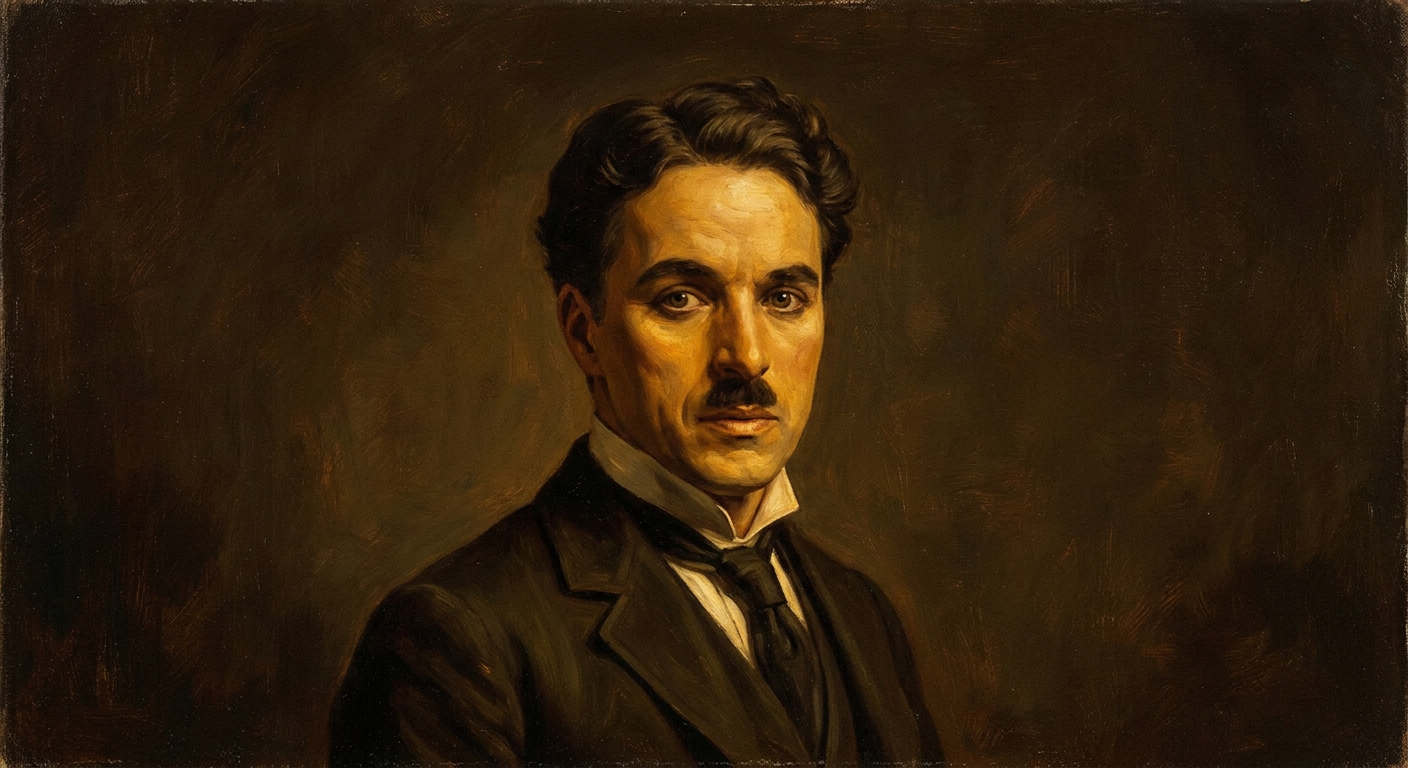
Quick Facts
- Years
- 1889 – 1977
- Category
- Artists & Composers
- Nationality
- British
- Occupation
- Actor, comedian, filmmaker, screenwriter, producer and composer
Charlie Chaplin
1889 – 1977 · British · Actor, comedian, filmmaker, screenwriter, producer and composer
Recommended Audiobooks
Listen next from Marcus Alden

Life Lessons from Franz Liszt
Marcus Alden · 53 min

Life Lessons from Camille Saint-Saëns
Marcus Alden · 53 min
Charlie Chaplin transformed silent-film comedy into an art capable of expressing tenderness, social criticism and universal emotion. Born into severe poverty in Victorian London, he entered show business as a child and became one of the first truly global celebrities. His best-known character—the bowler-hatted, cane-twirling Little Tramp—could be comic, defiant and heartbreaking, sometimes within the same scene.
Chaplin did far more than perform. He wrote, directed, produced, edited and eventually composed music for his films. Works such as The Kid, The Gold Rush, City Lights, Modern Times and The Great Dictator helped establish cinema as a major narrative art. By co-founding United Artists, he also fought for filmmakers to control their own work.
His life was not an uncomplicated success story. Chaplin's marriages to much younger women, a bitter paternity case, political accusations and his exclusion from the United States damaged his reputation. Historians continue to debate aspects of his private conduct and politics, while generally recognizing his exceptional artistic importance.
Chaplin remains worth studying because his career connects entertainment with industrialization, war, celebrity culture, censorship and political fear. More than a century after the Tramp first appeared, his carefully constructed images can still make audiences laugh—and then ask who society leaves behind.
Quick Facts
| Field | Details |
|---|---|
| Full Name | Charles Spencer Chaplin |
| Common Name(s) | Charlie Chaplin; Charlot in several countries |
| Born | 16 April 1889 |
| Died | 25 December 1977 |
| Age at Death | 88 |
| Birthplace | London, England |
| Nationality | British |
| Occupation | Actor, comedian, director, writer, producer, editor and composer |
| Historical Era | Silent-film era and early sound cinema |
| Famous For | The Little Tramp and pioneering feature-length comedy |
| Political Affiliation | No formal party affiliation; publicly associated with humanitarian and broadly left-leaning causes |
| Religion | Baptized in the Church of England; his mature views were generally nonsectarian and skeptical of organized religion |
| Education | Limited formal schooling; attended institutions for poor children and learned chiefly through stage work |
| Parents | Charles Chaplin Sr. and Hannah Chaplin, née Hill |
| Spouse(s) | Mildred Harris, Lita Grey, Paulette Goddard and Oona O'Neill |
| Children | 11 |
| Major Works | The Kid, The Gold Rush, City Lights, Modern Times, The Great Dictator, Monsieur Verdoux, Limelight |
| Major Achievements | Co-founded United Artists; received honorary Academy Awards in 1929 and 1972; knighted in 1975 |
Early Life
Charles Spencer Chaplin was born in south London to music-hall performers Charles Chaplin Sr. and Hannah Hill, who performed under the name Lily Harley. No surviving official birth certificate has been conclusively identified, but the date and London setting accepted by Chaplin and his biographers are well established.
His parents separated when he was young. His father, an alcoholic, contributed little and died in 1901. Hannah struggled to support Charlie and his older half-brother, Sydney. Periods of unemployment and illness forced the family into workhouses and schools for destitute children. Hannah also experienced serious mental illness and spent long periods in institutions.
These experiences supplied Chaplin with more than a dramatic origin story. He closely observed London streets, policemen, laborers, drunks, performers and respectable citizens trying to preserve appearances. Versions of these figures later populated his films.
Chaplin's schooling was fragmented. His practical education came from music hall, where timing, gesture and immediate audience response mattered. According to his later recollections, he first appeared onstage at about five after Hannah's voice failed during a performance. Some details depend on Chaplin's autobiography and cannot be independently verified, but his childhood stage experience is undisputed.
He joined the Eight Lancashire Lads, a clog-dancing troupe, and performed in theatrical productions including Sherlock Holmes. Sydney later helped him enter Fred Karno's prestigious comedy company. Karno's disciplined physical sketches taught Chaplin how to build comedy through movement rather than words—ideal preparation for silent film.
Rise to Prominence
Touring the United States with Karno brought Chaplin to the attention of Mack Sennett's Keystone Film Company. He signed with Keystone in late 1913 and began making films in 1914.
The Tramp costume emerged during this period: loose trousers, tight coat, oversized shoes, bowler hat, toothbrush mustache and flexible cane. Chaplin later described selecting contradictory items to create a figure who looked both shabby and dignified. The exact order in which every element developed is less certain than the character's explosive popularity.
At Keystone, Chaplin learned filmmaking rapidly but clashed with Sennett over creative control. He moved to Essanay in 1915, Mutual in 1916 and First National in 1917, receiving increasingly extraordinary salaries and authority. His films grew longer and more emotionally ambitious.
Shorts such as The Tramp, The Immigrant and Easy Street refined his combination of slapstick and sympathy. He slowed the frantic Keystone style, giving audiences time to understand what a character wanted before the gag disrupted it. His comedy consequently depended not merely on falls and chases, but on personality.
In 1919 Chaplin joined Mary Pickford, Douglas Fairbanks and director D. W. Griffith in founding United Artists. The company distributed independently produced films, allowing its founders to resist studio control. For Chaplin, this independence enabled years of experimentation on individual projects.
Major Achievements
Turning the Tramp into a universal character
The Tramp was an outsider who insisted on dignity despite poverty, rejection and bad luck. Because silent cinema crossed language barriers, the character became internationally recognizable. His lasting importance lies in combining a clown's physical freedom with a vulnerable social identity.
Expanding the emotional range of comedy
The Kid (1921) united slapstick with a moving story about an impoverished man raising an abandoned child, played by Jackie Coogan. Its mixture of laughter and pathos influenced later filmmakers who treated comedy as a vehicle for serious feeling.
Creating major silent features
The Gold Rush (1925) produced some of Chaplin's most famous sequences, including the dance of the bread rolls and the meal made from a boiled shoe. The Circus (1928) turned the difficulties of performance into comedy and earned him a special Academy Award.
Defending silent expression
When synchronized speech became dominant, Chaplin continued making largely silent films. City Lights (1931) paired the Tramp with a blind flower seller and ended with one of cinema's most celebrated recognition scenes. Modern Times (1936) used sound effects and limited voices but preserved pantomime, turning factory automation and unemployment into comic subjects.
Confronting dictatorship
In The Great Dictator (1940), Chaplin played both a persecuted Jewish barber and the dictator Adenoid Hynkel, a satire of Adolf Hitler. Made before the United States entered the Second World War, it openly attacked fascism and antisemitism. Chaplin later said that, had he known the full extent of the Nazi death camps, he could not have made a comedy about Nazi insanity.
Advancing creative independence
Chaplin's United Artists role demonstrated that successful artists could own productions and negotiate distribution rather than surrender complete authority to a studio. Although the company's history was complicated, its model influenced later independent filmmakers.
Composing enduring film music
Chaplin could not conventionally write orchestral scores, but he developed melodies with trained arrangers and closely supervised their realization. His song “Smile,” derived from the score for Modern Times, became a standard recorded by numerous performers.
Leadership or Work
Chaplin was an intensely controlling filmmaker. He often began with situations rather than a completed screenplay, rehearsing and filming numerous versions until movement, framing and rhythm satisfied him. Production could therefore be slow and expensive.
He expected actors to reproduce precise gestures. Some collaborators admired his visual intelligence; others found the repetition exhausting. Actress Virginia Cherrill was briefly dismissed during City Lights before being rehired, illustrating both his difficult perfectionism and willingness to reverse a decision when necessary.
His major strengths included:
- Extraordinary control of physical movement and screen composition.
- An ability to make simple objects—a cane, globe or dinner roll—carry narrative meaning.
- Independence from changing commercial fashion.
- Close attention to editing rhythm and audience sympathy.
His weaknesses were connected to those strengths. Creative control could become inflexibility, improvisation could inflate budgets, and professional relationships could revolve excessively around his authority. Chaplin's studio was less collaborative than many modern productions, even though skilled actors, cinematographers, designers, musicians and technicians were essential to the final films.
Personal Life
Chaplin married four times. His first marriage, to actress Mildred Harris in 1918, ended in divorce in 1920. Their infant son died shortly after birth. Chaplin married Lita Grey in 1924; they had two sons, Charles Jr. and Sydney, before an acrimonious 1927 divorce.
His third wife was actor Paulette Goddard, his co-star in Modern Times and The Great Dictator. The precise date and circumstances of their marriage were kept private, but they publicly acknowledged the union and divorced in 1942.
In 1943 the 54-year-old Chaplin married 18-year-old Oona O'Neill, daughter of playwright Eugene O'Neill. The age difference was controversial, and Eugene broke with his daughter. Charlie and Oona nevertheless remained married until his death and had eight children: Geraldine, Michael, Josephine, Victoria, Eugene, Jane, Annette and Christopher.
Chaplin enjoyed music and frequently played violin and cello left-handed, although he was not a concert-level performer. After leaving the United States, the family settled at Manoir de Ban near Corsier-sur-Vevey, Switzerland. Strokes and declining mobility affected his final years. He died in his sleep on Christmas Day 1977.
Philosophy or Beliefs
Chaplin's worldview grew from poverty and theatrical life rather than formal political study. His films repeatedly favor vulnerable individuals over powerful institutions. Police, bureaucracies, factories and wealthy patrons often appear absurd, while generosity emerges among people with little material security.
He supported Soviet-American wartime cooperation, addressed meetings calling for a second European front against Nazi Germany and associated with progressive causes. Critics portrayed him as a communist. Chaplin denied being one, and no persuasive evidence shows that he joined the Communist Party. Historians generally describe him as a humanitarian individualist with left-leaning sympathies rather than a disciplined party ideologue.
His public statements emphasized peace, human dignity and suspicion of nationalism. The Great Dictator ends with a direct appeal for democracy and fraternity. Some critics consider the speech artistically overexplicit; others see its abandonment of comic disguise as morally necessary.
Chaplin did not make orthodox religious belief central to his public identity. His ethical language was usually humanistic: compassion mattered because people shared suffering and hope, not because a particular institution commanded it.
Challenges and Controversies
Chaplin's relationships with teenage women have drawn serious criticism. Mildred Harris was 16 when they married; Lita Grey was 16 when their sexual relationship began and 17 at marriage; Oona O'Neill was 18. Age-of-consent laws, social norms and legal circumstances differed from today's, but historical context does not remove legitimate ethical concern about age and power disparities.
In the 1940s Joan Barry filed a paternity suit claiming Chaplin fathered her child. Blood tests excluded him, but California courts did not then accept such tests as decisive evidence. A jury found him legally responsible, and he paid support. Modern summaries should distinguish that legal judgment from the biological evidence.
Federal prosecutors also charged him under the Mann Act, alleging that he transported Barry across state lines for immoral purposes. He was acquitted in 1944. The case unfolded amid sensational press coverage and political hostility, making it difficult to separate genuine scrutiny of his behavior from campaigns aimed at his reputation.
Chaplin never became a U.S. citizen despite living in America for decades. In 1952, while he was sailing to Europe for the premiere of Limelight, U.S. Attorney General James P. McGranery revoked his re-entry permit and demanded that he answer questions about politics and morality. Chaplin chose not to contest the decision and settled in Switzerland.
Defenders viewed the episode as persecution during the anticommunist climate. Critics argued that his personal scandals and provocative politics invited investigation. The available evidence supports the conclusion that political suspicion and moral controversy reinforced one another; it does not establish that Chaplin was a Soviet agent.
Some films also contain material now viewed critically. Early works occasionally employ racial or ethnic stereotypes common in contemporary popular entertainment. Acknowledging those elements permits a fuller assessment rather than either dismissing his achievements or treating them as beyond criticism.
Legacy
Chaplin helped create the grammar of screen comedy. Buster Keaton, Harold Lloyd and other silent contemporaries had distinct styles, but Chaplin's fusion of humor, sentiment and social observation became especially influential. Later performers and directors—from Jacques Tati to Rowan Atkinson—drew on the possibilities of visual characterization, whether or not they imitated the Tramp directly.
His films remain accessible because their central conflicts need little explanation: hunger, loneliness, work, love and resistance to humiliation. At the same time, they offer historians evidence about mass entertainment, urban poverty, machinery, dictatorship and the birth of celebrity culture.
Chaplin received a triumphant welcome at the 1972 Academy Awards, where he accepted an honorary Oscar after roughly two decades away from the United States. Queen Elizabeth II made him a Knight Commander of the Order of the British Empire in 1975.
Manoir de Ban is now Chaplin's World, a museum devoted to his life and filmmaking. His London connections are commemorated by plaques and a statue in Leicester Square. Film archives continue restoring his work, while orchestras perform his scores alongside screenings.
His legacy remains dual: an artistic innovator of rare global reach and a public figure whose private relationships deserve scrutiny. Studying both dimensions produces a more credible history than either hero worship or simple condemnation.
Interesting Facts
- Chaplin was born four days before Adolf Hitler, whom he later satirized.
- The Tramp first reached audiences in Kid Auto Races at Venice in 1914.
- Chaplin wore a small mustache partly because it left his facial expressions visible.
- He was about 25 when the Tramp became internationally famous.
- His older half-brother Sydney became his manager and business associate.
- Jackie Coogan's performance in The Kid made him one of cinema's earliest child stars.
- Chaplin owned his studio on La Brea Avenue in Hollywood.
- Production of City Lights lasted more than two years.
- Modern Times contains the first time Chaplin's voice was heard in a feature, singing invented words.
- He played two roles in The Great Dictator.
- Chaplin received no competitive acting Oscar.
- “Smile” began as an instrumental theme; lyrics were added years later by John Turner and Geoffrey Parsons.
- He did not become an American citizen.
- His daughter Geraldine Chaplin became an internationally respected actor.
- His 1972 honorary Oscar appearance received an exceptionally long standing ovation.
- He was knighted only two years before his death.
- Grave robbers stole his coffin in 1978 and demanded money; police recovered it months later.
- Manoir de Ban, his Swiss home, opened as Chaplin's World museum in 2016.
Famous Quotes
- “I remain just one thing, and one thing only—and that is a clown.” In My Autobiography (1964), Chaplin placed comic identity above political labels.
- “You are not machines! You are not cattle! You are men!” The barber's final speech in The Great Dictator rejects dehumanizing dictatorship.
- “We think too much and feel too little.” Also from The Great Dictator, this criticizes technical progress without compassion.
- “More than machinery we need humanity.” The same speech summarizes a theme already dramatized in Modern Times.
- “Buck up—never say die. We'll get along!” A title card near the end of Modern Times expresses the Tramp's resilience.
- “One murder makes a villain; millions, a hero. Numbers sanctify.” Spoken in Monsieur Verdoux, this bitter line challenges moral double standards surrounding organized violence.
- “Nothing is permanent in this wicked world—not even our troubles.” Spoken in Monsieur Verdoux, it turns impermanence into dark consolation.
- “Life is a tragedy when seen in close-up, but a comedy in long-shot.” Widely attributed to Chaplin and consistent with his art, but its exact primary source is uncertain; it should not be treated as securely documented.
- “All I need to make a comedy is a park, a policeman and a pretty girl.” Frequently credited to Chaplin, though documentation is weak and wording varies.
- “To truly laugh, you must be able to take your pain, and play with it!” Published in My Autobiography, this connects his difficult childhood with his creative method.
Timeline
- 1889 — Born in London on 16 April.
- 1890s — Experiences poverty, workhouse residence and his mother's recurring illness.
- 1898 — Joins the Eight Lancashire Lads.
- 1903 — Appears in stage productions of Sherlock Holmes.
- 1908 — Joins Fred Karno's comedy company.
- 1910–1912 — Tours North America with Karno.
- 1913 — Signs with Keystone Film Company.
- 1914 — Makes his film debut and introduces the Tramp to audiences.
- 1915 — Moves to Essanay and releases The Tramp.
- 1916 — Signs with Mutual Film Corporation.
- 1917 — Signs with First National and builds a Hollywood studio.
- 1918 — Marries Mildred Harris.
- 1919 — Co-founds United Artists.
- 1921 — Releases The Kid.
- 1924 — Marries Lita Grey.
- 1925 — Releases The Gold Rush.
- 1927 — Divorces Grey amid damaging publicity.
- 1928 — Releases The Circus and receives a special Academy Award.
- 1931 — Releases City Lights.
- 1936 — Releases Modern Times.
- 1940 — Releases The Great Dictator.
- 1942 — Divorces Paulette Goddard.
- 1943 — Marries Oona O'Neill.
- 1944 — Acquitted of Mann Act charges.
- 1947 — Releases Monsieur Verdoux amid political controversy.
- 1952 — Releases Limelight; loses permission to re-enter the United States and settles in Switzerland.
- 1957 — Releases A King in New York.
- 1964 — Publishes My Autobiography.
- 1967 — Releases his final film, A Countess from Hong Kong.
- 1972 — Returns to the United States to receive an honorary Academy Award.
- 1975 — Knighted by Queen Elizabeth II.
- 1977 — Dies in Switzerland on 25 December.
- 1978 — His stolen coffin is recovered and reburied securely.
Frequently Asked Questions
1. Why was Charlie Chaplin important?
Chaplin helped turn movies from a fairground novelty into an expressive international art. He demonstrated that visual comedy could support complex characterization, social observation and deep emotion. As actor, writer, director and producer, he exercised unusual control over his films. His role in founding United Artists also advanced the idea that filmmakers could own and distribute their work independently.
2. Did Charlie Chaplin grow up poor?
Yes. His childhood included severe poverty, unstable housing and stays in institutions for impoverished children. His father offered little support and died young, while his mother's health repeatedly prevented her from working. These experiences influenced his sympathy for outsiders, though individual film scenes should not automatically be read as literal autobiography.
3. What was the Little Tramp?
The Little Tramp was Chaplin's signature screen character: a poorly dressed wanderer with a bowler hat, cane and improbable dignity. He could be mischievous or selfish, yet usually sought affection and survival in an unfriendly world. The costume's contradictions made him both gentleman and vagrant, allowing audiences across social and linguistic boundaries to recognize him.
4. Was Chaplin really a silent-film actor?
He became famous in silent cinema, but his work was never literally without sound in theaters; screenings had musical accompaniment. Chaplin later made films with synchronized music, effects and speech. The Great Dictator was his first fully speaking feature, while Modern Times deliberately restricted intelligible speech to preserve the Tramp's visual universality.
5. Why did Chaplin resist talking pictures?
Chaplin believed the Tramp communicated through movement and might lose his universal appeal if given a specific language and voice. He was not opposed to sound technology itself: he composed scores and used effects inventively. His resistance concerned spoken dialogue as the organizing basis of comedy, not sound in every form.
6. What is Chaplin's greatest film?
There is no objective answer. City Lights is frequently praised for emotional and visual precision; Modern Times for social satire; The Gold Rush for iconic comedy; and The Great Dictator for political courage. The choice depends on whether a viewer values formal comedy, pathos, historical importance or explicit political engagement most highly.
7. Was Charlie Chaplin a communist?
No reliable evidence proves that Chaplin joined the Communist Party. He supported progressive causes, Soviet-American cooperation against Hitler and public campaigns for a second front in Europe. These positions made him a target during American anticommunist campaigns. Most historians characterize him as an independent, left-leaning humanist rather than a party communist.
8. Why was he prevented from returning to America?
In 1952 the U.S. government revoked Chaplin's re-entry permit while he traveled abroad, requiring him to answer questions about politics and morality before returning. Years of anticommunist accusations and personal scandal shaped the action. Chaplin declined to contest it and moved to Switzerland, although he later returned briefly for the 1972 Academy Awards.
9. How many times did Chaplin marry?
Chaplin married four times: Mildred Harris, Lita Grey, Paulette Goddard and Oona O'Neill. The first three marriages ended in divorce. His marriages to Harris, Grey and O'Neill involved substantial age differences, and Grey was a minor when their relationship began. Those facts remain central to modern ethical criticism of his personal life.
10. How many children did he have?
Chaplin had 11 children. His first child, Norman Spencer Chaplin, died in infancy. He had two sons with Lita Grey and eight children with Oona O'Neill. Several descendants entered acting and other arts, most famously Geraldine Chaplin, whose career has included major European and American productions.
11. Did a court prove Chaplin fathered Joan Barry's child?
A civil jury declared him legally responsible for support, but blood tests excluded him biologically. California law at the time did not recognize those tests as conclusive evidence. It is therefore misleading either to ignore the verdict or to claim that modern scientific evidence proved paternity. The legal and biological questions produced conflicting answers.
12. Did Chaplin make his own film music?
Chaplin conceived melodies and closely directed the emotional effect of his scores, but trained musicians helped arrange and notate them. Credits and descriptions should acknowledge both his creative leadership and the technical contributions of collaborators. The famous song “Smile” developed from his Modern Times theme, with lyrics added later by others.
13. What made his comedy innovative?
Chaplin connected physical gags to character goals. A fall was funnier because the Tramp wanted to appear dignified; a meal was moving because hunger gave each comic object meaning. He also controlled framing and editing carefully, often allowing viewers to see the full body so that movement remained clear rather than hiding action through rapid cuts.
14. Did Chaplin win an Oscar?
He received honorary Academy Awards rather than a competitive acting award. His 1929 honor recognized his varied accomplishments on The Circus. In 1972 the Academy honored his influence on filmmaking. He also shared an Oscar for the score of Limelight when the film became eligible after its delayed Los Angeles release.
15. Where did Chaplin spend his final years?
Chaplin lived with Oona and their family at Manoir de Ban in Corsier-sur-Vevey, overlooking Lake Geneva in Switzerland. He continued writing, revising scores and overseeing reissues, although his health declined. The estate later became Chaplin's World, a museum using the house, studio displays and film material to interpret his life.
16. How did Charlie Chaplin die?
Chaplin died in his sleep on 25 December 1977 after years of declining health, including strokes that limited his mobility. He was 88. In a bizarre later episode, thieves removed his coffin and demanded a ransom. Police recovered it, and it was reburied under protective concrete.
Lessons We Can Learn
- Observation strengthens creativity. Chaplin transformed closely watched gestures and street behavior into comedy. Modern creators can learn from attention to ordinary life.
- Technical limits can inspire invention. Silent cinema required visual clarity. The broader lesson—that constraints may focus artistic choices—is a modern interpretation supported by his method.
- Humor can address suffering. The Kid and Modern Times made hardship approachable without pretending it was harmless.
- Independence has costs. United Artists gave Chaplin control, but his perfectionism created long schedules and financial risk.
- Popular art can carry serious ideas. The Great Dictator used accessible comedy to oppose fascism and antisemitism.
- Adapt without abandoning core strengths. Chaplin adopted music and sound effects while preserving visual storytelling.
- Success does not excuse harmful conduct. His achievements should not prevent scrutiny of age and power disparities in his relationships.
- Legal outcomes require context. The Barry case shows why legal responsibility, scientific evidence and public opinion must be distinguished.
- Political labels can oversimplify. Chaplin's experience demonstrates how complex humanitarian positions may be reduced to accusations during fearful periods.
- Reputation can change over time. His 1972 return showed that institutions and audiences can reassess figures once rejected, though recognition does not erase controversy.
Related Historical Figures
- Buster Keaton — Chaplin's great silent-comedy contemporary, known for a more impassive screen persona and mechanical precision.
- Harold Lloyd — Another major silent comedian whose ambitious modern character contrasted with the Tramp.
- Mary Pickford — Actor, producer and fellow co-founder of United Artists.
- Douglas Fairbanks — Chaplin's friend and United Artists partner, celebrated for adventure films.
- D. W. Griffith — The fourth United Artists founder and an influential but deeply controversial director.
- Mack Sennett — Keystone producer who gave Chaplin his first film contract.
- Fred Karno — British impresario whose company trained Chaplin in disciplined physical comedy.
- Paulette Goddard — Chaplin's third wife and leading performer in Modern Times and The Great Dictator.
- Jackie Coogan — Child actor whose partnership with Chaplin made The Kid a landmark.
- Adolf Hitler — Nazi dictator satirized as Adenoid Hynkel in The Great Dictator; Chaplin used their superficial visual resemblance to attack fascism.
Watch and Learn
The Great Dictator – Final Speech — Charlie Chaplin
Approximate duration: 4 minutes
This official presentation of the final speech from The Great Dictator is not a complete biographical documentary, but it is a valuable primary source from Chaplin's career. It shows the moment when he set aside the Tramp-like barber's comic identity and spoke directly about dictatorship, machinery, democracy and human solidarity. Viewers should watch it in the context of 1940, before the United States entered the Second World War.
Watch and Learn
The Great Dictator – Final Speech · Charlie Chaplin
Related Historical Figures