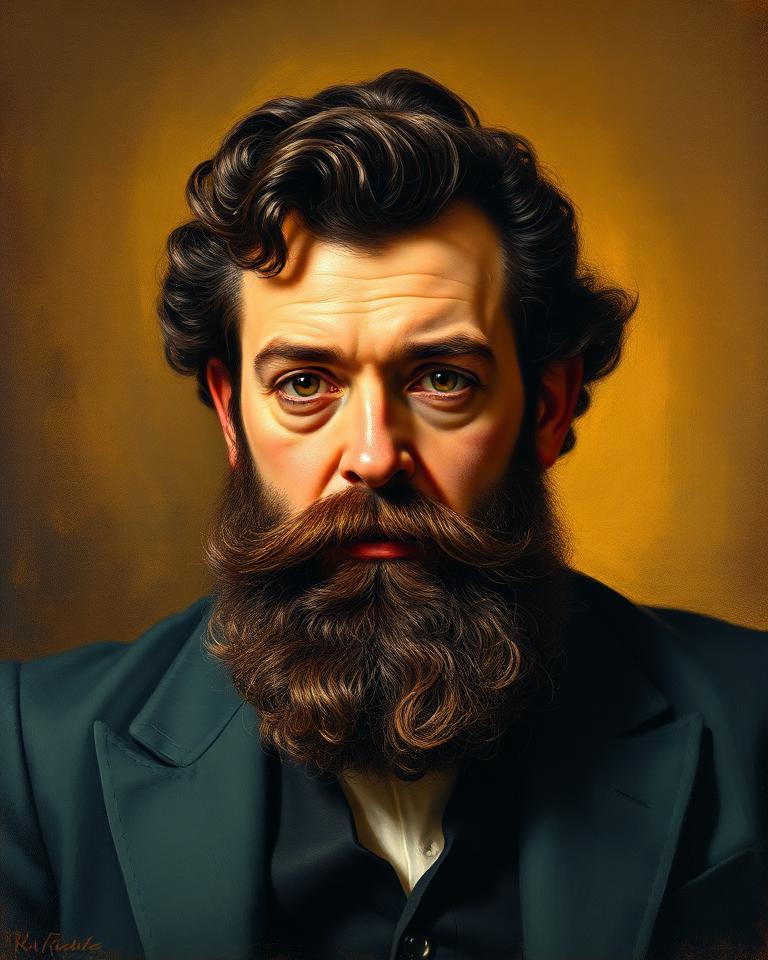
Quick Facts
- Years
- 1862 – 1918
- Category
- Artists & Composers
- Subcategory
- Classical Music
- Nationality
- French
- Occupation
- Composer
Claude Debussy
1862 – 1918 · French · Composer
Audiobook

Life Lessons from Claude Debussy
Marcus Alden · 53 min
Claude Debussy (1862–1918) was a French composer whose treatment of harmony, orchestral color, rhythm, and musical form transformed Western art music. Although often labeled an “Impressionist,” Debussy disliked that term when applied to his work. His music was linked more directly to Symbolist poetry, visual art, French literary culture, and his search for alternatives to established Germanic models.
Debussy first gained official recognition by winning the Prix de Rome in 1884. His mature reputation rests on works including Prélude à l’après-midi d’un faune, the opera Pelléas et Mélisande, Nocturnes, La mer, Images, the piano collections Estampes, Images, and Préludes, and his late chamber sonatas. Through modes, whole-tone and pentatonic collections, unresolved dissonances, fluid rhythms, and finely differentiated instrumental colors, he expanded the possibilities available to later composers.
His career unfolded amid the cultural energy and political divisions of France’s Third Republic. He resisted academic convention, Wagnerian dominance, and simplistic ideas of musical progress, yet absorbed and reworked influences ranging from Javanese gamelan to Russian composition and Renaissance polyphony. Debussy remains central to concert life and musical education because his works reward close listening while challenging assumptions about melody, harmony, atmosphere, and structure.
Quick Facts
| Field | Information |
|---|---|
| Full Name | Achille-Claude Debussy |
| Common Name(s) | Claude Debussy; Achille Debussy in early records |
| Born | 22 August 1862 |
| Died | 25 March 1918 |
| Age at Death | 55 |
| Birthplace | Saint-Germain-en-Laye, Seine-et-Oise, France |
| Nationality | French |
| Occupation | Composer, pianist, music critic |
| Historical Era | Late Romantic and early modernist periods; French Third Republic |
| Famous For | Transforming harmony, form, rhythm, piano writing, and orchestral color |
| Political Affiliation if applicable | No formal party affiliation recorded; strongly patriotic during World War I |
| Religion if significant | Raised in a Catholic cultural setting; personal adherence was limited or unclear |
| Education | Paris Conservatoire, 1872–1884; Prix de Rome residency at the Villa Medici |
| Parents | Manuel-Achille Debussy and Victorine Joséphine Sophie Manoury Debussy |
| Spouse(s) | Rosalie “Lilly” Texier (married 1899; divorced 1905); Emma Bardac (married 1908) |
| Children | Claude-Emma Debussy, called “Chouchou” (1905–1919) |
| Major Works | Prélude à l’après-midi d’un faune, Pelléas et Mélisande, Nocturnes, La mer, Images, Children’s Corner, Préludes, Jeux, late sonatas |
| Major Achievements | Prix de Rome; creation of a landmark French opera; major influence on modern harmony and orchestration |
Early Life
Achille-Claude Debussy was born on 22 August 1862 in Saint-Germain-en-Laye, west of Paris. His father, Manuel-Achille, operated a china shop for a time and later held various jobs. His mother, Victorine, worked as a seamstress. The family was of modest means and did not belong to France’s musical establishment.
The Franco-Prussian War of 1870–71 disrupted the family’s life. During this period Debussy spent time in Cannes with relatives and began piano lessons. An important early teacher was Antoinette Mauté de Fleurville, who claimed to have studied with Frédéric Chopin. Historians have questioned the details of that claim, but her instruction clearly helped prepare Debussy for conservatory admission.
In 1872, at only ten, he entered the Paris Conservatoire. He studied piano with Antoine François Marmontel, solfège with Albert Lavignac, harmony with Émile Durand, accompaniment with Auguste Bazille, and composition with Ernest Guiraud. Fellow students and teachers recognized his exceptional ear, although his unconventional harmonic choices could irritate academic instructors.
Debussy initially hoped to become a concert pianist. He won prizes but did not secure the highest distinctions necessary for that career. Accompaniment, composition, and practical musical work gradually became more important. As a teenager and young adult, he worked for Nadezhda von Meck, the wealthy Russian patron best known for supporting Tchaikovsky. Travel with her household exposed him to Russian music and life beyond France.
Paris in Debussy’s youth was rebuilding after war and the Paris Commune. Conservatory discipline coexisted with experimental literature, new painting, colonial exhibitions, and debate over French identity. These tensions—academic rules versus individual sensation, inherited forms versus new cultural encounters—would define his artistic development.
Rise to Prominence
Debussy competed repeatedly for the Prix de Rome, France’s most prestigious composition prize. After receiving a second prize in 1883, he won the grand prize in 1884 with the cantata L’Enfant prodigue. The award required him to reside at the Villa Medici in Rome and submit works to the Académie des Beaux-Arts.
He found Rome artistically restrictive. The institutional expectations attached to the prize conflicted with his developing preferences, and official reports criticized aspects of his submissions. Nevertheless, the award gave him prestige, time, and professional visibility.
After returning to Paris in 1887, Debussy entered literary and artistic circles associated with Symbolism. He attended Stéphane Mallarmé’s gatherings and encountered writers and artists interested in suggestion, ambiguity, and states of consciousness rather than literal representation. He also heard Wagner’s operas at Bayreuth. Wagner initially fascinated him, but Debussy later sought a more distinctly French, less rhetorically massive musical language.
The 1889 Exposition Universelle in Paris offered another turning point. Debussy heard Javanese gamelan and other non-European traditions. Scholars caution against reducing his mature style to a single encounter, yet the exhibition strengthened his interest in layered sonorities, cyclical patterns, unusual scales, and alternatives to European functional harmony.
His String Quartet of 1893 attracted serious attention. Wider recognition followed the 1894 premiere of Prélude à l’après-midi d’un faune, inspired by Mallarmé’s poem. Its famous flute opening, ambiguous tonal direction, and sensuous orchestration announced a distinctive voice.
Debussy’s fame increased decisively with Pelléas et Mélisande at the Opéra-Comique in 1902. The opera provoked disputes during rehearsals and divided its first audiences, but it soon became the central French operatic event of its generation. Debussy was no longer merely a promising outsider; he had become an internationally discussed composer.
Major Achievements
Winning the Prix de Rome
Debussy’s victory in 1884 gave him official validation within the very academic system he often resisted. L’Enfant prodigue demonstrated that he could meet conventional dramatic and technical demands.
The prize mattered because it provided institutional standing and connected him to France’s artistic administration. His dissatisfaction in Rome also clarified what he did not want: obedient continuation of inherited formulas. That conflict helped sharpen his independence.
Redefining Orchestral Color
With Prélude à l’après-midi d’un faune, Nocturnes, La mer, and Images, Debussy treated timbre as a structural force rather than decoration. Instrumental combinations emerge, change, and dissolve like musical perspectives.
This approach mattered because form could now be articulated through color, texture, register, and recurrence rather than conventional thematic development alone. Later composers—including Ravel, Messiaen, Boulez, and many film composers—learned from this model.
Creating Pelléas et Mélisande
Debussy spent years shaping Maurice Maeterlinck’s Symbolist drama into his only completed opera. Premiered in 1902, it avoided conventional arias and theatrical display. Vocal lines follow the contour and pacing of French speech, while the orchestra reveals emotional undercurrents.
Its long-term impact lies in proving that opera could achieve intensity through restraint, silence, ambiguity, and subtle orchestral commentary. It offered an alternative to both Italian verismo and Wagnerian music drama.
Transforming Piano Music
Works such as Estampes, Images, Children’s Corner, the two books of Préludes, and the Études expanded pianistic sonority. Debussy used resonance, layered articulation, extreme registers, and carefully controlled pedaling to create effects that resemble bells, water, wind, dance, or distant processions.
These pieces changed how composers and performers imagined the piano. They remain fundamental to advanced training because color, touch, timing, and pedaling are inseparable from their structure.
Expanding Harmonic Language
Debussy employed modes, pentatonic and whole-tone collections, parallel chords, pedal points, and dissonances that need not resolve conventionally. He did not abandon tonality altogether; instead, he made tonal direction flexible and context-dependent.
This mattered to later modernists who sought freedom from nineteenth-century harmonic expectations. His influence extended into classical modernism, jazz harmony, popular music, and cinema, though those traditions adapted his techniques in different ways.
The Late Sonatas
During World War I and serious illness, Debussy planned six sonatas for varied instruments but completed three: for cello and piano; flute, viola, and harp; and violin and piano. He signed them as “musicien français,” emphasizing national tradition.
Their compressed forms, spare textures, and unusual instrumental dialogue anticipated later chamber music. They also demonstrated that Debussy continued evolving rather than merely repeating the luxuriant style associated with his earlier works.
Leadership and Work
Debussy did not lead a school, institution, or political movement. His leadership was artistic: he influenced others by example, criticism, and uncompromising attention to sound. He worked slowly, revised extensively, and sometimes left projects unfinished.
His methods combined intuition with exact craftsmanship. Scores that sound spontaneous are meticulously marked for dynamics, articulation, balance, and tempo. He selected literary texts carefully and often preferred suggestion over explicit narrative.
As a critic, sometimes writing under the persona “Monsieur Croche,” Debussy could be witty, severe, and deliberately provocative. He attacked routine, empty virtuosity, and excessive dependence on established authorities. His judgments were not always fair, but they articulated a forceful ideal of artistic independence.
He maintained productive relationships with performers, conductors, publishers, and writers, yet disagreements were frequent. Strengths included originality, a remarkable ear, self-criticism, and sensitivity to language. Weaknesses included missed deadlines, financial disorder, inconsistent personal loyalties, and a capacity for cutting remarks.
Personal Life
Debussy’s private relationships were often turbulent. He lived with Gabrielle Dupont for much of the 1890s. After their separation, he married the model and fashion worker Rosalie “Lilly” Texier in 1899. Their marriage deteriorated as Debussy became involved with Emma Bardac, an educated singer and the wife of banker Sigismond Bardac.
Debussy and Emma left their spouses and traveled together in 1904. Lilly attempted suicide, survived, and received sympathy from many of Debussy’s friends. The scandal damaged his social circle. Debussy’s divorce became final in 1905, and he married Emma in 1908 after her divorce.
Their daughter, Claude-Emma, known as Chouchou, was born in 1905. Debussy adored her and dedicated Children’s Corner to her. She died of diphtheria in 1919, little more than a year after her father.
Debussy enjoyed poetry, painting, decorative objects, cats, and the cultivated comforts of Parisian life. His refined tastes often exceeded his income, leading to recurrent money problems despite increasing fame.
He was described by acquaintances as charming, elusive, ironic, sensitive, and sometimes self-centered. His closest friendships shifted over time. Among important associates were Pierre Louÿs, Stéphane Mallarmé, André Caplet, Ernest Chausson, and publisher Jacques Durand.
Debussy developed colorectal cancer, diagnosed in 1909. Surgery and treatment could not cure it. He continued composing and performing when able, but his final years were marked by pain, wartime anxiety, and declining strength.
Philosophy and Beliefs
Debussy resisted rigid systems. Musically, he argued that pleasure and the ear should not be subordinated to abstract rules. He admired nature’s irregularity and frequently used images of wind, water, clouds, moonlight, and changing light—not as literal programs in every case, but as prompts for fluid musical thought.
His relationship to religion was not conventionally devotional. Sacred subjects interested him, and he admired older church music, yet the surviving evidence does not establish consistent orthodox practice. His language often reflects aesthetic spirituality and reverence for mystery rather than formal doctrine.
Politically, Debussy had no known party career. During World War I he expressed intense French patriotism and hostility toward German militarism. He revived the formulation “Claude Debussy, musicien français” and looked toward French Baroque traditions. Some wartime letters contain harsh national stereotypes that should be understood critically within the period’s propaganda and trauma.
He valued freedom, concision, clarity, and direct perception. At the same time, his dislike of systems did not mean lack of discipline: his music shows deliberate organization beneath its apparent fluidity.
Challenges and Controversies
Debussy faced conservative criticism that his music lacked proper form, harmonic logic, or emotional substance. Admirers heard a new structural language; opponents heard vagueness. Modern analysis generally supports the view that his works are carefully organized, though often by means different from sonata-based development.
The label “Impressionist” remains disputed. It can help listeners connect his music with color, atmosphere, and contemporary painting, but Debussy objected to the term and had stronger direct ties to Symbolist literature. Scholars often use the label cautiously rather than as a complete explanation.
The premiere of Pelléas et Mélisande generated conflict with Maeterlinck. The playwright wanted his companion Georgette Leblanc to sing Mélisande, whereas the Opéra-Comique cast Mary Garden. Maeterlinck publicly denounced the production and later acknowledged that he had misjudged the opera.
Debussy’s departure from Lilly Texier caused a major scandal, especially after her suicide attempt. Some contemporaries severed ties with him. No assessment of his biography should excuse the suffering involved, although historians distinguish moral judgment about his conduct from evaluation of his music.
He was also criticized for borrowing or exoticizing non-European musical ideas. Debussy’s encounters with gamelan and other traditions were transformative, but they occurred within a colonial exhibition that presented cultures through unequal imperial frameworks. Scholars debate how directly particular techniques derive from gamelan and warn against treating Asian music merely as material for European innovation.
Some major premieres disappointed audiences. La mer received a mixed initial response in 1905, partly because of performance limitations and personal hostility surrounding Debussy. Jeux in 1913 was overshadowed two weeks later by Stravinsky’s The Rite of Spring. Both works later gained high critical standing.
Legacy
Debussy altered the vocabulary of twentieth-century music. His flexible tonality, nontraditional scales, timbral structures, and rhythmic subtlety influenced Ravel, Bartók, Stravinsky, Messiaen, Takemitsu, Boulez, jazz musicians, and generations of screen composers. Influence does not mean imitation: later artists drew different lessons from his work.
His music remains standard repertory for pianists, orchestras, singers, chamber ensembles, and opera companies. Conservatories study his orchestration and harmony, while performers continue debating tempo, rubato, pedaling, and the relationship between precision and atmosphere.
The composer’s birthplace in Saint-Germain-en-Laye houses the Musée municipal Ducastel-Vera’s Debussy-related collection and commemorative displays. His grave is in the Passy Cemetery in Paris. Streets, schools, auditoriums, competitions, and festivals bear his name, including the Conservatoire Claude-Debussy in Saint-Germain-en-Laye.
Debussy’s continuing relevance lies in his demonstration that innovation need not depend on greater volume or complexity. Music can become radical through delicacy, ambiguity, silence, color, and a changed way of listening.
Interesting Facts
- Debussy entered the Paris Conservatoire at ten years old.
- His birth name was Achille-Claude, but he later preferred Claude.
- He worked as a pianist in Nadezhda von Meck’s household.
- He won the Prix de Rome with L’Enfant prodigue in 1884.
- He disliked his required residence at Rome’s Villa Medici.
- He attended Mallarmé’s influential Tuesday gatherings.
- He heard Javanese gamelan at the 1889 Paris Exposition.
- The opening flute solo of Prélude à l’après-midi d’un faune became an emblem of musical modernism.
- Pelléas et Mélisande was his only completed opera.
- He wrote music criticism under the name “Monsieur Croche.”
- The titles in his piano Préludes appear at the ends of the pieces, not the beginnings.
- Children’s Corner was dedicated to his daughter, Chouchou.
- “Golliwogg’s Cake-Walk” parodies a phrase from Wagner’s Tristan und Isolde.
- La mer was completed partly while Debussy was away from the sea.
- Vaslav Nijinsky choreographed Debussy’s Jeux for the Ballets Russes.
- Debussy planned six wartime sonatas but completed only three.
- His last public performance was in 1917, with violinist Gaston Poulet.
- He died while Paris was under German bombardment in World War I.
- Wartime conditions prevented an elaborate public funeral.
- His daughter died in 1919, aged fourteen.
Famous Quotes
Translations vary because Debussy wrote in French.
- “Music is the arithmetic of sounds as optics is the geometry of light.” From his critical writings; it compares music’s organization with perception while preserving its sensuous character.
- “There is no theory. You have merely to listen. Pleasure is the law.” From an interview associated with his anti-academic stance; it rejects rules that override auditory judgment.
- “Music is made for the inexpressible.” From his writings on music and theater; it summarizes his preference for suggestion over literal explanation.
- “I love music passionately. And because I love it, I try to free it from barren traditions that stifle it.” From his critical prose; it frames innovation as preservation of musical vitality.
- “The sound of the sea, the curve of a horizon, the wind in the leaves, the cry of a bird deposit in us multiple impressions.” From a published interview; it links natural perception with musical imagination.
- “Works of art make rules; rules do not make works of art.” Commonly translated from Debussy’s critical writings; it argues that principles should arise from creation rather than precede it.
- “Music is a free art, a gushing-forth, an open-air art, an art boundless as the elements.” From “Monsieur Croche” criticism; it expresses his resistance to confinement by formulas.
- “Never follow anybody’s advice.” Advice reported in correspondence, often quoted with varying wording; it reflects his ideal of artistic independence rather than a literal ban on learning.
- “Collect impressions. Don’t be in a hurry to write them down.” Attributed to Debussy’s advice to a young composer and reproduced in biographical sources; exact translation varies.
- “I am trying to do ‘something different’—in a way realities—what the imbeciles call ‘impressionism.’” From a 1908 letter to Jacques Durand; it documents his irritation with the label.
Timeline
- 1862 — Born in Saint-Germain-en-Laye on 22 August.
- 1870–71 — Franco-Prussian War and Paris Commune disrupt family life; he begins serious piano study.
- 1872 — Enters the Paris Conservatoire.
- 1880–82 — Travels and works as a pianist for Nadezhda von Meck’s household.
- 1883 — Wins second prize in the Prix de Rome competition.
- 1884 — Wins the Prix de Rome with L’Enfant prodigue.
- 1885–87 — Resides mainly at the Villa Medici in Rome.
- 1887 — Returns to Paris.
- 1888–89 — Visits Bayreuth and hears Wagnerian opera.
- 1889 — Encounters Javanese gamelan at the Paris Exposition Universelle.
- 1893 — String Quartet premieres; work begins in earnest on Pelléas et Mélisande.
- 1894 — Prélude à l’après-midi d’un faune premieres.
- 1899 — Marries Lilly Texier.
- 1900–01 — Nocturnes receive their first performances.
- 1902 — Pelléas et Mélisande premieres at the Opéra-Comique.
- 1903 — Publishes Estampes and receives appointment as a chevalier of the Legion of Honour.
- 1904 — Leaves Lilly and begins life with Emma Bardac.
- 1905 — Daughter Claude-Emma is born; La mer premieres; divorce from Lilly is finalized.
- 1908 — Marries Emma Bardac; Children’s Corner is published.
- 1909 — Cancer is diagnosed.
- 1910 — First book of Préludes appears.
- 1912 — Second book of Images for orchestra is completed; Khamma and other theatrical projects occupy him.
- 1913 — Jeux premieres in Paris; second book of Préludes appears.
- 1915 — Composes En blanc et noir, the Cello Sonata, the Sonata for Flute, Viola and Harp, and the Études.
- 1917 — Violin Sonata premieres with Debussy at the piano; his final public appearance.
- 1918 — Dies in Paris on 25 March.
- 1919 — His daughter Chouchou dies of diphtheria.
Frequently Asked Questions
Why is Claude Debussy important?
Debussy changed how composers organized harmony, color, rhythm, and form. Instead of relying primarily on goal-directed chord progressions and thematic development, he often used modes, pedal tones, parallel chords, instrumental color, and subtle recurrence. His works provided alternatives to late Romantic conventions without abandoning beauty or expressive immediacy. His innovations shaped classical modernism and influenced jazz, film music, and other traditions. He is also important because works such as Pelléas et Mélisande and La mer show that ambiguity and atmosphere can possess rigorous structure.
Was Debussy an Impressionist composer?
He is commonly called an Impressionist because his music emphasizes color, atmosphere, light, and fleeting sensation, qualities associated with painters such as Monet. Debussy himself objected to the label, believing critics used it vaguely. His strongest literary relationships were with Symbolists, especially Mallarmé and Maeterlinck. Most scholars therefore treat “Impressionist” as a useful but limited shorthand. It describes certain effects in his work but does not explain his techniques, intellectual background, or the diversity of his output.
What is Debussy’s most famous work?
Several works could claim that status. Clair de lune, the third movement of the Suite bergamasque, is probably his most widely recognized individual piece. In orchestral music, Prélude à l’après-midi d’un faune and La mer are central. Pelléas et Mélisande is his most consequential theatrical work, while the piano Préludes represent a peak of his keyboard writing. Choosing one depends on whether fame is measured by public recognition, historical influence, or critical stature.
What does “Clair de lune” mean?
The French title means “moonlight.” Debussy took it from a poem by Paul Verlaine, although the piece does not narrate the poem literally. It belongs to the four-movement Suite bergamasque, begun in an earlier form and revised before publication in 1905. Its flowing accompaniment, restrained melody, and shifting harmony create an atmosphere of distance and reflection. Because it is frequently used in films and popular culture, it has become an entry point into Debussy’s music, though it represents only one side of his style.
How did gamelan influence Debussy?
Debussy heard Javanese gamelan at the 1889 Paris Exposition Universelle and probably again in 1900. Its layered textures, cyclical patterns, resonant percussion, and tuning systems offered a striking alternative to European practice. Later works sometimes show comparable interest in pentatonic patterns, stratified sound, and non-goal-directed repetition. Scholars emphasize, however, that direct borrowing is difficult to prove in every case. Russian music, older French music, Symbolism, and Debussy’s own experiments were also essential to his development.
Did Debussy invent the whole-tone scale?
No. Whole-tone collections existed before Debussy and appeared in the work of Russian and other nineteenth-century composers. His achievement was to use them with exceptional consistency and imagination. Since every adjacent note in a whole-tone scale is equally spaced, the collection weakens familiar tonal hierarchies and creates harmonic ambiguity. Debussy combined it with diatonic, chromatic, modal, and pentatonic materials rather than building his entire language around one scale.
Why was Pelléas et Mélisande revolutionary?
The opera rejected conventional showpiece arias, clear-cut numbers, and overt vocal display. Debussy shaped the vocal lines around the rhythms of spoken French and used the orchestra to suggest motives, memories, and emotions left unstated by the characters. Maeterlinck’s ambiguous drama allowed silence and understatement to become central. The result offered a distinct alternative to Wagner, Italian verismo, and grand opera. Its restraint initially puzzled listeners, but it became a model for twentieth-century musical theater.
Did Debussy admire Wagner?
Yes, especially early in his career. He visited Bayreuth and knew Wagner’s operas closely. The harmonic language of Tristan und Isolde left traces in Debussy’s early music. Yet admiration became resistance: he feared that French composers were surrendering their identity to Wagner’s enormous influence. Debussy retained lessons in continuity and orchestral symbolism while seeking lighter textures, greater concision, and vocal writing suited to French speech. His mature position was therefore neither simple rejection nor imitation.
What was Debussy’s relationship with Ravel?
Debussy and Maurice Ravel admired aspects of each other’s work and moved in overlapping Parisian circles, but they were not close collaborators. Critics and partisan supporters frequently compared them, sometimes accusing one of borrowing from the other. Personal relations cooled amid these rivalries and the scandal surrounding Debussy’s private life. Their styles share interests in color, modes, dance, and precise craftsmanship, yet Ravel often favored clearer outlines and mechanical precision, while Debussy more often cultivated fluidity and elusive transition.
Why did Debussy use unusual scales?
Modes, pentatonic collections, and whole-tone scales allowed Debussy to weaken the expectations created by conventional major-minor harmony. They could produce suspended motion, unfamiliar color, or melodic shapes not driven toward standard cadences. He did not apply these collections as fixed formulas. Instead, he moved among them, combined them, or set them against pedal points. Their purpose was expressive and structural: they made it possible for a piece to unfold through resonance, register, repetition, and subtle transformation.
Was Debussy a child prodigy?
He showed unusual musical ability and entered the Conservatoire at ten, but his development does not fit the most sensational image of a prodigy. He was not touring Europe as a celebrated child virtuoso, and he initially struggled to establish a clear career. His early talent lay particularly in his ear, improvisatory imagination, and resistance to routine harmonic solutions. Mature originality emerged gradually through study, travel, literary contact, and repeated experimentation.
How did Debussy earn a living?
His income came from several sources: teaching, accompanying, performing, publishing, commissions, conducting, criticism, and royalties. Early in life he worked as a household pianist. Later, Jacques Durand became an important publisher and supporter. International fame increased his earnings, but Debussy’s expensive tastes, family obligations, illness, and irregular working habits caused financial strain. He did not enjoy the security that his modern canonical status might suggest.
What caused Debussy’s death?
Debussy died from colorectal cancer on 25 March 1918. The disease had been diagnosed years earlier, and he underwent surgery and other painful treatments. His health steadily declined during World War I, although he continued composing important works. He died in Paris during a German bombardment, and wartime conditions produced a subdued funeral. He was first buried temporarily at Père Lachaise before reinterment in Passy Cemetery.
What should a beginner listen to first?
A balanced introduction might begin with Clair de lune, Arabesque No. 1, and selected piano Préludes such as “La fille aux cheveux de lin” and “La cathédrale engloutie.” Then hear Prélude à l’après-midi d’un faune and all three movements of La mer. The String Quartet reveals his chamber writing, while Pelléas et Mélisande rewards listeners who follow a translated text. The late Sonata for Flute, Viola and Harp shows his leaner final style.
Did Debussy write symphonies?
He did not produce a mature numbered symphony in the standard nineteenth-century form. An early work known as the Symphony in B minor survives primarily in a version for piano four hands. La mer carries the subtitle “three symphonic sketches,” but it is neither a conventional symphony nor merely descriptive program music. Debussy often avoided inherited genre expectations, preferring flexible titles such as images, nocturnes, sketches, and preludes.
How should Debussy’s piano music be performed?
Successful performance requires precision as well as atmosphere. His markings for dynamics, articulation, voicing, and tempo are detailed. Excessive pedal can blur harmonic distinctions, while rigid rhythm can destroy flexibility. Pianists must balance layered textures, control resonance, and allow melodic fragments to emerge without forcing them. Debussy’s music is sometimes mistaken for vague “mood music,” but the scores demand disciplined touch, careful listening, and architectural awareness.
What did Debussy contribute to modernism?
He demonstrated that modern music could develop through transformed perception rather than complete rejection of tonality. Timbre could organize form; dissonance could function as stable color; pulse could become fluid; and repetition could replace traditional development. These ideas affected composers with otherwise conflicting aims. His modernism was also culturally strategic: he searched for French alternatives to dominant German models while drawing selectively from older European and non-European sources.
Lessons We Can Learn
- Question inherited rules. Debussy challenged conservatory formulas when they obstructed what he heard. Today, expertise is strongest when rules remain tools rather than unquestionable ends.
- Master tradition before transforming it. His Prix de Rome score proved technical command. Innovation gains force when creators understand the systems they revise.
- Listen beyond one field. Poetry, painting, theater, nature, and non-European music widened his imagination. Cross-disciplinary curiosity can reveal solutions unavailable inside a single specialty.
- Treat subtlety as strength. Pelléas achieves drama through understatement. Quiet, ambiguity, and restraint can communicate more than constant emphasis.
- Revise carefully. Debussy’s polished scores often emerged through extended reworking. Apparent spontaneity commonly rests on patient craftsmanship.
- Build form from the material. In La mer, color and recurrence shape structure. Projects work better when organization grows from their purpose rather than a borrowed template.
- Accept that new work may divide audiences. Early reactions to La mer and Pelléas were mixed. Immediate approval is not the only measure of lasting value.
- Recognize the ethics of personal choices. Debussy’s treatment of Lilly caused real harm. Artistic greatness does not erase responsibility in private life.
- Keep developing under hardship. Despite cancer and war, he completed three radically concise sonatas. Adversity can narrow resources without eliminating meaningful work.
- Engage other cultures thoughtfully. Gamelan expanded Debussy’s outlook, but its colonial presentation raises questions. Modern learners should combine openness with historical awareness and respect.
Related Historical Figures
- Stéphane Mallarmé — Symbolist poet whose Afternoon of a Faun inspired Debussy’s orchestral prelude.
- Maurice Maeterlinck — Playwright whose drama became Pelléas et Mélisande; the two later quarreled over casting.
- Maurice Ravel — Younger French contemporary frequently compared with Debussy and similarly influential in orchestral and piano color.
- Richard Wagner — A major early influence whom Debussy later resisted in seeking a distinct French language.
- Nadezhda von Meck — Russian patron who employed the young Debussy as a pianist and exposed him to Russian musical circles.
- Pyotr Ilyich Tchaikovsky — Von Meck’s celebrated beneficiary; his world formed part of Debussy’s early Russian connection, though the composers did not meet.
- Erik Satie — Friend and fellow Parisian innovator who shared opposition to academic solemnity, despite later tensions.
- Igor Stravinsky — Younger composer who admired Debussy; their works helped redefine early twentieth-century music.
- Pierre Louÿs — Writer and close friend whose poetry inspired Debussy’s Chansons de Bilitis.
- Mary Garden — Scottish-American soprano who created Mélisande and became closely identified with Debussy’s opera.
Related Historical Figures