Quick Facts
- Years
- 1843 – 1907
- Category
- Artists & Composers
- Subcategory
- Classical Music
- Nationality
- Norwegian
- Occupation
- Composer
Edvard Grieg
1843 – 1907 · Norwegian · Composer
Audiobook

Life Lessons from Edvard Grieg
Marcus Alden · 50 min
Edvard Grieg (1843–1907) was Norway’s most internationally influential Romantic composer. Best known for the incidental music to Henrik Ibsen’s Peer Gynt, the Piano Concerto in A minor, the Holberg Suite, and the miniature piano pieces collected as Lyric Pieces, he developed a musical language closely associated with Norwegian landscape, folklore, dance, and national identity.
Grieg did not create Norwegian folk music, nor did he merely copy it. He absorbed its rhythms, melodic turns, drones, and dance patterns into a refined European style shaped by his training at the Leipzig Conservatory and his admiration for composers such as Robert Schumann. His achievement was to make small forms—songs, dances, character pieces, and chamber works—carry unusual emotional and national significance.
Working while Norway remained politically united with Sweden, Grieg became a cultural representative of a country seeking a more distinct public identity. His music traveled far beyond Scandinavia, winning praise from Franz Liszt and later influencing composers including Claude Debussy, Maurice Ravel, Béla Bartók, and Percy Grainger. Although critics sometimes faulted him for avoiding large symphonic forms, his strongest works demonstrate concentrated craftsmanship, harmonic originality, and lyrical immediacy. Grieg remains studied because his career illuminates Romantic nationalism, the adaptation of traditional culture, and the ability of concise music to achieve lasting international reach.
Quick Facts
| Field | Details |
|---|---|
| Full Name | Edvard Hagerup Grieg |
| Common Name(s) | Edvard Grieg |
| Born | 15 June 1843 |
| Died | 4 September 1907 |
| Age at Death | 64 |
| Birthplace | Bergen, Norway, then in union with Sweden |
| Nationality | Norwegian |
| Occupation | Composer, pianist, conductor |
| Historical Era | Romantic era; age of European musical nationalism |
| Famous For | Peer Gynt music, Piano Concerto in A minor, Lyric Pieces, Holberg Suite, songs and Norwegian dances |
| Political Affiliation | No formal party affiliation recorded; associated culturally with Norwegian national aspirations |
| Religion | Raised in a Lutheran society; personal belief was nuanced and not strongly doctrinal in public life |
| Education | Leipzig Conservatory, 1858–1862 |
| Parents | Alexander Greig, merchant and British vice-consul; Gesine Judithe Hagerup Grieg, pianist and music teacher |
| Spouse(s) | Nina Hagerup Grieg, married 1867 |
| Children | One daughter, Alexandra, who died in infancy |
| Major Works | Piano Concerto in A minor; Peer Gynt Suites; Lyric Pieces; Holberg Suite; String Quartet in G minor; Violin Sonatas; Piano Sonata; Cello Sonata; songs |
| Major Achievements | Established a distinctive Norwegian concert idiom; gained international recognition as composer and pianist; helped found musical institutions in Christiania; became a leading interpreter of Norwegian poetry and traditional dance |
Early Life
Edvard Hagerup Grieg was born in Bergen on 15 June 1843. His family belonged to the city’s prosperous commercial and cultural class. His paternal great-grandfather, Alexander Greig, had emigrated from Scotland after the Jacobite era; the family later adopted the spelling Grieg. Edvard’s father, also named Alexander, was a merchant and British vice-consul. His mother, Gesine Judithe Hagerup Grieg, was an accomplished pianist trained in Hamburg and became his first music teacher.
Music filled the Grieg household. Gesine organized gatherings at which chamber and piano works were performed, exposing her son to Mozart, Beethoven, Weber, Chopin, and other European composers. Edvard began piano lessons with her at about six. He disliked aspects of conventional schooling and later remembered school life as difficult, but he showed an early fascination with harmony and the expressive possibilities of the keyboard.
A decisive intervention came in 1858, when the celebrated Norwegian violinist Ole Bull visited the family. After hearing the fifteen-year-old play and seeing his compositions, Bull urged his parents to send him to the Leipzig Conservatory. Founded by Felix Mendelssohn, Leipzig was one of Europe’s most respected music schools.
Grieg studied there from 1858 to 1862. His teachers included Ernst Ferdinand Wenzel in piano, Carl Reinecke in composition, and Moritz Hauptmann in theory. The curriculum grounded him in German classical and Romantic traditions. Schumann’s lyricism and piano writing made an especially durable impression.
The experience was not wholly happy. Grieg considered some teaching excessively academic, and a serious attack of pleurisy in 1860 permanently damaged one lung. He nevertheless graduated with solid professional training and performed his own works at a conservatory concert in 1862. Leipzig gave him technique; his mature artistic identity emerged when that technique encountered Scandinavian cultural nationalism.
Rise to Prominence
After Leipzig, Grieg spent time in Bergen before moving in 1863 to Copenhagen, then Scandinavia’s principal musical center. There he met the Danish composer Niels W. Gade, who encouraged him, though Gade’s German-oriented style did not provide the national direction Grieg sought.
More transformative was Grieg’s friendship with Rikard Nordraak, composer of the melody later adopted as Norway’s national anthem. Nordraak argued that Norwegian composers should draw upon their own country’s history and traditional culture. His death from tuberculosis in 1866, at only twenty-three, deeply affected Grieg, who wrote a funeral march in his memory.
Grieg also encountered folk materials collected and arranged by Ludvig Mathias Lindeman. He increasingly used rhythms associated with the halling and springar dances, drone-like basses, modal color, and melodic ornaments resembling those heard in Norwegian traditional music. This process was selective and artistic rather than ethnographic: Grieg transformed sources for the concert hall.
In 1866 he settled in Christiania, now Oslo. He conducted, taught, and promoted Scandinavian music. With the conductor Johan Svendsen, he helped establish the Music Society in 1871, strengthening the capital’s fragile concert culture. His marriage in 1867 to his cousin Nina Hagerup, a gifted soprano, created an important performing partnership.
The major breakthrough was the Piano Concerto in A minor, composed in 1868 during a stay at Søllerød, Denmark. Edmund Neupert gave its premiere in Copenhagen on 3 April 1869. The work combined Schumannesque concerto tradition with Grieg’s rhythmic and melodic identity. Franz Liszt’s enthusiastic reception of the score in Rome in 1870 gave the younger composer invaluable prestige.
A commission from Henrik Ibsen in 1874 brought Grieg an even wider audience. He wrote incidental music for Peer Gynt, first performed in Christiania in 1876. Pieces later extracted into two orchestral suites—especially “Morning Mood,” “The Death of Åse,” “Anitra’s Dance,” and “In the Hall of the Mountain King”—became among the most recognizable works in orchestral repertory.
Major Achievements
Creating a Norwegian Concert Language
Grieg’s central achievement was the integration of Norwegian-associated musical features into cosmopolitan Romantic forms. He used dance accents, open fifths, pedal tones, modal inflections, and distinctive melodic contours without abandoning European harmony or formal discipline.
This mattered in nineteenth-century Norway, which had its own constitution but remained in a political union with Sweden until 1905. Literature, language, painting, and music all contributed to national self-definition. Grieg’s works allowed Norwegian listeners to hear local cultural references represented on international stages.
His example encouraged later composers to treat vernacular traditions as serious artistic resources. The broader method—transforming traditional materials rather than merely quoting them—anticipated important aspects of twentieth-century nationalism and modernism.
The Piano Concerto in A Minor
Written when Grieg was twenty-five, the Piano Concerto remains his largest universally established instrumental work. Its dramatic opening, lyrical slow movement, and dance-inflected finale gave audiences both virtuoso display and memorable melody.
The concerto established Grieg beyond Scandinavia. Liszt reportedly sight-read portions during Grieg’s 1870 visit and praised the score, although popular retellings sometimes embellish the encounter. Grieg revised the concerto repeatedly throughout his life, demonstrating that its apparent spontaneity rested on sustained craftsmanship.
It remains a standard concerto for professional pianists and advanced students. Its orchestration, motivic unity, and balance between soloist and ensemble continue to provide material for musical analysis.
Music for Peer Gynt
Ibsen asked Grieg to provide music for a stage production of his dramatic poem. Grieg found parts of the task difficult and expressed frustration with the play’s satirical and fantastical episodes. Nevertheless, the resulting score heightened its contrasts between Norwegian setting, psychological drama, exotic fantasy, and theatrical spectacle.
The 1876 production succeeded, and Grieg later arranged selections as Suites No. 1 and No. 2. These suites detached the music from the complicated drama and made it accessible to international orchestras.
Their popularity has sometimes obscured the complete incidental score and Ibsen’s irony. Yet it also demonstrated Grieg’s ability to create vivid atmosphere with economical means. The music remains central to concert programming, education, film, and popular culture.
Mastery of the Lyric Miniature
Grieg published ten books of Lyric Pieces between 1867 and 1901. These short piano works include intimate reveries, dances, marches, nature scenes, and character sketches. Familiar examples include “Wedding Day at Troldhaugen,” “To Spring,” “Notturno,” and “Butterfly.”
Rather than treating miniatures as minor work, Grieg refined them into concentrated statements of mood and color. Their manageable scale brought his music into homes and teaching studios, while their harmonic detail rewarded expert interpretation.
Later French and Scandinavian composers responded to his tonal color and compressed form. The pieces also helped shape the commercial market for serious domestic piano music.
Songs and Partnership with Nina Grieg
Grieg wrote more than 140 songs, setting poets in Norwegian, Danish, and German. Nina Grieg’s voice and interpretive abilities influenced many of them, and the couple performed together across Europe.
His songs show close attention to speech rhythm, poetic atmosphere, and piano texture. Settings of Aasmund Olavsson Vinje, Bjørnstjerne Bjørnson, and Arne Garborg connected literary nationalism with art song. The cycle Haugtussa, based on Garborg, is often considered his finest sustained vocal achievement.
These works expanded the Scandinavian song repertory and remain important evidence that Grieg’s artistry extended well beyond his orchestral favorites.
Championing Norwegian Musical Life
Grieg worked as conductor, organizer, teacher, and advocate. In Christiania he promoted concerts and helped create infrastructure for professional music. Later, his international tours brought attention to Norwegian compositions and performers.
He was not an administrator on the scale of a state institution builder, and recurring illness limited continuous public work. Nonetheless, his prestige gave Norwegian music visibility abroad. He also supported younger artists, most notably developing a close musical friendship with the Australian-born pianist Percy Grainger late in life.
Leadership and Work
Grieg led primarily through artistic example, collaboration, and advocacy rather than bureaucratic authority. As a conductor and concert organizer, he favored programming that elevated Scandinavian composers alongside established European masters. His methods reflected a conviction that national music needed professional standards and international exchange, not cultural isolation.
His compositional process was often meticulous. Grieg revised important works, including the Piano Concerto, and was sensitive to phrasing, tempo, articulation, and instrumental color. He could work quickly on miniatures, but larger forms sometimes caused difficulty. He openly recognized that his strongest gifts lay in concentrated lyrical expression.
Relationships were central to his work. Nina was singer, adviser, and touring partner. Publishers such as C. F. Peters helped circulate his scores internationally. Writers supplied texts, while performers—including Neupert, violinist Adolf Brodsky, and Grainger—helped establish his music.
His strengths included melodic memorability, harmonic imagination, responsiveness to poetry, and an ability to translate cultural identity into accessible art. His weaknesses included impatience with administrative burdens, uneven confidence in extended forms, and dependence on touring income despite poor health. He could be sharply critical in correspondence, but colleagues also described warmth, wit, loyalty, and energetic musicianship.
Personal Life
Grieg married his first cousin Nina Hagerup on 11 June 1867. Both families initially opposed the match, partly because they doubted the financial security of a composer’s career. Nina possessed a clear soprano voice and became the leading interpreter of many of his songs.
Their only child, Alexandra, was born in 1868 and died of meningitis in 1869, aged about thirteen months. The loss caused profound grief. The marriage later experienced strain, and the couple briefly separated in 1883, but they reconciled with help from their friend Frants Beyer and remained together.
From 1885, their principal Norwegian home was Troldhaugen, a villa near Bergen overlooking Nordås Lake. Grieg composed in a small detached hut, where quiet and the surrounding landscape aided concentration. He divided his life between composing there and undertaking demanding European concert tours.
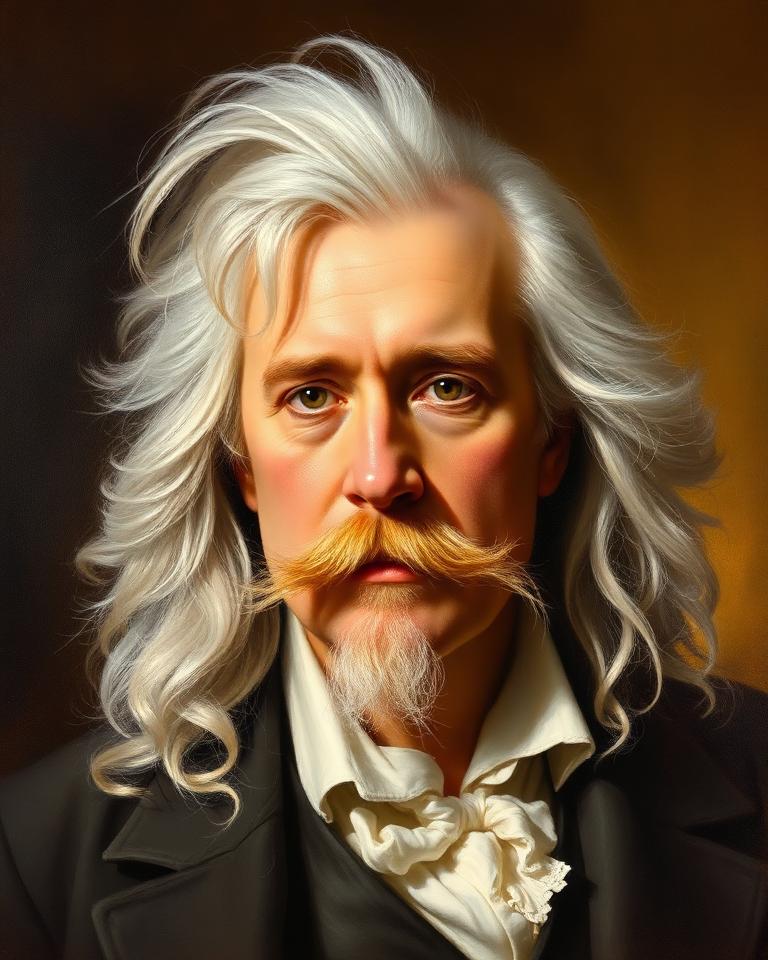
He was short in stature—about 1.52 meters, or five feet—and instantly recognizable in later life by his white hair and mustache. Friends noted his humor, animation, generosity, and sensitivity. He enjoyed walking when health permitted and drew inspiration from western Norway’s mountains, fjords, and rural culture.
The pleurisy suffered in Leipzig left lasting respiratory damage. Grieg endured repeated infections, exhaustion, and periods of convalescence. Travel was physically taxing, yet financial needs and professional commitments kept him performing. He died in Bergen Municipal Hospital on 4 September 1907, shortly before a planned trip to England. His and Nina’s ashes were later placed in a cliffside tomb at Troldhaugen.
Philosophy and Beliefs
Grieg’s public identity was strongly patriotic but not narrowly chauvinistic. He wanted Norway to develop an independent cultural voice while participating fully in European artistic life. He celebrated the peaceful dissolution of the union with Sweden in 1905, though he was not chiefly a party-political activist.
His nationalism was cultural and humanistic. He drew on folk idioms but worked with Danish, German, Dutch, Russian, and other artists. He admired international composers and rejected the idea that national character required artistic isolation.
Religion was part of his Lutheran upbringing, and sacred references appear in his world, but his surviving correspondence suggests a personal, searching outlook rather than rigid doctrinal commitment. It is safest to avoid assigning him a systematic theology.
Ethically, Grieg demonstrated concern for dignity and civil courage. In 1899 he publicly condemned the injustice of the Dreyfus affair in France and initially refused an invitation to perform there. When he eventually appeared in Paris in 1903, protests accompanied the concert, illustrating the cost of his position.
He believed art could express the character of a people through individual imagination. His famous comments about drawing from Norwegian folk song should be read as an artistic credo: inherited culture supplied possibilities, but the composer had to transform them into personal expression.
Challenges and Controversies
Grieg’s health was his most persistent obstacle. Chronic respiratory illness interrupted composition and made touring hazardous. His limited physical stamina helps explain his attraction to shorter forms, though it would be reductive to attribute his style entirely to illness.
Critics sometimes accused him of being a miniaturist unable to sustain symphonies or large sonata structures. Grieg himself withdrew his early Symphony in C minor and wrote on its score that it should never be performed. Modern performances have prompted reassessment: some hear an accomplished student work, while others agree that it lacks his mature individuality.
His nationalism has also generated debate. Admirers see an imaginative synthesis of folk idioms and art music. Critics have argued that picturesque reception turned Norway into an exotic commodity for foreign audiences. Scholarship now generally distinguishes between direct folk quotation, stylized imitation, and Grieg’s own innovations.
The Peer Gynt suites create another interpretive problem. Their beauty and familiarity can detach the music from Ibsen’s darker satire, including the hero’s selfishness and evasions. “Morning Mood,” for example, accompanies a North African scene in the drama, despite its frequent modern association with Norwegian sunrise.
Grieg’s stand on the Dreyfus affair was principled but controversial at the time. French nationalist protesters considered his intervention insulting; supporters viewed it as courageous resistance to antisemitism and judicial abuse.
He has also been judged against supposedly more “serious” Austro-German composers. Such criticism often reflects older hierarchies that privileged symphonies over songs and miniatures. Balanced assessment recognizes unevenness in his output while taking small forms seriously on their own terms.
Legacy
Grieg became an emblem of Norwegian culture during his lifetime and remained one after Norway achieved independence in 1905. His harmonic color, modal writing, and rhythmic treatment of dance contributed to later developments in French impressionism and European folk-inspired modernism. Debussy criticized some aspects of Grieg yet absorbed a musical environment that Grieg helped reshape; Bartók’s systematic folk engagement followed a different method but shared the premise that vernacular traditions could renew art music.
Troldhaugen is now the Edvard Grieg Museum and forms part of KODE Art Museums and Composer Homes. Visitors can see the villa, composing hut, concert hall, and cliffside grave. Bergen hosts the annual Bergen International Festival, whose origins are linked to ideas Grieg championed, though the modern festival began in 1953. The city’s major concert venue is named Grieghallen, and the Bergen Philharmonic Orchestra maintains a strong association with his music.
Statues and memorials stand in Bergen and elsewhere. His portrait appeared on Norway’s 500-kroner banknote in an earlier series, reinforcing his national status. The Edvard Grieg International Piano Competition and numerous schools, streets, choirs, and ensembles bear his name.
His melodies circulate far beyond classical concerts. “In the Hall of the Mountain King” and “Morning Mood” appear in films, advertisements, animation, games, and educational media. Such reuse can trivialize context, but it also testifies to their structural clarity and extraordinary recognizability.
Modern scholarship studies Grieg not only as a nationalist but also as a cosmopolitan professional, song composer, performer, correspondent, and participant in European cultural networks. His enduring importance lies in showing that intimate scale and regional inspiration can produce art of global reach.
Interesting Facts
- Grieg’s paternal ancestors came from Scotland, and the family name was originally spelled Greig.
- His mother was his first piano teacher.
- Violinist Ole Bull helped persuade his parents to send him to Leipzig.
- Pleurisy contracted as a student permanently impaired his health.
- Grieg composed an early symphony but prohibited its performance.
- Rikard Nordraak strongly encouraged his Norwegian artistic direction.
- Grieg and Nina Hagerup were first cousins.
- Their only child, Alexandra, died in infancy.
- The Piano Concerto was written mainly in Denmark, not Norway.
- Franz Liszt warmly praised the concerto during Grieg’s visit to Rome.
- Grieg initially found writing music for Peer Gynt frustrating.
- “Morning Mood” accompanies a scene in North Africa in Ibsen’s drama.
- He published sixty-six Lyric Pieces across ten books.
- His home Troldhaugen means roughly “Troll Hill.”
- He composed in a separate hut near the villa.
- Grieg received honorary doctorates from Cambridge and Oxford.
- He publicly supported Alfred Dreyfus during the French political crisis.
- Percy Grainger became a valued friend and interpreter of his music.
- Tens of thousands reportedly lined Bergen’s streets during his funeral observances.
- Grieg and Nina’s ashes rest in a rock tomb at Troldhaugen.
Famous Quotes
Translations vary because Grieg often wrote in Norwegian, Danish, or German. Context is essential, and wording differs among editions.
- “Artists like Bach and Beethoven erected churches and temples on the heights. I only wanted … to build dwellings for men in which they might feel happy and at home.” Often cited from Grieg’s reflections on his modest artistic scale. It expresses his preference for intimate, humane music; exact English wording varies by translation.
- “The traditional way of life of the Norwegian people, together with Norway’s legends, Norway’s history, Norway’s natural scenery, stamped itself on my creative imagination from my earliest years.” From an autobiographical statement, explaining the roots of his national style; translation varies.
- “I have recorded the folk music of my country.” Frequently quoted from Grieg’s account of his vocation, often followed by remarks about drawing from its rich treasury. It means transformation, not simply documentary collection; translations differ.
- “Why not begin by remembering the wonderful, mysterious power of music?” From Grieg’s writings on musical experience. It reflects his belief that music’s emotional force precedes technical explanation; translated wording varies.
- “My heart is like a sea, has storm and ebb and flow.” A line associated with his correspondence and emotional self-description. It conveys his volatile sensitivity; English versions vary.
- “I am sure my music has a taste of codfish in it.” A humorous remark reported in connection with his Norwegian identity. It is widely attributed, but the precise documentary wording and context are uncertain, so it should be treated cautiously.
- “I must protest against this contempt for small forms.” A sentiment documented in his defense of concise composition, though English phrasing varies. It clarifies why he regarded songs and piano miniatures as artistically substantial.
- “The Norwegian landscape and Norwegian folk music have been my inspiration.” Commonly presented as a summary of Grieg’s outlook. The idea is authentic, but this exact compact English formulation may be a later paraphrase.
- “I have no confidence in myself as a conductor.” Grieg made self-critical comments of this kind in correspondence, despite conducting regularly. Exact translations differ and reveal his recurring professional insecurity.
- “One must first be a human being. All true art grows out of that which is distinctively human.” Widely associated with Grieg’s humanistic artistic outlook. Because versions circulate without consistent source details, the precise wording should be regarded as uncertain.
Timeline
- 1843 — Born in Bergen on 15 June.
- 1849 — Began piano study with his mother at approximately six.
- 1858 — Ole Bull recommended professional training; Grieg entered the Leipzig Conservatory.
- 1860 — Suffered severe pleurisy, causing lifelong respiratory problems.
- 1862 — Completed his Leipzig studies and performed his compositions there.
- 1863 — Moved to Copenhagen and met Niels W. Gade and Rikard Nordraak.
- 1866 — Nordraak died; Grieg settled in Christiania and gave an important concert of Norwegian music.
- 1867 — Married Nina Hagerup; published the first book of Lyric Pieces.
- 1868 — Daughter Alexandra was born; Grieg composed the Piano Concerto in A minor.
- 1869 — Piano Concerto premiered in Copenhagen; Alexandra died.
- 1870 — Met Franz Liszt in Rome and received encouragement.
- 1871 — Helped found the Music Society in Christiania with Johan Svendsen.
- 1874 — Received a Norwegian state artist’s grant and Ibsen’s commission for Peer Gynt.
- 1876 — Peer Gynt premiered with Grieg’s incidental music.
- 1883 — Experienced a marital separation; later reconciled with Nina.
- 1884 — Composed the Holberg Suite for the bicentenary of Ludvig Holberg’s birth.
- 1885 — Completed and moved into Troldhaugen near Bergen.
- 1888 — Met Tchaikovsky in Leipzig; Peer Gynt Suite No. 1 appeared.
- 1891 — Peer Gynt Suite No. 2 was published.
- 1893 — Received an honorary doctorate from Cambridge University.
- 1895 — Composed Haugtussa, Op. 67.
- 1898 — Helped initiate a Norwegian music festival in Bergen.
- 1899 — Publicly protested the injustice of the Dreyfus affair.
- 1903 — Performed in Paris amid demonstrations related to his Dreyfus stance.
- 1906 — Met and formed a close friendship with Percy Grainger.
- 1907 — Received an honorary doctorate from Oxford; died in Bergen on 4 September.
Frequently Asked Questions
Who was Edvard Grieg?
Edvard Grieg was a Norwegian Romantic composer, pianist, and conductor born in 1843. He developed an internationally recognized musical idiom that combined European concert traditions with rhythms, melodic features, and atmosphere associated with Norway. His best-known works include the Piano Concerto in A minor, music for Ibsen’s Peer Gynt, the Holberg Suite, and ten books of Lyric Pieces. He also wrote a large and important body of songs. Grieg became a cultural symbol during Norway’s movement toward national self-definition and remains the country’s most widely performed classical composer.
Why is Grieg historically important?
Grieg demonstrated that music rooted in a comparatively small national culture could command international attention. He brought Norwegian-associated dances, folk idioms, poetry, and landscapes into dialogue with German Romantic technique. His success gave Norway cultural visibility while influencing later composers interested in harmonic color and vernacular traditions. He also challenged assumptions about artistic scale: his songs and piano miniatures show that short forms can possess structural precision and emotional depth. Historically, his career links Romantic nationalism, modern concert culture, publishing, touring, and the rise of independent Norway.
What are Grieg’s most famous compositions?
His most famous composition is probably the incidental music for Peer Gynt, particularly “Morning Mood” and “In the Hall of the Mountain King.” The Piano Concerto in A minor is a central work of the Romantic concerto repertory. Other major pieces include the Holberg Suite, the String Quartet in G minor, three violin sonatas, the Cello Sonata, Norwegian dances, and the ten collections of Lyric Pieces. Among his songs, the cycle Haugtussa is especially admired. Public familiarity varies: orchestral audiences know the suites, while pianists and singers encounter a much broader Grieg repertory.
Did Grieg use authentic Norwegian folk songs?
Sometimes, but not always. Grieg arranged existing melodies in works such as the Norwegian Folk Songs and Dances, drawing in part on collections by Ludvig Mathias Lindeman. In many original compositions, however, he did not quote a specific tune. Instead, he created melodies and textures shaped by features associated with Norwegian music: drone basses, modal inflections, irregular accents, ornaments, and rhythms of dances such as the halling and springar. Scholars therefore distinguish direct arrangement, stylized imitation, and original composition. Calling all his themes “folk songs” oversimplifies his method.
What is special about the Piano Concerto in A minor?
The concerto combines dramatic virtuosity with unusually direct lyricism. Its opening timpani roll and descending piano gesture establish immediate theatrical energy. The first movement balances bold themes with reflective passages; the slow movement offers sustained tenderness; and the finale incorporates dance-like rhythms before a broad concluding transformation. Schumann’s concerto influenced its general model, but Grieg’s rhythmic and harmonic voice is distinctive. Composed in 1868 and premiered in 1869, it brought him international recognition. He revised it repeatedly, so the familiar version represents decades of refinement rather than a single youthful inspiration.
Why did Grieg write music for Peer Gynt?
Henrik Ibsen commissioned him in 1874 to compose incidental music for a stage version of the dramatic poem. Grieg accepted partly because the project offered prestige and financial support, although he found aspects of the drama difficult to translate musically. The score accompanied songs, dances, scene changes, and dramatic episodes at the 1876 Christiania premiere. Grieg later selected and rearranged movements into two orchestral suites. Those suites became more popular than the complete theatrical score, sometimes changing how audiences understand Ibsen’s ironic, morally complex work.
Is “Morning Mood” a depiction of Norway?
Not in its original dramatic context. In Peer Gynt, “Morning Mood” accompanies dawn in North Africa, where Peer has traveled. Its pastoral flute and oboe writing has nevertheless become widely associated with Norwegian mountains and sunrise because listeners connect Grieg so strongly with Norway. The discrepancy illustrates how concert excerpts acquire meanings apart from their theatrical sources. It is reasonable to hear Grieg’s characteristic landscape sensibility in the music, but historically inaccurate to claim that Ibsen and Grieg placed this particular scene in a Norwegian fjord.
Who was Nina Grieg?
Nina Hagerup Grieg was Edvard’s cousin, wife, and principal vocal collaborator. Born in 1845, she trained as a singer and became an admired interpreter of his songs, valued for expressive phrasing and attention to words. The couple married in 1867 despite family objections and toured together widely. Their marriage endured the death of their infant daughter and a period of separation. Nina’s artistry helped shape how Grieg wrote and performed vocal music. After his death, she continued to preserve his memory and lived until 1935.
Did Grieg have children?
Edvard and Nina had one child, Alexandra, born in April 1868. She died from meningitis in May 1869, when she was about thirteen months old. Her death was a devastating experience for both parents, and they had no other children. Biographers appropriately connect the loss with periods of grief in their lives, but particular compositions should not be labeled direct memorials unless documentary evidence supports that interpretation. The tragedy formed part of a marriage already challenged by unstable finances, touring, illness, and demanding artistic careers.
Why was Grieg often ill?
While studying in Leipzig in 1860, Grieg contracted severe pleurisy. One lung was permanently damaged, and he subsequently experienced chronic respiratory weakness, infections, fatigue, and breathing difficulties. Nineteenth-century medicine offered limited treatment, while cold climates, smoke, and repeated railway and sea travel could worsen his condition. Illness interrupted his work and forced periods of rest at spas and warmer locations. It may have influenced his working patterns, but claims that it directly caused his preference for miniatures remain speculative. Artistic temperament, market conditions, and musical taste also mattered.
Why did Grieg withdraw his symphony?
Grieg composed the Symphony in C minor in 1863–1864 during his early development. He later wrote that it should never be performed, apparently believing it too derivative and unrepresentative of his mature identity. The prohibition was respected for decades, though the work was eventually performed and recorded in the twentieth century. Modern listeners often find it skillful and attractive but strongly indebted to composers such as Gade, Schumann, and Mendelssohn. Its withdrawal reflects Grieg’s self-criticism and his decision to pursue a more individual Norwegian-inflected style.
Was Grieg involved in politics?
He did not build a career in party politics, but he took public positions on national and ethical questions. Grieg supported Norwegian cultural independence and welcomed the peaceful end of Norway’s union with Sweden in 1905. His most prominent international intervention concerned Alfred Dreyfus, the Jewish French army officer wrongfully convicted of treason. Grieg condemned the injustice and initially rejected a French invitation. This action provoked hostility when he later performed in Paris. His politics are therefore best described as patriotic, liberal-humanistic, and issue-oriented rather than partisan.
What was Grieg’s connection to Franz Liszt?
The two met in Rome in 1870 after Liszt had shown interest in the younger Norwegian composer’s music. During their encounter, Liszt examined and played from Grieg’s Piano Concerto score and offered enthusiastic encouragement. Accounts based on Grieg’s own report describe Liszt’s extraordinary sight-reading and praise, though later anecdotes sometimes add theatrical details that are difficult to verify. Liszt’s approval mattered because he was one of Europe’s most prestigious musicians. It strengthened Grieg’s confidence and gave his concerto valuable international validation.
Where did Grieg live and compose?
He was born in Bergen, studied in Leipzig, developed his national outlook in Copenhagen, and began his public career in Christiania. From 1885 his best-known home was Troldhaugen, near Bergen. The villa overlooked Nordås Lake, and a small detached hut served as his private composing studio. Grieg nevertheless traveled frequently throughout Europe for concerts, conducting engagements, treatment, and meetings with artists. Troldhaugen became his emotional and creative base rather than his only workplace. It is now a museum preserving the domestic setting, hut, concert tradition, and grave.
How did Grieg influence later composers?
His chromatic harmony, modal color, pedal points, compressed forms, and vivid piano textures helped broaden late-Romantic musical language. French composers encountered in Grieg an alternative to heavy German symphonic rhetoric, while later national composers saw how local traditions could be transformed for international art music. Direct influence varies and should not be exaggerated: Debussy, Ravel, Bartók, and others developed very different methods. Grieg’s clearest long-term contribution was demonstrating that harmonic experimentation, vernacular reference, and concise form could coexist with accessibility.
How did Edvard Grieg die?
Grieg died of heart failure in Bergen Municipal Hospital on 4 September 1907 after years of serious respiratory illness. He had been preparing to travel to England for a music festival but became acutely unwell. Norway treated his death as a major national loss. Large crowds participated in the funeral observances, and his funeral march for Rikard Nordraak was among the music associated with the ceremony. Grieg was cremated, and his ashes were eventually placed in a rock tomb at Troldhaugen; Nina’s ashes joined his after her death.
Lessons We Can Learn
- Build on local culture without becoming isolated. Grieg used Norwegian idioms within European forms. Today, creators can honor regional identity while communicating internationally.
- Small forms can carry large ideas. The Lyric Pieces show that importance does not depend on duration. Concision can demand greater focus, not less ambition.
- Transform influences rather than copying them. Grieg learned from Schumann and folk traditions but developed a recognizable voice. Education becomes valuable when absorbed critically.
- Seek honest mentors. Ole Bull, Nordraak, and Liszt offered different kinds of encouragement. Timely guidance can redirect a career.
- Revise successful work. Grieg repeatedly improved his Piano Concerto. Popular success should not end careful craftsmanship.
- Know your strengths. He concentrated on lyricism, song, piano writing, and color rather than forcing a career around symphonies. Self-knowledge supports sustainable excellence.
- Collaborate deeply. Nina’s singing shaped his songs, while writers and performers expanded his reach. Major achievements are rarely solitary.
- Create despite limitations. Chronic illness restricted Grieg, yet he adjusted his schedule and workspace. Adaptation can preserve meaningful work without denying hardship.
- Use public standing ethically. His Dreyfus protest risked professional hostility. Reputation can be used to defend principles rather than merely protect comfort.
- Let place inspire craft, not stereotype. Troldhaugen and Norway’s landscapes nourished his imagination, but technique turned feeling into durable music. Inspiration requires disciplined execution.
Related Historical Figures
- Nina Hagerup Grieg (1845–1935) — Grieg’s wife, cousin, and principal singer; her interpretations were central to his songs and touring career.
- Ole Bull (1810–1880) — Norwegian violin virtuoso who recognized Grieg’s talent and recommended conservatory study.
- Rikard Nordraak (1842–1866) — Composer and friend who encouraged Grieg to develop a distinctly Norwegian musical voice.
- Henrik Ibsen (1828–1906) — Playwright who commissioned the incidental music for Peer Gynt.
- Franz Liszt (1811–1886) — Pianist-composer whose praise of the Piano Concerto strengthened Grieg’s international standing.
- Niels W. Gade (1817–1890) — Danish composer and Copenhagen mentor representing the Scandinavian-German tradition from which Grieg partly emerged.
- Johan Svendsen (1840–1911) — Norwegian composer-conductor who worked with Grieg to improve Christiania’s concert life.
- Robert Schumann (1810–1856) — A major stylistic influence, especially on Grieg’s piano music and concerto writing.
- Pyotr Ilyich Tchaikovsky (1840–1893) — Russian composer who met Grieg in Leipzig and admired his warmth and musical individuality.
- Percy Grainger (1882–1961) — Australian-born pianist and composer who became Grieg’s friend and an influential interpreter of his piano music.
Related Historical Figures