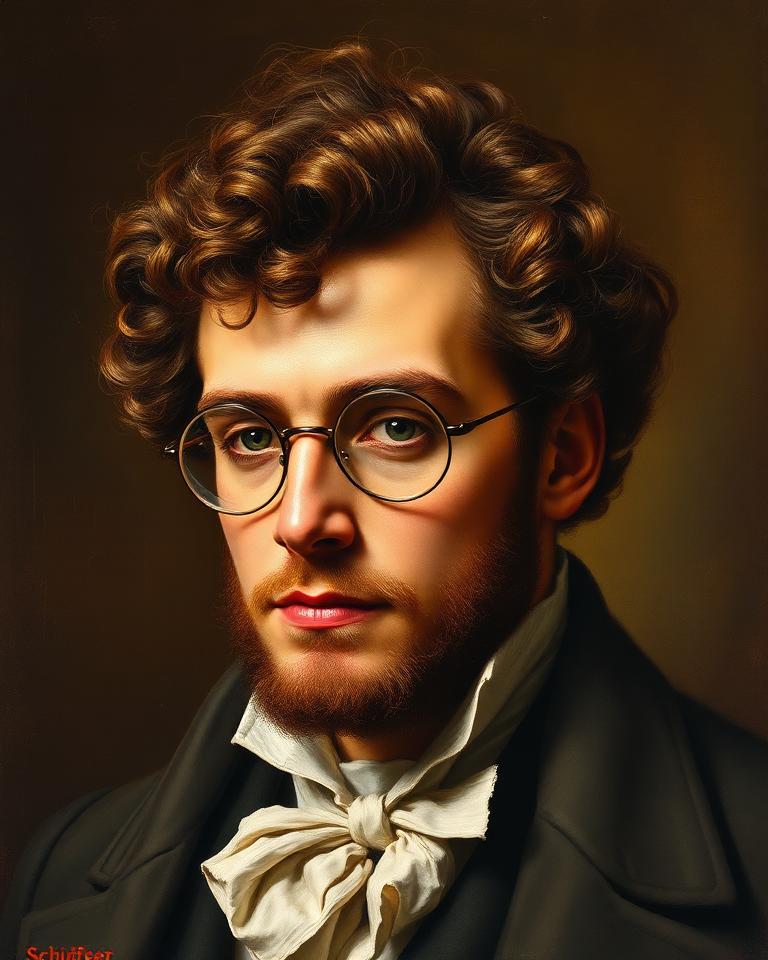
Quick Facts
- Years
- 1797 – 1828
- Category
- Artists & Composers
- Subcategory
- Classical Composers
- Nationality
- Austrian
- Occupation
- Composer
Franz Schubert
1797 – 1828 · Austrian · Composer
Audiobook

Life Lessons from Franz Schubert
Marcus Alden · 52 min
Franz Schubert was an Austrian composer whose extraordinary gift for melody transformed Western music. Born in Vienna in 1797, he lived only thirty-one years, yet produced more than 600 songs, nine numbered symphonies in the traditional catalogue, chamber music, piano works, sacred compositions, operas, and dances. His finest music combines Classical balance with the emotional intensity, harmonic freedom, and literary sensitivity associated with Romanticism.
Schubert is especially celebrated for elevating the German art song, or Lied, into a major artistic form. Works such as “Gretchen am Spinnrade,” “Erlkönig,” and the cycles Die schöne Müllerin and Winterreise unite poetry and music with remarkable psychological depth. His instrumental masterpieces include the “Unfinished” Symphony, the “Great” C-major Symphony, the “Trout” Quintet, the String Quintet in C major, and his final piano sonatas.
Although respected by a close Viennese circle, Schubert never achieved the public security enjoyed by some contemporaries. Much of his greatest music was unpublished or rarely performed during his lifetime. Its rediscovery and promotion by musicians including Robert Schumann, Felix Mendelssohn, Franz Liszt, and Johannes Brahms secured his lasting reputation. Schubert remains central to concert life because he connected intimate human feeling with ambitious musical architecture, profoundly influencing later song, chamber music, symphonic writing, and piano literature.
Quick Facts
| Field | Details |
|---|---|
| Full Name | Franz Peter Schubert |
| Common Name(s) | Franz Schubert |
| Born | 31 January 1797 |
| Died | 19 November 1828 |
| Age at Death | 31 |
| Birthplace | Himmelpfortgrund, near Vienna, Archduchy of Austria; now part of Vienna, Austria |
| Nationality | Austrian |
| Occupation | Composer; briefly schoolteacher |
| Historical Era | Late Classical and early Romantic periods |
| Famous For | More than 600 Lieder, symphonies, chamber music, piano works, and sacred music |
| Political Affiliation if applicable | None recorded; associated socially with some liberal-minded friends under Metternich-era censorship |
| Religion if significant | Baptized and raised Roman Catholic; his mature personal beliefs are debated |
| Education | Lessons from his family and Michael Holzer; Imperial-Royal City Seminary and Stadtkonvikt; composition studies with Antonio Salieri |
| Parents | Franz Theodor Florian Schubert and Maria Elisabeth Katharina Vietz Schubert |
| Spouse(s) | Never married |
| Children | None known |
| Major Works | Erlkönig; Gretchen am Spinnrade; Die schöne Müllerin; Winterreise; “Unfinished” Symphony; “Great” C-major Symphony; Trout Quintet; String Quartet in D minor, “Death and the Maiden”; String Quintet in C major; final three piano sonatas |
| Major Achievements | Transformed the German Lied; expanded Romantic harmony and musical narrative; created enduring masterpieces across song, chamber, piano, sacred, and orchestral genres |
Early Life
Franz Peter Schubert was born in Himmelpfortgrund, a suburban district of Vienna, on 31 January 1797. He was the twelfth child of schoolmaster Franz Theodor Schubert and Maria Elisabeth Vietz, although many of their children died in infancy. His father ran a parish school, and the family’s modest home was filled with practical music-making.
Schubert first learned violin from his father and piano from his elder brother Ignaz. The local choirmaster Michael Holzer taught him organ, singing, and harmony. Holzer later suggested that the boy’s abilities quickly exceeded what he could formally teach him.
In 1808 Schubert won a place as a choirboy in the Imperial court chapel and entered the Stadtkonvikt, a boarding school that trained talented pupils. There he encountered orchestral music from inside the ensemble, playing violin and eventually helping to lead the student orchestra. The experience introduced him to Haydn, Mozart, and Beethoven. Mozart’s lyricism and Beethoven’s scale would remain powerful reference points throughout his career.
The institution offered strong musical opportunities but strict discipline. Schubert also studied privately with Antonio Salieri, Vienna’s influential court composer, who encouraged his command of vocal writing and Italian prosody. Contrary to later caricatures, Salieri was an important and supportive teacher.
Schubert’s mother died in 1812. His changing voice ended his choir service, and he left the Stadtkonvikt in 1813. After teacher training, he became an assistant at his father’s school. He disliked the repetitive work, but teaching provided minimal stability while he composed at astonishing speed.
His youth unfolded during the Napoleonic Wars and their aftermath. Vienna was occupied by French forces in 1805 and 1809, and the Congress of Vienna reshaped Europe in 1814–1815. The subsequent government of Prince Klemens von Metternich imposed censorship and surveillance. This climate encouraged private cultural gatherings—the setting in which much of Schubert’s music first flourished.
Rise to Prominence
Schubert’s creative breakthrough came remarkably early. In October 1814, aged seventeen, he composed “Gretchen am Spinnrade,” setting a passage from Goethe’s Faust. The piano’s circling figure evokes both a spinning wheel and Gretchen’s obsessive thoughts. It is often regarded as an early landmark of Romantic song.
The year 1815 brought an extraordinary outpouring: roughly 150 songs, alongside symphonies, church music, and stage works. Among them was “Erlkönig,” whose galloping accompaniment and sharply differentiated characters turn Goethe’s ballad into a compact musical drama.
In 1816 Schubert left schoolteaching temporarily to live with Franz von Schober, a cultivated friend who gave him time and social access. The baritone Johann Michael Vogl soon became his most important interpreter. Vogl’s performances introduced Schubert’s songs to influential Viennese listeners and helped establish the composer beyond his immediate circle.
Private evenings devoted to his work became known as “Schubertiads.” These gatherings mixed music, poetry, conversation, dancing, and sociability. They were not a single formal series, and surviving images sometimes idealize them, but they were crucial to his artistic network.
Publication came slowly. In 1821 supporters financed the issue of “Erlkönig” as his Opus 1. It sold well, and additional songs followed. Publishers nevertheless offered unfavorable terms, and Schubert lacked a permanent court, church, or aristocratic appointment. Operatic projects failed to secure a durable place in the theater, while large instrumental works often remained unheard.
His reputation therefore developed unevenly. Viennese audiences increasingly knew selected songs and piano pieces, but many symphonies and chamber works circulated only privately or remained in manuscript. His sole large public concert devoted entirely to his own music, on 26 March 1828, was artistically and financially successful. By then, however, his health had been compromised for years.
Major Achievements
Transforming the German Lied
Schubert did not invent the German art song, but he radically enlarged its expressive range. In more than 600 Lieder, he treated the piano as an equal dramatic partner rather than a neutral accompaniment. Repeated figures can portray water, footsteps, wind, spinning, or emotional fixation.
His settings of Goethe, Schiller, Wilhelm Müller, and many other poets match melody, harmony, rhythm, and form to the language’s changing psychology. This mattered because a short domestic genre gained the depth of miniature drama. Schumann, Brahms, Hugo Wolf, and later song composers built upon this achievement.
Creating the Song Cycle as Psychological Journey
Die schöne Müllerin (1823) follows a young miller’s love, jealousy, despair, and death through poems by Wilhelm Müller. Winterreise (1827), also after Müller, depicts a rejected wanderer moving through a frozen landscape that becomes an image of alienation.
Neither cycle depends on conventional stage action. Instead, recurring symbols and tonal relationships create inward narratives. Their emotional complexity established a model for integrated song cycles and continues to challenge singers, pianists, and audiences.
Expanding Chamber Music
Schubert’s chamber works unite lyrical expansiveness with bold architecture. The Trout Quintet, probably composed in 1819, uses the unusual combination of piano, violin, viola, cello, and double bass; its variations draw on his song “Die Forelle.”
The “Death and the Maiden” Quartet, the G-major Quartet, and the C-major String Quintet push domestic chamber music toward symphonic dimensions. The String Quintet’s two-cello scoring produces exceptional warmth and depth. These works influenced later composers by showing how songlike themes could sustain large forms.
Reimagining the Symphony
The Symphony in B minor, known as the “Unfinished,” survives as two completed movements plus material for a scherzo. Why Schubert abandoned it remains unknown. Its dark sonorities, lyrical themes, and dramatic contrasts make it one of the nineteenth century’s defining symphonic works.
The “Great” C-major Symphony combines expansive scale, rhythmic drive, and cumulative structure. Robert Schumann encountered its manuscript in Vienna in 1839, and Felix Mendelssohn conducted the first known public performance in Leipzig. Its influence can be heard in later Romantic symphonists, especially Schumann, Brahms, Bruckner, and Dvořák.
Enriching the Piano Repertoire
Schubert’s piano music ranges from social dances to ambitious sonatas. The Impromptus, Moments musicaux, “Wanderer” Fantasy, and final three sonatas balance lyrical intimacy with harmonic exploration and long-range structure.
His use of remote keys, sudden shifts of mood, and extended time altered how composers understood musical space. Liszt admired and transcribed his songs, while later pianists and composers recognized the late sonatas as monuments comparable in seriousness to Beethoven’s.
Sustaining Sacred and Choral Traditions
Schubert wrote six Latin masses, smaller church works, part-songs, and the late E-flat Mass. These compositions combine inherited Classical forms with distinctive lyricism and harmonic color.
He sometimes omitted or altered portions of the Creed’s text, including “and in one holy catholic and apostolic Church” in several masses. Scholars disagree over whether this reflected theological reservations, practical convention, or compositional preference. The works nevertheless remain important examples of early Romantic sacred music.
Leadership and Work
Schubert held no major institution and commanded no orchestra over the long term, so “leadership” applies chiefly to his artistic influence and collaborative circle. He led through creative abundance rather than administrative authority.
His working method was rapid but not careless. Manuscripts show corrections, revisions, and abandoned alternatives. He could write songs swiftly because he possessed exceptional command of harmony and text, while major instrumental works demanded sustained reconsideration. Friends recalled intense concentration and a near-continuous urge to compose.
He depended on interpreters and advocates. Vogl shaped the public reception of his songs; friends organized gatherings and publications; poets supplied texts; and performers tested chamber works. Schubert could be sociable and generous, yet he was not consistently effective in business. He accepted weak publishing arrangements and struggled to convert growing esteem into reliable income.
His principal strength was imaginative responsiveness: a poem, ensemble, performer, or occasion could unlock a new musical world. His weaknesses included limited financial planning, difficulty gaining theatrical success, and dependence on informal patronage. Even so, he maintained an independent musical voice amid pressure to imitate fashionable opera or Beethovenian grandeur.
Personal Life
Schubert never married and had no known children. As a young man he appears to have admired Therese Grob, a singer who participated in the first performance of his Mass in F major. Whether he seriously intended marriage is uncertain. Austrian marriage regulations required evidence of financial means, which he lacked.
His closest world was a changing network of male and female friends, including Franz von Schober, Joseph von Spaun, Leopold Kupelwieser, Moritz von Schwind, Eduard von Bauernfeld, and the Sonnleithner family. Their gatherings gave him listeners, lodgings, contacts, and emotional support. Tensions also occurred, especially where artistic ambition, money, or personality intervened.
Contemporaries described Schubert as short, physically unassuming, and severely nearsighted; his spectacles became part of his familiar appearance. He could be shy among strangers but lively in trusted company. He enjoyed taverns, coffeehouses, country excursions, poetry, dancing, and social music-making.
In late 1822 or early 1823, Schubert became seriously ill, and documentary evidence strongly indicates syphilis. He underwent treatment and spent time in hospital. His health later fluctuated, while periods of depression and anxiety appear in letters and recollections. It is simplistic, however, to treat every dark composition as autobiography.
In 1828 he moved into the Vienna home of his brother Ferdinand. His final illness was diagnosed at the time as typhus or “nervous fever”; modern scholars have proposed typhoid fever, possibly worsened by underlying disease. He died on 19 November and was buried near Beethoven at Währing Cemetery.
Philosophy and Beliefs
Schubert left no systematic philosophical statement. His choices must therefore be interpreted cautiously through letters, texts, friendships, and music.
He was raised Catholic and composed substantial sacred music, yet his relationship to doctrine seems personal rather than institutionally demonstrative. His textual omissions in mass settings have prompted debate, but they do not prove a simple rejection of Christianity. His music often approaches faith through humility, suffering, awe, consolation, and longing.
Politically, he belonged to no recorded party. Some friends held liberal or nationalist sympathies, and in 1820 police arrested several members of his circle during a gathering; Schubert was questioned and released. His songs sometimes touch liberty, human dignity, or resistance to tyranny, but direct political interpretation is complicated by censorship and poetic convention.
Ethically and artistically, he appears committed to friendship, sincerity, and the serious value of poetry. His settings preserve ambiguity rather than forcing moral conclusions. He repeatedly gave voice to outsiders—wanderers, rejected lovers, mythic figures, prisoners, and the lonely—making empathy one of the most recognizable qualities of his art.
Challenges and Controversies
Schubert’s greatest practical challenge was professional insecurity. He never obtained the stable appointment he sought, and his income depended on publication, commissions, teaching, performances, and friends. Some historians emphasize an exploitative music market; others note that his limited self-promotion and concentration on less profitable genres also contributed.
His operas and stage works were largely unsuccessful. Alfonso und Estrella, Fierrabras, and other projects suffered from weak librettos, theatrical politics, changing management, or lack of production. Admirers hear dramatic invention in them, while critics find that his genius for lyrical moments did not always translate into continuous stage action.
Numbering his symphonies remains confusing because manuscripts surfaced gradually and catalogues adopted different systems. The “Unfinished” may be called No. 7 or No. 8, and the “Great” C major No. 8 or No. 9. Modern scholarship generally relies on titles, keys, and Deutsch catalogue numbers to avoid ambiguity.
Schubert’s sexuality has also generated debate. Some scholars have proposed that his intimate male friendships and aspects of his social environment suggest same-sex desire. Others argue that the evidence is insufficient and that nineteenth-century friendship language cannot be read through modern categories. No definitive documentation establishes his sexual orientation; responsible biography should leave the question open.
Romantic legend long portrayed him as a neglected, instinctive genius writing masterpieces without revision. This is misleading. He had dedicated supporters, achieved some publication success, and revised extensively. Yet it is equally wrong to minimize his neglect: many major instrumental works received no adequate public hearing while he lived.
Legacy
Schubert’s posthumous rise was dramatic. In 1839 Robert Schumann found the “Great” C-major Symphony manuscript through Schubert’s brother Ferdinand, and Mendelssohn conducted it in Leipzig. George Grove and Arthur Sullivan later investigated manuscripts in Vienna, while Brahms helped edit Schubert’s works. Liszt’s transcriptions carried the songs into the concert hall.
His influence extends across Romantic and modern music. Schumann inherited his literary sensitivity; Brahms absorbed his rhythmic and harmonic methods; Bruckner and Mahler learned from his large-scale processes; Hugo Wolf developed the Lied further. Later composers were drawn to his abrupt tonal shifts, repetition, suspended time, and mixture of beauty with unease.
Schubert’s birthplace at Nußdorfer Straße 54 and the house where he died at Kettenbrückengasse 6 are maintained as museums by the Wien Museum. Vienna contains numerous plaques, statues, and memorials, including the Schubert monument in the Stadtpark. In 1888 his remains, along with Beethoven’s, were transferred to honorary graves in Vienna’s Central Cemetery.
The Deutsch catalogue, compiled by Otto Erich Deutsch and first published in 1951, provides the standard “D” numbers used to identify his compositions. The International Schubert Society and the Neue Schubert-Ausgabe have advanced critical editing and scholarship.
Today Schubert is indispensable to singers, pianists, chamber ensembles, and orchestras. His modern relevance lies partly in his treatment of isolation, memory, movement, and uncertain belonging. He made private emotion structurally powerful without reducing it to sentimentality.
Interesting Facts
- Schubert was the twelfth child born to his parents; only five of their fourteen children survived infancy.
- He entered Vienna’s Stadtkonvikt as a choir scholar in 1808.
- Antonio Salieri taught him composition.
- He composed “Gretchen am Spinnrade” at seventeen.
- During 1815 he wrote approximately 150 songs.
- “Erlkönig” assigns four dramatic identities to one singer: narrator, father, child, and Erlking.
- His works are commonly identified by Deutsch catalogue numbers beginning with “D.”
- Schubertiads ranged from intimate home gatherings to larger social events.
- Johann Michael Vogl was more than twenty-five years older than Schubert and became his leading song interpreter.
- The Trout Quintet includes a double bass rather than the second violin usual in piano quintets.
- The “Unfinished” Symphony has two completed movements, although sketches survive for a third.
- He served as a pallbearer or torchbearer at Beethoven’s funeral in 1827; sources vary in terminology.
- Schubert’s only large public concert devoted wholly to his music occurred in March 1828.
- He wrote his final three piano sonatas during the last months of his life.
- His String Quintet was not publicly performed until 1850.
- The “Great” C-major Symphony was publicly premiered eleven years after his death.
- His spectacles are preserved among objects associated with him in Vienna.
- He died in his brother Ferdinand’s apartment, now a museum.
Famous Quotes
Reliable Schubert quotations often survive in letters and diaries, and translations vary.
- “I came into the world for no purpose but to compose.” Reported by friend Johann Leopold von Sonnleithner rather than preserved in Schubert’s hand. It summarizes his perceived vocation but should be treated as a recollection.
- “Every night, when I go to sleep, I hope I may never awake…” From a March 1824 letter to Leopold Kupelwieser during illness and discouragement. It documents profound despair, not his permanent state.
- “…and every morning renews yesterday’s grief.” From the same letter. The line conveys the persistence of suffering during his health crisis.
- “My peace is gone, my heart is heavy.” This is Goethe’s text in Schubert’s “Gretchen am Spinnrade,” not Schubert’s own statement. It is frequently misattributed because his setting made it famous.
- “The state should regard us as artists, not as mere craftsmen.” A sentiment attributed to Schubert in memoir literature; exact wording and reliability are uncertain.
- “Happy is the man who finds a true friend, and far happier is he who finds a true friend in his wife.” Recorded in Schubert’s 1816 diary, reflecting his idealization of companionship.
- “Man resembles a ball in play, subject to chance and passion.” From his 1816 diary in common English translation, expressing youthful reflection on human instability.
- “O imagination, humanity’s greatest treasure…” From an 1824 diary entry often titled “My Dream.” It identifies imagination as a refuge and creative force.
- “No one understands another’s grief, and no one understands another’s joy.” From “My Dream,” 1824. It expresses the isolation that recurs in his mature works.
- “The products of my genius and my misery… seem to please the world best.” From a March 1824 letter to Kupelwieser, linking creative output to hardship without claiming that suffering alone produced his art.
Timeline
- 1797 — Born in Himmelpfortgrund on 31 January.
- 1804–1808 — Receives early violin, piano, organ, singing, and theory lessons.
- 1808 — Enters the Stadtkonvikt and Imperial court chapel choir.
- 1812 — His mother dies; begins advanced study with Salieri around this period.
- 1813 — Leaves the Stadtkonvikt and trains as a schoolteacher.
- 1814 — Becomes an assistant in his father’s school; writes “Gretchen am Spinnrade” and Mass in F major.
- 1815 — Produces an exceptional body of songs, including “Erlkönig,” and completes Symphonies Nos. 2 and 3.
- 1816 — Leaves regular teaching for Schober’s household; meets Vogl.
- 1817 — Vogl begins championing Schubert’s songs.
- 1818 — Works briefly as music teacher to the Esterházy family at Zseliz; completes Symphony in C major, D 589.
- 1819 — Travels with Vogl in Upper Austria; composes the Trout Quintet around this time.
- 1820 — Friends are arrested at a gathering; Schubert is questioned and released.
- 1821 — “Erlkönig” appears as Opus 1; publications increase.
- 1822 — Composes the B-minor “Unfinished” Symphony and Wanderer Fantasy.
- 1823 — Suffers serious illness; composes Die schöne Müllerin and music for Rosamunde.
- 1824 — Writes “Death and the Maiden” Quartet and Octet; returns to Zseliz.
- 1825 — Makes an extended journey through Upper Austria; composes the A-major Piano Sonata, D 845.
- 1826 — Completes the G-major String Quartet and works on the “Great” C-major Symphony.
- 1827 — Participates in Beethoven’s funeral; composes Winterreise and the two piano trios.
- 1828 — Gives his major public concert; writes the E-flat Mass, String Quintet, final piano sonatas, and “Schwanengesang” songs; dies on 19 November.
- 1839 — Schumann brings attention to the “Great” C-major Symphony; Mendelssohn conducts it in Leipzig.
- 1888 — Schubert’s remains are transferred to Vienna’s Central Cemetery.
- 1951 — Otto Erich Deutsch publishes the first edition of the thematic catalogue bearing his name.
Frequently Asked Questions
Who was Franz Schubert?
Franz Schubert was an Austrian composer active in Vienna during the transition from the Classical to the Romantic era. In only about eighteen productive years, he wrote more than 600 songs as well as symphonies, chamber music, piano works, masses, operas, and dances. He is particularly important for making the Lied a psychologically and musically ambitious genre. Although he gained recognition among performers, publishers, and private audiences, many of his largest works became widely known only after his death.
When and where was Schubert born?
Schubert was born on 31 January 1797 in Himmelpfortgrund, then a suburban community near Vienna in the Habsburg monarchy. The district has since been incorporated into Vienna and lies in today’s ninth municipal district, Alsergrund. His birthplace survives as a museum. Vienna’s churches, theaters, domestic salons, schools, publishers, and instrumental traditions shaped his musical development, while its repressive post-Napoleonic politics encouraged the private artistic culture in which his songs first circulated.
What is Schubert most famous for?
He is most famous for his Lieder, especially “Erlkönig,” “Gretchen am Spinnrade,” “Ave Maria,” Die schöne Müllerin, and Winterreise. He is equally important for the “Unfinished” and “Great” C-major symphonies, the Trout Quintet, “Death and the Maiden” Quartet, C-major String Quintet, and late piano sonatas. His enduring achievement was to combine memorable melody with daring harmony, subtle literary interpretation, and large-scale musical design.
Did Schubert write “Ave Maria”?
Yes, but the familiar title can mislead. Schubert’s 1825 song D 839 originally set a German translation of “Ellen’s Third Song” from Walter Scott’s The Lady of the Lake. Its refrain begins with the words “Ave Maria,” because Ellen invokes the Virgin Mary. The piece was later performed with the Latin prayer, creating the version widely heard at religious ceremonies. Schubert did not originally compose it as a complete setting of the traditional Latin Ave Maria text.
How many songs did Schubert compose?
Schubert composed more than 600 solo songs, with totals varying slightly according to whether fragments, alternate versions, and ensemble songs are counted. The Deutsch catalogue is the standard reference for identifying them. His output includes simple strophic songs, extended ballads, dramatic scenes, and integrated cycles. The quantity is remarkable, but its historical importance rests on quality and variety: Schubert repeatedly found distinctive musical structures for poems with different speakers, images, rhythms, and emotional trajectories.
What is a Schubertiad?
A Schubertiad was a social gathering centered on Schubert’s music. Friends, singers, pianists, artists, writers, and patrons met in private homes or other venues to hear songs and chamber pieces, recite poetry, dance, and converse. The term covered events of different sizes rather than one organized concert series. Schubertiads were important because public performance opportunities were limited. Modern festivals use the name for formal concert series, but historical gatherings were usually more intimate and socially mixed.
Why is the “Unfinished” Symphony unfinished?
No surviving document gives a definitive explanation. Schubert completed two movements in 1822, drafted part of a scherzo, and then stopped. Theories include illness, dissatisfaction, competing projects, or uncertainty about how to continue after two unusually powerful movements. Claims that he considered the work complete are speculative; four movements remained the normal symphonic expectation. The manuscript went to Anselm Hüttenbrenner and was not publicly performed until 1865, long after Schubert’s death.
How did Schubert die?
Schubert died in Vienna on 19 November 1828 after an acute illness. Contemporary accounts used terms such as typhus or nervous fever, and many modern writers identify typhoid fever as the immediate cause. He had also suffered from syphilis since about 1822–1823, which may have weakened his health. Because nineteenth-century diagnosis was imprecise and no modern clinical examination is possible, the exact interaction of diseases remains uncertain. He was thirty-one years old.
Did Schubert know Beethoven?
Schubert revered Beethoven and lived in the same city, but evidence for a close personal relationship is lacking. They may have met briefly, and Schubert participated ceremonially in Beethoven’s funeral in 1827. Anecdotes claiming that Beethoven praised Schubert’s songs on his deathbed are difficult to verify. Beethoven’s influence is nevertheless unmistakable in Schubert’s instrumental ambitions. Schubert was initially buried near him at Währing, symbolically placing the younger composer beside the master he admired.
Was Schubert famous during his lifetime?
He was neither wholly unknown nor fully established. By the 1820s, his songs and short piano pieces were published and performed, and educated Viennese listeners recognized his talent. He had influential advocates and earned money from music. Yet many symphonies, chamber works, and operas remained unperformed or unpublished, and he lacked a secure official appointment. His broad international fame and canonical standing developed mainly after his death as manuscripts were recovered, edited, performed, and circulated.
Why are Schubert’s works identified with “D” numbers?
The “D” refers to Otto Erich Deutsch, the scholar who compiled a chronological thematic catalogue of Schubert’s works. Because opus numbers cover only part of Schubert’s output and were assigned inconsistently, Deutsch numbers provide a more comprehensive system. Thus the “Unfinished” Symphony is D 759 and Winterreise is D 911. Revisions to the catalogue have refined chronology and attribution, but D numbers remain the standard tools for performers, researchers, libraries, and recordings.
Was Schubert a Romantic composer?
Schubert is usually classified as an early Romantic, though his work also stands firmly in the Classical Viennese tradition. He inherited sonata forms, chamber genres, and symphonic procedures from Haydn, Mozart, and Beethoven. At the same time, his literary orientation, harmonic mobility, emotional inwardness, fascination with wandering, and expansion of song anticipate central Romantic concerns. Calling him a bridge between Classical and Romantic styles is useful, provided it does not understate his originality.
Did Schubert have a wife or children?
No. Schubert never married, and no children are known. He appears to have felt affection for Therese Grob during his youth, but the precise nature and duration of the relationship remain unclear. Austrian regulations made marriage difficult for men unable to demonstrate sufficient income, and Schubert never achieved stable financial security. His strongest documented personal bonds were with the friends, performers, artists, and patrons who formed his Viennese social circle.
What was Schubert’s relationship with Goethe?
Goethe was one of Schubert’s most important poetic sources. Schubert set dozens of his texts, including “Gretchen am Spinnrade” and “Erlkönig,” and his friends sent Goethe manuscript copies hoping for recognition. Goethe did not meaningfully promote the young composer and preferred more restrained song settings. The lack of response disappointed Schubert’s circle, but it did not diminish his engagement with the poet. Their indirect relationship became one of history’s most consequential meetings of poetry and music.
What is special about Winterreise?
Winterreise is a cycle of twenty-four songs based on poems by Wilhelm Müller. Its rejected protagonist leaves his former beloved’s town and travels through a winter landscape, encountering memories, illusions, a crow, a signpost, and finally a mysterious hurdy-gurdy player. Schubert’s piano writing creates physical and psychological environments rather than merely supporting the voice. The cycle refuses easy consolation, making it a profound study of alienation, persistence, and unstable perception.
Why did many works appear after Schubert’s death?
Schubert produced music faster than publishers and performers could absorb it. Large works were expensive to stage, his professional network was mostly private, and publishers favored marketable songs, dances, and piano miniatures. Manuscripts remained with family members, friends, societies, and archives. Later musicians such as Schumann, Mendelssohn, Liszt, Brahms, Grove, and Sullivan helped uncover, perform, arrange, or edit the neglected music, revealing that his lifetime reputation represented only part of his achievement.
Lessons We Can Learn
- Master foundations before transforming them. Schubert learned counterpoint, vocal writing, and Classical forms before expanding them. Innovation is stronger when grounded in technical knowledge.
- Use constraints creatively. Private rooms and modest resources encouraged his concentrated songs and chamber music. Limited scale need not limit depth.
- Build collaborative networks. Vogl, Schober, Spaun, and others created opportunities Schubert could not create alone. Artistic careers depend on trusted interpreters and advocates.
- Treat supporting roles as meaningful. His piano parts became dramatic agents. In modern teamwork, supposedly secondary contributions can reshape the whole project.
- Respond closely to source material. Schubert listened to poetic rhythm and imagery rather than imposing one formula. Careful attention produces more fitting solutions.
- Revise the myth of effortless talent. His speed was supported by training and revision. Fluency usually reflects long preparation, not magic.
- Separate recognition from value. Many masterpieces were neglected during his lifetime. Immediate popularity is an unreliable measure of lasting worth.
- Protect financial sustainability. Weak contracts and unstable employment restricted Schubert’s options. Creative independence requires practical planning.
- Do not romanticize suffering. Illness coincided with major works but damaged his life and career. Hardship may shape art, yet health and support remain essential.
- Preserve unfinished and overlooked work. Manuscripts saved by associates transformed Schubert’s reputation. Archives and responsible stewardship allow future generations to reassess achievement.
Related Historical Figures
- Ludwig van Beethoven — Schubert’s revered Viennese predecessor, whose symphonic and chamber achievements challenged him to think on a larger scale.
- Wolfgang Amadeus Mozart — An essential stylistic model for Schubert’s lyricism, formal clarity, and vocal expression.
- Joseph Haydn — A foundational figure in the symphony and string quartet traditions Schubert inherited and expanded.
- Antonio Salieri — Schubert’s composition teacher and a major representative of Vienna’s court musical establishment.
- Johann Michael Vogl — The baritone who became Schubert’s leading interpreter and introduced his songs to wider audiences.
- Johann Wolfgang von Goethe — The poet whose writings inspired many of Schubert’s greatest early songs, although Goethe offered little direct support.
- Wilhelm Müller — The poet behind Die schöne Müllerin and Winterreise, Schubert’s two great narrative song cycles.
- Robert Schumann — A composer and critic who helped recover the “Great” C-major Symphony and promoted Schubert’s posthumous reputation.
- Felix Mendelssohn — Conducted the first known public performance of the “Great” C-major Symphony in Leipzig in 1839.
- Franz Liszt — Popularized Schubert through virtuosic piano transcriptions and helped carry his songs into international concert culture.
Related Historical Figures