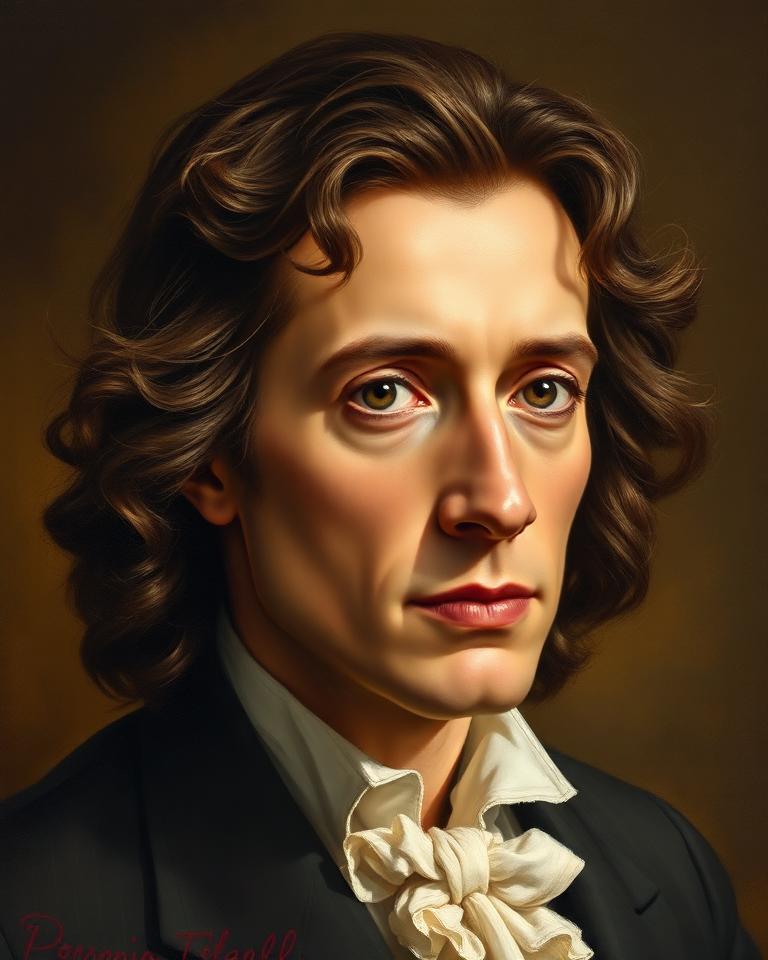
Quick Facts
- Years
- 1810 – 1849
- Category
- Artists & Composers
- Subcategory
- Romanticism
- Nationality
- Polish
- Occupation
- Pianist and Composer
Frédéric Chopin
1810 – 1849 · Polish · Pianist and Composer
Audiobook

Life Lessons from Frederic Chopin
Marcus Alden · 54 min
Frédéric Chopin was a Polish-born pianist and composer whose music transformed the expressive possibilities of the piano. Born near Warsaw in 1810 and based in Paris from 1831, he wrote almost entirely for his own instrument. His nocturnes, études, mazurkas, polonaises, preludes, waltzes, ballades, scherzos, and sonatas united poetic imagination with daring harmony and highly refined technique.
Chopin was celebrated during his lifetime as both a composer and an unusually distinctive performer. Rather than pursuing the career of a traveling virtuoso, he generally preferred salons, private gatherings, teaching, and relatively infrequent public concerts. His restrained but flexible playing, especially his use of rubato, singing melodic lines, and subtle tone colors, became central to his reputation.
His work also acquired lasting importance for Polish cultural identity. The rhythms and gestures of the mazurka and polonaise gave his music a recognizable national character, although most of his compositions were not literal arrangements of folk songs. At the same time, their harmonic innovation influenced composers from Franz Liszt and Johannes Brahms to Claude Debussy, Sergei Rachmaninoff, and Karol Szymanowski.
Chopin remains essential to conservatory training and the international concert repertoire. Scholars continue to study his manuscripts, editions, performance style, nationalism, Parisian networks, and relationship with George Sand. Pianists study him because his music demands not only dexterity, but also judgment, balance, disciplined freedom, and an understanding of the piano as a singing instrument.
Quick Facts
| Field | Details |
|---|---|
| Full Name | Fryderyk Franciszek Chopin; French form: Frédéric François Chopin |
| Common Name(s) | Frédéric Chopin, Fryderyk Chopin |
| Born | 1 March 1810; a family baptismal record gives 22 February 1810 |
| Died | 17 October 1849 |
| Age at Death | 39 |
| Birthplace | Żelazowa Wola, Duchy of Warsaw |
| Nationality | Polish; born to a French father and Polish mother, later resident in France |
| Occupation | Composer, pianist, piano teacher |
| Historical Era | Romantic era |
| Famous For | Nocturnes, études, mazurkas, polonaises, preludes, ballades, and poetic piano performance |
| Political Affiliation | No formal party affiliation; strongly attached to Poland and sympathetic to Polish émigré circles |
| Religion | Baptized Roman Catholic; the precise character of his adult religious practice is debated |
| Education | Warsaw Lyceum; Warsaw Conservatory/School of Music under Józef Elsner |
| Parents | Nicolas Chopin and Justyna Krzyżanowska Chopin |
| Spouse(s) | Never married |
| Children | None |
| Major Works | Piano Concertos Nos. 1 and 2; 24 Preludes, Op. 28; Études, Opp. 10 and 25; four Ballades; four Scherzos; Piano Sonatas Nos. 2 and 3; numerous nocturnes, mazurkas, polonaises, and waltzes |
| Major Achievements | Redefined Romantic piano writing; elevated the étude and salon miniature; created the instrumental ballade; shaped Polish musical nationalism; exerted lasting influence on harmony and piano technique |
Early Life
Chopin was born at Żelazowa Wola, an estate west of Warsaw. The accepted birthday is 1 March 1810, the date observed by Chopin and his family, although a baptismal document records 22 February. This discrepancy remains unresolved.
His father, Nicolas Chopin, had emigrated from France as a young man and became thoroughly integrated into Polish society. He worked as a tutor and later taught French at the Warsaw Lyceum. Chopin's mother, Justyna Krzyżanowska, came from a Polish family and played the piano. Fryderyk grew up with three sisters: Ludwika, Izabela, and Emilia. Music was part of domestic life, and Ludwika was among his earliest guides at the keyboard.
Soon after his birth, the family moved to Warsaw. The city belonged first to the Napoleonic Duchy of Warsaw and, after 1815, to the Russian-dominated Kingdom of Poland. Polish political hopes, cultural resilience, and foreign rule formed the background to Chopin's youth.
His first professional piano teacher was the Czech-born Wojciech Żywny. Żywny introduced him to Johann Sebastian Bach and Wolfgang Amadeus Mozart—composers Chopin revered throughout his life. The child rapidly gained attention. His Polonaise in G minor was published in 1817, and he performed before Warsaw audiences and aristocratic patrons.
Chopin attended the Warsaw Lyceum from 1823 to 1826. He then studied composition with Józef Elsner at the Warsaw School of Music. Elsner recognized that conventional instruction should not suppress his pupil's individuality, famously assessing him as a “musical genius.” During holidays in the Polish countryside, Chopin encountered regional dances and music. These experiences contributed to his treatment of mazurka rhythms, though scholars caution against treating his mature works as straightforward folk transcriptions.
As a teenager he traveled to places including Berlin and Vienna, attended opera, improvised, composed, drew caricatures, and participated in amateur theatricals. Italian bel canto singing—especially its phrasing, ornament, and legato—became a decisive influence on his melodic language.
Rise to Prominence
By the late 1820s, Chopin had become one of Warsaw's leading young musicians. He composed works for piano and orchestra, including variations on Mozart's Don Giovanni, the Krakowiak, and two piano concertos. Robert Schumann later praised the Mozart variations with the celebrated declaration, “Hats off, gentlemen, a genius,” helping establish Chopin's reputation in German-speaking musical circles.
His Warsaw debut concerts in 1830 displayed the concertos now numbered 1 and 2. Their numbering reflects publication order rather than composition: the F-minor concerto was written first. These works combine brilliant keyboard writing with lyrical passages modeled partly on vocal music.
Chopin left Warsaw on 2 November 1830, intending to advance his career abroad. Soon afterward, the November Uprising began against Russian rule. He did not return to live in Poland. News of the uprising's defeat in 1831 caused him anguish, documented in letters and the so-called Stuttgart diary. The popular association of the Étude in C minor, Op. 10, No. 12, with the uprising earned it the later nickname “Revolutionary,” but Chopin did not publish it under that title.
After time in Vienna, Munich, and Stuttgart, he arrived in Paris in autumn 1831. Paris was a major center of European music and home to a large Polish émigré community. Chopin met leading artists and intellectuals, including Franz Liszt, Hector Berlioz, Eugène Delacroix, and Heinrich Heine.
His Paris debut at the Salle Pleyel on 26 February 1832 attracted favorable notice. Yet he did not thrive through constant public performance. His touch could be too delicate for large halls, and he experienced severe performance anxiety or physical distress before concerts. Instead, he built a successful career teaching affluent pupils, publishing music, and performing in salons. This model offered financial support and suited his preference for intimacy and tonal nuance.
Major Achievements
Revolutionizing Piano Technique
The Études, Opp. 10 and 25, turned technical exercises into major concert works. Each addresses specific challenges—arpeggios, double notes, rapid passagework, wide stretches, voicing, or independence of the fingers—while maintaining a distinct emotional and architectural identity.
This mattered because technique ceased to be merely preparatory. Chopin demonstrated that disciplined physical problems could become poetry. His études remain core conservatory repertoire and influenced Liszt, Debussy, Rachmaninoff, and generations of pianist-composers.
Transforming Short Piano Forms
Chopin raised nocturnes, preludes, waltzes, and impromptus to new levels of concentration and expressive range. He learned from the nocturnes of Irish composer John Field, then expanded the genre through richer harmony, dramatic contrasts, ornamentation, and long melodic arcs.
The 24 Preludes, Op. 28, traverse all major and minor keys. Unlike traditional preludes, many function as self-contained miniatures. Their compression showed later composers how a brief work could suggest an entire emotional world.
Reimagining Polish Dances
Chopin composed mazurkas throughout his career and repeatedly returned to the polonaise. He stylized the rhythmic accents, modal colors, drones, and gestures associated with Polish traditions rather than simply reproducing village music.
The mazurkas became laboratories for rhythm and harmony. The polonaises often projected ceremony, struggle, grandeur, or memory. Together they acquired immense importance for Polish identity, especially because Chopin lived in exile during a period when Poland lacked political independence.
Creating the Instrumental Ballade
Chopin's four ballades established a new large-scale instrumental genre. The title had literary associations, and Adam Mickiewicz's poetry has often been proposed as an influence. No conclusive evidence assigns each ballade a specific narrative, however.
Their fusion of storytelling momentum, thematic transformation, lyricism, and dramatic climax shaped later Romantic composition. Liszt, Brahms, and others adopted or developed instrumental forms with narrative implications.
Expanding Harmonic Language
Chopin used chromaticism, altered chords, suspensions, enharmonic shifts, and unexpected modulations with unusual subtlety. These were not decorative novelties: they often intensified melodic expression or blurred tonal direction.
His harmonic imagination helped prepare the way for late-Romantic and early modern music. Wagner, Fauré, Debussy, Scriabin, and others developed possibilities that Chopin's music had made newly audible.
Establishing a Distinctive Performance Ideal
Contemporary descriptions emphasize Chopin's refined touch, flexible timing, delicate dynamic shading, and ability to make the piano “sing.” His rubato appears to have involved expressive freedom without destroying rhythmic coherence. Accounts suggest that one hand might bend the phrase while the accompaniment preserved continuity.
His example encouraged pianists to seek color, voicing, and rhetorical flexibility. It also generated debate: later traditions sometimes exaggerated Chopin into sentimental instability, whereas informed performance stresses structure as well as freedom.
Leadership and Work
Chopin led neither an institution nor a political movement. His leadership was artistic: he shaped standards through composition, teaching, performance, and personal influence. He was exacting but generally avoided public manifestos. Rather than explaining a grand system, he demonstrated values through meticulously revised scores and lessons tailored to individual students.
As a teacher, he emphasized a supple hand, natural movement, beautiful tone, legato, careful fingering, and avoidance of mechanical harshness. He valued Bach and Mozart and encouraged pupils to listen to singers. He did not demand identical hand shapes or rigidly standardized solutions.
His compositional method was painstaking. Friends reported that ideas might arise readily at the keyboard, but writing them down and perfecting details could be difficult. Surviving manuscripts reveal revisions in rhythm, ornament, articulation, and harmony. Differences among early editions sometimes reflect publishers, engravers, or Chopin's own changing decisions, creating challenges for modern editors.
He maintained productive relationships with publishers in France, Britain, and the German states, often issuing works simultaneously to protect rights across jurisdictions. Copyright law was fragmented, however, and unauthorized editions circulated.
His strengths included originality, self-criticism, concentration, and acute sensitivity to instrumental color. His weaknesses included reluctance toward concert organization, anxiety around public appearances, and a dependence on teaching and elite networks. These limitations narrowed his public activity but also helped preserve the artistic environment in which he worked best.
Personal Life
Chopin remained close to his parents and sisters, maintaining family ties through letters and visits when possible. Separation from Warsaw was painful, and news of family illness affected him deeply. His younger sister Emilia died of tuberculosis in 1827.
In the mid-1830s he became attached to Maria Wodzińska, a young Polish woman he had known through family connections. Evidence suggests that they reached a private understanding resembling an engagement, but her family did not permit a marriage. Concerns about Chopin's health and uncertain circumstances probably contributed, although the precise reasons are not fully documented.
His most famous relationship was with the French novelist Amantine-Lucile-Aurore Dupin, known as George Sand. They became lovers around 1838. Sand provided companionship, practical care, and access to her estate at Nohant, where Chopin completed many important works during productive summers.
Their winter in Majorca in 1838–1839 has become legendary. Seeking a healthier climate, they encountered bad weather, social hostility, and housing difficulties. At the former Carthusian monastery in Valldemossa, Chopin worked on the Op. 28 Preludes while seriously ill. The often-repeated image of uninterrupted romantic inspiration conceals difficult living conditions and delays in receiving a suitable piano.
The relationship deteriorated amid family tensions, particularly involving Sand's children, Maurice and Solange. Chopin sympathized with Solange during a conflict over her marriage, while Sand viewed his position as interference. They separated in 1847.
Chopin was known for elegance, wit, mimicry, and skill at caricature. In society he could be charming and controlled; his private letters sometimes display sharp judgments and emotional volatility. He preferred refined surroundings and was attentive to clothing and manners.
He suffered recurrent respiratory illness for much of his adult life. Tuberculosis is the traditional and most widely accepted diagnosis. A noninvasive 2014 examination of his preserved heart found features considered consistent with tuberculous pericarditis, although absolute certainty remains impossible without destructive testing.
Philosophy and Beliefs
Chopin left no systematic philosophical writings. His worldview must therefore be reconstructed cautiously from music, letters, friendships, and conduct.
His attachment to Poland was profound. He associated with Polish exiles in Paris, supported charitable events, and expressed grief over Russian domination. Yet he was not a political organizer, and assigning him a detailed ideological program would go beyond the evidence. His nationalism was strongest as cultural memory and emotional allegiance.
He had been raised Roman Catholic and received Catholic rites at his death after conversations with his friend, the priest Aleksander Jełowicki. Accounts of the final days are partly devotional and should be read critically. Scholars debate how observant or skeptical Chopin had been during adulthood.
Artistically, he prized beauty, proportion, sincerity, and craftsmanship. His admiration for Bach and Mozart complicates any stereotype of Romanticism as unchecked emotion. He believed expressive freedom required control. His dislike of empty display is evident in both his teaching and the musical balance between virtuosity and structure.
Challenges and Controversies
Chopin's fragile health limited travel, performance, and productivity. Illness repeatedly interrupted work and increased dependence on friends. His 1848 tour of Britain, encouraged and organized largely by Jane Stirling, brought prestige but exhausted him.
Contemporaries admired his playing, yet some found it too quiet for large spaces. Liszt projected orchestral power; Chopin cultivated intimacy. Treating one approach as inherently superior misses the different artistic purposes involved.
His relationship with Sand remains contentious because later retellings often sought a villain. Sand's autobiographical and fictional treatments shaped perceptions, while Chopin's admirers sometimes portrayed her as callous. Modern historians generally see a complicated partnership involving affection, illness, creativity, family conflict, and mutual frustration.
Questions of national identity also invite oversimplification. Chopin's father was French, Chopin lived much of his adult life in Paris, and he used the French form of his name. Nevertheless, he consistently regarded himself as Polish. Calling him exclusively French ignores his self-identification and musical-cultural roots; denying the importance of France ignores the environment that sustained his mature career.
The circumstances of his death have produced alternative medical theories, including cystic fibrosis and other conditions. Tuberculosis remains the leading explanation, but retrospective diagnosis cannot attain complete certainty.
Performance practice is another field of dispute. Tempos, pedaling, ornamentation, rubato, and variant readings differ among sources. No single recording can claim to reproduce Chopin exactly, since sound recording did not exist during his lifetime and pianos have changed substantially.
Legacy
Chopin's music became central to the international piano canon soon after his death. Liszt, Schumann, Brahms, Tchaikovsky, Grieg, Fauré, Debussy, Scriabin, Rachmaninoff, and Szymanowski absorbed aspects of his technique, harmony, nationalism, or miniature forms. His influence also extends into film, jazz, popular arrangements, and ballet.
For Poland, he became a cultural emblem of endurance and identity. His preserved heart was placed in a pillar of Warsaw's Holy Cross Church, while his body was buried at Père Lachaise Cemetery in Paris. His Warsaw monument in Łazienki Park, designed by Wacław Szymanowski, was destroyed by Nazi German forces in 1940 and reconstructed after the Second World War.
The Fryderyk Chopin Institute in Warsaw supports scholarship, publishing, recordings, museums, and performances. The institute operates the Chopin Museum in the Ostrogski Palace and helps preserve his Żelazowa Wola birthplace.
The International Fryderyk Chopin Piano Competition, founded in Warsaw in 1927, is among the world's most prestigious music competitions. Its laureates have included Maurizio Pollini, Martha Argerich, and Krystian Zimerman.
Chopin remains modern because his music balances intimacy with formal strength. It asks performers to interpret rather than merely execute. Every generation must reconsider his rhythm, tone, editions, instruments, and cultural meanings.
Interesting Facts
- Chopin's family celebrated 1 March as his birthday, although his baptismal record gives 22 February.
- His first published composition was a polonaise issued when he was seven.
- He was also talented at drawing caricatures and performing comic imitations.
- His two piano concertos are numbered in publication order, not composition order.
- He left Poland weeks before the November Uprising began.
- He never returned to live in his homeland.
- Most of his mature works include the piano; he wrote comparatively little orchestral or chamber music.
- He gave only a limited number of public concerts compared with touring virtuosos such as Liszt.
- Teaching wealthy pupils supplied a substantial part of his Paris income.
- He preferred the instruments of the Pleyel firm, though he also used Érard pianos.
- The nickname “Minute Waltz” refers to smallness, not a requirement that it be played in sixty seconds.
- The “Revolutionary Étude” nickname was not Chopin's published title.
- George Sand was a pen name used by novelist Aurore Dupin.
- Chopin and Sand spent the winter of 1838–1839 at Majorca.
- His cello sonata was the last work published during his lifetime with an opus number.
- At his funeral, Mozart's Requiem was performed according to his wishes.
- His body lies in Paris, but his heart is preserved in Warsaw.
- The Chopin Competition has been held in Warsaw since 1927, with interruptions caused by war and other circumstances.
Famous Quotes
Chopin's correspondence was written mainly in Polish and French, so English wording varies by translator.
- “Hats off, gentlemen, a genius!” Robert Schumann wrote this about Chopin's Mozart variations in 1831. It is famous praise of Chopin, not a quotation spoken by him.
- “I tell my piano the things I used to tell you.” Written to his close friend Tytus Woyciechowski in 1830, this conveys how composition and performance served intimate emotional expression.
- “I am only going away to die.” Chopin reportedly said this before his 1848 journey to Britain. The wording survives through recollection and translation, so it should not be treated as a verbatim recording.
- “Here you doubtless see my tendency to do wrong against my will.” From the Stuttgart diary after the fall of Warsaw, it reflects guilt, despair, and helplessness in exile; translations differ.
- “The earth is suffocating... Has it swallowed them?” Also from the Stuttgart writings, this anguished passage concerns Poland and loved ones amid political disaster; punctuation and wording vary by edition.
- “Time is the best censor, and patience a most excellent teacher.” Frequently traced to Chopin's correspondence and widely translated. It expresses his belief in judgment matured through time, though English versions differ.
- “Simplicity is the highest goal, achievable when you have overcome all difficulties.” Commonly attributed through accounts of his teaching rather than a secure verbatim manuscript. It summarizes his ideal of concealed technique but should be treated cautiously.
- “Bach will not grow old.” Reported in recollections of Chopin's teaching and conversation. It reflects his lifelong respect for Bach, but the exact wording is not securely documented.
- “Play Mozart in memory of me.” Reported as a request near his death. It suits his known admiration for Mozart, though deathbed recollections vary.
- “My earthly body has been a terrible disappointment to me.” Often attributed to Chopin in late-life recollections. It captures his frustration with illness, but the exact form is not independently certain.
Timeline
- 1810 — Born at Żelazowa Wola and baptized at Brochów.
- 1810 — Family moves to Warsaw.
- 1816 — Begins formal piano study with Wojciech Żywny around this time.
- 1817 — Polonaise in G minor is published.
- 1818 — Gives an early public concert in Warsaw.
- 1823 — Enters the Warsaw Lyceum.
- 1826 — Begins advanced composition studies with Józef Elsner.
- 1827 — Sister Emilia dies; Chopin's family moves into the Warsaw University complex.
- 1828 — Visits Berlin and encounters major musical productions.
- 1829 — Performs successfully in Vienna and completes formal studies.
- 1830 — Gives major Warsaw concerts featuring his piano concertos.
- 1830 — Leaves Warsaw on 2 November; the November Uprising begins later that month.
- 1831 — Travels through Vienna, Munich, and Stuttgart; reaches Paris in autumn.
- 1832 — Makes his Paris debut at the Salle Pleyel.
- 1833 — Publishes major works and establishes himself as a fashionable teacher.
- 1835 — Meets his parents at Carlsbad and renews contact with Maria Wodzińska.
- 1836 — Relationship with Maria approaches a private engagement; meets George Sand around this period.
- 1837 — Prospective marriage to Maria ends.
- 1838 — Relationship with George Sand develops; travels to Majorca.
- 1839 — Returns from Majorca and begins the pattern of productive summers at Nohant.
- 1842 — Moves to Square d'Orléans in Paris.
- 1844 — His father dies.
- 1846 — Completes works including the Barcarolle, Op. 60, and Polonaise-Fantaisie, Op. 61.
- 1847 — Relationship with George Sand ends.
- 1848 — Gives his last Paris concert; tours Britain and performs at a Polish benefit in London.
- 1849 — Dies in Paris on 17 October.
- 1849 — Funeral held at the Church of the Madeleine; buried at Père Lachaise.
- 1850 — His heart is installed at Holy Cross Church in Warsaw.
- 1927 — First International Chopin Piano Competition is held in Warsaw.
- 1940 — Nazi German occupiers destroy the Chopin monument in Warsaw.
- 1958 — Reconstructed Warsaw monument is unveiled.
- 2010 — Bicentenary of Chopin's birth is marked internationally.
Frequently Asked Questions
Who was Frédéric Chopin?
Frédéric Chopin was a Polish composer and pianist of the Romantic era. Born in 1810 near Warsaw, he moved to Paris in 1831 and spent the rest of his life mainly in France. He wrote overwhelmingly for piano, producing études, nocturnes, mazurkas, polonaises, preludes, waltzes, sonatas, concertos, ballades, and scherzos. His importance rests on his fusion of expressive melody, original harmony, Polish dance elements, and innovative keyboard technique. He was also an influential teacher and a celebrated, though infrequent, public performer.
Was Chopin Polish or French?
Chopin was Polish in upbringing, cultural identity, and self-understanding, but his background was binational. His father, Nicolas, was born in France and settled permanently in Poland; his mother was Polish. Chopin was born in the Duchy of Warsaw, grew up speaking Polish, and drew deeply on Polish culture. He later lived in Paris, used the French form Frédéric, and moved within French artistic society. Describing him as a Polish composer of French paternal ancestry best reflects the evidence without denying either part of his life.
When was Chopin born?
Chopin and his family observed 1 March 1810 as his birthday, and this is the date generally used in commemorations. However, his baptismal record lists 22 February 1810. Historians cannot conclusively explain the discrepancy. It may result from a clerical error, delayed reporting, or a family misunderstanding. Both dates therefore appear in reliable scholarship, but 1 March remains the conventional date because Chopin himself accepted it.
Why did Chopin leave Poland?
Chopin left Warsaw in November 1830 to develop his career in European musical centers, not because he was initially fleeing as a political refugee. The November Uprising against Russian rule began later that month. Its defeat made a safe and satisfactory return difficult, while Paris offered professional opportunities and a substantial Polish émigré community. He remained deeply attached to Poland and experienced exile painfully, but he built his mature career in France and never returned to live in his homeland.
What is Chopin's most famous piece?
There is no single universally accepted answer. Frequently recognized works include the “Funeral March” from Piano Sonata No. 2, the “Revolutionary” Étude, the “Minute Waltz,” the Nocturne in E-flat major, Op. 9, No. 2, and the Polonaise in A-flat major, Op. 53, known as the “Heroic.” Many nicknames were added by publishers, critics, or audiences rather than Chopin. Among musicians, the ballades, études, preludes, and late works often receive especially high regard for their structural and harmonic depth.
Why is Chopin important to piano history?
Chopin expanded what the piano could express and how pianists approached technique. His études converted technical problems into concert masterpieces. His melodies imitate the breathing and ornamentation of singers, while his textures require highly controlled balance between voices. He also explored pedal effects, chromatic harmony, rhythmic flexibility, and new kinds of figuration. Later composers inherited these advances, and pianists still use his music to develop voicing, legato, touch, independence, imagination, and stylistic discipline.
Did Chopin invent the nocturne?
No. The Irish pianist-composer John Field established the piano nocturne as a lyrical genre before Chopin. Chopin admired and learned from Field's model of a singing melody over a patterned accompaniment. He nevertheless transformed the genre by adding more complex harmony, dramatic middle sections, contrapuntal writing, elaborate ornamentation, and broader emotional range. His nocturnes became so influential that the genre is now more closely associated with him than with its originator.
What is rubato in Chopin's music?
Rubato means flexible treatment of time for expressive purposes. In Chopin, it does not imply arbitrary slowing and speeding or loss of pulse. Contemporary reports suggest that he sometimes allowed the melodic line to move freely while the accompaniment retained steadiness. Rubato also operates across larger phrases through subtle acceleration, delay, and compensation. Because no recordings of Chopin exist, performers must combine written evidence, historical instruments, contemporary testimony, and musical structure rather than rely on a rigid formula.
Was Chopin married to George Sand?
No. Chopin never married, and George Sand was still legally linked to her estranged husband during much of their relationship. Chopin and Sand became lovers around 1838 and remained together for approximately nine years. She cared for him during illness and hosted him at Nohant, where he composed many significant works. Their partnership ended in 1847 after accumulated emotional and family conflicts. Simplistic accounts that portray either person as solely responsible do not capture the relationship's complexity.
What happened during Chopin's stay in Majorca?
Chopin traveled to Majorca with George Sand and her children in late 1838, hoping that the climate would improve his health. Instead, the party encountered rain, cold, local suspicion, accommodation problems, and difficulty obtaining an appropriate piano. They eventually stayed in a former monastery at Valldemossa. Chopin worked on the Preludes, Op. 28, and other music there, but his respiratory condition worsened. The episode inspired romantic legends, yet contemporary evidence shows that it was physically and logistically difficult.
What illness did Chopin have?
Tuberculosis is the traditional and still most widely accepted diagnosis. Chopin experienced chronic cough, weakness, weight loss, and episodes of serious respiratory illness. In 2014, specialists visually examined his preserved heart without opening its container and reported signs compatible with tuberculous pericarditis. Other diagnoses, including cystic fibrosis, have been proposed retrospectively. Because full modern testing has not been performed and historical symptoms can have multiple causes, the diagnosis remains highly probable rather than absolutely proven.
How did Chopin die?
Chopin died in his Paris apartment at Place Vendôme on 17 October 1849, aged 39, after a prolonged decline. Friends, pupils, his sister Ludwika, and medical attendants were present during his final period. The official cause was generally understood as tuberculosis. His funeral took place at the Church of the Madeleine, where Mozart's Requiem was performed. He was buried at Père Lachaise Cemetery, while his heart was taken to Warsaw according to his wishes.
Why is Chopin's heart in Warsaw?
Chopin feared premature burial and asked that his body be opened after death. His sister Ludwika arranged for his heart to be preserved and transported to Poland. It eventually came to rest in a pillar of Holy Cross Church in Warsaw, beneath an inscription from the Gospel of Matthew: “For where your treasure is, there will your heart be also.” The relic became a powerful symbol of the composer's enduring bond with his homeland despite his burial in Paris.
Did Chopin write symphonies or operas?
No completed Chopin symphony or opera is known. He admired opera deeply, especially Italian bel canto, and its vocal style influenced his piano melodies. His output centers on solo piano, though it also includes two piano concertos, several works for piano and orchestra, chamber music involving cello, songs, and a piano trio. This concentration was not evidence of limited imagination. Instead, he explored one instrument with extraordinary depth and expanded its musical vocabulary.
How many public concerts did Chopin give?
The exact number depends on what is counted as public, semipublic, charitable, or shared performance, but it was small compared with the schedules of major touring virtuosos. He preferred salons and private rooms, where listeners could perceive his delicate dynamics and subtle colors. He also experienced intense strain before public appearances. His reputation therefore spread through publishing, elite social networks, teaching, reviews, and the testimony of musicians as much as through large-scale concert touring.
Did Chopin use Polish folk songs directly?
Occasionally scholars have identified possible relationships, but most mazurkas are not direct arrangements of specific folk melodies. Chopin absorbed dance rhythms, accent patterns, modal inflections, drones, and memories of rural music, then transformed them through sophisticated harmony and form. His national style was therefore both culturally rooted and highly individual. Calling the mazurkas “folk music” understates their artifice; denying their Polish sources overlooks their rhythmic vocabulary and the historical meaning they acquired.
What piano did Chopin prefer?
Chopin was closely associated with Pleyel pianos, whose clarity, responsiveness, and nuanced tone suited his playing. He reportedly regarded Pleyel instruments as ideal when he felt at his best. He also played and taught on Érard instruments and encountered other makers during travel. Nineteenth-century pianos had lighter actions, quicker decay, and different tonal registers from modern concert grands. Historically informed performances on period instruments can therefore reveal balances and colors unlike those heard on contemporary pianos.
What is the Chopin Competition?
The International Fryderyk Chopin Piano Competition is a major piano contest founded in Warsaw in 1927. It is devoted primarily to Chopin's music and normally occurs every five years, although exceptional events have altered schedules. Competitors are evaluated on technique, interpretation, style, structure, and tonal imagination. Winning or placing can launch an international career. The competition also demonstrates how widely interpretations can differ while remaining grounded in the same scores.
Lessons We Can Learn
- Master fundamentals before seeking novelty. Chopin studied Bach, Mozart, harmony, and counterpoint before forging a unique style. Innovation is stronger when built on durable knowledge.
- Turn constraints into identity. He wrote mainly for piano rather than pursuing every genre. Focus allowed exceptional depth and shows the modern value of specialization.
- Technique should serve meaning. The études are difficult, but never merely athletic. Skill matters most when it communicates an artistic or practical purpose.
- Choose an environment suited to your strengths. Chopin preferred salons and teaching over relentless touring. Sustainable work need not follow the dominant career model.
- Revise carefully. His manuscripts preserve repeated refinements. Inspiration benefits from editing, patience, and attention to small decisions.
- Draw from heritage without merely copying it. He transformed Polish dance idioms into original art. Tradition can be a source for invention rather than a cage.
- Balance freedom with structure. Chopin's rubato depends on an underlying pulse. Creativity often succeeds when flexibility operates within a stable framework.
- Maintain relationships across disciplines. His circle included writers, painters, publishers, aristocrats, and musicians. Diverse networks can stimulate and sustain creative work.
- Recognize physical limits. Illness shaped his choices and sometimes made travel harmful. Ambition should be balanced against health and long-term capacity.
- Let quality carry influence. Chopin wrote no theoretical manifesto and gave relatively few concerts, yet his carefully made work changed music. Lasting authority can arise from excellence rather than constant visibility.
Related Historical Figures
- Józef Elsner — Chopin's composition teacher in Warsaw, who encouraged his originality while grounding him in musical form and counterpoint.
- Wojciech Żywny — His childhood piano teacher, important for introducing him to Bach, Mozart, and disciplined keyboard study.
- Franz Liszt — Fellow pianist-composer and Paris acquaintance whose brilliant public style contrasted with Chopin's intimate approach; each influenced Romantic pianism.
- Robert Schumann — German composer and critic who announced Chopin's genius to a broad readership and admired his musical originality.
- George Sand — French novelist, companion, and caregiver whose homes, especially Nohant, provided an important setting for Chopin's mature work.
- Eugène Delacroix — French Romantic painter and close friend who created important portraits and discussed art, music, and creativity with Chopin.
- Adam Mickiewicz — Leading Polish Romantic poet and fellow exile; his narrative poetry is often connected to Chopin's ballades, though specific programs remain unproven.
- John Field — Irish composer-pianist whose nocturnes provided a starting point that Chopin greatly expanded.
- Pauline Viardot — Celebrated singer, friend, and musician whose bel canto artistry aligned with Chopin's vocal conception of piano melody.
- Jane Stirling — Scottish pupil and devoted supporter who helped organize Chopin's 1848 British visit and assisted him during his final years.
Related Historical Figures