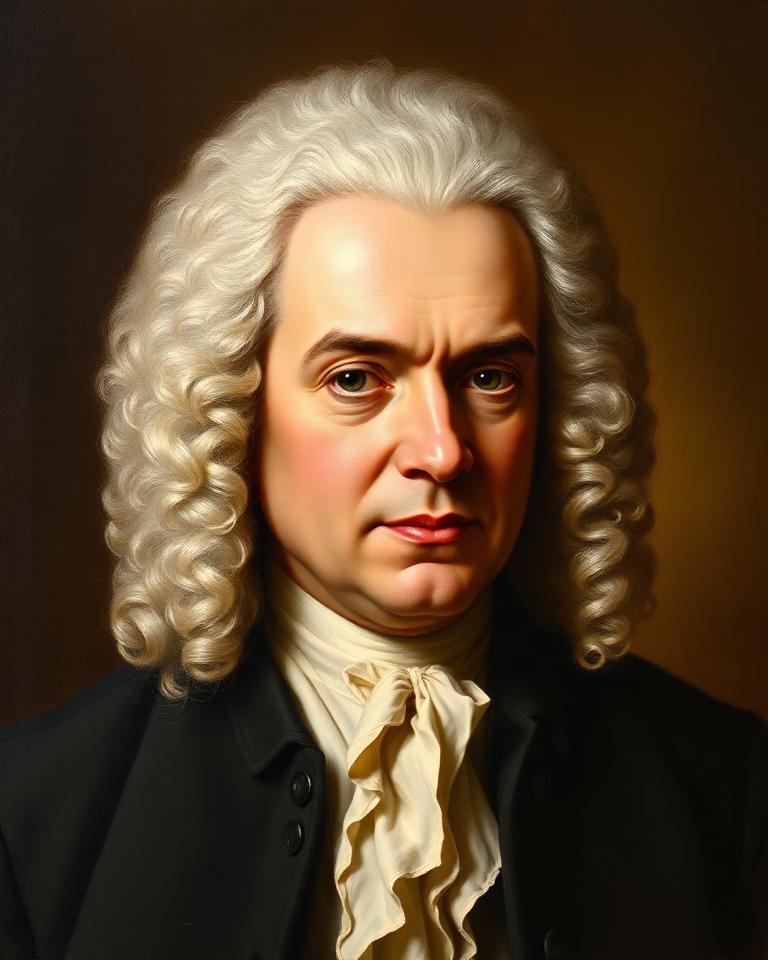
Quick Facts
- Years
- 1685 – 1750
- Category
- Artists & Composers
- Subcategory
- Baroque Music
- Nationality
- German
- Occupation
- Composer
Johann Sebastian Bach
1685 – 1750 · German · Composer
Audiobook

Life Lessons from Johann Sebastian Bach
Marcus Alden · 56 min
Johann Sebastian Bach (1685–1750) was a German composer, organist, violinist, teacher, and musical director whose works stand at the summit of the Baroque tradition. Employed chiefly by churches and princely courts rather than as an independent celebrity, he created music of extraordinary technical discipline, emotional range, and spiritual intensity. His surviving output includes sacred cantatas, passions, organ works, concertos, chamber music, and compositions for keyboard.
Among Bach’s greatest achievements are the Brandenburg Concertos, The Well-Tempered Clavier, the St John Passion, the St Matthew Passion, the Goldberg Variations, and the Mass in B Minor. He also transformed inherited forms—such as the fugue, chorale prelude, concerto, and dance suite—through contrapuntal mastery and imaginative harmony. As Leipzig’s Thomaskantor, he supplied music for major churches, directed ensembles, taught students, and composed extensive cycles of liturgical works.
Bach enjoyed considerable respect as an organist and musical expert during his lifetime, but many of his compositions circulated only narrowly. Nineteenth-century performers and scholars helped establish his broader reputation, although his music had never vanished completely. Today it remains central to concert life, worship, conservatory training, recording culture, and scholarship. Musicians still study Bach because his works unite intellectual structure with expressive power, making them enduring models of composition and performance.
Quick Facts
| Field | Information |
|---|---|
| Full Name | Johann Sebastian Bach |
| Common Name(s) | Johann Sebastian Bach; J. S. Bach |
| Born | 21 March 1685, Old Style; 31 March 1685, New Style |
| Died | 28 July 1750 |
| Age at Death | 65 |
| Birthplace | Eisenach, Duchy of Saxe-Eisenach, Holy Roman Empire |
| Nationality | German |
| Occupation | Composer, organist, violinist, violist, teacher, Kapellmeister, Thomaskantor |
| Historical Era | Late Baroque |
| Famous For | Sacred vocal music, keyboard works, organ music, concertos, counterpoint, fugues |
| Political Affiliation | Not applicable; served municipal, ecclesiastical, and princely employers |
| Religion | Lutheran Christianity |
| Education | Latin schools in Eisenach, Ohrdruf, and Lüneburg; largely trained through family, professional practice, and independent study |
| Parents | Johann Ambrosius Bach and Maria Elisabeth Lämmerhirt Bach |
| Spouse(s) | Maria Barbara Bach (m. 1707; died 1720); Anna Magdalena Wilcke Bach (m. 1721) |
| Children | 20 recorded children, 10 of whom survived into adulthood |
| Major Works | Brandenburg Concertos, The Well-Tempered Clavier, St John Passion, St Matthew Passion, Goldberg Variations, Christmas Oratorio, Mass in B Minor, The Art of Fugue |
| Major Achievements | Mastered and expanded Baroque contrapuntal forms; produced major cantata cycles; advanced keyboard pedagogy and tuning practice; profoundly influenced later Western music |
Early Life
Bach was born in Eisenach into a large, interconnected dynasty of professional musicians. His father, Johann Ambrosius Bach, directed the town musicians and probably introduced him to string playing and practical ensemble work. His mother, Maria Elisabeth, died in 1694; his father died the following year. Orphaned at about ten, Bach moved to Ohrdruf to live with his eldest brother, Johann Christoph Bach, an organist and former pupil of Johann Pachelbel.
In Ohrdruf, Bach attended the local Latin school and received further keyboard instruction. A later family account says that he secretly copied music from a manuscript his brother kept from him, though some colorful details of the story cannot be independently verified. What is clear is that Bach eagerly studied the works of other composers throughout his life.
Around 1700, he moved to Lüneburg and joined the choir of St Michael’s School. The institution offered a strong general education and exposed him to sophisticated church music. Lüneburg also placed him near Hamburg, where he could hear major organists, and near the court at Celle, whose repertory reflected French musical taste. Northern German organ traditions, Lutheran chorales, Italian concertos, and French dances would all become important elements of his musical language.
Bach grew up within the fragmented political landscape of the Holy Roman Empire. German-speaking territories contained numerous courts, cities, schools, and churches, each maintaining its own musical establishment. This system created employment opportunities but also subjected musicians to rigid hierarchies, local regulations, and demanding patrons.
Rise to Prominence
In 1703 Bach briefly entered the service of Duke Johann Ernst at Weimar, probably as a court musician. Later that year he became organist of the New Church at Arnstadt. His playing impressed the authorities, but relations soon became strained. He was criticized for an unauthorized extension of a journey to Lübeck, where he had gone to hear Dieterich Buxtehude, and for accompanying congregational hymns in ways officials considered confusing.
In 1707 he moved to the better-paid post of organist at St Blasius Church in Mühlhausen and married his second cousin Maria Barbara Bach. His cantata Gott ist mein König was printed—an unusual distinction for a young composer. Yet he left Mühlhausen after about a year, apparently seeking better conditions and a musical environment more suited to his ambitions.
Returning to Weimar in 1708, Bach served Duke Wilhelm Ernst as court organist and chamber musician. He gained renown as an organ performer, examiner, and composer. In 1714 he became Konzertmeister, a position requiring him to produce cantatas regularly. He also studied and transcribed Italian concertos, especially works associated with Antonio Vivaldi, absorbing their clear structures and energetic ritornello patterns.
Bach’s departure from Weimar was contentious. After being passed over for promotion, he accepted employment with Prince Leopold of Anhalt-Köthen. The duke refused his resignation and imprisoned him for nearly four weeks in 1717 before dismissing him. At Köthen, where Calvinist worship allowed relatively little elaborate church music, Bach concentrated on instrumental works. In 1723 he moved to Leipzig as Thomaskantor, the position that defined the rest of his career.
Major Achievements
The Weimar Organ and Cantata Repertory
At Weimar, Bach developed into one of Germany’s leading organists. Works associated with this broad period include chorale preludes, preludes and fugues, and the unfinished collection known as the Orgelbüchlein or Little Organ Book. He also composed church cantatas that joined Lutheran texts to dramatic musical forms.
This mattered because Bach made traditional chorales the basis of concentrated musical argument. His organ writing became a benchmark for technique, registration, counterpoint, and theological expression. Organists still treat these works as a central repertory.
Instrumental Music at Köthen
As Kapellmeister to Prince Leopold from 1717 to 1723, Bach directed skilled court musicians. The period is associated with the Brandenburg Concertos, orchestral suites, violin concertos, works for unaccompanied violin and cello, and the first book of The Well-Tempered Clavier. Exact dating remains debated for several compositions, and some may have originated or been revised elsewhere.
These pieces mattered because they expanded the expressive and technical possibilities of instrumental music. The solo violin and cello works imply multiple voices on instruments normally associated with a single melodic line. The Brandenburg Concertos employ constantly changing combinations of soloists and ensemble. Their influence extends from conservatory study to modern concert programming.
The Well-Tempered Clavier
Bach assembled Book I in 1722 and completed Book II around 1742. Each contains a prelude and fugue in every major and minor key. “Well-tempered” refers to tuning systems that permitted effective performance in all keys; it does not necessarily mean the equal temperament standard on modern pianos.
The collection demonstrated the expressive individuality of different keys and the versatility of contrapuntal writing. Mozart, Beethoven, Chopin, and many later musicians studied it. It remains both a pedagogical foundation and a major artistic achievement.
Leipzig Cantata Cycles
After becoming Thomaskantor in 1723, Bach undertook the immense task of composing and directing cantatas for Sundays and feast days. During his first Leipzig years he produced music at an exceptional rate, including a cycle built extensively around Lutheran chorales.
The cantatas integrated biblical readings, congregational hymn traditions, poetic reflection, recitative, aria, and orchestral color. They created a musical commentary on the church calendar and formed one of history’s most ambitious bodies of liturgical composition. Roughly 200 sacred cantatas survive, while others are lost.
The Passions and Major Sacred Works
The St John Passion, first performed in 1724, and the St Matthew Passion, probably first performed in 1727 and later revised, combine Gospel narration, dramatic choruses, arias, and chorales. Bach also created the Christmas Oratorio, the Magnificat, and other large sacred works.
These compositions mattered because they joined communal worship, dramatic storytelling, and profound private reflection. The St Matthew Passion became especially important to Bach’s nineteenth-century revival and is now regarded as a landmark of sacred music.
Goldberg Variations and Mature Keyboard Art
Published in 1741 as the fourth part of Bach’s Clavier-Übung, the Goldberg Variations consist of an aria followed by 30 variations and a return of the aria. The familiar story that Count Hermann Carl von Keyserlingk commissioned the work to relieve insomnia comes from a later biography and is not securely documented.
The variations explore canon, dance, virtuosity, and character while preserving an underlying harmonic design. They became a model of large-scale unity and have inspired performers, composers, writers, and recording artists.
Mass in B Minor, The Musical Offering, and The Art of Fugue
Near the end of his life Bach assembled the Mass in B Minor, reworking music from several decades into a monumental Latin setting. After visiting Frederick II of Prussia in 1747, he used the king’s theme to construct The Musical Offering. The Art of Fugue, left without a fully prepared final publication, systematically investigated contrapuntal possibilities.
These late works summarize and transcend Baroque techniques. Their long-term importance lies in their synthesis of styles, rigorous thematic development, and demonstration that learned counterpoint could carry great expressive force.
Leadership and Work
Bach led ensembles through detailed preparation, practical knowledge, and exceptionally high standards. As Kapellmeister and Thomaskantor, he selected repertory, trained performers, copied or supervised parts, taught pupils, tested instruments, and managed rehearsals. His knowledge extended beyond composition to instrument construction, acoustics, vocal capability, and scheduling.
He adapted pragmatically. Bach reused and transformed existing music—a normal Baroque practice known as parody or reworking—when new occasions required it. He borrowed techniques from Italian, French, and German traditions without surrendering his individual voice.
His strength was disciplined craftsmanship joined to imaginative ambition. Surviving documents, however, also reveal a forceful and sometimes inflexible employee. He resisted interference from officials whom he believed obstructed good music. Leipzig authorities complained about administrative matters and questioned his cooperation; Bach complained about weak performers, inadequate resources, and diminished authority.
His professional relationships varied. Prince Leopold appears to have valued him highly. In Leipzig, Bach cultivated patrons beyond municipal government and obtained the title of royal Polish and electoral Saxon court composer in 1736. His leadership was therefore both institutional and entrepreneurial: when one source of authority frustrated him, he sought recognition through another.
Personal Life
Bach married Maria Barbara Bach in 1707. They had seven children, four of whom survived into adulthood. While Bach was away with Prince Leopold in 1720, Maria Barbara died and was buried before he returned. The surviving evidence does not establish the exact cause of her death.
In 1721 Bach married Anna Magdalena Wilcke, a professional court singer. They had 13 children, six of whom reached adulthood. Anna Magdalena participated in the household’s musical life, and manuscripts in her hand preserve important repertory. Scholars caution, however, against attributing compositions to her without strong evidence.
Four Bach sons became notable composers: Wilhelm Friedemann, Carl Philipp Emanuel, Johann Christoph Friedrich, and Johann Christian. The household also included pupils and copyists, making domestic life closely connected to professional music-making.
Accounts portray Bach as sociable within musical circles, devoted to family, proud of his expertise, and quick to defend his status. He enjoyed tobacco and owned instruments, theological books, and musical materials. No diary survives, so claims about his daily habits or inner personality must be inferred cautiously from letters, official records, and family testimony.
Bach’s eyesight deteriorated late in life. In 1750 he underwent operations by the itinerant eye surgeon John Taylor. His condition worsened, and he died on 28 July after severe illness, traditionally described in contemporary terms as involving fever and stroke-like complications.
Philosophy and Beliefs
Bach was a committed Lutheran working within a culture shaped by Scripture, catechism, hymns, sermons, and confessional debate. He owned an extensive theological library, including an annotated Bible commentary associated with Abraham Calov. His sacred music closely engages biblical texts and Lutheran chorales.
He often wrote “S.D.G.”—Soli Deo Gloria, “Glory to God alone”—on manuscripts, and “J.J.”—Jesu juva, “Jesus, help”—at the beginning of some works. These inscriptions indicate that religious devotion and professional labor were connected in his mind. Yet historians should not reduce all his music to a single theological program. Instrumental works also served courtly entertainment, education, technical exploration, and artistic ambition.
Bach left little direct evidence of political ideology. He worked within hereditary courts, municipal government, and established churches rather than advocating a recorded political movement. His disputes generally concerned contracts, authority, rank, resources, and musical standards.
Ethically, his work reflects diligence, stewardship of talent, and respect for inherited forms. He repeatedly revised earlier material instead of treating a composition as permanently fixed. This suggests a worldview in which craft was cumulative: tradition could be preserved most effectively by transforming it.
Challenges and Controversies
Bach frequently clashed with employers. Arnstadt officials objected to his long Lübeck absence and unconventional hymn accompaniment. In Weimar, his attempt to leave led to imprisonment. In Leipzig, arguments arose over student discipline, appointments, rehearsal control, and the quality of available musicians.
One dispute involved university official Johann August Ernesti, who appointed a student prefect without Bach’s approval. Bach regarded the matter as an attack on the cantor’s musical authority. Higher officials eventually intervened, but the conflict exposed overlapping jurisdictions within Leipzig’s institutions.
Bach could be severe in judgment. His 1730 memorandum to Leipzig’s council described the musical establishment’s deficiencies and classified performers by ability. Supporters view the document as realistic advocacy for professional standards; critics may see it as evidence of impatience and poor diplomacy. Both interpretations recognize genuine structural problems.
Questions also surround Bach’s modern reception. Earlier biographies sometimes portrayed him as an isolated genius far ahead of an indifferent age. Current scholarship emphasizes that he was embedded in family networks, institutions, confessional culture, and European musical exchange. Likewise, Felix Mendelssohn did not “rediscover” a completely forgotten Bach in 1829: composers, collectors, pupils, and connoisseurs had preserved and studied Bach’s music before that celebrated revival.
Debate continues over chronology, instrumentation, theology, performance forces, and authorship of individual works. Such disputes reflect incomplete evidence rather than dishonesty. Responsible biography distinguishes documentary certainty from attractive but unverified stories.
Legacy
Bach’s influence reaches nearly every later period of Western art music. Haydn, Mozart, Beethoven, Chopin, Schumann, Mendelssohn, Brahms, and many others studied or adapted his counterpoint. Twentieth- and twenty-first-century composers have continued to engage his structures, motifs, and tuning concepts. His music also appears in jazz, film, popular arrangements, electronic performance, and experimental media.
The nineteenth-century Bach revival, strengthened by Mendelssohn’s 1829 performance of the St Matthew Passion, helped establish historical concert repertory. The Bach-Gesellschaft began publishing a collected edition in 1851, while modern scholarship later produced the Neue Bach-Ausgabe. Historically informed performance has further transformed understanding of tempo, articulation, instruments, ensemble size, and vocal practice.
Important sites include the Bach Archive and Bach Museum in Leipzig, the reconstructed Bach House museum in Eisenach, St Thomas Church in Leipzig, and memorials in several German cities. Bach’s remains have been associated with St Thomas Church since 1950, though earlier relocations and identification procedures have generated scholarly discussion.
Institutions bearing his name include the Bach-Archiv Leipzig, the Neue Bachgesellschaft, international Bach festivals, competitions, choirs, and specialist research projects. His works are foundational in music education because they teach voice leading, harmony, keyboard technique, ensemble balance, and interpretation.
Bach remains modern not because his world resembled ours, but because his music continuously rewards new approaches. It can function as worship, abstract design, emotional drama, intellectual exercise, and communal performance—often simultaneously.
Interesting Facts
- Bach belonged to a family that had produced professional musicians for generations.
- His birth date appears as 21 March 1685 under the Julian calendar then used locally, equivalent to 31 March in the Gregorian calendar.
- He walked or otherwise traveled roughly 400 kilometers to Lübeck to hear Buxtehude.
- His Lübeck leave was authorized for about four weeks, but his absence lasted nearly four months.
- Weimar authorities jailed him in 1717 during a dispute over his resignation.
- He fathered 20 children in two marriages.
- Ten of his children survived into adulthood.
- Four sons became important professional composers.
- The six Brandenburg Concertos were dedicated to the Margrave of Brandenburg in 1721.
- The Well-Tempered Clavier covers every major and minor key twice across its two books.
- Bach used a musical form of his surname—B-flat, A, C, B-natural in German notation—as a motif.
- He was highly respected as an organ examiner and improviser.
- He visited Frederick the Great at Potsdam in 1747.
- Frederick’s theme became the basis of The Musical Offering.
- Only a small portion of Bach’s music was printed during his lifetime.
- Around 200 sacred cantatas survive, but more are believed lost.
- The insomnia origin story for the Goldberg Variations is unconfirmed.
- Two twentieth-century spacecraft carried recordings of Bach on the Voyager Golden Records.
Famous Quotes
Bach left relatively few quotable personal statements. Several popular sayings come from later reports, so attribution must be graded carefully.
- “The aim and final end of all music should be none other than the glory of God and the refreshment of the soul.” Often attributed to Bach, but its precise documentary basis is disputed. It summarizes the religious interpretation of his vocation.
- “Jesus, help.” Bach wrote the Latin abbreviation J.J. (Jesu juva) on some manuscripts when beginning work, framing composition as an act requiring divine aid.
- “Glory to God alone.” The abbreviation S.D.G. (Soli Deo Gloria) appears at the ends of various manuscripts, connecting completed labor with Lutheran devotion.
- “I was obliged to be industrious; whoever is equally industrious will succeed equally well.” Reported by Johann Nikolaus Forkel from testimony connected with Bach’s sons. It reflects Bach’s emphasis on work, though the wording is secondhand.
- “There is nothing very wonderful about it; you have only to hit the right notes at the right moment and the instrument does the rest.” A famous attribution found in later anecdotal tradition; not securely documented and likely polished after his death.
- “Since I could not have access to a better organist, I was forced to choose one of mediocre ability.” From Bach’s defensive account of an Arnstadt altercation, revealing his sharp confidence and difficult relations with some colleagues.
- “I have been compelled to be contentious.” A sentiment appearing in his 1730 letter to school friend Georg Erdmann, where Bach described worsening conditions in Leipzig and his dissatisfaction with the post.
- “The authorities are little interested in music.” A close translation of Bach’s complaint in the Erdmann letter. It shows his frustration, not a universal judgment on Leipzig culture.
- “A well-appointed church music requires vocalists and instrumentalists.” From the substance of his 1730 memorandum on Leipzig’s musical needs, expressing his practical insistence on adequate personnel.
- “With a gracious prince who both loved and understood music, I intended to spend the rest of my life in his service.” From the Erdmann letter, referring to Prince Leopold of Köthen and explaining Bach’s attachment to that court.
Timeline
- 1685 — Born in Eisenach on 21 March Old Style.
- 1694 — His mother died.
- 1695 — His father died; Bach moved to Ohrdruf.
- 1700 — Entered St Michael’s School in Lüneburg as a chorister.
- 1703 — Served briefly at Weimar; became organist at Arnstadt.
- 1705–1706 — Traveled to Lübeck to hear Dieterich Buxtehude.
- 1707 — Became organist at Mühlhausen and married Maria Barbara Bach.
- 1708 — Returned to Weimar as court organist and chamber musician.
- 1714 — Promoted to Konzertmeister at Weimar.
- 1717 — Imprisoned during his resignation dispute; moved to Köthen as Kapellmeister.
- 1720 — Maria Barbara died while Bach was traveling.
- 1721 — Dedicated the Brandenburg Concertos; married Anna Magdalena Wilcke.
- 1722 — Completed Book I of The Well-Tempered Clavier.
- 1723 — Became Thomaskantor and music director in Leipzig.
- 1724 — First performed the St John Passion.
- 1727 — Probable first performance of the St Matthew Passion.
- 1729 — Took leadership of Leipzig’s Collegium Musicum.
- 1730 — Submitted his memorandum on the needs of Leipzig church music.
- 1733 — Presented the Kyrie and Gloria that later entered the Mass in B Minor to the Dresden court.
- 1734–1735 — Performed the six-part Christmas Oratorio.
- 1736 — Received the title of court composer to the king of Poland and elector of Saxony.
- 1741 — Published the Goldberg Variations.
- c. 1742 — Completed Book II of The Well-Tempered Clavier.
- 1747 — Visited Frederick II at Potsdam; published The Musical Offering; joined Lorenz Mizler’s Corresponding Society of Musical Sciences.
- 1748–1749 — Assembled the Mass in B Minor in its final form.
- 1750 — Underwent eye operations; died in Leipzig on 28 July.
- 1751 — The Art of Fugue appeared posthumously.
- 1829 — Mendelssohn directed a landmark revival of the St Matthew Passion in Berlin.
- 1850 — The Bach-Gesellschaft was founded.
- 1950 — The bicentenary of Bach’s death stimulated international commemoration and scholarship.
Frequently Asked Questions
Why is Johann Sebastian Bach so important?
Bach brought many Baroque techniques to an exceptional level of concentration and expressive power. He did not invent fugue, counterpoint, concerto form, or chorale-based composition, but he used them with unmatched range. His music combines independent melodic lines with clear large-scale architecture. Later composers treated his works as both technical textbooks and artistic monuments. His importance also rests on breadth: sacred drama, keyboard pedagogy, orchestral music, chamber music, organ repertory, and solo instrumental writing all contain enduring masterpieces.
When and where was Bach born?
Bach was born in Eisenach in the Duchy of Saxe-Eisenach, then part of the Holy Roman Empire. The local record gives 21 March 1685 because the territory still used the Julian calendar. That date corresponds to 31 March under the Gregorian calendar. Both dates therefore appear in modern publications. Eisenach was also associated with Martin Luther and possessed an active musical culture in which Bach’s father worked as director of the town musicians.
Was Bach famous during his lifetime?
He was respected, particularly as an organist, improviser, teacher, and authority on instruments. Courts and churches employed him in prestigious positions, and he was invited to examine organs. However, his international fame as a composer was narrower than that of some contemporaries, and relatively few works appeared in print. After his death, musicians continued to study his keyboard and contrapuntal music. His wider public canonization accelerated in the nineteenth century, especially after the 1829 St Matthew Passion revival.
Did Bach go deaf?
No. Deafness is associated most famously with Ludwig van Beethoven, not Bach. Bach suffered serious eyesight problems late in life. In 1750 he underwent procedures performed by John Taylor, an itinerant surgeon whose treatments are now regarded as dangerous. Bach’s health deteriorated afterward, although the precise medical chain leading to his death cannot be reconstructed with certainty. There is no reliable evidence that deafness shaped his career.
How many children did Bach have?
Bach had 20 recorded children: seven with Maria Barbara and 13 with Anna Magdalena. Childhood mortality was high in eighteenth-century Europe, and only ten survived into adulthood. Several entered musical professions. Wilhelm Friedemann, Carl Philipp Emanuel, Johann Christoph Friedrich, and Johann Christian became recognized composers, each working in styles that helped move European music beyond the mature Baroque language associated with their father.
What was Bach’s main job in Leipzig?
As Thomaskantor, Bach taught at St Thomas School and oversaw music for Leipzig’s principal churches, especially St Thomas and St Nicholas. He trained singers, directed instrumentalists, prepared music for Sundays and festivals, and handled administrative responsibilities. He was not simply the organist of St Thomas Church. His role combined education, composition, performance, discipline, and civic service. Limited resources and divided authority made the position demanding and contributed to recurring disputes.
What are Bach’s most famous works?
Frequently performed works include the Brandenburg Concertos, The Well-Tempered Clavier, Goldberg Variations, solo violin sonatas and partitas, cello suites, St John Passion, St Matthew Passion, Christmas Oratorio, Mass in B Minor, Musical Offering, and Art of Fugue. Individual favorites also include the Toccata and Fugue in D Minor, although its authorship has been debated, and “Air” from the Third Orchestral Suite. Bach’s cantatas and organ works form equally important parts of his legacy.
Did Bach write operas?
No surviving opera by Bach is known, and he did not hold a regular operatic appointment. Nevertheless, he understood theatrical musical language. His passions, secular cantatas, and sacred cantatas use recitative, aria, dramatic characterization, and vivid orchestration familiar from opera. Leipzig’s institutional and religious environment differed from major operatic centers, but Bach’s vocal music proves that he could deploy dramatic techniques powerfully without writing staged opera.
What does BWV mean?
BWV abbreviates Bach-Werke-Verzeichnis, or “Bach Works Catalogue.” Wolfgang Schmieder first published the catalogue in 1950. Its numbers organize works mainly by genre rather than date, so a lower number does not necessarily indicate an earlier composition. Revisions account for newly assessed sources, doubtful works, and discoveries. BWV numbers provide a more precise identification than titles alone because translations and naming conventions can vary.
Why is The Well-Tempered Clavier important?
Its two books present preludes and fugues in all 24 major and minor keys, demonstrating the possibilities of a well-tempered tuning system and Bach’s extraordinary stylistic range. The pieces move from concise teaching works to highly developed artistic statements. Generations of composers and keyboard players have used the collection to study fingering, harmony, phrasing, and counterpoint. “Well-tempered” should not automatically be equated with modern equal temperament; Bach’s exact preferred tuning remains debated.
Did Mendelssohn rediscover Bach?
Mendelssohn played a crucial role in the public revival of Bach’s large vocal works by conducting the St Matthew Passion in Berlin in 1829. Yet “rediscovery” is misleading if it implies complete oblivion. Bach’s pupils, sons, collectors, theorists, and composers preserved manuscripts and studied his music continuously. Mozart and Beethoven knew important Bach works before 1829. Mendelssohn’s achievement was to bring a major passion to a broad modern concert audience and energize sustained public interest.
Was Bach a deeply religious composer?
The evidence strongly supports sincere Lutheran belief. Bach used devotional inscriptions, owned theological books, and spent much of his career composing for worship. His music interprets Scripture and chorales with great care. Scholars differ, however, over how specifically particular musical details encode theology. It is safest to say that faith was central to his professional and personal world while recognizing that his compositions also reflect artistic, pedagogical, courtly, and practical purposes.
Why was Bach imprisoned?
In 1717 Bach wanted to leave Duke Wilhelm Ernst’s service at Weimar for a Kapellmeister position at Köthen. The duke refused to release him. According to the official record, Bach pressed his dismissal too insistently and was detained for nearly four weeks before being released “in disgrace” and permitted to depart. The episode illustrates the limited freedom of court employees and Bach’s determination to control his career.
Who commissioned the Brandenburg Concertos?
Bach dedicated a manuscript containing six concertos to Christian Ludwig, Margrave of Brandenburg-Schwedt, in 1721. Whether the margrave formally commissioned them is uncertain. Bach may have hoped for patronage or employment, and several concertos probably drew on earlier materials. The manuscript does not prove that the works were performed at the margrave’s court. Their modern collective title was applied much later by Bach’s biographer Philipp Spitta.
Were the cello suites written at Köthen?
They are commonly associated with Bach’s Köthen period because that court supported sophisticated instrumental music, but no autograph score survives, and precise dating is uncertain. Important sources include a manuscript copied by Anna Magdalena Bach and copies by other musicians. Most scholars place the suites around the Köthen years, while acknowledging that evidence does not allow a definitive composition history for each suite.
What caused Bach’s death?
Bach had declining vision and underwent two eye procedures in 1750. His condition worsened, and contemporary reports describe a final illness involving fever and an apoplectic or stroke-like event. Modern diagnoses remain speculative because the records are incomplete and eighteenth-century terminology differs from present medicine. It is plausible that surgery, infection, underlying disease, or several factors contributed, but no single cause can be stated with certainty.
Where is Bach buried?
Bach was originally buried at St John’s Cemetery in Leipzig. During nineteenth-century efforts to locate his remains, bones believed to be his were examined and transferred. They were moved to St Thomas Church in 1950, where a floor tomb now marks his resting place near the sanctuary. The identification is generally accepted in public commemoration, although the history of exhumation and forensic attribution invites appropriate scholarly caution.
Lessons We Can Learn
- Master foundations before seeking novelty. Bach absorbed chorales, dances, concertos, and counterpoint before transforming them. Deep knowledge makes innovation more durable.
- Learn across traditions. He studied German organ music, French style, and Italian concertos. Modern creators benefit from looking beyond one school or culture.
- Turn constraints into form. Limited church forces and fixed liturgical schedules did not prevent ambitious work. Constraints can focus imagination.
- Revise rather than discard. Bach frequently reworked older compositions for new settings. Thoughtful reuse can improve ideas and conserve effort.
- Practice steadily. The disciplined craftsmanship reported by his family mattered as much as natural ability. Expertise grows through sustained labor.
- Advocate for necessary resources. His 1730 memorandum documented staffing problems clearly. Effective work often requires explaining practical needs to decision-makers.
- Balance standards with diplomacy. Bach’s conflicts show both the value and cost of uncompromising expectations. Excellence is easier to sustain when communication remains constructive.
- Teach through real art. Works such as the inventions and Well-Tempered Clavier educate without becoming artistically trivial. Learning materials can still inspire.
- Build for purposes larger than recognition. Much of Bach’s music had limited circulation during his life. Work can acquire influence long after its immediate occasion.
- Preserve while transforming tradition. Bach treated inherited forms as living resources. Today, continuity and change need not be opposites.
Related Historical Figures
- Johann Ambrosius Bach — Bach’s father and a professional town musician who introduced him to the family trade.
- Johann Christoph Bach — His elder brother and guardian in Ohrdruf, important to his early keyboard education.
- Dieterich Buxtehude — North German organ master whom Bach traveled to Lübeck to hear.
- Antonio Vivaldi — Italian composer whose concertos helped shape Bach’s understanding of ritornello form and instrumental clarity.
- Prince Leopold of Anhalt-Köthen — Bach’s musically knowledgeable patron during a major instrumental phase.
- Anna Magdalena Bach — His second wife, a trained singer and significant manuscript copyist within the Bach household.
- Carl Philipp Emanuel Bach — His son, an influential composer linking Baroque and Classical styles.
- Frederick II of Prussia — The monarch whose musical theme prompted The Musical Offering.
- George Frideric Handel — Bach’s exact contemporary, also born in 1685, whose international career offers a striking contrast.
- Felix Mendelssohn — Composer and conductor whose 1829 St Matthew Passion performance expanded Bach’s nineteenth-century public reputation.
Watch and Learn
Bach, the Master of Counterpoint · Listening In
Related Historical Figures