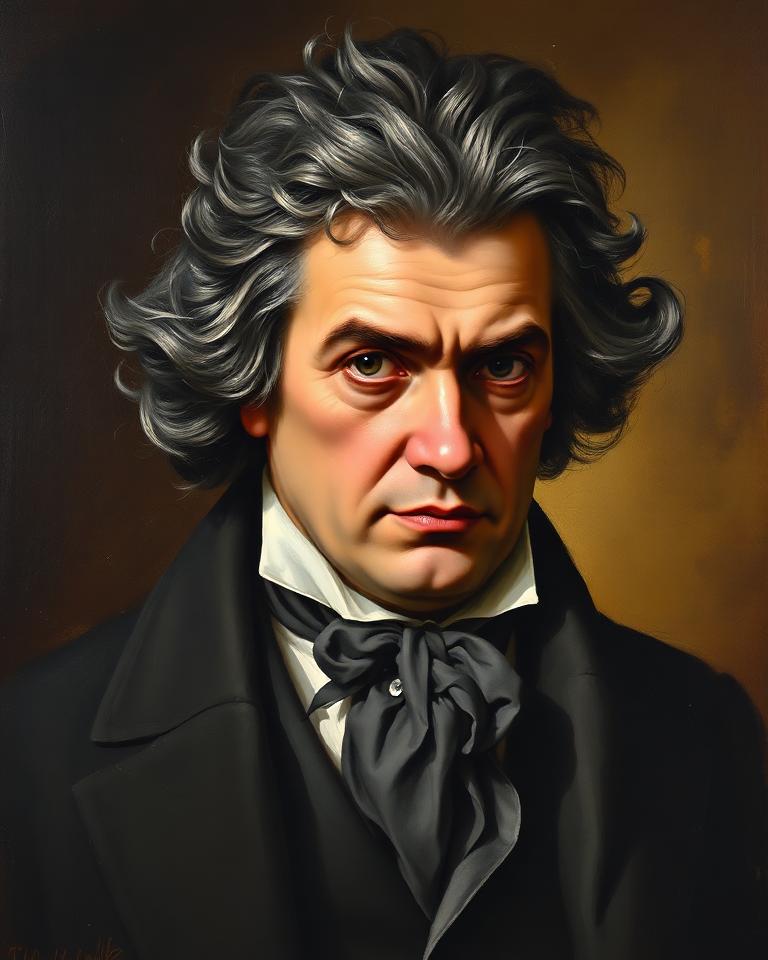
Quick Facts
- Years
- 1770 – 1827
- Category
- Artists & Composers
- Subcategory
- Classical Music
- Nationality
- German
- Occupation
- Composer
Ludwig van Beethoven
1770 – 1827 · German · Composer
Audiobook

Life Lessons from Ludwig van Beethoven
Marcus Alden · 58 min
Ludwig van Beethoven was a German-born composer and pianist whose music transformed the Classical tradition and helped open the Romantic era. Born in Bonn in 1770 and active mainly in Vienna, he inherited the formal language of Joseph Haydn and Wolfgang Amadeus Mozart but expanded its scale, intensity, and expressive range. His nine symphonies, thirty-two piano sonatas, sixteen string quartets, concertos, chamber works, sacred compositions, and only opera, Fidelio, became central to Western concert life.
Beethoven’s greatest achievements include the Eroica Symphony, the Fifth and Ninth Symphonies, the Emperor Concerto, the Missa solemnis, and the late quartets. These works altered expectations about musical development, personal expression, and the cultural status of composers. His career was also shaped by progressive hearing loss, which eventually left him functionally deaf. Rather than ending his work, deafness changed how he composed and communicated.
He remains important not merely as an inspiring figure who overcame disability, but as a rigorous musical thinker working amid revolution, war, censorship, patronage, and social change. Scholars continue to study his manuscripts, politics, health, relationships, business practices, and evolving style. Musicians still confront his works as technical challenges and profound statements about struggle, freedom, fellowship, and human dignity.
Quick Facts
| Field | Information |
|---|---|
| Full Name | Ludwig van Beethoven |
| Common Name(s) | Beethoven |
| Born | Baptized 17 December 1770; traditionally believed born 16 December 1770 |
| Died | 26 March 1827 |
| Age at Death | 56 |
| Birthplace | Bonn, Electorate of Cologne, Holy Roman Empire |
| Nationality | German-born; resident of Vienna in the Habsburg lands |
| Occupation | Composer, pianist, improviser, conductor |
| Historical Era | Classical and early Romantic periods |
| Famous For | Nine symphonies, thirty-two piano sonatas, sixteen string quartets, Fidelio, Missa solemnis |
| Political Affiliation if applicable | No formal party affiliation; sympathetic to Enlightenment ideals and personal liberty |
| Religion if significant | Baptized and raised Roman Catholic; personal beliefs were individual and difficult to define precisely |
| Education | Schooling in Bonn; music study with Christian Gottlob Neefe and others; lessons in Vienna with Haydn, Albrechtsberger, and Salieri |
| Parents | Johann van Beethoven and Maria Magdalena Keverich van Beethoven |
| Spouse(s) | Never married |
| Children | None known |
| Major Works | Eroica, Fifth, Sixth, Seventh, and Ninth Symphonies; Fidelio; Missa solemnis; late quartets; piano sonatas and concertos |
| Major Achievements | Expanded symphonic and sonata form; advanced musical Romanticism; created foundational piano and chamber repertory |
Early Life
Beethoven was baptized in Bonn on 17 December 1770. Because Catholic infants were commonly baptized soon after birth, 16 December is usually accepted as his birthday, although no birth certificate survives. The Flemish-derived “van” in his surname was not an aristocratic “von.”
His grandfather, also named Ludwig, had become Kapellmeister at the electoral court and represented family success. Beethoven’s father, Johann, was a court singer. His mother, Maria Magdalena, was remembered by Beethoven as kind and serious. Of the couple’s children, Ludwig and his younger brothers Caspar Carl and Nikolaus Johann survived infancy.
Johann recognized his son’s musical ability and tried to present him as a child prodigy, apparently making him seem younger at his first public performance in 1778. Training could be harsh, but later stories about extreme abuse are unevenly documented and should be treated cautiously.
The young Beethoven studied keyboard, violin, and viola with several local teachers. His most important early mentor was Christian Gottlob Neefe, Bonn’s court organist. Neefe introduced him to Johann Sebastian Bach’s Well-Tempered Clavier, encouraged composition, and arranged for his first published work, a set of keyboard variations, in 1782. Beethoven became Neefe’s assistant and later served as a court musician.
He probably visited Vienna in 1787. A meeting with Mozart is often reported, but reliable contemporary proof is absent. He returned quickly because his mother was dying. After her death in July 1787 and his father’s decline through alcoholism, Beethoven increasingly supported the household.
Bonn exposed him to Enlightenment culture. Through the Breuning family and university-connected intellectuals, he encountered literature, social refinement, and debates about reform. Count Ferdinand von Waldstein became a supporter. In 1792, amid the political upheaval following the French Revolution, Beethoven left Bonn for Vienna. Waldstein famously predicted that he would receive “Mozart’s spirit from Haydn’s hands.”
Rise to Prominence
In Vienna, Beethoven studied with Joseph Haydn, though their relationship was not always easy. He also learned counterpoint from Johann Georg Albrechtsberger and vocal composition from Antonio Salieri. These teachers gave him disciplined command of inherited forms even as he developed a forceful individual style.
He first established himself as a pianist and improviser in aristocratic salons. Witnesses praised his ability to improvise variations, create dramatic contrasts, and defeat rivals in musical contests. Patrons including Prince Karl Lichnowsky supplied money, contacts, lodging, and performance opportunities.
His Opus 1 piano trios were published in 1795 and sold successfully. Piano sonatas such as the Pathétique and Moonlight broadened his reputation, while his first two symphonies demonstrated mastery of the Viennese Classical language.
The decisive obstacle was hearing loss, noticed by Beethoven by the late 1790s. In 1802, while staying in Heiligenstadt, he wrote an anguished document to his brothers. Now called the Heiligenstadt Testament, it described isolation and thoughts of suicide but also his decision to continue living for art. He never sent it.
Soon afterward came the works often associated with his “heroic” middle period. The Third Symphony, Eroica, was unprecedented in breadth and developmental power. The Fifth Symphony turned a compact rhythmic idea into a large dramatic argument. Public concerts, publications, commissions, and foreign editions made him internationally famous, even as performing became increasingly difficult.
Major Achievements
Transforming the Symphony
Beethoven enlarged the symphony’s duration, emotional scope, and structural ambition. The Eroica treated musical development as an extended dramatic process; the Fifth created striking unity from a short motif; the Sixth represented feelings associated with nature; and the Ninth introduced vocal soloists and chorus into its finale.
These innovations mattered because they changed the symphony from prestigious entertainment into a form widely understood as capable of philosophical and public significance. Later composers—from Brahms and Mahler to Berlioz and Shostakovich—worked in Beethoven’s shadow.
Redefining Piano Music
The thirty-two piano sonatas chart Beethoven’s development across his career. Early sonatas challenge Classical conventions; middle-period works such as the Waldstein and Appassionata exploit the growing power of the piano; late sonatas explore fugue, variation, recitative-like writing, and unusual structures.
They became essential to pianistic training and concert culture. Their technical demands also encouraged performers and instrument makers to rethink sonority, range, pedaling, and endurance.
Advancing Chamber Music
Beethoven’s sixteen string quartets form another central achievement. The middle-period Razumovsky quartets expanded scale and complexity. The late quartets—especially Opp. 127, 130, 131, 132, and 135—use intricate counterpoint, abrupt contrasts, unusual movement sequences, and deeply concentrated expression.
Some contemporaries found these works bewildering. Their later influence was immense, shaping composers including Schubert, Bartók, and twentieth-century modernists.
Creating a Lasting Opera of Liberty
Beethoven repeatedly revised Fidelio, first staged in 1805 as Leonore. Its story concerns Leonore, who disguises herself as a man to rescue her unjustly imprisoned husband, Florestan. Political circumstances, dramaturgical problems, and Beethoven’s difficulties writing for the theater complicated its history.
The successful 1814 version became a durable “rescue opera” and a symbol of marital courage, justice, and liberation from tyranny.
Composing the Ninth Symphony
Premiered in Vienna on 7 May 1824, the Ninth Symphony culminates in a choral setting of Friedrich Schiller’s “Ode to Joy.” Its finale seeks fellowship beyond social division, though the work’s meaning has been interpreted differently in changing political settings.
The melody became a global emblem and, without Schiller’s words, the anthem of the European Union. The symphony remains a landmark in the relationship between instrumental music, poetry, and public ideals.
Sustaining a Freelance Career
Unlike many predecessors, Beethoven was not permanently employed as a court Kapellmeister. He combined patronage, publishing, benefit concerts, commissions, and negotiated payments. In 1809, Archduke Rudolph, Prince Lobkowitz, and Prince Kinsky promised him an annuity to remain in Vienna.
The arrangement was disrupted by war, inflation, and patrons’ financial problems, but it represented an important model of the composer as an autonomous creative figure rather than a conventional servant.
Leadership and Work
Beethoven led principally through artistic example. He demanded seriousness from performers, publishers, patrons, and himself. His surviving sketchbooks show persistent experimentation: famous passages often emerged through repeated revision rather than effortless inspiration.
He planned works from small motifs and tested many alternatives. This method produced exceptional structural coherence, but his perfectionism caused delays and conflict. He frequently complained about printing errors, fees, missed deadlines, and inadequate performances.
His relationships with patrons were unusually assertive. He valued aristocratic support but resisted being treated as a servant. The often-repeated story that he told Prince Lichnowsky there were many princes but only one Beethoven survives in later testimony; its precise wording is uncertain, though it fits documented tensions.
As a conductor, Beethoven became unreliable as his hearing deteriorated. At the Ninth Symphony premiere, Michael Umlauf effectively directed the performance while Beethoven remained onstage. His strengths were imagination, persistence, formal command, and uncompromising standards. His weaknesses included volatility, suspicion, poor organization in daily affairs, and difficulty sustaining cooperation.
Personal Life
Beethoven never married and had no known children. He formed intense attachments to several women, often from aristocratic families whose social position made marriage unlikely. Among them were Josephine Brunsvik, Giulietta Guicciardi, and Antonie Brentano, though the nature of individual relationships remains debated.
After his death, an unsent 1812 letter addressed to his “Immortal Beloved” was discovered. Scholars have proposed several recipients. Antonie Brentano and Josephine Brunsvik are prominent candidates, but no identification commands universal agreement.
His friends and associates included Stephan von Breuning, Franz Wegeler, Ferdinand Ries, Ignaz Schuppanzigh, and Archduke Rudolph. Relationships were often marked by quarrels followed by reconciliation. Conversation books used during his deaf years preserve visitors’ written comments, although Beethoven’s spoken replies were usually not recorded.
His domestic life was disorderly. He moved frequently within Vienna, had conflicts with servants and landlords, and neglected personal appearance. He enjoyed walking in the countryside and often carried sketch materials. Nature offered both creative stimulation and emotional relief.
Following his brother Caspar Carl’s death in 1815, Beethoven fought his sister-in-law Johanna for control of his nephew Karl. The prolonged litigation became an obsession. Karl’s attempted suicide in 1826 revealed the severe strain surrounding the relationship.
Beethoven suffered from progressive deafness, recurrent abdominal illness, and ultimately serious liver disease. Modern studies have suggested multiple contributing factors, but retrospective diagnosis remains uncertain. He died in Vienna on 26 March 1827.
Philosophy and Beliefs
Beethoven absorbed Enlightenment ideas of reason, dignity, liberty, and moral improvement. He admired heroic resistance to oppression and initially respected Napoleon Bonaparte as a republican figure. According to Ferdinand Ries, Beethoven angrily removed Napoleon’s dedication from the Third Symphony after Napoleon declared himself emperor. The manuscript’s damaged title page supports a repudiation, although details of the episode come from later recollection.
His politics were not a systematic program. He depended on aristocratic patrons and wrote music for imperial occasions, including the patriotic Wellington’s Victory. This apparent inconsistency reflects both practical circumstances and the complexity of living under Habsburg censorship and wartime nationalism.
Raised Catholic, Beethoven composed major sacred works, notably the Mass in C and Missa solemnis. His letters and notebooks also show an expansive, personal spirituality involving providence, nature, moral duty, and reverence for the divine. Scholars disagree over how closely he followed formal Catholic doctrine.
Ethically, he elevated art into a vocation. The Heiligenstadt Testament presents creative responsibility as a reason to endure suffering. Yet idealism did not always make him fair or patient in private life, particularly during the custody dispute over Karl.
Challenges and Controversies
Deafness was Beethoven’s defining practical challenge. It restricted performance, conversation, and social confidence. Romantic biography sometimes portrays deafness as magically deepening his genius; a more balanced view recognizes both severe hardship and his ability to compose through inner hearing, training, notation, and experimentation.
The custody battle for Karl remains the strongest criticism of his conduct. Beethoven considered Johanna morally unfit and wanted to direct the boy’s upbringing. Some historians stress his sincere concern and the period’s harsh judgment of women’s sexual conduct. Others emphasize his controlling behavior, legal maneuvering, and unrealistic demands. Karl’s distress makes the episode difficult to defend simply as paternal devotion.
His business dealings could be contentious. He sometimes offered works to multiple publishers while negotiating terms, and publishers sometimes delayed, underpaid, or produced inaccurate editions. The disputes reveal both commercial assertiveness and a music market lacking modern contractual clarity.
Several works received poor or confused receptions. The first version of Fidelio failed partly because Vienna was occupied by French troops and its audience was unfavorable. Wellington’s Victory achieved enormous popularity but is now often judged artistically weaker than his major compositions. The late quartets were criticized as obscure before later generations recognized their importance.
Myths also complicate his biography. There is no secure evidence that he met Mozart, that he was consistently destitute, or that his final gesture during a thunderstorm occurred exactly as later witnesses described. His death attracted dramatic retellings that should not replace documentary evidence.
Legacy
Beethoven became a model of the composer as an independent, visionary artist. His music influenced Romantic ideals of personal expression while retaining disciplined Classical structures. The symphonies became benchmarks for orchestras; the sonatas and quartets became foundations of professional training.
His reception has not been politically uniform. Liberals, nationalists, revolutionaries, authoritarian governments, and democratic institutions have all appropriated his music. “Ode to Joy” has served both ceremonial power and international reconciliation, demonstrating how canonical art can acquire meanings beyond its creator’s control.
Modern performers debate tempo, instruments, editions, articulation, and historical practice. Scholars study his sketches, paper types, correspondence, conversation books, finances, medical evidence, and social networks. Disability historians also examine how he adapted to hearing loss without reducing his identity to a triumph-over-adversity narrative.
The Beethoven-Haus in Bonn preserves his birthplace and supports research, exhibitions, and performances. Vienna maintains important sites, memorials, and museum collections connected with him. The Beethoven monument in Bonn, unveiled in 1845, became an early major public memorial to a composer. His grave lies in Vienna’s Central Cemetery, where his remains were transferred in 1888.
Beethoven remains modern because his works resist a single interpretation. They can sound intimate or monumental, tragic or comic, disciplined or disruptive. Their continuing presence in concerts, recordings, education, film, and public ceremony confirms an influence extending far beyond nineteenth-century Europe.
Interesting Facts
- Beethoven’s exact birth date is unrecorded; his baptism on 17 December 1770 is documented.
- The “van” in his name did not indicate German nobility.
- His first published composition appeared when he was about eleven or twelve.
- He initially became famous in Vienna as a pianist and improviser.
- Mozart’s Don Giovanni inspired variations in Beethoven’s early chamber repertory.
- He kept extensive musical sketchbooks.
- The Moonlight Sonata received that nickname after his death.
- The Third Symphony was first associated with Napoleon, then titled Eroica.
- He wrote only one completed opera, Fidelio.
- Four different overtures are connected with Fidelio and its earlier versions.
- He dedicated the Hammerklavier Sonata to Archduke Rudolph.
- By his final years, visitors commonly wrote in conversation books to communicate with him.
- Schubert helped carry a torch at Beethoven’s funeral.
- Thousands attended or followed the funeral procession, though exact estimates vary.
- The Ninth Symphony was the first Beethoven symphony to use chorus and vocal soloists.
- The compact disc’s original playing-length standard is often linked to the Ninth, but accounts of this claim differ.
- A lock of hair once used to support a lead-poisoning theory was later found to have come from a woman.
- Genetic research reported in 2023 found a strong inherited risk for liver disease and evidence of hepatitis B infection late in life.
Famous Quotes
- “Oh, you men who think or say that I am malevolent, stubborn, or misanthropic, how greatly do you wrong me.” — Heiligenstadt Testament, 1802. Beethoven explained that deafness, not hatred of humanity, caused his withdrawal.
- “It seemed impossible to leave the world until I had brought forth all that I felt was within me.” — Heiligenstadt Testament. Art became his stated reason for survival.
- “Recommend to your children virtue; that alone can make happy, not gold.” — Letter to Johanna van Beethoven, 1819. It reflects his moralizing approach during the custody conflict.
- “Music is a higher revelation than all wisdom and philosophy.” — Widely attributed through reported conversation, but its exact wording and documentary basis are disputed.
- “From the heart—may it return to the heart!” — Inscription associated with the Missa solemnis. It summarizes his intended spiritual communication.
- “Must it be? It must be!” — Written into the finale of String Quartet Op. 135, 1826. Its immediate origin may involve a mundane joke, although the music gives it broader resonance.
- “Plaudite, amici, comoedia finita est.” (“Applaud, friends, the comedy is over.”) — A deathbed attribution reported in varying forms; authenticity is disputed.
- “There are and will be thousands of princes; there is only one Beethoven.” — Traditionally linked to a dispute with Prince Lichnowsky. The sentiment is plausible, but the precise text rests on later reports.
- “I shall seize Fate by the throat; it shall certainly not bend and crush me completely.” — Letter to Franz Wegeler, 1801. It expresses resistance to hearing loss.
- “The true artist has no pride.” — From an 1812 letter to a young pianist, commonly translated in varying wording. Beethoven contrasted artistic humility with relentless striving.
Timeline
- 1770 — Baptized in Bonn on 17 December.
- 1778 — Makes a documented public appearance as a child pianist.
- 1782 — First published keyboard variations appear; studies with Neefe.
- 1784 — Receives appointment as assistant court organist.
- 1787 — Probably visits Vienna; returns as his mother becomes fatally ill.
- 1789 — Helps secure part of his father’s salary to support the family.
- 1792 — Moves to Vienna and begins study with Haydn.
- 1795 — Performs publicly in Vienna and publishes Opus 1 trios.
- 1798–1800 — Hearing problems become increasingly apparent.
- 1800 — First Symphony premieres.
- 1802 — Writes the Heiligenstadt Testament.
- 1803–1804 — Completes the Eroica Symphony.
- 1805 — First version of Fidelio, then titled Leonore, is staged.
- 1808 — Fifth and Sixth Symphonies premiere in the marathon concert of 22 December.
- 1809 — Receives an annuity agreement from three aristocratic patrons.
- 1811 — Emperor Concerto premieres in Leipzig.
- 1812 — Writes the “Immortal Beloved” letter; meets Goethe at Teplitz.
- 1813 — Wellington’s Victory brings major popular success.
- 1814 — Revised Fidelio succeeds; Seventh and Eighth Symphonies gain exposure.
- 1815 — Brother Caspar Carl dies; custody conflict over Karl begins.
- 1819 — Conversation books become a regular communication aid.
- 1820 — Beethoven gains legal control of Karl after prolonged litigation.
- 1823 — Completes the Missa solemnis.
- 1824 — Ninth Symphony premieres in Vienna.
- 1825 — Composes major late quartets, including Op. 132.
- 1826 — Karl attempts suicide; Beethoven completes his last quartet.
- 1827 — Dies on 26 March and is buried at Währing cemetery.
- 1888 — Remains are transferred to Vienna’s Central Cemetery.
Frequently Asked Questions
When and where was Beethoven born?
Beethoven was born in Bonn, then the capital of the Electorate of Cologne within the Holy Roman Empire. His baptism is recorded on 17 December 1770. No surviving document gives his birth date, but 16 December is traditionally accepted because infants were normally baptized soon after birth. Claims that he was born in 1772 arose partly because his father presented him as younger during childhood performances.
Was Beethoven German or Austrian?
He was born in Bonn and is generally described as a German composer. In 1792 he moved permanently to Vienna, capital of the Habsburg monarchy, where he built his career and died. Modern national categories do not map neatly onto his period: Germany was not yet a unified nation-state, and the Austrian Empire was dynastic and multilingual. “German-born, Vienna-based” is therefore especially precise.
Did Beethoven meet Mozart?
Beethoven probably traveled to Vienna in 1787, and later tradition says that he played for Mozart. No reliable contemporary document confirms a meeting, however. Mozart was extremely busy, and Beethoven’s visit was cut short by his mother’s illness. Historians usually treat the encounter as possible but unproven rather than established fact.
Who were Beethoven’s main teachers?
Christian Gottlob Neefe was his most influential Bonn teacher, introducing him to Bach and helping publish his early music. In Vienna, Beethoven studied composition with Joseph Haydn. Dissatisfied with some aspects of the arrangement, he also worked with Johann Georg Albrechtsberger in counterpoint and Antonio Salieri in Italian vocal composition. His education was broad, practical, and rooted in close study of earlier masters.
When did Beethoven become deaf?
Symptoms appeared by the late 1790s, when Beethoven was still in his twenties. His 1801 letters acknowledge worsening hearing, and the 1802 Heiligenstadt Testament reveals its emotional impact. The condition progressed unevenly. He continued performing for years but eventually withdrew from public piano playing. By the 1810s and 1820s, he had severe or near-total functional deafness and relied increasingly on written conversation.
How did he compose while deaf?
Beethoven possessed highly developed inner hearing built through decades of performance, theory, score reading, and composition. He could imagine pitch, rhythm, harmony, instrumental color, and structure without hearing an external performance. Sketchbooks allowed him to test and revise ideas on paper. He also used devices such as ear trumpets, although these had limited value. His achievement depended on expertise and disciplined work, not a supernatural compensation for disability.
What caused Beethoven’s deafness?
The cause remains unknown. Proposed explanations include otosclerosis, inflammatory disease, autoimmune conditions, infection, and toxic exposure. Lead was detected in some hair samples, but one famous lock proved not to be Beethoven’s, and lead alone does not settle the question. Genetic analysis published in 2023 offered information about liver risk but did not identify a definitive genetic cause for his hearing loss.
What are Beethoven’s most famous works?
The best-known works include the Fifth and Ninth Symphonies, the Eroica and Pastoral Symphonies, Für Elise, the Moonlight, Waldstein, Appassionata, and Pathétique Sonatas, the Emperor Concerto, the Violin Concerto, Fidelio, Missa solemnis, and the late string quartets. Fame varies by audience: short piano pieces are widely recognized, while musicians often regard the late quartets as his most searching achievements.
Why is the Third Symphony called Eroica?
Beethoven originally associated the symphony with Napoleon, whom he appears to have viewed as representing republican or heroic ideals. When Napoleon crowned himself emperor, Beethoven rejected the personal dedication, according to Ferdinand Ries. The surviving manuscript title page shows Napoleon’s name violently erased. Published as Sinfonia eroica, the work commemorated the memory of a great man rather than naming Napoleon directly.
Why is the Ninth Symphony important?
The Ninth combines an enormous instrumental design with solo voices and chorus in the finale, setting passages from Schiller’s “Ode to Joy.” This challenged conventional boundaries between symphony, cantata, and philosophical public statement. Its message of fellowship has made it internationally influential, although different regimes have interpreted it in conflicting ways. The “Ode to Joy” theme now serves, without words, as the European Union’s anthem.
Did Beethoven write “Für Elise” for Elise?
The identity of “Elise” is uncertain. The manuscript is lost, and the piece was published in 1867 from a transcription by Ludwig Nohl. Scholars have proposed Therese Malfatti, Elisabeth Röckel, and others. One theory suggests that Nohl misread “Für Therese,” but this is not proven. The familiar title is authentic to the reported inscription, yet its recipient remains unresolved.
Was Beethoven married?
No. He never married and had no known children. He fell in love several times, often with women of higher social rank or complicated marital status. His unsent letter to an unnamed “Immortal Beloved” shows an intense attachment, but the recipient is disputed. Social barriers, his difficult circumstances, illness, and personality may all have contributed to his lifelong bachelorhood.
Who was the “Immortal Beloved”?
The phrase comes from an unsent letter written on 6–7 July 1812. Numerous candidates have been proposed. Josephine Brunsvik and Antonie Brentano are among the leading possibilities, with arguments based on travel records, correspondence, and emotional context. Evidence remains incomplete, and scholars do not agree. Confident claims that the mystery has been permanently solved exceed what the documents support.
Why did Beethoven fight for custody of Karl?
After his brother Caspar Carl died, Beethoven sought guardianship of his nephew Karl and portrayed Karl’s mother, Johanna, as morally unsuitable. The legal struggle lasted years and moved between courts partly because Beethoven exaggerated his own noble status. He wanted Karl to receive disciplined education, but his control became oppressive. Karl’s attempted suicide in 1826 demonstrates the damaging pressure within the relationship.
Did Beethoven conduct the Ninth Symphony premiere?
He stood onstage and indicated tempos, but Michael Umlauf had instructed the performers to follow him rather than Beethoven because the composer could not hear the ensemble reliably. Accounts say that a singer turned Beethoven toward the applauding audience after the performance. Details differ among witnesses, but the central fact is clear: Beethoven participated visibly while Umlauf provided effective musical direction.
What did Beethoven die from?
Beethoven died after months of declining health involving jaundice, abdominal swelling, and repeated medical procedures to drain fluid. Cirrhosis and liver failure were central. Genetic research has identified a strong predisposition to liver disease and evidence consistent with hepatitis B infection late in life; alcohol consumption may also have contributed. The relative importance of these factors cannot be determined with certainty.
Was Beethoven poor?
He experienced financial anxiety, inflation, delayed payments, family expenses, and periods of limited cash. Yet he also received substantial publishing income, commissions, patronage, and an annuity, and he left bank shares at death. Describing him as constantly destitute is misleading. His finances were unstable and contentious rather than uniformly impoverished.
How many people attended his funeral?
Contemporary reports describe a very large procession in Vienna on 29 March 1827, and later estimates often cite around 10,000 to 20,000 people. Exact counting was not available, so such figures should be treated as approximate. The scale nevertheless demonstrates Beethoven’s extraordinary public stature. Franz Schubert was among the torchbearers, and the actor Heinrich Anschütz delivered a funeral oration written by Franz Grillparzer.
Lessons We Can Learn
- Turn constraints into new methods. As hearing failed, Beethoven relied more on notation, sketches, and inner hearing. Modern professionals can redesign processes instead of assuming one lost capacity ends meaningful work.
- Revise relentlessly. His sketchbooks reveal repeated alternatives behind apparently inevitable music. Excellence often results from patient iteration rather than instant inspiration.
- Master tradition before transforming it. Beethoven studied Bach, Haydn, Mozart, and counterpoint. Innovation becomes stronger when grounded in technical knowledge.
- Protect creative independence. He negotiated with patrons and publishers rather than accepting a conventional servant role. Today, autonomy likewise requires business skill as well as talent.
- Let purpose sustain perseverance. In the Heiligenstadt Testament, unfinished artistic work gave him a reason to live. A meaningful long-term purpose can stabilize people during crisis.
- Accept that success can follow initial failure. Fidelio failed in 1805 but succeeded after major revision in 1814. A poor launch need not determine a project’s final value.
- Do not romanticize suffering. Deafness caused isolation and practical loss; it was not a gift required for genius. Modern societies should remove barriers rather than celebrate preventable hardship.
- High standards need humane relationships. Beethoven’s demands produced great art but also damaged cooperation. Excellence is more sustainable when joined with patience and respect.
- Good intentions do not excuse control. He believed he was protecting Karl, yet his guardianship contributed to severe distress. Care must preserve another person’s dignity and agency.
- Create beyond immediate approval. The late quartets puzzled early audiences but influenced generations. Responsible long-term work may require resisting current fashion without dismissing all criticism.
Related Historical Figures
- Joseph Haydn — Beethoven’s principal early Vienna teacher and a foundational Classical composer whose forms Beethoven inherited and expanded.
- Wolfgang Amadeus Mozart — A major artistic model; their alleged meeting is unproven, but Mozart’s concertos, operas, and chamber music influenced Beethoven.
- Christian Gottlob Neefe — His Bonn mentor, who introduced him to Bach and supported his first publication.
- Antonio Salieri — Taught Beethoven Italian vocal composition and advised him on writing for voices.
- Archduke Rudolph — Pupil, patron, and friend; recipient of works including the Archduke Trio and Missa solemnis.
- Napoleon Bonaparte — Initially associated with the Eroica Symphony and later rejected as a betrayed symbol of republican heroism.
- Johann Wolfgang von Goethe — Germany’s leading literary figure; he met Beethoven at Teplitz in 1812, and Beethoven set several of his texts.
- Friedrich Schiller — Poet of “Ode to Joy,” whose vision of fellowship supplied the Ninth Symphony’s final text.
- Franz Schubert — Younger Viennese composer deeply influenced by Beethoven; served as a torchbearer at his funeral.
- Ignaz Schuppanzigh — Violinist and quartet leader who premiered important Beethoven chamber works and helped establish professional string-quartet culture.
Watch and Learn
Beethoven Biography: The Greatest Composer of All Time · Biographics
Related Historical Figures