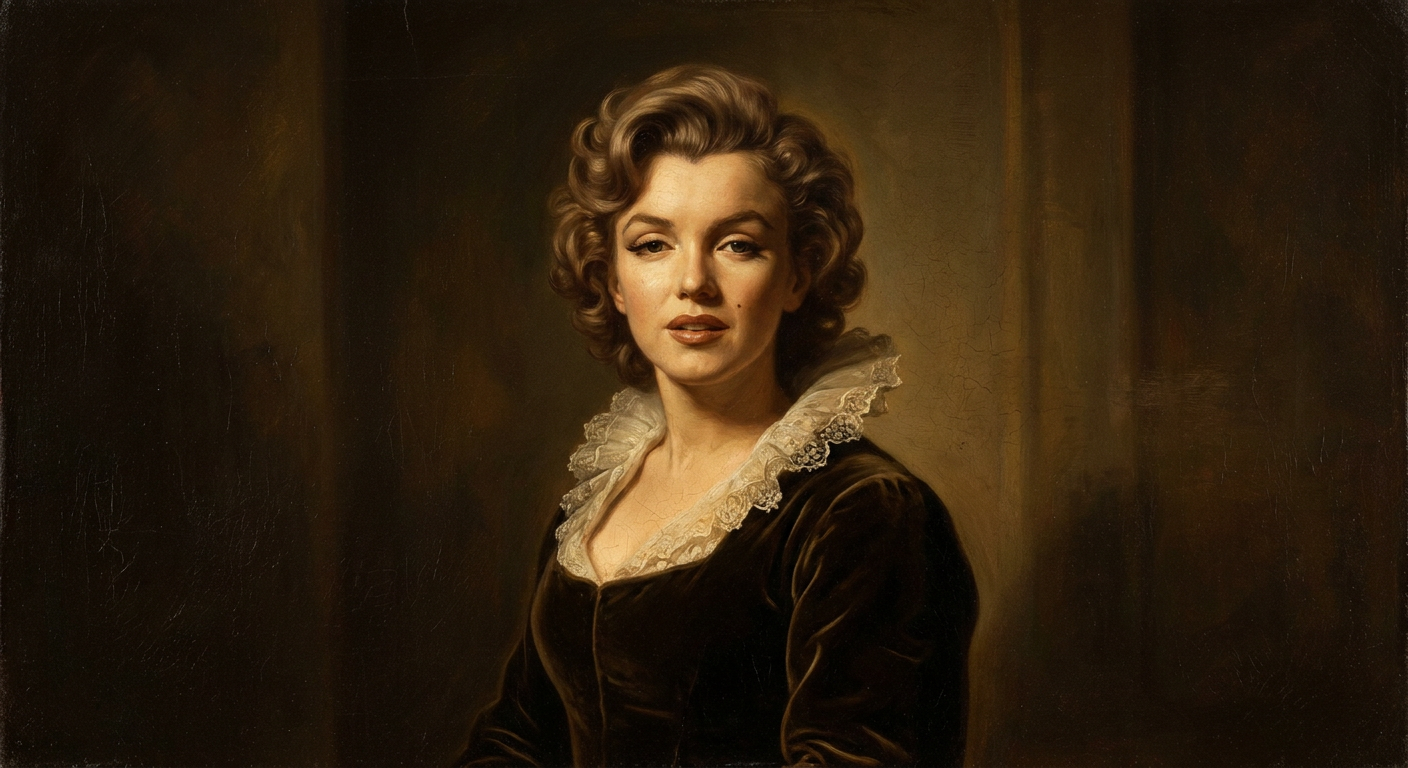
Quick Facts
- Years
- 1926 – 1962
- Category
- Artists & Composers
- Nationality
- American
- Occupation
- Actress, model, singer, and film producer
Marilyn Monroe
1926 – 1962 · American · Actress, model, singer, and film producer
Recommended Audiobooks
Listen next from Marcus Alden

Life Lessons from Franz Liszt
Marcus Alden · 53 min

Life Lessons from Camille Saint-Saëns
Marcus Alden · 53 min
Marilyn Monroe was an American actress, model, singer, and producer whose image became one of the most recognizable symbols of the twentieth century. Born Norma Jeane Mortenson in 1926, she survived an unstable childhood marked by foster homes, family separation, and financial insecurity. Within two decades, she transformed herself into an international film star celebrated for performances in comedies such as Gentlemen Prefer Blondes, The Seven Year Itch, and Some Like It Hot.
Monroe mattered for more than her beauty or celebrity. At a time when Hollywood studios exercised enormous control over actors, she challenged her contract, left California, studied acting in New York, and formed Marilyn Monroe Productions. Her campaign for stronger roles and better pay helped expose inequalities within the studio system, particularly those affecting women marketed as glamorous commodities.
Her public image concealed a more complicated person: ambitious yet insecure, witty yet frequently underestimated, professionally determined yet increasingly affected by insomnia, anxiety, and dependence on prescription medication. Her death at thirty-six intensified the myths surrounding her, but it should not eclipse her achievements as a performer and businesswoman.
Monroe remains important because her life illuminates celebrity culture, gender expectations, mental health, labor relations, and the manufacture of public identity. Scholars still study how Norma Jeane became “Marilyn Monroe”—and how that creation eventually seemed almost impossible for its creator to control.
Quick Facts
| Field | Information |
|---|---|
| Full Name | Norma Jeane Mortenson; baptized Norma Jeane Baker |
| Common Name(s) | Marilyn Monroe, Norma Jeane |
| Born | June 1, 1926 |
| Died | August 4, 1962; pronounced dead early August 5 |
| Age at Death | 36 |
| Birthplace | Los Angeles, California, United States |
| Nationality | American |
| Occupation | Actress, model, singer, and film producer |
| Historical Era | Golden Age of Hollywood; postwar America |
| Famous For | Gentlemen Prefer Blondes, The Seven Year Itch, Bus Stop, and Some Like It Hot |
| Political Affiliation | No formal party role; generally sympathetic to liberal and civil-rights causes |
| Religion | Raised around Christian Science and other Protestant influences; converted to Judaism in 1956 |
| Education | Attended several schools, including Van Nuys High School; later studied at the Actors Studio |
| Parents | Gladys Pearl Baker and, according to later DNA evidence, Charles Stanley Gifford |
| Spouse(s) | James Dougherty, Joe DiMaggio, Arthur Miller |
| Children | None |
| Major Works | Niagara, Gentlemen Prefer Blondes, How to Marry a Millionaire, The Seven Year Itch, Bus Stop, The Prince and the Showgirl, Some Like It Hot, The Misfits |
| Major Achievements | International film stardom; Golden Globe for Some Like It Hot; co-founding Marilyn Monroe Productions; successful challenge to her studio contract |
Early Life
Norma Jeane Mortenson was born at Los Angeles General Hospital on June 1, 1926. Her mother, Gladys Pearl Baker, worked as a film negative cutter. The birth certificate named Gladys’s estranged husband, Martin Edward Mortensen, as the father, although Monroe generally used the surname Baker in childhood. DNA research announced in 2022 supported the long-held conclusion that her biological father was Gladys’s former colleague Charles Stanley Gifford.
Gladys struggled with financial hardship and serious mental illness. Soon after the birth, Norma Jeane was placed with foster parents Albert and Ida Bolender in Hawthorne, California. Gladys later attempted to establish a home with her daughter, but she experienced a psychiatric crisis and was institutionalized in 1934.
The child consequently moved among guardians, foster homes, and an orphanage. Grace Goddard, a friend of Gladys, became an important guardian and encouraged Norma Jeane’s interest in movies. These years gave her little lasting security. Monroe later reported that she experienced sexual abuse during childhood. Details in her recollections varied, but biographers generally agree that she endured exploitation and instability.
She attended several schools and spent part of her adolescence with relatives of Grace’s husband. In 1942, when that household planned to leave California, sixteen-year-old Norma Jeane faced another possible return to institutional care. She married twenty-one-year-old neighbor James Dougherty on June 19. The marriage provided immediate stability but ended her formal schooling.
Rise to Prominence
During the Second World War, Dougherty served in the merchant marine. Norma Jeane worked at the Radioplane Company, which manufactured military drones. In 1944, Army photographer David Conover visited the plant to photograph women contributing to wartime industry. He noticed her ability before the camera and encouraged her to model.
She joined the Blue Book Model Agency, straightened and lightened her hair, and appeared in advertisements and magazine photographs. Her modeling success brought her to the attention of film studios. In 1946, she signed a short contract with 20th Century Fox and adopted the professional name Marilyn Monroe. “Marilyn” was suggested by executive Ben Lyon; “Monroe” came from her mother’s family.
Her first Fox contract produced few opportunities, and the studio released her. She took minor parts elsewhere, including a brief appearance in the Marx Brothers comedy Love Happy. Her career changed in 1950 with small but noticeable roles in John Huston’s The Asphalt Jungle and Joseph L. Mankiewicz’s All About Eve. Critics began identifying her as a performer with unusual screen presence.
Fox signed her again. Publicity photographs and supporting roles helped build her profile, although the studio often emphasized her body more than her acting. When it emerged that she had posed nude for a calendar before becoming famous, Monroe acknowledged doing so because she had needed money. Her frank response helped turn a potential scandal into public sympathy.
In 1953 she became a major star through three films. The thriller Niagara presented her as a dangerous, sexually confident figure. The musical comedy Gentlemen Prefer Blondes showcased her timing, singing, dancing, and command of the screen. How to Marry a Millionaire confirmed her commercial appeal.
Major Achievements
Creating a distinctive comic persona
Monroe’s “blonde” characters were often assumed to be foolish, yet her performances made them observant, strategic, and emotionally direct. In Gentlemen Prefer Blondes, she balanced glamour with precise comedy. Her performance of “Diamonds Are a Girl’s Best Friend” became a landmark of film imagery, repeatedly referenced by later performers.
Becoming an international box-office star
By the mid-1950s, Monroe was among Hollywood’s most marketable actors. The Seven Year Itch produced the famous image of her white dress rising above a subway grate. The scene became culturally enduring, although the publicity surrounding its filming damaged her marriage to Joe DiMaggio.
Challenging the studio system
Fox paid Monroe less than some less profitable performers and repeatedly assigned similar roles. After refusing another project, she was suspended. In late 1954 she left Hollywood for New York, where she founded Marilyn Monroe Productions with photographer Milton Greene.
The company gave her bargaining power. Fox eventually offered a new contract providing higher compensation, greater choice over directors and projects, and the right to work for other companies. She did not overthrow the studio system by herself, but her stand was unusual and influential for a female star of the period.
Pursuing serious acting
In New York, Monroe studied with Lee Strasberg and attended the Actors Studio. Her preparation helped deepen her performance in Bus Stop (1956), in which she played Chérie, a vulnerable nightclub singer resisting a possessive cowboy. Reviewers who had dismissed her increasingly acknowledged her dramatic ability.
Producing a major film
Marilyn Monroe Productions made The Prince and the Showgirl (1957), co-starring and directed by Laurence Olivier. Production was strained by contrasting working styles and Monroe’s lateness, anxiety, and reliance on acting coach Paula Strasberg. Even so, the film demonstrated that she could develop and produce a substantial international project.
Winning acclaim for Some Like It Hot
Billy Wilder’s Some Like It Hot (1959) is widely regarded as one of cinema’s greatest comedies. Monroe played singer Sugar Kane alongside Tony Curtis and Jack Lemmon. The production was difficult, but her finished performance combined vulnerability, sensuality, and comic rhythm. She won the Golden Globe for best actress in a musical or comedy.
Leadership or Work
Monroe approached acting less casually than her publicity image suggested. She studied photographs, watched performances, rehearsed expressions, and searched for the emotional motivation behind scenes. Her photographic modeling experience gave her exceptional awareness of camera position and lighting.
Her main professional strengths included:
- A rare ability to establish intimacy with the camera.
- Precise comic timing and expressive movement.
- Determination to improve through formal training.
- Awareness of publicity and visual branding.
- Willingness to confront an unfavorable contract.
Her working weaknesses were also consequential. She frequently arrived late, forgot lines, and required many takes. Anxiety sometimes became worse when directors displayed impatience. Medication, insomnia, and fear of failure compounded the problem. Colleagues differed sharply in their judgments: some regarded her as professionally unreliable, while others emphasized that she eventually delivered performances of exceptional value.
As a businesswoman, Monroe made bold strategic choices but relied heavily on trusted advisers. Marilyn Monroe Productions strengthened her position, although Milton Greene handled much of its administration. Her leadership was therefore collaborative rather than managerial in the conventional sense.
Personal Life
Monroe’s first marriage, to James Dougherty, lasted from 1942 until 1946. As her modeling career advanced, their goals diverged. Dougherty later remembered their early domestic life warmly, but Monroe viewed the marriage as partly a response to childhood circumstances.
She married retired baseball star Joe DiMaggio in January 1954. The relationship attracted enormous attention. DiMaggio reportedly wanted a more private wife, while Monroe’s career depended upon public visibility and sexualized publicity. They divorced after nine months. Despite the failure of the marriage, they later remained connected, and DiMaggio assisted her during periods of crisis.
In 1956 Monroe married playwright Arthur Miller, whose intellectual seriousness she admired. She converted to Judaism before their wedding. Their relationship coincided with her effort to become a respected dramatic actress. Monroe suffered pregnancies that did not result in children, including an ectopic pregnancy and a miscarriage. These experiences caused her considerable distress. The marriage deteriorated during the making of The Misfits, written by Miller, and they divorced in 1961.
Friends described Monroe as warm, funny, curious, and generous, but also sensitive to rejection. She read widely and owned hundreds of books. Her interests included poetry, art, psychology, and politics. She experienced chronic insomnia and emotional distress and became increasingly dependent on barbiturates and other prescribed drugs. Medical treatment in that period often involved several doctors without effective coordination, increasing the danger of accidental interactions or overdose.
Philosophy or Beliefs
Monroe did not produce a systematic political philosophy. Available evidence suggests that she leaned toward liberal, internationalist, and civil-rights causes. She supported the Hollywood Committee for a Sane Nuclear Policy and expressed sympathy for workers and people subjected to racial discrimination.
A widely repeated account says that she helped Ella Fitzgerald obtain a booking at Hollywood’s Mocambo nightclub by promising to attend nightly. Fitzgerald later credited Monroe with helping her career, although some popular versions exaggerate the club’s prior exclusion of Black performers. Monroe’s intervention remains evidence of personal support, but it should not be turned into a simplified story in which she single-handedly integrated the venue.
Her conversion to Judaism was connected to her marriage to Arthur Miller, but it was not treated merely as paperwork. She studied with Rabbi Robert Goldberg and retained a Jewish prayer book and menorah. How deeply she practiced later is less clear.
Her worldview was strongly shaped by the desire to be recognized as a complete person rather than a manufactured image. That aspiration influenced her contract rebellion, acting studies, and search for more complex roles.
Challenges and Controversies
Monroe’s career unfolded within a publicity industry that blurred private truth and marketable fantasy. Fox altered aspects of her biography, while reporters often reduced her to romance, appearance, and scandal. Monroe also participated in shaping this persona because it created opportunities. The tension between exploitation and agency cannot be resolved into a simple victim-or-master narrative.
Her on-set behavior generated legitimate criticism. Delays during Some Like It Hot, The Prince and the Showgirl, and Something’s Got to Give increased costs and frustrated colleagues. Illness and medication explain part of the difficulty but do not erase its professional consequences.
In 1962 Fox dismissed her from the unfinished Something’s Got to Give after repeated absences. The studio publicized her as unreliable, though it was also under financial pressure from Cleopatra. Negotiations later began for her return, indicating that the dispute was not final when she died.
Her relationships with President John F. Kennedy and Attorney General Robert Kennedy have inspired extensive speculation. Evidence supports at least some social contact and makes a brief sexual relationship with John Kennedy plausible, but sensational claims involving conspiracies, intelligence secrets, or sustained affairs remain unproven.
Monroe was found dead at her Brentwood home in Los Angeles on August 5, 1962. The coroner concluded that she died from acute barbiturate poisoning and classified the death as a probable suicide. Investigators found no persuasive evidence of homicide. Questions about timing, witness statements, and medical practices have encouraged alternative theories, but no conspiracy account has achieved credible evidentiary support among mainstream historians.
Legacy
Monroe’s legacy operates simultaneously in cinema, fashion, business history, photography, and debates about celebrity. Her films continue to be screened and studied, particularly Some Like It Hot, Gentlemen Prefer Blondes, and The Misfits. Performers from Madonna to contemporary pop artists have borrowed her costumes, poses, and songs.
Andy Warhol’s Monroe screen prints transformed a publicity photograph into a meditation on mass reproduction, celebrity, and death. Her image has since appeared so often that it can obscure the working actress who created it.
Monroe also became a reference point in discussions of women’s labor in Hollywood. Her production company and renegotiated contract did not give her complete independence, but they demonstrated how star power could challenge restrictive employment structures.
Important sites and collections associated with her include her crypt at Westwood Village Memorial Park Cemetery, the Marilyn Monroe Collection held by private collectors and institutions, film archives, and museum exhibitions devoted to Hollywood photography and costume. Her Brentwood residence remains privately owned and has been the subject of preservation efforts.
Modern assessments increasingly move beyond the idea of Monroe as a tragic victim. They examine her as a skilled comic actor, an ambitious worker, a reader, a producer, and a person whose health problems were treated within an unsafe medical culture.
Interesting Facts
- Monroe was born Norma Jeane Mortenson but was baptized Norma Jeane Baker.
- She worked at the Radioplane factory during the Second World War.
- Her modeling career began after an Army photographer visited the factory.
- She selected “Monroe” from her mother’s family name.
- She was briefly signed by Fox before achieving any major film success.
- Her small role in All About Eve helped establish her reputation.
- She openly admitted posing nude because she had needed money.
- She and Jane Russell placed their handprints outside Grauman’s Chinese Theatre.
- She founded Marilyn Monroe Productions in 1954.
- She studied at the Actors Studio in New York.
- She converted to Judaism before marrying Arthur Miller.
- She owned a substantial personal library containing literature, poetry, history, and psychology.
- Her natural hair was brown before she adopted her famous blonde appearance.
- Some Like It Hot earned her a Golden Globe.
- The Misfits was the final completed film for both Monroe and Clark Gable.
- She performed “Happy Birthday” for President Kennedy in May 1962.
- Joe DiMaggio arranged her funeral and sent roses to her crypt for years afterward.
- Her estate eventually became highly valuable through image licensing.
Famous Quotes
- “I’ve never fooled anyone. I’ve let people fool themselves.” In her 1962 Life interview, Monroe distinguished her private identity from assumptions projected onto her.
- “Please don’t make me a joke.” Also from the final Life interview, this request reveals her fear that the comic persona would erase her humanity.
- “I want to be an artist, not an erotic freak.” Reported from her 1955 press conference announcing Marilyn Monroe Productions; it summarized her demand for creative respect.
- “The truth can only be recalled, never invented.” From My Story, the memoir assembled with Ben Hecht. Because the book was ghostwritten and published after her death, its exact wording should be treated cautiously.
- “Hollywood is a place where they’ll pay you a thousand dollars for a kiss and fifty cents for your soul.” Also associated with My Story; memorable, but mediated through a ghostwriter.
- “What do I wear in bed? Why, Chanel No. 5, of course.” This famous answer derives from a 1952 interview and later French-language recording; common English versions vary.
- “I restore myself when I’m alone.” Recorded in a 1961 interview with journalist W. J. Weatherby, expressing the value she placed on privacy.
- “A sex symbol becomes a thing. I just hate to be a thing.” From a 1962 interview, rejecting the dehumanizing side of fame.
- “We are all of us stars, and we deserve to twinkle.” Appears in correspondence attributed to Monroe and reflects her language of self-worth, although its exact original context is often omitted.
- “Fame is fickle, and I know it.” Published in her final Life interview, showing awareness that celebrity offered no reliable security.
Timeline
- 1926 — Born in Los Angeles on June 1.
- 1934 — Gladys Baker is institutionalized; Norma Jeane’s unstable guardianship continues.
- 1935–1937 — Lives in foster care and at the Los Angeles Orphans Home.
- 1942 — Marries James Dougherty at age sixteen.
- 1944 — Photographed at the Radioplane factory by David Conover.
- 1945 — Begins professional modeling.
- 1946 — Divorces Dougherty, signs with Fox, and adopts the name Marilyn Monroe.
- 1948 — Appears in Ladies of the Chorus.
- 1950 — Gains notice in The Asphalt Jungle and All About Eve.
- 1952 — Nude-calendar story becomes public; Monroe’s candid response limits the scandal.
- 1953 — Stars in Niagara, Gentlemen Prefer Blondes, and How to Marry a Millionaire.
- 1954 — Marries and divorces Joe DiMaggio; begins challenging Fox.
- 1955 — Moves to New York, studies acting, and announces Marilyn Monroe Productions.
- 1956 — Wins a new Fox contract, stars in Bus Stop, marries Arthur Miller, and converts to Judaism.
- 1957 — Produces and stars in The Prince and the Showgirl.
- 1959 — Stars in Some Like It Hot.
- 1960 — Receives a Golden Globe for her performance.
- 1961 — Divorces Miller; The Misfits is released.
- 1962 — Performs for President Kennedy, works on the unfinished Something’s Got to Give, and dies in August.
Frequently Asked Questions
1. What was Marilyn Monroe’s real name?
She was born Norma Jeane Mortenson and baptized Norma Jeane Baker. The surname on her birth certificate came from her mother’s estranged husband, while Baker was the name Monroe commonly used during childhood. She adopted Marilyn Monroe professionally in 1946. The change was part of the studio-era practice of creating memorable screen identities, although Monroe later made the name legally her own.
2. Who was her biological father?
For decades the answer was uncertain because Monroe never had an acknowledged relationship with her father. Her mother identified Charles Stanley Gifford, a former coworker, as the likely father. DNA research publicized in 2022 compared genetic material from Monroe and Gifford’s descendants and supported that identification. Martin Mortensen nevertheless remained the man listed on her birth certificate.
3. Did Monroe grow up in an orphanage?
She spent about two years at the Los Angeles Orphans Home, but she was not legally an orphan. Her mother was alive but unable to provide consistent care because of psychiatric illness and poverty. Monroe also lived with foster parents, guardians, and family acquaintances. The repeated moves, rather than any single institution, defined her unsettled childhood.
4. How did she become famous?
Her path began with wartime factory photographs, followed by pinup and advertising work. Small film roles demonstrated her camera presence, particularly in The Asphalt Jungle and All About Eve. Fox then promoted her heavily. Three successful 1953 films—Niagara, Gentlemen Prefer Blondes, and How to Marry a Millionaire—turned her into an international star.
5. Was Marilyn Monroe a good actress?
Critical opinion during her lifetime was mixed, partly because her publicity overshadowed her craft. Her best performances display exact comic timing, emotional openness, and exceptional awareness of the camera. Bus Stop, Some Like It Hot, and The Misfits show considerable range. Her work habits could be disruptive, but production difficulty and artistic quality are separate questions.
6. Did she really sing in her films?
Yes, although studio recording methods sometimes involved vocal coaching, editing, and occasional assistance. Monroe performed well-known numbers including “Diamonds Are a Girl’s Best Friend” and “I Wanna Be Loved by You.” Her voice was intimate rather than powerful, but she used phrasing, breath, movement, and character to make songs dramatically effective.
7. Why did she form a production company?
Monroe believed Fox underpaid her and trapped her in repetitive “dumb blonde” parts. By forming Marilyn Monroe Productions with Milton Greene, she gained leverage to negotiate better terms. Her revised Fox contract increased her salary and offered greater choice over projects and collaborators. The company represented both an artistic declaration and a practical labor strategy.
8. Why was she often late to film sets?
There was no single cause. Monroe experienced severe anxiety, insomnia, physical illness, and dependence on prescription drugs. Her perfectionism and fear of forgetting lines could delay her further, while reliance on acting coaches sometimes complicated filming. These circumstances provide context, but colleagues still faced real costs and frustration from her absences and repeated takes.
9. How many times did she marry?
Monroe married three times. Her marriage to James Dougherty lasted from 1942 to 1946, her marriage to Joe DiMaggio lasted nine months in 1954, and her marriage to Arthur Miller lasted from 1956 until 1961. Each relationship corresponded to a different stage of her life: adolescent survival, global celebrity, and pursuit of intellectual and artistic respect.
10. Did Marilyn Monroe have children?
No. Monroe wanted children and became pregnant during her marriage to Arthur Miller, but the pregnancies did not result in a birth. She experienced an ectopic pregnancy and a miscarriage, and she suffered from endometriosis, which may have affected her reproductive health. Biographers agree that these losses caused significant emotional pain.
11. Was she involved with President Kennedy?
Monroe and John F. Kennedy moved in overlapping social circles, and many historians consider a brief sexual encounter plausible. The evidence does not establish the elaborate, continuing affair portrayed in popular mythology. Claims that she possessed dangerous government secrets or was killed to silence her depend largely on inconsistent testimony and speculation rather than reliable documentation.
12. How did Marilyn Monroe die?
She died from acute barbiturate poisoning at her Los Angeles home in August 1962. The coroner classified the death as a probable suicide. Her history of overdoses, emotional distress, and access to several prescriptions informed that conclusion. Although questions about the timeline have fueled conspiracy theories, official reviews have found no convincing evidence that she was murdered.
13. Why is the date of her death sometimes given differently?
Monroe was last known to be alive on the evening of August 4, 1962, but her body was discovered and authorities were called in the early hours of August 5. Consequently, some references use August 4 and others August 5. Her crypt records August 5, while many biographies describe her death as occurring late on August 4.
14. What was her best film?
There is no objective answer, but Some Like It Hot receives the strongest overall critical consensus. Its screenplay, direction, ensemble acting, and treatment of gender disguise made it historically influential. Viewers interested in Monroe’s dramatic ambition may prefer Bus Stop or The Misfits, while Gentlemen Prefer Blondes best demonstrates her musical and comic star power.
15. Was the subway-dress scene filmed exactly as shown?
The famous publicity event occurred above a Manhattan subway grate during filming of The Seven Year Itch, before a large crowd of photographers and spectators. Noise made the footage unusable, so the scene was recreated on a studio set. The public photographs, rather than only the finished movie, created one of Hollywood’s most enduring images.
16. Did she help Ella Fitzgerald’s career?
Fitzgerald said Monroe helped secure an important Mocambo booking and attended performances, bringing press attention. That support was meaningful. However, retellings sometimes incorrectly suggest Fitzgerald had never played major venues or that Monroe alone ended a formal color ban. The accurate story is one of influential advocacy, not solitary rescue.
17. Was Monroe highly educated?
She did not finish high school, but lack of formal credentials should not be confused with lack of intellectual interest. She read literature, drama, poetry, psychology, and political writing, took classes, and pursued demanding acting study. Some photographs of her reading were publicity images, yet her surviving library and correspondence confirm genuine curiosity.
18. Why does she remain famous?
Monroe combined compelling films, memorable photography, beauty, humor, vulnerability, and an early death. Her image can be endlessly reproduced, while her private struggle complicates the glamour it represents. She also speaks to current questions about women’s autonomy, mental health, workplace power, and the gap between a public brand and a private person.
Lessons We Can Learn
- A difficult childhood need not determine an entire future. Monroe converted an unstable beginning into professional achievement, though her later struggles also show that early trauma can have lasting effects.
- Public images are constructed. “Marilyn Monroe” emerged through styling, performance, publicity, and her own choices. Modern audiences should question how celebrity brands are manufactured.
- Skill can hide beneath stereotype. Critics who saw only a glamorous blonde often overlooked her comic technique. Judging work closely matters more than accepting labels.
- Workers can challenge unfair contracts. Her production company strengthened her bargaining position. The broader lesson about negotiation is a modern interpretation grounded in her documented dispute with Fox.
- Improvement requires study. At the height of fame, she sought demanding acting instruction rather than assuming popularity equaled mastery.
- Ambition does not eliminate vulnerability. Monroe could make bold career decisions while suffering intense anxiety. Strength and fragility are not opposites.
- Health care must be coordinated. Multiple prescriptions and poorly integrated treatment increased her risks, a historically grounded warning with continuing relevance.
- Support across racial barriers can matter. Her assistance to Ella Fitzgerald illustrates how influential people can open doors, provided the story is told without exaggeration.
- Success cannot replace private stability. Fame gave Monroe wealth and access but did not resolve loneliness, illness, or fear of abandonment.
- Remember the person behind the symbol. Studying her complete career resists reducing a human being to a dress, photograph, scandal, or tragic ending.
Related Historical Figures
- Joe DiMaggio — Baseball legend, second husband, and later source of personal support.
- Arthur Miller — Playwright and third husband who wrote The Misfits for her.
- James Dougherty — Her first husband during the transition from adolescence to modeling.
- Ella Fitzgerald — Jazz singer whose nightclub engagement Monroe publicly supported.
- Billy Wilder — Director of The Seven Year Itch and Some Like It Hot.
- Lee Strasberg — Acting teacher who became one of Monroe’s most influential mentors.
- Paula Strasberg — Acting coach whose close involvement both reassured Monroe and frustrated directors.
- Jane Russell — Friend and co-star in Gentlemen Prefer Blondes.
- Laurence Olivier — Co-star and director of The Prince and the Showgirl.
- John F. Kennedy — President connected to Monroe socially and through her famous 1962 birthday performance.
Watch and Learn
Recommended video: Marilyn Monroe: Still Life, from American Masters PBS. Approximate duration: 85 minutes.
This documentary uses archival footage, photographs, recordings, and interviews to examine Monroe’s development as an actress and public figure. It is especially useful because it looks beyond familiar glamour photographs and places her career within Hollywood’s studio system, while allowing viewers to compare personal testimony with the myths that accumulated after her death.
Watch and Learn
Marilyn Monroe: Still Life · American Masters PBS
Related Historical Figures