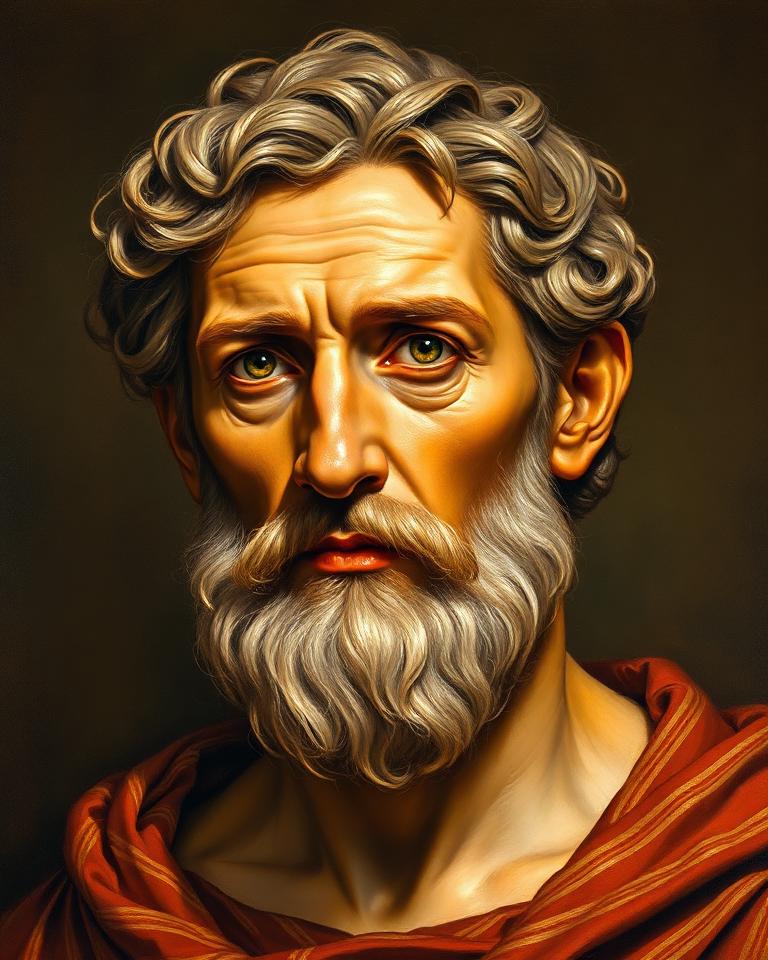
Quick Facts
- Years
- 1475 – 1564
- Category
- Artists & Composers
- Subcategory
- Renaissance Art
- Nationality
- Italian
- Occupation
- Sculptor, Painter, Architect
Michelangelo
1475 – 1564 · Italian · Sculptor, Painter, Architect
Audiobook

Life Lessons from Michelangelo
Marcus Alden · 48 min
Michelangelo di Lodovico Buonarroti Simoni (1475–1564) was an Italian sculptor, painter, architect, and poet whose work helped define the High Renaissance. Celebrated during his own lifetime as Il Divino—“the Divine One”—he combined close study of the human body with extraordinary technical ambition and emotional intensity.
His best-known achievements include the marble Pietà in St. Peter’s Basilica, the colossal David in Florence, the ceiling and Last Judgment of the Sistine Chapel, and his architectural work on St. Peter’s Basilica in Rome. Although he considered sculpture his primary vocation, he transformed every major field in which he worked. His monumental bodies, complex poses, and unfinished surfaces influenced Mannerism, Baroque art, and later generations of artists.
Michelangelo worked for republican officials, wealthy merchants, and powerful popes amid war, political upheaval, and religious reform. He could be proud, suspicious, intensely disciplined, and difficult with patrons, yet his surviving letters also reveal loyalty to family and serious concern about money, reputation, and salvation. His poems disclose a more private voice shaped by love, aging, guilt, and Christian faith. Michelangelo remains central to the study of art because his career illuminates Renaissance creativity, patronage, anatomy, artistic identity, and the demanding relationship between imagination and material form.
Quick Facts
| Field | Information |
|---|---|
| Full Name | Michelangelo di Lodovico Buonarroti Simoni |
| Common Name(s) | Michelangelo Buonarroti; Michelangelo; Il Divino |
| Born | 6 March 1475 |
| Died | 18 February 1564 |
| Age at Death | 88 |
| Birthplace | Caprese, Republic of Florence (now Caprese Michelangelo, Italy) |
| Nationality | Florentine/Italian |
| Occupation | Sculptor, painter, architect, poet, draftsman |
| Historical Era | Italian Renaissance; High Renaissance; early Mannerist period |
| Famous For | Pietà, David, Sistine Chapel ceiling, Last Judgment, Medici Chapel, St. Peter’s Basilica |
| Political Affiliation if applicable | Sympathetic to the Florentine Republic; served it in 1529–1530, though he also worked for the Medici and numerous popes |
| Religion if significant | Roman Catholic; increasingly devotional in later life |
| Education | Grammar schooling under Francesco da Urbino; apprenticeship with Domenico Ghirlandaio; study in the Medici sculpture garden under Bertoldo di Giovanni |
| Parents | Lodovico di Leonardo Buonarroti Simoni and Francesca di Neri del Miniato di Siena |
| Spouse(s) | Never married |
| Children | None |
| Major Works | Pietà, David, Moses, Sistine ceiling, Last Judgment, Medici Chapel, Laurentian Library, Capitoline design, St. Peter’s dome design, Florentine Pietà, Rondanini Pietà |
| Major Achievements | Redefined monumental sculpture and fresco; shaped Western representations of the heroic body; became chief architect of St. Peter’s; elevated the social status of the artist |
Early Life
Michelangelo was born in Caprese, where his father briefly served as a Florentine judicial administrator. The Buonarroti claimed old Florentine lineage but possessed limited wealth. Soon after his birth, the family returned toward Florence. His mother died in 1481, when he was six.
He spent part of his childhood with a nurse’s family in Settignano, a village associated with stonecutters and quarries. Later biographers turned this circumstance into a symbolic explanation for his love of marble. Michelangelo himself joked that he had absorbed chisels and hammers with his nurse’s milk, but that remark should not be treated as literal evidence of childhood training.
His father initially resisted an artistic career because manual craft seemed socially inferior to traditional learned professions. Michelangelo showed little enthusiasm for formal grammar studies and preferred drawing. In 1488, at about thirteen, he entered the workshop of Domenico Ghirlandaio, a leading Florentine painter. There he learned drawing, fresco preparation, and workshop organization.
His stay may have been shorter than the three-year term stipulated in his contract. By about 1490, he was studying sculpture in the garden maintained by Lorenzo de’ Medici near San Marco. Bertoldo di Giovanni, a sculptor associated with Donatello’s legacy, supervised the collection. Access to antique sculpture and to Lorenzo’s humanist circle exposed Michelangelo to classical literature, Neoplatonic discussion, and elite patronage.
Early reliefs such as the Madonna of the Stairs and Battle of the Centaurs already display remarkable command of stone. During these years, fellow student Pietro Torrigiano struck Michelangelo and permanently flattened his nose. The injury became a recognizable feature in later portraits.
Florence itself was a decisive influence. It combined republican traditions, Medici power, commercial wealth, classical scholarship, and intense religious debate. The Dominican preacher Girolamo Savonarola denounced corruption and luxury during Michelangelo’s youth. His sermons and eventual execution formed part of the unsettled moral and political environment that shaped the artist.
Rise to Prominence
Lorenzo de’ Medici died in 1492, depriving Michelangelo of an important protector. As French forces approached Florence in 1494, Michelangelo left the city and traveled through Venice to Bologna. In Bologna he completed small marble figures for the Shrine of St. Dominic, demonstrating his ability to adapt to an established monument.
He returned briefly to Florence, where he carved a sleeping Cupid. According to early sources, it was treated to resemble an ancient work and sold through intermediaries as an antiquity. Cardinal Raffaele Riario, its Roman purchaser, discovered the deception but recognized Michelangelo’s ability and helped bring him to Rome in 1496. The exact responsibility for the fraud remains debated; there is no secure basis for portraying Michelangelo as its sole organizer.
In Rome he carved the marble Bacchus, an unusually unstable and sensuous image of the pagan god. More important was the commission from French cardinal Jean de Bilhères for a marble Pietà. Completed around 1498–1499, it joined technical refinement with controlled grief. Michelangelo signed the sash across Mary’s chest—the only work known to bear his signature—reportedly after hearing the sculpture attributed to another artist.
Returning to Florence in 1501, he received a damaged, long-abandoned block of marble intended for the cathedral. From it he carved David between 1501 and 1504. A committee of artists and officials placed the finished statue outside the Palazzo della Signoria rather than high on the cathedral. There it became an emblem of the republic’s courage against stronger enemies.
Michelangelo’s fame was now international. Florence commissioned him to paint the Battle of Cascina for the council hall opposite Leonardo da Vinci’s planned Battle of Anghiari. Michelangelo produced a celebrated cartoon, but the mural was never completed. In 1505 Pope Julius II summoned him to Rome to design a vast papal tomb. The project began magnificently but became a prolonged source of conflict, revision, and frustration.
Major Achievements
The Pietà
Carved while Michelangelo was still in his twenties, the Vatican Pietà presents the dead Christ across the lap of a youthful Virgin Mary. Michelangelo polished the marble to extraordinary smoothness and arranged the figures within a stable pyramidal form.
The work mattered because it brought a northern European devotional subject into Italian monumental sculpture with unusual anatomical credibility and ideal beauty. Its emotional restraint influenced religious art for centuries and established Michelangelo in Rome.
David
Michelangelo transformed a difficult block into a figure more than five meters tall. Rather than showing David after victory, he represented the tense moment before combat: alert, concentrated, and physically prepared.
Its relocation to Florence’s civic center changed its meaning. The biblical hero became a political symbol of a small republic defending liberty. The statue’s scale and psychological force made it a standard against which later monumental sculpture was judged.
The Sistine Chapel Ceiling
Julius II commissioned Michelangelo to repaint the ceiling in 1508. The artist, who insisted he was primarily a sculptor, designed an immense program centered on nine scenes from Genesis, surrounded by prophets, sibyls, ancestors of Christ, ignudi, and architectural illusion.
Working mainly from scaffolding between 1508 and 1512, Michelangelo mastered fresco on an unprecedented scale. Contrary to a popular myth, he generally painted standing and leaning backward, not lying flat. The ceiling’s Creation of Adam, with its nearly touching hands, became one of the most reproduced images in Western art.
The project mattered not simply for size. It joined Christian history, prophetic expectation, classical bodily ideals, and complex visual rhythm. Its influence spread rapidly through drawings and copies, encouraging younger artists to pursue muscular anatomy and difficult poses.
The Tomb of Julius II and Moses
The original tomb planned in 1505 was a freestanding monument containing many statues. Changes in papal priorities, financial disputes, and Julius’s death reduced it through successive contracts. A much smaller wall tomb was finally installed in San Pietro in Vincoli in 1545.
Its commanding central figure, Moses, conveys restrained power through massive anatomy, twisting posture, and intense expression. The tomb was a painful compromise for Michelangelo, yet Moses remains among his greatest sculptures. The affair also demonstrates how Renaissance art depended on unstable patronage rather than solitary inspiration alone.
The Medici Chapel and Laurentian Library
For Medici patrons in Florence, Michelangelo designed the New Sacristy of San Lorenzo and tombs for Giuliano, Duke of Nemours, and Lorenzo, Duke of Urbino. Reclining personifications—Night, Day, Dawn, and Dusk—suggest time’s destructive power. The project remained incomplete when Michelangelo permanently left Florence in 1534.
Nearby, his Laurentian Library used columns, brackets, stairs, and wall surfaces in unconventional ways. Architecture appears compressed, energetic, and almost sculptural. These designs became foundational for Mannerist architecture.
The Last Judgment
Pope Clement VII initiated, and Paul III continued, the commission for the altar wall of the Sistine Chapel. Painted from 1536 to 1541, the fresco depicts Christ judging humanity amid ascending saved souls and falling damned figures.
Its nudity, emotional violence, and departure from orderly Renaissance balance generated admiration and criticism. It reflected both Michelangelo’s late spiritual anxiety and the crisis-ridden world of Reformation-era Christianity. The work became a key monument of later Renaissance painting, even after portions were draped by another artist.
St. Peter’s Basilica and Late Architecture
In 1546 Paul III appointed Michelangelo chief architect of St. Peter’s Basilica. He simplified previous plans and strengthened the central structure, restoring emphasis on a unified Greek-cross conception. He designed the great dome, although it was completed after his death with modifications by Giacomo della Porta and Domenico Fontana.
Michelangelo also redesigned Rome’s Capitoline Hill and worked on the Porta Pia and Santa Maria degli Angeli. His architecture gave massive walls, columns, and domes the expressive force of sculpture. St. Peter’s dome became one of the defining forms of Rome and a model for later civic and religious buildings.
Poetry and the Unfinished Late Sculptures
Michelangelo wrote hundreds of poems, chiefly sonnets and madrigals. Many address artistic creation, spiritual longing, aging, and love, notably his attachment to Tommaso de’ Cavalieri and his friendship with Vittoria Colonna.
His late Florentine Pietà and Rondanini Pietà abandon the polished finish of his youth. Their broken or elongated forms have inspired debate: some incompletion resulted from technical problems or changing intentions, while some may reflect a deliberate preference for emergent form. They profoundly influenced modern appreciation of the non-finito, or unfinished work.
Leadership and Work
Michelangelo led through personal authority rather than easy collaboration. He prepared many drawings and models, studied poses, and altered designs repeatedly. In sculpture he often worked directly into marble with exceptional confidence, but the romantic claim that he simply released a finished figure already “inside” the stone oversimplifies his planning and revisions.
His discipline was formidable. He endured prolonged physical labor, uncomfortable conditions, and tight deadlines. He guarded his designs and destroyed numerous drawings, possibly to prevent others from studying his process or to control his posthumous reputation.
Relations with assistants were mixed. The Sistine ceiling required laborers for plaster, pigments, and preparation, even though Michelangelo executed the central artistic work. As an architect, he necessarily depended on large teams. He could recognize reliable collaborators, but his suspicion and impatience made projects difficult.
With patrons he was unusually assertive. He fled Rome after feeling neglected during the Julius II tomb project, argued over contracts, and resisted interference. This independence strengthened the emerging ideal of the artist as an intellectual creator rather than a compliant craftsman. It also contributed to delays, lawsuits, and unfinished commissions.
His strengths included visual imagination, anatomical knowledge, persistence, engineering judgment, and the ability to think monumentally. His weaknesses included abrasiveness, secrecy, pessimism, and difficulty compromising. Yet letters show that beneath his public severity he managed family property, supported relatives, and carefully protected his professional obligations.
Personal Life
Michelangelo never married and had no children. He maintained close, sometimes burdensome ties with his father and brothers, regularly sending money and intervening in family affairs. He valued the Buonarroti name and sought to restore the family’s standing.
Contemporaries described him as solitary, poorly dressed, intensely hardworking, and indifferent to comfort. Such reports partly served the Renaissance ideal of the self-denying genius and should not all be read literally. He accumulated substantial wealth despite frequently presenting himself as financially insecure.
His most important later relationships included the Roman nobleman Tommaso de’ Cavalieri, to whom he sent poems and highly finished drawings, and the poet and religious thinker Vittoria Colonna. Michelangelo’s poetry expresses intense love for both men and women. Scholars debate how these texts relate to sexual identity; the evidence supports profound emotional attachment but does not document a physical relationship.
He suffered from ailments associated with age and relentless work, including kidney or urinary problems and pain consistent with arthritis or gout. Nevertheless, he remained active into his late eighties. He rode, inspected building work, wrote poetry, and continued carving the Rondanini Pietà shortly before his death.
Philosophy and Beliefs
Michelangelo’s outlook joined classical humanism with increasingly urgent Christian devotion. The ideal body could express divine creation, moral struggle, and spiritual aspiration. Yet his later poetry often treats physical beauty as both a path toward God and a dangerous attachment.
Politically, he had strong ties to Florence’s republican tradition. In 1529 he became governor general of fortifications for the Florentine Republic during the Medici siege. He briefly fled, fearing betrayal or defeat, then returned and resumed his duties. After the republic fell, he eventually received a pardon and worked again for Medici patrons, illustrating the compromises required for survival.
Religiously, he remained Catholic and worked for the papacy. His friendship with Colonna brought him close to Italian reform circles emphasizing inward faith, grace, and spiritual renewal. Whether he held doctrines later condemned as Protestant is disputed. His art and poetry show penitence and Christ-centered devotion, but not a clear break with Catholicism.
He regarded art as both vocation and moral trial. Late poems question the value of fame and art when measured against salvation. This tension helps explain the severity of the Last Judgment and the fragile, prayerful character of his final Pietà sculptures.
Challenges and Controversies
The tomb of Julius II was Michelangelo’s longest professional crisis. He blamed court intrigue and shifting papal priorities; patrons complained about delay and contractual failure. Historians generally view the “tragedy of the tomb” as a product of ambition, politics, finance, and Michelangelo’s own difficulty accepting compromise.
The Sistine ceiling was physically demanding and involved early technical trouble when mold appeared in plaster. Michelangelo adjusted his methods and continued. Later restoration, completed between 1980 and 1994, removed centuries of grime and glue, revealing vivid color. Critics argued that cleaning erased intentional shading, while conservators maintained that it recovered Michelangelo’s palette. Debate continues, though scholarly understanding of his color has changed substantially.
The nudity of the Last Judgment provoked objections, especially in the climate surrounding the Council of Trent. Papal master of ceremonies Biagio da Cesena reportedly criticized it as suitable for baths and taverns. Michelangelo portrayed Minos with donkey ears and a serpent; the identification comes from early testimony. After Michelangelo’s death, Daniele da Volterra painted draperies over some figures, earning the nickname Il Braghettone, or “breeches-maker.”
Michelangelo’s treatment of women has also been debated. Many female figures possess muscular bodies derived from male models or classical ideals. Some critics see limited observation of female anatomy; others emphasize his purposeful creation of heroic bodies transcending ordinary gender conventions.
His sexuality remains a subject of scholarly discussion. Poems to Cavalieri use unmistakably passionate language, but assigning a modern identity label without qualification risks anachronism. Early editors changed masculine pronouns to feminine ones, obscuring the documentary record. Modern scholarship generally preserves the original genders while distinguishing literary expression from proof of conduct.
Finally, Michelangelo left many works unfinished. Older accounts often romanticized this as pure artistic intention. In reality, abandoned commissions, flawed marble, political upheaval, dissatisfaction, and deliberate experimentation all played roles in different cases.
Legacy
Michelangelo reshaped the Western idea of artistic genius. Giorgio Vasari presented him as the culmination of painting, sculpture, and architecture, while Ascanio Condivi produced an authorized biography during the artist’s lifetime. These accounts helped Michelangelo manage his reputation and set a pattern for later artist biographies.
His figures inspired Mannerists such as Pontormo and Bronzino and influenced Baroque masters including Bernini and Rubens. The expressive unfinished surface of his late sculpture later appealed to Rodin and modern artists. His architecture affected church domes, libraries, civic spaces, and monumental planning across Europe and the Americas.
Major works remain in the Vatican Museums and St. Peter’s Basilica, Florence’s Galleria dell’Accademia, Museo Nazionale del Bargello, Medici Chapels, Laurentian Library, and Museo dell’Opera del Duomo, as well as San Pietro in Vincoli in Rome and Castello Sforzesco in Milan. The Casa Buonarroti in Florence preserves family collections and early works.
Michelangelo died in Rome on 18 February 1564. His body was secretly transported to Florence according to his family’s wishes. He received an elaborate funeral and was buried in Santa Croce beneath a tomb designed by Vasari. His continuing importance rests not only on technical mastery but on unresolved tensions—body and spirit, freedom and patronage, completion and fragmentation—that remain central to creative work.
Interesting Facts
- Michelangelo was born in Caprese but regarded himself fundamentally as a Florentine.
- His mother died when he was six.
- Pietro Torrigiano broke his nose during their youth.
- The Vatican Pietà is his only known signed work.
- He carved David from a block previously attempted and abandoned by other sculptors.
- David originally stood outside Florence’s seat of government.
- He generally painted the Sistine ceiling while standing on scaffolding, not lying down.
- He wrote a humorous poem about the bodily strain of painting the ceiling.
- The Sistine ceiling contains more than 300 figures.
- His planned Battle of Cascina mural was never painted, but copies preserve parts of its design.
- He designed fortifications for republican Florence.
- Michelangelo was both wealthy and habitually anxious about money.
- He wrote hundreds of surviving poems.
- Early editors altered pronouns in poems addressed to Tommaso de’ Cavalieri.
- His sculpted Moses has horns because of a traditional Latin rendering of Exodus.
- He included a flayed skin resembling his own face in the Last Judgment.
- He became chief architect of St. Peter’s at about seventy-one.
- He continued working on the Rondanini Pietà days before his death.
- He lived to eighty-eight, an exceptional age for his period.
- His remains were transferred from Rome to Florence for burial.
Famous Quotes
Translations vary because Michelangelo wrote in sixteenth-century Italian.
- “I am not a painter.” — From a 1509 letter concerning the Sistine ceiling. It expresses frustration with the commission and his primary identity as a sculptor, not lack of ability.
- “I live here in great toil and great weariness of body, and have no friends of any kind, nor do I want any.” — Written to his brother Buonarroto in 1509 while painting the ceiling. It reveals isolation and exhaustion.
- “My beard turns up to heaven; my memory rests upon my hump.” — From his comic poem about painting the Sistine ceiling. The exaggerated bodily description documents the work’s discomfort.
- “The best artist has no conception that a single marble block does not contain within its excess.” — From a sonnet, often translated differently. It describes artistic form as discovered through removal, while also serving as a metaphor for love and spiritual refinement.
- “Neither painting nor sculpture will now be able to calm my soul, turned toward that divine love which opened His arms upon the cross to take us in.” — From a late sonnet. It shows his movement away from artistic fame toward salvation.
- “I am a poor man and of little worth, who is laboring in that art which God has given me in order to extend my life as long as possible.” — From correspondence, reflecting his habitual humility and anxiety despite his fame.
- “I go thinking that this thing happened as it did in order to prove that I was not worthy of such an office.” — From a letter during the Julius II tomb conflict. It conveys wounded pride and providential interpretation.
- “The promises of the world have taken all my time.” — Opening of a late poem. Michelangelo regrets worldly ambition when confronting death.
- “I am still learning.” — Commonly attributed to Michelangelo as “Ancora imparo,” but the attribution is disputed and lacks secure contemporary documentation.
- “Trifles make perfection, and perfection is no trifle.” — Disputed attribution. It suits Michelangelo’s reputation for exacting work but is not securely traceable to his writings.
- “I saw the angel in the marble and carved until I set him free.” — Probably apocryphal. It popularizes the removal metaphor but is not a documented verbatim statement by Michelangelo.
Timeline
- 1475 — Born at Caprese on 6 March.
- 1481 — His mother dies.
- 1488 — Apprenticed to Domenico Ghirlandaio.
- c. 1490–1492 — Studies in Lorenzo de’ Medici’s sculpture garden; creates early reliefs.
- 1492 — Lorenzo de’ Medici dies.
- 1494–1495 — Leaves unsettled Florence; works in Bologna.
- 1496 — Moves to Rome.
- 1496–1497 — Carves Bacchus.
- 1498–1499 — Creates the Vatican Pietà.
- 1501 — Returns to Florence and begins David.
- 1504 — David installed outside the Palazzo della Signoria.
- 1504–1505 — Designs the Battle of Cascina.
- 1505 — Summoned by Julius II to design the papal tomb.
- 1506 — Leaves Rome after conflict; reconciles with Julius in Bologna.
- 1508–1512 — Paints the Sistine Chapel ceiling.
- 1513 — Julius II dies; tomb project is reduced.
- 1515–1516 — Works on designs associated with the Medici and San Lorenzo.
- 1520–1534 — Develops the Medici Chapel and Laurentian Library projects.
- 1527 — Medici expelled from Florence; republic restored.
- 1529–1530 — Directs Florentine fortifications during the siege.
- 1530 — Republic falls; Michelangelo later receives a pardon.
- 1534 — Leaves Florence permanently for Rome.
- 1536–1541 — Paints the Last Judgment.
- 1542–1550 — Paints the Pauline Chapel frescoes.
- 1545 — Reduced tomb of Julius II installed with Moses.
- 1546 — Appointed chief architect of St. Peter’s Basilica.
- c. 1547–1555 — Works on the Florentine Pietà.
- 1552 onward — Develops the Rondanini Pietà.
- 1561 — Works on Porta Pia and Santa Maria degli Angeli.
- 1564 — Dies in Rome on 18 February; buried in Santa Croce, Florence.
Frequently Asked Questions
Who was Michelangelo?
Michelangelo was a Florentine sculptor, painter, architect, draftsman, and poet of the Italian Renaissance. Born in 1475, he worked chiefly in Florence and Rome for republican governments, Medici rulers, and popes. His principal masterpieces include the Pietà, David, Sistine Chapel ceiling, Last Judgment, Medici Chapel, and designs for St. Peter’s Basilica. His ability to give the human body monumental force transformed European art. He was famous during his lifetime and became a model of the independent creative genius.
What was Michelangelo’s full name?
His full name was Michelangelo di Lodovico Buonarroti Simoni. “Michelangelo Buonarroti” is the usual shortened form. He belonged to a Florentine family that claimed distinguished ancestry, and he took the family’s social standing seriously. Contemporary admirers also called him Il Divino, meaning “the Divine One,” to express the seemingly superhuman quality of his art. That title helped create the later image of Michelangelo as an inspired genius, although his achievements also depended on training, assistants, patrons, and sustained physical labor.
Why is Michelangelo important?
Michelangelo expanded what sculpture, fresco, and architecture could communicate. His bodies convey thought, tension, suffering, and spiritual power rather than functioning merely as anatomical displays. The Sistine ceiling created a vast visual history of humanity, while David joined biblical heroism to Florentine politics. His architecture treated buildings as dynamic masses, especially at St. Peter’s. He also strengthened the social status of artists by insisting on creative autonomy. Mannerist, Baroque, Romantic, and modern artists all responded to his work.
Did Michelangelo paint the Sistine Chapel alone?
He was the ceiling’s principal designer and painter, but “alone” needs qualification. A project of that scale required workers to construct scaffolding, grind pigments, prepare plaster, and perform other practical tasks. Some painters initially assisted, though Michelangelo reportedly dismissed several and took unusually direct control. Scholars distinguish this workshop support from authorship: the design and decisive execution are his. The later Last Judgment likewise depended on material assistance while remaining Michelangelo’s artistic creation.
Did Michelangelo paint lying on his back?
No. The familiar image of him lying flat beneath the ceiling is a myth reinforced by novels and films. He worked on platforms supported by scaffolding and generally stood, bending his neck and torso backward to reach the wet plaster. A comic poem and sketch by Michelangelo describe paint dripping on his face, his beard pointing upward, and his body becoming distorted by the posture. The work was physically punishing, but the historical evidence does not support the claim that he painted while reclining.
How long did the Sistine Chapel ceiling take?
Michelangelo worked on the ceiling from 1508 until 1512, with interruptions. The chapel reopened ceremonially after completion on 31 October 1512. Preparing cartoons, transferring designs, applying fresh plaster, and painting hundreds of figures required extraordinary organization. Early plaster problems forced adjustments, and disputes over payment and access complicated the undertaking. Roughly four years is therefore accurate, but it should not be imagined as uninterrupted painting by one person every day.
Why is Michelangelo’s David famous?
David combines immense scale, technical daring, anatomical precision, and concentrated psychology. Michelangelo carved it from a narrow block that had already been worked and abandoned. Instead of depicting David with Goliath’s severed head, he showed the hero before battle, gathering courage. Installed outside Florence’s government palace in 1504, it became a symbol of republican vigilance and resistance. The original has been displayed in the Galleria dell’Accademia since the nineteenth century; a replica stands at its former outdoor location.
Why did Michelangelo sign the Pietà?
The Pietà is the only work Michelangelo is known to have signed. Giorgio Vasari reported that Michelangelo overheard visitors crediting it to another sculptor, so he carved his name across Mary’s sash. The inscription identifies him as Michelangelo Buonarroti of Florence. Whether every detail of Vasari’s anecdote is exact cannot be proved, but the signature itself survives. Its prominent placement suggests a young artist determined to establish authorship in Rome, where he was not yet universally known.
Was Michelangelo primarily a sculptor or painter?
Michelangelo regarded himself principally as a sculptor. In correspondence from the Sistine project, he complained that painting was not his profession. Nevertheless, he had trained in Ghirlandaio’s workshop and became one of history’s most influential painters. His sculptural habits shaped his frescoes: figures appear massive, modeled, and architectonic. His career shows that personal identity and historical reputation can differ. He preferred sculpture, but his achievements in painting and architecture were equally transformative.
Did Michelangelo and Leonardo da Vinci compete?
They were contemporaries with sharply different personalities and artistic methods, and sources report tension between them. In 1504 both received commissions for battle scenes in Florence’s council hall: Leonardo’s Battle of Anghiari and Michelangelo’s Battle of Cascina. Neither mural was completed, but their cartoons became famous teaching models. The episode encouraged direct comparison. Stories of personal hostility may be embellished, yet artistic rivalry was real and reflected Florence’s practice of using competition to stimulate prestigious public art.
Why does Michelangelo’s Moses have horns?
The horns come from a long translation and artistic tradition rather than an attempt to portray Moses as demonic. The Hebrew text of Exodus describes Moses’s face as radiating after he encounters God. The Latin Vulgate used wording that could be understood as “horned,” and medieval and Renaissance artists often represented Moses with horns. Michelangelo followed that established iconography. In the sculpture, the horns identify Moses and suggest supernatural radiance; modern negative associations with horns can obscure their historical meaning.
Was Michelangelo religious?
Yes. He remained a Roman Catholic, created major works for churches and popes, and became increasingly preoccupied with repentance and salvation. His late poems question whether artistic achievement can help a soul facing death. Through Vittoria Colonna, he encountered reform-minded Catholics who emphasized inward devotion and divine grace. Scholars debate his precise theological position, but there is no conclusive evidence that he formally embraced Protestantism. His late religious art is both institutionally Catholic and deeply personal.
Was Michelangelo gay?
Modern scholars approach this question cautiously. Michelangelo wrote passionate poems to Tommaso de’ Cavalieri and other men, and later editors altered masculine pronouns, apparently to conceal this fact. The poems provide clear evidence of emotional and aesthetic attraction. They do not, however, prove a sexual relationship, and sixteenth-century categories do not correspond neatly to modern identities. It is reasonable to discuss same-sex desire in his writing, but definitive labels should be presented as interpretation rather than documented self-identification.
Why are some Michelangelo sculptures unfinished?
There was no single reason. Political disruption stopped some commissions, patrons changed plans, marble revealed flaws, and Michelangelo abandoned works after revising his intentions. In other cases, partly carved surfaces may have become aesthetically meaningful to him. The unfinished Prisoners appear to struggle out of stone, inspiring the idea that Michelangelo revealed forms trapped in marble. Yet historians avoid assuming every incomplete work was deliberately left that way. Practical failure and artistic experimentation often overlapped.
What did Michelangelo contribute to architecture?
Michelangelo treated architecture as an expressive arrangement of mass, pressure, rhythm, and light. At the Laurentian Library he disrupted classical expectations through recessed columns, oversized brackets, and a flowing staircase. His Capitoline plan organized an irregular civic site into a unified ceremonial space. At St. Peter’s, he simplified earlier schemes, reinforced the structure, and designed the dome’s essential form. These projects strongly influenced Mannerist and Baroque architecture and the later history of monumental domes.
How did Michelangelo die?
Michelangelo died at his Roman home on 18 February 1564 after a brief illness, just short of his eighty-ninth birthday. Friends and associates were present during his final days. His nephew Leonardo Buonarroti arranged for the body to be transported discreetly to Florence. Michelangelo was honored with an elaborate memorial ceremony and buried in the Basilica of Santa Croce. His tomb, designed by Giorgio Vasari, includes personifications of painting, sculpture, and architecture mourning the master of all three arts.
Where can Michelangelo’s works be seen today?
The Sistine ceiling and Last Judgment are in Vatican City, while the Pietà is in St. Peter’s Basilica. Florence’s Accademia houses David and several Prisoners; the Bargello displays early sculptures; the Medici Chapels contain his ducal tombs; and Casa Buonarroti preserves early reliefs. Rome’s San Pietro in Vincoli contains Moses. The Rondanini Pietà is in Milan’s Castello Sforzesco. Drawings and smaller works are distributed among major museums worldwide.
Lessons We Can Learn
- Master fundamentals before seeking originality. Michelangelo studied drawing, fresco, antique sculpture, and anatomy before producing mature masterpieces. Strong innovation grows from technical knowledge.
- Difficult materials can become opportunities. He created David from an abandoned block. Constraints can stimulate solutions rather than merely limit them.
- Preparation supports bold execution. Drawings, cartoons, models, and anatomical studies underlay his apparent spontaneity. Ambitious work benefits from disciplined planning.
- Adapt across fields. Though he preferred sculpture, Michelangelo mastered painting and architecture. Professional identity need not prevent useful expansion.
- Protect standards without romanticizing conflict. He resisted weak compromises, but disputes also delayed the Julius tomb. Conviction works best when joined to negotiation.
- Understand the power of context. David became a republican symbol because of where Florence placed it. Audiences and settings shape meaning.
- Revise when conditions change. Michelangelo repeatedly redesigned buildings and monuments. Revision can preserve the central purpose of a project under new constraints.
- Accept that major achievements require collaboration. Assistants, quarry workers, plasterers, engineers, and patrons made his monuments possible. Individual vision still depends on collective labor.
- Question familiar myths. He did not paint the Sistine ceiling lying down, and many popular quotations are undocumented. Responsible learning requires checking evidence.
- Reassess success over time. Michelangelo’s late poetry placed salvation above fame. His example encourages reflection on whether achievement serves deeper values.
Related Historical Figures
- Lorenzo de’ Medici — Early patron who admitted Michelangelo to his household and humanist environment.
- Domenico Ghirlandaio — Florentine master under whom Michelangelo trained in drawing and fresco.
- Bertoldo di Giovanni — Sculptor who supervised the Medici garden where Michelangelo studied antique art.
- Leonardo da Vinci — Older rival whose Florentine battle mural commission paralleled Michelangelo’s.
- Raphael — Younger High Renaissance painter deeply influenced by Michelangelo’s monumental figures.
- Pope Julius II — Forceful patron of the papal tomb and Sistine ceiling.
- Pope Paul III — Patron of the Last Judgment who appointed Michelangelo architect of St. Peter’s.
- Vittoria Colonna — Poet and spiritual friend who influenced Michelangelo’s later religious thought.
- Tommaso de’ Cavalieri — Roman nobleman, intimate friend, and recipient of poems and presentation drawings.
- Giorgio Vasari — Artist, architect, biographer, and admirer who helped shape Michelangelo’s posthumous reputation.
Watch and Learn
Michelangelo, Pietà · Smarthistory
Related Historical Figures