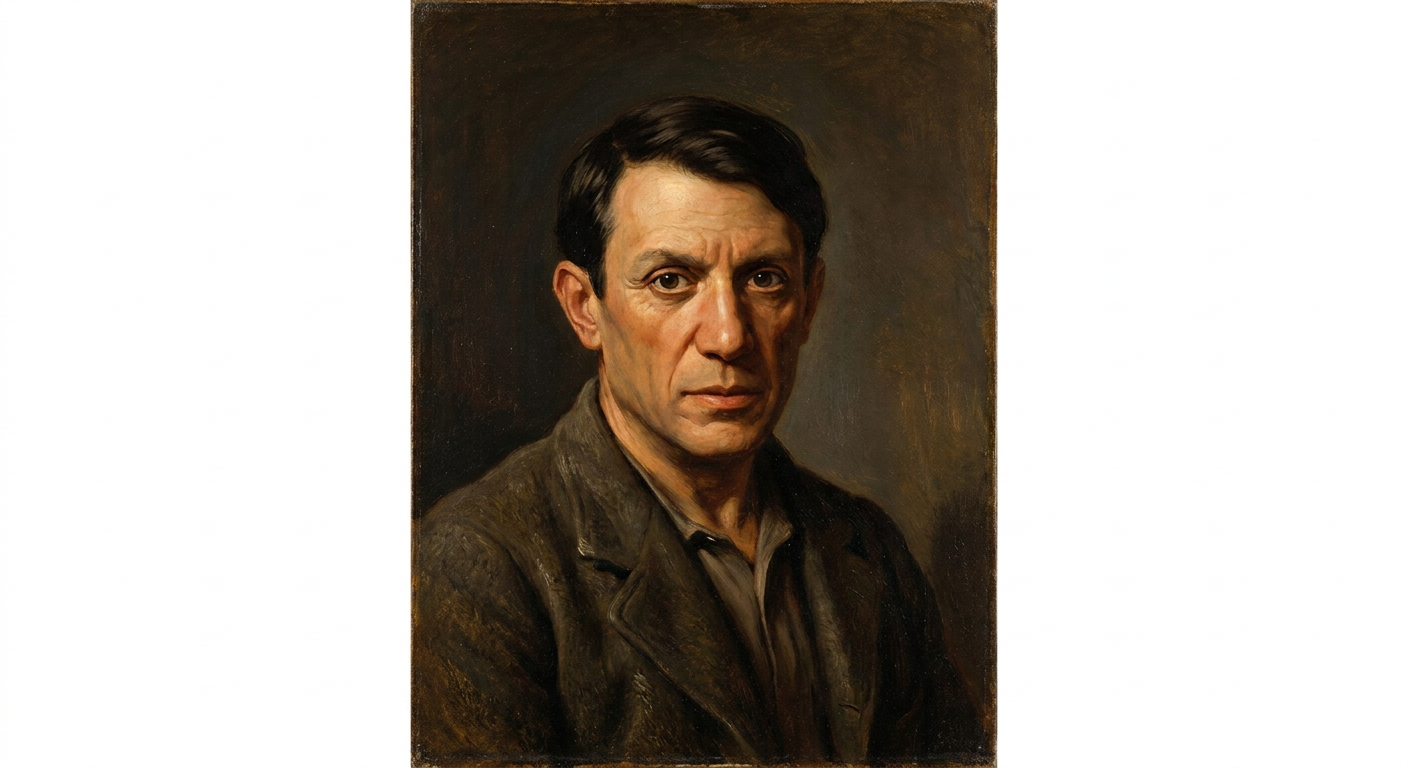
Quick Facts
- Years
- 1881 – 1973
- Category
- Artists & Composers
- Nationality
- Spanish
- Occupation
- Painter, sculptor, printmaker, ceramicist, and stage designer
Pablo Picasso
1881 – 1973 · Spanish · Painter, sculptor, printmaker, ceramicist, and stage designer
Recommended Audiobooks
Listen next from Marcus Alden

Life Lessons from Franz Liszt
Marcus Alden · 53 min

Life Lessons from Camille Saint-Saëns
Marcus Alden · 53 min
Pablo Picasso was one of the most inventive, influential, and controversial artists of the twentieth century. Born in Spain and active mainly in France, he helped overturn centuries-old assumptions about how pictures should represent reality. Together with Georges Braque, he developed Cubism, a radical visual language that broke subjects into shifting planes and presented several viewpoints at once. His experiments transformed painting and sculpture while influencing architecture, photography, design, and popular culture.
Picasso was not defined by a single style. His melancholy Blue Period, warmer Rose Period, confrontational early modernism, Cubist experiments, neoclassical figures, political imagery, ceramics, prints, and late reinterpretations of older masters reveal an artist who repeatedly changed direction. His best-known painting, Guernica, turned the destruction of a Basque town during the Spanish Civil War into an enduring indictment of violence against civilians.
His extraordinary productivity and innovation coexist with a difficult personal legacy. Scholars, biographers, and artists continue to debate his treatment of women, his political commitments, and the mythology surrounding his public persona. Studying Picasso therefore means examining both a revolution in modern art and the troubling human relationships behind it. His career remains essential because it shows how artistic freedom can expand culture while raising serious questions about power, responsibility, and fame.
Quick Facts
| Field | Details |
|---|---|
| Full Name | Pablo Ruiz Picasso; his baptismal name contained numerous additional saints’ names |
| Common Name(s) | Pablo Picasso, Picasso |
| Born | 25 October 1881 |
| Died | 8 April 1973 |
| Age at Death | 91 |
| Birthplace | Málaga, Andalusia, Spain |
| Nationality | Spanish; he lived mainly in France but did not become a French citizen |
| Occupation | Painter, sculptor, printmaker, ceramicist, draughtsman, and stage designer |
| Historical Era | Modernism; twentieth-century European art |
| Famous For | Co-founding Cubism, Les Demoiselles d’Avignon, and Guernica |
| Political Affiliation | Member of the French Communist Party from 1944 |
| Religion | Baptized Roman Catholic; generally non-observant as an adult |
| Education | Schools of Fine Arts in A Coruña, Barcelona, and Madrid; much of his later development was self-directed |
| Parents | José Ruiz Blasco and María Picasso López |
| Spouse(s) | Olga Khokhlova, married 1918; Jacqueline Roque, married 1961 |
| Children | Paulo, Maya, Claude, and Paloma |
| Major Works | The Old Guitarist, Les Demoiselles d’Avignon, Ma Jolie, Still Life with Chair Caning, Three Musicians, Guernica, and The Weeping Woman |
| Major Achievements | Co-created Cubism, helped establish collage in fine art, renewed modern sculpture, and produced one of history’s most powerful antiwar paintings |
Early Life
Pablo Ruiz Picasso was born in Málaga on 25 October 1881. His father, José Ruiz Blasco, taught drawing and painted birds and other naturalistic subjects. His mother, María Picasso López, came from a family whose surname Pablo later adopted professionally. He eventually preferred Picasso because it was distinctive and less common than Ruiz.
Accounts of his childhood emphasize exceptional drawing ability, although later family stories sometimes turned that talent into legend. What is firmly established is that his father trained him in academic observation from an early age. Picasso learned to draw from plaster casts, living models, and carefully arranged objects before rejecting many conventions of academic realism.
The family moved to A Coruña in 1891 and then to Barcelona in 1895. That year Picasso’s younger sister Conchita died of diphtheria, a painful family loss. In Barcelona, the fourteen-year-old passed the entrance examination for the advanced classes at the School of Fine Arts, where his father taught. He completed accomplished academic paintings such as Science and Charity in 1897.
Picasso briefly attended Madrid’s Royal Academy of San Fernando. He disliked its rigid instruction and spent more time studying paintings in the Prado, especially works by Diego Velázquez, Francisco Goya, and El Greco. Illness then took him to Horta de Sant Joan, a rural Catalan village where he developed greater independence.
Back in Barcelona, Picasso entered the circle around Els Quatre Gats, a café associated with Catalan modernism. Artists and writers there introduced him to Symbolism, avant-garde journals, and debates about Europe’s changing culture. In 1900 he first visited Paris, the center of the international art market.
Rise to Prominence
Picasso moved repeatedly between Barcelona and Paris before settling permanently in Paris in 1904. His early years were financially insecure. He shared cramped studios, relied on dealers and friends, and sometimes struggled to sell paintings.
The suicide of his friend Carles Casagemas in 1901 contributed to the somber mood of the Blue Period. Paintings such as The Old Guitarist portrayed poverty, isolation, blindness, and age in cool blue-green tones. These works were not simple records of Parisian life; they transformed marginalized figures into emotionally concentrated symbols.
Around 1904–06, Picasso’s palette became warmer. The Rose Period featured circus performers, acrobats, and harlequins. His relationship with Fernande Olivier and contacts with collectors helped stabilize his life. The American siblings Gertrude and Leo Stein purchased his work and introduced it to influential visitors. Dealer Daniel-Henry Kahnweiler later provided crucial commercial support.
A decisive turning point came in 1907 with Les Demoiselles d’Avignon. Its fractured bodies, masklike faces, compressed space, and confrontational gaze shocked many who saw it privately. Picasso drew from Iberian sculpture, Paul Cézanne, and African objects encountered in Paris. Scholars caution against treating these diverse sources as interchangeable: Picasso worked within a colonial European culture that often removed African art from its original meanings.
Between 1908 and 1914, Picasso and Georges Braque developed Cubism through unusually close collaboration. They dismantled conventional perspective, reduced subjects to interlocking planes, and later incorporated printed paper, wallpaper, and other materials. By the First World War, Picasso had become a central figure of the European avant-garde.
Major Achievements
The Cubist Revolution
Analytical Cubism broke objects into facets rendered in restricted colors. Instead of creating the illusion of a window onto a stable scene, paintings such as Ma Jolie made viewers reconstruct objects from visual clues. This challenged Renaissance perspective and changed how artists understood pictorial space.
Synthetic Cubism introduced simpler shapes, brighter colors, and collage. Picasso’s Still Life with Chair Caning incorporated commercially printed material and rope. By mixing manufactured objects with painted illusion, he questioned where art ended and everyday life began. Later movements—including Constructivism, Dada, and Pop Art—developed aspects of this breakthrough.
Reinventing Sculpture
Picasso approached sculpture as construction rather than carving alone. His 1912 Guitar assembled flat surfaces into an open structure, making empty space part of the object. He later combined found materials in sculptures such as Bull’s Head, formed from a bicycle seat and handlebars. These works helped expand the possibilities of assemblage.
Guernica
In 1937 the Spanish Republican government commissioned Picasso to create a mural for the Paris International Exposition. After German and Italian aircraft supporting Francisco Franco bombed Guernica on 26 April, Picasso transformed the commission into a monumental black, white, and gray scene of suffering.
The painting does not narrate the attack literally. A screaming mother, wounded horse, bull, fallen fighter, and burning architecture create a compressed catastrophe. Its symbolism remains debated, and Picasso resisted providing a complete key. Its enduring power comes partly from combining a specific historical crime with a broader image of civilian terror.
Political and Peace Imagery
Picasso’s 1949 lithograph of a dove became associated with the international peace movement. Although Soviet-aligned organizations used the image, it spread beyond party politics. Picasso also addressed the Korean War in Massacre in Korea and condemned executions in Spain through later works.
Exceptional Range and Output
Picasso produced paintings, drawings, prints, sculptures, ceramics, illustrated books, and theater designs over roughly seven decades. Catalogues list tens of thousands of works, although totals vary depending on whether sketches, editions, and ceramics are counted separately. His importance lies not merely in quantity but in repeated reinvention across media.
Leadership or Work
Picasso did not lead an institution in the conventional sense. His influence operated through studios, exhibitions, collectors, dealers, collaborators, and the example of his work. He was intensely competitive and absorbed ideas from both historical art and contemporary experimentation.
His methods included rapid drawing, extensive revision, reuse of motifs, and movement between media. Photographs and technical studies show that apparently spontaneous works could involve many stages. Dora Maar’s photographs of Guernica, for example, document substantial changes during its creation.
He valued artistic freedom and resisted being confined to Cubism. He could paint naturalistically while simultaneously pursuing radical distortion. This versatility was a strength, but his fame also created an unequal environment around him. Assistants, dealers, partners, and craftspeople helped sustain his enormous production, and their contributions have sometimes received less attention.
Picasso’s collaboration with Braque was unusually productive. During early Cubism, their paintings became so similar that attribution could be difficult. Yet Picasso also guarded his independence and cultivated a powerful personal mythology. Admiration, competition, loyalty, and domination all shaped his professional relationships.
Personal Life
Picasso’s personal life was closely intertwined with his art. His partners included Fernande Olivier, Eva Gouel, Marie-Thérèse Walter, Dora Maar, Françoise Gilot, and Jacqueline Roque. They appeared repeatedly in his portraits, but describing them merely as muses understates their identities. Maar was an accomplished photographer and Surrealist artist, while Gilot built a substantial painting career of her own.
In 1918 Picasso married Olga Khokhlova, a dancer with Sergei Diaghilev’s Ballets Russes. They had a son, Paulo. The marriage deteriorated, and the couple separated in 1935 but remained legally married because Picasso would not accept the financial consequences of divorce. During the marriage he began a relationship with the much younger Marie-Thérèse Walter, with whom he had a daughter, Maya.
Picasso later had two children, Claude and Paloma, with Françoise Gilot. Gilot left him in 1953 and published a memoir, Life with Picasso, with Carlton Lake. Picasso unsuccessfully sought to prevent its publication. He married Jacqueline Roque in 1961 and remained with her until his death.
He generally worked late, accumulated objects, and treated studios as both workshops and archives. He divided his later years among residences in southern France. Picasso died from pulmonary edema and heart failure at Mougins on 8 April 1973. He was buried at the Château of Vauvenargues.
Philosophy or Beliefs
Picasso was baptized Catholic but was not known for regular religious practice as an adult. Christian imagery nevertheless appears in his work, often combined with mythology, Spanish tradition, and personal symbolism.
His politics became especially visible during the Spanish Civil War. He supported the Spanish Republic against Franco’s Nationalists and accepted the honorary directorship of the Prado, although he administered the role from abroad. He never returned to live in Francoist Spain.
Picasso joined the French Communist Party in 1944. The decision reflected antifascism, wartime politics, and his attraction to the party’s international prestige. He attended peace congresses and contributed images to left-wing causes. Yet he did not follow Socialist Realism, and some party critics disliked his modernist portraits. His wealth and independence also sat uneasily beside communist ideals.
His art suggests a worldview built on transformation: an object or body could be dismantled and recreated without losing its identity. That idea should not be treated as a formal philosophical system, but it helps explain his refusal to maintain one style.
Challenges and Controversies
Picasso’s treatment of women is the most serious controversy surrounding his private life. Memoirs and biographies describe infidelity, jealousy, emotional manipulation, and severe power imbalances. Some partners experienced lasting distress. Interpretations vary in detail, but modern scholarship increasingly insists that artistic achievement should not erase harmful conduct.
Earlier art history often reduced women around Picasso to symbols of his changing style. Recent exhibitions and research have restored attention to their own careers, testimony, and agency. At the same time, scholars warn against diagnosing Picasso from a distance or treating every distorted portrait as straightforward evidence of abuse.
His engagement with African art is also debated. African masks and sculptures helped European modernists challenge Western naturalism, but those objects reached Paris through colonial systems. Picasso initially minimized or denied some influences before speaking more openly about their power. Critics describe this as appropriation; others emphasize that influence is central to artistic exchange. A balanced account must recognize both formal innovation and colonial inequality.
Politically, Picasso condemned fascism but remained publicly loyal to the Communist Party during periods of Soviet repression. His portrait of Joseph Stalin, published after Stalin’s death, angered party officials because it was insufficiently heroic. Critics fault Picasso for not forcefully confronting communist abuses, while defenders note that his membership never produced strict obedience in art.
His market dominance creates another tension. Picasso challenged elite definitions of art, yet his works became trophies in a highly commercial market. Vast prices and aggressive branding can overshadow collaborators and other modernists, especially women and non-European artists.
Legacy
Picasso changed the basic vocabulary of modern art. Cubism affected Futurism, Constructivism, abstraction, modern typography, architecture, cinema, and graphic design. Collage and assemblage became standard artistic methods. His freedom to shift styles helped establish the modern expectation that an artist could reinvent an entire practice.
Guernica remains a global antiwar image. After years at New York’s Museum of Modern Art, it was transferred to Spain in 1981, following the restoration of constitutional democracy. It is now displayed at Madrid’s Museo Nacional Centro de Arte Reina Sofía.
Major collections are held by the Musée Picasso in Paris, the Museu Picasso in Barcelona, the Museo Picasso Málaga, and museums in Antibes and elsewhere. The Musée National Picasso-Paris draws heavily from works accepted by the French state in settlement of inheritance taxes.
His legacy also includes renewed scrutiny. Museums now examine colonial influence, gender, celebrity, and personal ethics alongside formal innovation. Picasso remains relevant not because every judgment about him is settled, but because his work continues to generate difficult and productive questions.
Interesting Facts
- Picasso was born in Málaga but spent most of his adult career in France.
- He adopted his mother’s surname as his principal professional name.
- His father was an art teacher and provided rigorous early instruction.
- Picasso completed accomplished academic paintings while still a teenager.
- He first visited Paris in 1900.
- The Blue Period was shaped partly by the death of Carles Casagemas.
- Les Demoiselles d’Avignon was not publicly exhibited until 1916.
- Picasso and Braque sometimes avoided signing early Cubist canvases on the front.
- His collages incorporated ordinary printed materials into fine art.
- He designed scenery and costumes for the Ballets Russes.
- Dora Maar photographed the evolving stages of Guernica.
- Picasso remained legally married to Olga until her death in 1955.
- He became a member of the French Communist Party in 1944.
- His peace dove was based on a bird given to him by Henri Matisse.
- He produced ceramics extensively at the Madoura pottery in Vallauris.
- He never returned to settle in Spain after Franco’s victory.
- He was buried at his own Château of Vauvenargues.
- His daughter Paloma became a prominent designer and businesswoman.
Famous Quotes
- “We all know that Art is not truth. Art is a lie that makes us realize truth.” Published in Marius de Zayas’s 1923 account of Picasso’s remarks, this describes artistic invention as a route to deeper recognition.
- “Painting is not made to decorate apartments. It is an instrument of war.” From a 1945 interview in Les Lettres françaises, the remark explains Picasso’s understanding of art as political resistance.
- “No, painting is not done to decorate houses.” This closely related wording appears in translations of the same postwar statement; versions differ because Picasso spoke in French.
- “For me there is no past or future in art.” Recorded in a 1923 interview, it expresses his belief that great works remain active rather than becoming obsolete.
- “If a work of art cannot live always in the present it must not be considered at all.” From the same published discussion, this clarifies his resistance to a simple story of artistic progress.
- “The different styles I have been using in my art must not be seen as an evolution.” Published in Cahiers d’Art in 1935, it warns against arranging his career as a steady climb toward abstraction.
- “A picture is not thought out and settled beforehand.” Also from his 1935 statements, it describes painting as a process that changes during execution.
- “Computers are useless. They can only give you answers.” Frequently linked to a 1964 interview, the line is widely reproduced, but its exact publication history is less secure than that of his 1923 and 1935 statements.
- “Every child is an artist. The problem is how to remain an artist once we grow up.” Popularly attributed to Picasso, but researchers have not established a reliable primary source; it should not be treated as fully authenticated.
Timeline
- 1881 — Born in Málaga, Spain.
- 1891 — Family moves to A Coruña.
- 1895 — Sister Conchita dies; family relocates to Barcelona.
- 1897 — Paints Science and Charity and studies briefly in Madrid.
- 1900 — Makes his first visit to Paris.
- 1901 — Begins work associated with the Blue Period.
- 1904 — Settles in Paris; Rose Period develops.
- 1907 — Completes Les Demoiselles d’Avignon.
- 1908–14 — Develops Cubism with Georges Braque.
- 1912 — Creates pioneering collages and the constructed Guitar.
- 1917 — Works with the Ballets Russes and meets Olga Khokhlova.
- 1918 — Marries Olga.
- 1921 — Paints major versions of Three Musicians.
- 1927 — Begins relationship with Marie-Thérèse Walter.
- 1935 — Daughter Maya is born; Picasso and Olga separate.
- 1936 — Spanish Civil War begins; Picasso supports the Republic.
- 1937 — Paints Guernica and The Weeping Woman.
- 1944 — Joins the French Communist Party.
- 1947 — Son Claude is born; Picasso begins intensive ceramic work.
- 1949 — Daughter Paloma is born; dove image becomes a peace emblem.
- 1953 — Françoise Gilot leaves him.
- 1955 — Olga dies; Picasso acquires the Château of Vauvenargues.
- 1957 — Produces his Las Meninas variations.
- 1961 — Marries Jacqueline Roque.
- 1973 — Dies at Mougins on 8 April.
- 1981 — Guernica arrives in democratic Spain.
Frequently Asked Questions
1. Why is Pablo Picasso important?
Picasso helped alter how artists represent space, objects, and the human body. Cubism abandoned a single fixed viewpoint and made viewers actively assemble visual information. His collages and constructed sculptures also blurred boundaries between art and everyday material. Beyond technique, Guernica demonstrated that avant-garde art could respond powerfully to political violence. His influence spread through painting, sculpture, graphic design, architecture, photography, and film.
2. Did Picasso invent Cubism by himself?
No. Picasso and Georges Braque developed Cubism together, particularly between 1908 and 1914. Paul Cézanne’s late paintings were an important foundation, while African and Iberian sculpture contributed to Picasso’s rejection of conventional naturalism. Other artists, dealers, poets, and critics also helped shape and circulate the movement. Picasso was indispensable to Cubism, but portraying him as its solitary inventor misrepresents a collaborative historical process.
3. What does Guernica depict?
Guernica responds to the bombing of the Basque town of Guernica during the Spanish Civil War. German and Italian aircraft supporting Franco attacked the town on 26 April 1937. Picasso did not paint a literal aerial view. Instead, he assembled screaming people, a wounded horse, a bull, fire, and shattered bodies into a symbolic catastrophe. Scholars disagree about individual symbols, but its condemnation of civilian suffering is clear.
4. Why is Guernica black and white?
Picasso never left one definitive explanation. The restricted palette may evoke newspaper photographs through which reports of the bombing circulated. It also removes decorative color and gives the mural a stark, mournful unity. Preparatory works show that Picasso deliberately refined the composition. Interpretations connecting the palette to documentary evidence are persuasive, but they remain historical analysis rather than a complete explanation supplied by Picasso himself.
5. What were Picasso’s Blue and Rose Periods?
The Blue Period, approximately 1901–04, featured cool colors and subjects associated with poverty, grief, disability, and isolation. The Rose Period, around 1904–06, used warmer pink and earth tones and frequently portrayed circus performers. These labels are useful but can make Picasso’s development seem more orderly than it was. Works overlap in date, mood, and technique, and neither period was completely uniform.
6. Was Picasso Spanish or French?
Picasso was Spanish. He was born in Málaga and retained Spanish nationality, although he spent most of his adult life in France. He applied for French citizenship in 1940 but was not naturalized. His identity was shaped by Spanish culture, Catalan modernism, Parisian artistic life, and long residence in France. Calling him simply French therefore obscures both his legal nationality and his continuing engagement with Spain.
7. Why did Picasso use distorted faces and bodies?
Distortion allowed Picasso to represent several viewpoints, intensify emotion, and question inherited standards of beauty. Cubist portraits could combine profile and frontal views within one image. In other works, distortion conveyed violence, desire, fear, or formal experimentation. It is unsafe to assume that every altered face is a direct psychological statement about the sitter; composition, historical sources, and artistic convention also mattered.
8. How many works did Picasso create?
Picasso produced tens of thousands of objects, including paintings, drawings, prints, sculptures, ceramics, book illustrations, and designs. Published totals vary widely because researchers count sketchbook pages, print editions, and ceramic multiples differently. Claims of a single exact total should therefore be treated cautiously. What is certain is that his output was exceptionally large and sustained from childhood until shortly before his death.
9. What was Picasso’s relationship with African art?
African sculpture and masks were significant to Picasso’s early modernist breakthrough, especially around Les Demoiselles d’Avignon. He encountered such objects in a Europe shaped by colonial conquest and collecting. Their formal power helped him reject Western naturalism, but he did not necessarily understand their original cultural functions. Scholars consequently discuss both creative influence and appropriation, emphasizing the unequal colonial conditions under which these encounters occurred.
10. Was Picasso a communist?
Yes. Picasso joined the French Communist Party in 1944 and remained a member until his death. He participated in peace campaigns and supported left-wing causes, but his art never consistently followed party doctrine. Communist officials sometimes criticized his modernism, notably his unconventional portrait of Stalin. His affiliation reflected genuine antifascist commitments, yet critics reasonably question his limited public opposition to repression in communist states.
11. Did Picasso fight in the Spanish Civil War?
No. Picasso did not serve as a soldier and lived mainly in France during the conflict. He supported the Spanish Republic through art, fundraising, statements, and his honorary appointment as director of the Prado. Guernica became his most significant contribution to the Republican cause. His role was cultural and political rather than military, and he remained in exile after Franco’s victory.
12. Was Picasso abusive toward women?
Several partners and biographers described controlling behavior, infidelity, humiliation, and emotional cruelty. These accounts have substantially changed modern evaluation of Picasso. The experiences of individual women differed, and not every claim can be verified in the same way, but the overall pattern of unequal and damaging relationships cannot responsibly be dismissed. Understanding this history does not require denying his artistic importance; it requires examining achievement and conduct together.
13. Who were Picasso’s children?
Picasso had four children. Paulo was his son with Olga Khokhlova. Maya was his daughter with Marie-Thérèse Walter. Claude and Paloma were his children with Françoise Gilot. Inheritance disputes became complicated because Picasso died without a will. His descendants later participated in managing rights, authentication, archives, and the artist’s estate, while several built independent public careers.
14. Where can Picasso’s work be seen today?
Major holdings are displayed at the Musée Picasso in Paris, Museu Picasso in Barcelona, Museo Picasso Málaga, Museum of Modern Art in New York, and many other international museums. Guernica is housed at the Reina Sofía in Madrid. Because Picasso’s works are widely distributed and frequently loaned, exhibition details change. Museum catalogues and official collection databases provide the most reliable current information.
15. Why did Picasso keep changing styles?
Picasso rejected the idea that an artist should advance through one fixed sequence. He borrowed from classical art, Iberian sculpture, African objects, children’s drawings, popular imagery, and contemporary movements whenever they served a new problem. Naturalistic and abstract approaches often coexisted in his work. This restlessness helped sustain his creativity, although the familiar narrative of endless solitary invention can understate his dependence on collaborators and sources.
Lessons We Can Learn
- Master foundations before rejecting them. Picasso’s academic training gave him technical knowledge that he later transformed. Modern interpretation: innovation often grows from understanding existing practice.
- Collaboration can produce breakthroughs. Cubism emerged through sustained exchange with Braque, not isolated genius. Creative partnerships still matter.
- Change methods when the question changes. Picasso used painting, collage, sculpture, printmaking, and ceramics rather than forcing every idea into one medium.
- Art can address public events. Guernica shows how a work can preserve attention on civilian suffering without functioning as literal reportage.
- Productivity requires discipline. His vast output reflects decades of regular work, although quantity alone does not guarantee quality.
- Reputation should not prevent criticism. Evidence about his relationships demonstrates why cultural achievement must not excuse harmful behavior.
- Credit influences honestly. Debate over African art shows the importance of recognizing cultural sources and unequal systems of exchange.
- Do not become trapped by success. Picasso refused to repeat Cubism simply because it made him famous.
- Symbols can travel beyond their creators. The peace dove acquired international meanings that exceeded Picasso’s original political setting.
- Keep evidence separate from legend. Many attractive Picasso anecdotes and quotations lack secure sources; responsible history values verification over mythology.
Related Historical Figures
- Georges Braque — Picasso’s closest collaborator in the creation of Cubism.
- Paul Cézanne — His restructuring of landscape and form strongly influenced Cubist experimentation.
- Henri Matisse — Picasso’s great contemporary rival, colleague, and occasional friend.
- Gertrude Stein — Collector, writer, and patron who promoted Picasso in early twentieth-century Paris.
- Daniel-Henry Kahnweiler — Dealer who supported and documented the Cubists.
- Juan Gris — Spanish painter who developed a precise form of Synthetic Cubism.
- Dora Maar — Photographer and artist who documented Guernica and was Picasso’s partner.
- Françoise Gilot — Painter, memoirist, partner, and mother of Claude and Paloma.
- Joan Miró — Spanish modernist whose international career intersected with Picasso’s cultural world.
- Francisco Franco — Dictator whose victory drove Picasso’s political exile and shaped the history of Guernica.
Watch and Learn
Recommended video: Why is Picasso's Guernica so powerful? by TED-Ed (approximately 5 minutes).
This concise animated lesson explains the historical setting, composition, and enduring political force of Guernica. It is a useful introduction for students because it connects Picasso’s formal choices to the bombing while acknowledging that the mural’s individual symbols permit multiple interpretations.
Watch and Learn
Why is Picasso's Guernica so powerful? · TED-Ed
Related Historical Figures