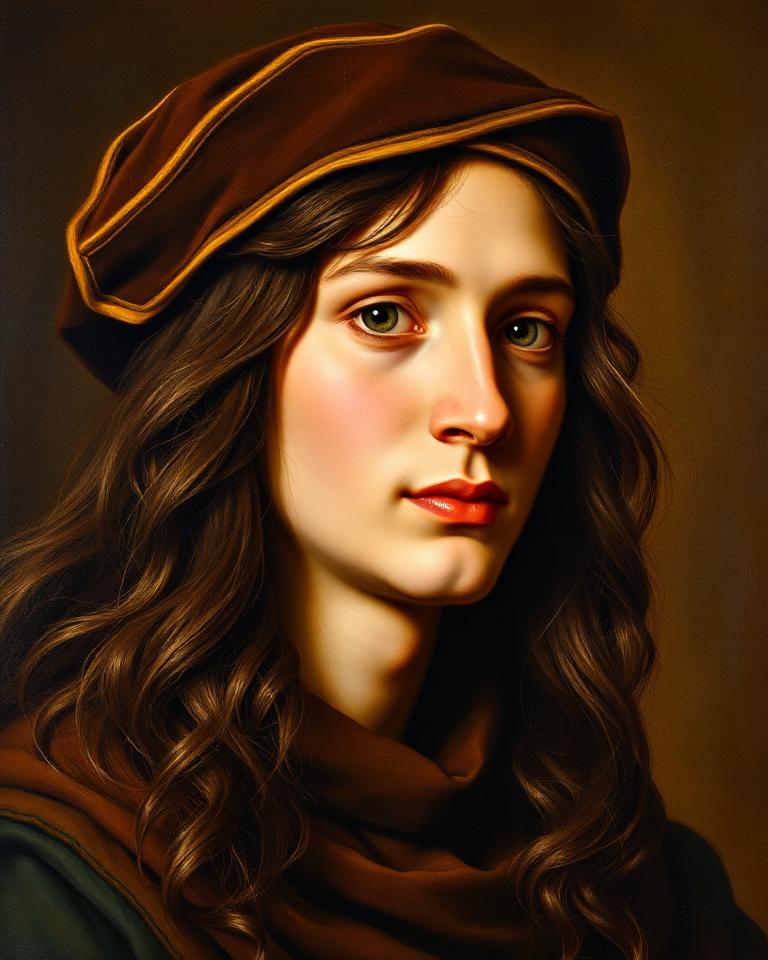
Quick Facts
- Years
- 1483 – 1520
- Category
- Artists & Composers
- Subcategory
- Renaissance Art
- Nationality
- Italian
- Occupation
- Painter, Architect
Raphael
1483 – 1520 · Italian · Painter, Architect
Audiobook

Life Lessons from Raphael Grace
Marcus Alden · 52 min
Raphael—born Raffaello Sanzio or Santi—was an Italian painter and architect whose balanced compositions, lucid storytelling, and idealized figures helped define the High Renaissance. Born in Urbino in 1483, he absorbed the courtly culture of central Italy, developed his craft in Umbria, studied artistic innovations in Florence, and achieved extraordinary success in papal Rome. Although he died at only 37, he directed a large workshop and completed an unusually broad body of work.
His best-known achievements include the Vatican Palace frescoes, especially The School of Athens; celebrated images of the Virgin and Child; portraits of exceptional psychological presence; designs for tapestries in the Sistine Chapel; and architectural work on St. Peter’s Basilica and Roman palaces. His compositions united observation of nature with clarity, harmony, and classical grandeur.
Raphael’s influence extended far beyond his lifetime. European academies treated his art as a standard of excellence for centuries, while printmakers and workshop assistants disseminated his designs internationally. Later artists sometimes challenged his reputation as too polished, yet his technical command and ability to synthesize competing traditions remain central to the study of Renaissance art. He is still examined not only as an individual genius, but also as an effective collaborator, court artist, designer, architect, and guardian of antiquity.
Quick Facts
| Field | Information |
|---|---|
| Full Name | Raffaello Sanzio da Urbino; contemporary forms also include Raffaello Santi |
| Common Name(s) | Raphael; Raffaello |
| Born | 28 March or 6 April 1483; the exact date is debated |
| Died | 6 April 1520 |
| Age at Death | 37 |
| Birthplace | Urbino, Duchy of Urbino, Italian peninsula |
| Nationality | Italian |
| Occupation | Painter, draftsman, architect, designer, antiquarian |
| Historical Era | High Renaissance |
| Famous For | Vatican Rooms, The School of Athens, Madonnas, portraits, tapestry cartoons |
| Political Affiliation if applicable | None recorded; served the papal court |
| Religion if significant | Roman Catholic |
| Education | Courtly and workshop training; traditionally associated with Pietro Perugino |
| Parents | Giovanni Santi and Màgia di Battista Ciarla |
| Spouse(s) | Never married; betrothed to Maria Bibbiena |
| Children | None documented |
| Major Works | The School of Athens, Sistine Madonna, Transfiguration, Portrait of Baldassare Castiglione, Vatican Stanze, Sistine Chapel tapestry cartoons |
| Major Achievements | Leading painter of papal Rome; architect of St. Peter’s; influential designer; surveyor of Roman antiquities |
Early Life
Raphael was born in Urbino, a small but sophisticated ducal capital governed by the Montefeltro family. His father, Giovanni Santi, worked as a court painter and wrote verse. Through him, Raphael encountered artists, patrons, and the etiquette of court life at an early age. His mother, Màgia, died in 1491; Giovanni died in 1494, leaving Raphael orphaned at about 11. His uncle Bartolomeo, a priest, became a guardian, although surviving records reveal family disagreements over the estate.
Urbino’s court valued mathematics, classical literature, architecture, and refined conduct. This environment probably contributed to Raphael’s later ease among popes, diplomats, and scholars. Giovanni’s workshop may have provided his first instruction, but the details are poorly documented.
Giorgio Vasari later wrote that Giovanni placed Raphael with Pietro Perugino, the eminent Umbrian painter. Scholars accept strong Peruginesque influence, visible in Raphael’s serene landscapes and orderly compositions, but debate whether a formal apprenticeship occurred exactly as Vasari described. Raphael was called a magister, or master, in a contract of 1500, demonstrating professional status while still a teenager.
His early commissions were concentrated around Urbino, Città di Castello, and Perugia. They included altarpieces, banners, and devotional paintings. Works such as the Mond Crucifixion and Coronation of the Virgin show him transforming Umbrian conventions through increasingly controlled space and graceful interaction.
Rise to Prominence
Raphael’s first documented major commission came in 1500, when he and Evangelista da Pian di Meleto contracted to paint an altarpiece for the church of Sant’Agostino at Città di Castello. The resulting Baronci Altarpiece was later severely damaged in an earthquake, but surviving fragments attest to his early ambition.
A decisive achievement was The Marriage of the Virgin of 1504. Its symmetrical plaza and centrally planned temple draw upon Perugino while exhibiting greater spatial integration and rhythmic movement. The signed and dated panel announced Raphael’s independence.
Around 1504 he began working in Florence, though he continued accepting Umbrian commissions. There he studied Leonardo da Vinci’s pyramidal figure groups, atmospheric effects, and psychological gestures, as well as Michelangelo’s powerful anatomy. Raphael copied and adapted rather than merely imitated. His Florentine Madonnas—including the Madonna of the Meadow and La belle jardinière—combine intimate human exchange with geometric stability.
His move to Rome in 1508 transformed his career. Pope Julius II commissioned him to decorate rooms in the Vatican Palace. The young artist entered an environment in which Bramante, Michelangelo, humanist advisers, and ancient Roman monuments competed for attention. The success of the Stanza della Segnatura established him as one of Rome’s leading masters. Under Julius II and Leo X, his responsibilities expanded to architecture, antiquarian work, portraiture, tapestry design, and supervision of a large workshop.
Major Achievements
The Vatican Rooms
In the Stanza della Segnatura, Raphael created frescoes representing theology, philosophy, poetry, and law. The School of Athens gathers ancient thinkers inside a monumental imagined architecture, with Plato and Aristotle at its center. Opposite it, the Disputation of the Holy Sacrament presents Christian revelation.
The program mattered because it gave visual form to a papal ideal: classical learning and Christian truth could belong within an ordered intellectual universe. Raphael’s legible grouping, convincing space, and expressive gestures became models for large-scale historical painting. Later rooms addressed papal protection, political authority, and biblical history, increasingly relying on assistants under Raphael’s direction.
Reinventing the Madonna
Raphael painted numerous depictions of Mary, Christ, and the infant John the Baptist. Rather than repeat a fixed formula, he varied gesture, gaze, landscape, and emotional tone. The Sistine Madonna, probably commissioned for San Sisto in Piacenza, presents a visionary apparition framed by Saints Sixtus and Barbara; its two contemplative cherubs later acquired an independent popular life.
These works mattered because they made sacred subjects emotionally accessible while retaining dignity. Their compositional harmony shaped devotional imagery, academic art, and popular reproduction for centuries.
Portraiture
Raphael portrayed popes, cardinals, writers, and friends. Pope Julius II presents an aging ruler in reflective concentration rather than conventional triumph. Pope Leo X with Cardinals Giulio de’ Medici and Luigi de’ Rossi combines sumptuous surfaces with an atmosphere of alert political tension. The Portrait of Baldassare Castiglione conveys intelligence and controlled warmth through subdued color and direct presence.
His portraits helped establish a model in which status, material detail, and inner character reinforce one another. Titian and many later European portraitists responded to this legacy.
Sistine Chapel Tapestry Cartoons
Leo X commissioned Raphael to design tapestries illustrating the Acts of the Apostles for the lower walls of the Sistine Chapel. The full-scale cartoons were sent to Pieter van Aelst’s Brussels workshop, where weavers translated them into costly textiles.
Raphael had to design images that would remain forceful in another medium and often in reversed orientation. The surviving cartoons, now in the Victoria and Albert Museum on loan from the British Royal Collection, became influential teaching objects and helped spread his style across northern Europe.
Architecture and St. Peter’s Basilica
After Donato Bramante’s death in 1514, Raphael became architect of the new St. Peter’s. He proposed modifications to the developing church, including a more longitudinal plan, although later architects substantially changed the project. He also worked on the Chigi Chapel, Palazzo Branconio dell’Aquila, Villa Madama, and other buildings or designs.
His architecture joined classical vocabulary with practical demands. Because several buildings were altered or destroyed, drawings and records are crucial for assessing his contribution. His appointment nevertheless demonstrates that contemporaries regarded him as more than a painter.
Recording Ancient Rome
Leo X entrusted Raphael with responsibility for antiquities and ancient marble connected to papal building. With Baldassare Castiglione and collaborators, he developed an ambitious proposal to survey and record Rome’s ancient monuments. A famous letter associated with Raphael urged systematic measurement and lamented destruction.
Although the project remained incomplete, it anticipated archaeological documentation and heritage conservation. It also influenced Raphael’s designs, especially the ornamental system known as grotesques, inspired by ancient Roman interiors.
Workshop, Prints, and Design
Raphael organized one of Renaissance Rome’s largest artistic workshops. Giulio Romano, Gianfrancesco Penni, Giovanni da Udine, and others helped execute frescoes, decorations, and architectural projects. Raphael also collaborated with engraver Marcantonio Raimondi, whose prints distributed his compositions widely.
This system magnified his reach. It also complicated attribution: some works preserve Raphael’s invention but were executed partly or largely by assistants. Modern scholarship therefore distinguishes among autograph works, collaborative production, and workshop copies.
Leadership and Work
Raphael’s leadership depended on planning, delegation, and social intelligence. Drawings show him testing poses, adjusting groups, and refining narrative emphasis. For large commissions he supplied overall concepts and important studies, then assigned portions to specialists. Giovanni da Udine, for example, excelled at decorative foliage and stucco; Giulio Romano developed into a powerful independent designer.
Unlike the later stereotype of the isolated genius, Raphael operated as the head of a creative enterprise. He coordinated patrons, scholars, craftsmen, architects, engravers, and assistants. His apparent diplomacy helped him retain trust through the transition from Julius II to Leo X.
His strengths included synthesis, clarity, adaptability, and an ability to match visual form to institutional purpose. The same workshop model created weaknesses. Quality could vary, and heavy delegation makes authorship difficult to determine. Later Vatican projects sometimes lack the unity and freshness of the Stanza della Segnatura, perhaps because the workload became too large and because assistants executed increasing portions.
Personal Life
Raphael never married. He became engaged to Maria Bibbiena, niece of Cardinal Bernardo Dovizi da Bibbiena, but the marriage did not occur before her death in 1520. Sources do not establish precisely why it was delayed.
Vasari describes Raphael as charming, generous, sociable, and beloved by artists. Although Vasari wrote decades later and shaped his account to present exemplary artistic lives, Raphael’s extraordinary patronage network supports the impression that he possessed considerable tact.
Tradition identifies Margherita Luti, often called “La Fornarina,” as his lover and as the model for certain paintings. The connection rests on later testimony and interpretation rather than conclusive contemporary documentation. The woman’s identity and the nature of their relationship remain debated.
Raphael’s friends and associates included Baldassare Castiglione, banker Agostino Chigi, humanists at Leo X’s court, and many artists. He accumulated wealth and lived prominently in Rome. His interests extended to poetry, architecture, archaeology, and classical culture.
He died after a short illness on Good Friday, 6 April 1520. Vasari’s sensational claim that excessive sexual activity caused the fatal fever is not reliable medical evidence. The actual illness is unknown. Raphael was buried in the Pantheon, as he had requested.
Philosophy and Beliefs
Raphael left no systematic philosophical treatise. His worldview must therefore be reconstructed cautiously from his work, appointments, correspondence associated with his projects, and court environment.
He operated within Catholic institutions and produced images affirming Christian doctrine, papal legitimacy, and apostolic history. Yet his Vatican paintings also reflect Renaissance humanism. The School of Athens does not treat classical philosophy as an enemy of Christianity; within the room’s larger program, reason, revelation, poetry, and law form complementary domains.
His approach to antiquity was neither simple imitation nor pagan revival. He studied ancient architecture and ornament as living resources that could strengthen modern Christian Rome. The antiquities survey associated with him suggests an ethical concern for preserving cultural remains from careless demolition.
Politically, Raphael served patrons rather than articulating a party program. His art supported papal power, but that fact reflects both personal advancement and the institutional purposes of commissions. Claims that he held a fully developed modern conservation philosophy or a specific political ideology go beyond the evidence.
Challenges and Controversies
Rivalry with Michelangelo
Vasari and other traditions emphasize rivalry between Raphael and Michelangelo. Competition in Rome was real: both sought patronage and offered contrasting artistic ideals. Michelangelo reportedly suspected that Bramante and Raphael maneuvered against him. Yet the relationship cannot be reduced to personal hostility. Raphael studied Michelangelo’s figures, while their works participated in a broader culture of emulation.
Workshop Attribution
Raphael’s large studio enabled enormous productivity but created enduring disputes over authorship. Paintings such as La Fornarina or late Vatican frescoes may include varying degrees of workshop participation. Technical examination sometimes changes assessments. Rather than treating collaboration as deception, historians generally recognize it as normal Renaissance practice while still distinguishing the master’s hand.
Borrowing and Synthesis
Raphael borrowed compositional ideas from Perugino, Leonardo, Michelangelo, antiquity, and contemporaries. Critics in later periods sometimes interpreted this as insufficient originality. Most scholars instead view synthesis as his defining creative strength: he transformed sources into unusually coherent solutions. The boundary between adaptation and rivalry remains a productive subject of study.
Idealization and Academic Reputation
From the eighteenth century onward, some critics elevated Raphael into an untouchable standard. Nineteenth-century artists, including members of the Pre-Raphaelite Brotherhood, reacted against what they saw as the formulaic academic tradition that followed him. Their objection often targeted later institutional imitation more than Raphael’s actual works.
Death Legends
Vasari connected Raphael’s death with secret sexual excess and a resulting fever. This colorful story has often been repeated as fact, but it is unverifiable and medically implausible as a diagnosis. Fever, infection, medical treatment, and other possibilities have been proposed, yet no cause can be established securely.
Legacy
Raphael’s burial in Rome’s Pantheon symbolized his association with classical grandeur. His epitaph, composed by Pietro Bembo, famously suggests that Nature feared defeat while he lived and feared death when he died.
His pupils carried his manner across Italy. Giulio Romano transformed Raphael’s language at Mantua; engravings after his designs circulated throughout Europe. Academies later treated his compositions as models of disegno, decorum, and ideal beauty. Nicolas Poussin, Jean-Auguste-Dominique Ingres, and many others learned from his organization of figures and narratives.
Major holdings are preserved in the Vatican Museums, Uffizi Gallery, Louvre, Prado, National Gallery in London, Gemäldegalerie in Dresden, and other collections. The Victoria and Albert Museum displays seven surviving tapestry cartoons. His tomb remains in the Pantheon, beneath the Madonna del Sasso by his pupil Lorenzetto.
Modern study has broadened beyond admiration of individual masterpieces. Conservators investigate materials and workshop hands; historians examine patronage, gender, copying, architecture, and archaeological practice. Raphael remains relevant because his career reveals how creativity can emerge through observation, adaptation, collaboration, and institutional negotiation.
Interesting Facts
- Raphael was born and raised in the court city of Urbino.
- His father, Giovanni Santi, was both a painter and poet.
- He lost both parents before reaching adolescence.
- A contract identifies him as a master by 1500.
- He signed The Marriage of the Virgin on the temple depicted in the painting.
- He moved among several Italian centers rather than maintaining a single early workshop.
- He arrived in Rome at approximately 25 years old.
- The School of Athens forms part of a four-subject intellectual program.
- The identities of many figures in that fresco remain debated.
- Raphael portrayed both Julius II and Leo X.
- His tapestry cartoons were woven in Brussels.
- Seven large cartoons survive in Britain’s Royal Collection.
- He succeeded Bramante as architect of St. Peter’s in 1514.
- He worked on a plan to document ancient Roman monuments.
- Marcantonio Raimondi’s engravings expanded his international reputation.
- Raphael was engaged but never married.
- He died on Good Friday, reportedly also his 37th birthday under one birth-date tradition.
- His final painting, Transfiguration, was displayed near his body before burial.
- He was buried in the Pantheon in Rome.
- The famous cherubs from the Sistine Madonna occupy only a small part of the original altarpiece.
Famous Quotes
Raphael’s authenticated verbal record is small. Many internet quotations are unsupported; the following include documented texts, historical reports, or clearly flagged traditions.
- “In order to paint one beautiful woman, I would have to see several beautiful women.” — From Raphael’s letter to Baldassare Castiglione, generally dated around 1514. It explains ideal beauty as a selection from multiple observations; translations vary.
- “But since there are so few good judges and beautiful women, I make use of a certain idea that comes into my mind.” — From the same letter. It links empirical study with an internal artistic ideal.
- “The difficulty lies in choosing the best.” — A common translation or condensation of the Castiglione letter’s thought; wording varies by edition.
- “Rome was very rich in ancient ornaments.” — From the letter to Leo X associated with Raphael and Castiglione, written around 1519. It introduces concern for the city’s remains; translation varies.
- “How many pontiffs…have permitted the ruin and dismemberment of ancient temples, statues, arches and other buildings!” — From the same preservation letter. It criticizes losses caused by human action; wording varies in translation.
- “One might almost say that this new Rome we now see…is made with lime from ancient marbles.” — Also from the letter to Leo X. It condemns reuse that destroyed archaeological evidence; translation varies.
- “I have found a method of measuring buildings that is neither by mathematical instrument nor compass.” — From the proposed survey discussion in the Leo X letter; editions and translations differ.
- “Nature feared that she would be conquered while he lived, and when he died, feared that she herself would die.” — Not Raphael’s words. This is a translation of Pietro Bembo’s Latin epitaph on Raphael’s tomb.
- “Here lies that famous Raphael by whom Nature feared to be conquered.” — An abbreviated rendering of the epitaph, often misattributed directly to Raphael.
- “The bearer of this is Raphael, painter of Urbino.” — Reported from a letter of recommendation by Giovanna Feltria della Rovere in 1504. It documents his movement toward Florentine patronage; exact English translations vary.
Timeline
- 1483 — Raphael is born in Urbino, on either 28 March or 6 April.
- 1491 — His mother, Màgia, dies.
- 1494 — His father, Giovanni Santi, dies.
- 1500 — Raphael is named as a master in the contract for the Baronci Altarpiece.
- 1502–1503 — He produces important Umbrian altarpieces, including the Coronation of the Virgin.
- 1504 — Completes The Marriage of the Virgin and begins sustained work in Florence.
- 1504–1508 — Studies Florentine art and develops major Madonna compositions and portraits.
- 1508 — Moves to Rome and begins work in the Vatican Palace.
- 1509–1511 — Executes the principal fresco program of the Stanza della Segnatura.
- 1511–1514 — Works on the Stanza di Eliodoro.
- c. 1512–1513 — Paints the Sistine Madonna.
- 1513 — Leo X becomes pope and continues Raphael’s patronage.
- 1514 — Raphael becomes architect of St. Peter’s after Bramante’s death.
- 1514–1515 — Receives major architectural and antiquarian responsibilities.
- 1515–1516 — Designs the Sistine Chapel tapestry cartoons.
- 1517 onward — Oversees work on Villa Madama and expanding workshop projects.
- c. 1518–1520 — Paints or supervises Transfiguration.
- 1519 — Develops the antiquities survey proposal associated with the letter to Leo X.
- 1520 — Dies in Rome on 6 April and is buried in the Pantheon.
Frequently Asked Questions
Who was Raphael?
Raphael was an Italian High Renaissance painter, architect, and designer. He began his career in central Italy, matured through engagement with Florentine art, and became a leading artist at the papal court in Rome. His reputation rests on harmonious figure compositions, emotionally accessible religious paintings, penetrating portraits, and monumental Vatican frescoes. He also designed tapestries, supervised a large workshop, worked on St. Peter’s Basilica, and helped formulate a plan to record ancient Rome.
What was Raphael’s full name?
He was known in Italian as Raffaello Sanzio or Raffaello Santi, often qualified as “da Urbino,” meaning “of Urbino.” His father’s surname appears in the form Santi, while Sanzio is a Latinized or modified form that became standard. English-language history usually calls him simply Raphael, following the long-standing practice of using an anglicized single name for several major Renaissance artists.
When was Raphael born?
Raphael was born in 1483, but his exact birthday is uncertain. The two principal dates given are 28 March and 6 April. Vasari’s account implies that he was born and died on Good Friday; other evidence supports a March date. Scholars therefore commonly print either one date with qualification or both alternatives. His birthplace—Urbino—and his death date—6 April 1520—are securely established.
Who taught Raphael to paint?
His father, Giovanni Santi, probably gave him early exposure to workshop practice and court culture. Vasari says Raphael then trained with Pietro Perugino. Strong similarities between their early works support a close connection, although documentation does not fully confirm the traditional apprenticeship narrative. Raphael also learned through intensive study of other artists, especially Leonardo and Michelangelo in Florence, and through ancient and contemporary art in Rome.
Why is The School of Athens important?
The fresco translates abstract philosophy into a clear, monumental assembly of thinkers. Plato and Aristotle occupy the center, while other figures discuss, calculate, teach, and contemplate. Its architecture, gestures, and balanced groups make a complex subject immediately intelligible. Within the Vatican room, philosophy appears alongside theology, poetry, and law, embodying a Renaissance effort to coordinate classical learning with Christian culture. Its precise iconography, including several identifications, remains debated.
Did Raphael paint himself in The School of Athens?
Most scholars identify Raphael with the dark-haired young man looking toward the viewer near the right edge of the fresco, beside figures connected with astronomy and geometry. The resemblance to accepted self-images supports the identification, but the fresco lacks labels for most participants. As with many individual identities in the scene, the conclusion is strong rather than absolutely documented.
Were Raphael and Michelangelo enemies?
They were professional rivals in the competitive environment of papal Rome, and later sources report tension. Michelangelo believed Raphael benefited from Bramante’s support and criticized aspects of his practice. Raphael, meanwhile, absorbed lessons from Michelangelo’s anatomy and monumentality. “Enemies” is too simple: rivalry, admiration, strategic competition, and artistic borrowing could coexist in Renaissance culture.
Did Raphael work on the Sistine Chapel ceiling?
No. Michelangelo painted the famous ceiling between 1508 and 1512. Raphael’s connection to the chapel came through ten tapestry designs commissioned by Leo X for its lower walls. He prepared monumental cartoons showing episodes from Saints Peter and Paul. The tapestries were woven in Brussels and displayed during important ceremonies, creating a dialogue with the earlier wall frescoes and Michelangelo’s ceiling.
Was Raphael also an architect?
Yes. His architectural career became especially important after he succeeded Bramante as architect of St. Peter’s in 1514. He contributed to Villa Madama, the Chigi Chapel, and Roman palace designs, among other projects. Later rebuilding, demolition, and modification obscure parts of his record, while St. Peter’s evolved substantially under subsequent architects. Drawings and documents nonetheless confirm that architecture was a major component of his mature career.
Was Raphael married?
No. He was formally betrothed to Maria Bibbiena, the niece of Cardinal Bernardo Dovizi da Bibbiena, but the marriage was repeatedly delayed and never occurred. Maria died shortly before Raphael in 1520. The reasons for the delay are uncertain. Later narratives about his romantic life, especially those involving Margherita Luti, should not be treated as fully documented biography.
Who was La Fornarina?
“La Fornarina,” meaning approximately “the baker’s daughter,” is the conventional title of a portrait and the traditional nickname of Margherita Luti, whom later accounts describe as Raphael’s lover and model. Evidence linking all these elements is incomplete. The painting’s bracelet bears Raphael’s name, and its intimate character has encouraged biographical interpretations, but the sitter’s identity and exact relationship to the artist remain scholarly questions.
How did Raphael die?
Raphael died after a brief illness on 6 April 1520. The exact cause is unknown. Vasari attributed the illness to sexual excess followed by inadequate disclosure to physicians, but this moralized anecdote was written decades afterward and cannot function as a diagnosis. Modern proposals include infectious fever and complications of treatment, yet the available evidence is insufficient to choose among them. Responsible accounts therefore record an unidentified acute illness.
What was Raphael’s last painting?
Transfiguration is generally regarded as his final major painting. Commissioned by Cardinal Giulio de’ Medici, it juxtaposes Christ’s radiant transformation above with the apostles’ unsuccessful attempt to heal a suffering boy below. Workshop assistance is possible, but Raphael’s authorship and design dominate the work. According to early accounts, it was displayed near his body after his death, intensifying its association with his final days.
Where is Raphael buried?
Raphael is buried in the Pantheon in Rome, an ancient Roman temple converted into a Christian church. Choosing this location connected his identity with both classical antiquity and Christian Rome. His tomb bears Pietro Bembo’s celebrated Latin epitaph, and a sculpture of the Madonna by Raphael’s pupil Lorenzetto stands above it. The grave remains one of Rome’s most visited artists’ memorials.
How large was Raphael’s workshop?
No complete roster survives, but it was among the largest and most productive workshops in early sixteenth-century Rome. Important collaborators included Giulio Romano, Gianfrancesco Penni, Giovanni da Udine, Perino del Vaga, and Polidoro da Caravaggio. The workshop could execute frescoes, architectural decoration, paintings, and designs simultaneously. Its scale explains both Raphael’s productivity and modern disagreement over which passages he personally painted.
Why did academies admire Raphael?
Art academies valued his clear narratives, balanced compositions, controlled drawing, idealized anatomy, and ability to express emotion without sacrificing decorum. His works seemed to reconcile nature with selection and order. Prints and copies made them accessible even to students who never visited Italy. This admiration sometimes hardened into formula, prompting later reactions, but Raphael’s own art is more varied and experimental than the academic stereotype suggests.
Where can Raphael’s work be seen today?
The Vatican Museums preserve the Vatican Rooms and other major works. Important paintings are also held by the Uffizi, Louvre, Prado, National Gallery in London, Gemäldegalerie Alte Meister in Dresden, Palazzo Barberini, and numerous European and American museums. Seven tapestry cartoons are displayed at the Victoria and Albert Museum in London on loan from the British Royal Collection. Locations and gallery access can change, so visitors should consult official museum information.
Lessons We Can Learn
- Learn from rivals. Raphael studied Leonardo and Michelangelo rather than avoiding competition. Modern creators can turn comparison into disciplined learning.
- Synthesize rather than copy. His Florentine paintings combine multiple influences into coherent new designs. Innovation often comes from transforming sources responsibly.
- Build complementary teams. Specialists such as Giovanni da Udine extended his workshop’s abilities. Leaders should recruit strengths they do not possess themselves.
- Plan before execution. Raphael’s drawings reveal repeated testing of poses and groups. Preparation reduces confusion in complex projects.
- Adapt communication to context. He made philosophy, scripture, and authority visually intelligible to different audiences. Clear form matters as much as expert content.
- Balance ideals with observation. His letter to Castiglione describes constructing beauty from both models and an internal idea. Good work joins evidence with judgment.
- Protect cultural heritage. The proposed survey of ancient Rome recognized that development can erase knowledge. Documentation remains essential today.
- Cultivate professional trust. Raphael retained major responsibilities under successive popes. Reliability and diplomacy can sustain creative opportunity.
- Recognize the risks of overextension. His enormous late workload increased dependence on assistants and unevenness. Growth must be matched by quality control.
- Design for transmission. Tapestries and engravings carried his ideas beyond Rome. Choosing reproducible formats can greatly enlarge an idea’s impact.
Related Historical Figures
- Giovanni Santi — Raphael’s father, a court painter and poet who introduced him to Urbino’s cultural world.
- Pietro Perugino — The Umbrian master traditionally identified as Raphael’s teacher and clearly influential on his early style.
- Leonardo da Vinci — Raphael studied his compositions, gestures, and atmospheric techniques in Florence.
- Michelangelo — His chief Roman rival and a major source of anatomical and monumental inspiration.
- Donato Bramante — Architect of St. Peter’s and a fellow native of the Urbino region; Raphael succeeded him at the basilica.
- Pope Julius II — The patron who commissioned Raphael’s first Vatican rooms and portraits.
- Pope Leo X — Expanded Raphael’s duties into tapestries, architecture, and the care of antiquities.
- Baldassare Castiglione — Humanist, diplomat, friend, portrait subject, and collaborator associated with the antiquities letter.
- Marcantonio Raimondi — Engraver whose prints after Raphael’s designs spread his reputation throughout Europe.
- Giulio Romano — Raphael’s leading pupil and collaborator, who carried his workshop legacy to Mantua after 1520.
Related Historical Figures