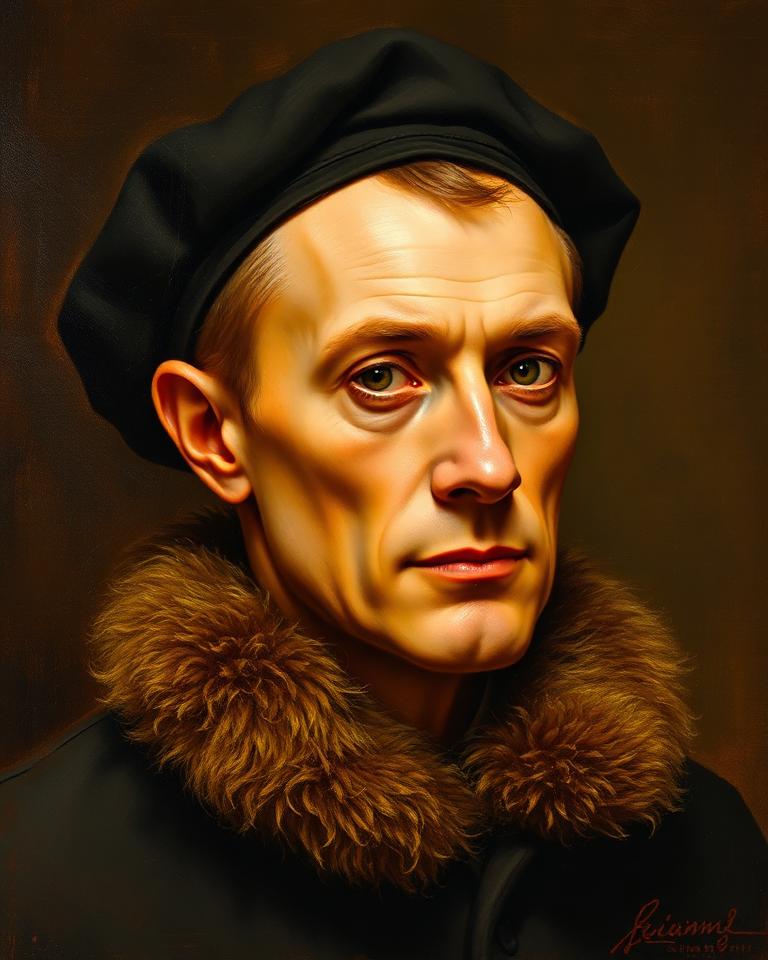
Quick Facts
- Years
- 1606 – 1669
- Category
- Artists & Composers
- Subcategory
- Fine Art
- Nationality
- Dutch
- Occupation
- Painter
Rembrandt van Rijn
1606 – 1669 · Dutch · Painter
Audiobook

Life Lessons from Rembrandt
Marcus Alden · 52 min
Rembrandt Harmenszoon van Rijn was a Dutch painter, draftsman, and printmaker whose searching images of human character transformed European art. Working during the Dutch Golden Age, he created ambitious history paintings, intimate portraits, psychologically complex self-portraits, evocative landscapes, and biblical scenes notable for their emotional immediacy. His command of light, shadow, texture, and narrative made him famous in seventeenth-century Amsterdam.
Among his best-known works are The Anatomy Lesson of Dr. Nicolaes Tulp, The Night Watch, The Jewish Bride, and The Return of the Prodigal Son. He was equally important as an etcher: through impressions that circulated internationally, his reputation spread farther than paintings alone could have carried it. His approximately forty years of self-portraits form an unusually sustained visual record of artistic identity, aging, success, and vulnerability.
Rembrandt’s career was not a simple triumph. He enjoyed substantial demand and operated a busy workshop, but experienced bereavement, legal conflict, changing taste, and financial insolvency. Yet his later work became increasingly bold and emotionally concentrated. Artists from Francisco Goya to Vincent van Gogh, Käthe Kollwitz, and many modern painters and printmakers studied his example. He remains central to art history because his works unite technical experiment, narrative intelligence, and an enduring interest in the dignity and complexity of individuals.
Quick Facts
| Field | Details |
|---|---|
| Full Name | Rembrandt Harmenszoon van Rijn |
| Common Name(s) | Rembrandt; Rembrandt van Rijn |
| Born | 15 July 1606 |
| Died | 4 October 1669 |
| Age at Death | 63 |
| Birthplace | Leiden, Dutch Republic, now the Netherlands |
| Nationality | Dutch |
| Occupation | Painter, draftsman, printmaker, workshop master, art dealer |
| Historical Era | Dutch Golden Age; Baroque period |
| Famous For | Portraits, self-portraits, biblical and historical scenes, etchings, dramatic light and shadow |
| Political Affiliation | None recorded |
| Religion | Raised in the Dutch Reformed tradition; religious practice and precise personal beliefs remain debated |
| Education | Latin School in Leiden; briefly enrolled at Leiden University; trained under Jacob van Swanenburg and Pieter Lastman |
| Parents | Harmen Gerritszoon van Rijn and Neeltgen Willemsdochter van Zuijtbrouck |
| Spouse(s) | Saskia van Uylenburgh, married 1634–1642 |
| Children | Four documented children with Saskia: Rombertus, two daughters named Cornelia, and Titus; only Titus survived infancy. A daughter, Cornelia, was later born to Hendrickje Stoffels. |
| Major Works | The Anatomy Lesson of Dr. Nicolaes Tulp, The Night Watch, The Hundred Guilder Print, Bathsheba at Her Bath, The Syndics of the Drapers’ Guild, The Jewish Bride, The Return of the Prodigal Son |
| Major Achievements | Leading Dutch history painter and portraitist; revolutionary printmaker; extensive self-portrait sequence; major influence on European and modern art |
Early Life
Rembrandt was born in Leiden on 15 July 1606, the ninth child in a prosperous artisan household. His father, Harmen Gerritszoon, operated a malt mill beside the Rhine; his mother, Neeltgen Willemsdochter, came from a baker’s family. The surname “van Rijn” referred to the river near the family mill rather than aristocratic status.
The Dutch Republic was then expanding commercially and militarily after its revolt against Habsburg Spain. Leiden had recovered from siege and become a center of textile production, scholarship, printing, and Protestant learning. Its university, founded in 1575, attracted important intellectuals. This environment gave a miller’s son access to education and a growing urban market for art.
Rembrandt attended Leiden’s Latin School, where the curriculum likely included classical literature, rhetoric, and scripture. He enrolled at Leiden University in 1620, but appears not to have pursued a degree. His family instead supported professional artistic training—an indication both of his aptitude and of their resources.
He first studied for roughly three years with Leiden painter Jacob Isaacsz van Swanenburg. Van Swanenburg had worked in Italy and specialized in architectural scenes and visions of hell, offering instruction in painting materials, perspective, and dramatic effects. Around 1624, Rembrandt spent about six months in Amsterdam with Pieter Lastman, the leading Dutch history painter of his generation. Lastman taught him to stage biblical, mythological, and historical narratives through expressive gesture, costume, concentrated action, and archaeological detail.
Unlike many ambitious northern artists, Rembrandt never traveled to Italy. He encountered Italian Renaissance and Baroque art through Lastman, imported paintings, prints, and Amsterdam collections. The dramatic illumination associated with Caravaggio and his followers reached him through this broader visual network, although Rembrandt developed a distinct approach rather than merely imitating Caravaggism.
Rise to Prominence
By about 1625, Rembrandt had established an independent studio in Leiden, initially working closely with Jan Lievens. The young painters shared models, themes, and artistic problems, making some early works difficult to distinguish. Both produced small, densely painted history scenes designed to display technical command and emotional intensity.
Constantijn Huygens, secretary to Stadholder Frederick Henry and an influential connoisseur, visited their workshop around 1628–1629. He praised both artists while observing differences in temperament and method. His attention brought courtly opportunities. Rembrandt received commissions for a Passion series intended for Frederick Henry, demonstrating that his reputation had moved beyond Leiden.
Rembrandt also began making etchings in the 1620s. Small prints of beggars, expressive heads, self-studies, and religious subjects reached collectors beyond local boundaries. Because plates could be printed repeatedly and impressions transported cheaply, printmaking became essential to his international fame.
Around 1631, he relocated to Amsterdam, the republic’s commercial capital. He entered a professional association with art dealer Hendrick van Uylenburgh, whose workshop supplied portraits to wealthy clients. Rembrandt’s group portrait The Anatomy Lesson of Dr. Nicolaes Tulp (1632) established him as a major Amsterdam painter. Rather than arranging sitters as an inert row, he organized them around a shared demonstration, balancing likeness, status, and drama.
In 1634 Rembrandt married Uylenburgh’s cousin Saskia van Uylenburgh, linking him to a respected Frisian family. Demand for his portraits grew, and he trained pupils including Govert Flinck, Ferdinand Bol, and Carel Fabritius. In 1639, at the height of his success, he bought a large house on Amsterdam’s Breestraat. The expensive purchase, financed through debt, later contributed to his financial difficulties.
Major Achievements
Transforming Portraiture
Rembrandt gave commissioned portraiture a heightened sense of presence. In The Anatomy Lesson of Dr. Nicolaes Tulp (1632), attention converges on the lecturer’s demonstration while each participant remains individually recognizable. The Syndics of the Drapers’ Guild (1662) presents officials as though viewers have interrupted a meeting.
This mattered because Dutch portrait clients expected accurate likeness and social dignity. Rembrandt met those requirements while creating narrative situations and subtle exchanges of gaze. Later portraitists learned from his ability to make formal groups appear mentally alert and momentarily alive.
Reimagining the Civic Guard Portrait
The Night Watch (1642), formally titled Militia Company of District II under the Command of Captain Frans Banninck Cocq, turned a civic guard commission into a moving public spectacle. Captain Cocq and Lieutenant Willem van Ruytenburch advance as figures load weapons, carry standards, and emerge through shifting light.
Its dynamism departed from more evenly ordered militia portraits. The painting later darkened, encouraging the mistaken idea that it showed a nocturnal scene. It was also trimmed on several sides in 1715 to fit Amsterdam Town Hall, permanently altering the composition. Today it is regarded as a landmark of large-scale narrative portraiture.
Expanding the Art of Etching
Rembrandt treated the copper plate as a field for experimentation. He combined etching, drypoint, engraving, selective wiping, varied papers, and repeated revisions. Works such as Christ Healing the Sick, called The Hundred Guilder Print, integrate multiple episodes into a unified meditation on mercy.
Different states of his prints allowed collectors to follow the evolution of an image. His velvety drypoint lines and atmospheric inking helped establish printmaking as an autonomous creative art rather than simply a means of reproducing paintings. Goya, Whistler, and many later printmakers inherited this experimental ideal.
Creating an Unprecedented Self-Portrait Record
Across paintings, etchings, and drawings, Rembrandt represented himself dozens of times from youth to the final year of his life. Early etched faces explored expressions useful for history painting. Later images show him in work clothes, elaborate costume, or sober contemporary dress.
These works should not all be read as spontaneous autobiography: some were marketable character studies, demonstrations of status, or meditations on earlier artistic traditions. Collectively, however, they form one of the most sustained investigations of an artist’s changing face and public identity in Western art.
Humanizing Sacred and Historical Narratives
Rembrandt repeatedly returned to the Hebrew Bible, the New Testament, classical history, and apocryphal stories. He emphasized hesitation, forgiveness, grief, touch, and recognition rather than relying solely on pageantry. Bathsheba at Her Bath (1654) presents moral and psychological conflict through quiet introspection; The Return of the Prodigal Son, generally dated to his final years, centers on reconciliation through gesture and light.
His figures often wear a mixture of contemporary, imagined ancient, and “Eastern” costume. While this was not archaeological reconstruction, it helped distinguish sacred history from ordinary Amsterdam life while preserving emotional accessibility. His approach profoundly shaped later religious art.
Developing a Bold Late Style
From the 1650s onward, Rembrandt increasingly used broad strokes, layered pigments, scratched passages, and selective finish. Faces and hands often receive concentrated attention while other areas remain suggestive. Critics once interpreted this as decline or incomplete execution; modern scholarship generally recognizes it as purposeful artistic choice.
The tactile surfaces of The Jewish Bride and late self-portraits made paint itself carry emotion. This freedom became especially meaningful to nineteenth- and twentieth-century artists, who saw Rembrandt as a precursor to expressive modern painting.
Leadership and Work
Rembrandt led a substantial workshop rather than working as an isolated genius. Pupils generally paid fees for instruction and access to studio space, models, costumes, and objects. They copied his works, made variations on his themes, and learned through drawing and painting. Workshop production has complicated attribution: some pictures once accepted as Rembrandt’s are now assigned to pupils or collaborators.
His teaching appears to have emphasized observation, narrative clarity, expressive gesture, and experimentation. Surviving works associated with pupils indicate that he encouraged mastery of his methods, though several students later developed independent styles. Samuel van Hoogstraten became an artist and theorist; Carel Fabritius moved toward luminous spatial effects distinct from Rembrandt’s darker manner.
As a decision-maker, Rembrandt was ambitious and independent. He sometimes resisted conventional expectations about smooth finish or balanced emphasis. That independence produced masterpieces, but it could create friction with patrons and markets. Documentary evidence suggests that at least some commissions generated disputes over likeness, completion, or payment.
His strengths included sustained experimentation, close observation, visual storytelling, and an ability to integrate painting, drawing, and printmaking. His weaknesses included risky financial management and expensive collecting. He acquired prints, paintings, weapons, costumes, shells, and curiosities useful for art and status, but his purchases and house debt exceeded his long-term capacity.
Personal Life
Rembrandt married Saskia van Uylenburgh in 1634. Her family connections and inheritance contributed to the couple’s social position. Saskia also appeared in drawings and paintings, although identifying every supposed portrait of her remains uncertain.
Their family life was marked by repeated loss. Three children—Rombertus and two daughters each named Cornelia—died in infancy. Their son Titus, born in 1641, survived. Saskia died in 1642 at age twenty-nine, probably after a prolonged illness; tuberculosis is often proposed but not conclusively documented. Her will gave Rembrandt use of Titus’s inheritance so long as he did not remarry, a provision relevant to his later domestic arrangements.
Geertje Dircx, hired as Titus’s nurse, became Rembrandt’s companion. Their relationship ended acrimoniously. She sued him after an alleged promise of marriage; a court awarded her maintenance. Rembrandt later assisted efforts that resulted in her confinement in a house of correction, an episode widely judged troubling and discussed from differing legal and ethical perspectives.
Hendrickje Stoffels subsequently joined the household, first as a servant and then as Rembrandt’s partner. They did not marry. In 1654, the Dutch Reformed Church summoned her for “living in whoredom” with Rembrandt; she admitted the relationship and was barred from communion. Their daughter Cornelia was born that year.
After Rembrandt’s insolvency, Hendrickje and Titus formed a business that employed him, helping shield income from creditors. Hendrickje died in 1663, probably during an outbreak of plague, though the precise cause is not certain. Titus married Magdalena van Loo in 1668 but died later that year. Rembrandt outlived him by about a year and was buried in an unmarked rented grave in Amsterdam’s Westerkerk.
Contemporaries and early biographers described Rembrandt as deeply committed to art, indifferent to some social conventions, and avid in collecting. Such accounts include literary conventions and should not be treated as transparent psychological records. His works reveal intense curiosity about faces, clothing, age, gesture, and material surfaces, but they cannot by themselves prove a fixed personality.
Philosophy and Beliefs
No surviving diary or systematic statement sets out Rembrandt’s philosophy. His beliefs must therefore be reconstructed cautiously from documents, social context, and art. He was baptized and raised in a Reformed environment, and his children were baptized in Reformed churches. Yet records do not show him becoming a formal church member.
His biblical art ranges across Protestant and Catholic subject matter and sometimes draws on apocryphal texts. This breadth may reflect artistic tradition, patronage, Amsterdam’s religious diversity, or personal curiosity. Claims that he belonged secretly to a particular sect are not established.
Rembrandt lived and worked near Jewish residents in Amsterdam and depicted several Jewish sitters or types. He owned visual and material objects associated with distant cultures and consulted costume as a means of evoking antiquity. Older scholarship sometimes romanticized him as uniquely free of contemporary prejudice. A more careful view recognizes both his sympathetic individual studies and the conventional “Oriental” language of seventeenth-century European art.
Ethically, his narratives repeatedly focus on mercy, responsibility, reconciliation, and the vulnerability of the body. That does not prove that his private conduct consistently embodied those values, especially given the Geertje Dircx case. The tension between compassionate art and imperfect behavior is part of a historically honest assessment.
No political affiliation is known. His patrons came from mercantile, civic, medical, courtly, and religious circles. His work reflects the prosperous but unequal urban culture of the Dutch Republic without supplying a clear political program.
Challenges and Controversies
Rembrandt’s greatest practical crisis was financial. In 1656 he petitioned for cessio bonorum, a form of insolvency that allowed an honest debtor to surrender assets. Inventories documented his house, studio equipment, artworks, and collection. Auctions in 1657 and 1658 brought disappointing proceeds, and the Breestraat house was sold.
Older biographies often said he was “bankrupt” because The Night Watch offended patrons and destroyed his career. The evidence does not support such a simple collapse. He continued receiving significant commissions after 1642. His difficulties arose from expensive property, collecting, debt, irregular payments, family obligations, and perhaps reduced demand as tastes favored smoother classicism.
The reception of The Night Watch is similarly surrounded by myth. There is no firm evidence that every guardsman rejected it or that it immediately ruined Rembrandt. Some sitters may have cared about visibility because contributions varied, but the painting remained valued by the civic institution that owned it.
Attribution is another major controversy. The Rembrandt Research Project, established in 1968, reassessed paintings using connoisseurship, documents, and technical analysis. Its scholars removed many works from the accepted corpus and later reconsidered some decisions. Debate continues because Rembrandt’s pupils worked in his style and because workshop practices blurred modern ideas of individual authorship.
Modern scholars also examine representations of women, Jewish subjects, Africans, and exoticized costume. Rembrandt’s images can display uncommon individuality, yet they arose within a society connected to colonial commerce and slavery. He owned two rare Mughal miniature albums and studied global visual materials, but the extent and meaning of his engagement remain debated.
Finally, his conduct toward Geertje Dircx complicates heroic narratives. Surviving legal records show financial and personal conflict, but cannot recover every motive or private exchange. The responsible conclusion is neither to excuse the imbalance of power nor to invent facts beyond the documents.
Legacy
Rembrandt’s influence began during his lifetime through pupils, copies, and prints. Eighteenth-century classicist critics sometimes faulted his departures from ideal beauty and polished finish, while collectors continued to prize his etchings. Romantic and realist artists later elevated him as a model of emotional truth and individual genius.
Goya absorbed lessons from his printmaking; Delacroix admired his color and drama; Van Gogh wrote passionately about paintings such as The Jewish Bride; Käthe Kollwitz drew on his expressive chiaroscuro and humane attention to suffering. Twentieth-century artists found precedents in his rough surfaces, compressed spaces, and self-scrutiny.
The Rijksmuseum in Amsterdam centers its Gallery of Honour on The Night Watch and has undertaken “Operation Night Watch,” a highly public conservation and research project. The Rembrandt House Museum preserves the Breestraat residence and reconstructs aspects of his studio, collecting, and print practice. Major holdings also belong to the Mauritshuis, National Gallery in London, Louvre, Metropolitan Museum of Art, Gemäldegalerie in Berlin, and Hermitage Museum.
Leiden and Amsterdam commemorate him through street names, statues, exhibitions, and institutions. Amsterdam’s Rembrandtplein bears his name and contains a nineteenth-century statue by Louis Royer, later accompanied by a sculptural group inspired by The Night Watch. His birthday has been celebrated by museums and cultural organizations.
Modern technical research—X-radiography, infrared imaging, pigment analysis, dendrochronology, and digital reconstruction—continues to revise knowledge of his methods. Rembrandt remains relevant not because every work offers a simple moral lesson, but because his art asks how appearance, identity, memory, and empathy can be made visible.
Interesting Facts
- Rembrandt was born in Leiden, not Amsterdam.
- “Harmenszoon” means “son of Harmen.”
- He briefly enrolled at Leiden University but did not take a degree.
- He never made the customary artistic journey to Italy.
- He began signing works simply “Rembrandt” in the 1630s.
- The Night Watch is a daytime civic guard scene darkened by aging varnish and grime, not a literal night scene.
- That painting was cut down in 1715 to fit a new location.
- He made roughly three hundred etchings, though catalogues vary.
- His prints were known internationally during his lifetime.
- He revised some copper plates repeatedly, creating distinct “states.”
- His 1656 insolvency inventory is an important source for his collection and studio.
- He owned prints, natural specimens, costumes, weapons, and Asian artworks.
- Only one of his four children with Saskia survived infancy.
- His daughter Cornelia was named after Rembrandt’s mother.
- Hendrickje Stoffels and Titus managed an art business employing him after his insolvency.
- Many paintings formerly attributed to him are now assigned to workshop associates.
- The Syndics depicts officials responsible for regulating cloth quality.
- The nickname The Jewish Bride was coined long after the painting was made.
- He was buried in an unmarked grave in the Westerkerk.
- No securely documented lifetime portrait of Rembrandt by another artist is generally accepted as defining his appearance; his own images dominate his public identity.
Famous Quotes
Authentic first-person quotations by Rembrandt are scarce. Most surviving words come from letters and legal or inscriptional documents, while popular quotation websites frequently misattribute sayings to him. Translations below vary by editor.
- “I have naturally applied myself to no less than the greatest and most natural movement.” — Letter to Constantijn Huygens, 1639. Rembrandt was explaining his Passion paintings; “movement” can mean both physical action and emotional expression.
- “That they be hung in a strong light and so that one can stand at a distance.” — Letter to Huygens, 1639. This practical instruction shows that he considered viewing conditions part of a painting’s effect.
- “My dear lord.” — Recurrent salutation in letters to Huygens. Though not an aphorism, it documents the deferential conventions governing an artist’s relationship with a powerful intermediary.
- “Done in the year 1639.” — Formula used in the Huygens correspondence. It reminds readers that much of Rembrandt’s surviving language is functional rather than philosophical.
- “Rembrandt.” — His increasingly independent signature from the 1630s. Signing with one name has been interpreted as artistic self-fashioning comparable to renowned Italian masters, though the motive is not documented.
- “The most natural movement.” — A shortened translation of the 1639 letter phrase. In context it concerns expressive narrative, not a general manifesto about nature.
- “Choose only one master—nature.” — Disputed attribution. No reliable primary source establishes that Rembrandt said this.
- “Painting is the grandchild of nature.” — Disputed attribution. Widely circulated online, but not securely traceable to Rembrandt’s surviving documents.
- “Practice what you know, and it will help to make clear what now you do not know.” — Disputed attribution. The sentiment suits artistic training, but there is no secure documentary basis for assigning it to him.
- “A painting is finished when the artist says it is finished.” — Disputed attribution. Often linked to Rembrandt, yet the wording is modern and unsupported by a verified source.
Timeline
- 1606 — Born in Leiden on 15 July.
- 1620 — Enrolled at Leiden University.
- About 1621–1624 — Trained with Jacob van Swanenburg.
- About 1624 — Studied briefly with Pieter Lastman in Amsterdam.
- About 1625 — Opened a Leiden studio and worked alongside Jan Lievens.
- 1626 — Produced early dated paintings and etchings.
- 1628–1629 — Attracted the attention of Constantijn Huygens.
- About 1631 — Moved to Amsterdam and associated with Hendrick van Uylenburgh’s workshop.
- 1632 — Painted The Anatomy Lesson of Dr. Nicolaes Tulp.
- 1633 — Became engaged to Saskia van Uylenburgh.
- 1634 — Married Saskia and joined Amsterdam’s painters’ guild.
- 1635 — Son Rombertus was born and died in infancy.
- 1638 — First daughter named Cornelia was born and died in infancy.
- 1639 — Purchased the Breestraat house; wrote surviving letters to Huygens.
- 1640 — Second daughter named Cornelia was born and died in infancy.
- 1641 — Son Titus was born.
- 1642 — Completed The Night Watch; Saskia died.
- Late 1640s — Produced Christ Healing the Sick, or The Hundred Guilder Print.
- 1649–1650 — Legal conflict with Geertje Dircx intensified.
- 1654 — Painted Bathsheba at Her Bath; daughter Cornelia was born to Hendrickje Stoffels.
- 1656 — Declared insolvency through cessio bonorum.
- 1657–1658 — Collection and household possessions were auctioned; house was sold.
- 1660 — Moved to the Rozengracht; Hendrickje and Titus operated the business employing him.
- 1662 — Completed The Syndics of the Drapers’ Guild.
- 1663 — Hendrickje Stoffels died.
- About 1665–1669 — Created major late works including The Jewish Bride and The Return of the Prodigal Son.
- 1668 — Titus married and died.
- 1669 — Painted late self-portraits; died in Amsterdam on 4 October and was buried in the Westerkerk.
Frequently Asked Questions
Why is Rembrandt so famous?
Rembrandt united technical mastery with unusually concentrated studies of character and emotion. He reinvented established forms rather than abandoning them: portraits became encounters, biblical stories became psychologically immediate, and prints became fields for experimentation. His self-portraits also provide an exceptional record of how an early modern artist constructed and reconsidered identity. His fame rests not only on The Night Watch, but on achievement across painting, drawing, and printmaking.
Was Rembrandt his first name or surname?
Rembrandt was his given name. His full name, Rembrandt Harmenszoon van Rijn, means Rembrandt, son of Harmen, from or associated with the Rhine. Early signatures used forms such as “RHL,” referring to Rembrandt Harmenszoon of Leiden. During the 1630s he increasingly signed simply “Rembrandt,” a distinctive form of artistic branding that may have echoed famous artists known by one name.
What was Rembrandt’s nationality?
He was Dutch and lived in the Dutch Republic, the independent state that developed from the northern provinces’ revolt against Spanish Habsburg rule. He was born in Leiden and spent most of his mature career in Amsterdam. “Dutch Golden Age” describes the era’s commercial, scientific, and artistic growth, although historians also stress its warfare, inequality, colonial expansion, and participation in slavery.
What is Rembrandt’s most famous painting?
The Night Watch is generally his most famous painting. Completed in 1642 for an Amsterdam civic guard company, it depicts Captain Frans Banninck Cocq and Lieutenant Willem van Ruytenburch leading their unit into action. The popular title arose because darkened varnish made the scene appear nocturnal. Its theatrical movement, scale, lighting, and complicated history have made it a national and international cultural landmark.
Why was The Night Watch cut down?
In 1715 the painting was transferred to Amsterdam Town Hall. It was too large for the intended wall, so strips were removed from all four sides, especially the left. This eliminated figures and changed the spatial balance. The missing pieces have not survived, but an early copy by Gerrit Lundens records the fuller composition and has supported digital reconstruction by the Rijksmuseum.
Did The Night Watch ruin Rembrandt’s career?
No persuasive evidence shows that it immediately ruined him. The traditional story combines later financial failure with speculation about dissatisfied guardsmen. Rembrandt continued to receive important commissions, including portraits, religious works, and The Syndics. His fortunes did change, but causes included debt, expensive collecting, property obligations, bereavement, legal problems, economic conditions, and shifting taste—not a single painting.
How many self-portraits did Rembrandt make?
The exact number depends on attribution and on whether paintings, drawings, and prints are counted together. Scholars generally recognize dozens of painted self-portraits, more than thirty etched examples, and several drawings. Some older attributions have been rejected as workshop works. Even with uncertainty, the surviving sequence is unprecedented in its duration and range, extending from youthful expression studies to grave late images.
Why did Rembrandt paint himself so often?
There was no single reason. His own face was an available model for studying expression and light. Etched self-images could be sold to collectors interested in famous artists. Painted portraits helped establish professional identity and sometimes placed him in dialogue with Renaissance masters or historical roles. Later viewers often read them autobiographically, but their costume, pose, audience, and market purpose must also be considered.
Was Rembrandt wealthy?
He earned substantial sums during his successful Amsterdam years and lived in an expensive house, but income did not guarantee financial stability. He borrowed heavily, purchased art and curiosities, and faced family and legal expenses. By 1656 he could not meet his obligations and surrendered his property for sale. He continued working afterward, but legal arrangements placed business dealings under Hendrickje Stoffels and Titus.
Did Rembrandt go bankrupt?
In ordinary language, yes, though the legal process was specifically cessio bonorum. Rembrandt petitioned to surrender his goods to creditors, a procedure intended for debtors not considered fraudulent. His possessions were inventoried and auctioned, and his house was sold. The distinction matters because seventeenth-century Dutch insolvency law did not operate exactly like modern bankruptcy systems.
Who was Saskia van Uylenburgh?
Saskia was Rembrandt’s wife and the daughter of a former mayor of Leeuwarden. They married in 1634 and had four children, only one of whom, Titus, survived infancy. She appears to have contributed inheritance and social connections to the household. Saskia died in 1642. Her will shaped Rembrandt’s later finances by protecting Titus’s inheritance and discouraging Rembrandt from remarrying.
Did Rembrandt marry Hendrickje Stoffels?
No. Hendrickje became his long-term partner and the mother of their daughter Cornelia, but they did not legally marry. Saskia’s will meant remarriage could jeopardize Rembrandt’s use of Titus’s inheritance, though other practical factors may also have mattered. In 1654 church authorities disciplined Hendrickje for cohabitation outside marriage. She later played a crucial role in managing the household and art business.
Was Rembrandt religious?
He was raised in a Reformed Christian setting and devoted a large part of his art to biblical subjects. Nevertheless, no document supplies a complete confession of personal faith, and he does not appear in surviving records as a formal church member. His use of Catholic, Protestant, Jewish, and apocryphal materials suggests broad artistic engagement. It is safest to describe religion as central to his imagery while leaving his exact private theology unresolved.
Did Rembrandt have Jewish friends or patrons?
Rembrandt lived near Amsterdam’s Jewish quarter and made portraits or studies connected with Jewish sitters, including the physician Ephraim Bonus. However, many traditional identifications of unnamed “Jewish” models are uncertain. Claims of extensive intimate friendships sometimes exceed the evidence. His proximity to Jewish communities and interest in biblical history were significant, but each proposed identity must be evaluated from documents rather than costume alone.
How did Rembrandt make his prints?
He coated copper plates with an acid-resistant ground, drew through it with a needle, and used acid to bite exposed lines. He also employed drypoint, which scratches the plate directly and raises a burr that prints a rich, velvety line, as well as engraving. By changing plates, ink, wiping, paper, and parchment, he created impressions with distinct effects and encouraged collectors to value successive states.
Who studied under Rembrandt?
His documented or closely associated pupils include Govert Flinck, Ferdinand Bol, Carel Fabritius, Gerbrand van den Eeckhout, Nicolaes Maes, and Samuel van Hoogstraten. The workshop attracted aspiring artists because his style was prestigious. Their close imitation later produced attribution problems, but their diverse mature careers also demonstrate that his teaching supplied methods rather than permanently fixing every student to one style.
Where can visitors see Rembrandt’s work today?
The Rijksmuseum in Amsterdam displays The Night Watch, The Jewish Bride, and other major works. The nearby Rembrandt House Museum interprets his former home and printmaking practice. Important collections are also held by the Mauritshuis in The Hague, the National Gallery in London, the Louvre in Paris, the Metropolitan Museum of Art in New York, Berlin’s Gemäldegalerie, and the Hermitage in St. Petersburg.
How did Rembrandt die?
Rembrandt died in Amsterdam on 4 October 1669 at age sixty-three. The precise cause was not recorded. He was buried on 8 October in a rented grave in the Westerkerk, a normal arrangement for someone without a permanently purchased family tomb. Later claims assigning a particular disease go beyond surviving evidence. His daughter Cornelia and granddaughter Titia were among his close surviving descendants.
Lessons We Can Learn
- Master fundamentals before breaking conventions. Rembrandt learned narrative construction from Lastman before transforming it. Innovation is strongest when supported by disciplined knowledge.
- Use available tools creatively. He turned his own face into a laboratory for expression. Constraints can generate sustained experimentation.
- Treat every medium seriously. His etchings were not secondary products. Excellence often comes from respecting supposedly minor formats.
- Make technique serve meaning. Light, texture, and unfinished-looking passages direct attention and emotion. Style is most powerful when it clarifies purpose.
- Study people without simplifying them. His best portraits preserve dignity, uncertainty, age, and individuality. Modern communication also benefits from resisting stereotypes.
- Keep revising. Rembrandt reworked print plates through multiple states. Revision can be creation, not merely correction.
- Success does not replace financial planning. Strong earnings did not protect him from debt. Creative professionals still need sustainable budgets and contractual care.
- Separate myths from evidence. The claim that The Night Watch destroyed his career is appealing but misleading. Good judgment requires examining several causes.
- Allow late work to evolve. His later style became broader and more selective rather than repeating youthful polish. Experience can deepen work through subtraction.
- Admire achievement without erasing flaws. His compassionate art coexisted with troubling conduct toward Geertje Dircx. Historical learning requires appreciation and ethical scrutiny together.
Related Historical Figures
- Saskia van Uylenburgh — Rembrandt’s wife, family partner, and frequent presumed model; her death and will shaped his household and finances.
- Hendrickje Stoffels — His later partner, mother of Cornelia, and manager with Titus of the business that employed him after insolvency.
- Titus van Rijn — His only child with Saskia to survive infancy; he helped administer his father’s later commercial affairs.
- Pieter Lastman — Rembrandt’s influential Amsterdam teacher, who introduced him to concentrated, expressive history painting.
- Jan Lievens — Fellow Leiden prodigy and early studio associate whose closely related work sharpened Rembrandt’s development.
- Constantijn Huygens — Statesman and connoisseur who recognized Rembrandt’s talent and connected him with court commissions.
- Frans Banninck Cocq — Amsterdam civic leader and captain at the center of The Night Watch.
- Carel Fabritius — Gifted pupil who developed an independent approach to light and space before dying in the Delft explosion of 1654.
- Samuel van Hoogstraten — Pupil whose later theoretical writing helps historians understand seventeenth-century Dutch workshop culture.
- Peter Paul Rubens — Flemish Baroque master and important contemporary precedent for ambitious northern European history painting; Rembrandt competed with, studied, and diverged from his model.
Related Historical Figures