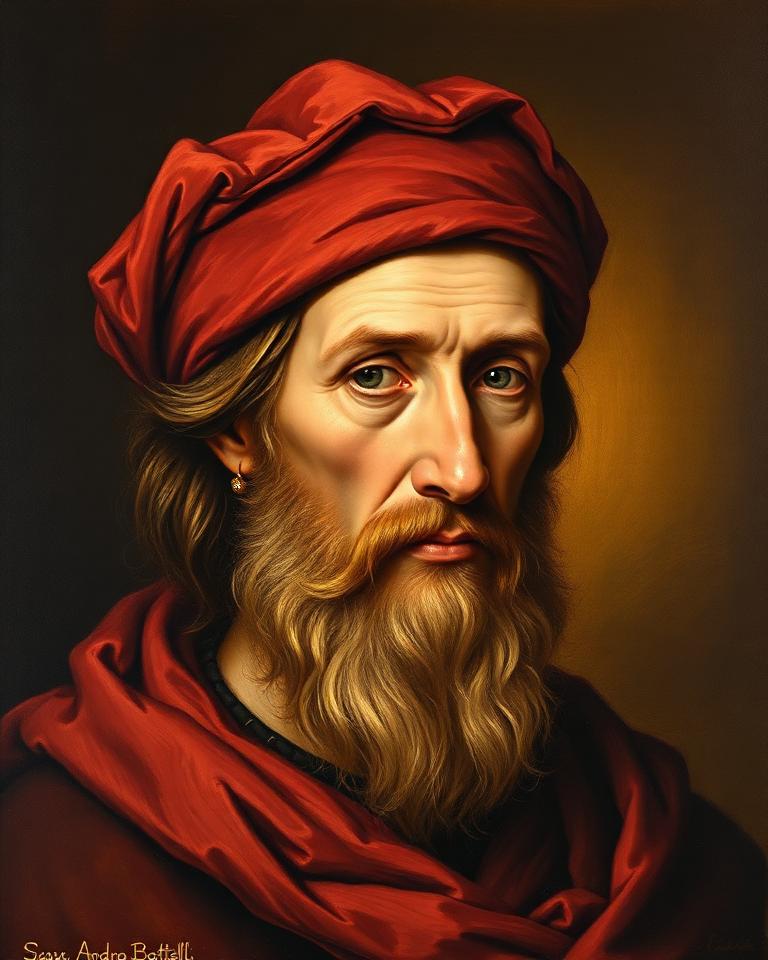
Quick Facts
- Years
- 1445 – 1510
- Category
- Artists & Composers
- Subcategory
- Renaissance Art
- Nationality
- Italian
- Occupation
- Painter
Sandro Botticelli
1445 – 1510 · Italian · Painter
Audiobook

Life Lessons from Sandro Botticelli
Marcus Alden · 55 min
Sandro Botticelli was one of the defining painters of the Italian Renaissance. Working principally in Florence, he created images distinguished by flowing contours, elegant figures, expressive faces, and an unusual combination of classical mythology and Christian spirituality. His best-known paintings, Primavera and The Birth of Venus, have become universal symbols of Renaissance culture.
Born Alessandro di Mariano di Vanni Filipepi around 1445, Botticelli trained under Fra Filippo Lippi before establishing a successful workshop. He painted devotional panels, portraits, altarpieces, mythological scenes, and frescoes. His patrons included members and associates of the Medici circle, although the exact purposes and original destinations of several famous commissions remain debated. In 1481–1482, he joined the distinguished team decorating the Sistine Chapel in Rome.
Botticelli's reputation declined as Renaissance taste shifted toward monumental naturalism and architectural harmony. His art was rediscovered by nineteenth-century critics and artists, especially the Pre-Raphaelites. Today, scholars study him not only for his beauty of line but also for his engagement with poetry, humanism, politics, devotion, and the turbulent civic life of Florence. His paintings remain central to discussions of how Renaissance artists transformed classical antiquity into compelling visual culture.
Quick Facts
| Field | Information |
|---|---|
| Full Name | Alessandro di Mariano di Vanni Filipepi |
| Common Name(s) | Sandro Botticelli; Alessandro Botticelli |
| Born | c. 1445; traditionally dated 1 March 1445, though the exact date is uncertain |
| Died | 17 May 1510 |
| Age at Death | Approximately 65 |
| Birthplace | Florence, Republic of Florence |
| Nationality | Florentine (Italian) |
| Occupation | Painter and workshop master |
| Historical Era | Early Renaissance |
| Famous For | The Birth of Venus, Primavera, Adoration of the Magi, and Sistine Chapel frescoes |
| Political Affiliation if applicable | No formal affiliation recorded; worked for patrons connected with the Medici and lived through Florence's republican and Savonarolan periods |
| Religion if significant | Roman Catholic |
| Education | Apprenticeship or training under Fra Filippo Lippi; earlier association with goldsmithing reported by Giorgio Vasari |
| Parents | Mariano di Vanni d'Amedeo Filipepi and Smeralda Filipepi |
| Spouse(s) | Never married, according to surviving records |
| Children | None recorded |
| Major Works | Primavera; The Birth of Venus; Adoration of the Magi; Madonna of the Magnificat; Mystic Nativity; illustrations for Dante's Divine Comedy; Sistine Chapel frescoes |
| Major Achievements | Created landmark mythological paintings; helped decorate the Sistine Chapel; developed an influential linear and emotionally expressive style |
Early Life
Botticelli was born in Florence around 1445, the youngest son of Mariano Filipepi, a tanner, and Smeralda Filipepi. The family lived in the Ognissanti district, an active neighborhood of artisans and merchants. Tax records indicate that Alessandro had several older brothers. One, Antonio, worked as a goldsmith; another, Giovanni, was nicknamed “Botticello,” meaning something like “little barrel.” The artist's later name may have developed from this family nickname, although its precise route to him is uncertain.
Florence was then a wealthy but politically competitive republic. Banking, textile production, international trade, religious institutions, and elite patronage supported an exceptional artistic culture. Cosimo de' Medici and his successors exercised enormous influence without formally abolishing republican government. Artists worked for churches, guilds, confraternities, civic bodies, and private households.
Giorgio Vasari, writing decades after Botticelli's death, said that the young Alessandro was restless in school and was placed with a goldsmith. Whether he completed formal goldsmith training is unknown, but the craft's emphasis on exact design may help explain his later command of contour. More securely, Botticelli trained with Fra Filippo Lippi, probably during the 1460s. Lippi's graceful Madonnas, delicate faces, transparent veils, and tender emotional effects strongly shaped his pupil.
Botticelli also absorbed lessons from Antonio del Pollaiuolo, Andrea del Verrocchio, and the broader Florentine interest in anatomy, movement, perspective, and antique art. By 1470, he had established himself as an independent master with his own workshop.
Rise to Prominence
Botticelli's early independent paintings included devotional images of the Virgin and Child and an allegorical figure of Fortitude, commissioned in 1470 for Florence's merchant tribunal. Fortitude belonged to a cycle of virtues otherwise entrusted to the Pollaiuolo workshop. Receiving part of this prestigious commission showed that Botticelli had already attracted influential support.
During the 1470s, he developed a recognizable style: clear silhouettes, rhythmic drapery, pale and refined figures, and psychologically charged faces. He joined the Compagnia di San Luca, a painters' confraternity, and trained assistants, including Filippino Lippi, the son of his former master.
The Adoration of the Magi, probably painted around 1475 for a chapel in Santa Maria Novella, was a major turning point. It incorporated portraits traditionally identified with members of the Medici family and their circle. Botticelli also included a self-portrait at the composition's edge. The painting demonstrated his ability to unite sacred narrative, portraiture, courtly display, and complex spatial organization.
His Florentine reputation led to a papal commission. In 1481, Pope Sixtus IV summoned Botticelli and other leading painters to Rome to decorate the walls of the Sistine Chapel. Botticelli produced three major narrative frescoes and several papal portraits. Working at the center of papal power gave him prestige beyond Florence.
After returning home, he created the mythological works now most closely associated with his name. Their original circumstances are not completely documented, but they were linked by the sixteenth century with a Medici branch residence. Their sophisticated literary and philosophical references indicate a cultivated audience.
Major Achievements
Transforming Classical Myth into Renaissance Painting
In Primavera, Botticelli arranged Venus, Cupid, Mercury, the Three Graces, Flora, Chloris, and Zephyrus within an orange grove filled with carefully differentiated plants. The painting's precise program remains debated. Interpretations have connected it with marriage, spring, fertility, classical poetry, Medici culture, and Neoplatonic ideas about love.
The Birth of Venus presents the goddess arriving at the shore on a shell, driven by winds and greeted by a female attendant. Rather than reconstruct antiquity archaeologically, Botticelli created an idealized poetic vision. These pictures mattered because they made large-scale pagan subjects acceptable and intellectually resonant within Christian Renaissance society. They remain among the most influential images of classical reception in European art.
Contributing to the Sistine Chapel
Botticelli's Sistine Chapel frescoes include The Trials of Moses, The Temptations of Christ, and The Punishment of Korah and His Sons. The narratives use repeated appearances of principal figures to relate several events in one landscape.
The frescoes formed part of a program comparing Moses and Christ and affirming papal authority. Their architectural settings, crowds, costumes, and energetic movement displayed Botticelli's narrative skill. Although later overshadowed by Michelangelo's ceiling and Last Judgment, they remain essential parts of the chapel's original decorative conception.
Advancing Florentine Devotional Painting
Botticelli produced numerous images of the Virgin and Child, including the Madonna of the Magnificat and Madonna of the Book. Their circular formats, precious details, solemn expressions, and refined gestures appealed to domestic and institutional patrons.
These works balance tenderness with foreknowledge of Christ's suffering. Their emotional subtlety influenced workshop production and helped define an enduring image of Florentine grace.
Illustrating Dante's Divine Comedy
Botticelli designed an ambitious series of drawings for Dante's poem, probably for Lorenzo di Pierfrancesco de' Medici. More than ninety sheets associated with the project survive, principally in Berlin and the Vatican.
The drawings trace Dante and Virgil through intricate otherworldly spaces. Botticelli used continuous line to map narrative movement with remarkable economy. The project is one of the most important Renaissance attempts to visualize Dante and demonstrates that his intelligence extended well beyond panel painting.
Creating a Distinctive Expressive Style
Botticelli's line often takes precedence over strictly naturalistic mass. Hair streams in decorative currents, drapery follows emotional rhythms, and bodies sometimes bend with deliberate artificiality. His later religious paintings could become darker, more compressed, and more intense.
This individuality ultimately secured his modern reputation. Nineteenth-century admirers valued precisely what earlier academic judgments had considered archaic: flattened space, linear elegance, melancholy beauty, and emotional strangeness.
Leadership and Work
Botticelli managed a productive Florentine workshop. Assistants prepared panels, transferred designs, painted secondary passages, and repeated popular compositions. Differences in quality among works attributed to “Botticelli and workshop” show both the reach of his designs and the difficulty of separating his hand from those of collaborators.
His methods began with drawing. Surviving studies and underdrawings reveal adjustments to pose, gesture, and grouping. He used tempera extensively, applying translucent layers and sharply controlled contours. His fresco work required broader planning and coordination with other painters.
As a master, he appears to have been adaptable. He served religious institutions, private patrons, papal authorities, and cultivated Florentine households. He could create monumental public narratives as well as intimate devotional panels.
His strengths included invention, expressive line, memorable figure types, and the ability to translate difficult texts into images. Possible weaknesses included inconsistent workshop quality and, in some late works, crowded compositions or diminished spatial coherence. Such features may also represent intentional expressive choices rather than technical decline.
Personal Life
Botticelli never married, and no children are recorded. A 1502 denunciation accused him and another man of sodomy, but the allegation was anonymous, no supporting evidence is known, and no prosecution followed. Historians therefore cannot responsibly infer his sexual life from it.
He remained closely connected to his family and neighborhood. He eventually owned property near the Ognissanti church and was buried there. His friendships and professional relationships included artists, artisans, religious patrons, and members of elite circles. Filippino Lippi became both an important pupil and an independent master.
Vasari portrayed Botticelli as witty, impractical, and financially careless, but his account was written more than forty years after the painter's death and contains anecdotes that cannot always be verified. Records show periods of success and property ownership, followed by reduced activity and possible financial difficulty late in life.
His art demonstrates strong literary interests, particularly in Dante. A surviving 1503–1504 record states that he belonged to a committee considering the placement of Michelangelo's David, showing that he retained professional standing in Florence.
Philosophy and Beliefs
Botticelli was a Catholic artist whose career depended heavily on Christian subjects. His Madonnas, altarpieces, saints, and biblical narratives show sustained attention to Incarnation, suffering, repentance, and salvation.
He also worked within a humanist culture that treated classical literature as compatible, when interpreted carefully, with Christian moral and philosophical concerns. Scholars often connect Primavera and The Birth of Venus with the Medici circle and Florentine Neoplatonism. Yet no text written by Botticelli explains these works, so detailed philosophical readings remain hypotheses rather than settled fact.
The Dominican preacher Girolamo Savonarola condemned Florentine luxury and called for moral reform in the 1490s. Vasari said Botticelli became a follower, or piagnone, and abandoned work. Some late paintings, especially the apocalyptic Mystic Nativity, suggest engagement with the era's religious anxieties. Nevertheless, evidence that he stopped painting or destroyed his own works in Savonarola's “bonfires of the vanities” is lacking.
Politically, Botticelli's personal commitments are uncertain. He worked under changing governments and accepted commissions from patrons associated with different power structures. His surviving art reflects civic tensions but does not establish a consistent party allegiance.
Challenges and Controversies
A central controversy concerns Medici patronage. Botticelli plainly portrayed Medici figures and worked for members or associates of the family. However, the familiar picture of him as Lorenzo the Magnificent's official court painter is too simple. Florence had no court in the conventional monarchical sense, and documentation for the initial commissions of Primavera and The Birth of Venus is incomplete.
The meanings of those paintings are also disputed. Proposals include wedding allegories, celebrations of fertility, poetic reconstructions of antiquity, moral journeys through forms of love, and political compliments to the Medici. Their imagery may support more than one level of meaning, but no single interpretation has won universal agreement.
Botticelli's connection to Savonarola creates another debate. Vasari's account encouraged the story that religious fanaticism ruined the artist's career. Modern scholars are more cautious. Botticelli remained active after Savonarola's execution in 1498, and stylistic change cannot be reduced to one influence.
His late career brought declining demand as Leonardo da Vinci, Michelangelo, and Raphael established a new ideal of monumental High Renaissance art. Botticelli's elongated bodies and emphatic outlines appeared old-fashioned to later viewers. Attribution is an additional challenge because his workshop repeated designs extensively.
The unsupported claim that Botticelli burned his pagan paintings should be rejected. No contemporary source proves that he contributed his own works to Savonarola's bonfires.
Legacy
Botticelli died in 1510 and was buried in the Church of Ognissanti in Florence. His fame diminished during the sixteenth and seventeenth centuries, although his works were never entirely forgotten. Vasari's biography preserved important information while also shaping enduring legends.
A major revival began in the nineteenth century. British critics and Pre-Raphaelite artists admired Botticelli's linearity, decorative pattern, spiritual intensity, and unconventional beauty. His women influenced painting, illustration, fashion, photography, and eventually cinema and advertising.
The Uffizi Gallery in Florence houses Primavera, The Birth of Venus, and several other major works, making it the principal destination for studying him. Important paintings also belong to the National Gallery in London, the Gemäldegalerie in Berlin, the Vatican Museums, the Louvre, the National Gallery of Art in Washington, and other collections.
Modern scholarship uses technical imaging, archival research, conservation science, botanical study, literary analysis, and workshop comparison to investigate his methods and meanings. His grave in Ognissanti remains a place of remembrance, while exhibitions and research projects continue to reassess his work. Botticelli remains relevant because he demonstrates how beauty can be intellectually complex, emotionally unsettled, and historically political.
Interesting Facts
- “Botticelli” was a nickname rather than the artist's family surname.
- His legal name was Alessandro Filipepi; “Sandro” is a shortened form of Alessandro.
- His father worked as a tanner.
- Botticelli trained with Fra Filippo Lippi.
- Filippino Lippi, his teacher's son, later worked in Botticelli's workshop.
- His first securely documented independent commission was Fortitude in 1470.
- He included a probable self-portrait in Adoration of the Magi.
- He traveled to Rome to work in the Sistine Chapel before Michelangelo painted its ceiling.
- The Birth of Venus is painted on canvas, an unusual support for such a large Florentine picture at the time.
- The plants in Primavera include numerous recognizable species.
- Venus's pose recalls the ancient Venus Pudica type.
- Botticelli designed an extensive illustrated cycle for Dante's Divine Comedy.
- His Map of Hell visualizes the structure of Dante's Inferno.
- Mystic Nativity bears a Greek inscription referring to apocalyptic troubles.
- He participated in the committee discussing where to place Michelangelo's David.
- He never married, according to surviving documentation.
- Claims that he burned his own paintings in Savonarola's bonfires are unproven.
- Nineteenth-century Pre-Raphaelites helped restore his international reputation.
- His remains were buried at Ognissanti, the church of his home district.
- The exact birth date often given for him is traditional rather than securely documented.
Famous Quotes
Very few, if any, verbatim personal statements by Botticelli survive. Consequently, lists of inspirational quotations credited to him online are generally unreliable. The following documented words are inscriptions within, or directly associated with, his art rather than recorded speech.
- “I, Sandro, made this picture at the end of the year 1500…” — Translation of the opening of the Greek inscription on Mystic Nativity. It identifies the maker and situates the painting amid Italian troubles.
- “…in the troubles of Italy…” — From the same inscription, reflecting the wars and instability that afflicted the peninsula.
- “…in the half-time after the time…” — A difficult phrase from Mystic Nativity, drawing on apocalyptic chronology. Translations vary.
- “…in the fulfillment of the eleventh chapter of Saint John…” — The inscription connects current events with the Book of Revelation; its precise interpretive framework is debated.
- “…in the second woe of the Apocalypse…” — Another phrase linking the painting to end-times imagery and spiritual conflict.
- “…during the loosing of the devil for three and a half years…” — A reference to Revelation that scholars have related to the crisis surrounding Savonarola.
- “Afterwards he shall be chained…” — From the inscription's hopeful conclusion, forecasting the defeat of evil.
- “…and we shall see him trodden down as in this picture.” — The painting depicts demons fleeing or being overcome, giving visual form to this promise.
- “Sandro Botticelli said that the reason was that the figure was shown in an attitude in which it was not Jesus Christ who baptized Saint John…” — A reported opinion preserved in the 1490 record of a Florentine artistic consultation. Wording varies by translation; it concerns the decorum of a proposed cathedral façade figure, not a modern-style maxim.
- “The line of beauty is not in the face, but the light that the face casts.” — Widely attributed online to Botticelli, but no reliable Renaissance source has been established; attribution is disputed and likely spurious.
Timeline
- c. 1445 — Born in Florence to Mariano and Smeralda Filipepi.
- 1460s — Trains with Fra Filippo Lippi; possible earlier exposure to goldsmithing.
- 1470 — Receives the commission for Fortitude and operates as an independent master.
- 1472 — Recorded in the Compagnia di San Luca; Filippino Lippi is associated with his workshop.
- c. 1475 — Paints Adoration of the Magi for Santa Maria Novella.
- 1478 — Produces painted images connected with the executed Pazzi conspirators; these works are lost.
- c. 1480–1482 — Works on major mythological and devotional paintings; dating remains debated.
- 1481–1482 — Paints narrative frescoes in the Sistine Chapel in Rome.
- 1480s — Creates Primavera, The Birth of Venus, and important Madonna paintings.
- 1480s–1490s — Works on drawings illustrating Dante's Divine Comedy.
- 1490 — Participates in a consultation concerning Florence Cathedral's façade.
- 1492 — Lorenzo de' Medici dies; Florence enters a period of increasing instability.
- 1494 — Medici expelled from Florence; French invasion transforms the political climate.
- 1498 — Savonarola is executed.
- 1500–1501 — Completes Mystic Nativity, dated through its inscription.
- 1502 — Named in an unsubstantiated anonymous denunciation; no prosecution is recorded.
- 1503–1504 — Serves on the committee considering the placement of Michelangelo's David.
- 17 May 1510 — Dies in Florence and is buried at Ognissanti.
- Nineteenth century — Critics and Pre-Raphaelite artists lead a major revival of interest.
Frequently Asked Questions
What was Sandro Botticelli's real name?
His full name was Alessandro di Mariano di Vanni Filipepi. “Sandro” is a familiar shortened form of Alessandro, while “Botticelli” was a nickname rather than his inherited surname. It may have derived from the nickname “Botticello,” associated with his older brother Giovanni, though the exact explanation is uncertain. Renaissance artists were often known by nicknames, places of origin, family associations, or their fathers' names.
When and where was Botticelli born?
He was born in Florence around 1445. A date of 1 March 1445 is often repeated, but the documentary basis for an exact birthday is uncertain. Florentine tax declarations and later records allow historians to estimate the year. He grew up in the Ognissanti district, a neighborhood tied to commerce, crafts, and religious life.
Who taught Botticelli to paint?
His principal master was Fra Filippo Lippi, one of Florence's leading painters. Lippi's influence is visible in Botticelli's delicate faces, graceful Madonnas, fine drapery, and emotional intimacy. Botticelli also learned from the artistic environment surrounding Antonio del Pollaiuolo and Andrea del Verrocchio. Vasari reported an earlier connection with goldsmithing, but its extent is unclear.
Why is The Birth of Venus famous?
The painting combines an instantly memorable mythological subject with Botticelli's highly individual style. Venus appears on a shell, propelled toward shore by wind gods and welcomed by an attendant. Its flowing hair, elongated body, rhythmic contours, and pale coastal light create an image unlike strict naturalism. It also embodies Renaissance engagement with classical poetry and ideal beauty, although its exact original purpose remains debated.
What does Primavera mean?
There is no universally accepted interpretation. The scene includes Mercury, the Three Graces, Venus, Cupid, Flora, Chloris, and Zephyrus in a flowering grove. Scholars have connected it with spring, fertility, marriage, poetic love, education, Medici politics, and Neoplatonic philosophy. The title Primavera, meaning “Spring,” was recorded by Vasari decades after the work was painted and may not have been its original title.
Did the Medici employ Botticelli?
Members and associates of the Medici network certainly patronized him, and he portrayed figures traditionally identified as Medici family members. Lorenzo di Pierfrancesco de' Medici is particularly connected with works and records involving Botticelli. However, describing the painter simply as Lorenzo the Magnificent's official court artist exaggerates the evidence. Florence remained a republic, and documentation for several famous commissions is incomplete.
What did Botticelli paint in the Sistine Chapel?
He painted three major wall frescoes: The Trials of Moses, The Temptations of Christ, and The Punishment of Korah and His Sons. He also contributed portraits of popes to the decorative program. Created in 1481–1482, these works compare events from the lives of Moses and Christ and support the chapel's claims about religious authority. They predate Michelangelo's ceiling by roughly three decades.
Was Botticelli a follower of Savonarola?
Vasari stated that Botticelli became a follower of the Dominican reformer, and some late works share the intense religious atmosphere of Savonarola's Florence. Mystic Nativity explicitly invokes apocalyptic crisis. Nevertheless, direct evidence of formal commitment is limited. The claim that Savonarola caused Botticelli to abandon art is contradicted by works and professional activity after the preacher's death.
Did Botticelli burn his paintings?
No reliable evidence shows that he burned his own paintings in the “bonfires of the vanities.” Savonarola's supporters did collect and destroy luxury objects regarded as morally dangerous, but later writers expanded this fact into a dramatic story about Botticelli renouncing pagan art. Historians generally treat that version as an unsupported legend.
Was Botticelli married?
No. Surviving records indicate that he never married, and no children are known. Vasari also described him as unmarried. Historians know little about his intimate life, and an anonymous 1502 accusation of sodomy produced no known legal action or substantiating evidence. It should not be treated as proof of his sexual orientation or conduct.
How did Botticelli paint?
He relied heavily on drawing and contour. For panel paintings, he commonly used tempera, building forms through carefully controlled layers of pigment. He manipulated outlines, drapery, hair, and gesture to generate movement and emotion. Workshop assistants sometimes participated in preparation and execution. On plaster in the Sistine Chapel, he adapted his designs to fresco technique and large-scale narrative.
Why do Botticelli's figures look elongated?
The elongation was often an expressive and decorative choice rather than inability to observe anatomy. Extended necks, sloping shoulders, swaying poses, and flowing garments create rhythm and elegance. In Venus, for example, anatomical improbabilities help produce an ideal figure that seems suspended between physical presence and poetic vision. Late works sometimes intensify distortion to express spiritual urgency.
Did Botticelli illustrate Dante?
Yes. He designed an extensive sequence for Dante's Divine Comedy, probably for Lorenzo di Pierfrancesco de' Medici. More than ninety associated drawings survive. They follow Dante's journeys through Hell, Purgatory, and Paradise, often showing the travelers repeatedly within a single continuous space. The celebrated Map of Hell demonstrates Botticelli's ability to turn a complex literary structure into a coherent visual system.
Why did Botticelli's reputation decline?
Taste changed. By the early sixteenth century, patrons increasingly admired the monumental bodies, sophisticated spatial unity, and technical innovations associated with Leonardo, Michelangelo, and Raphael. Botticelli's linear elegance appeared old-fashioned. His workshop's many repetitions also complicated judgments of quality. Nineteenth-century critics later revalued these very characteristics and restored him to prominence.
Where can visitors see Botticelli's works?
The Uffizi Gallery in Florence holds the largest and most famous group, including Primavera and The Birth of Venus. Other important works are in the National Gallery, London; the Vatican Museums; Berlin's Gemäldegalerie and Kupferstichkabinett; the Louvre; and the National Gallery of Art in Washington. His Sistine frescoes remain in their original Vatican setting, while his grave is in Ognissanti, Florence.
How did Botticelli die?
The specific cause of his death is not recorded. He died in Florence on 17 May 1510, at about 65 years old. Vasari suggested that he suffered physical decline late in life, but details are uncertain and should not be treated as a clinical diagnosis. He was buried in the Church of Ognissanti, near the neighborhood where he had spent much of his life.
Lessons We Can Learn
- Develop a recognizable voice. Botticelli absorbed Lippi's teaching but transformed it into his own linear style. Strong foundations need not prevent originality.
- Translate old ideas for new audiences. His mythologies reshaped classical poetry for Renaissance Florence. Cultural inheritance survives through creative reinterpretation.
- Master more than one format. He worked in panels, frescoes, portraits, devotional rounds, and book illustration. Versatility creates resilience.
- Use design to express emotion. In Botticelli's work, line and rhythm carry feeling as much as facial expression. Form and message should reinforce one another.
- Accept uncertainty responsibly. The meanings of Primavera remain debated. Good research distinguishes plausible interpretation from documented fact.
- Collaborate without losing direction. His workshop extended his productivity while following master designs. Effective leadership balances delegation with standards.
- Adapt to different patrons. Botticelli served papal, civic, religious, and domestic clients. Understanding context is part of professional skill.
- Do not confuse changing fashion with permanent failure. His reputation declined, then revived dramatically. Immediate popularity is not the sole measure of lasting value.
- Let difficult times deepen—not simplify—creative work. His later religious images responded to Florentine instability with emotional complexity.
- Question compelling legends. Stories about burned paintings and total renunciation lack evidence. Historical literacy requires checking attractive narratives against sources.
Related Historical Figures
- Fra Filippo Lippi — Botticelli's principal teacher, whose graceful figures and devotional intimacy profoundly influenced him.
- Filippino Lippi — Fra Filippo's son, Botticelli's pupil or workshop associate, and later a major Florentine painter.
- Lorenzo de' Medici — Florence's dominant political and cultural figure during much of Botticelli's career; connected indirectly and sometimes directly to his patronage world.
- Lorenzo di Pierfrancesco de' Medici — Member of a junior Medici branch and an important patron linked to Botticelli's Dante project and famous mythologies.
- Giuliano de' Medici — Lorenzo's brother, traditionally identified in Botticelli portraits and commemorated after his murder in the Pazzi Conspiracy.
- Girolamo Savonarola — Dominican reformer whose preaching shaped late-fifteenth-century Florence and may have influenced Botticelli's later religious outlook.
- Pope Sixtus IV — Summoned leading Florentine painters, including Botticelli, to decorate the Sistine Chapel.
- Dante Alighieri — Poet of the Divine Comedy, which inspired Botticelli's extraordinary illustration cycle.
- Leonardo da Vinci — Florentine contemporary whose naturalism and technical innovation helped shift artistic taste toward the High Renaissance.
- Michelangelo Buonarroti — Younger master whose David Botticelli helped evaluate and whose Sistine ceiling later overshadowed the chapel's earlier fresco cycle.
Related Historical Figures