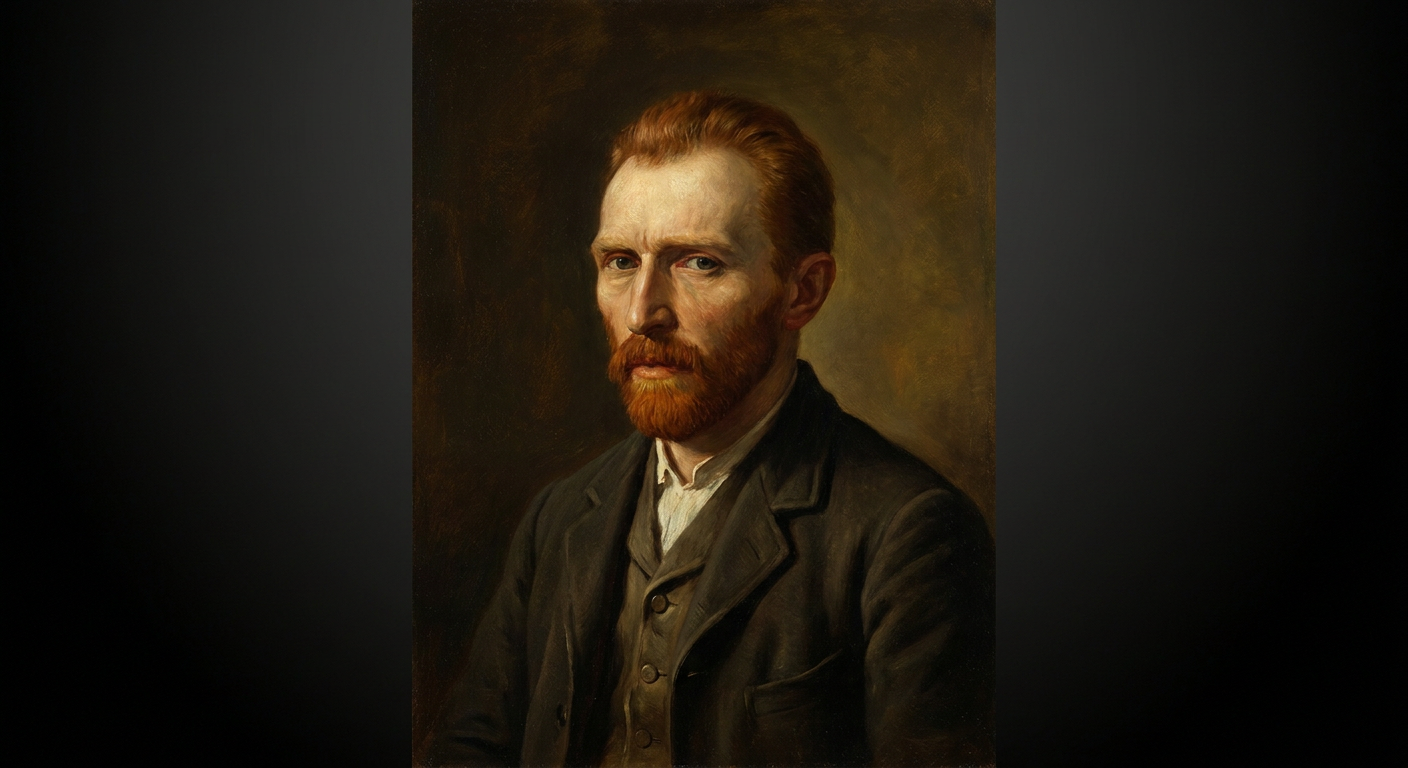
Quick Facts
- Years
- 1853 – 1890
- Category
- Artists & Composers
- Nationality
- Dutch
- Occupation
- Painter and draughtsman
Vincent van Gogh
1853 – 1890 · Dutch · Painter and draughtsman
Recommended Audiobooks
Listen next from Marcus Alden

Life Lessons from Franz Liszt
Marcus Alden · 53 min

Life Lessons from Camille Saint-Saëns
Marcus Alden · 53 min
Vincent van Gogh was a Dutch painter whose intensely colored landscapes, portraits and still lifes helped transform modern art. Today, paintings such as The Starry Night, Sunflowers and The Bedroom are recognized around the world. During his lifetime, however, Van Gogh remained financially dependent on his younger brother Theo and received only limited public attention.
His artistic career was astonishingly brief. Van Gogh did not seriously commit himself to art until about 1880, and he died in 1890 at the age of 37. In that decade he produced roughly 2,100 surviving works, including around 860 oil paintings. His thick brushwork, daring color combinations and emotionally charged treatment of ordinary subjects influenced Expressionism, Fauvism and generations of later artists.
Van Gogh’s story is often reduced to madness, poverty and the severed ear. Those events mattered, but they do not explain his achievement. He was a disciplined reader, a close observer of nature and a determined craftsman who studied perspective, anatomy, color theory and earlier art. His hundreds of letters—especially those exchanged with Theo—reveal an articulate person continually analyzing his methods and purposes.
People still study Van Gogh because his life raises enduring questions about creativity, illness, friendship, failure and recognition. His paintings show how familiar fields, rooms, faces and night skies can become vehicles for powerful human feeling.
Quick Facts
| Fact | Details |
|---|---|
| Full Name | Vincent Willem van Gogh |
| Common Name(s) | Vincent van Gogh; Van Gogh |
| Born | 30 March 1853 |
| Died | 29 July 1890 |
| Age at Death | 37 |
| Birthplace | Groot-Zundert, North Brabant, Netherlands |
| Nationality | Dutch |
| Occupation | Painter and draughtsman |
| Historical Era | Late 19th century; Post-Impressionist period |
| Famous For | The Starry Night, Sunflowers, expressive color and vigorous brushwork |
| Political Affiliation | None documented; sympathetic to poor and working people |
| Religion | Raised in the Dutch Reformed Church; briefly worked as an evangelist and later developed a personal, less institutional spirituality |
| Education | Schools in Zevenbergen and Tilburg; brief study at the Brussels and Antwerp academies; largely self-educated as an artist |
| Parents | Theodorus van Gogh and Anna Cornelia Carbentus |
| Spouse(s) | Never married |
| Children | None |
| Major Works | The Potato Eaters, Sunflowers, The Bedroom, The Night Café, Irises, The Starry Night, portraits of the Roulin family and wheat-field landscapes |
| Major Achievements | Created a highly influential body of modern painting; advanced expressive uses of color and brushwork; left an exceptionally important artistic correspondence |
Early Life
Vincent was born in Groot-Zundert, a village in the predominantly Catholic province of North Brabant. His father, Theodorus, was a Dutch Reformed minister; his mother, Anna, came from a bookselling family and enjoyed drawing and nature. Vincent was the eldest surviving child of six. A stillborn brother, also named Vincent, had been born exactly one year earlier. Claims that seeing the earlier child’s gravestone caused Vincent lasting psychological harm are speculative rather than established fact.
The family valued religion, duty, books and outdoor walks. Vincent attended local schools and later boarding school at Zevenbergen. In 1866 he entered Willem II secondary school in Tilburg, where he received drawing instruction, but left in 1868 without completing his studies.
In 1869 his uncle helped him obtain work with the international art dealership Goupil & Cie in The Hague. The position introduced him to commercial prints and contemporary European painting. He transferred to London in 1873 and then worked in Paris. Initially successful, he became increasingly unhappy with treating art as merchandise. Goupil dismissed him in 1876.
Van Gogh then moved through several occupations: assistant teacher in England, bookstore employee in Dordrecht and aspiring clergyman. He attempted theological preparation in Amsterdam but found formal study difficult. In 1878 he went to the Borinage, a poor coal-mining district in Belgium, as an evangelical worker. He lived austerely and gave possessions to miners. Church authorities considered his behavior excessive and declined to renew his appointment.
This failure was painful, yet the Borinage became a turning point. Van Gogh began drawing miners and laborers, discovering that art could express the compassion he had previously directed into preaching.
Rise to Prominence
In 1880, encouraged financially and emotionally by Theo, Vincent resolved to become an artist. He studied basic drawing in Brussels and learned from manuals, prints and close observation. Rather than seeking elegant subjects, he drew workers, peasants, worn clothing and humble interiors.
After periods in The Hague and Drenthe, he settled with his parents in Nuenen in 1883. There he made dark-toned studies of weavers and farm laborers. His first major painting, The Potato Eaters (1885), portrayed a peasant family sharing an evening meal. Van Gogh believed its rough figures communicated honest labor. Critics and some artist friends objected to its anatomy and murky color, but the work marked an important attempt at an ambitious group composition.
In Antwerp he studied briefly at the academy, encountered Japanese prints and admired the color of Peter Paul Rubens. He joined Theo in Paris in 1886. Contact with Impressionists and other experimental painters—including Camille Pissarro, Paul Signac, Henri de Toulouse-Lautrec and Émile Bernard—brightened his palette. He adopted broken brushstrokes, complementary colors and unconventional compositions inspired partly by Japanese ukiyo-e prints.
Seeking stronger sunlight and cheaper living, Van Gogh moved to Arles in southern France in February 1888. Over the next 15 months he produced many celebrated works: orchards, bridges, cafés, portraits, bedrooms, chairs and sunflower still lifes. He hoped to establish a cooperative “Studio of the South.” Paul Gauguin joined him in October, but their intense partnership deteriorated.
Van Gogh did not become broadly famous during his life. A few critics and fellow artists recognized his talent, and six paintings were exhibited in Brussels early in 1890. His major public reputation arose after his death through exhibitions, criticism and the sustained efforts of Theo’s widow, Johanna van Gogh-Bonger.
Major Achievements
Transforming color into an expressive language
Van Gogh increasingly used color not simply to reproduce appearances but to communicate mood. Contrasting yellows, blues, reds and greens could suggest hope, heat, loneliness or agitation. This approach helped later artists treat color as an independent emotional force.
Giving ordinary subjects monumental presence
He painted worn shoes, wooden chairs, cafés, postal workers, peasants and modest rooms. Through scale, rhythm and concentrated attention, these everyday subjects acquired dignity. His work demonstrated that modern art did not require heroic mythology or aristocratic sitters.
The Arles paintings
The Arles period united bright color with ambitious decorative planning. Van Gogh intended versions of Sunflowers to welcome Gauguin and decorate the Yellow House. The Bedroom used simplified perspective and flat areas of color to communicate rest, although its tilted space also creates tension. These paintings became landmarks of Post-Impressionism.
Work at Saint-Rémy
After mental-health crises in Arles, Van Gogh voluntarily entered the Saint-Paul-de-Mausole asylum near Saint-Rémy in May 1889. Between attacks he worked with remarkable productivity. He painted the enclosed garden, olive groves, cypresses and views from his window. The Starry Night combined observation with imaginative reconstruction, turning the night landscape into a pattern of swirling motion.
Portraiture and human character
Unable to afford professional models, Van Gogh painted himself repeatedly and persuaded neighbors and acquaintances to sit. His portraits of Joseph Roulin, Augustine Roulin, Dr. Gachet and others explore character through color and brushwork rather than polished realism.
An extraordinary written record
More than 800 surviving letters, most written by Vincent and many addressed to Theo, document his reading, technical experiments, finances, health and artistic ambitions. They are indispensable evidence, though letters also reflect the writer’s changing emotions and should not be treated as perfectly objective reports.
Leadership or Work
Van Gogh led no formal institution, but his working methods reveal unusual intensity and self-direction. He often painted outdoors and worked quickly to capture changing light, while carefully planning compositions through drawings and studies. Speed did not mean carelessness: letters describe deliberate choices involving perspective frames, pigments, canvases and complementary colors.
His central values included sincerity, perseverance and respect for labor. He admired artists who portrayed rural and working-class life, especially Jean-François Millet. He wanted art to console people, not merely decorate wealthy homes.
Theo was his essential partner. He supplied money, materials, professional advice and access to the Parisian art world. Vincent could be affectionate and grateful, but also demanding. Similar intensity complicated relationships with friends. His dream of an artists’ community in Arles showed generosity and ambition, yet he struggled with compromise and shared authority.
His strengths were concentration, visual memory, courage in experimentation and relentless practice. His weaknesses included impulsiveness, difficult interpersonal behavior and poor financial management. Illness periodically stopped him from working, but during stable intervals he displayed methodical discipline rather than uncontrolled inspiration.
Personal Life
Van Gogh never married and had no children. His romantic attachments were generally unhappy. In 1881 he declared love for his widowed cousin Kee Vos-Stricker, who rejected him. Later he lived in The Hague with Clasina “Sien” Hoornik, a pregnant sex worker who already had a child. He hoped to create a household with her, but financial pressure, family opposition and incompatibility ended the relationship in 1883.
His closest enduring bond was with Theo. Their correspondence records disagreements as well as profound affection. Theo married Johanna Bonger in 1889; their son, born in January 1890, was named Vincent Willem.
Van Gogh read widely, enjoying the Bible, Shakespeare, Charles Dickens, Émile Zola and other modern novelists. He smoked a pipe, drank alcohol and often lived on an inadequate diet, spending scarce money on paint. These habits may have worsened his health, although they do not provide a complete medical explanation.
Accounts describe him as earnest, argumentative, compassionate and socially awkward. He sought companionship but could exhaust people through intensity. His self-portraits should not be read as straightforward medical records; they were artistic experiments made when models were unavailable.
Philosophy or Beliefs
Van Gogh’s worldview developed from Protestant Christianity but moved away from organized doctrine. In the Borinage he tried to imitate Christ through service and poverty. His conflict with church officials strengthened his distrust of religious institutions that appeared detached from suffering.
He did not simply abandon spiritual concerns. Nature, art and human solidarity became central to his mature beliefs. His letters frequently present creative work as a source of consolation and moral purpose. Fields, sowers, stars and seasonal cycles carried associations with endurance, renewal and mortality without functioning as fixed theological symbols.
Politically, Van Gogh belonged to no party. His sympathy for miners, peasants and urban poor reflected social concern, but it would be misleading to assign him a detailed modern ideology. His ethics emphasized compassion, honest work and attention to neglected lives.
Artistically, he rejected photographic imitation. He altered colors and forms to communicate what he considered a deeper truth of experience. This belief shaped his boldest choices and helped open the way for Expressionism.
Challenges and Controversies
Van Gogh endured repeated professional failure, poverty, isolation and serious illness. The exact diagnosis of his condition remains uncertain. Scholars and physicians have proposed temporal-lobe epilepsy, bipolar disorder, psychosis, alcohol-related illness and other explanations. Retrospective diagnosis from letters and reports cannot produce certainty, and he may have experienced interacting conditions.
On 23 December 1888, after conflict with Gauguin, Van Gogh injured his left ear with a razor. Reports differ over how much was removed and the precise sequence of events. Most historians conclude that he mutilated himself during a crisis. A minority theory suggests Gauguin wounded him, but it has not gained broad scholarly acceptance. Van Gogh then delivered part of the ear to a woman associated with a brothel; her identity and the circumstances have been debated.
The familiar claim that he sold only one painting is too simple. The Red Vineyard was documented as a sale, but Van Gogh also exchanged works and may have sold or received payment for others. The surviving evidence is incomplete.
His death is also debated. The standard account holds that he shot himself in the chest on 27 July 1890 near Auvers-sur-Oise and died two days later. Later writers proposed that he was accidentally or deliberately shot by someone else. That theory highlights genuine gaps in the evidence, including the missing weapon, but most specialists and the Van Gogh Museum continue to regard suicide as the most likely explanation.
Modern marketing can romanticize his suffering as the source of genius. His illness influenced his circumstances, but his achievement also depended on sustained study, planning and work during lucid periods. Equating mental illness with creativity distorts both his art and the realities of illness.
Legacy
Van Gogh’s reputation expanded rapidly after 1890. Theo died in January 1891, leaving Johanna van Gogh-Bonger responsible for Vincent’s paintings and letters. She organized exhibitions, cultivated critics, made strategic sales and published the brothers’ correspondence. Her work was crucial to establishing his international standing.
Fauvist and German Expressionist artists learned from his non-naturalistic color, visible brushwork and emotional directness. Later painters as different as Edvard Munch, Ernst Ludwig Kirchner and Francis Bacon engaged with aspects of his example. His influence also entered literature, film, music and popular design.
The Van Gogh Museum opened in Amsterdam in 1973 and holds the largest collection of his works. Important paintings are also preserved by the Kröller-Müller Museum and major museums worldwide. The Van Gogh House in Zundert and sites in Arles, Saint-Rémy and Auvers connect his art to real landscapes, although some buildings, including the Yellow House, no longer survive.
His market value eventually reached levels unimaginable during his life. This creates an irony: paintings rooted in sympathy for ordinary people have become elite commodities. Yet reproductions have also made his art unusually accessible.
Van Gogh remains relevant not because he fits a simple myth of the tortured genius, but because he combined vulnerability with disciplined observation. His work invites viewers to look again at common things—a chair, a tree, a face or a night sky—and recognize their emotional force.
Interesting Facts
- Van Gogh began his serious artistic career at about 27.
- His career as a mature artist lasted only around a decade.
- Roughly 2,100 works survive, including about 860 oil paintings.
- He signed many paintings simply “Vincent,” partly because French speakers found his surname difficult.
- The correct Dutch pronunciation of “Van Gogh” differs from common English pronunciations.
- He worked for Goupil & Cie before becoming an artist.
- He once hoped to become a Protestant minister.
- Japanese prints strongly influenced his cropping, outlines and flat color.
- He painted more than 35 self-portraits.
- The famous Arles sunflower pictures belong to more than one series.
- The Starry Night was painted at Saint-Rémy, not during the ear crisis in Arles.
- Theo’s widow Johanna played a decisive role in building his reputation.
- Some red pigments in his works have faded, changing their present appearance.
- The Yellow House in Arles was destroyed after wartime bombing damage.
- His nephew Vincent Willem helped establish the Van Gogh Museum.
- Van Gogh admired novels and discussed literature frequently in his letters.
- The Red Vineyard is the best-documented sale of a painting during his lifetime.
- He created several paintings after prints by artists he admired while confined at Saint-Rémy.
Famous Quotes
The following translations come from Van Gogh’s documented letters; wording varies among editions.
- “I want to touch people with my art.” In an 1888 letter to Theo, Van Gogh explained his wish to make viewers feel that his work came from deep emotion. It summarizes his belief that technical skill should serve human connection.
- “One must work and dare if one really wants to live.” Written to Theo in 1884, this reflects his conviction that meaningful life required effort and risk.
- “Great things are not done by impulse, but by a series of small things brought together.” In an 1882 letter, he emphasized patient development. The quotation counters the myth that his paintings were products of spontaneous frenzy.
- “I am seeking, I am striving, I am in it with all my heart.” Written in 1882, this statement described his commitment while still mastering basic drawing.
- “For my part I know nothing with any certainty, but the sight of the stars makes me dream.” In 1888, Van Gogh connected night skies with imagination and questions about existence.
- “There is nothing more truly artistic than to love people.” Written to Theo in 1888, the line expresses the ethical and emotional purpose he associated with art.
- “I put my heart and my soul into my work, and have lost my mind in the process.” This often-circulated wording is not securely documented in Van Gogh’s surviving letters and should be treated as a disputed or modern attribution.
- “The sadness will last forever.” Theo reportedly recalled words of this kind at Vincent’s deathbed, but the exact French phrase and context depend on later testimony; it was not recorded in a contemporary letter by Vincent.
Timeline
- 1853 — Born in Groot-Zundert on 30 March.
- 1869 — Begins work for Goupil & Cie in The Hague.
- 1873 — Transfers to London.
- 1875 — Works in Paris as religious interests intensify.
- 1876 — Dismissed by Goupil; teaches and assists a minister in England.
- 1877 — Begins preparation for theological study in Amsterdam.
- 1878 — Goes to the Borinage as an evangelist.
- 1880 — Decides to pursue art seriously and studies in Brussels.
- 1881 — Lives in Etten; rejected by Kee Vos-Stricker.
- 1882 — Studies in The Hague and lives with Sien Hoornik.
- 1883 — Leaves Sien; works in Drenthe and moves to Nuenen.
- 1885 — Paints The Potato Eaters; father dies; Vincent moves to Antwerp.
- 1886 — Joins Theo in Paris and encounters avant-garde art.
- 1887 — Exhibits with fellow experimental painters and collects Japanese prints.
- 1888 — Moves to Arles; paints major sunflower and landscape works; Gauguin arrives; ear crisis occurs in December.
- 1889 — Enters the asylum at Saint-Rémy and paints Irises and The Starry Night.
- 1890 — Exhibits in Brussels; moves to Auvers-sur-Oise; suffers a gunshot wound on 27 July and dies on 29 July.
- 1891 — Theo dies; Johanna van Gogh-Bonger begins preserving and promoting the brothers’ legacy.
- 1973 — Van Gogh Museum opens in Amsterdam.
Frequently Asked Questions
1. Why is Vincent van Gogh famous?
Van Gogh is famous for using vivid color, emphatic outlines and visible brushstrokes to convey emotional experience. Paintings such as Sunflowers, The Bedroom and The Starry Night helped later artists move beyond naturalistic representation. His life story and unusually rich correspondence also attract attention. His fame was mainly posthumous, developed through exhibitions, criticism and Johanna van Gogh-Bonger’s careful promotion of both paintings and letters.
2. Was Van Gogh famous during his lifetime?
He received limited recognition, but not broad fame. Fellow artists knew his work, the critic Albert Aurier praised him in 1890, and paintings appeared in Paris and Brussels exhibitions. He remained dependent on Theo and had not secured a stable market. Describing him as completely unknown is therefore inaccurate, while portraying him as successful would also be misleading. His international reputation emerged chiefly in the decades after his death.
3. Did Van Gogh sell only one painting?
The Red Vineyard is the best-known documented sale, purchased by Anna Boch in 1890. The often-repeated claim that it was his only sale oversimplifies incomplete records. Van Gogh exchanged paintings with other artists, and evidence suggests that money or commissions may have changed hands for additional works. What is certain is that sales were rare and insufficient to support him; Theo financed most of his living and artistic expenses.
4. Why did Van Gogh cut off his ear?
The injury followed a period of tension with Gauguin in Arles in December 1888 and occurred during an acute mental crisis. Van Gogh’s precise thoughts cannot be reconstructed reliably. Most historians believe he injured himself with a razor, although details—including how much of the ear was removed—remain disputed. A theory blaming Gauguin exists but lacks broad acceptance. Reducing the event to a romantic gesture ignores its medical seriousness and uncertain evidence.
5. What illness did Van Gogh have?
No diagnosis can be established with certainty. Contemporary doctors used terms such as epilepsy, while modern researchers have suggested mood disorder, psychosis, neurological illness, alcohol effects, malnutrition or combinations of these. Records indicate recurring attacks involving confusion and incapacity, separated by productive periods. Because modern clinicians cannot examine him and surviving accounts are incomplete, responsible biographies describe symptoms and competing proposals rather than presenting one diagnosis as proven.
6. Did mental illness create Van Gogh’s art?
His illness affected his life, access to subjects and periods of productivity, but it does not adequately explain his skill. Van Gogh studied drawing, perspective, anatomy, prints, literature and color theory over many years. During severe attacks he often could not work. His strongest paintings generally emerged from deliberate practice during more stable periods. The “mad genius” label can obscure both his craftsmanship and the suffering caused by illness.
7. What is Van Gogh’s most famous painting?
The Starry Night, painted at Saint-Rémy in June 1889, is probably his most widely recognized work. It depicts a pre-dawn landscape based partly on the view near his asylum room, transformed through memory and imagination. The village was not a literal record of what he saw. Swirling sky patterns, cypresses and strong color contrasts create a vision that feels both cosmic and intimate.
8. Why did he paint so many sunflowers?
Van Gogh valued sunflowers for their intense yellow and decorative power. In Arles he painted them partly to furnish rooms in the Yellow House for Gauguin’s arrival and to demonstrate what could be achieved with variations of a limited color family. He produced multiple versions, not one single Sunflowers. The pictures became associated with friendship, gratitude and his artistic identity, though interpretations should remain grounded in his letters.
9. Who was Theo van Gogh?
Theo was Vincent’s younger brother, confidant and principal financial supporter. As an art dealer in Paris, he introduced Vincent to modern artists and provided money, canvases, paint and professional advice. Their letters preserve one of history’s richest records of an artist’s development. The relationship was loving but sometimes strained by money and Vincent’s demands. Theo died only six months after Vincent and was later reburied beside him in Auvers.
10. Who made Van Gogh famous after his death?
Many dealers, artists and critics contributed, but Johanna van Gogh-Bonger was central. After Theo’s death she inherited a large collection and the brothers’ letters. She organized exhibitions, lent and sold works strategically, corresponded with critics and published letters that helped audiences understand Vincent’s aims. Her role corrects the misleading idea that fame appeared automatically because the art’s greatness was immediately obvious.
11. Why did Van Gogh move to Arles?
He sought bright southern light, strong color, rural subjects and lower expenses than Paris offered. He also dreamed of creating a community where artists could live and work together. Arles inspired an extraordinary burst of landscapes, interiors and portraits. Yet loneliness, financial stress, local tensions and the collapse of his partnership with Gauguin made the period unstable. It was simultaneously one of his most creative and most difficult phases.
12. Was Van Gogh an Impressionist?
He learned from Impressionism but is usually classified as Post-Impressionist, a broad label for artists who extended or challenged Impressionist methods. In Paris he adopted brighter colors and broken brushwork, yet he increasingly altered form and color to convey emotion rather than fleeting optical impressions alone. The category is useful for context, but Van Gogh did not belong to a formal Post-Impressionist organization with a single program.
13. How did Japanese art influence him?
Van Gogh collected inexpensive Japanese ukiyo-e prints and admired their bold outlines, flat colors, unusual cropping and high viewpoints. He copied some prints and incorporated related compositional ideas into portraits and landscapes. Like many Europeans of his era, he idealized Japan through limited information, imagining it as a harmonious society of artists. His enthusiasm was transformative but also reflected 19th-century European assumptions about another culture.
14. How did Van Gogh die?
He died in Auvers-sur-Oise on 29 July 1890, two days after suffering a gunshot wound to the chest. The traditional conclusion is suicide, supported by early testimony and his psychological history. A later theory proposes that someone else shot him, possibly accidentally. Because no weapon was recovered and details are incomplete, questions remain; nevertheless, most specialists consider self-inflicted injury the explanation best supported by the overall evidence.
15. Where can people see his art today?
The Van Gogh Museum in Amsterdam owns the largest collection, including paintings, drawings and letters. The Kröller-Müller Museum in Otterlo holds another major group. Important works are distributed among institutions such as the Museum of Modern Art in New York, the National Gallery in London, the Musée d’Orsay in Paris and the J. Paul Getty Museum. Because the works are fragile, displays and loans can change.
Lessons We Can Learn
- Mastery requires practice. Van Gogh spent years drawing before creating his best-known paintings. Modern readers can reasonably see this as evidence that innovation grows from repeated work, not inspiration alone.
- Failure can redirect a life. His unsuccessful careers in commerce and religion preceded his artistic commitment. The lesson is interpretive, but the sequence is historical fact.
- Support networks matter. Theo’s financial and emotional assistance made Vincent’s career possible. Talent rarely develops in complete isolation.
- Study and originality can coexist. Van Gogh copied prints and studied earlier masters, then transformed those lessons into a distinct language.
- Ordinary subjects deserve attention. He found significance in shoes, chairs, laborers and fields, showing how careful observation can challenge social and artistic hierarchies.
- Collaboration requires flexibility. The failed partnership with Gauguin illustrates how shared ambition can collapse when personalities and expectations conflict.
- Health should not be romanticized. Van Gogh’s crises caused pain and interrupted work. His history argues for compassion and treatment, not celebration of suffering.
- Communication preserves creative thought. His letters allow later generations to understand his methods. Documenting a process can become valuable beyond its immediate purpose.
- Recognition may be shaped by advocates. Johanna’s work demonstrates that cultural reputations depend partly on preservation, interpretation and access.
- Uncertainty should be acknowledged. Debates over his diagnosis, ear and death show why responsible history distinguishes strong evidence from attractive theories.
Related Historical Figures
- Theo van Gogh — Vincent’s brother, supporter and principal correspondent; indispensable to his career.
- Johanna van Gogh-Bonger — Theo’s wife, who preserved the collection and promoted Vincent’s reputation.
- Paul Gauguin — Artist who lived with Van Gogh in Arles; their collaboration ended in crisis.
- Émile Bernard — Friend and fellow experimental painter who exchanged ideas and letters with Vincent.
- Henri de Toulouse-Lautrec — Parisian colleague who portrayed Van Gogh and moved in the same avant-garde circles.
- Camille Pissarro — Impressionist whose work and example helped shape Van Gogh’s Paris development.
- Paul Signac — Neo-Impressionist friend who visited Van Gogh after his hospitalization in Arles.
- Jean-François Millet — Earlier painter of peasant life whom Van Gogh deeply admired and copied.
- Adolphe-Joseph-Thomas Monticelli — Painter whose thick handling of paint and rich color interested Van Gogh.
- Dr. Paul Gachet — Physician and amateur artist who cared for Van Gogh during his final weeks in Auvers.
Watch and Learn
“The unexpected math behind Van Gogh's Starry Night” — TED-Ed — approximately 5 minutes. This widely viewed educational animation explains how the visual movement in The Starry Night has been compared with mathematical patterns found in turbulent fluids. It is recommended as an accessible exploration of one famous painting, although its scientific focus should supplement—not replace—a broader historical study of Van Gogh’s life and artistic methods.
Watch and Learn
The unexpected math behind Van Gogh's Starry Night · TED-Ed
Related Historical Figures