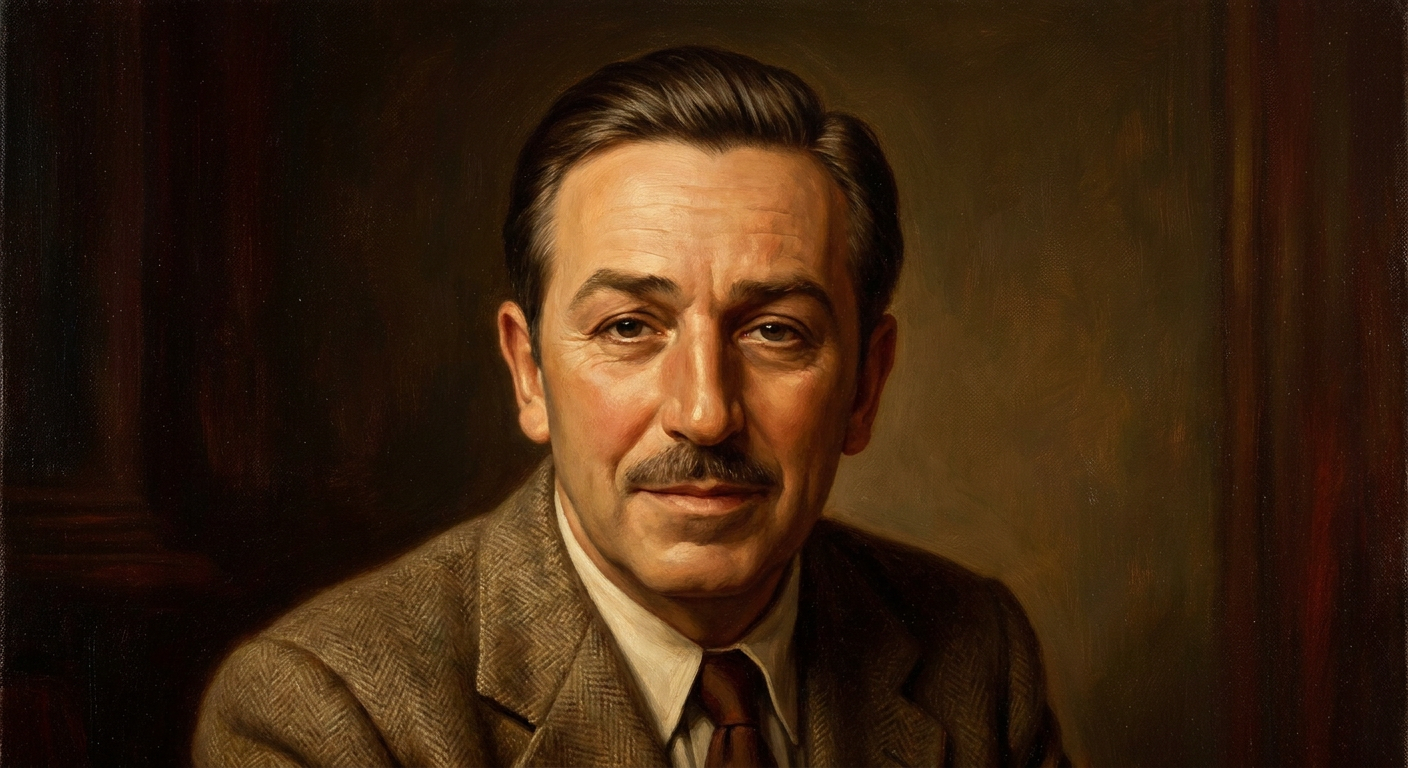
Quick Facts
- Years
- 1901 – 1966
- Category
- Artists & Composers
- Nationality
- American
- Occupation
- Animator, film producer, entrepreneur, voice actor and theme-park innovator
Walt Disney
1901 – 1966 · American · Animator, film producer, entrepreneur, voice actor and theme-park innovator
Recommended Audiobooks
Listen next from Marcus Alden

Life Lessons from Franz Liszt
Marcus Alden · 53 min

Life Lessons from Camille Saint-Saëns
Marcus Alden · 53 min
Walt Disney transformed animation from a cinematic novelty into a major form of storytelling. As an artist, producer and entrepreneur, he helped create Mickey Mouse, pioneered synchronized-sound cartoons, advanced feature-length animation and built Disneyland, a new kind of meticulously designed public entertainment space. By the time of his death in 1966, his name had become an international brand associated with imagination, technical innovation and family entertainment.
Disney's achievements were never his alone. Animators, musicians, engineers, writers, performers and business partners—including his brother Roy—turned ambitious ideas into finished works. Yet Walt possessed an unusual ability to identify possibilities, persuade others to pursue them and connect art with emerging technology. Films such as Snow White and the Seven Dwarfs, Pinocchio, Fantasia and Mary Poppins influenced generations of filmmakers, while Disneyland reshaped the amusement industry.
His record was also complicated. Disney could be inspiring, demanding, paternalistic and fiercely anti-communist. His company experienced a bitter labor strike, and some productions perpetuated racial and cultural stereotypes. Historians continue to debate aspects of his politics and personality.
Disney remains worth studying not because every project succeeded or every decision deserves admiration, but because his career reveals how modern popular culture is made: through creativity, collaboration, risk, technology, commerce and control.
Quick Facts
| Fact | Details |
|---|---|
| Full Name | Walter Elias Disney |
| Common Name(s) | Walt Disney |
| Born | December 5, 1901 |
| Died | December 15, 1966 |
| Age at Death | 65 |
| Birthplace | Chicago, Illinois, United States |
| Nationality | American |
| Occupation | Animator, producer, entrepreneur, voice actor and theme-park developer |
| Historical Era | Early-to-mid-20th-century American cinema |
| Famous For | Mickey Mouse, animated features, Disneyland and television production |
| Political Affiliation | Generally Republican; publicly anti-communist |
| Religion | Raised in a Congregationalist Christian household; adult observance was comparatively private |
| Education | Benton Grammar School; McKinley High School; night study at the Chicago Academy of Fine Arts; no college degree |
| Parents | Elias Disney and Flora Call Disney |
| Spouse(s) | Lillian Bounds Disney, married 1925–1966 |
| Children | Diane Marie Disney Miller and Sharon Mae Disney Lund |
| Major Works | Steamboat Willie, Snow White and the Seven Dwarfs, Pinocchio, Fantasia, Bambi, Cinderella, Mary Poppins and Disneyland |
| Major Achievements | Popularized synchronized-sound animation; produced the first American full-length cel-animated feature; developed influential multiplane-camera techniques; created Disneyland; won 22 competitive Academy Awards |
Early Life
Walter Elias Disney was born in Chicago on December 5, 1901, the fourth son of Elias Disney and Flora Call Disney. He had four siblings: Herbert, Raymond, Roy and Ruth. Elias worked in several occupations, including construction and farming, while Flora had trained as a teacher.
In 1906 the family moved to a farm near Marceline, Missouri. Walt later remembered Marceline as an almost ideal rural community. Animals, trains and small-town streets became recurring elements in his work, although his nostalgic recollections should not obscure the family's financial difficulties.
The Disneys moved to Kansas City in 1911. Elias acquired a newspaper-delivery route, and Walt and Roy helped deliver papers before and after school. Walt later described the work as exhausting. He nevertheless found time to draw and attended Saturday art classes at the Kansas City Art Institute.
In 1917 the family returned to Chicago. Walt attended McKinley High School, contributed cartoons to its newspaper and took night classes at the Chicago Academy of Fine Arts. He left school without graduating. Too young to enlist during the First World War, he altered the birth date on an application to join the American Red Cross ambulance service. He reached France after the armistice and decorated vehicles with drawings.
Returning to Kansas City in 1919, Disney worked as a commercial artist. At the Pesmen-Rubin Commercial Art Studio he met Ub Iwerks, a gifted draftsman who became one of his most important early collaborators. Their complementary abilities—Disney's storytelling and promotion, Iwerks's technical drawing speed—helped establish the foundation of Disney animation.
Rise to Prominence
Disney and Iwerks briefly operated a commercial-art business before Disney joined the Kansas City Film Ad Company, where he learned cutout animation. Convinced that drawn animation offered greater possibilities, he created short films called Laugh-O-Grams.
The Laugh-O-Gram studio secured attention but not financial stability. Poor contracts, undercapitalization and Disney's inexperience pushed it into bankruptcy in 1923. Carrying a reel of an unfinished film combining live action and animation, Alice's Wonderland, Disney went to California.
Roy Disney, recovering from tuberculosis, joined him in Los Angeles. On October 16, 1923, distributor Margaret Winkler agreed to purchase a series of Alice comedies. That agreement is commonly treated as the beginning of the Disney Brothers Cartoon Studio. Walt directed creative work; Roy managed finances.
The brothers later produced cartoons featuring Oswald the Lucky Rabbit for distributor Charles Mintz. In 1928 Walt learned that Mintz controlled the character and had recruited several Disney artists. Losing Oswald became a formative lesson: Disney thereafter placed exceptional importance on owning characters and distribution rights.
Walt, Iwerks and collaborators developed Mickey Mouse. The first two Mickey films failed to secure a distributor, but Steamboat Willie, released in November 1928, used synchronized sound with unusual precision. It became a sensation. Disney voiced Mickey for years, while Iwerks supplied much of the character's early animation.
The studio continued experimenting through the musical Silly Symphonies. Flowers and Trees became the first commercially released three-strip Technicolor cartoon and won the first Academy Award for animated short subject. Mickey, Donald Duck, Goofy and Pluto soon became internationally recognizable figures.
Major Achievements
Transforming Sound and Color Animation
Steamboat Willie was not the first sound cartoon, but its close coordination of movement, effects and music demonstrated sound's storytelling power. Disney then negotiated exclusive access to three-strip Technicolor for cartoons for a limited period. These decisions helped establish technical standards competitors had to match.
Snow White and Feature Animation
During the 1930s Disney committed the studio to Snow White and the Seven Dwarfs. Many observers considered a feature-length cartoon financially reckless, and the press nicknamed it “Disney's Folly.” Costs rose to about $1.5 million, forcing Disney to seek additional financing.
Released in 1937, Snow White became an enormous commercial success. It proved that audiences would emotionally engage with sustained animated storytelling. The film funded a new Burbank studio and encouraged feature animation worldwide. Its success depended on hundreds of artists, especially women in ink-and-paint departments whose labor was essential but long received less public recognition.
The Ambitious Features of the 1940s
Pinocchio, Fantasia, Dumbo and Bambi expanded animation's visual and emotional range. Fantasia combined classical music with experimental imagery and introduced the stereophonic Fantasound system. Initial returns were uneven, partly because war closed overseas markets, but several films later became canonical.
During the Second World War, the studio produced military training films, insignia and government-sponsored educational pictures. This work kept facilities active while placing Disney production within the American wartime information system.
Television and Diversification
Disney embraced television when many film executives regarded it as a threat. Programs such as Disneyland, The Mickey Mouse Club and Walt Disney's Wonderful World of Color promoted films and parks while creating successful entertainment in their own right. Walt's calm on-screen persona made him a familiar presence in American homes.
The company also expanded into documentaries and live-action cinema. Its True-Life Adventures nature films won awards, although scholars have criticized some sequences for staging or manipulating animal behavior. Mary Poppins in 1964 successfully combined live action, animation and music and became one of the studio's greatest triumphs.
Disneyland
Disneyland opened in Anaheim, California, on July 17, 1955. Its nationally televised opening day suffered from heat, crowding, unfinished surfaces and operational problems. The park nevertheless became a major success.
Rather than presenting unrelated rides along a midway, Disneyland organized experiences into themed environments. Designers—eventually called Imagineers—used architecture, landscaping, sound, controlled sightlines and narrative progression to create coherent worlds. The model influenced parks, museums, shopping districts and urban entertainment projects internationally.
EPCOT and the Florida Project
During his final years, Disney secretly purchased land in central Florida. Walt Disney World was planned as more than an eastern Disneyland. Disney's most radical idea was the Experimental Prototype Community of Tomorrow, or EPCOT: a continuously updated city intended to demonstrate transportation and urban technology.
Disney died before construction began. Walt Disney World opened in 1971 under Roy Disney's supervision, but EPCOT was not built as Walt's residential city. EPCOT Center, opened in 1982, became a theme park inspired only partly by his concept.
Leadership or Work
Disney led by presenting a compelling goal and asking specialists to solve practical problems. He was not the studio's strongest draftsman, and after the 1920s he rarely animated scenes himself. His main creative role became that of editor, storyteller and producer.
Story meetings were central to his method. Ideas were displayed as drawings on boards, allowing scenes to be rearranged and criticized. Disney frequently demanded revisions and pushed artists to study movement, anatomy and acting. He promoted technological experimentation when it served emotional clarity.
His strengths included curiosity, persistence, audience awareness and the ability to unite different art forms. He also understood promotion exceptionally well. His weaknesses included impatience, uneven financial judgment and a tendency toward personal control. Employees sometimes received enthusiastic praise, but others experienced him as intimidating or unpredictable.
Roy Disney supplied the financial discipline Walt often lacked. Their partnership was occasionally strained, particularly when Walt pursued expensive projects, yet it remained fundamental. Walt imagined possibilities; Roy found financing and built the corporate structure needed to sustain them.
Personal Life
Disney married studio employee Lillian Bounds in Lewiston, Idaho, on July 13, 1925. Their daughter Diane was born in 1933, and they adopted Sharon in 1936. Walt guarded his family's privacy and disliked having his daughters treated as public celebrities.
At home he enjoyed trains, miniatures and mechanical projects. In 1950 he completed the Carolwood Pacific Railroad, a miniature steam railway running around his Holmby Hills property. His fascination with transportation later influenced Disneyland's trains, monorail and other systems.
Disney played polo until injuries and declining health made the sport impractical. He was a heavy smoker for much of his adult life, commonly holding a cigarette but often having it removed from publicity photographs. In November 1966 doctors discovered lung cancer while treating a neck injury. He died of circulatory collapse associated with the disease on December 15, ten days after his sixty-fifth birthday.
Contrary to a persistent legend, his body was not cryonically frozen. He was cremated, and his ashes were interred at Forest Lawn Memorial Park in Glendale, California.
Philosophy or Beliefs
Disney emphasized optimism, progress, family life and the possibility of improving experience through design. His projects often presented technology as beneficial when guided by skilled planning. Disneyland's orderly environments reflected his preference for cleanliness, narrative coherence and controlled public space.
He was raised in a Congregationalist family and sometimes used broadly Christian moral language, but religion was not usually the explicit center of his public work. Claims portraying him as either exceptionally devout or entirely secular tend to simplify a private and changing subject.
Politically, Disney became a conservative Republican and forceful anti-communist. He supported organizations including the Motion Picture Alliance for the Preservation of American Ideals and testified before the House Committee on Un-American Activities in 1947. His views were shaped partly by the 1941 studio strike, which he believed involved communist influence. Critics argue that this interpretation reduced legitimate labor grievances to political subversion.
His public idealism coexisted with strict control over intellectual property, workers and commercial presentation. That tension—between imaginative freedom and managerial authority—runs throughout his career.
Challenges and Controversies
Bankruptcy and Financial Risk
Laugh-O-Gram failed, and later productions repeatedly strained studio finances. Pinocchio and Fantasia initially underperformed despite their artistry. Disney's willingness to risk capital enabled innovation, but it also exposed employees and investors to instability.
The 1941 Animators' Strike
Pay disparities, uncertain screen credit and management favoritism contributed to union organizing. After prominent artists were dismissed, employees struck for several weeks. Disney regarded the action as a personal betrayal; strikers saw it as a fight for fair representation. Federal mediation produced a settlement, but the conflict permanently altered the studio culture and Disney's politics.
Anti-Communism and the Blacklist Era
In testimony before Congress, Disney named former employees he believed were communists or agitators. His cooperation with anti-communist investigations remains one of the most criticized aspects of his life because Hollywood blacklisting damaged careers without normal judicial protections. Supporters note that fear of Soviet influence was widespread; that context explains, but does not erase, the consequences.
FBI records also show that Disney cooperated with the bureau and was designated a Special Agent in Charge contact, an honorary confidential-source category, in the 1950s. This did not make him a law-enforcement agent.
Race, Gender and Cultural Representation
Several Disney productions contain stereotypes now recognized as harmful, including scenes in Dumbo, Peter Pan and other films. Song of the South presented an idealized plantation-era setting and avoided the realities surrounding Reconstruction and racial oppression. The company has withheld the complete film from modern U.S. home-video and streaming release.
Some defenders emphasize changing historical conventions and the contributions of diverse artists. Critics respond that popularity amplified such imagery and shaped childhood perceptions. Both production context and cultural impact require examination.
Allegations of Antisemitism
Disney has sometimes been accused of antisemitism. Evidence shows that he associated with some conservative figures who held prejudiced views and welcomed filmmaker Leni Riefenstahl to his studio in 1938. However, several Jewish colleagues rejected the claim that he personally displayed systematic anti-Jewish hostility, and major biographers disagree over how to interpret the evidence. The strongest responsible conclusion is that the allegation remains contested and should not be repeated as established fact.
Authorship and the “Great Man” Problem
Branding encouraged audiences to imagine that Walt personally drew every character and created every story. In reality, Disney productions were intensely collaborative. Recognizing artists such as Ub Iwerks, Mary Blair, Les Clark, Ward Kimball, Frank Thomas, Ollie Johnston and countless less-famous workers does not eliminate Walt's contribution; it defines it more accurately.
Legacy
The Walt Disney Company became one of the world's most influential entertainment businesses, expanding into film studios, television networks, publishing, merchandise, resorts and streaming. Its scale long outlived its founder and has generated both admiration and concern about media concentration.
Disney's most durable artistic legacy is the elevation of animation as a vehicle for feature storytelling. Studios in the United States, Europe and Asia borrowed from—and reacted against—the Disney model. Even filmmakers who rejected its sentimentality or realism were working in a field it had helped transform.
Disneyland established standards for themed design, operations and environmental storytelling. Disney's Imagineers influenced museums, exhibitions and hospitality projects as well as amusement parks. Walt Disney World remains central to Florida tourism.
Institutions preserving his history include the Walt Disney Family Museum in San Francisco, the Walt Disney Archives and restored sites associated with his Kansas City career. His birthplace survives in Chicago, while Marceline celebrates its connection through the Walt Disney Hometown Museum.
Disney received 22 competitive Academy Awards and four honorary awards, more individual Oscars than any other person. He also received the Presidential Medal of Freedom in 1964 and was inducted into the Television Hall of Fame after his death.
His legacy remains powerful precisely because it is not simple. He expanded what popular entertainment could accomplish, yet his work also reflected the inequalities and ideological conflicts of twentieth-century America.
Interesting Facts
- Disney's middle name, Elias, honored his father.
- He arrived in France with the Red Cross only after the First World War armistice.
- His first Kansas City animation business ended in bankruptcy.
- The loss of Oswald the Lucky Rabbit strengthened his insistence on character ownership.
- Ub Iwerks animated much of the earliest Mickey Mouse footage.
- Walt provided Mickey's voice from 1928 until the 1940s.
- Mickey was initially considered for the name Mortimer; Lillian preferred Mickey.
- Flowers and Trees was the first commercially released cartoon in three-strip Technicolor.
- Disney received a special Oscar for Snow White accompanied by seven miniature statuettes.
- The multiplane camera created depth by photographing artwork on separate glass layers.
- Disney's studio designed hundreds of military insignia during the Second World War.
- He visited South America in 1941 on a U.S.-supported goodwill mission.
- His private miniature railroad carried passengers around his garden.
- Disneyland's opening was watched on live national television.
- Disney purchased Florida land through separate companies to limit price speculation.
- He never saw Walt Disney World completed.
- The EPCOT he proposed was intended to be a functioning residential city.
- He holds the record for the most individual competitive Academy Awards.
- The claim that he was cryonically frozen is false.
- Roy insisted that the Florida resort be named Walt Disney World in his brother's honor.
Famous Quotes
- “I only hope that we never lose sight of one thing—that it was all started by a mouse.” Disney made versions of this observation when discussing Mickey and the growth of his company. It expressed gratitude for the character's decisive role, although Mickey himself arose from collaboration.
- “Disneyland will never be completed. It will continue to grow as long as there is imagination left in the world.” Published in a 1956 Disneyland souvenir book, this described the park as an evolving creative project rather than a finished monument.
- “We keep moving forward, opening new doors, and doing new things, because we're curious.” From Disney's discussion of creative progress, this summarizes the curiosity that drove his expansion into sound, features, television and parks.
- “All our dreams can come true, if we have the courage to pursue them.” Widely associated with Disney, but a reliable primary source is difficult to establish; its attribution should be treated as uncertain.
- “It's kind of fun to do the impossible.” Documented in connection with Disney's reflections on difficult projects, the line captures his enjoyment of challenges others considered commercially unrealistic.
- “I have been up against tough competition all my life. I wouldn't know how to get along without it.” Reported from his writings and interviews, this reflected a career shaped by rival studios, distributors and changing media.
- “I do not make films primarily for children. I make them for the child in all of us.” Disney repeatedly explained his audience in similar terms. The statement shows his aim to create family entertainment rather than work restricted to young viewers.
- “When you're curious, you find lots of interesting things to do.” Associated with Disney's television-era commentary, this aligns with his experimental working style.
- “We believed in our idea—a family park where parents and children could have fun together.” Disney used this explanation when recounting Disneyland's origins. It identifies the park's intergenerational ambition.
- “Animation can explain whatever the mind of man can conceive.” Disney used this idea when describing animation's educational and imaginative range, not merely its capacity for comedy.
Timeline
- 1901 — Born in Chicago, Illinois.
- 1906 — Family moves to a farm near Marceline, Missouri.
- 1911 — Moves to Kansas City and helps deliver newspapers.
- 1917 — Returns to Chicago and attends McKinley High School.
- 1918 — Joins the American Red Cross ambulance service.
- 1919 — Begins commercial-art work in Kansas City and meets Ub Iwerks.
- 1922 — Establishes Laugh-O-Gram Films.
- 1923 — Laugh-O-Gram fails; Disney relocates to California and begins the Alice series with Roy.
- 1925 — Marries Lillian Bounds.
- 1927 — Begins producing Oswald the Lucky Rabbit cartoons.
- 1928 — Loses control of Oswald; Mickey Mouse debuts publicly in Steamboat Willie.
- 1932 — Flowers and Trees advances color animation; Disney receives his first competitive Oscar.
- 1933 — Daughter Diane is born; Three Little Pigs becomes a hit.
- 1936 — Walt and Lillian adopt Sharon.
- 1937 — Snow White and the Seven Dwarfs premieres.
- 1940 — Pinocchio and Fantasia are released; the Burbank studio opens.
- 1941 — Animators strike; Disney undertakes a South American goodwill tour.
- 1942 — Bambi is released; wartime government production expands.
- 1947 — Testifies before the House Committee on Un-American Activities.
- 1950 — Cinderella strengthens the studio's finances.
- 1954 — Disney television anthology begins; construction advances on Disneyland.
- 1955 — Disneyland and The Mickey Mouse Club open.
- 1961 — Becomes involved in planning attractions for the 1964–1965 New York World's Fair.
- 1964 — Mary Poppins premieres; Disney receives the Presidential Medal of Freedom.
- 1965 — Publicly announces the Florida project.
- 1966 — Records his EPCOT presentation and dies on December 15.
- 1971 — Walt Disney World opens under Roy Disney's supervision.
- 1982 — EPCOT Center opens as a theme park rather than Walt's planned city.
Frequently Asked Questions
1. What was Walt Disney's greatest achievement?
There is no single objective answer. Snow White proved that feature-length cel animation could achieve artistic depth and commercial success, while Disneyland transformed themed public entertainment. Mickey Mouse supplied the international recognition and revenue that made later experiments possible. Historians therefore often treat Disney's greatest achievement as the creation of an organization capable of combining art, technology, storytelling and commerce across several media—not simply one film or character.
2. Did Walt Disney draw Mickey Mouse?
Disney participated in developing Mickey's personality and early stories, but Ub Iwerks performed most of the animation for the first Mickey films and refined the visual design. Walt voiced Mickey and controlled the character's development. Saying Disney single-handedly drew or invented Mickey overlooks Iwerks and other studio workers; saying he had no role understates his direction, performance and understanding of character-based entertainment.
3. Was Mickey Mouse Disney's first character?
No. Before Mickey, Disney produced Laugh-O-Gram fairy-tale cartoons, the hybrid Alice comedies and Oswald the Lucky Rabbit shorts. Oswald was particularly important because losing contractual control of him taught Disney to protect ownership of characters. Mickey was the breakthrough character Disney controlled, not his first animated creation. Oswald's rights were eventually reacquired by the Disney company in 2006.
4. Why was Steamboat Willie important?
Sound cartoons existed before Steamboat Willie, so it should not be called the first. Its importance came from the precise, entertaining synchronization of music, effects and action. Audiences encountered sound as an integral part of the comedy rather than a loosely attached novelty. Its success made Mickey famous, secured distribution and demonstrated Disney's ability to turn new technology into a clear storytelling advantage.
5. Did people really think Snow White would fail?
Yes, some industry observers doubted that audiences would tolerate a feature-length cartoon, and escalating costs created genuine danger. The nickname “Disney's Folly” reflects that skepticism, although later accounts sometimes dramatize the opposition. The finished film succeeded because it combined character animation, music, comedy and emotional storytelling. Its profits financed studio expansion and convinced competitors that animated features could constitute a viable business.
6. Was Walt Disney a good animator?
Disney could draw and animate, particularly during his early Kansas City and silent-film years, but he was not the studio's greatest technical animator. Ub Iwerks and later specialists possessed stronger draftsmanship and performance skills. Walt's exceptional ability lay in identifying story problems, judging audience response and coordinating talent. His mature profession is best understood as creative producer and director, even though “animator” remains an accurate description of his beginnings.
7. Why did Disney employees strike in 1941?
The strike grew from wage disparities, inconsistent credit, layoffs, favoritism and disagreement over union representation. Disney believed he had built a close studio community and saw collective action as disloyal. Many artists instead believed the company's paternal culture denied them fair bargaining power. The settlement recognized union representation, but the episode damaged relationships and encouraged several prominent artists to leave. It also intensified Disney's anti-communism.
8. Was Walt Disney antisemitic?
The historical evidence does not support presenting this disputed allegation as a settled fact. Critics cite his conservative associations, his meeting with Leni Riefenstahl and prejudices within the era's entertainment industry. Several Jewish employees and associates defended him, while biographers have reached different conclusions about particular incidents. A careful judgment distinguishes documented actions from later rumor and acknowledges that uncertainty does not excuse stereotypes appearing in some studio productions.
9. Was Walt Disney racist?
A one-word label can conceal more than it explains. Some Disney films unquestionably reproduced racist stereotypes, and Song of the South offered a deeply misleading treatment of the post-Civil War South. Disney also employed and worked with artists from varied backgrounds, though leadership opportunities were unequal. Historians examine both personal evidence and institutional output. Whatever Disney's private intentions, widely distributed images had real cultural effects and deserve criticism.
10. Was Walt Disney involved with the FBI?
Yes. Documents released under freedom-of-information laws show that Disney communicated with the FBI and became a Special Agent in Charge contact during the 1950s. That designation referred to a trusted confidential source, not an actual federal officer with police authority. He shared information and permitted bureau interests to influence certain television arrangements. The relationship fit his strong anti-communism and his desire to maintain favorable government connections.
11. Did Walt Disney create Disneyland by himself?
No. Walt originated and championed the concept, made major creative decisions and supervised development, but architects, artists, engineers, horticulturalists and operations specialists built the park. Important collaborators included Harper Goff, Herb Ryman, Marc Davis and many others. Financing also depended on ABC and outside investors. Disney's achievement was leadership and synthesis: he organized specialized contributions into an unusually consistent environment.
12. Why did Walt Disney enter television?
Television offered both creative opportunity and financing. Disney used ABC's investment to help build Disneyland, while the Disneyland anthology program promoted the park and recycled or expanded studio material. Unlike many movie executives, he recognized that television could strengthen rather than simply compete with cinema. Programs also established Walt himself as a reassuring host, connecting viewers personally to the company and its projects.
13. What did Walt Disney intend EPCOT to be?
His Experimental Prototype Community of Tomorrow was planned as a functioning city, not a conventional theme park. It would have housed residents, restricted private automobile traffic in central areas and continually demonstrated new technologies. Corporations would test products there, making the city perpetually change. Critics question whether its corporate governance allowed meaningful democracy. After Walt died, the company judged the residential vision impractical and eventually built EPCOT Center instead.
14. Did Walt Disney win more Oscars than anyone else?
Yes, Disney holds the record for the most Academy Awards won by an individual. He received 22 competitive Oscars and four honorary awards from 59 nominations. The famous special award for Snow White included one standard statuette and seven smaller ones. Awards recognized cartoons, documentaries, nature films and technological or creative achievements, illustrating the breadth of studio production under his supervision.
15. Was Walt Disney frozen after death?
No. This is one of the most persistent celebrity myths. Disney was cremated shortly after his death in December 1966, and his ashes were interred at Forest Lawn Memorial Park in Glendale. No reliable contemporary evidence supports cryonic preservation. The story likely flourished because cryonics attracted publicity during the period and because Disney's fascination with futuristic technology made the invented connection seem believable.
16. How did Walt Disney die?
Doctors discovered lung cancer in November 1966 after Disney entered the hospital for treatment connected with a neck injury. Surgeons removed his left lung, but the disease was advanced. He died on December 15, 1966, from circulatory collapse associated with the cancer. His decades of heavy cigarette smoking were a major health risk, although studio publicity had often concealed cigarettes in photographs.
17. What happened to the company after his death?
Roy Disney postponed retirement to complete the Florida resort, which he named Walt Disney World. It opened in 1971, shortly before Roy's death. The company then passed through periods of uncertainty, revival and major expansion. Later leadership developed international parks, acquired prominent entertainment companies and entered streaming. These choices greatly expanded the corporation but cannot automatically be treated as Walt's own intentions.
Lessons We Can Learn
- Treat failure as evidence, not destiny. Laugh-O-Gram's bankruptcy taught Disney about contracts and finance. Modern advice to “embrace failure” is interpretation; the documented lesson is that he changed his practices afterward.
- Protect essential rights. Losing Oswald showed the importance of intellectual-property ownership. Creators today should understand agreements before surrendering control.
- Pair vision with complementary expertise. Walt relied on Roy's financial skills and Iwerks's drawing ability. Ambitious work rarely succeeds through one person's talents alone.
- Use technology to serve a clear purpose. Sound, color and the multiplane camera mattered because they strengthened stories. Novelty without audience value was not enough.
- Research raises creative quality. Disney artists studied animals, actors and motion. Preparation can support imagination rather than restrict it.
- Calculated risks require financing. Snow White succeeded spectacularly, but its cost nearly endangered the studio. Courage and financial planning must coexist.
- New media can become allies. Disney used television to finance and promote Disneyland. Established organizations can adapt by exploring rather than dismissing new platforms.
- Workplace culture requires fairness. The 1941 strike demonstrates that a leader's belief in a “family” atmosphere cannot replace transparent pay, credit and representation.
- Popular images carry responsibility. Harmful stereotypes in Disney films show that entertainment can shape social attitudes even when creators claim innocent intentions.
- A legacy is collaborative and contested. Disney's reputation rests on his vision and thousands of employees' labor. Responsible history recognizes achievement without turning admiration into mythology.
Related Historical Figures
- Roy O. Disney — Walt's brother, financial partner and co-founder who stabilized the company and completed Walt Disney World.
- Ub Iwerks — Early collaborator who animated the first Mickey films and later developed important visual-effects technology.
- Lillian Disney — Walt's wife and trusted private adviser, traditionally credited with favoring the name Mickey over Mortimer.
- Margaret J. Winkler — Distributor whose 1923 contract for the Alice comedies helped launch the Disney studio.
- Max Fleischer — Rival animation pioneer whose studio competed with Disney through characters and technical experimentation.
- David O. Selznick — Influential film producer whose large-scale Hollywood career paralleled Disney's combination of business and spectacle.
- Mary Blair — Artist whose bold color and design shaped films and attractions, especially “it's a small world.”
- Sergei Eisenstein — Soviet filmmaker and admirer of Disney animation who analyzed its fluid transformations and emotional force.
- Jim Henson — Later creator who similarly combined characters, television, film, family entertainment and a recognizable creative company.
- Hayao Miyazaki — Japanese animation director whose internationally influential features invite comparison with—and often depart from—the Disney tradition.
Watch and Learn
“Defunctland: Walt Disney's City of the Future, E.P.C.O.T.” — Defunctland — approximately 41 minutes. This widely viewed documentary examines Disney's original EPCOT proposal using archival recordings, plans and historical context. It is recommended because it clearly distinguishes Walt's planned experimental city from the theme park that opened in 1982, while also addressing the project's technological optimism and unresolved political questions.
Watch and Learn
Defunctland: Walt Disney's City of the Future, E.P.C.O.T. · Defunctland
Related Historical Figures