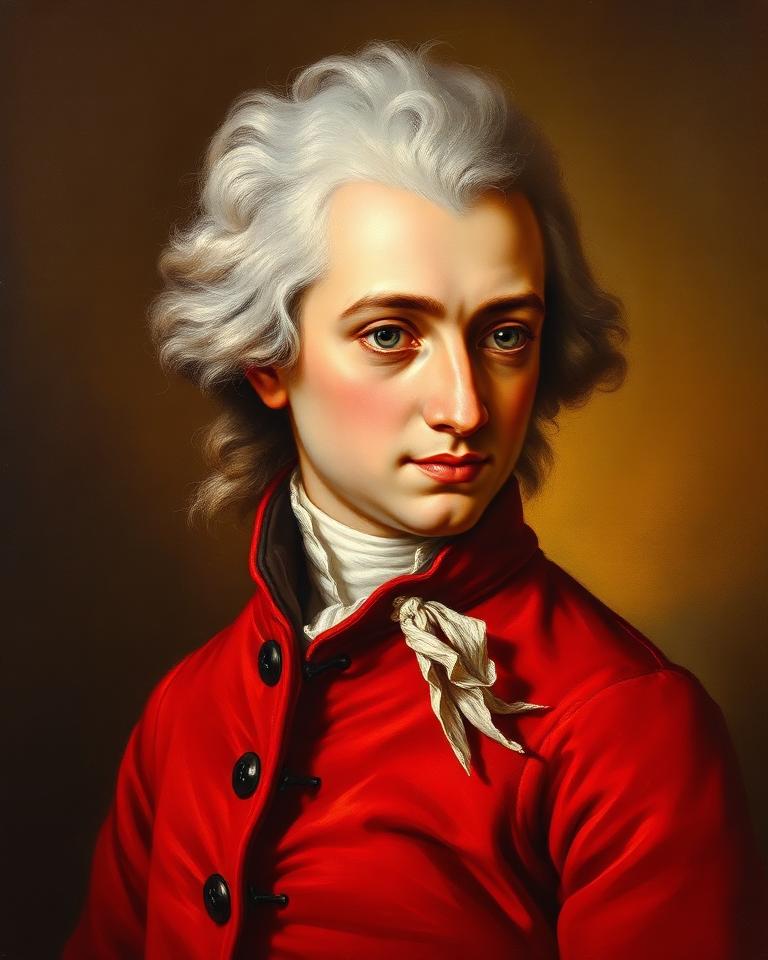
Quick Facts
- Years
- 1756 – 1791
- Category
- Artists & Composers
- Subcategory
- Classical Composers
- Nationality
- Austrian
- Occupation
- Composer
Wolfgang Amadeus Mozart
1756 – 1791 · Austrian · Composer
Audiobook

Life Lessons from Wolfgang Amadeus Mozart
Marcus Alden · 53 min
Introduction
Wolfgang Amadeus Mozart (1756–1791) was an Austrian composer, pianist, violinist and conductor whose music stands at the summit of the Classical era. In a life lasting only 35 years, he created more than 600 works across nearly every important genre of his time: opera, symphony, concerto, chamber music, sacred music, songs and works for solo keyboard. His mature compositions combine technical mastery with emotional immediacy, balancing elegance and clarity with drama, humor, melancholy and psychological depth.
Mozart first became famous as a child prodigy. Guided by his father, Leopold Mozart, he traveled through the courts and cultural centers of Europe, astonishing aristocratic audiences with his keyboard playing, improvisation and ability to compose at an exceptionally young age. These journeys exposed him to a remarkable range of national styles, from Italian opera and French dance music to German counterpoint and the cosmopolitan orchestral writing of Mannheim.
As an adult, Mozart struggled to transform early celebrity into lasting professional security. After leaving the service of the prince-archbishop of Salzburg, he established himself in Vienna as a freelance performer and composer—an ambitious and relatively independent career choice in an age when many musicians depended on courts or churches. During the 1780s he produced an extraordinary sequence of piano concertos, chamber works and operas, including The Marriage of Figaro, Don Giovanni and Così fan tutte.
Mozart died in Vienna on 5 December 1791 while working on his Requiem. The incompleteness of that score, the circumstances of its anonymous commission and the composer’s early death later encouraged legends, including the unsupported claim that he had been poisoned by his rival Antonio Salieri. Historical evidence instead presents a more complex figure: a disciplined craftsman as well as a prodigy, an inventive entrepreneur as well as a court-trained musician, and a composer whose humanity remains audible in every part of his work.
Quick Facts
| Category | Details |
|---|---|
| Full baptismal name | Joannes Chrysostomus Wolfgangus Theophilus Mozart |
| Common name | Wolfgang Amadeus Mozart |
| Born | 27 January 1756 |
| Birthplace | Salzburg, Prince-Archbishopric of Salzburg, Holy Roman Empire |
| Died | 5 December 1791 |
| Place of death | Vienna, Archduchy of Austria, Holy Roman Empire |
| Age at death | 35 |
| Nationality and cultural identity | Salzburg-born Austrian composer of the Classical era |
| Parents | Leopold Mozart and Anna Maria Walburga Mozart, née Pertl |
| Sibling | Maria Anna Mozart, known as “Nannerl” |
| Spouse | Constanze Weber, married 4 August 1782 |
| Surviving children | Karl Thomas Mozart and Franz Xaver Wolfgang Mozart |
| Main occupations | Composer, pianist, violinist, violist, conductor and teacher |
| Principal residences | Salzburg and Vienna |
| Major genres | Opera, symphony, concerto, chamber music, sacred music and keyboard music |
| Approximate output | More than 600 works listed in the Köchel catalogue |
| Famous works | The Marriage of Figaro, Don Giovanni, The Magic Flute, Jupiter Symphony, Eine kleine Nachtmusik and the Requiem |
| Patron and final court appointment | Emperor Joseph II appointed him chamber composer in 1787 |
| Catalogue abbreviation | K. or KV, referring to Ludwig von Köchel’s catalogue |
| Burial place | St. Marx Cemetery, Vienna; exact grave location unknown |
Early Life & Background
Mozart was born on 27 January 1756 in Salzburg, then the capital of an independent ecclesiastical principality within the Holy Roman Empire. He was baptized the following day at Salzburg Cathedral as Joannes Chrysostomus Wolfgangus Theophilus Mozart. “Amadeus” is the Latin form of the Greek-derived name Theophilus, meaning “beloved of God.” Mozart himself often used “Wolfgang Amadè,” particularly in adult correspondence.
His father, Leopold Mozart, was a violinist, composer and respected music educator employed by the Salzburg court. In 1756—the year of Wolfgang’s birth—Leopold published an influential violin treatise, Versuch einer gründlichen Violinschule. Mozart’s mother, Anna Maria Walburga Pertl, came from St. Gilgen near Salzburg. Of the couple’s seven children, only Wolfgang and his elder sister, Maria Anna, survived infancy.
Maria Anna, born in 1751 and known as Nannerl, was herself a highly talented keyboard player. Leopold began teaching her, and the young Wolfgang listened closely. By the age of five, he was playing keyboard instruments and composing short pieces that Leopold wrote down. His earliest surviving compositions, including a minuet and trio entered in Nannerl’s music notebook, date from around 1761.
Recognizing the extraordinary abilities of both children, Leopold arranged public and private performances. In January 1762 the family traveled to Munich, where the children performed at the Bavarian court. Later that year they visited Vienna and appeared before Empress Maria Theresa at Schönbrunn Palace. Stories of the young Mozart’s confidence, memory and improvisational powers circulated widely.
From 1763 to 1766, the Mozart family undertook an extensive European tour. They visited Munich, Augsburg, Frankfurt, Brussels, Paris, London, The Hague and numerous smaller cities. In London, Mozart met Johann Christian Bach, the youngest surviving son of Johann Sebastian Bach. Johann Christian’s elegant, melodic style and approach to the concerto had a lasting influence on him.
The tour was educational but physically demanding. Travel was slow, accommodations were inconsistent and both children suffered illnesses. Leopold nevertheless treated the journey as a practical musical education. Wolfgang encountered leading performers, new instruments, unfamiliar genres and contrasting regional styles. He also composed for the audiences and ensembles available to him, developing an unusual adaptability.
Following the family’s return to Salzburg, Mozart continued writing symphonies, sacred works and theatrical music. In 1768, while in Vienna, he composed the opera La finta semplice, although disputes and professional rivalries delayed its intended production. His German singspiel Bastien und Bastienne probably received a private performance around the same period.
Between 1769 and 1773, Mozart and his father made three journeys to Italy, the center of European opera. In Milan, Mozart’s opera Mitridate, re di Ponto was successfully staged in December 1770. He later composed Ascanio in Alba and Lucio Silla for Milan. In Bologna, he studied with the renowned theorist Giovanni Battista Martini and was admitted to the Accademia Filarmonica.
A celebrated account from the first Italian journey describes Mozart hearing Gregorio Allegri’s Miserere in the Sistine Chapel and writing it down from memory. The story was promoted by Leopold and may have been embellished, but it reflects Mozart’s exceptional auditory memory and the public image built around his gifts.
Rise to Prominence
After his Italian successes, Mozart returned to a less glamorous professional environment in Salzburg. In 1772 he was appointed concertmaster in the court orchestra of Prince-Archbishop Hieronymus Colloredo. The position provided a salary and opportunities to compose, but Salzburg’s musical life offered limited scope for the operatic and instrumental ambitions Mozart had developed abroad.
During the early and middle 1770s, he produced symphonies, serenades, divertimenti, sacred music and violin concertos. Works such as the Symphony No. 25 in G minor, K. 183, show the dramatic intensity associated with the Sturm und Drang style. His five authenticated violin concertos were all written in Salzburg in 1773 and 1775.
Mozart increasingly resented his subordinate status and sought a more prestigious appointment. In 1777, after failing to secure release for another journey with his father, he traveled with his mother to Munich, Mannheim and Paris. Mannheim possessed one of Europe’s finest orchestras, famous for its disciplined playing and dynamic effects. There Mozart formed friendships with musicians and fell in love with the singer Aloysia Weber.
No permanent appointment materialized. In Paris, Mozart’s mother became ill and died on 3 July 1778. Mozart was devastated and initially softened the news in letters to his father before reporting her death directly. His Paris visit nevertheless produced important music, including the Symphony No. 31 in D major, known as the “Paris” Symphony.
Mozart returned reluctantly to Salzburg in early 1779 and accepted the position of court organist. His opera Idomeneo, commissioned for Munich and first performed on 29 January 1781, became a decisive artistic breakthrough. Drawing on the traditions of Italian opera seria while expanding the role of the chorus and orchestra, Idomeneo demonstrated his command of large-scale music drama.
Conflict with Archbishop Colloredo soon reached a breaking point. Mozart was summoned to Vienna as part of the archbishop’s household but objected to being treated as a servant and prevented from pursuing independent opportunities. In June 1781, after a series of arguments, the archbishop’s chief steward, Count Karl Joseph Arco, formally dismissed him. Mozart remained in Vienna, determined to build an independent career.
His first years there were highly successful. He gave concerts, published music, taught wealthy pupils and became known as one of the city’s finest pianists. His singspiel Die Entführung aus dem Serail—The Abduction from the Seraglio—premiered at Vienna’s Burgtheater on 16 July 1782 and became his first major popular stage success.
Major Achievements
Mozart’s achievement rests not simply on the quantity of his music but on the breadth and sustained quality of his output. He absorbed established forms and transformed them through melodic invention, harmonic daring, rhythmic vitality and profound sensitivity to instrumental and vocal character.
His piano concertos were central to his Viennese career. Mozart usually composed them for subscription concerts at which he appeared as soloist and director. Between 1782 and 1786, he wrote a remarkable series that includes the concertos in D minor, K. 466; C major, K. 467; E-flat major, K. 482; A major, K. 488; and C minor, K. 491. These works turned the concerto into an arena of dramatic interaction between soloist and orchestra.
Mozart’s operatic partnership with the Italian librettist Lorenzo Da Ponte produced three masterpieces. Le nozze di Figaro—The Marriage of Figaro—premiered in Vienna on 1 May 1786. Based on a controversial comedy by Pierre Beaumarchais, it combines social tension with complex characterization and intricately organized ensembles.
Don Giovanni, first performed in Prague on 29 October 1787, blends comedy, tragedy and supernatural drama. Its title character is charismatic, predatory and ultimately defiant in the face of damnation. Così fan tutte, premiered in Vienna on 26 January 1790, uses an apparently artificial story of exchanged lovers to explore desire, loyalty, performance and self-deception.
His instrumental music was equally significant. The six string quartets dedicated to Joseph Haydn, composed between 1782 and 1785, reflect intensive study of Haydn’s quartet writing while asserting Mozart’s own contrapuntal and dramatic voice. Haydn reportedly told Leopold Mozart in 1785 that Wolfgang was “the greatest composer known to me in person or by name.”
Mozart’s final three symphonies—No. 39 in E-flat major, No. 40 in G minor and No. 41 in C major, the “Jupiter”—were composed during the summer of 1788. Their exact original performance circumstances remain uncertain. The “Jupiter” Symphony concludes with a contrapuntal finale in which several themes combine with extraordinary clarity and momentum.
His sacred works include the Great Mass in C minor, K. 427, left incomplete, and the Requiem in D minor, K. 626. Earlier Salzburg church works, such as the Coronation Mass, also remain important. His chamber output includes the Clarinet Quintet in A major, K. 581, and the String Quintet in G minor, K. 516, while his orchestral serenades include Eine kleine Nachtmusik, K. 525.
Modern scholarship numbers Mozart’s works through the catalogue first published by Ludwig von Köchel in 1862. Revised editions have corrected chronology and attribution, but Köchel numbers remain the standard means of identifying individual works.
Defining Moments
One defining moment was Mozart’s childhood encounter with European musical life. His tours transformed him from a gifted Salzburg child into a cosmopolitan musician familiar with Italian opera, French taste, English concert life and German instrumental traditions.
A second was the Italian premiere of Mitridate in 1770. Mozart was only 14, yet he successfully handled professional singers, theatrical conventions and public expectations in one of Europe’s most demanding operatic environments.
The death of his mother in Paris in 1778 marked a personal and professional crisis. The journey had failed to secure employment, his romance with Aloysia Weber did not develop as he hoped, and relations with his father became strained.
His dismissal from Archbishop Colloredo’s service in 1781 was another turning point. Although humiliating, it allowed Mozart to pursue a freelance career in Vienna. For several years, he achieved considerable artistic and financial success without holding a major permanent court position.
His admission to the Freemasons in December 1784 influenced his social circle and some of his music. Masonic themes of fraternity, enlightenment, moral testing and reconciliation are especially evident in The Magic Flute.
Finally, the year 1791 brought both renewed success and death. Mozart completed the Clarinet Concerto, The Magic Flute and La clemenza di Tito, while working on the Requiem. His final months were not simply a steady decline into obscurity; they were intensely productive and included significant public recognition.
Timeline
| Year | Event |
|---|---|
| 1756 | Born in Salzburg on 27 January and baptized the following day |
| 1761 | Composes some of his earliest surviving keyboard pieces |
| 1762 | Performs with Nannerl in Munich and at the imperial court in Vienna |
| 1763–1766 | Undertakes an extensive family tour through western Europe |
| 1764–1765 | Lives and performs in London; meets Johann Christian Bach |
| 1768 | Composes La finta semplice and Bastien und Bastienne |
| 1769 | Begins the first of three Italian journeys with Leopold |
| 1770 | Mitridate, re di Ponto premieres in Milan |
| 1771 | Ascanio in Alba is performed in Milan |
| 1772 | Appointed concertmaster at the Salzburg court |
| 1773 | Composes Symphony No. 25 in G minor, K. 183 |
| 1775 | Writes several violin concertos and La finta giardiniera |
| 1777 | Leaves Salzburg with his mother to seek employment |
| 1778 | Anna Maria Mozart dies in Paris on 3 July |
| 1779 | Returns to Salzburg as court organist |
| 1781 | Idomeneo premieres in Munich; Mozart leaves Archbishop Colloredo’s service |
| 1782 | The Abduction from the Seraglio premieres; marries Constanze Weber |
| 1784 | Joins the Viennese Masonic lodge Zur Wohltätigkeit |
| 1785 | Completes several quartets dedicated to Joseph Haydn |
| 1786 | The Marriage of Figaro premieres in Vienna |
| 1787 | Leopold Mozart dies; Don Giovanni premieres in Prague; Mozart becomes imperial chamber composer |
| 1788 | Composes Symphonies Nos. 39, 40 and 41 |
| 1789 | Tours German cities, including Dresden, Leipzig and Berlin |
| 1790 | Così fan tutte premieres in Vienna |
| 1791 | La clemenza di Tito and The Magic Flute premiere; Mozart dies on 5 December |
| 1792 | Franz Xaver Süssmayr’s completion of the Requiem is delivered to its commissioner |
| 1862 | Ludwig von Köchel publishes the first chronological catalogue of Mozart’s works |
Personal Life
Mozart married Constanze Weber on 4 August 1782 at St. Stephen’s Cathedral in Vienna. Constanze was the younger sister of Aloysia Weber, with whom Mozart had once been infatuated. Leopold initially opposed or hesitated over the marriage, contributing to tension between father and son.
The couple had six children, but only two survived infancy: Karl Thomas, born in 1784, and Franz Xaver Wolfgang, born in 1791. Infant mortality was common in eighteenth-century Europe, but the repeated losses were nevertheless profound family tragedies.
Mozart’s surviving letters reveal an affectionate, playful and sometimes coarse personality. His scatological humor, shared with several family members and reflecting broader South German and Austrian comic traditions, has often surprised later readers. It coexisted with seriousness about music, family responsibilities and professional reputation.
The Mozarts enjoyed periods of comfort, particularly during Wolfgang’s successful early Viennese years. They occupied well-appointed apartments, employed servants and participated in an active social life. Their finances later became unstable because of fluctuating income, expenses, debts and the decline of profitable public concerts. Mozart repeatedly borrowed money from his fellow Freemason Michael Puchberg.
Constanze has sometimes been unfairly depicted as irresponsible or indifferent to her husband’s work. In reality, she managed difficult circumstances after his death, arranged memorial concerts, negotiated publications and helped preserve his reputation. She later married the Danish diplomat Georg Nikolaus Nissen, who worked with her on an important early Mozart biography.
Mozart had a complicated relationship with Leopold, who served as teacher, manager and adviser. Leopold’s ambitions made Wolfgang’s early career possible, but he had difficulty accepting his son’s independence. Their correspondence shows deep affection as well as conflict over employment, marriage, money and personal judgment.
Beliefs & Philosophy
Mozart was raised as a Roman Catholic and composed extensively for the Catholic liturgy. His letters contain religious language, and he received the last rites during his final illness. At the same time, his faith existed within the intellectual and social environment of the Enlightenment, in which reason, tolerance and moral improvement were widely discussed.
In December 1784, Mozart joined the Viennese Masonic lodge Zur Wohltätigkeit—“Beneficence.” Freemasonry in Joseph II’s Vienna attracted aristocrats, professionals and intellectuals interested in fraternity, philanthropy and Enlightenment ideals. Leopold also became a Mason during a visit to Vienna in 1785.
Mozart wrote several works for Masonic occasions, including the Masonic Funeral Music, K. 477. The Magic Flute incorporates imagery associated with initiation, trials, brotherhood, wisdom and the triumph of light over darkness. Its symbolism, however, also draws on fairy tale, popular theater and broader Enlightenment culture.
His letters suggest a practical philosophy shaped by work, friendship, family loyalty and awareness of mortality. In an often-quoted letter of 4 April 1787, written while Leopold was seriously ill, Mozart described death as humanity’s true destination and as a source of consolation rather than terror. The passage demonstrates a reflective acceptance of mortality, though it should not be treated as a complete philosophical system.
Artistically, Mozart believed deeply in clarity, expression and theatrical truth. His operas reveal no simple division between noble and comic characters. Servants, aristocrats, seducers, lovers and outsiders are all granted distinct musical identities. His music repeatedly suggests that technical order and human complexity need not be opposites.
Challenges & Controversies
Mozart’s career was shaped by the insecurity of musical employment. His break with Archbishop Colloredo offered independence but removed the protection of a regular court position. Vienna’s concert economy depended on fashion, aristocratic patronage and political conditions. The Austro-Turkish War beginning in 1788 contributed to economic uncertainty and reduced opportunities for lavish private entertainment.
His financial difficulties have sometimes been exaggerated into a picture of permanent poverty. Mozart earned substantial sums at various points, but his income was irregular, his household expenses were high and he accumulated debts. Surviving appeals to Michael Puchberg document genuine distress, though not unbroken destitution.
The cause of Mozart’s death remains uncertain. Contemporary records described “severe miliary fever,” a nonspecific diagnosis rather than a modern medical explanation. Later theories have proposed infections, rheumatic disease, kidney failure and other conditions, but the surviving evidence does not permit a definitive diagnosis.
There is no credible evidence that Antonio Salieri poisoned Mozart. Rumors circulated after Mozart’s death and were amplified by nineteenth-century literature, especially Alexander Pushkin’s drama Mozart and Salieri, Nikolai Rimsky-Korsakov’s opera based on it, and later Peter Shaffer’s play Amadeus. Mozart and Salieri were professional competitors, but they also moved in the same musical world, and evidence indicates mutual respect on some occasions.
Mozart was not buried in a “pauper’s grave” in the modern sense. He received a standard third-class funeral and was buried in a common grave at St. Marx Cemetery, in accordance with Viennese practices and burial regulations of the period. Such graves were not reserved solely for the destitute. The exact location of his remains is unknown.
Another controversy concerns the completion of the Requiem. The work had been anonymously commissioned by Count Franz von Walsegg, who apparently intended to present it in memory of his wife. After Mozart’s death, Constanze arranged for the score to be completed, chiefly by Franz Xaver Süssmayr, so that she could collect the remaining fee. Modern performances may use Süssmayr’s version or one of several later reconstructions.
Famous Quotes
Translations and wording vary among editions of Mozart’s letters. The following passages are among those grounded in surviving correspondence rather than later fictional portrayals.
“I cannot write poetically, for I am no poet. I cannot arrange the parts of speech with such art that they cast shadows and light, for I am no painter. Even by signs and gestures I cannot express my thoughts and feelings, for I am no dancer. But I can do so by means of sounds, for I am a musician.”
—Letter to his father, 8 November 1777
“As death, when we come to consider it closely, is the true goal of our existence, I have formed during the last few years such close relations with this best and truest friend of mankind that his image is not only no longer terrifying to me, but is indeed very soothing and consoling.”
—Letter to Leopold Mozart, 4 April 1787
“I must finish now, because I’ve got to compose at breakneck speed.”
—Letter to Maria Anna Mozart, 13 February 1782
“Prague should hold on to me—and should reward me. But it is too late now.”
—Letter reflecting Mozart’s strong reception in Prague, 1787
The widely repeated statement that Mozart’s art came easily only because he had worked harder than anyone else is often linked to Friedrich Rochlitz’s later anecdotes. Because Rochlitz was not always a reliable source, such quotations should not be treated as securely documented words from Mozart.
Legacy & Influence
Mozart’s reputation grew rapidly after his death. Memorial concerts, publications and biographies helped establish him as a central figure in European music. The unfinished Requiem acquired particular symbolic power, while his operas and instrumental works entered a gradually expanding canon.
Ludwig van Beethoven admired Mozart deeply and modeled aspects of his early concertos, chamber works and piano writing on him. Joseph Haydn recognized his exceptional stature during his lifetime. Later composers—including Franz Schubert, Frédéric Chopin, Johannes Brahms, Pyotr Ilyich Tchaikovsky and Richard Strauss—studied, arranged, quoted or paid tribute to his music.
Mozart’s operas transformed musical characterization. Rather than merely pausing the action for decorative arias, his mature stage works use ensembles and orchestral writing to reveal simultaneous emotions and changing relationships. The finales of The Marriage of Figaro are especially influential examples of dramatic accumulation through music.
His concertos established a lasting model for dialogue between soloist and orchestra. His chamber music demonstrated how equality among instruments could produce both intellectual complexity and conversational naturalness. His symphonies brought together lyricism, formal balance and contrapuntal power.
The image of Mozart has also influenced literature, theater and film. Peter Shaffer’s stage play Amadeus and Miloš Forman’s 1984 film adaptation introduced millions to Mozart’s music, although both deliberately fictionalized his personality and relationship with Salieri.
Today, Mozart’s works are performed in concert halls, opera houses, churches, schools and homes across the world. His music is used in education because it illuminates form, harmony, orchestration and dramatic expression, but it also remains popular beyond academic settings. Its durability lies partly in its dual nature: it can sound immediately graceful while revealing deeper structural and emotional layers through repeated listening.
Interesting Facts
- Mozart was born in the building now known as Mozart’s Geburtshaus at Getreidegasse 9 in Salzburg.
- Only two of Leopold and Anna Maria Mozart’s seven children survived infancy.
- Mozart’s sister Nannerl was also a gifted musician, but the social expectations placed on women limited her professional opportunities.
- He wrote his first known compositions at about five years old.
- As a child, he performed before Empress Maria Theresa in Vienna and King George III in London.
- He could play the violin and viola as well as keyboard instruments and particularly enjoyed playing viola in chamber ensembles.
- His first opera written for Milan, Mitridate, was composed when he was 14.
- Mozart did not consistently call himself “Amadeus”; “Wolfgang Amadè” was one of his preferred adult forms.
- The Köchel catalogue assigns numbers to his works in approximate chronological order.
- He kept a personal thematic catalogue of his compositions from 1784 until shortly before his death.
- Eine kleine Nachtmusik was probably composed in 1787, but its original occasion is unknown.
- Mozart owned a starling whose song he recorded in a notebook. He marked the bird’s death in 1787 with a humorous poem and funeral.
- The nickname “Jupiter” for Symphony No. 41 was not Mozart’s own and became attached to the work later.
- He often composed with particular performers in mind, including clarinetist Anton Stadler and soprano Josepha Hofer.
- The Queen of the Night in The Magic Flute was written for Josepha Hofer, Constanze’s sister.
- Mozart’s exact grave in St. Marx Cemetery has never been identified.
- The familiar monument at the cemetery marks a memorial site, not a confirmed burial location.
- His two surviving sons never married and left no direct descendants.
- The Requiem was unfinished at Mozart’s death and was completed principally by his pupil Franz Xaver Süssmayr.
- More than one chronological revision of the Köchel catalogue exists because scholarship continues to refine dates and attributions.
Frequently Asked Questions
Why is Wolfgang Amadeus Mozart so famous?
Mozart is famous for the exceptional quality, variety and emotional range of his music. He mastered nearly every major genre of his period and created enduring works in opera, symphony, concerto, chamber music and sacred music. His compositions unite formal precision with memorable melody and vivid characterization.
Was Mozart really a child prodigy?
Yes. Contemporary reports, manuscripts and family documents confirm that he performed publicly and composed at an extraordinarily young age. Leopold promoted his son’s abilities energetically, but the basic facts of Mozart’s early achievement are well established.
How many works did Mozart compose?
Mozart composed more than 600 catalogued works. The precise total depends on how incomplete pieces, arrangements, doubtful attributions and revised versions are counted. His compositions are generally identified by Köchel numbers, abbreviated K. or KV.
What are Mozart’s most famous compositions?
His best-known works include The Marriage of Figaro, Don Giovanni, The Magic Flute, the Requiem, Eine kleine Nachtmusik, the Clarinet Concerto, the “Jupiter” Symphony, Symphony No. 40 in G minor and several mature piano concertos.
Did Mozart and Salieri hate each other?
They were professional competitors in Vienna, but there is no evidence of the murderous hatred portrayed in later fiction. Salieri participated in Vienna’s musical life alongside Mozart and later taught Mozart’s son Franz Xaver. The poisoning story is unsupported.
What caused Mozart’s death?
The exact cause is unknown. Mozart suffered fever, swelling, pain and weakness during his final illness. Historical sources do not provide enough clinical detail for a certain modern diagnosis, and theories ranging from infection to kidney disease remain speculative.
Did Mozart die poor?
Mozart experienced serious financial difficulties and debts, especially during the late 1780s. However, he was not continuously impoverished and earned significant income during successful periods. His situation is best understood as financially unstable rather than simply destitute.
Was Mozart buried in a mass grave?
He was buried in a common grave at St. Marx Cemetery under ordinary Viennese funeral practices. This was not necessarily a mass grave in the modern disaster-related sense, nor does it prove that he was treated as a pauper. The grave’s exact location was later lost.
Who completed Mozart’s Requiem?
Several musicians contributed after Mozart’s death, but Franz Xaver Süssmayr produced the traditional completed version delivered to Count Franz von Walsegg. Süssmayr used Mozart’s completed sections, sketches and possibly oral instructions, while composing or expanding other portions.
Why did Mozart leave Salzburg?
Mozart believed that his duties under Archbishop Colloredo restricted his artistic and professional opportunities. After repeated disagreements over status, travel and outside performances, he was dismissed in 1781 and chose to remain in Vienna as an independent musician.
Did Mozart have perfect pitch?
Mozart clearly possessed an exceptional musical ear and memory, but “perfect pitch” is a modern technical label that cannot be tested retrospectively. Reports of his ability to identify and reproduce sounds make it plausible, but not historically provable.
What was Mozart’s relationship with Freemasonry?
Mozart joined a Viennese Masonic lodge in 1784 and remained active in Masonic circles. He wrote music for lodge ceremonies and incorporated themes of fraternity, wisdom and initiation into works such as The Magic Flute.
Lessons from Wolfgang Amadeus Mozart
- Talent requires disciplined development. Mozart’s gifts were extraordinary, but years of study, travel, rehearsal and practical composition shaped them.
- Learn from many traditions. He created a personal style by absorbing Italian, French, German, Austrian and English influences.
- Mastery can coexist with accessibility. His music demonstrates that technical sophistication need not prevent direct emotional communication.
- Independence carries risk. Leaving secure court employment gave Mozart artistic freedom but exposed him to financial instability.
- Collaboration strengthens art. His work with performers, patrons, librettists and fellow composers was essential to his success.
- Adapt to specific people and circumstances. Mozart often wrote to the strengths of individual singers and instrumentalists.
- Humor and seriousness are not opposites. His personality and music move naturally between comedy, tenderness, grief and grandeur.
- Reputation may change after death. Mozart’s modern image contains both historical truth and layers of myth created by later generations.
- A short life can have a vast impact. His 35 years produced a body of work that continues to shape global musical culture.
- Creative work can outlast uncertainty. Despite career setbacks, debt and illness, Mozart continued composing through his final months.
Further Reading
- Maynard Solomon, Mozart: A Life
- Stanley Sadie, Mozart: The Early Years, 1756–1781
- Simon P. Keefe, Mozart: The Reign of Love
- Cliff Eisen and Simon P. Keefe, editors, The Cambridge Mozart Encyclopedia
- Hermann Abert, W. A. Mozart
- Ruth Halliwell, The Mozart Family: Four Lives in a Social Context
- David Cairns, Mozart and His Operas
- Julian Rushton, Mozart
- Neal Zaslaw, Mozart’s Symphonies: Context, Performance Practice, Reception
- Robert W. Gutman, Mozart: A Cultural Biography
- Emily Anderson, editor and translator, The Letters of Mozart and His Family
- Otto Erich Deutsch, Mozart: A Documentary Biography
- Ludwig Ritter von Köchel, Chronological-Thematic Catalogue of the Complete Musical Works of Wolfgang Amadé Mozart
- The Digital Mozart Edition of the Internationale Stiftung Mozarteum
- The New Grove Dictionary of Music and Musicians, entry on Wolfgang Amadeus Mozart
Watch and Learn
Related Historical Figures