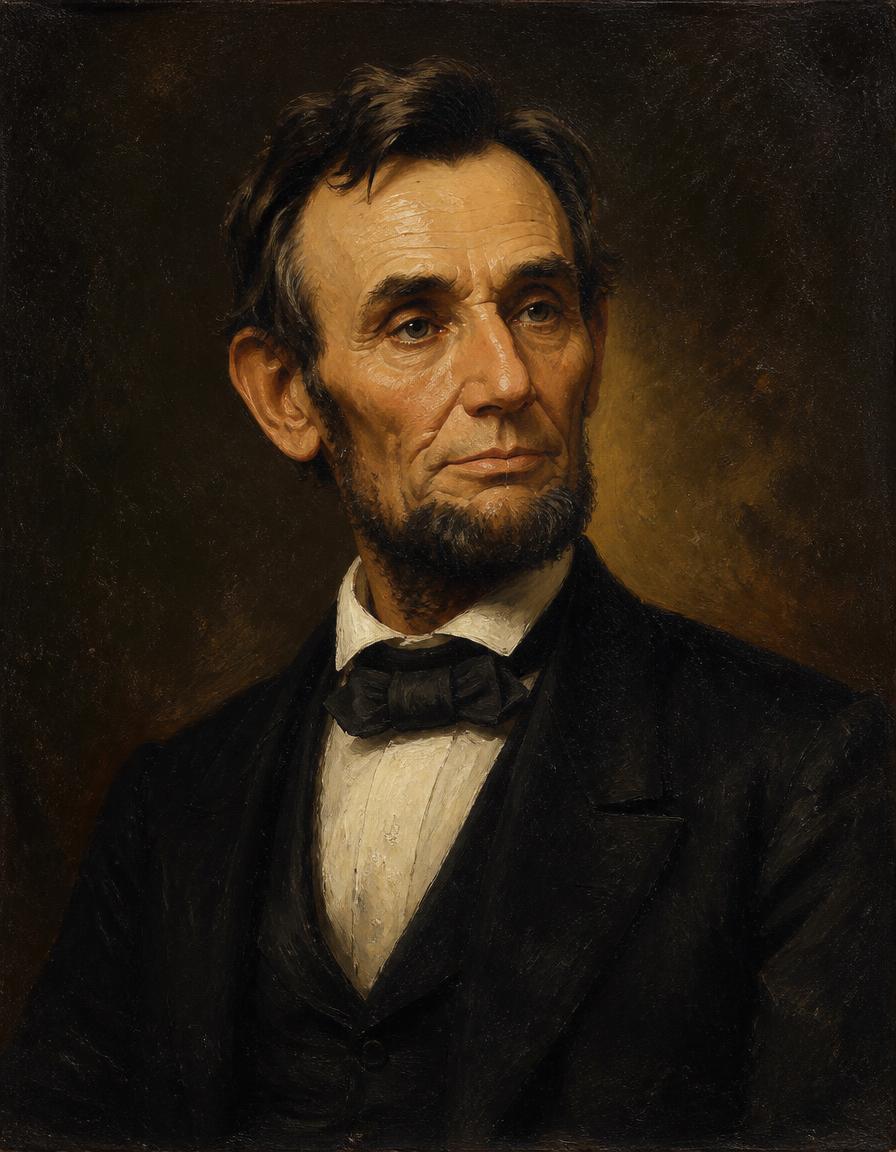
Quick Facts
- Years
- 1809 – 1865
- Category
- World Leaders & Revolutionaries
- Nationality
- American
- Occupation
- President & Statesman
Abraham Lincoln
1809 – 1865 · American · President & Statesman
Audiobook

Life Lessons from Abraham Lincoln
Marcus Alden · 55 min
Abraham Lincoln was the sixteenth president of the United States and the central political leader of the nation during the American Civil War. Born into poverty on the Kentucky frontier, he educated himself, became an Illinois lawyer and politician, and rose to national prominence through his opposition to the expansion of slavery.
Elected president in 1860, Lincoln faced the secession of Southern states and the creation of the Confederacy before he even took office. He preserved the Union through four years of devastating war, issued the Emancipation Proclamation, supported the enlistment of Black soldiers, and helped secure congressional passage of the Thirteenth Amendment abolishing slavery. His Gettysburg Address redefined the war as a test of democratic government and national equality.
Lincoln was neither politically infallible nor untouched by the prejudices and constitutional assumptions of his era. His policies on civil liberties, race, emancipation, military strategy, and Indigenous peoples remain subjects of serious historical examination. Yet his capacity to learn, manage disagreement, communicate moral purpose, and combine principle with political strategy made him one of the most consequential statesmen in American history. Assassinated just as Union victory arrived in 1865, Lincoln became a national martyr. He remains essential to debates about democracy, equality, executive power, leadership, and historical memory.
Quick Facts
| Field | Details |
|---|---|
| Full Name | Abraham Lincoln |
| Common Name(s) | Abraham Lincoln; Lincoln; Honest Abe |
| Born | February 12, 1809 |
| Died | April 15, 1865 |
| Age at Death | 56 |
| Birthplace | Sinking Spring Farm, near Hodgenville, Kentucky, United States |
| Nationality | American |
| Occupation | Lawyer, legislator, congressman, president, statesman |
| Historical Era | Antebellum America; American Civil War |
| Famous For | Preserving the Union, advancing emancipation, leading the United States during the Civil War, delivering the Gettysburg Address |
| Political Affiliation | Whig Party; later Republican Party |
| Religion | No formal church membership; deeply engaged with biblical language and providential belief |
| Education | About one year of intermittent formal schooling; largely self-educated |
| Parents | Thomas Lincoln and Nancy Hanks Lincoln |
| Spouse(s) | Mary Todd Lincoln, married 1842 |
| Children | Robert Todd, Edward Baker, William Wallace, and Thomas “Tad” Lincoln |
| Major Works | Gettysburg Address; Emancipation Proclamation; First and Second Inaugural Addresses; House Divided Speech |
| Major Achievements | Preserved the Union, made emancipation a Union war policy, supported the Thirteenth Amendment, expanded federal wartime capacity |
Early Life
Abraham Lincoln was born in a one-room log cabin on Sinking Spring Farm in Kentucky. His parents, Thomas and Nancy Hanks Lincoln, were farmers of modest means. Land-title disputes contributed to the family's move to Indiana in 1816, when the region remained a demanding frontier environment.
Lincoln's mother died in 1818, probably from milk sickness. Thomas married Sarah Bush Johnston the following year. Lincoln developed a warm relationship with his stepmother, who encouraged his reading. His sister Sarah died in childbirth in 1828; his younger brother had died in infancy.
The family moved to Illinois in 1830. Lincoln's formal schooling was brief and scattered, totaling roughly a year. He borrowed books and studied independently, reading the Bible, Aesop's fables, Shakespeare, biographies, law, and arithmetic. His physical strength became locally famous, but he preferred reading and writing to farm labor.
In 1831 Lincoln settled in New Salem, Illinois. He worked as a clerk, surveyor, postmaster, and laborer. During the Black Hawk War of 1832, his militia company elected him captain, an honor he later remembered proudly, although he saw no combat. New Salem exposed him to commerce, political discussion, and friendships that supported his ambitions.
Rise to Prominence
Lincoln ran unsuccessfully for the Illinois legislature in 1832 but won election in 1834 as a Whig. He served four terms and supported internal improvements, economic development, and legislative government. In 1837 he moved to Springfield and entered a law partnership with John T. Stuart. He later practiced with Stephen T. Logan and, most famously, William H. Herndon.
As a circuit lawyer, Lincoln traveled through central Illinois handling civil and criminal cases. His practice sharpened his command of evidence, plain language, and jury persuasion. He earned a reputation for preparation, humor, and practical reasoning rather than theatrical eloquence.
Lincoln served one term in the U.S. House of Representatives from 1847 to 1849. He criticized President James K. Polk's justification for the Mexican-American War, a stand that hurt him politically. He also introduced a proposal for compensated emancipation in the District of Columbia, though it went nowhere.
After leaving Congress, Lincoln concentrated on law. The Kansas-Nebraska Act of 1854 brought him back into politics. By allowing settlers to decide the slavery question in territories previously closed to slavery under the Missouri Compromise, the act intensified sectional conflict. Lincoln argued that slavery was morally wrong and must not be permitted to expand, while acknowledging that the federal government lacked clear authority to abolish it in states where it already existed.
He joined the new Republican Party and gained national attention in the 1858 Illinois Senate campaign. His debates with Democratic senator Stephen A. Douglas focused on slavery's expansion, popular sovereignty, and the meaning of equality. Lincoln lost the legislative contest but became nationally known. His 1860 Cooper Union address in New York demonstrated that many founders had accepted federal restrictions on slavery in the territories. That carefully researched speech strengthened his presidential prospects.
At the Republican convention in Chicago, Lincoln emerged as a compromise candidate more acceptable to different factions than front-runner William H. Seward. He won the presidency in November 1860 without carrying a Southern state. His victory triggered a secession crisis rooted above all in Southern leaders' determination to protect slavery.
Major Achievements
Preserving the Union
By Lincoln's inauguration on March 4, 1861, seven slaveholding states had declared secession. Four more joined the Confederacy after fighting began at Fort Sumter. Lincoln rejected secession as legally invalid and treated the conflict as an insurrection rather than a war between sovereign nations.
He mobilized troops, expanded the army and navy, instituted a blockade, and coordinated an unprecedented national war effort. Union victory in 1865 ended the Confederacy and preserved the United States. The result established that constitutional elections could not be overturned by unilateral secession and armed force.
Transforming the War Through Emancipation
Lincoln initially emphasized Union preservation, partly to retain the loyal slave states and Northern support. Enslaved people, abolitionists, military realities, and changing public opinion pushed emancipation forward. Congress also enacted confiscation laws and abolished slavery in the District of Columbia and federal territories.
After the strategic Union success at Antietam, Lincoln issued a preliminary proclamation. The final Emancipation Proclamation took effect on January 1, 1863, declaring enslaved people free in areas still in rebellion. It did not apply everywhere, and freedom depended on Union military advance, but it transformed federal policy and made slavery's destruction a central Union objective.
Enlisting Black Soldiers
The proclamation authorized the reception of African American men into United States service. By the war's end, approximately 180,000 Black soldiers had served in the Union Army, with additional service in the Navy. Their contribution added military strength, advanced claims to citizenship, and made restoration of slavery increasingly impossible.
Black troops endured discrimination, unequal pay for much of the war, and the threat of execution or re-enslavement if captured. Their service became one of emancipation's most consequential outcomes.
Advancing the Thirteenth Amendment
Because the proclamation rested on wartime authority and had limited geographic reach, constitutional abolition remained necessary. Lincoln publicly supported the Thirteenth Amendment and worked to secure votes for it in the House of Representatives. Congress approved it on January 31, 1865; the states ratified it after his death.
The amendment abolished slavery throughout the United States, except as punishment for crime. It placed emancipation on a permanent constitutional foundation.
Reframing American Democracy
At Gettysburg on November 19, 1863, Lincoln delivered a speech of about 270 words. He connected the Union cause to the Declaration of Independence and its proposition of human equality. He described the conflict as a test of whether democratic government could survive.
The Gettysburg Address became an enduring statement of national purpose. Its promise of a “new birth of freedom” influenced later movements seeking fuller equality.
Winning Reelection and Planning Reunion
Lincoln's reelection was uncertain in the difficult summer of 1864. Military victories, especially the capture of Atlanta, strengthened public confidence. Running with Democrat Andrew Johnson on the National Union ticket, Lincoln defeated George B. McClellan.
Reelection ensured continuity of the war effort and blocked any immediate movement toward a negotiated peace that might have preserved Confederate independence or slavery. Lincoln favored a relatively flexible process for restoring loyal governments, but his assassination left the shape of Reconstruction unresolved.
Leadership and Work
Lincoln combined patience, political calculation, humor, empathy, and persistence. He welcomed competing advice and appointed former rivals—including Seward, Salmon P. Chase, and Edward Bates—to his cabinet. The popular phrase “team of rivals” captures part of this arrangement, although historians caution that cabinet management remained contentious and depended on Lincoln's growing authority.
He wrote carefully, reduced complex issues to clear propositions, and used stories to lower tension or illustrate an argument. He visited military hospitals, reviewed troop movements, met ordinary petitioners, and spent long hours in the War Department telegraph office following campaigns.
Lincoln learned on the job as commander in chief. He replaced generals who would not act aggressively enough, sometimes misjudged commanders, and endured repeated defeats. His relationship with George B. McClellan was especially strained. In Ulysses S. Grant, Lincoln found a general prepared to coordinate sustained offensives across multiple theaters.
His strengths included resilience, strategic learning, emotional intelligence, and the ability to connect military policy with political objectives. His weaknesses included occasional indecision, excessive tolerance of poorly performing subordinates, and policies that imposed severe costs on civil liberties. He could be pragmatic to the point of frustrating reformers, yet he gradually adopted more far-reaching positions when he believed law, military necessity, and public support could sustain them.
Personal Life
Lincoln married Mary Todd on November 4, 1842. Mary was educated, politically interested, and from a prominent Kentucky family. Their marriage included affection and shared ambition but also grief, financial tension, political pressure, and episodes of conflict.
They had four sons. Edward died in 1850, William in 1862, and Tad in 1871. Only Robert Todd Lincoln lived to adulthood and survived into the twentieth century. Willie's death in the White House deeply affected both parents.
Lincoln was tall—about six feet four inches—with a distinctive, angular appearance. He enjoyed jokes, storytelling, poetry, theater, and Shakespeare. He disliked alcohol and tobacco and was known for informal manners. The nickname “Honest Abe” arose from his public reputation, though it was also useful political branding.
He experienced periods contemporaries described as melancholy, especially after personal and political disappointments. Retrospective psychiatric diagnosis is uncertain, but strong evidence indicates recurrent depression or severe low moods. He maintained close friendships with men such as Joshua Speed and long professional relationships with colleagues including William Herndon.
Philosophy and Beliefs
Lincoln's politics grew from the Whig tradition: respect for law, economic opportunity, internal improvements, education, and the belief that laborers should be able to improve their condition. He celebrated “free labor,” contrasting it with permanent enslavement.
He treated the Declaration of Independence's assertion of equality as a foundational moral principle. Yet his racial views changed over time and remained limited by modern standards. In the 1850s he denied advocating full social and political equality between Black and white Americans. By 1865 he publicly supported voting rights for at least some Black men, especially educated men and veterans. Frederick Douglass recognized Lincoln's growth while continuing to criticize his caution.
Lincoln never formally joined a church. His early views may have included religious skepticism, but his presidential writings increasingly invoked divine providence. The Second Inaugural Address presented the war as possible judgment upon both North and South for slavery, avoiding a simple claim that God favored one side.
Ethically, Lincoln sought to join moral purpose with constitutional process. He believed slavery wrong, but he usually acted through powers he considered legally defensible and politically sustainable.
Challenges and Controversies
Lincoln's administration suspended habeas corpus in certain circumstances, authorized military arrests, and suppressed some antiwar activity. Defenders argue that rebellion required extraordinary measures and note that elections and opposition newspapers continued. Critics contend that military detention and restrictions on speech exceeded legitimate executive authority. The arrest and military trial of Clement Vallandigham became a prominent controversy.
His emancipation policy developed gradually. Abolitionists criticized delays, proposals for compensated emancipation, and his longtime interest in voluntary Black colonization outside the United States. Supporters emphasize the danger of losing border states and the need to build a durable coalition. Scholars generally view emancipation as the product of many forces—including enslaved people's self-liberation—not the gift of one leader.
Lincoln's racial record is complex. He opposed slavery's expansion and eventually promoted abolition, Black military service, and limited Black suffrage. Nevertheless, he expressed racist assumptions common among white Americans of his period and did not advocate modern racial equality throughout most of his career.
His administration's Indigenous policy also draws criticism. During the U.S.-Dakota War of 1862, military commissions sentenced 303 Dakota men to death. Lincoln reviewed the cases and reduced the number executed to 38—the largest mass execution in U.S. history. His review prevented many deaths, but the executions and broader federal dispossession remain grave parts of his record.
The war itself involved conscription, immense casualties, property destruction, and harsh measures against civilians. Lincoln faced criticism from Radical Republicans who thought him too moderate, conservative Unionists who opposed emancipation, and Democrats who condemned wartime centralization.
Legacy
Lincoln's immediate legacy was shaped by victory, abolition, and assassination. John Wilkes Booth shot him at Ford's Theatre on April 14, 1865; he died the next morning. National mourning turned him into a martyr, sometimes simplifying a complicated political life into legend.
His ideas influenced Reconstruction, though his exact postwar program cannot be known. Later civil rights leaders repeatedly invoked the Declaration, emancipation, and the Gettysburg Address while pressing the nation to fulfill promises Lincoln had only partially advanced.
Major sites include the Lincoln Memorial in Washington, D.C.; President Lincoln's Cottage; Ford's Theatre; the Abraham Lincoln Presidential Library and Museum in Springfield; the Lincoln Home National Historic Site; and the Abraham Lincoln Birthplace National Historical Park. His image appears on the five-dollar bill and the cent.
Lincoln remains admired worldwide as a defender of democratic government. He is also studied critically for the expansion of presidential war powers, the limits of his racial views, Indigenous policy, and the role of myth in national memory. That combination of achievement and contradiction keeps his life relevant.
Interesting Facts
- Lincoln held a patent for a device intended to lift boats over shoals.
- He is the only U.S. president to receive a patent.
- His formal education totaled roughly one year.
- His militia company elected him captain during the Black Hawk War.
- He served only one term in the U.S. House before becoming president.
- He lost the 1858 Senate contest despite gaining national fame from it.
- Lincoln grew a beard after eleven-year-old Grace Bedell suggested it in a letter.
- He was the first Republican president.
- He was the first president born outside the original thirteen states.
- He frequently stored notes in his tall hat.
- He personally reviewed hundreds of military justice and pardon cases.
- The Gettysburg Address lasted only a few minutes.
- No single definitive manuscript of that address exists; five known copies in Lincoln's hand survive.
- He signed the Yosemite Grant in 1864, protecting land later incorporated into Yosemite National Park.
- He established Thanksgiving as a recurring national observance in 1863, building on earlier proclamations.
- He was the first U.S. president assassinated.
- He was attending the comedy Our American Cousin when shot.
- His coffin was viewed in numerous cities during a long funeral journey to Springfield.
Famous Quotes
- “A house divided against itself cannot stand.” — From the 1858 House Divided Speech. Adapting biblical language, Lincoln warned that the country could not remain permanently half slave and half free.
- “Those who deny freedom to others deserve it not for themselves.” — Letter to Henry L. Pierce and others, 1859. It states Lincoln's moral case against slavery.
- “I have never had a feeling politically that did not spring from the sentiments embodied in the Declaration of Independence.” — Independence Hall speech, 1861. Lincoln tied his political identity to the Declaration's principles.
- “My paramount object in this struggle is to save the Union.” — Letter to Horace Greeley, 1862. Written before the preliminary proclamation, it explained his public constitutional objective while noting his personal wish that all people could be free.
- “All persons held as slaves” within designated rebellious areas “are, and henceforward shall be, free.” — Emancipation Proclamation, 1863. This announced the new federal war policy.
- “Government of the people, by the people, for the people, shall not perish from the earth.” — Gettysburg Address, 1863. Lincoln defined Union victory as vital to democratic survival.
- “With malice toward none; with charity for all.” — Second Inaugural Address, 1865. He called for humility and reconstruction without vindictiveness.
- “Fondly do we hope—fervently do we pray—that this mighty scourge of war may speedily pass away.” — Second Inaugural Address. The passage frames war as tragedy and possible divine judgment.
- “Whenever I hear anyone arguing for slavery I feel a strong impulse to see it tried on him personally.” — Remarks to an Indiana regiment, 1865. Lincoln exposed the hypocrisy of defending bondage for others.
- “You can fool all the people some of the time…” — Commonly attributed to Lincoln, but the evidence is late and uncertain; scholars treat the attribution as disputed.
Timeline
- 1809 — Born in Kentucky on February 12.
- 1816 — Family moves to Indiana.
- 1818 — His mother, Nancy Hanks Lincoln, dies.
- 1819 — Thomas Lincoln marries Sarah Bush Johnston.
- 1830 — Family moves to Illinois.
- 1831 — Lincoln settles in New Salem.
- 1832 — Serves in the Black Hawk War and loses his first legislative race.
- 1834 — Elected to the Illinois legislature.
- 1836 — Receives a law license.
- 1837 — Moves to Springfield and begins legal practice there.
- 1842 — Marries Mary Todd.
- 1847 — Enters the U.S. House of Representatives.
- 1849 — Leaves Congress and returns to law.
- 1854 — Reenters active politics after the Kansas-Nebraska Act.
- 1856 — Joins the emerging Republican movement in Illinois.
- 1858 — Delivers the House Divided Speech and debates Stephen Douglas.
- 1860 — Gives the Cooper Union address, wins the Republican nomination, and is elected president.
- 1861 — Inaugurated; Civil War begins at Fort Sumter.
- 1862 — Signs the Homestead Act and preliminary Emancipation Proclamation; reviews Dakota cases.
- 1863 — Final Emancipation Proclamation takes effect; delivers Gettysburg Address.
- 1864 — Appoints Grant general-in-chief and wins reelection.
- 1865 — Supports passage of the Thirteenth Amendment; delivers Second Inaugural; Confederacy collapses.
- April 14, 1865 — Shot by John Wilkes Booth at Ford's Theatre.
- April 15, 1865 — Dies in Washington, D.C.
- December 1865 — Thirteenth Amendment is ratified.
Frequently Asked Questions
Why is Abraham Lincoln important?
Lincoln led the United States through the Civil War, preserved the Union, and helped turn the conflict into a struggle against slavery. The Emancipation Proclamation changed federal policy, enabled large-scale Black military enlistment, and undermined the Confederacy's labor system. His support helped the Thirteenth Amendment pass Congress. Through speeches such as the Gettysburg Address, he also articulated an influential vision of democracy grounded in equality and popular government. His wartime expansion of presidential power, however, continues to generate constitutional debate.
Was Abraham Lincoln born poor?
Lincoln was born to a farming family with limited wealth and unstable land ownership. His childhood involved physical work, migration, and few educational opportunities. Describing him as frontier poor is broadly accurate, although later campaign biographies polished the “log cabin” story into a powerful political symbol. His rise was unusual but also reflected the expanding economic and political opportunities available to some white men in the nineteenth-century West.
How did Lincoln educate himself?
Lincoln attended several brief local schools but received only about a year of formal instruction. He borrowed books, practiced writing and arithmetic, and read whenever work permitted. Later he studied grammar, surveying, and law independently. He learned legal procedure from books and professional contacts before obtaining his license. Calling him self-educated does not mean he learned without assistance; family members, neighbors, lawyers, and New Salem friends gave him access to books, discussion, and opportunity.
What political parties did Lincoln belong to?
Lincoln began as a Whig, supporting Henry Clay's vision of economic development, internal improvements, banking, and protective tariffs. The Whig Party collapsed amid sectional conflict over slavery. During the 1850s Lincoln joined the Republican Party, a coalition opposed to slavery's expansion into federal territories. He became its first successful presidential candidate in 1860. In 1864 he ran under the broader National Union label with Andrew Johnson to attract War Democrats as well as Republicans.
Did Lincoln free all enslaved people?
No single act by Lincoln immediately freed every enslaved person. The Emancipation Proclamation applied to areas in rebellion, exempting loyal slave states and certain Union-controlled regions. Its enforcement followed Union armies. Enslaved people also drove emancipation by escaping, resisting owners, and entering Union lines. State abolition, congressional legislation, military action, and Black service all mattered. The Thirteenth Amendment, ratified in December 1865, ended legal slavery nationwide except as punishment for crime.
Why did Lincoln wait to issue the Emancipation Proclamation?
Lincoln believed he needed a defensible constitutional basis, sufficient public support, and a military position that would prevent the order from appearing desperate. He also feared alienating loyal slave states such as Kentucky. Critics, especially abolitionists, argued that delay prolonged injustice. Lincoln eventually grounded the measure in commander-in-chief powers against rebellious areas and announced it after Antietam. Historians debate whether his timing was excessively cautious or politically necessary; most recognize both moral pressure and strategic calculation.
What was the significance of the Gettysburg Address?
The address connected the Civil War to the Declaration of Independence's principle that all people are created equal. Lincoln honored Union dead but also argued that their sacrifice must produce a “new birth of freedom.” By presenting the conflict as a test of whether representative government could survive, he gave the war international and democratic significance. The speech did not create equality by itself, but it became a standard against which later generations measured American conduct.
Did Lincoln believe in racial equality?
Lincoln's views evolved and cannot be reduced to a simple yes or no. He consistently opposed slavery's moral legitimacy, but in the 1850s he rejected full social and political equality and sometimes used language reflecting white prejudice. During the war he supported Black military service, met African American leaders, and came to endorse limited Black male suffrage. His movement was consequential, yet it stopped short of the equal-citizenship vision advocated by Black abolitionists and later civil rights movements.
Was Lincoln an abolitionist?
Lincoln opposed slavery but was not initially an abolitionist in the movement's usual antebellum sense. Abolitionists demanded immediate national action and often condemned constitutional compromises with slavery. Lincoln focused before the war on stopping slavery's expansion and placing it on a path toward eventual extinction. Wartime developments moved him toward immediate military emancipation and constitutional abolition. He ultimately achieved goals abolitionists had long demanded, while using different methods and moving more cautiously than they preferred.
Did Lincoln suspend habeas corpus?
Yes. His administration authorized suspension of habeas corpus in areas affected by rebellion, allowing detention without immediate judicial review. Lincoln argued that emergency action was necessary to prevent the destruction of the government and later received statutory support from Congress. Chief Justice Roger Taney challenged presidential authority in Ex parte Merryman. The issue remains central to debates over whether constitutional liberty may be restricted during rebellion and which branch controls emergency powers.
Why did Southern states secede after his election?
Secession declarations and speeches by Confederate leaders show that slavery was the central cause. Lincoln had promised not to abolish slavery where it already existed, but Republicans opposed its territorial expansion. Slaveholding leaders feared that restriction would weaken slavery politically, economically, and morally. They also feared future federal action and resistance by enslaved people. Tariffs and states' rights appeared in sectional politics, but states' rights arguments were repeatedly deployed to defend slavery.
How did Lincoln manage his cabinet?
Lincoln appointed prominent figures from different Republican factions, including Seward, Chase, Bates, and Edward Stanton. Several had greater national experience or had competed against him. He listened to disagreement, used private conversations and written memoranda, and gradually established control. Relationships were not always harmonious: Chase maneuvered politically, and cabinet members sometimes distrusted one another. Lincoln's achievement lay not in eliminating rivalry but in keeping talented, difficult officials directed toward the war effort.
What was Lincoln's relationship with Frederick Douglass?
Douglass initially criticized Lincoln for moving too slowly against slavery and tolerating discriminatory military policies. The two met several times during the war. Douglass pressed for equal pay and protection for Black soldiers and later said Lincoln treated him with unusual respect. He also described Lincoln as preeminently the white man's president while acknowledging that, viewed against his era and responsibilities, Lincoln advanced the cause of freedom. Their relationship illustrates both pressure from activists and presidential change.
What happened in the Dakota executions?
After the U.S.-Dakota War in Minnesota, military commissions condemned 303 Dakota men to death. Lincoln reviewed the records and sought to distinguish those convicted of attacks on civilians from participants in battles. He approved 39 executions, one of which was later suspended; 38 men were hanged at Mankato on December 26, 1862. Supporters cite his commutation of most sentences, while critics emphasize procedural injustice, dispossession, and the mass execution's enduring trauma.
Was Lincoln religious?
Lincoln used biblical language extensively but never joined a church. As a young man he may have held skeptical or unorthodox views. Personal loss and wartime catastrophe deepened his engagement with providence, prayer, judgment, and human inability to know God's purposes. The Second Inaugural is his fullest religious statement. It interprets the war as possible punishment for the national sin of slavery without claiming certainty that either side perfectly understood divine will.
Who assassinated Lincoln and why?
Actor and Confederate sympathizer John Wilkes Booth shot Lincoln at Ford's Theatre on April 14, 1865. Booth was part of a conspiracy that also targeted Vice President Andrew Johnson and Secretary of State William Seward. He hoped to avenge the Confederacy and destabilize the government. Lincoln died the next morning. Federal troops killed Booth on April 26; several conspirators were later convicted, and four were executed.
What would Lincoln have done during Reconstruction?
The answer is unknowable. Lincoln favored rapid restoration of loyal state governments and spoke of “malice toward none,” but he also insisted on ending slavery and, shortly before his death, endorsed voting rights for some Black men. His policies were still developing, and Congress would have constrained any presidential program. Claims that he certainly would have produced either a lenient or a strongly egalitarian Reconstruction go beyond the evidence.
Lessons We Can Learn
- Keep learning beyond formal education. Lincoln's disciplined self-study created professional opportunity; modern learners can use sustained reading to overcome limited beginnings.
- Explain complex ideas plainly. His speeches made constitutional questions understandable. Clear communication strengthens public trust.
- Let evidence change policy. Wartime experience moved Lincoln toward emancipation and Black enlistment. Adaptability is not necessarily inconsistency.
- Build broad coalitions. He balanced Republicans, border-state Unionists, and War Democrats. Durable change often requires partners with different motives.
- Pair ideals with workable strategy. Lincoln joined opposition to slavery with legal and military planning. Moral goals need effective implementation.
- Listen to critics. Abolitionists and Black leaders pushed him toward stronger policies. Leaders improve when they engage principled pressure.
- Accept responsibility in crisis. Lincoln absorbed blame for military setbacks while continuing to search for capable commanders.
- Avoid triumphalism. His Second Inaugural treated war as shared national judgment. Humility can prepare societies for reconciliation.
- Protect rights even under pressure. Civil-liberties controversies warn that emergency powers require scrutiny, oversight, and limits.
- Study heroes critically. Lincoln's achievements coexist with racial limitations and harmful Indigenous policy. Honest history supports mature civic judgment.
Related Historical Figures
- Mary Todd Lincoln — His wife, political partner, and mother of their four sons.
- Frederick Douglass — Abolitionist who criticized, met, and influenced Lincoln on emancipation and Black military equality.
- Stephen A. Douglas — Illinois rival whose debates with Lincoln made slavery's expansion a national issue.
- William H. Seward — Former presidential rival who became Lincoln's secretary of state and close adviser.
- Salmon P. Chase — Treasury secretary, antislavery leader, cabinet rival, and later chief justice.
- Ulysses S. Grant — Union general whose coordinated campaigns helped secure final victory.
- George B. McClellan — Union commander frequently at odds with Lincoln and his Democratic opponent in 1864.
- Jefferson Davis — Confederate president and Lincoln's principal opposing head of government.
- Harriet Tubman — Abolitionist, Underground Railroad conductor, scout, and wartime operative whose work embodied self-emancipation.
- John Wilkes Booth — Confederate sympathizer and actor who assassinated Lincoln in 1865.
Watch and Learn
Abraham Lincoln - U.S. President | Mini Bio | BIO · Biography
Related Historical Figures