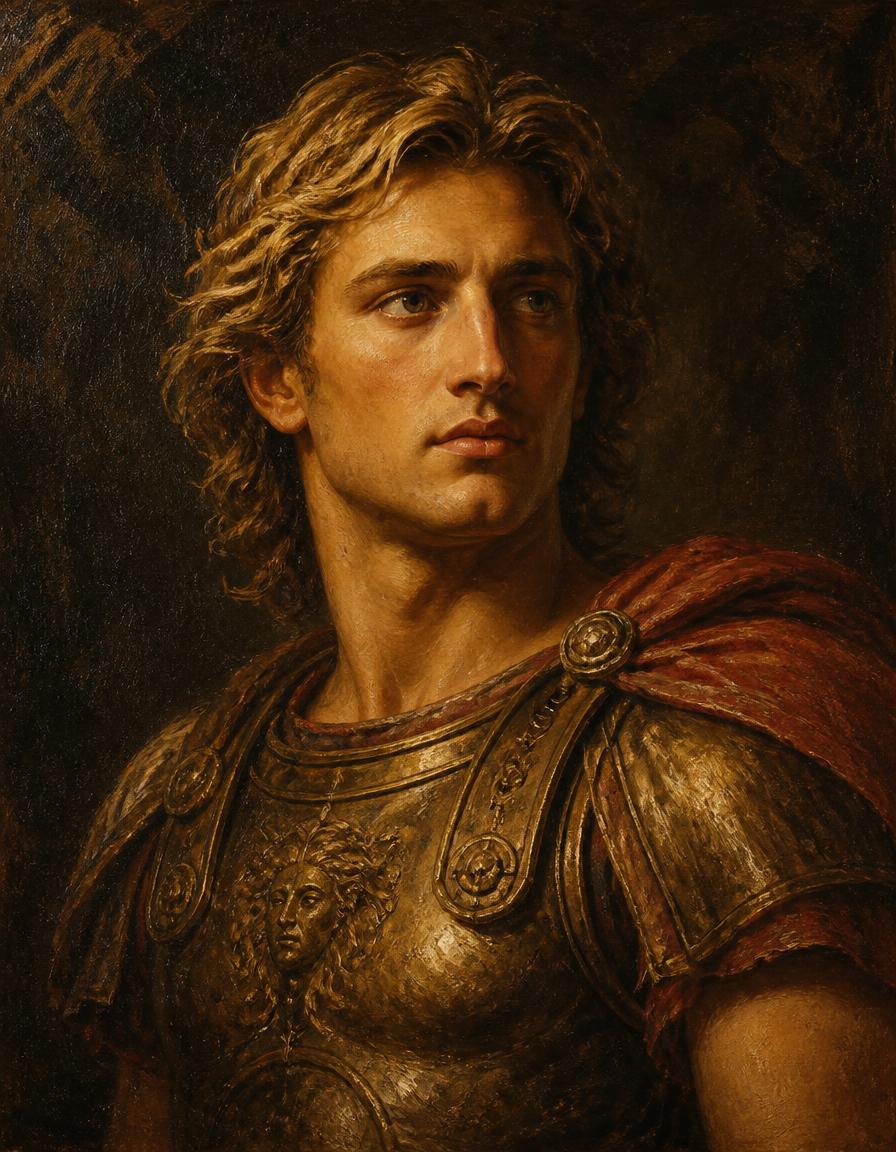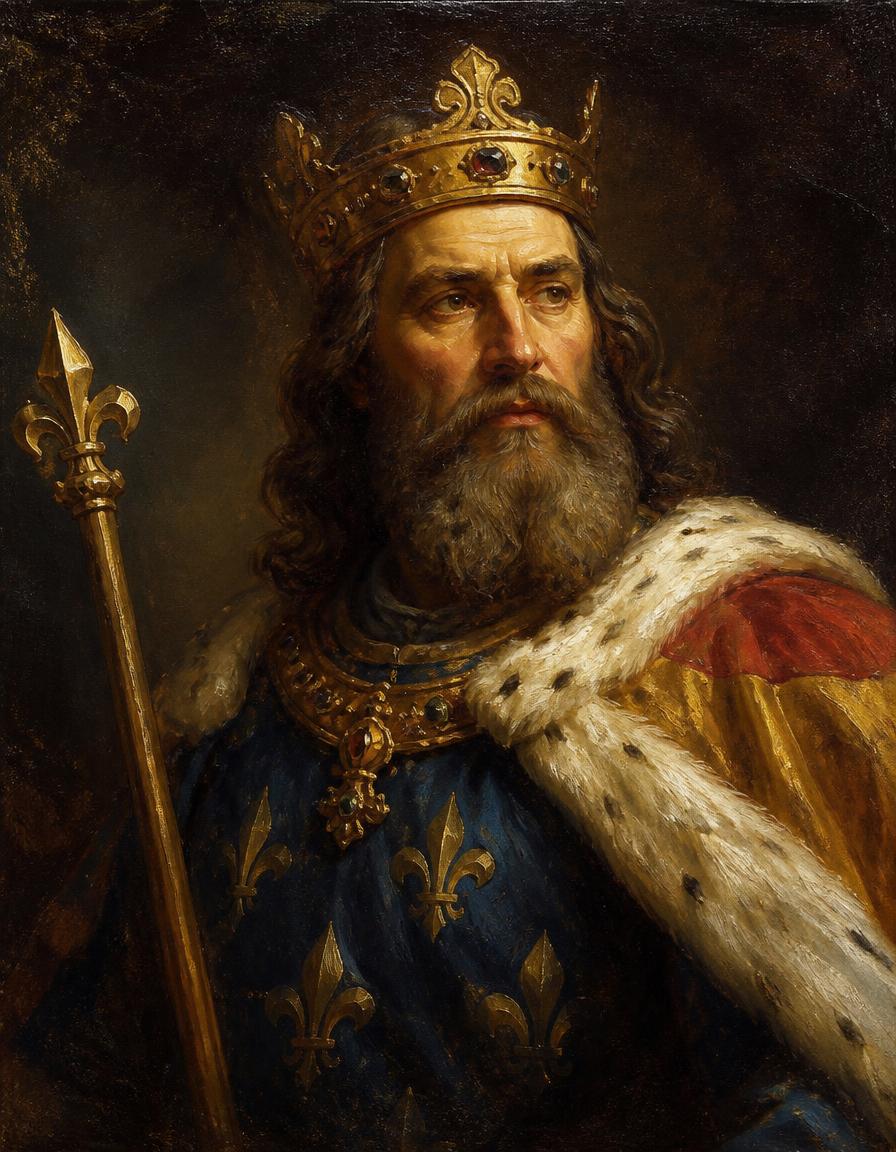
Quick Facts
- Years
- 748 – 814
- Category
- World Leaders & Revolutionaries
- Nationality
- Frankish
- Occupation
- King & Emperor
Charlemagne
748 – 814 · Frankish · King & Emperor
Audiobook

Life Lessons from Charlemagne
Marcus Alden · 55 min
Charlemagne, or Charles the Great, was king of the Franks from 768, king of the Lombards from 774, and the first western European emperor since antiquity. Through warfare, diplomacy, administration, and close cooperation with the Latin Church, he built a realm covering much of present-day France, Germany, the Low Countries, Switzerland, Austria, and northern Italy. Pope Leo III crowned him emperor in Rome on Christmas Day 800.
His importance extends beyond conquest. Charlemagne strengthened royal government through regional officials, assemblies, written decrees, and traveling inspectors. His court promoted the Carolingian Renaissance: a revival of learning that improved schools, Latin literacy, manuscript copying, and handwriting. The resulting Carolingian minuscule helped preserve classical and Christian texts and influenced later European scripts.
His reign also had a violent side. The long Saxon Wars involved forced conversion, deportation, and mass execution. His empire depended heavily on personal loyalty and military expansion, and it fragmented after his descendants divided it.
Charlemagne remains central to debates about medieval kingship, Christian empire, European identity, cultural revival, and coercive state-building. France and Germany have both claimed aspects of his legacy, while historians emphasize that he belonged to a Frankish world predating modern nations.
Quick Facts
| Field | Details |
|---|---|
| Full Name | Charles; Latin: Carolus; later called Carolus Magnus |
| Common Name(s) | Charlemagne, Charles the Great |
| Born | Traditionally 2 April 742; 747 or 748 is often favored by modern scholars |
| Died | 28 January 814 |
| Age at Death | About 65–66 if born in 747/748; traditionally given as 71 |
| Birthplace | Uncertain; traditionally associated with the Frankish heartlands, with Aachen or areas in modern Belgium sometimes proposed |
| Nationality | Frankish; modern nationality does not apply |
| Occupation | King, military commander, emperor |
| Historical Era | Early Middle Ages; Carolingian period |
| Famous For | Creating the Carolingian Empire, imperial coronation, Saxon Wars, Carolingian Renaissance |
| Political Affiliation | Carolingian dynasty |
| Religion | Latin Christianity |
| Education | Courtly instruction; learned Latin, rhetoric, theology, astronomy, and calculation, though his ability to write remained limited |
| Parents | Pepin the Short and Bertrada of Laon |
| Spouse(s) | Himiltrude's precise status is disputed; Desiderata; Hildegard; Fastrada; Luitgard; later companions included Madelgard, Gerswind, Regina, and Adallind |
| Children | At least 18 are commonly identified, though classifications vary; included Charles the Younger, Pepin of Italy, Louis the Pious, Rotrude, Bertha, Gisela, Drogo, and Hugh |
| Major Works | Capitularies and royal legislation issued in his name; Admonitio Generalis (789); no surviving book authored personally by him |
| Major Achievements | United much of western and central Europe, conquered Lombardy, subdued Saxony, became emperor, reformed administration, supported education and manuscript preservation |
Early Life
Charlemagne was the elder son of Pepin the Short, ruler of the Franks, and Bertrada of Laon. His birth date is uncertain. Einhard, his principal biographer, says little about his childhood, and later chronological evidence does not fit the traditional year 742 neatly. Many historians therefore prefer 747 or 748. His birthplace is likewise unknown.
The Carolingians had risen as mayors of the palace under the nominally ruling Merovingian kings. Charlemagne's grandfather, Charles Martel, consolidated the family's military and political power. In 751 Pepin removed the last Merovingian king, Childeric III, and assumed the crown with ecclesiastical support. Pope Stephen II later anointed Pepin and his sons, strengthening an alliance between the dynasty and the papacy.
Little is recorded about Charlemagne's formal education. As a prince, he probably learned warfare, hunting, riding, court ceremony, law, and Christian observance. He understood spoken Latin and later studied grammar, rhetoric, astronomy, and arithmetic. Einhard reports that he attempted writing in adulthood but never mastered it fully.
Charlemagne grew up in a mobile royal household. Kings governed by traveling among estates, meeting nobles, hearing disputes, rewarding followers, and leading armies. This environment taught him that Frankish rule depended on personal presence, military success, aristocratic cooperation, and religious legitimacy.
Rise to Prominence
Pepin died in 768 and divided the kingdom between Charlemagne and his younger brother Carloman. Relations between them were tense. Their mother attempted to preserve cooperation and arranged diplomatic connections with the Lombard royal family, but competing courts and territorial interests threatened conflict.
Carloman died unexpectedly in 771. His widow and children sought refuge with Desiderius, king of the Lombards, while Charlemagne took control of Carloman's lands. He thus became sole king without a civil war, though Carloman's heirs represented a potential dynastic challenge.
When Desiderius pressured papal territories and supported Carloman's family, Charlemagne invaded Italy in 773. After a prolonged siege, Pavia fell in 774. Charlemagne assumed the title “king of the Franks and Lombards,” an unusual decision that incorporated a conquered kingdom rather than merely replacing its institutions.
His fame grew through nearly continuous campaigning. He fought Saxons, Lombards, Bavarians, Avars, Slavs, and Muslim forces in Iberia. Not every expedition succeeded—the 778 campaign in Spain ended with the destruction of his rearguard at Roncesvalles—but repeated victories established him as the dominant western ruler.
Major Achievements
Creation of a Vast Frankish Empire
Charlemagne expanded the realm through campaigns conducted in most years of his reign. He annexed Lombard Italy, absorbed Bavaria, defeated the Avar Khaganate, extended influence among Slavic peoples, and established frontier regions such as the Spanish March.
This expansion brought enormous wealth, tribute, land, and manpower under Carolingian control. It also connected diverse regions through a single royal network. Although the empire did not survive intact, its political geography shaped the later histories of France, Germany, Italy, and central Europe.
Conquest of the Lombard Kingdom
In 773–774 Charlemagne crossed the Alps in response to Lombard pressure on Rome. He captured Pavia, deposed Desiderius, and became king of the Lombards. He later confirmed papal territorial claims, though boundaries and practical control remained disputed.
The conquest removed a major papal rival and gave the Frankish monarchy a lasting Italian dimension. It also demonstrated Charlemagne's ability to preserve local law and officeholding while placing a conquered society beneath his authority.
Saxon Conquest and Christianization
The Saxon Wars lasted intermittently from 772 to 804. Charlemagne destroyed the Irminsul sanctuary, imposed tribute, built forts, demanded baptism, and faced repeated revolts led most famously by Widukind. After Widukind's baptism in 785, resistance continued in some regions.
The conquest integrated Saxony into Latin Christendom and the Frankish political order. Yet it came through severe coercion. The Capitulary on the Saxon Regions prescribed death for numerous religious and political offenses, and the Royal Frankish Annals report the execution of 4,500 Saxons at Verden in 782. The event's precise circumstances are debated, but the brutality of the policy is not.
Imperial Coronation
On 25 December 800, Pope Leo III crowned Charlemagne emperor at St. Peter's Basilica. The coronation followed Charlemagne's intervention after Leo's Roman opponents assaulted and accused the pope. Leo cleared himself by oath before an assembly presided over by the Frankish ruler.
The title presented Charlemagne as protector and ruler of a renewed Christian empire in the West. It complicated relations with the Byzantine Empire, whose rulers considered themselves Roman emperors. Byzantium eventually recognized Charlemagne's imperial status in 812, without necessarily conceding all Roman claims.
Administrative Reform
Charlemagne governed through counts, bishops, abbots, assemblies, royal agents, and written directives known as capitularies. Teams of missi dominici, commonly one cleric and one lay aristocrat, traveled through designated regions to inspect officials, receive complaints, administer oaths, and proclaim royal commands.
These measures did not create a modern bureaucracy. Local magnates retained substantial power, and enforcement varied. Nevertheless, Charlemagne improved oversight and articulated ideals of justice, accountability, public order, and protection of churches, widows, orphans, and the poor.
The Carolingian Renaissance
Charlemagne gathered scholars including Alcuin of York, Paul the Deacon, Theodulf of Orléans, and Einhard. The palace school and monastic and cathedral schools promoted correct Latin, biblical study, liturgical uniformity, grammar, and the liberal arts. The Admonitio Generalis of 789 ordered educational and ecclesiastical improvements.
Scriptoria copied religious and classical works in clearer scripts, especially Carolingian minuscule. Many ancient texts survive because Carolingian scribes reproduced them. The revival was limited mainly to clerical and courtly elites, but its influence on European education, handwriting, and textual preservation was profound.
Currency and Economic Standardization
The Carolingian government promoted a silver-based monetary system centered on the pound, shilling, and penny, with the silver denarius as the principal minted coin. Charlemagne also regulated weights, measures, markets, tolls, and royal estates.
Actual practice remained regionally diverse, but the system supplied a durable framework for medieval European accounting. The later British pound-shilling-pence system ultimately reflected this Carolingian inheritance.
Leadership and Work
Charlemagne's kingship was personal, mobile, and intensely active. He traveled among palaces and estates, particularly favoring Aachen later in life. Annual assemblies enabled nobles and church leaders to advise him, confirm policy, and prepare military campaigns.
He delegated extensively but tried to prevent delegation from becoming independence. Counts administered justice and raised forces; bishops and abbots supplied expertise and moral authority; the missi dominici inspected them. Royal capitularies addressed matters ranging from military service to clerical discipline and estate management.
His strengths included energy, strategic persistence, adaptability, personal authority, and skill in selecting talented advisers. He could integrate conquered elites rather than governing every region identically. Diplomacy connected his court with Byzantium, the papacy, Anglo-Saxon kingdoms, and the Abbasid caliph Harun al-Rashid.
His weaknesses grew from the same system. Government relied heavily on loyalty to the ruler, spoils from expansion, and aristocratic cooperation. Written commands did not guarantee implementation. His readiness to use exemplary violence—most notoriously in Saxony—revealed the coercive core of his kingship.
Succession was another difficulty. Charlemagne planned to divide his lands among his sons according to Frankish custom. The deaths of Charles the Younger and Pepin of Italy left only Louis the Pious as surviving legitimate adult son, temporarily preserving imperial unity.
Personal Life
Einhard describes Charlemagne as tall, broad, physically vigorous, and skilled at riding and swimming. The claim that he was seven feet tall is a later exaggeration; study of his attributed remains has suggested above-average height, though precise reconstruction is uncertain. He enjoyed hunting, bathing, conversation, and listening to readings during meals.
His marital history was complex. His relationship with Himiltrude produced Pepin the Hunchback, but whether it was a recognized marriage is debated. Charlemagne then married a daughter of Desiderius, often called Desiderata, before repudiating her. His marriage to Hildegard produced many children, including Charles, Pepin, and Louis. Fastrada and Luitgard followed; he also had children by several companions.
Charlemagne was affectionate toward his children and kept his daughters close to court. He did not arrange conventional marriages for them, perhaps to avoid creating powerful sons-in-law, although some formed relationships and had children. His handling of dynastic sexuality did not always match the standards promoted by church reformers.
A serious family crisis came in 792, when Pepin the Hunchback joined a conspiracy. Charlemagne suppressed it and confined Pepin to the monastery of Prüm. In later life the emperor suffered from fevers and pleuritic pain. He died at Aachen on 28 January 814 and was buried there.
Philosophy and Beliefs
Charlemagne viewed kingship as a divinely entrusted duty. The ruler was expected to defend the Church, maintain justice, correct wrongdoing, suppress paganism and heresy, and guide Christian society toward salvation. Secular and religious government were distinct but deeply intertwined.
He valued correctio—the correction or reform of worship, education, morals, law, and administration. Correct Latin mattered because errors in language could produce errors in prayer or doctrine. Schools and standardized texts therefore served both religious and political purposes.
His empire did not eliminate regional identity. Lombards, Bavarians, Saxons, Romans, and Franks retained laws and customs, while royal authority stood above them. He ordered legal traditions written down or revised, seeking unity of obedience rather than complete uniformity.
His beliefs also justified coercion. In Saxony, political submission and baptism became inseparable. Later policies moderated some punishments, partly under the influence of advisers such as Alcuin, who argued that faith could not simply be forced. This tension between pastoral persuasion and imperial compulsion marked the reign.
Challenges and Controversies
The Saxon Wars remain the greatest moral controversy. Defenders in Charlemagne's own age regarded rebellion and apostasy as threats to both political order and salvation. Modern historians stress forced conversion, deportation, destruction of sacred sites, and collective punishment. Verden's reported mass execution is accepted by many scholars, although its exact scale and the legal status of those killed are debated.
The Spanish expedition of 778 failed to secure Zaragoza. During the retreat, Basque forces destroyed the Frankish rearguard at Roncesvalles. Later epic tradition transformed the event into a Christian-Muslim battle and made Roland its hero, obscuring the probable Basque identity of the attackers.
Charlemagne's coronation also invites debate. Einhard claimed that Charles would not have entered St. Peter's had he known the pope intended to crown him. Some historians accept his surprise; others think the ceremony must have been negotiated and that Einhard's account protected imperial independence from papal claims.
Relations with Byzantium were strained because a western emperor challenged Constantinople's unique Roman legitimacy. The proposed marriage between Charlemagne and Empress Irene reported in a Byzantine source never occurred, and its seriousness is uncertain.
The empire's durability was limited. Charlemagne created stronger institutions, but no impersonal state capable of overcoming dynastic division and aristocratic rivalry. Critics therefore caution against portraying him as the conscious founder of modern Europe. His aims were Frankish, Christian, dynastic, and imperial—not nationalist or democratic.
Legacy
Charlemagne's empire fragmented in the ninth century, especially after the Treaty of Verdun in 843 divided the realm of his grandsons. Even so, his imperial title influenced the Holy Roman Empire, medieval political theology, and later European monarchies. French and German traditions both incorporated him into national narratives, although neither modern nation existed during his lifetime.
The Carolingian Renaissance supplied a lasting intellectual legacy. Clearer scripts, corrected biblical texts, school curricula, libraries, and manuscript copying shaped medieval learning. Carolingian minuscule helped inspire Renaissance humanist handwriting and, indirectly, modern lowercase type.
Aachen Cathedral remains the principal monument associated with him. Its Palatine Chapel formed the spiritual center of his court and contains his shrine. The cathedral became a UNESCO World Heritage Site in 1978. Statues and memorials appear in Aachen, Frankfurt, Paris, Liège, and other European cities.
The International Charlemagne Prize of Aachen, founded after the Second World War, honors contributions to European unity. Its name reflects a modern interpretation rather than Charlemagne's own political program. Scholars continue to study him because his reign joins cultural renewal and administrative ambition with conquest, religious coercion, and fragile succession.
Interesting Facts
- “Charlemagne” derives from the Latin Carolus Magnus, meaning Charles the Great.
- He was the first Frankish ruler to become king of the Lombards.
- His exact birth year and birthplace remain uncertain.
- He usually wore Frankish clothing rather than imperial robes.
- Einhard says he disliked foreign dress but wore Roman ceremonial clothing in Rome.
- Aachen became his favored residence, partly because of its hot springs.
- He was an enthusiastic swimmer and invited companions to bathe with him.
- He could understand Latin and may have understood some Greek better than he spoke it.
- He tried to learn writing in adulthood by keeping tablets near his bed.
- He named the months and winds in his Frankish language, according to Einhard.
- An elephant named Abul-Abbas reached his court as a gift associated with Harun al-Rashid.
- The elephant died in 810 during a campaign near the Rhine.
- The ambush at Roncesvalles inspired The Song of Roland centuries later.
- He had close scholarly ties with Alcuin of York, whom he nicknamed “Flaccus.”
- Members of the court used playful classical or biblical nicknames; Charlemagne was called “David.”
- He was buried at Aachen on the day he died.
- Antipope Paschal III proclaimed him a saint in 1165, but this canonization was not universally recognized.
- His monogram appears on royal documents, although scribes generally produced the texts.
- The imperial title continued through his son Louis the Pious.
- Many classical Latin works survive in their earliest complete copies from Carolingian scriptoria.
Famous Quotes
Most authentic words associated with Charlemagne survive in documents issued under royal authority, not verbatim transcripts of conversation. Medieval documents were drafted by clerics, so authorship is institutional rather than necessarily personal.
- “By the grace of God, king of the Franks and Lombards and patrician of the Romans.” — A standard pre-imperial royal title in his charters. It expressed divine legitimacy and authority across multiple peoples.
- “Charles, most serene Augustus, crowned by God, great and peace-giving emperor.” — Imperial titulature used after 800. It presented his rule as sacred and universal.
- “Let schools be established in which boys may learn to read.” — A close translation of a directive in the Admonitio Generalis (789). It illustrates the educational program, though officials formulated the Latin text.
- “That peace and concord and unanimity with all Christian people may be preserved.” — From the Admonitio Generalis. Reform was intended to secure both religious order and political cohesion.
- “Let everyone live in justice.” — A recurring capitulary ideal, represented in formulations such as ut omnes iustitiam faciant. It summarized the king's corrective mission.
- “Our task is, with the help of divine goodness, outwardly to defend Christ's holy Church.” — From Charlemagne's 796 letter to Pope Leo III. It distinguished the king's protective role from the pope's spiritual ministry.
- “It is our duty to gather together those whom error has dispersed.” — Associated with the circular letter De litteris colendis. It links learning, correction, and religious unity; exact English wording varies by translation.
- “Right action is better than knowledge; but in order to do what is right, we must know what is right.” — Widely attributed to Charlemagne, but no secure contemporary source establishes it. Disputed attribution.
- “To have another language is to possess a second soul.” — Frequently credited to Charlemagne online, but not securely documented in Carolingian sources. Disputed attribution.
- “Let my armies be the rocks and the trees and the birds in the sky.” — A popular modern attribution with no reliable medieval source. Spurious or highly doubtful.
Timeline
- 747/748 — Probable birth period, although 742 is traditional.
- 751 — Pepin the Short becomes king of the Franks.
- 754 — Pope Stephen II anoints Pepin and his sons.
- 768 — Pepin dies; Charlemagne and Carloman inherit separate portions.
- 770 — Charlemagne enters a Lombard marriage alliance.
- 771 — Carloman dies; Charlemagne becomes sole Frankish king.
- 772 — Saxon Wars begin; Irminsul is destroyed.
- 773–774 — Charlemagne invades Lombardy and captures Pavia.
- 774 — Becomes king of the Lombards and visits Rome.
- 778 — Spanish expedition fails; rearguard destroyed at Roncesvalles.
- 781 — Sons Pepin and Louis are made kings of Italy and Aquitaine.
- 782 — Major Saxon revolt; reported execution at Verden.
- 785 — Saxon leader Widukind is baptized.
- 787–788 — Bavaria is absorbed after Duke Tassilo III's removal.
- 789 — Admonitio Generalis advances religious and educational reform.
- 791–796 — Campaigns break Avar power and seize its treasure.
- 792 — Conspiracy of Pepin the Hunchback is suppressed.
- 794 — Council of Frankfurt addresses doctrine and ecclesiastical policy.
- 795 — Leo III becomes pope.
- 799 — Charlemagne protects Leo after an attack in Rome.
- 800 — Crowned emperor in Rome on Christmas Day.
- 804 — Final large-scale Saxon deportations mark the conquest's completion.
- 806 — Divisio Regnorum outlines inheritance among his sons.
- 810 — Pepin of Italy dies; elephant Abul-Abbas also dies.
- 811 — Charles the Younger dies.
- 812 — Byzantium recognizes Charlemagne's imperial status.
- 813 — Louis the Pious is crowned co-emperor at Aachen.
- 814 — Charlemagne dies on 28 January and is buried at Aachen.
Frequently Asked Questions
When and where was Charlemagne born?
His birth is traditionally dated to 2 April 742, but many modern historians favor 747 or 748 because contemporary chronological evidence points to a later year. No reliable source identifies his birthplace. Aachen, Herstal, and other locations in the Frankish heartlands have been proposed, but none can be established. The uncertainty reflects the sparse documentation of his childhood: detailed records became common only after he was already a ruler.
Was Charlemagne French or German?
Neither label fits precisely. Charlemagne was a Frankish ruler who lived centuries before France and Germany developed as recognizable kingdoms and modern nations. His territories and cultural connections lay on both sides of the Rhine. Medieval French and German traditions later claimed him, and both national histories were shaped by the breakup of the Carolingian world. Historians therefore describe him as Frankish rather than assigning a modern nationality.
What does the name Charlemagne mean?
“Charlemagne” means “Charles the Great.” It developed from the Latin Carolus Magnus, with Old French forms helping produce the familiar English name. During his lifetime he was usually called Charles, while “the Great” became an enduring mark of his reputation. The name should not be mistaken for a surname; medieval rulers generally did not use hereditary family names in the modern fashion.
How did Charlemagne become king?
When Pepin the Short died in 768, Frankish custom divided the kingdom between his sons Charlemagne and Carloman. The arrangement created two courts and considerable tension. Carloman died in 771, and Charlemagne assumed control of his brother's territories while Carloman's widow and sons fled to Lombardy. With no surviving brother to share power, Charlemagne became sole king of the Franks and soon eliminated the Lombard threat.
Why did the pope crown Charlemagne emperor?
Pope Leo III depended on Charlemagne after Roman opponents attacked and accused him. Charlemagne restored Leo and oversaw proceedings in Rome, after which the pope crowned him on Christmas Day 800. The ceremony rewarded Frankish protection, strengthened Leo's position, and proclaimed a renewed western empire. Historians debate whether Charlemagne knew the precise form of the ritual beforehand, but the coronation emerged from an established political partnership rather than a spontaneous gesture.
Did Charlemagne found the Holy Roman Empire?
Not directly. His coronation revived imperial rule in western Europe and supplied an important precedent, but the entity later called the Holy Roman Empire developed after Otto I's imperial coronation in 962. Medieval rulers looked back to Charlemagne as an exemplary predecessor, and Aachen remained symbolically important. Calling his realm the Holy Roman Empire can therefore be misleading, even though his imperial ideology contributed significantly to its formation.
How large was Charlemagne's empire?
At its height, his authority covered most of modern France, Germany, Belgium, the Netherlands, Luxembourg, Switzerland, Austria, and northern and central Italy, along with parts of Spain, Croatia, Slovenia, the Czech Republic, and neighboring regions. Borders and degrees of control varied, especially along frontiers. It was the largest western European political formation since the Roman Empire, but it was not a centralized territorial state in the modern sense.
Why were the Saxon Wars so long?
Saxony lacked a single centralized ruler whose defeat could end resistance. Frankish armies could win campaigns, build forts, and take hostages, yet local groups repeatedly rebelled after the army withdrew. The conflict also joined political submission to religious conversion, making resistance cultural and spiritual as well as military. Geography, decentralized leadership, seasonal campaigning, and harsh Frankish policies prolonged the wars for more than three decades.
Did Charlemagne force people to become Christian?
Yes, especially during the Saxon conquest. Baptism and political loyalty became linked, and early legislation threatened severe penalties, including death, for rejecting Christian practices or maintaining certain pagan rites. Missionaries and monasteries also pursued teaching and pastoral work, and policy later became somewhat less punitive. Nevertheless, describing the conversion as purely peaceful would be inaccurate: coercion, deportation, and military domination played major roles.
What happened at the Massacre of Verden?
The Royal Frankish Annals state that Charlemagne ordered 4,500 Saxons executed at Verden in 782 after a major Frankish defeat and renewed rebellion. Historians debate details, including the number, the nature of the legal proceedings, and whether a textual misunderstanding is possible. Most accept that a mass execution occurred. It stands as the clearest example of the extreme violence used to enforce Carolingian rule in Saxony.
What was the Carolingian Renaissance?
It was a court-supported revival of education, textual correction, art, theology, and manuscript production during the late eighth and ninth centuries. Charlemagne recruited scholars, ordered schools improved, and encouraged standardized liturgy and Latin. Scribes developed or refined Carolingian minuscule, a highly legible script. The movement did not create mass literacy, but it strengthened educated clerical networks and preserved many Christian and classical works for later generations.
Could Charlemagne read and write?
He was intellectually engaged and could understand Latin, though his first language was a Frankish Germanic dialect. Einhard says he enjoyed hearing books read and studied several subjects. He also reports that Charlemagne practiced forming letters on tablets kept beneath his pillow but began too late to achieve success. Scholars therefore distinguish his learning and probable reading ability from fluent handwriting; royal documents were normally produced by trained scribes.
Who were Charlemagne's most important advisers?
Alcuin of York was central to educational, theological, and moral reform. Theodulf of Orléans contributed poetry, biblical scholarship, and administration. Paul the Deacon brought Lombard historical and literary learning. Einhard served at court and later wrote the most famous biography. Charlemagne also relied on relatives, counts, bishops, abbots, and military commanders. His achievements were collective products of a broad court network, not the work of one ruler alone.
How many wives and children did Charlemagne have?
Counting depends on whether every union is classified as marriage or concubinage. He had several recognized wives, including Hildegard, Fastrada, and Luitgard; the status of Himiltrude is disputed, and his brief Lombard marriage ended in repudiation. He also had several later companions. At least 18 children are commonly listed, though sources and classifications differ. Three legitimate sons—Charles, Pepin, and Louis—were initially central to succession planning.
Why did Charlemagne not marry off his daughters?
No source gives a definitive explanation. Einhard says Charlemagne was so attached to his daughters that he kept them with him, but political calculation probably mattered. Marrying royal daughters to powerful aristocrats could create rival dynasties or dangerous sons-in-law. Some daughters nevertheless formed partnerships and had children. The arrangement reveals both paternal attachment and the difficulty of controlling dynastic politics within an aristocratic court.
How did Charlemagne die?
Charlemagne developed a fever and pleuritic pain at Aachen in January 814. Einhard says he reduced his food intake, hoping fasting would help, but died after about a week of illness on 28 January. He was buried the same day in the church at Aachen. No credible evidence supports later tales of poisoning or mystery; the contemporary description is consistent with a serious respiratory illness.
Why did Charlemagne's empire collapse?
It did not collapse immediately. Louis the Pious inherited the whole empire in 814, but conflicts among Louis and his sons weakened unity. Frankish inheritance practices encouraged division, while regional elites possessed strong local interests. After civil war, the Treaty of Verdun in 843 divided the empire among Charlemagne's grandsons. Viking, Muslim, and Magyar attacks later intensified pressure. The empire's institutions remained influential even as political unity dissolved.
Where is Charlemagne buried?
He is buried in Aachen Cathedral in modern Germany. His remains were later placed in an ornate medieval shrine in the choir. The cathedral's octagonal Palatine Chapel, begun during his reign, is the most important surviving building connected to his court. Although medieval rulers reopened and rearranged the burial, Aachen's identification as his resting place is securely rooted in early evidence and enduring tradition.
Lessons We Can Learn
- Invest in knowledge. Charlemagne's schools and scriptoria show that durable influence can come from education, not only political power. Modern institutions likewise depend on trained people and preserved information.
- Clear communication matters. Carolingian minuscule and corrected texts reduced ambiguity. Today, legible records and shared standards remain foundations of effective organizations.
- Use inspection alongside delegation. The missi dominici checked local officials. Leaders who delegate still need independent feedback and accountability.
- Adapt government to local conditions. Charlemagne retained Lombard and regional laws. Effective leadership often combines common goals with respect for local practice.
- Build teams of different talents. Alcuin, Theodulf, Einhard, bishops, and counts contributed distinct expertise. Complex problems require varied perspectives.
- Legitimacy requires more than force. Charlemagne used religion, ritual, law, and assemblies as well as armies. Authority lasts longer when people recognize a governing framework as valid.
- Coercion creates enduring harm. Forced conversion and Verden darken his reputation. Even policies judged successful by contemporaries can impose unacceptable human costs.
- Plan succession realistically. Dynastic divisions eventually fractured the empire. Organizations need durable transition plans rather than dependence on one exceptional leader.
- Learn from failure. The defeat at Roncesvalles did not end Frankish engagement in Iberia; later policy relied on frontier territories and local alliances. Strategy should change when direct intervention fails.
- Judge legacies critically. Charlemagne supported learning while practicing severe conquest. Historical leadership should be assessed as a whole, without turning admiration into hero worship or criticism into caricature.
Related Historical Figures
- Pepin the Short — Charlemagne's father, whose royal coronation and papal alliance established the dynasty's foundation.
- Bertrada of Laon — His mother, an influential dynastic mediator during the early years of his reign.
- Carloman I — His younger brother and co-ruler from 768 to 771; their rivalry could have produced civil war.
- Desiderius — Last Lombard king, defeated and deposed by Charlemagne in 774.
- Widukind — Saxon leader who organized resistance before accepting baptism in 785.
- Pope Leo III — Pope protected by Charlemagne and responsible for crowning him emperor in 800.
- Alcuin of York — Scholar and adviser who shaped educational, theological, and moral reform.
- Einhard — Courtier and author of The Life of Charlemagne, the chief narrative biography of the emperor.
- Harun al-Rashid — Abbasid caliph who exchanged envoys and gifts with Charlemagne, demonstrating long-distance diplomacy.
- Louis the Pious — Charlemagne's surviving legitimate son and imperial successor, whose reign exposed the difficulties of preserving unity.
Related Historical Figures