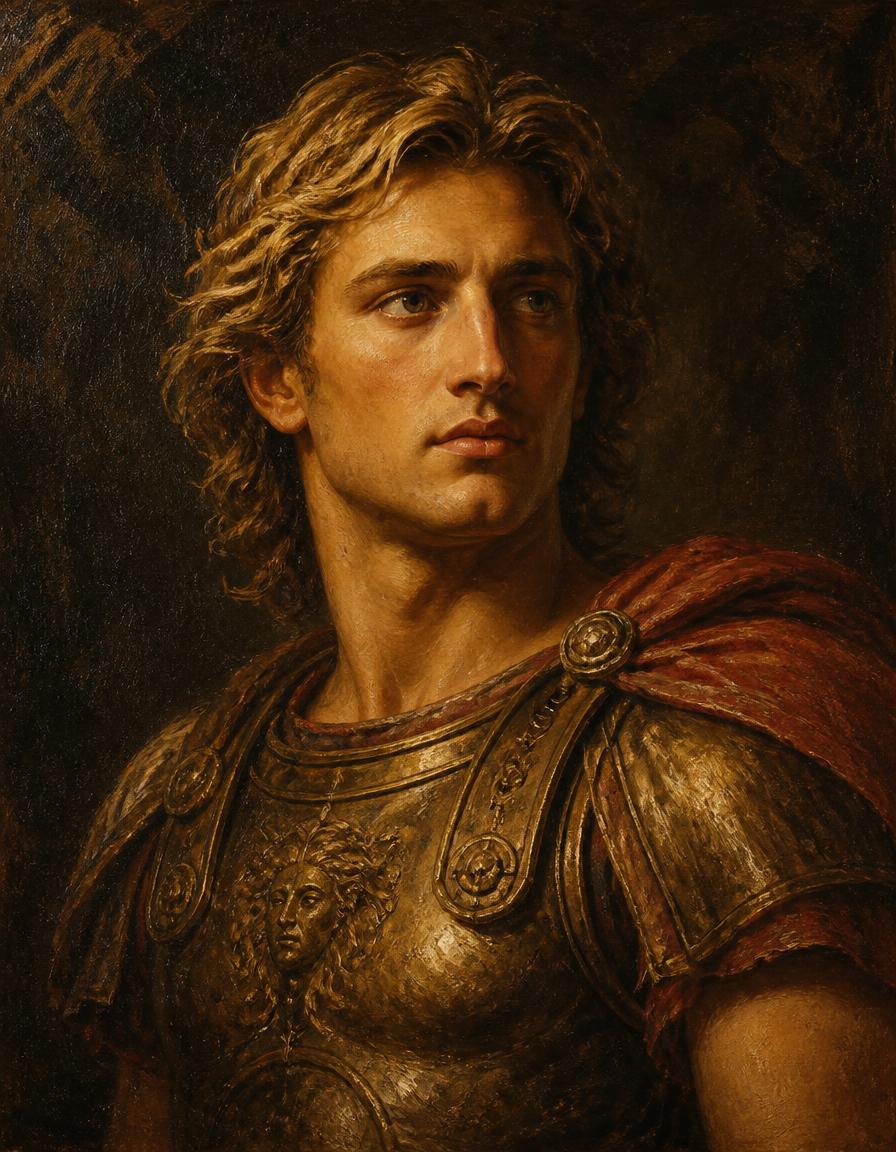
Quick Facts
- Years
- 356 BC – 323 BC
- Category
- World Leaders & Revolutionaries
- Nationality
- Macedonian
- Occupation
- King & Conqueror
Alexander the Great
356 BC – 323 BC · Macedonian · King & Conqueror
Audiobook

Life Lessons from Alexander the Great
Marcus Alden · 48 min
Alexander III of Macedon, better known as Alexander the Great, was a king and conqueror whose campaigns transformed the ancient world. Born in 356 BCE, he inherited Macedonia from his father, Philip II, in 336 BCE. Within little more than a decade, Alexander destroyed the Achaemenid Persian Empire, conquered Egypt, advanced into Central Asia, and crossed the Indus River. His dominion stretched from the Balkans to territories in modern Pakistan.
Alexander combined exceptional battlefield skill with speed, personal courage, logistical planning, diplomacy, and calculated brutality. Victories at the Granicus, Issus, and Gaugamela made him one of history's most celebrated commanders. He founded or refounded numerous settlements, encouraged exchanges among Macedonian, Greek, Egyptian, Persian, and Asian elites, and helped create the conditions for the Hellenistic Age.
His record was also deeply controversial. His armies destroyed cities, enslaved captives, and killed large numbers of combatants and civilians. His adoption of Persian customs angered some Macedonians, while executions and suspicious deaths darkened his court. Alexander died at Babylon in 323 BCE, aged thirty-two, without a stable adult successor. His empire quickly fractured, but the cultural and political world shaped by his conquests endured for centuries. Historians still study him as a military genius, an ambitious monarch, an agent of cultural interaction, and a devastating imperial conqueror.
Quick Facts
| Field | Details |
|---|---|
| Full Name | Alexander III of Macedon |
| Common Name(s) | Alexander the Great; Alexander of Macedon |
| Born | 356 BCE, traditionally 20 or 21 July |
| Died | 10 or 11 June 323 BCE |
| Age at Death | 32 |
| Birthplace | Pella, Kingdom of Macedon |
| Nationality | Macedonian |
| Occupation | King, military commander, conqueror |
| Historical Era | Classical antiquity; beginning of the Hellenistic Age |
| Famous For | Conquering the Achaemenid Persian Empire and campaigning as far as India |
| Political Affiliation | Argead dynasty; Kingdom of Macedon |
| Religion | Ancient Macedonian and Greek polytheism; also honored Egyptian and Asian cults |
| Education | Educated by tutors including Leonidas, Lysimachus, and Aristotle |
| Parents | Philip II of Macedon and Olympias of Epirus |
| Spouse(s) | Roxane; Stateira II; Parysatis II |
| Children | Alexander IV; Heracles was reportedly his son, though the claim is uncertain |
| Major Works | Military campaigns, royal foundations, administrative measures, and city foundations; no surviving book authored by him |
| Major Achievements | Defeat of Persia, conquest of Egypt and Central Asian territories, invasion of northwestern India, expansion of Hellenic influence |
Early Life
Alexander was born at Pella, Macedonia's capital, in 356 BCE. His father, Philip II, had rebuilt Macedonia into the strongest military state in Greece through diplomacy, warfare, and reforms to the army. His mother, Olympias, belonged to the royal house of Epirus and remained a powerful influence in dynastic politics.
Ancient writers surrounded Alexander's birth with omens and legends, many written generations later. Stories that Zeus fathered him or that the Temple of Artemis burned on the night of his birth belong to royal mythology rather than verifiable biography.
As a prince, Alexander learned literature, music, horsemanship, hunting, medicine, and warfare. Leonidas and Lysimachus were among his early tutors. Around age thirteen, he studied under Aristotle at Mieza. Aristotle introduced him to philosophy, ethics, politics, science, and medicine. Alexander developed a lifelong admiration for Homer's Iliad, but claims that Aristotle supplied a complete political program for his reign are unsupported.
The famous story of Alexander taming the horse Bucephalus illustrates his reputation for observation and confidence. According to Plutarch, the young prince realized that the horse feared its shadow and turned it toward the sun. The details cannot be independently confirmed, but Bucephalus later became his celebrated warhorse.
Alexander grew up amid dynastic rivalry. Philip's multiple marriages generated competing claims and strained Alexander's relationship with his father. Nevertheless, Philip entrusted him with responsibility. While Philip campaigned in 340 BCE, the teenage Alexander served as regent and suppressed a revolt. At Chaeronea in 338 BCE, he commanded part of the Macedonian army—traditionally the Companion cavalry—during the victory that established Philip's control over most Greek states.
Rise to Prominence
Philip II was assassinated at Aegae in 336 BCE. The killer, Pausanias, was killed while fleeing, and his motives remain debated. Alexander, aged twenty, quickly secured recognition by the army and eliminated or neutralized potential rivals. Some deaths associated with the succession were ordered by Alexander; Olympias was responsible for others.
Greek and Balkan communities treated Philip's death as an opportunity to rebel. Alexander responded with rapid campaigns north of Macedonia in 335 BCE, defeating Thracian and Illyrian opponents. He then marched south after hearing that Thebes had revolted.
The capture of Thebes became a terrifying demonstration of royal power. The city was destroyed, thousands were reportedly killed, and most survivors were enslaved, although ancient casualty figures may be exaggerated. Alexander spared temples and, according to tradition, the house of the poet Pindar. Other Greek states submitted. He was reconfirmed as leader of the Corinthian League's campaign against Persia.
In 334 BCE, Alexander crossed the Hellespont into Asia with a Macedonian-led coalition army. He visited Troy and associated himself symbolically with Achilles. At the Granicus River, he defeated Persian satrapal forces. The victory opened western Asia Minor, though several cities resisted and required sieges.
Alexander's decisive breakthrough came at Issus in 333 BCE. Despite fighting on constricted terrain, he defeated King Darius III, who withdrew from the battlefield. Darius's family fell into Macedonian hands and was reportedly treated with royal courtesy. Alexander was now famous not merely as Philip's heir but as a credible claimant to the Persian king's empire.
Major Achievements
Destruction of Persian Power
Alexander defeated major Persian armies at the Granicus, Issus, and Gaugamela. After Gaugamela in 331 BCE, he occupied Babylon, Susa, and Persepolis. The Achaemenid Empire, the largest imperial system yet seen in the region, ceased to exist as an independent power.
This mattered because it shifted the political center of the eastern Mediterranean and Near East. Alexander retained many Persian taxes, officials, roads, and administrative divisions while placing trusted commanders in strategic positions. His successor kingdoms inherited both Greek-Macedonian and Achaemenid institutions.
Control of the Eastern Mediterranean
Rather than immediately pursue Darius after Issus, Alexander secured the eastern Mediterranean coast. Tyre resisted him in 332 BCE. He built a causeway to the island city and captured it after a seven-month siege. The resulting killing and enslavement displayed the severe penalties imposed on prolonged resistance. Gaza also fell after a difficult siege.
By reducing Persian naval bases, Alexander weakened the enemy fleet without needing to defeat it in a single sea battle. The strategy protected his communications and prevented Persian forces from easily carrying war back to Greece.
Conquest of Egypt and Foundation of Alexandria
Egypt received Alexander in 332 BCE after years of Persian rule. He was recognized in pharaonic terms and sacrificed to Egyptian gods. He founded Alexandria near the western Nile Delta in 331 BCE. The city's design was developed under his successors, but its strategic location connected Mediterranean trade with Egypt.
Alexandria became one of antiquity's greatest commercial and intellectual centers, famous for its library, Mouseion, and multicultural population. Alexander also visited the oracle of Amun at Siwa. Ancient sources disagree about exactly what he asked and what answer he received.
Campaigns in Central Asia
After Darius III was deposed and killed by followers of Bessus in 330 BCE, Alexander claimed to avenge the murdered Persian king. He pursued opponents through Bactria and Sogdiana, regions corresponding broadly to parts of Afghanistan, Uzbekistan, and neighboring countries.
These campaigns were prolonged and brutal. Alexander used mobile columns, founded garrison settlements, negotiated with local elites, and married Roxane, the daughter of the Bactrian noble Oxyartes. He eventually suppressed organized resistance, but only at high cost. The campaigns demonstrated both his adaptability and the limits of conventional battle against dispersed insurgency.
Invasion of India
In 327–326 BCE, Alexander crossed into the northwestern Indian subcontinent. At the Hydaspes River, he outmaneuvered King Porus by secretly crossing upstream during stormy weather. Porus's army included war elephants, which challenged Macedonian formations, but Alexander prevailed.
He restored Porus as a subordinate ruler and enlarged his territory. This practical settlement secured local administration. The campaign opened short-lived political connections and longer-lasting commercial and cultural contacts between the Mediterranean world and South Asia.
Creation of a Hellenistic Political World
Alexander founded or refounded numerous cities and military settlements, many called Alexandria, although ancient lists vary and some attributions are doubtful. These centers accommodated veterans, guarded routes, and supported administration and trade.
His conquests accelerated the movement of Greek language, art, institutions, and settlers eastward. Local cultures did not simply disappear; they interacted with imported forms. The resulting Hellenistic world produced hybrid artistic, religious, and political traditions from Egypt to Central Asia.
Leadership and Work
Alexander led from the front. He repeatedly exposed himself in battle and suffered numerous wounds. This personal courage inspired loyalty but created grave strategic risk because the empire depended heavily upon him.
His operational strengths included speed, surprise, intelligence gathering, and coordination among infantry, cavalry, engineers, archers, and siege units. The Macedonian phalanx fixed opponents in place while Companion cavalry attacked vulnerable points. Yet his success also rested on Philip II's army, finances, alliances, and experienced officers.
Alexander could be pragmatic. He retained local administrators, respected selected religious traditions, and allowed rulers such as Porus to govern under his authority. He also adopted elements of Persian court dress and employed Iranian troops. These policies broadened his monarchy but alarmed Macedonians who feared losing privileged status.
His treatment of opposition varied sharply. Cooperative elites might receive honors; resisting communities could face massacre or enslavement. His anger became increasingly dangerous. He killed Cleitus the Black during a drunken quarrel and later expressed remorse. Philotas was executed after a conspiracy investigation, and Philotas's father, the veteran general Parmenion, was killed without trial because Alexander feared retaliation.
Alexander was charismatic, ambitious, intellectually curious, and extraordinarily resilient. His principal weaknesses included escalating suspicion, dependence on personal authority, excessive drinking on some occasions, and failure to establish an orderly succession.
Personal Life
Alexander's closest relationships included the Macedonian noble Hephaestion, his lifelong companion and senior officer. Ancient evidence establishes unusual emotional closeness, but historians differ over whether their relationship was sexual. Modern labels cannot be imposed confidently on incomplete ancient evidence.
Alexander married Roxane in 327 BCE, apparently combining personal attraction with political reconciliation in Bactria. At Susa in 324 BCE, he married Stateira II, a daughter of Darius III, and Parysatis II, a daughter of Artaxerxes III. These dynastic marriages linked him to the Achaemenid royal line. He also organized mass marriages between officers and Asian noblewomen, though many unions dissolved after his death.
Roxane gave birth to Alexander IV after Alexander died. A boy named Heracles was later presented as Alexander's son by Barsine, but his paternity and status remain uncertain. Both alleged sons were eventually murdered amid the wars of succession.
Alexander enjoyed hunting, literature, music, athletic competition, and philosophical discussion. He reportedly drank heavily at banquets, as did many members of the Macedonian elite. Evidence does not justify a simple diagnosis of alcoholism, but alcohol contributed to the quarrel in which Cleitus died.
His health endured repeated injuries, exhaustion, and harsh climates. His final illness involved fever over several days. Proposed diagnoses include malaria, typhoid fever, and other infections, but no retrospective diagnosis can be proved.
Philosophy and Beliefs
Alexander participated in traditional Macedonian and Greek religion through sacrifices, omens, festivals, and consultation of seers. He also honored local gods, presenting himself as pharaoh in Egypt and sacrificing according to regional customs. Such acts could express sincere piety, political legitimacy, or both.
His admiration for heroic models was central to his identity. He associated himself with Achilles and Heracles, while his visit to Siwa reinforced a special connection to Zeus-Ammon. Ancient accounts differ over whether he came to believe himself literally divine or promoted divine honors mainly as imperial policy.
Politically, Alexander's later conduct suggests a vision of monarchy broader than a traditional Macedonian kingship. He recruited Iranian nobles, trained Asian youths in Macedonian warfare, and experimented with a mixed ruling elite. The Susa marriages and a banquet of reconciliation at Opis symbolized cooperation among Macedonians and Persians.
This was not modern egalitarianism. Alexander remained an absolute conqueror whose hierarchy centered on his own authority. Scholars therefore debate whether his policies reflected cultural fusion, practical imperial management, personal universalism, or all three.
Challenges and Controversies
The destruction of Thebes, punishment of Tyre, and campaigns in Central Asia and India reveal the violence underlying Alexander's achievements. Ancient conquest routinely involved killing and enslavement, but historical context does not remove moral responsibility or civilian suffering.
The burning of Persepolis in 330 BCE remains debated. Some sources describe an impulsive drunken act encouraged by the courtesan Thaïs; others present it as deliberate retaliation for Persian destruction in Greece. Alexander later reportedly regretted it. Archaeology confirms major burning, not the motive.
The Philotas affair in 330 BCE led to Philotas's conviction for failing to report a plot. Whether he joined the conspiracy is uncertain. Parmenion's preemptive killing, ordered before he could respond, shows Alexander's willingness to place security above legal process and personal loyalty.
In 328 BCE, Alexander killed Cleitus, who had saved his life at the Granicus, after an argument about Philip II and Persian customs. The incident damaged the image of a self-controlled philosopher-king.
The attempted introduction of proskynesis—a Persian court gesture—created further opposition. Greeks associated prostration with worship of gods, whereas Persian usage could express rank before the king. Alexander abandoned the experiment among Macedonians after resistance, notably from the historian Callisthenes.
At the Hyphasis River in 326 BCE, exhausted soldiers refused to march farther east. Alexander withdrew after failing to persuade them. The episode demonstrates that his charisma had limits. His return through the Gedrosian Desert caused severe losses. Explanations include strategic necessity, ambition, punishment, or emulation of legendary conquerors; no single motive is certain.
Finally, Alexander failed to secure succession. His reported deathbed answer that the empire should go “to the strongest” may be literary invention. Whatever his final words, the absence of an adult heir and agreed structure helped trigger decades of war.
Legacy
Alexander's empire fragmented among his generals, the Diadochi. The Antigonid, Seleucid, and Ptolemaic kingdoms emerged from these struggles. Although political unity vanished, Greek became a major language of government, commerce, and scholarship across much of the eastern Mediterranean and Near East.
Hellenistic science, philosophy, literature, and art flourished in centers such as Alexandria, Antioch, and Pergamon. Farther east, Greek and local forms interacted in Bactrian and Gandharan culture. These developments cannot be credited to Alexander alone, but his campaigns created their geopolitical setting.
Roman leaders including Pompey, Julius Caesar, and Caracalla treated Alexander as a model. Persian, Arabic, Jewish, Christian, and later European traditions reshaped him into philosopher, prophet, adventurer, villain, or ideal king. The legendary Alexander Romance spread in many languages and often bears little relation to the historical monarch.
Today, artifacts associated with his age appear in major institutions including the Archaeological Museum of Pella, the Museum of the Royal Tombs at Aigai, the British Museum, the Louvre, and museums across Greece, Egypt, Turkey, Iran, and Central and South Asia. Alexandria in Egypt remains his most famous urban memorial. Statues and monuments stand in cities such as Thessaloniki and Skopje, sometimes amid modern disputes over national identity.
Alexander remains relevant because his life raises enduring questions about military leadership, empire, cultural exchange, propaganda, violence, and the fragility of power centered on one individual.
Interesting Facts
- Alexander became king at twenty and died at thirty-two.
- His reign lasted less than thirteen years.
- He named many settlements Alexandria, though the exact number is disputed.
- Alexandria in Egypt became the most famous of those foundations.
- Aristotle taught him at Mieza.
- His treasured horse was named Bucephalus.
- He carried campaigns across three continents: Europe, Africa, and Asia.
- Darius III escaped both Issus and Gaugamela but was later killed by his own followers.
- Alexander never suffered a clearly recorded defeat in a major pitched battle.
- He was repeatedly wounded, including by an arrow that penetrated his chest in India.
- King Porus retained power after losing at the Hydaspes.
- Alexander adopted some Persian clothing and court customs.
- His troops compelled him to turn back at the Hyphasis River.
- Hephaestion's death in 324 BCE caused him profound grief.
- Alexander died in Nebuchadnezzar II's palace at Babylon.
- His body was eventually taken to Egypt rather than buried in Macedonia.
- The final location of his tomb is unknown.
- His posthumous son Alexander IV never ruled independently.
- The famous “Gordian knot” episode is reported in differing ancient versions.
- Many popular quotations attributed to Alexander lack ancient documentation.
Famous Quotes
Reliable verbatim quotations are difficult because surviving narratives were written centuries after Alexander. The following come from ancient authors but should not be treated as transcripts.
- “My boy, you must find a kingdom big enough for your ambitions. Macedonia is too small for you.” — Philip II to Alexander after the taming of Bucephalus, in Plutarch. It symbolizes early recognition of his ambition, but its wording is literary.
- “If I were not Alexander, I would be Diogenes.” — Plutarch's account of Alexander meeting Diogenes at Corinth. It expresses admiration for independence from power; historicity is uncertain.
- “Ask for whatever you wish.” — Alexander to Diogenes, according to Plutarch. Diogenes supposedly asked him to stop blocking the sunlight.
- “It is not fitting that I should steal a victory.” — Reported by Arrian when Parmenion suggested a night attack before Gaugamela. It projects confidence and concern for honorable victory.
- “I am not afraid of an army of lions led by a sheep…” — Widely attributed to Alexander, but no secure ancient source supports it; disputed attribution.
- “There is nothing impossible to him who will try.” — Common online attribution with no dependable ancient citation; disputed attribution.
- “To the strongest.” — Alleged answer when asked who should inherit the empire. Ancient traditions vary, and illness may have prevented speech; disputed as a deathbed statement.
- “I foresee great funeral games over me.” — Diodorus reports a similar prediction about struggles among Alexander's companions. It reflects the succession crisis, but the wording is uncertain.
- “Are you not ashamed…to care so much about making money and so little about virtue?” — Preserved by Plutarch in a letter attributed to Alexander rebuking Aristotle for publishing esoteric teachings; authenticity is uncertain.
- “Heaven cannot brook two suns, nor earth two masters.” — Attributed in later traditions and sometimes connected with Darius; not securely documented as Alexander's words.
Timeline
- 356 BCE — Alexander is born at Pella to Philip II and Olympias.
- 343/342 BCE — Aristotle begins tutoring Alexander at Mieza.
- 340 BCE — Alexander serves as regent while Philip campaigns.
- 338 BCE — He fights at the Battle of Chaeronea.
- 336 BCE — Philip II is assassinated; Alexander becomes king.
- 335 BCE — He campaigns in the Balkans and destroys rebellious Thebes.
- 334 BCE — Alexander crosses into Asia and wins at the Granicus.
- 333 BCE — He defeats Darius III at Issus.
- 332 BCE — Tyre and Gaza fall; Alexander enters Egypt.
- 331 BCE — Alexandria is founded; Alexander visits Siwa and wins at Gaugamela.
- 330 BCE — Persepolis burns; Darius dies; Philotas and Parmenion are killed.
- 329–327 BCE — Alexander campaigns in Bactria and Sogdiana.
- 328 BCE — He kills Cleitus during a quarrel.
- 327 BCE — Alexander marries Roxane and begins the Indian campaign.
- 326 BCE — He defeats Porus at the Hydaspes; the army refuses to advance at the Hyphasis.
- 325 BCE — Alexander crosses the Gedrosian Desert after reaching the Indian Ocean.
- 324 BCE — Susa marriages, Opis mutiny, and death of Hephaestion.
- 323 BCE — Alexander dies at Babylon; Roxane later gives birth to Alexander IV.
- 321 BCE or shortly afterward — His body is diverted to Egypt by Ptolemy.
- 309/308 BCE — Alexander IV is murdered on Cassander's orders.
Frequently Asked Questions
Who was Alexander the Great?
Alexander III was king of Macedonia from 336 to 323 BCE. He inherited the powerful army and Greek alliance constructed by Philip II, then used them to conquer the Persian Empire. His campaigns reached Egypt, Central Asia, and northwestern India. Later generations called him “the Great” because of the scale and speed of his victories, although his conquests also caused destruction, enslavement, and mass death.
When and where was Alexander born?
Alexander was born in 356 BCE at Pella, the capital of ancient Macedonia. Ancient tradition gives 20 or 21 July, but conversion from ancient calendars makes exact modern dating uncertain. Pella was a sophisticated royal center connected with the wider Greek world. Alexander grew up while his father transformed Macedonia from a vulnerable kingdom into the dominant power of the Balkans.
Was Alexander Greek or Macedonian?
He was an ancient Macedonian king of the Argead dynasty. The Macedonian royal house participated in Greek religion and culture and claimed Greek heroic ancestry, while Macedonia retained distinctive political and regional institutions. Modern national categories do not map neatly onto the fourth century BCE. Historians therefore identify him most precisely as Macedonian while recognizing Macedonia's deep involvement in the ancient Greek cultural world.
Who were Alexander's parents?
His father was Philip II, the king who reformed Macedonia's military and established supremacy over most Greek states. His mother was Olympias, a Molossian princess from Epirus. Both shaped Alexander's life: Philip provided his kingdom, army, and campaign plans, while Olympias supported his succession and remained active in dynastic politics. Their marriage became strained, particularly after Philip married Cleopatra Eurydice.
Was Aristotle really Alexander's teacher?
Yes. Philip II appointed Aristotle to teach Alexander and a group of young nobles at Mieza around 343 or 342 BCE. The curriculum probably included ethics, politics, literature, medicine, and natural science. Alexander's interest in Homer and learning is well attested. However, claims that Aristotle directly designed Alexander's imperial policies go beyond the evidence, and their later relationship is poorly documented.
How large was Alexander's empire?
At its greatest extent, Alexander's dominion ran from Macedonia and Greece through Egypt and the former Persian Empire to parts of Central Asia and the northwestern Indian subcontinent. It covered several million square kilometers, though exact calculations vary because frontiers and levels of control were fluid. Some regions were governed directly, others through satraps, garrisons, allied kings, or tributary arrangements.
Did Alexander ever lose a battle?
He suffered reverses, difficult sieges, serious casualties, and resistance, but no clearly recorded defeat in a major pitched battle. His most celebrated victories were at the Granicus, Issus, Gaugamela, and the Hydaspes. This record should not imply effortless success. His army nearly failed at several moments, and the refusal at the Hyphasis ended his eastward advance even though it was not a battlefield defeat.
Why was Gaugamela important?
The Battle of Gaugamela in 331 BCE broke Darius III's ability to defend the heartland of the Achaemenid Empire. Alexander used an oblique advance and flexible cavalry maneuvers to create and exploit a gap near the Persian center. Afterward, Babylon, Susa, and Persepolis became accessible. Persian resistance continued, but Gaugamela was the decisive strategic victory that made Alexander master of the empire's main capitals.
Why did Alexander burn Persepolis?
The motive remains disputed. Some ancient accounts describe a drunken celebration in which Thaïs encouraged Alexander to burn the palace. Others interpret the destruction as planned vengeance for Xerxes' invasion of Greece and the burning of Athenian temples. The act may also have symbolized the end of Achaemenid rule. Archaeology confirms extensive fire damage, but it cannot establish Alexander's exact intentions.
How did Alexander treat conquered peoples?
His treatment ranged from accommodation to extreme violence. He retained Persian officials, honored local gods, restored Porus, and recruited Asian soldiers. Conversely, Thebes and Tyre suffered killing and enslavement, and Central Asian resistance faced severe reprisals. His policies were guided less by consistent tolerance than by imperial strategy: submission could bring protection and status, while resistance often prompted exemplary punishment.
Why did Alexander adopt Persian customs?
Ruling the former Persian Empire required support from Iranian elites and symbols intelligible to Asian subjects. Alexander adopted parts of Persian royal dress, employed Persian nobles, and attempted to introduce proskynesis. These measures may reflect practical integration, admiration for Achaemenid kingship, or an expanding conception of monarchy. Many Macedonians opposed them because they feared diminished status and considered some customs incompatible with their traditions.
Why did Alexander stop invading India?
At the Hyphasis River in 326 BCE, his soldiers refused to continue. They had campaigned for years, endured monsoon conditions and casualties, and faced reports of powerful kingdoms and many war elephants farther east. Alexander waited and attempted persuasion, but ultimately turned back. The decision shows that even his authority depended on cooperation from the army and that logistical and psychological limits constrained conquest.
How did Alexander die?
Alexander became ill after banquets at Babylon and developed a worsening fever over roughly ten to twelve days before dying in June 323 BCE. Ancient rumors alleged poisoning, but the prolonged illness and practical difficulties of ancient poisons make this unlikely to many historians. Malaria, typhoid fever, and other infections have been proposed. The evidence is insufficient for a definitive medical diagnosis.
Where is Alexander buried?
His body was initially intended for transport, apparently toward Macedonia, but Ptolemy seized the funeral carriage and took it to Egypt. Alexander's remains were eventually displayed in a tomb at Alexandria, where Roman leaders reportedly visited them. The tomb's location was later lost, probably amid urban change and disasters. Numerous proposed discoveries have failed to achieve scholarly verification.
Who succeeded Alexander?
No single person securely succeeded him. His half-brother Philip III Arrhidaeus and posthumous son Alexander IV were named joint kings, but generals exercised real power as regents and governors. Their rivalries developed into the Wars of the Successors. Both kings were eventually murdered, and Alexander's empire divided among dynasties including the Ptolemies, Seleucids, and Antigonids.
Did Alexander promote cultural fusion?
He encouraged some forms of elite integration, including mixed marriages, Iranian appointments, and Asian military recruitment. The Susa marriages are the clearest symbolic example. Scholars disagree over whether this represented a coherent vision of cultural unity or practical imperial management. The broader Hellenistic blending of traditions continued under successor societies and cannot be reduced to Alexander's personal intentions.
Was Alexander's relationship with Hephaestion romantic?
The sources clearly portray Hephaestion as Alexander's closest companion and compare them with Achilles and Patroclus. They do not provide evidence sufficient to determine the precise sexual character of the relationship. Ancient Greek and Macedonian ideas about friendship, masculinity, and sexuality differed from modern categories. Responsible biographies therefore acknowledge the depth of their attachment without claiming certainty that the evidence cannot support.
Why is Alexander still called “the Great”?
The title reflects his extraordinary military record, vast conquests, and influence on later history. It does not constitute a moral judgment. Ancient and modern admirers emphasize courage and strategic brilliance; critics emphasize imperial violence, autocracy, and instability. Studying both perspectives explains why “great” can mean historically consequential rather than ethically admirable.
Lessons We Can Learn
- Build on inherited foundations. Alexander's victories relied on Philip's army and institutions. Success often begins by understanding what predecessors created.
- Speed can create strategic advantage. His rapid march against Thebes prevented a wider revolt. Timely action can stop problems from multiplying.
- Adapt methods to circumstances. Alexander used sieges, cavalry maneuvers, diplomacy, and local allies. Flexible tools outperform one rigid formula.
- Logistics set real limits. Distance, climate, supplies, and exhaustion halted expansion in India. Ambition cannot repeal material constraints.
- Respect experienced teams. Veteran officers made his campaigns possible. Leadership depends on skilled collaborators, not charisma alone.
- Personal courage must be balanced with continuity. Alexander inspired soldiers by fighting near them, but his wounds endangered the entire state. Leaders must manage risk.
- Cultural intelligence improves governance. Honoring Egyptian and Persian customs helped him claim legitimacy. Understanding local traditions remains essential.
- Anger can destroy trust. The killing of Cleitus transformed a dispute into an irreversible tragedy. Emotional control is a practical leadership skill.
- Plan succession early. Alexander's failure to create a durable transfer of power led to war. Institutions matter more than any single personality.
- Achievement should be judged with its costs. His empire encouraged exchange but arose through conquest and suffering. Ethical evaluation requires attention to those who paid the price.
Related Historical Figures
- Philip II of Macedon — Alexander's father, whose reforms and diplomacy created the military foundation for conquest.
- Olympias — Alexander's mother and a major participant in Macedonian dynastic politics.
- Aristotle — His tutor, associated with Alexander's education in philosophy, literature, and science.
- Darius III — The Achaemenid king defeated by Alexander at Issus and Gaugamela.
- Hephaestion — Alexander's closest companion, senior officer, and trusted representative.
- Parmenion — Philip's veteran general and one of Alexander's leading commanders until his execution.
- Roxane — Alexander's Bactrian wife and mother of Alexander IV.
- Porus — Indian king defeated at the Hydaspes and restored as Alexander's subordinate ally.
- Ptolemy I Soter — General who seized Egypt, obtained Alexander's body, and founded the Ptolemaic dynasty.
- Seleucus I Nicator — Successor general who established a vast Hellenistic kingdom across much of Alexander's former Asian empire.
Watch and Learn
Alexander the Great (All Parts) · Epic History TV
Related Historical Figures